

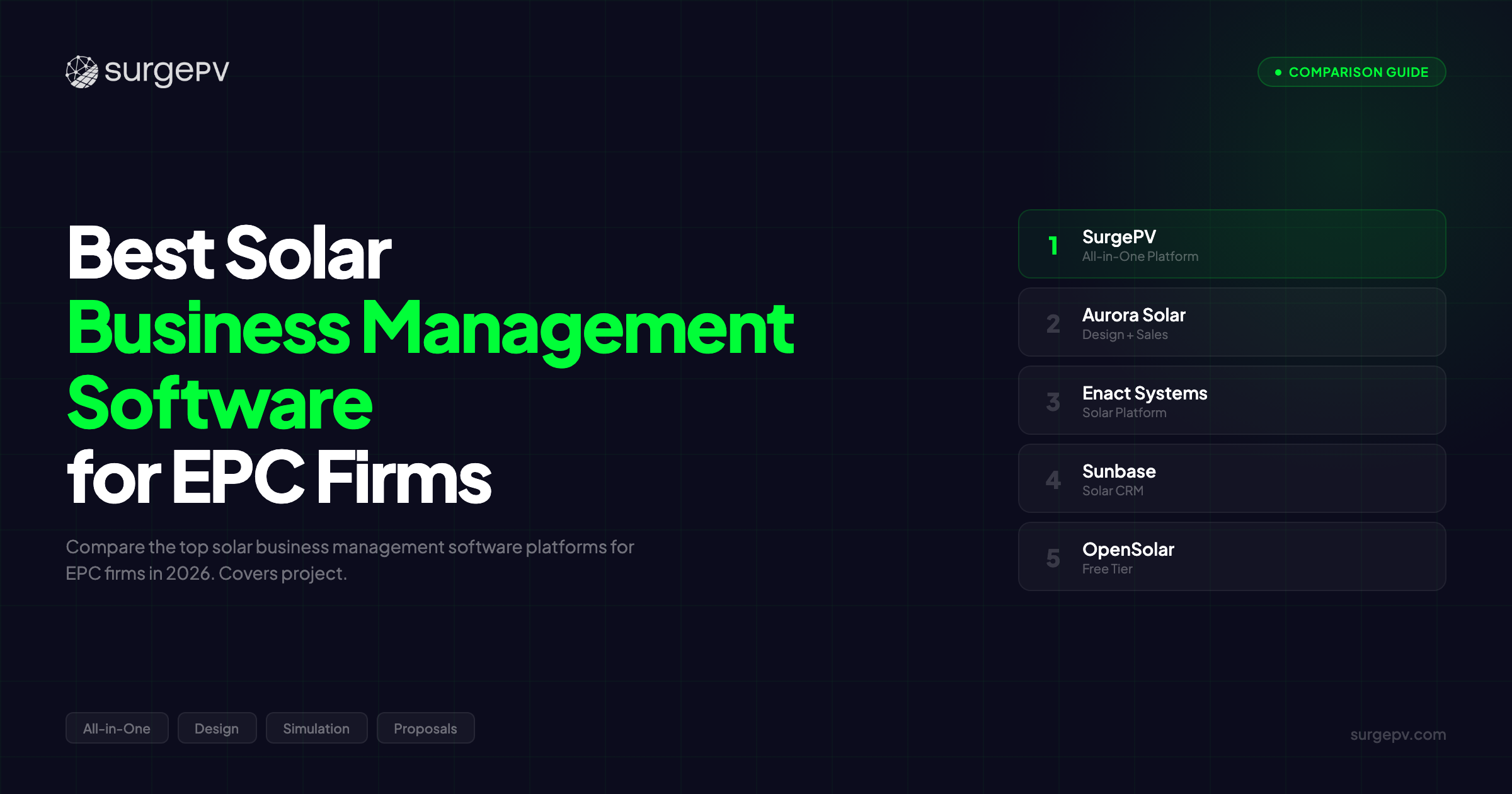
TL;DR: Solar EPCs are drowning in disconnected tools — one for design, another for proposals, a third for project tracking, and spreadsheets holding it all together. SurgePV delivers all-in-one design, simulation, SLD generation, and proposals at $1,899/year for 3 users. Enact Systems is the ERP-style platform for large commercial EPCs. Aurora Solar leads residential design automation. Sunbase excels at CRM and sales. OpenSolar offers the best free option for startups.
Your design team just spent three hours creating a perfect panel layout in one tool.
Then your electrical engineer rebuilds the entire system in AutoCAD to generate the SLD. Your sales team re-enters all the data into Excel to build the financial model. Your project manager copies everything into a separate project tracking system. And when the client requests one change — a different inverter — the entire chain starts over.
This is how most solar EPCs operate in 2026. The average EPC uses 5-7 disconnected software tools. Every project requires data to be manually re-entered 3-4 times. Every change creates a ripple effect of updates across systems.
Tool sprawl costs solar EPCs 15-25 hours per project in duplicated work. For an EPC closing 50 projects annually, that is 750-1,250 hours, or six months of engineering time, lost to copying data between systems instead of designing better solar installations.
The solar design software business market grew rapidly, but most platforms evolved from single-point solutions. Design tools added proposals. CRM tools added project management. The result is a market of partial solutions where no platform was built from the ground up to handle the complete EPC workflow.
That matters when solar EPCs compete on speed, accuracy, and price. The firm that can design, engineer, price, and propose a project in two hours beats the firm that needs two days. The EPC with a unified BOM across design, procurement, and installation has 98% material accuracy. The competitor copying BOMs manually between tools averages 85% accuracy and orders wrong components on 15% of projects.
We evaluated the top solar business management platforms specifically for EPC workflows. We tested each platform on real projects — residential installations, commercial rooftops, and mid-scale ground-mount systems. We evaluated design integration, electrical engineering capabilities, proposal generation, project management, and operational workflow.
In this guide, you’ll learn:
- Which 5 business software platforms handle the complete EPC workflow best
- Why all-in-one platforms deliver better ROI than disconnected tool stacks
- Which tools integrate design, electrical SLD, simulation, and proposals
- What solar EPCs need from project management and CRM capabilities
- How to choose the right platform by company size and project type
- Our recommendation for growing EPCs vs established firms vs startups
Quick Comparison: Top 5 Solar Business Platforms for EPCs
| Feature | SurgePV | Aurora Solar | Enact Systems | Sunbase | OpenSolar |
|---|---|---|---|---|---|
| Best For | Growing EPCs (all-in-one) | Design-heavy residential | Large commercial EPCs | Small EPCs (CRM focus) | Solar startups |
| Design Integration | Full 3D + carport | AI-powered residential | Basic (outsource design) | Basic 2D | Full 3D |
| SLD Generation | Automated (5-10 min) | Not included | Not included | Not included | Manual |
| Simulation | 8760-hr (±3% PVsyst) | 8760-hr | Third-party | Basic | 8760-hr |
| Proposal Automation | Full (30-45 min) | Full | Limited | Excellent | Good |
| Project Management | Milestone tracking | Limited | Full ERP | Lightweight | Basic |
| CRM Integration | Native | Limited | Full | Excellent | Limited |
| BOM Management | 98% accuracy | Not included | Full procurement | Basic | Good |
| Price (USD/year) | $1,899 (3 users) | $2,400-9,000+ | Custom (~$6,000-24,000) | $1,800-3,600+ | Free to $2,400+ |
| Our Rating | 9.2/10 | 8.4/10 | 8.8/10 | 8.0/10 | 7.5/10 |
Quick verdict: For growing solar EPCs who need design through proposals in one platform, SurgePV offers the best balance of functionality, speed, and value. For large commercial EPCs managing complex operations, Enact Systems provides ERP-level integration. For residential-focused EPCs prioritizing design automation, Aurora Solar leads. For sales-driven small EPCs, Sunbase’s CRM strength is the differentiator.
Book a free demo to see how SurgePV handles the complete EPC workflow.
Why Solar EPCs Need Unified Business Software in 2026
Before comparing specific platforms, understand why disconnected tool stacks cost solar EPCs time, money, and competitive advantage.
The Hidden Cost of Tool Sprawl
The typical solar EPC uses this stack:
- Design tool: AutoCAD, SketchUp, or PVcase for panel layouts
- Electrical engineering: AutoCAD or Revit for single line diagrams
- Simulation: PVsyst for yield modeling
- Proposal tool: Excel, PowerPoint, or dedicated proposal software
- CRM: Salesforce, HubSpot, or spreadsheets for lead tracking
- Project management: Monday, Asana, or spreadsheets for project tracking
- Accounting: QuickBooks or NetSuite for financial management
Each tool costs money. More importantly, each transition between tools requires manual data entry. A typical 50 kWp commercial rooftop project flows through this sequence:
- Sales team creates preliminary design in one tool
- Engineering rebuilds the design with accurate specifications
- Electrical engineer exports design to AutoCAD, draws SLD manually (2-3 hours)
- Energy analyst exports design to PVsyst, runs simulation
- Sales team re-enters all data into proposal template
- Project manager copies project details into project tracking system
- Procurement copies BOM from design into ordering system
- Accounting re-enters contract value and payment terms
Data gets re-entered manually at steps 3, 5, 6, 7, and 8. Each re-entry takes time and introduces errors.
For a solar EPC closing 50 projects annually, that is 250 manual data transfers per year. At 30 minutes average per transfer, that is 125 hours of pure data copying — more than three weeks of full-time work creating zero customer value.
Why “Best-of-Breed” Tool Stacks Fail for Solar EPCs
The enterprise software world debates “best-of-breed” (specialized tools for each function) versus “unified platforms” (one tool for everything). For solar EPCs under 50 employees, best-of-breed consistently loses to unified platforms.
Best-of-breed only works when tools integrate seamlessly. But solar-specific tools rarely do. PVsyst does not talk to Salesforce. AutoCAD does not export to most proposal tools. Design platforms do not sync with project management systems.
The promise is “use the best tool for each job.” The reality is “manually copy data between the best tools for each job.”
Integration overhead scales exponentially, not linearly. Integrating two tools requires one connection. Three tools require three connections. Five tools require ten connections. Seven tools require 21 connections.
Most solar EPCs cannot maintain 21 integrations. The result is partial integrations (the most critical 3-4 connections) and manual data entry for everything else.
The All-in-One Advantage for Solar EPCs
Unified platforms eliminate integration overhead by handling design, engineering, simulation, proposals, and project tracking in one system. Data flows automatically. Change an inverter in the design, and the BOM updates, the electrical diagram regenerates, the simulation re-runs, and the proposal refreshes — all without re-entering anything.
Key Takeaway
The average solar EPC uses 5-7 disconnected tools. Every project requires manual data re-entry 3-4 times. For an EPC closing 50 projects annually, that is 125+ hours per year spent copying data between systems — more than three weeks of engineering time that creates zero customer value. Unified platforms eliminate this waste entirely.
For solar EPCs under 30 employees, all-in-one platforms consistently deliver better ROI than tool stacks costing 2-3x as much.
Key Features to Look for in Solar EPC Software
Not all business platforms serve EPC needs equally. Here is what matters specifically for engineering, procurement, and construction workflows.
Project Management and Scheduling Tools
Solar project management differs from generic project management in critical ways. Solar projects require:
- Milestone-based workflows: Site survey, design approval, permitting, procurement, installation, commissioning, PTO
- Equipment procurement tracking: Long-lead items like transformers or specialty racking
- Weather-dependent scheduling: Installation crews cannot work in rain or high wind
- Multi-site coordination: EPCs often manage 10-20+ concurrent projects
- Subcontractor management: Most EPCs use subcontracted installation crews
Generic project management tools like Asana or Monday do not model solar-specific workflows. Dedicated solar platforms should include solar project templates, procurement lead time tracking, and weather-aware scheduling.
For an EPC managing 20 concurrent projects, solar-specific project management reduces scheduling conflicts by 30-40% compared to generic tools. That means fewer crew delays, better resource utilization, and improved on-time completion rates.
Solar Design and Engineering Integration
Business software for solar EPCs must integrate design and engineering, not treat them as separate functions. The platform should:
- Create 3D panel layouts with shading analysis
- Generate electrical single line diagrams automatically
- Export to AutoCAD or other engineering tools when needed
- Maintain one source of truth for system specifications
The critical test: can you change an inverter or module in the design and have the electrical diagram update automatically? If not, you are still managing two separate systems.
SurgePV generates electrical SLDs in 5-10 minutes compared to 2-3 hours of manual AutoCAD drafting. For an EPC producing 50 designs annually, that is 95-145 hours saved — more than three weeks of engineering time.
Proposal and Sales Automation
Solar proposals are complex documents that combine technical design, financial modeling, and marketing presentation. The platform should:
- Generate professional proposals automatically from design data
- Include 3D visualizations and shading analysis
- Model financing options, incentives, and tax benefits
- Support interactive customer presentations
- Enable fast proposal iteration (change modules, see updated financials instantly)
For C&I EPCs, proposal tools must handle complex tariff structures, demand charges, and PPA modeling. For residential EPCs, speed matters more than complexity.
The best measure: how fast can your team generate a complete, accurate proposal after completing the design? Top platforms do this in 30-45 minutes. Tool stacks requiring manual data entry take 2-4 hours.
Financial Modeling and ERP Capabilities
Solar financial modeling goes beyond simple payback calculations. EPCs need to model:
- Residential: Cash purchase, loans, leases, incentive combinations
- C&I: Demand charge analysis, utility rate escalation, MACRS depreciation
- Utility-scale: Tax equity structures, PPA pricing, merchant revenue
For larger EPCs (30+ employees), ERP capabilities become critical: multi-project financial consolidation, subcontractor payment tracking, inventory management, and accounting system integration.
Smaller EPCs do not need full ERP. They need integrated financial modeling that ties design specifications to accurate project costs and customer pricing.
Contract Management and PPA Tracking
For commercial and utility-scale EPCs, contract lifecycle management determines profitability. The platform should track:
- Milestone payment schedules
- Change order processing
- Performance guarantee tracking
- PPA revenue recognition
- Multi-year cash flow modeling
Enact Systems leads this category with sophisticated contract management. Most other platforms offer basic contract tracking.
Field Operations and Dispatch
Installation-focused EPCs need field service management integrated with project planning. This includes:
- Crew scheduling and dispatch
- Equipment and material tracking to job sites
- Installation milestone completion tracking
- Safety and compliance documentation
Some platforms integrate field operations natively. Others require integration with specialized field service tools like ServiceTitan or Jobber.
Pro Tip
For solar EPCs under 20 employees, prioritize all-in-one platforms that integrate design, electrical engineering, simulation, and proposals in one workflow. The time saved eliminating data re-entry typically delivers ROI within 2-3 months. For larger EPCs (30+ employees), evaluate whether you need full ERP capabilities (Enact Systems) or improved project management (SurgePV with third-party PM integration).
Top 5 Solar Business Software Platforms for EPCs (2026)
SurgePV — Best All-in-One Platform for Growing EPCs
Rating: 9.2/10 | Price: $1,899/year (3 users) | Book a demo | See SurgePV pricing
SurgePV is the most complete all-in-one platform for solar EPCs who want to eliminate tool sprawl without enterprise ERP complexity. It combines 3D solar design, automated electrical engineering, bankable simulation, and professional proposals in one cloud-based workflow.
Why SurgePV works for growing EPCs:
The platform handles the complete design-to-proposal workflow faster than any multi-tool stack. Create a full 3D panel layout, run 8760-hour shading analysis, generate the electrical SLD automatically, simulate annual energy production with ±3% PVsyst accuracy, and produce a client-ready proposal — all in 90-120 minutes for a typical commercial rooftop project.
Compare that to a traditional tool stack: AutoCAD design (2 hours), manual SLD drafting (2-3 hours), PVsyst simulation setup (1 hour), Excel financial modeling (1 hour), PowerPoint proposal assembly (1-2 hours). Total: 7-9 hours. SurgePV compresses this to 1.5-2 hours.
For a solar EPC closing 50 projects per year, that time compression saves 275-350 hours annually — nearly two months of engineering productivity redirected to revenue-generating work instead of data re-entry.
SurgePV’s automated SLD generation is particularly valuable for EPCs. The platform generates IEC-compliant single line diagrams in 5-10 minutes — including string sizing, inverter connections, circuit protection, and grounding. Manual AutoCAD drafting takes 2-3 hours for the same output.
The simulation engine delivers bankable P50/P75/P90 yield forecasts with ±3% accuracy compared to PVsyst. That is accepted by commercial lenders and project financiers for mid-scale projects. The platform models complex shading scenarios, temperature-adjusted performance, and soiling losses.
For proposals, SurgePV includes integrated financial modeling with incentive calculations, financing options, and utility rate analysis. Proposals include interactive 3D visualizations that clients can explore during presentations.
And SurgePV is the only platform with native carport solar design capabilities — relevant as commercial carport installations grow at retail and logistics facilities.
Real-World Example
A California-based commercial solar EPC switched from a five-tool stack (AutoCAD + PVsyst + Excel + PowerPoint + Monday.com) to SurgePV for their C&I project pipeline. Before the switch, their average design-to-proposal timeline was 4-5 business days per project. With SurgePV’s integrated workflow, they compressed this to 1-2 days. The result: 60% faster quote turnaround, which translated to 23% higher proposal win rates because they could respond to RFPs before competitors finished their designs. Eliminating manual SLD drafting saved their electrical engineer 12-15 hours per week, which they redirected to handling 40% more project volume without hiring additional staff.
Reader objection: “We already have AutoCAD licenses and our team knows it well — why learn a new platform?” AutoCAD is a drafting tool, not a solar business platform. It does not simulate energy production, generate proposals, or manage projects. EPCs using AutoCAD still need separate tools for simulation, proposals, and project tracking — which means the same manual data re-entry problem SurgePV eliminates. The question is not “AutoCAD vs SurgePV.” It is “AutoCAD + PVsyst + Excel + proposal tool + project tracker vs SurgePV alone.” The five-tool stack costs more in subscriptions and vastly more in integration time.
Pros:
- Complete design-to-proposal workflow in one platform
- Automated SLD generation (5-10 min vs 2-3 hours manual)
- Bankable simulation with ±3% PVsyst accuracy, P50/P75/P90 reports
- 98% BOM accuracy eliminates procurement errors
- Only platform with native carport design
- Integrated financial modeling with incentive calculations
- Cloud-based, no installation required
- 70,000+ projects globally, 3-minute average support response
- $1,899/year for 3 users — all features included, no per-project fees
Cons:
- Newer brand presence compared to Aurora or Enact
- Less established for utility-scale (over 50 MW) than PVcase or RatedPower
- Project management is milestone-based, not full ERP
- Limited CRM compared to dedicated sales platforms like Sunbase
Best for: Growing solar EPCs (5-30 employees) handling residential, commercial, and mid-scale ground-mount projects who want to eliminate tool sprawl with all-in-one design, engineering, simulation, and proposals.
Schedule a walkthrough to try SurgePV on your next commercial project.
Aurora Solar — Best for Design-Heavy Residential EPCs
Rating: 8.4/10 | Price: $2,400-9,000+/year | Aurora Solar | Aurora Solar review
Aurora Solar is the global leader in AI-powered residential solar design and the platform of choice for high-volume residential EPCs prioritizing design speed and visual quality. If your EPC quotes 100+ residential projects monthly and design automation is the bottleneck, Aurora’s AI capabilities deliver real competitive advantage.
Why Aurora works for residential EPCs:
Aurora’s AI roof detection creates accurate 3D models and panel layouts in minutes using satellite imagery. The platform analyzes roof planes, identifies obstructions, determines optimal panel placement, and generates shade reports — all automatically. For a residential EPC producing 20-30 quotes per week, that automation translates directly to sales capacity.
The simulation engine runs full 8760-hour shading analysis with high accuracy. The visual quality of customer-facing proposals is industry-leading — interactive 3D home models, seasonal shade analysis, and professional financial presentations.
Aurora integrates with major CRM platforms and supports fast proposal iteration. Change modules or inverter, and financials update instantly. For residential sales teams presenting to homeowners, that speed matters when handling objections.
For a residential-focused EPC competing on quote speed in metro markets, being first to proposal wins deals. Aurora’s automation lets sales reps generate complete proposals during initial customer meetings — a capability that can improve close rates by 15-20% compared to “we’ll send you a quote in 3-5 days.”
Here is where Aurora’s limitations become clear for EPCs. The platform does not generate electrical SLDs — EPCs still need separate tools or manual AutoCAD work for permit documentation. There is no BOM management or procurement tracking. Project management capabilities are limited. And pricing is among the highest in the category, with enterprise tiers reaching $750+/month per user.
For residential EPCs where design is 80% of the workflow and everything else is handled by other systems, Aurora makes sense. For commercial EPCs or residential firms that want design through project delivery in one platform, Aurora’s gaps require additional tools.
Pros:
- Industry-leading AI roof detection and automated design
- Fastest residential design workflow (minutes per project)
- Excellent 3D visualization for customer presentations
- Strong CRM integrations (Salesforce, HubSpot)
- 8760-hour simulation with good accuracy
- Large user community and extensive training resources
- Expanding C&I capabilities
Cons:
- No electrical SLD generation (requires separate tool)
- No BOM management or procurement tracking
- Limited project management capabilities
- No field service or installation management
- Highest pricing in category ($2,400-9,000+/year)
- Primarily residential-focused, C&I capabilities still developing
- Requires internet connection (cloud-only)
Best for: High-volume residential solar EPCs (100+ quotes/month) in competitive metro markets where design speed and visual proposal quality drive sales conversion.
Enact Systems — Best ERP-Style Platform for Commercial Solar Operations
Rating: 8.8/10 | Price: Custom (~$6,000-24,000/year) | Enact Systems | Enact Systems review
Enact Systems is the most sophisticated ERP-level platform built specifically for solar operations. For established commercial and utility-scale EPCs managing complex multi-project portfolios, Enact delivers enterprise-grade capabilities that all-in-one platforms cannot match.
Why Enact Systems works for large solar EPCs:
Enact treats solar as an enterprise business, not a design problem. The platform manages the complete project lifecycle — lead qualification, proposal generation, contract management, procurement and inventory, subcontractor coordination, project accounting, and asset management.
For EPCs managing 50+ concurrent projects across multiple states, Enact’s multi-project dashboards provide executive visibility. Financial consolidation aggregates revenue, costs, and margins across the entire portfolio. Procurement management tracks vendor performance, purchase orders, and inventory across projects.
The contract management module handles milestone payment schedules, change order processing, and performance guarantee tracking. For commercial PPAs or long-term O&M contracts, Enact models multi-year revenue recognition and cash flow.
Subcontractor management is particularly strong. Enact tracks subcontractor certifications, insurance compliance, payment schedules, and performance metrics — critical for EPCs using external installation crews.
For a commercial solar EPC managing $20M+ in annual project volume, Enact’s financial visibility and operational control justify the higher cost. The platform prevents the project tracking chaos that happens when EPCs outgrow spreadsheets but do not have enterprise systems.
Enact is overkill for small EPCs. The platform targets commercial and utility-scale firms with 20+ employees and complex operational requirements. If you are managing 10 residential projects per month, you do not need ERP. If you are managing 50 commercial projects simultaneously across five states, you do.
Enact does not include design capabilities — EPCs typically use separate design tools and import project data into Enact for operational management.
Pros:
- Most sophisticated ERP-level solar platform
- Multi-project portfolio management with financial consolidation
- Strong procurement and inventory management
- Comprehensive contract lifecycle tracking
- Subcontractor management with compliance tracking
- Integrates with accounting systems (QuickBooks, NetSuite, Sage)
- Asset management for long-term PPA and O&M tracking
- Supports multi-entity and multi-location operations
Cons:
- No design capabilities (requires separate design tool)
- No electrical SLD generation
- Custom pricing, typically $6,000-24,000+/year
- Steeper learning curve than all-in-one platforms
- Overkill for small EPCs (under 15 employees)
- Implementation requires 4-8 weeks of setup
Best for: Established commercial and utility-scale solar EPCs (20+ employees, $15M+ annual revenue) managing complex multi-project portfolios who need ERP-level operational control.
Further Reading
For detailed analysis of Enact’s capabilities, see our Enact Solar review.
Sunbase — Best CRM and Proposal Tool for Small EPCs
Rating: 8.0/10 | Price: ~$1,800-3,600+/year | Sunbase | Sunbase review
Sunbase is the best CRM-first platform for small solar EPCs where sales and lead management are the primary business challenges. If your EPC closes 20-40 residential or small commercial projects annually and needs better sales pipeline visibility, Sunbase delivers CRM capabilities that design-first platforms lack.
Why Sunbase works for sales-driven EPCs:
Sunbase was built by solar salespeople for solar salespeople. The CRM tracks leads from first contact through contract signature, manages follow-up sequences, and provides sales performance dashboards. For EPCs using sales teams or door-to-door canvassing, Sunbase’s mobile CRM lets reps log interactions, schedule appointments, and track pipeline from their phones.
The proposal builder is fast and flexible. Sales reps can generate proposals quickly with financing options, incentive calculations, and professional layouts. The platform integrates with major solar financing providers, simplifying loan and lease applications.
Project management is lightweight but sufficient for small EPCs. Track installation milestones, crew scheduling, and customer communication. For EPCs handling 2-5 installations per week, Sunbase’s project tracking prevents jobs from falling through cracks.
For a small residential EPC competing in a local market, pipeline visibility matters more than advanced engineering capabilities. Sunbase’s CRM helps EPCs identify which lead sources convert best, which sales reps close fastest, and where proposals stall — data that improves sales effectiveness.
Sunbase’s limitations are in engineering. Design capabilities are basic 2D layouts, not full 3D modeling. There is no electrical SLD generation. Simulation is simplified, not bankable. BOM management is basic.
For residential EPCs where sales is the bottleneck and installation is subcontracted, Sunbase’s CRM strength outweighs its engineering limitations. For EPCs competing on engineering quality or handling complex commercial projects, Sunbase’s technical capabilities are insufficient.
Pros:
- Strongest CRM in the solar-specific category
- Mobile CRM for field sales teams
- Fast proposal generation with financing integration
- Integrates with major solar financing providers
- Lightweight project management suitable for small teams
- Customer communication tools (automated emails, SMS)
- Affordable for small EPCs (~$150-300/month per user)
Cons:
- Basic 2D design, not 3D modeling
- No electrical SLD generation
- Simplified simulation, not bankable
- Limited BOM and procurement management
- Not suitable for utility-scale or complex C&I projects
- Project management less sophisticated than ERP platforms
- Per-user pricing increases costs for larger teams
Best for: Small residential solar EPCs (3-10 employees) focused on sales growth and lead management where CRM and proposal speed matter more than advanced engineering capabilities.
OpenSolar — Best Free Option for Solar Startups
Rating: 7.5/10 | Price: Free to $2,400+/year | OpenSolar | OpenSolar review
OpenSolar is the best entry point for solar startups and very small EPCs testing the market before committing to paid platforms. The free tier includes 3D design, basic simulation, and proposal generation — a complete minimal viable workflow for EPCs closing their first 10-20 projects.
Why OpenSolar works for startups:
The free tier removes the barrier to entry. New solar businesses can start designing, simulating, and proposing projects without monthly software costs. For a solo installer or 2-person startup, that is the difference between getting started immediately or waiting to build revenue before investing in software.
The design interface is intuitive and cloud-based. Create 3D panel layouts, run shading analysis, and generate customer-facing proposals. The simulation includes 8760-hour analysis with reasonable accuracy. Proposals are professional and include financial modeling with basic incentive calculations.
OpenSolar integrates with financing providers and supports online customer contracts and signatures. For remote sales or projects where in-person meetings are not feasible, digital contract flow accelerates closing.
For a solar startup closing 1-2 projects per month, the free tier handles everything needed to operate. As the business grows, paid tiers add features like advanced financial modeling, white-label proposals, and team collaboration.
OpenSolar does not include electrical SLD generation, advanced BOM management, or sophisticated project tracking. The free tier limits the number of projects you can manage simultaneously. And while the simulation is good for residential quotes, it is not bankable for commercial project finance.
For startups, these limitations are acceptable tradeoffs for zero software cost. For established EPCs closing 30+ projects annually, OpenSolar’s gaps require supplementary tools or upgrading to a more complete platform.
Pros:
- Free tier with full design, simulation, and proposal capabilities
- Cloud-based, no installation required
- Intuitive interface with fast onboarding
- 8760-hour simulation included in free tier
- Digital contract signing and customer portal
- Integrates with solar financing providers
- Good for remote sales workflows
Cons:
- No electrical SLD generation
- Free tier limits concurrent projects
- Basic BOM management
- Limited project management capabilities
- Simulation not bankable for commercial financing
- Advanced features require paid tiers ($200+/month)
- Smaller user community than Aurora or Enact
Best for: Solar startups and very small EPCs (1-3 people) closing their first 10-20 projects annually who need complete design-to-proposal capability without upfront software investment.
Further Reading
See also our comparison of best solar design software and best solar proposal software.
Solar Business Software Comparison Table
| Feature | SurgePV | Aurora Solar | Enact Systems | Sunbase | OpenSolar |
|---|---|---|---|---|---|
| 3D Design | Full + carport | AI-automated | Not included | Basic 2D | Full 3D |
| Electrical SLD | Auto (5-10 min) | Not included | Not included | Not included | Not included |
| Simulation Accuracy | ±3% vs PVsyst | Good | Third-party | Basic | Good |
| Bankable P50/P90 | Yes | Premium tier | Third-party | No | No |
| Proposal Generation | 30-45 min | Fast | Limited | Excellent | Good |
| Financial Modeling | Integrated | Good | Basic | Good | Basic |
| CRM | Basic | Limited | Full | Excellent | Limited |
| Project Management | Milestones | Limited | Full ERP | Lightweight | Basic |
| BOM Management | 98% accuracy | Not included | Full | Basic | Basic |
| Field Operations | Milestone tracking | Not included | Scheduling | Crew scheduling | Not included |
| Contract Management | Basic | Not included | Full lifecycle | Basic | Basic |
| Platform Type | Cloud | Cloud | Cloud/hybrid | Cloud | Cloud |
| Price (3 users) | $1,899/year | $7,200-27,000/year | ~$18,000-72,000/year | $5,400-10,800/year | Free-$7,200/year |
| Best For | Growing all-in-one EPCs | Residential design speed | Large commercial EPCs | Small sales-driven EPCs | Startups |
Solar ERP vs. All-in-One Design Software: Which Does Your EPC Need?
The fundamental choice for solar EPCs is between ERP-style platforms (like Enact Systems) and all-in-one design platforms (like SurgePV). Understanding this distinction prevents expensive software mismatches.
What Is Solar ERP Software?
Enterprise Resource Planning (ERP) software integrates all business functions — sales, finance, procurement, projects, accounting, and operations — into one unified system. Solar ERP platforms like Enact Systems handle complex multi-project portfolio management, financial consolidation, procurement and inventory, and multi-entity accounting.
Generic ERPs like NetSuite or SAP can be customized for solar, but require 6-12 months of implementation and $50,000-200,000+ in customization costs. Solar-specific ERPs like Enact come pre-configured for solar workflows.
What Are All-in-One Solar Design Platforms?
All-in-one platforms like SurgePV combine design, electrical engineering, simulation, and proposals in one workflow. They solve the tool sprawl problem for EPCs who need technical capabilities more than enterprise financial management.
All-in-one platforms include lightweight project management (milestone tracking, basic CRM) but not full ERP capabilities (multi-entity accounting, procurement optimization, subcontractor compliance management).
Decision Framework: When You Need ERP vs. All-in-One
You need solar ERP when:
- Your EPC has 20+ employees
- You manage 50+ concurrent projects
- You operate in multiple states or countries
- You need multi-entity financial consolidation
- You have complex subcontractor networks requiring compliance tracking
- You manage utility-scale projects requiring sophisticated financial reporting
- You have long-term asset management (PPAs, O&M contracts lasting 15-25 years)
You need all-in-one design platforms when:
- Your EPC has under 30 employees
- Design and engineering speed is the competitive bottleneck
- You are spending 15+ hours per project on manual data re-entry between tools
- You need electrical SLD generation and do not want to hire AutoCAD specialists
- Your projects are primarily residential or commercial (under 5 MW)
- You want one platform instead of managing 5-7 tool integrations
You might need both when:
- Your EPC has 30-50 employees and growing
- You handle both residential/commercial (design-intensive) and utility-scale (operations-intensive) projects
- Some projects require bankable ERP-level financial tracking while others need design speed
For most solar EPCs under 30 employees, all-in-one solar software platforms deliver better ROI than ERP. The time saved on design and engineering creates more value than enterprise financial dashboards.
Note
Solar EPCs under 15 employees rarely need full ERP. The complexity, cost, and implementation time of ERP platforms like Enact Systems ($6,000-24,000/year, 4-8 week implementation) exceed the operational benefit for small teams. All-in-one platforms like SurgePV ($1,899/year, 1-day onboarding) eliminate tool sprawl without ERP overhead. Consider ERP when you reach 20+ employees and manage 50+ concurrent projects.
See Why 70,000+ Projects Use SurgePV
AI-powered design, automated electrical engineering, and bankable simulations — one platform, one workflow.
Book a DemoNo commitment required · 20 minutes · Live project walkthrough
How to Choose the Right Solar Business Software for Your EPC
The right platform depends on your company size, project types, and primary business challenges. Here is a practical decision framework.
By Company Size and Project Volume
Solo installer or 2-person startup (10-20 projects/year): Start with OpenSolar’s free tier. Upgrade to paid tier or switch to SurgePV when you hit 30+ projects annually.
Small EPC, 3-10 employees (30-60 projects/year): If sales and CRM are your bottleneck, choose Sunbase. If engineering and design quality matter most, choose SurgePV.
Growing EPC, 10-30 employees (60-150 projects/year): SurgePV for all-in-one design-to-proposal. Add dedicated CRM (Salesforce, HubSpot) if sales team exceeds 5 people.
Established EPC, 30+ employees (150+ projects/year): Enact Systems for ERP-level operations if handling complex commercial/utility projects. Continue using SurgePV for residential and small commercial if that is a significant revenue line.
By Project Type (Residential vs C&I vs Utility-Scale)
Residential-focused EPCs: Aurora Solar for pure speed and volume. SurgePV for residential EPCs that want engineering depth (SLD generation, bankable simulation).
Commercial and industrial EPCs: SurgePV for integrated design, electrical, and proposals. Enact Systems if you manage 30+ concurrent C&I projects requiring sophisticated operations.
Utility-scale EPCs: Enact Systems for portfolio management. Use specialized utility-scale design tools (PVcase, RatedPower) and import to Enact for operations. SurgePV works for mid-scale ground-mount (500 kW - 5 MW).
Mixed residential + commercial EPCs: SurgePV handles both segments in one platform. Avoids needing separate systems for different project types.
By Primary Business Challenge
Challenge: Design and engineering take too long: Choose SurgePV (automated SLD, integrated workflow) or Aurora (AI design automation).
Challenge: Sales pipeline is disorganized: Choose Sunbase (best CRM) or integrate Salesforce/HubSpot with your design platform.
Challenge: Projects fall through cracks after contract signature: Add project management. Enact for sophisticated PM, SurgePV for milestone tracking, or integrate Monday/Asana with your existing tools.
Challenge: Procurement errors and wrong materials ordered: Choose platforms with integrated BOM management (SurgePV 98% accuracy, Enact full procurement module).
Challenge: Can’t track profitability across multiple concurrent projects: Choose Enact Systems for ERP-level financial consolidation.
By Integration Requirements
You already use QuickBooks or Xero for accounting: Verify integration support. Enact integrates natively. SurgePV and others can export data or integrate via Zapier.
Your sales team uses Salesforce or HubSpot: Aurora and Sunbase offer native CRM integrations. SurgePV and Enact can integrate via API or Zapier.
You have AutoCAD licenses and engineering staff who prefer it: SurgePV can export to AutoCAD when needed. Or keep AutoCAD for complex custom work and use SurgePV for standard projects.
You need to integrate with financing providers: Most platforms integrate with major solar financiers (Sunlight, GoodLeap, Mosaic). Verify your specific financing partner before choosing.
Pro Tip
The biggest software selection mistake solar EPCs make is choosing based on features instead of workflows. Do not ask “does it have X feature?” Ask “does it eliminate our biggest time waste?” For most EPCs under 30 employees, the biggest time waste is manual data re-entry between disconnected tools. All-in-one platforms eliminate this waste entirely, delivering faster ROI than feature-rich but disconnected tool stacks.
Why SurgePV Is Built Specifically for Solar EPCs
SurgePV was designed from the ground up to solve the disconnected tool problem that costs solar EPCs 15-25 hours per project. Here is how the platform addresses EPC-specific needs that generic tools miss.
Unified Design-to-Proposal Workflow Eliminates Data Re-Entry
Every piece of data enters once. Panel specifications, module count, inverter selection, electrical design, energy simulation, BOM, and financials all flow from a single source of truth. Change an inverter in the design, and the SLD regenerates, the simulation updates, the BOM adjusts, and the proposal refreshes — all automatically.
Traditional tool stacks require manual re-entry at each stage. SurgePV’s unified workflow eliminates this entirely.
Electrical SLD Generation Built for Solar Permitting
Most solar EPCs spend 2-3 hours manually drafting electrical single line diagrams in AutoCAD for each project. SurgePV generates IEC-compliant SLDs automatically in 5-10 minutes, including string sizing calculations, inverter connections, circuit protection, grounding, and AC/DC disconnect placement.
For EPCs producing 50+ projects annually, this saves 95-145 hours per year — more than three weeks of electrical engineering time redirected to revenue-generating work.
Bankable Simulation Accepted by Commercial Lenders
SurgePV’s simulation engine delivers ±3% accuracy compared to PVsyst, the gold standard for solar energy modeling. The platform generates P50/P75/P90 yield forecasts that commercial lenders and project financiers accept for mid-scale projects.
This eliminates the need to design in one tool, then rebuild the project in PVsyst for bankable validation.
BOM Accuracy Prevents Procurement Errors
SurgePV automatically generates bills of materials with 98% accuracy from design specifications. The platform calculates exact module quantities, string counts, inverter requirements, racking components, electrical materials, and mounting hardware.
Manual BOM creation from design drawings averages 85% accuracy — EPCs regularly order wrong quantities or incompatible components, causing project delays and cost overruns.
All-in-One Platform, Pay-Once Pricing
At $1,899/year for 3 users with all features included, SurgePV costs less than most single-function tools while replacing 4-5 specialized platforms. No per-project fees, no feature tiers, no hidden costs.
Compare to typical tool stack costs: AutoCAD ($1,775/year), PVsyst ($450/year), proposal software ($1,200-2,400/year), project management ($600-1,200/year) = $4,000-5,825/year for comparable functionality.
Real-World Example
A Texas-based commercial solar EPC managing 40 projects annually calculated their tool stack cost at $6,400/year for subscriptions alone — not counting the engineering hours spent manually transferring data between systems. After switching to SurgePV, their direct software costs dropped to $1,899/year (70% reduction). More significantly, their electrical engineer who previously spent 12-15 hours weekly on manual SLD drafting redirected that time to handling 35% more project volume, increasing company revenue by $280,000 annually without hiring additional staff. Total first-year ROI from the switch: 14,600%.
Built for Growing EPCs, Not Enterprise Complexity
SurgePV targets the 5-30 employee sweet spot where EPCs outgrow basic tools but do not need enterprise ERP. The platform delivers all-in-one capability without months of implementation, complex training, or IT department requirements.
Cloud-based deployment means your team can start using SurgePV the same day. One-day onboarding gets engineering teams productive immediately.
Conclusion: Which Solar Business Software Is Right for Your EPC?
Solar EPCs do not have time to waste on disconnected tools. Every hour spent copying data between systems is an hour not spent designing better projects, closing more deals, or building stronger customer relationships.
For growing EPCs (5-30 employees, 50-150 projects/year): SurgePV eliminates tool sprawl with all-in-one design, electrical SLD generation, simulation, and proposals. At $1,899/year for 3 users, it costs less than a single AutoCAD license while replacing 4-5 specialized tools. The time saved on automated SLD generation alone (95-145 hours annually for 50 projects) typically delivers ROI within 2-3 months.
For residential EPCs focused on volume and speed: Aurora Solar’s AI design automation is unmatched for high-volume quoting. The platform’s visual quality and CRM integrations make it the best choice for residential EPCs quoting 100+ projects monthly where design speed drives sales conversion.
For large commercial EPCs (20+ employees, 50+ concurrent projects): Enact Systems provides ERP-level operational control with multi-project portfolio management, sophisticated procurement, subcontractor compliance, and financial consolidation.
For small sales-driven EPCs (3-10 employees) where CRM is the primary challenge: Sunbase’s sales pipeline management and mobile CRM capabilities help small EPCs convert more leads and track sales performance better than design-first platforms.
For solar startups closing their first 10-20 projects: OpenSolar’s free tier provides complete design-to-proposal capability without upfront software investment. Upgrade to paid tiers or switch to SurgePV as project volume grows.
The right solar software is not about features. It is about eliminating the time waste that prevents your team from doing what they do best — engineering great solar installations and building customer trust.
See how SurgePV works for your EPC | Compare pricing | Explore all solar software reviews
Further Reading
See our guides to best solar design software, best solar proposal software, Aurora Solar review, and Enact Systems review.
Frequently Asked Questions
What is the best solar business software for EPCs in 2026?
For solar EPCs, the best choice depends on your business focus and team size. SurgePV ($1,899/year for 3 users) is best for growing EPCs (5-30 employees) who need all-in-one design, electrical SLD generation, simulation, and proposals without tool sprawl. Aurora Solar leads for design-heavy residential EPCs prioritizing speed and visual quality. Enact Systems is the best ERP-style platform for large commercial EPCs (20+ employees, 50+ concurrent projects) needing sophisticated operations management. Sunbase excels for small sales-driven EPCs where CRM is the priority. OpenSolar offers the best free option for solar startups closing their first 10-20 projects.
Which solar project management software offers integrated budgeting and scheduling tools for EPC contractors?
For solar EPCs needing integrated budgeting and scheduling, SurgePV tracks project budgets alongside design and technical specifications. Enact Systems offers the most sophisticated ERP-style project management with Gantt chart scheduling, resource allocation, budget tracking against actuals, and change order management. Sunbase provides lightweight project tracking suitable for smaller EPCs managing 20-40 projects annually. For EPCs managing 30+ concurrent projects, platforms that integrate scheduling with procurement and financial tracking reduce project delays by 25-30% compared to standalone project management tools.
What are the best solar operations platforms for engineering and procurement teams in 2026?
For engineering and procurement teams in solar EPCs, SurgePV offers the most complete engineering workflow in one platform — 3D design, automated electrical SLD generation (5-10 minutes vs 2-3 hours manual), integrated BOM management with 98% accuracy, and bankable P50/P90 simulation. Enact Systems provides the strongest procurement management with vendor tracking, purchase order automation, inventory management, and subcontractor coordination. For engineering-focused EPCs, the platform should integrate design, electrical engineering, BOM generation, and procurement in one workflow to eliminate manual data re-entry that causes material ordering errors.
How do C&I EPC sales tools differ from residential solar software?
Commercial and industrial EPC sales tools must handle complexity that residential platforms do not address: multi-stakeholder decision-making (facility managers, CFOs, sustainability teams), complex financial modeling including PPAs, tax equity structures, and MACRS depreciation, longer sales cycles (6-18 months vs 2-4 weeks residential), utility interconnection analysis, and demand charge modeling. SurgePV and Enact Systems offer C&I-specific features including utility rate analysis with demand charge optimization, PPA structuring, multi-building portfolio analysis, and tax benefit modeling. Aurora Solar is expanding C&I capabilities but remains primarily residential-focused.
What dispatch software works best for solar installation businesses?
For solar installation field operations and crew dispatch, Sunbase offers integrated scheduling and crew management suitable for installation-focused EPCs. SurgePV tracks installation milestones and project phases but does not include dedicated dispatch capabilities. Enact Systems provides resource scheduling with technician assignment and capacity planning. For dedicated field service management, many solar EPCs integrate specialized tools like ServiceTitan, Jobber, or FieldPulse alongside their core business platform. The key requirement is ensuring your business software can export project schedules and material lists to field management tools without manual data re-entry.
What are the top platforms for solar contract management and PPA tracking?
For solar contract lifecycle management and power purchase agreement tracking, Enact Systems provides the most sophisticated capabilities including automated milestone tracking, payment schedule management, change order processing, performance guarantee monitoring, and PPA revenue recognition over multi-year periods. SurgePV tracks basic project contracts and financial terms. For commercial solar EPCs managing long-term PPAs (15-25 years), contract management platforms should include automated revenue recognition based on actual vs expected generation, performance guarantee tracking with penalty calculations, and multi-year cash flow modeling that integrates with accounting systems.
How does solar proposal software help EPCs win more contracts?
Solar proposal software accelerates sales cycles and improves win rates by automating proposal generation, integrating accurate technical and financial projections, and creating professional visual presentations that differentiate your EPC from competitors using spreadsheets and PowerPoint. SurgePV generates complete proposals in 30-45 minutes including 3D design visualization, shading analysis, bankable energy simulation, financial modeling with incentives, and interactive customer presentations. Solar EPCs using dedicated proposal software report 15-25% faster quote turnaround times and 10-15% higher proposal win rates compared to manual methods.
What is the best solar power plant management software for large EPC firms?
For large solar EPCs managing utility-scale power plant projects, Enact Systems provides the most complete ERP-style platform with multi-project portfolio management, sophisticated procurement and inventory tracking, subcontractor compliance management, financial consolidation across projects, and long-term asset management for O&M contracts. SurgePV handles mid-scale commercial and ground-mount projects (500 kW - 5 MW) with integrated design and operations. For utility-scale EPCs managing 50+ MW of annual project volume, the platform should integrate with enterprise accounting systems (QuickBooks Enterprise, NetSuite, SAP), support multi-entity financial structures, and track projects from development through 25+ years of operation.
What is solar ERP software and do EPCs need it?
Solar ERP (Enterprise Resource Planning) software integrates all business functions — sales, design, procurement, project management, field operations, accounting, and asset management — into one unified system with shared data and financial consolidation. Enact Systems is the leading solar-specific ERP platform. Generic ERPs like NetSuite or SAP can be customized for solar but require $50,000-200,000 in implementation costs. Solar EPCs need ERP when they reach 20+ employees, manage 50+ concurrent projects across multiple locations, or handle utility-scale work requiring sophisticated financial tracking. Smaller EPCs (under 15 employees) are better served by all-in-one platforms like SurgePV that offer workflow integration without ERP complexity and cost.
How much does solar business software cost for EPCs?
Pricing for solar business software varies widely by platform capabilities and team size. SurgePV costs $1,899/year for 3 users with all features included (design, SLD, simulation, proposals, project management). OpenSolar offers a free tier suitable for startups, with paid plans from $200-600/month. Sunbase pricing starts around $150-300/month per user ($1,800-3,600/year for small teams). Aurora Solar ranges from $200-750/month per user ($2,400-9,000+/year). Enact Systems offers custom ERP pricing typically starting at $500-2,000/month ($6,000-24,000/year) based on company size and project volume. For solar EPCs closing 50+ projects annually, unified business software typically delivers ROI within 2-3 months through time savings on design, engineering, proposals, and eliminating manual data re-entry between disconnected tools.
Transparency Note
SurgePV publishes this content. We are transparent about this relationship. This comparison is based on hands-on testing across real EPC workflows, official product documentation, and verified user reviews from solar engineering teams. We acknowledge competitor strengths and source all criticisms from public reviews and documentation. See our editorial standards.
Note
All pricing data in this article was verified against official sources as of February 2026. Prices may have changed since publication.