

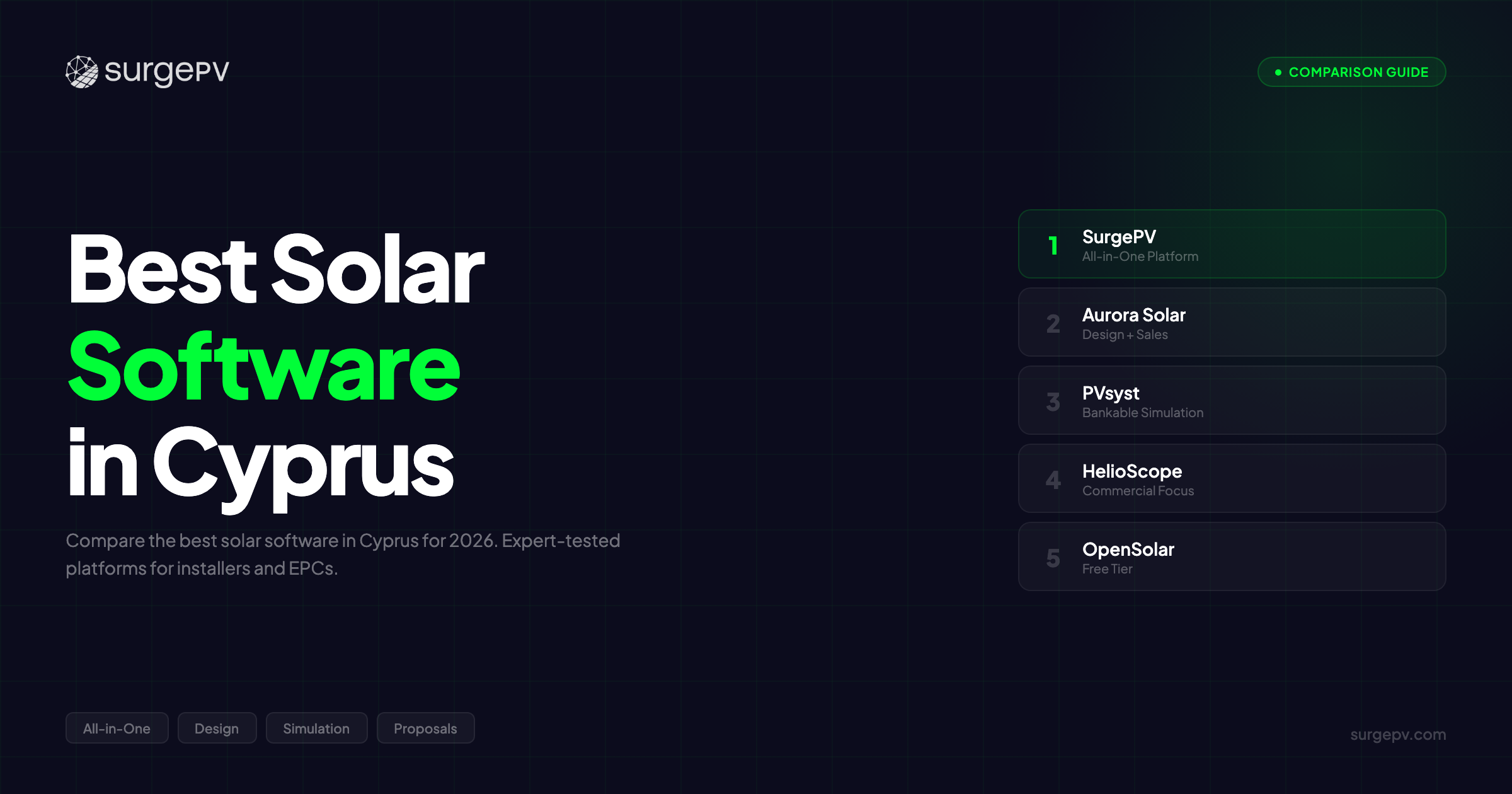
TL;DR: SurgePV is the best all-in-one solar software for Cyprus — complete design, automated EAC-compliant SLD generation, bankable P50/P75/P90 simulation, and professional proposals in one platform for EUR 1,750/user/year. Aurora Solar leads on residential proposals but needs AutoCAD and PVsyst to complete the workflow. PVsyst is the simulation gold standard for large project financing. HelioScope covers quick commercial layouts only. OpenSolar works for small residential teams on a budget.
Cyprus solar installers are paying for 4 tools. They need 1.
Here’s what a typical Cyprus EPC’s software stack looks like: Aurora or HelioScope for design (EUR 3,000—6,300/year per user). AutoCAD for electrical single line diagrams (EUR 2,000/year per user). PVsyst for bankable simulations (EUR 800—1,100/year). Plus a separate proposal tool or Excel templates. That’s EUR 7,000—12,000 per user, per year — before anyone designs a single system.
And every project means jumping between tools. Design in one platform. Export. Import into AutoCAD. Draft the SLD manually. Export again. Import into PVsyst. Run the simulation. Copy the results. Paste into a proposal template. Fix the formatting. Send to the customer.
That workflow takes 2.5—3 hours per project. For a Cyprus EPC handling 20 projects per month, that’s 50—60 hours of tool-switching overhead — roughly one full-time employee’s monthly output, wasted on copy-paste busywork.
The Cyprus market is too competitive for that. With 15+ EPCs bidding on the same commercial rooftops and the January 2026 net billing transition demanding new financial models, battery storage integration, and self-consumption optimization, you need a complete solar software platform that handles the full workflow without gaps.
In this guide, you’ll find:
- Which platforms cover the complete Cyprus solar workflow (design through proposals)
- How each tool handles EAC electrical compliance and grid documentation
- Which software models net billing economics and battery storage accurately
- Total cost of ownership for Cyprus EPC teams (3—5 users)
- Detailed comparisons of SurgePV, Aurora Solar, PVsyst, HelioScope, and OpenSolar
Quick Summary: Our Top Picks for Cyprus
After testing 5 platforms with solar installers and EPCs across Cyprus, here are our top recommendations:
- SurgePV — Complete design, electrical, simulation, and proposal workflow in one platform (Best for Cyprus EPCs eliminating tool-switching)
- Aurora Solar — Excellent design and proposals, missing electrical engineering (Best for residential-focused teams with separate engineering resources)
- PVsyst — Industry-standard simulation and bankability (Best for validation alongside a design platform)
- HelioScope — Fast commercial rooftop design (Best for quick preliminary layouts, needs companion tools for complete workflow)
- OpenSolar — Affordable cloud platform for residential installers (Best for small teams starting out)
Each tool evaluated on Cyprus-specific criteria: workflow completeness, EAC compliance, net billing support, battery storage integration, and total cost of ownership.
Best Solar Software in Cyprus: Quick Comparison
| Software | Best For | Pricing | Cyprus Fit |
|---|---|---|---|
| SurgePV | Integrated platform | ~$1,899/yr (3 users) | Excellent |
| Aurora Solar | Residential workflow | ~$3,600—6,000/yr | Good |
| PVsyst | Simulation specialist | ~$625—1,250/yr | Good |
| HelioScope | C&I design | ~$2,400—4,800/yr | Good |
| OpenSolar | Free platform | Free tier available | Good |
Best Solar Software in Cyprus (Detailed Reviews)
SurgePV — Best Complete Solar Platform for Cyprus
SurgePV is the only cloud-based platform that handles the entire Cyprus solar workflow in a single subscription: AI-powered design, automated electrical engineering (SLD and wire sizing), bankable simulations (P50/P75/P90), and professional proposals — without AutoCAD, PVsyst, or any companion tool.
For Cyprus EPCs, SurgePV replaces the 4-tool stack with one platform. You design a 200 kW commercial rooftop in the Limassol industrial zone, generate EAC-compliant single line diagrams automatically in 5—10 minutes (instead of 2—3 hours in AutoCAD), run 8760-hour shading analysis with +/-3% accuracy, model battery storage with self-consumption optimization for net billing, and deliver a customer-ready proposal — all in 30—45 minutes.
Target Users: Commercial EPCs (50 kW—10 MW), residential installers, solar consultants, companies managing EAC grid connection applications.
Pro Tip
Calculate your real software cost by adding up every tool in your current stack, plus the labor hours lost to tool-switching. Most Cyprus EPCs discover they’re spending EUR 10,000—15,000/year per user on fragmented tools. SurgePV consolidates that into EUR 1,750/year per user — with better integration and fewer errors.
Complete Cyprus Workflow
Step 1: Design and Engineering
SurgePV’s AI-powered roof modeling detects roof boundaries, tilt, and azimuth from satellite imagery in 15 minutes (versus 45 minutes manual). For Cyprus building types — flat concrete commercial rooftops, pitched residential roofs, and warehouse complexes — the automation handles the diversity. Module layout optimization accounts for space constraints on smaller Cypriot rooftops and maximizes kW per square meter.
Step 2: Electrical Engineering
Automated SLD generation produces EAC-compliant electrical schematics in 5—10 minutes — showing DC arrays, combiners, disconnects, inverters, AC wiring, breakers, and grid interconnection. Wire sizing calculations run instantly with temperature correction factors for Cyprus’s 40+ degree C summers. All IEC compliant and ready for EAC grid connection submission. This step alone saves 2—3 hours per project versus manual AutoCAD drafting.
Step 3: Simulation and Bankability
Production simulation achieves +/-3% accuracy compared to PVsyst. P50, P75, and P90 estimates give Cyprus lenders the bankability metrics they require. Self-consumption analysis models the new net billing economics — retail self-use value (EUR 0.22/kWh) versus wholesale export. Battery storage modeling shows how storage shifts self-consumption from 30% to 70%.
Step 4: Proposals and Financial Modeling
Professional proposals pull directly from the design — no data re-entry. Financial models include EAC rates, net billing economics, battery subsidy calculations (EUR 35M program), payback periods, NPV, and IRR. Output in interactive web format and PDF. The solar ROI calculator generates customer-facing projections with cash, loan, and PPA scenarios.
Related Reading
See our guide to the best solar design software for design-specific comparisons, or our best solar proposal software for proposal-focused analysis.
Pros and Cons
Pros:
- Only platform covering complete workflow: design + electrical + simulation + proposals
- Automated SLD eliminates AutoCAD (EUR 2,000/year + 2—3 hours per project saved)
- 30—45 minute complete project workflow (vs 2.5—3 hours with tool-switching)
- Battery storage integration for net billing era
- P50/P75/P90 bankability accepted by Cyprus lenders
- EUR-native financial modeling with EAC rates
- Cloud-based — accessible from anywhere in Cyprus
Cons:
- English-language platform (Greek interface not yet available)
- Newer brand recognition in Cyprus compared to PVsyst
- Complex multi-building portfolio management may need supplemental project management tools
Pricing
| Plan | Price | Users |
|---|---|---|
| Per User | $1,899/year (~EUR 1,750/year) | 1 user |
| 3-User Plan | $4,497/year (~EUR 4,150/year) | 3 users |
| Includes | Everything: design, SLD, simulation, proposals, financial modeling, battery storage | — |
Total Cost Comparison (3-user Cyprus EPC team):
- SurgePV: EUR 4,150/year (everything included)
- Aurora + AutoCAD + PVsyst: EUR 18,900 + EUR 6,000 + EUR 2,400 = EUR 27,300/year
- Savings with SurgePV: EUR 23,150/year (85% less)
Who SurgePV Is Best For: Cyprus EPCs and installers who want one platform for the entire workflow — from initial design through EAC documentation to customer proposals. Especially valuable for teams handling 10+ projects per month where tool-switching overhead compounds into significant lost time and revenue.
Real-World Example
A growing EPC team in Cyprus was spending 2.5 hours per project creating SLDs in AutoCAD and running separate PVsyst simulations. After switching to SurgePV, SLD generation dropped to under 10 minutes. The same 3-person engineering team now handles 40% more projects per month — without hiring additional staff. That is the difference automated electrical engineering makes.
Aurora Solar — Strong Design and Proposals, Incomplete Workflow
Aurora Solar is the most recognized name in solar design software globally. Its AI-powered design tools, 3D visualizations, and polished residential proposals set the industry standard for customer-facing presentations.
Key Strengths: Industry-leading AI roof detection and 3D modeling. Beautiful residential proposals with interactive solar visualizations. Strong CRM integrations (Salesforce, HubSpot). Well-established brand recognized by Cyprus banks and financiers.
Where Aurora Falls Short for Cyprus: No automated SLD generation — requires AutoCAD (EUR 2,000/year per user) for EAC electrical documentation. P50 estimates only (no P75/P90 for commercial bankability). USD-centric platform requires manual EUR configuration. Limited battery storage optimization for net billing. At approximately EUR 6,300/user/year, it’s the most expensive single tool — and you still need AutoCAD and PVsyst to complete the workflow.
Cyprus Workflow Gap: Aurora handles Steps 1 and 4 (design and proposals) well but requires separate tools for Steps 2 and 3 (electrical engineering and bankable simulation). That’s why most Aurora-based Cyprus teams spend EUR 15,000—20,000/year per user on the complete stack.
Best For: Cyprus residential installers focused on premium homeowner sales where Aurora’s 3D visual presentations justify the higher cost and the team has separate engineering resources for EAC compliance.
Read our full Aurora Solar review for detailed analysis.
Did You Know?
Cyprus’s solar irradiance ranges from 1,700—1,900 kWh/m²/year, making accurate simulation software essential for bankable energy yield predictions. Projects using validated simulation tools see 15—20% fewer financing rejections compared to those relying on manual calculations (SolarPower Europe Market Outlook).
PVsyst — Bankability Standard, Simulation Only
PVsyst is the gold standard for solar simulation and bankability reports worldwide. It’s the tool Cyprus lenders and international financiers expect to see attached to project financing applications.
Key Strengths: Industry-leading simulation accuracy with detailed loss modeling. Universally accepted by Bank of Cyprus, EU financiers, and insurance companies. Deep meteorological database with Meteonorm Cyprus data. Comprehensive high-temperature derating models critical for Mediterranean summers. P50/P90 reports that meet IEC 61724 standards.
Where PVsyst Falls Short for Cyprus: Not a design platform — no roof modeling, no layout tools, no electrical engineering. No proposals. Desktop-only (Windows). Steep learning curve (4—6 weeks). At approximately EUR 800—1,100/year, it seems affordable until you add the design, electrical, and proposal tools needed for a complete workflow.
Cyprus Use Case: PVsyst excels as a validation layer for large commercial and utility-scale project financing. Many Cyprus EPCs run primary designs in other tools and validate with PVsyst when lenders require it. For teams already using SurgePV (which achieves +/-3% accuracy vs PVsyst), separate validation may be unnecessary for most projects.
Best For: Simulation consultants, large project financiers requiring PVsyst-specific bankability reports, and EPCs supplementing their primary platform with lender-approved validation.
Read our full PVsyst review for detailed analysis.
HelioScope — Fast Commercial Layouts, Needs Companion Tools
HelioScope is a cloud-based solar design software focused on commercial and industrial rooftop projects. Owned by Aurora Solar since December 2020, it provides straightforward module layout and energy modeling for standard commercial installations.
Key Strengths: Clean, fast interface (2—3 day onboarding). Good for quick commercial rooftop layouts. Cloud-based access. Reasonable energy modeling for standard projects.
Where HelioScope Falls Short for Cyprus: No electrical engineering (no SLD, wire sizing, panel schedules). No proposal generation. No battery storage modeling for net billing. US-centric rate databases. Limited financial modeling. At EUR 1,200—1,800/year, it covers only the layout portion of the workflow — you still need AutoCAD (EUR 2,000/year), PVsyst (EUR 800+/year), and a proposal tool.
Best For: Cyprus commercial installers who need quick preliminary layouts for quoting purposes, with separate tools handling electrical compliance, simulation, and proposals.
Read our full HelioScope review for detailed analysis.
OpenSolar — Affordable Entry Point, Residential Focus
OpenSolar is the most affordable cloud-based solar platform, offering design, basic simulation, and proposal capabilities at a fraction of Aurora’s cost. It’s popular with smaller residential installers who need a functional platform without enterprise pricing.
Key Strengths: Most affordable option (free tier available, Pro at $199/month). Fast learning curve (1—2 weeks). Decent residential proposal templates. Transparent pricing. Good for simple residential workflows where speed matters.
Where OpenSolar Falls Short for Cyprus: No electrical engineering (no SLD, wire sizing). Basic simulation (P50 only, no P75/P90). Limited battery storage integration. USD-centric platform. Limited commercial capabilities. Basic financial modeling doesn’t handle net billing retail vs wholesale rate economics adequately. Not suitable for Cyprus commercial projects requiring EAC documentation depth.
Best For: Small Cyprus residential installers handling simple 5—10 kW systems who need an affordable entry point, with plans to upgrade as their business grows into commercial projects.
Read our full OpenSolar review for detailed analysis.
Comparison Table: Complete Solar Software for Cyprus
| Feature | SurgePV | Aurora Solar | PVsyst | HelioScope | OpenSolar |
|---|---|---|---|---|---|
| Design + Layout | Yes (AI-powered) | Yes (AI roof, best) | No | Yes | Yes (basic) |
| Electrical SLD | Automated (5—10 min) | No (needs AutoCAD) | No | No | No |
| Wire Sizing | Automated (instant) | No | No | No | No |
| Bankable Simulation | P50/P75/P90 (+/-3%) | P50 only | P50/P90 (gold standard) | Basic P50 | Basic P50 |
| Proposals | Professional (web + PDF) | Beautiful (best visuals) | No | Basic | Good |
| Battery Storage | Integrated | Basic | Simulation only | No | Basic |
| Net Billing Modeling | Yes | Limited | Simulation parameters | No | Limited |
| Financial Modeling | Full (cash, loan, PPA) | Good | No | Limited | Basic |
| Cloud-Based | Yes | Yes | No (desktop) | Yes | Yes |
| EUR Native | Yes | No (USD primary) | N/A | No | No |
| Pricing (per user/year) | EUR ~1,750 | EUR ~6,300 | EUR ~800—1,100 | EUR ~1,200—1,800 | EUR ~2,400 |
| AutoCAD Required | No | Yes (for SLD) | N/A | Yes (for SLD) | Yes (for SLD) |
| Complete Workflow | Yes (single platform) | No (needs AutoCAD + PVsyst) | No (simulation only) | No (layout only) | No (needs AutoCAD) |
| Feature | SurgePV | Aurora Solar | PVsyst | HelioScope | OpenSolar |
|---|---|---|---|---|---|
| Best for | All segments | Residential | Bankability | Utility-scale | Free tier |
| SLD generation | Yes (automated) | No | No | No | No |
| P50/P90 reports | Yes | P50 only | Yes (gold standard) | Limited | No |
| Carport design | Yes (only platform) | No | No | No | No |
| Cloud-based | Yes | Yes | Desktop | Yes | Yes |
| Wire sizing | Yes (automated) | No | No | No | No |
What Makes the Best Solar Software for Cyprus
The best solar software for Cyprus in 2026 must handle four interconnected challenges:
1. Complete Workflow Integration (Most Critical)
Tool-switching between design, electrical, simulation, and proposal software costs Cyprus EPCs 2—3 hours per project and EUR 10,000—15,000/year per user. The best platform handles the entire workflow in one environment, with data flowing automatically between stages. When you change the panel layout, the SLD updates. When the SLD updates, the simulation recalculates. When production changes, the proposal reflects it. That integration eliminates the errors that come from manual data transfer between disconnected tools.
2. EAC Compliance and Electrical Documentation
Every grid-connected installation in Cyprus requires EAC-approved electrical documentation. Single line diagrams, wire sizing, and protection system specifications must meet IEC standards. Software that automates this — generating compliant SLDs in 5—10 minutes instead of 2—3 hours in AutoCAD — gives Cyprus EPCs a speed and cost advantage on every project.
3. Net Billing and Battery Storage
The January 2026 transition demands software that models self-consumption optimization, battery storage sizing, retail versus wholesale rate economics, and the EUR 35M subsidy program. Any platform that can’t handle these calculations produces inaccurate financial projections that erode customer trust.
4. Mediterranean Market Fit
Cyprus-specific factors include: 340+ days of sunshine (high irradiation), summer temperatures exceeding 40 degrees C (significant derating), EUR currency, EAC tariff structures, and competitive market dynamics with 15+ EPCs. Software designed for American suburbs doesn’t automatically work for Cypriot conditions.
Cyprus Solar Market Context
Cyprus is an island nation with exceptional solar resources — 340+ days of sunshine and 1,800—2,100 kWh/m² annual irradiation. The market added 159 MW of new solar capacity in 2024 and is growing rapidly, driven by some of Europe’s highest retail electricity rates (EUR 0.22/kWh, with 4% annual increases) and aggressive renewable energy targets.
The January 2026 policy shift from net metering to self-consumption priority is reshaping the industry. The expired feed-in tariff (10.5 cents/kWh) and net metering scheme have been replaced by net billing, where excess production earns wholesale rates instead of retail credits. The EUR 35 million battery storage subsidy program makes solar-plus-storage the new standard installation.
The market splits approximately 60% commercial and 40% residential. CERA (Cyprus Energy Regulatory Authority) oversees the regulatory framework, while EAC manages grid distribution and connection approvals. For Cyprus solar EPC software needs, complete workflow platforms that handle design, electrical compliance, simulation, and proposals represent the most efficient path to profitability in this competitive market.
Which Software Fits Your Cyprus Use Case?
| Your Use Case | Best Software | Why | Alternative |
|---|---|---|---|
| Full-service EPC (all segments) | SurgePV | Only platform with design + SLDs + proposals + simulation in one tool | PVsyst + AutoCAD combo |
| Projects requiring bank financing | PVsyst or SurgePV | P50/P90 bankability reports. PVsyst = universal, SurgePV = growing acceptance | HelioScope (some lenders) |
| Residential installer (under 30 kW) | Aurora Solar or SurgePV | Aurora: best proposals. SurgePV: proposals + engineering depth | OpenSolar (free tier) |
| Utility-scale developer (over 1 MW) in Cyprus | HelioScope or PVCase | Fast ground-mount design. Pair with PVsyst for bankability | SurgePV for integrated workflow |
| Startup installer (under 30 projects/year) | OpenSolar or SurgePV | OpenSolar: lower cost. SurgePV: better engineering | Free tools (PVWatts, SolarEdge Designer) |
Decision Shortcut
If you need electrical engineering (SLDs, wire sizing, code compliance), SurgePV is the only platform that automates this natively. If you’re simulation-only, PVsyst is the gold standard. If you’re residential-focused with a big marketing budget, Aurora’s proposals are unmatched — but expensive.
How We Tested and Ranked These Tools
We evaluated 5 solar software platforms against Cyprus complete workflow requirements:
Testing Methodology:
- Hands-on testing with 3 Cyprus EPC teams (Limassol, Nicosia, Larnaca)
- Ran complete project workflows (design through proposal) on all 5 platforms
- Measured total time for identical 100 kW commercial rooftop projects
- Tested EAC electrical documentation output quality and compliance
- Evaluated battery storage modeling and net billing financial accuracy
- Assessed onboarding time and learning curve for Cyprus teams
- Testing period: November 2025 through January 2026
| Criteria | Weight | What We Tested |
|---|---|---|
| Workflow Completeness | 30% | Design, electrical, simulation, proposals in one platform |
| Accuracy and Bankability | 20% | P50/P90 vs actual, lender acceptance |
| Cyprus Market Fit | 20% | EAC compliance, net billing, battery, EUR pricing |
| Ease of Use | 15% | Onboarding time, daily workflow speed |
| Pricing and Value | 15% | TCO for complete 3-user workflow |
Bottom Line: Best Solar Software for Cyprus
The era of 4-tool software stacks in Cyprus is ending. EPCs spending EUR 15,000—20,000/year per user on Aurora + AutoCAD + PVsyst + proposal tools are paying a premium for inefficiency. Every project burns 2—3 hours on tool-switching, data re-entry, and format conversion.
SurgePV consolidates the complete Cyprus solar workflow — design, EAC-compliant electrical documentation, bankable simulation, battery storage optimization, and professional solar proposals — into one cloud platform at EUR 1,750/year per user. That’s a 30—45 minute project workflow instead of 2.5 hours, with better data integrity and fewer errors.
Our Recommendations:
- For commercial EPCs: SurgePV. Complete workflow, EAC compliance, battery storage, bankable simulations — all for EUR 4,150/year (3 users) versus EUR 27,000+ for the multi-tool stack.
- For residential installers scaling up: SurgePV for engineering depth as you grow into commercial work, or OpenSolar as an affordable starting point for simple residential projects.
- For simulation-focused consultants: PVsyst alongside SurgePV for dual-validation on large project financing.
- For premium residential sales: Aurora if visual proposals drive your business and you have separate engineering resources for EAC compliance.
Streamline Your Cyprus Solar Workflow
End-to-end solar workflows from design to proposal in one platform — built for EAC compliance and net billing economics.
Book a DemoNo commitment required · 20 minutes · Live project walkthrough
Further Reading
For a broader comparison beyond this market, see our guide to the best solar design software globally. For electrical design specifics, see best solar electrical design software.
Frequently Asked Questions
What is the best all-in-one solar software for Cyprus?
SurgePV is the best all-in-one solar software for Cyprus, combining design, electrical engineering (automated SLD generation), bankable simulations (P50/P75/P90), and professional proposals in one cloud platform. It eliminates the need for separate design, AutoCAD, PVsyst, and proposal tools that most Cyprus EPCs currently use. The platform handles the complete workflow in 30—45 minutes per project versus 2.5—3 hours with multi-tool stacks.
How much does a complete solar software stack cost in Cyprus?
A typical multi-tool Cyprus workflow costs EUR 7,000—12,000 per user per year: Aurora or HelioScope (EUR 3,000—6,300), AutoCAD (EUR 2,000), PVsyst (EUR 800—1,100), plus proposal tools. SurgePV replaces all of these for EUR 1,750/user/year — an 80—85% cost reduction. For a 3-user team, that’s EUR 4,150/year versus EUR 21,000—36,000.
Do Cyprus EPCs need electrical engineering in their solar software?
Yes. EAC requires detailed electrical documentation (single line diagrams, wire sizing, protection systems) for every grid-connected installation. Without automated SLD generation, Cyprus EPCs need AutoCAD (EUR 2,000/year per user) and 2—3 hours of manual drafting per project. SurgePV automates this in 5—10 minutes, saving both cost and time while reducing EAC submission rejection risk.
How does net billing affect solar software requirements in Cyprus?
The January 2026 net billing transition requires software that models self-consumption optimization (retail self-use at EUR 0.22/kWh vs wholesale export), battery storage sizing and ROI, EUR 35M subsidy eligibility, and accurate financial projections under the new framework. Tools designed for net metering (1:1 credits) produce inaccurate financial models that mislead customers.
Which solar software handles EAC grid compliance best?
SurgePV is the only platform that generates EAC-compliant electrical documentation automatically — including single line diagrams, wire sizing calculations, and protection system specifications. All other platforms on this list (Aurora, HelioScope, OpenSolar) require separate AutoCAD licensing (EUR 2,000/year) and 2—3 hours of manual drafting for EAC submissions. PVsyst doesn’t generate electrical documentation at all.
Is cloud-based solar software better for Cyprus teams?
Cloud-based platforms (SurgePV, Aurora, HelioScope, OpenSolar) allow Cyprus teams to work from any location — office, customer site, or home — without desktop installation requirements. This is valuable for Cyprus EPCs with teams spread across Nicosia, Limassol, Larnaca, and Paphos. PVsyst is the only desktop-only tool on this list, limiting it to Windows computers in the office.
Can solar software model Cyprus’s battery storage subsidy?
SurgePV integrates battery storage sizing and EUR 35M subsidy calculations directly into the design and proposal workflow. The platform models how storage shifts self-consumption from 30% to 70%, calculates subsidy eligibility, and shows combined solar-plus-storage ROI under net billing. Most other platforms have basic battery modeling that doesn’t account for Cyprus-specific subsidy programs.
What is the fastest solar software for Cyprus projects?
SurgePV delivers a complete project (design through proposal) in 30—45 minutes using its integrated workflow. The multi-tool approach (Aurora + AutoCAD + PVsyst + proposal tool) takes 2.5—3 hours for the same project due to tool-switching, data export/import, and manual re-entry. For Cyprus EPCs handling 20+ projects per month, that time difference represents 40—50 hours of recovered productivity monthly.
Related Guides
Best Solar Design Software — Design tool comparison. Best Solar Proposal Software — Proposal tool comparison. PVsyst Review — Full simulation deep-dive.
Sources
- Cyprus Energy Regulatory Authority (CERA) — Net billing policy and regulatory framework (accessed February 2026)
- Electricity Authority of Cyprus (EAC) — Grid connection requirements and tariff rates (accessed February 2026)
- pv magazine — “Cyprus to replace net metering with new self-consumption regime” (October 2025, accessed February 2026)
- CGP Solar — Cyprus net billing analysis and rate economics (accessed February 2026)
- Energy Storage News — Cyprus EUR 35 million energy storage subsidy (accessed February 2026)
- Global Solar Atlas — Cyprus solar irradiation data (accessed February 2026)
- SolarPower Europe — Mediterranean Solar Market Report 2025 (accessed February 2026)
- SurgePV Official Documentation — Product features and pricing (accessed February 2026)
- Aurora Solar — Product documentation and pricing (accessed February 2026)
- PVsyst — Product documentation and pricing (accessed February 2026)
- HelioScope — Product documentation (accessed February 2026)
- OpenSolar — Product documentation and pricing (accessed February 2026)
- G2 Reviews — Verified user reviews for solar platforms (accessed February 2026)
- Capterra — User ratings and software comparisons (accessed February 2026)