

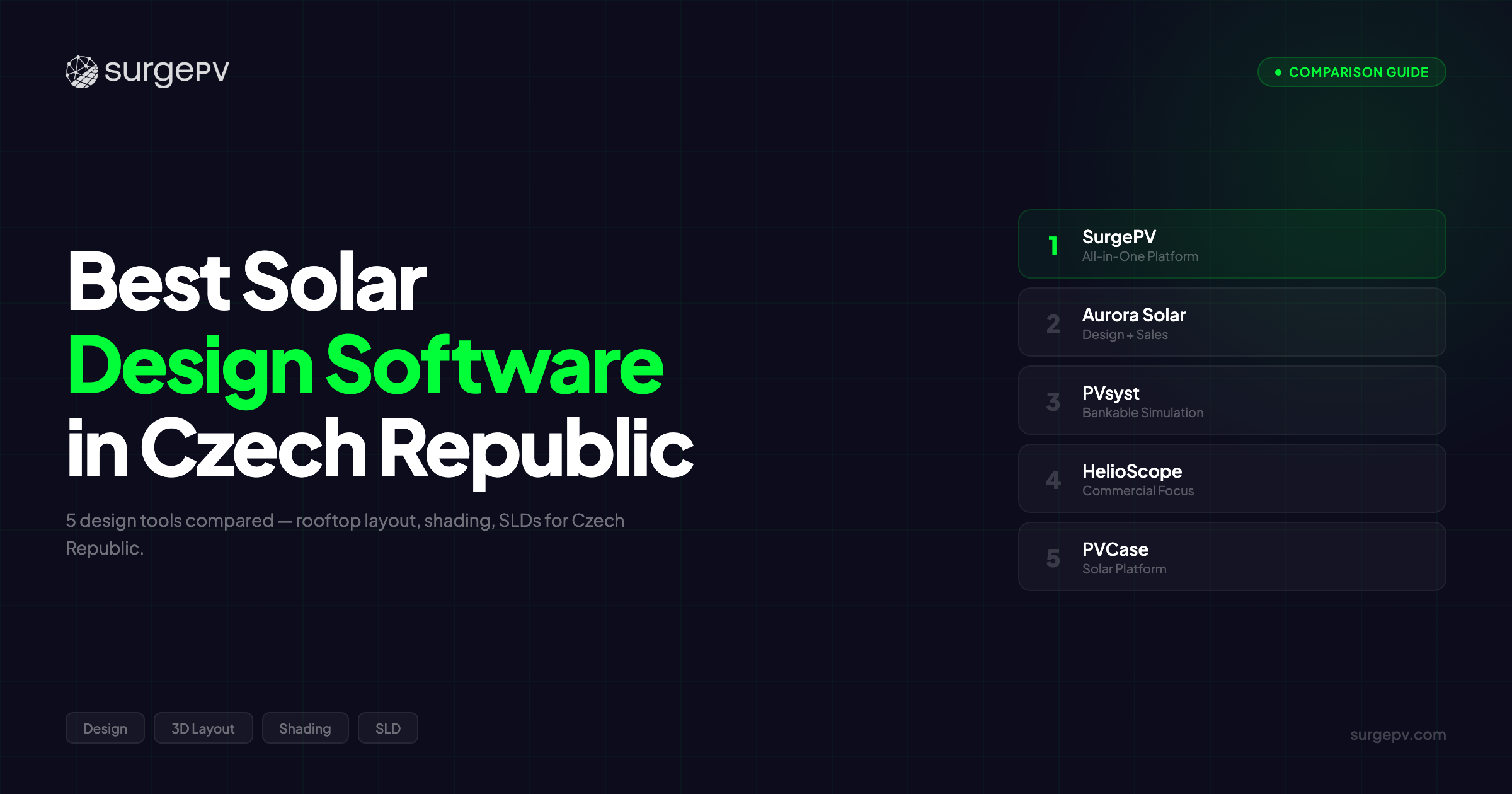
TL;DR: SurgePV is the best all-in-one solar design software for Czech Republic — combining design, bankable P50/P75/P90 simulation (+/-3% vs PVsyst), automated SLD generation, and proposals in one platform. PVsyst remains the gold standard for utility-scale bankability. Aurora Solar suits premium residential EPCs. HelioScope fits C&I specialists. PVCase handles large ground-mount pipelines.
Czech solar is booming. According to SolarPower Europe, the market is growing at 35% annually. Hundreds of new installers are fighting for the same projects.
But designing systems here is a different challenge entirely. Complex CSN EN standards. Three distribution network operators — CEZ Distribuce, E.ON Distribuce, and PRE — each with their own connection requirements. Bankability expectations from Czech and EU lenders. A price-sensitive market where 24-48 hour turnaround wins contracts and everything slower loses them.
Generic solar software does not cut it here.
The best solar design software for Czech Republic must deliver four outcomes: CSN EN compliant designs that pass building permits and ERU inspections. Bankable simulations accepted by Czech banks and EU lenders. Grid-connection-ready documentation for Czech DNO approval. And fast enough output to compete in a market where speed is not optional — it is survival.
We tested 5 leading platforms with Czech EPCs across all segments — residential installers in Prague, C&I specialists in Central Bohemia, and utility-scale developers in South Moravia. Here is what we found.
Quick Comparison Table
| Feature | SurgePV | Aurora Solar | PVsyst | HelioScope | PVCase |
|---|---|---|---|---|---|
| Best for | All segments | Premium residential | Bankability | C&I design | Utility-scale |
| SLD generation | Yes (automated) | No (needs AutoCAD) | No | No | Yes (needs AutoCAD) |
| Bankable simulation | Yes (P50/P75/P90) | Limited (P50 only) | Yes (gold standard) | Yes | No (needs PVsyst) |
| Proposal generation | Yes (15 min) | Yes (integrated) | No | Limited | No |
| Cloud-based | Yes | Yes | No (desktop) | Yes | No (desktop) |
| Czech compliance | EU/CSN aligned | Manual validation | Well-established | Manual validation | EU aligned |
| Pricing | $1,499/user/yr | Contact sales | ~CHF 1,100/yr | Subscription | Subscription |
| Onboarding | 2-3 weeks | 4-6 weeks | 2-4 weeks | 2-3 weeks | 6-8 weeks |
Further Reading
For a broader comparison beyond this market, see our guide to the best solar design software globally.
Best Solar Design Software in Czech Republic
SurgePV — Best End-to-End Solar Platform for Czech Republic
Best For: Czech EPCs and installers across all segments needing integrated design-to-proposal workflows
Pricing: $1,499/user/year — all features included
Ease of Use: 2-3 week onboarding
SurgePV is an end-to-end solar design, simulation, and proposal platform built for modern EPCs operating in competitive European markets. Unlike tools that focus solely on design or simulation, SurgePV integrates the entire pre-construction workflow — from initial site assessment to bankable proposals — in one platform.
For Czech installers, that integration matters. It eliminates the need to juggle AutoCAD for electrical SLDs, PVsyst for simulations, and Excel for proposals. One platform handles it all.
Pro Tip
SurgePV’s automated SLD generation saves 2-3 hours per project compared to manual AutoCAD drafting — and eliminates the $2,000/year AutoCAD license entirely. For Czech Republic EPCs handling 10+ projects per month, that’s 20-30 hours saved monthly. Book a demo to see it in action.
Key features for Czech Republic
Design and engineering:
- AI-powered 3D roof modeling reduces manual design time by 70% — critical when competing against 400+ other Czech installers
- Automated shading analysis accurately models complex urban environments in Prague, Brno, and Ostrava where surrounding buildings create intricate shadow patterns
- Snow and wind load calculations automated per CSN EN 1991-1-3 and CSN EN 1991-1-4 — no manual structural analysis needed
- EU Tier 1 component library with 70,000+ modules ensures Czech and EU lender acceptance. No scrambling to find datasheets or manually entering module specs — everything lenders need is already built in.
Simulation and accuracy:
- 8760-hour shading analysis delivers P50/P75/P90 results accepted by Czech commercial banks (CSOB, Komercni banka, Ceska sporitelna). That means your financing applications include the bankability data lenders actually require — not just optimistic P50 estimates that get rejected.
- Accuracy within +/-3% of PVsyst — close enough for bankable reports, fast enough for daily workflow
- PVGIS and Meteonorm weather data integration validated against Czech Hydrometeorological Institute data
- Grid export limitation modeling for Czech DNO compliance
Compliance and grid connection:
- Automated SLD generation produces single-line diagrams meeting CSN 33 2000-7-712 in 5-10 minutes versus 2-3 hours in AutoCAD. No more manual drafting errors, no AutoCAD license fees, and no bottleneck waiting for your one CAD-trained engineer.
- Multi-DNO documentation support adaptable for CEZ Distribuce, E.ON Distribuce, and PRE connection processes
- Building permit documentation supporting Czech Building Act requirements
- Wire sizing calculations with voltage drop analysis — no separate engineering tool needed. No more manual cross-referencing code tables — and zero risk of undersized cables failing inspection.
Pros and cons
| Pros | Cons |
|---|---|
| All-in-one platform eliminates need for AutoCAD, PVsyst, Excel | Czech-language UI not yet available (proposals can be Czech) |
| 70% faster design workflows for competitive Czech market | Newer platform — less Czech bank recognition than PVsyst (growing) |
| Automated SLD generation (5-10 min vs 2-3 hrs AutoCAD) | |
| Bankable P50/P75/P90 simulations (+/-3% vs PVsyst) | |
| Multi-segment: residential 5 kW to utility-scale 50+ MW | |
| Snow/wind load automation per CSN EN standards | |
| $1,499/user/year — transparent pricing |
Real-World Example
A mid-size EPC team in Central Bohemia was spending 2.5 hours per project creating SLDs in AutoCAD. After switching to SurgePV, SLD generation dropped to under 10 minutes. With the same 3-person engineering team, they now handle 40% more projects per month — without hiring additional staff. That is the difference automated electrical engineering makes.
You might be wondering: if SurgePV does all this, why haven’t I heard of it? Fair question. PVsyst has had a 30-year head start. Aurora Solar has spent hundreds of millions on marketing. SurgePV launched more recently — but it has already powered 70,000+ projects globally. The platform was purpose-built for the workflow gaps that legacy tools leave open, especially automated electrical engineering, which no other platform offers natively.
Further Reading
Best Solar Design Software (2026) — Global comparison across 10+ platforms. Best Solar Electrical Design Software — SLD generation compared. PVsyst Review — Full simulation analysis and pricing.
Pricing
- Individual Plan: $1,899/year for 3 users ($633/user/year)
- For 3 Users Plan: $1,499/user/year
- For 5 Users Plan: $1,299/user/year
- Enterprise: Custom pricing for large Czech developers
No hidden fees. No feature-gated tiers. Compare that to an Aurora Solar + AutoCAD stack at roughly $6,800/year per user — SurgePV saves over $5,300/user/year.
Who SurgePV is best for
- Multi-segment Czech EPCs serving residential, C&I, and utility-scale markets from one platform
- Residential installers in competitive Prague and Brno markets needing fast proposals
- Commercial solar specialists needing automated SLD generation and bankable simulations
- Growing installer businesses scaling from residential to commercial
Less ideal for: Czech utility-scale developers requiring absolute maximum bank acceptance (PVsyst still leads for 50+ MW projects) or teams requiring Czech-language UI.
See SurgePV Handle Czech Solar Projects
Automated SLD generation saves 2-3 hours per project. CSN EN compliance, multi-DNO documentation, and bankable P50/P90 reports — all in one platform.
Book a DemoNo commitment required · 20 minutes · Live project walkthrough
Aurora Solar — Premium Design and Sales Platform
Best For: Mid-to-large Czech EPCs with international projects
Pricing: Contact sales (premium tier)
Ease of Use: 4-6 week learning curve
Aurora Solar is a US-based premium platform widely used by mid-to-large EPCs globally. Known for strong AI roof detection, polished proposals, and integrated CRM workflows, Aurora brings a lot to the table.
But Aurora’s strengths lie in residential sales workflows. Commercial EPCs hit a wall when they need electrical engineering depth. Aurora lacks built-in SLD generation and wire sizing. You’ll need AutoCAD for those — adding $2,000/year and 2-3 hours per project.
Key Strengths
- Industry-leading AI roof modeling and 3D visualization
- Integrated CRM and sales workflows
- Strong financial modeling with multiple financing options
- Polished, professional proposals
Limitations
- Premium pricing may challenge smaller Czech installers in a margin-sensitive market
- US-centric workflows require adaptation for Czech grid connection and CSN EN standards
- No native SLD generation — grid connection applications need AutoCAD exports
- P50 only — no P75/P90 bankability reports for Czech lenders
Best for: Mid-to-large Czech EPCs with international portfolios or premium residential focus, willing to invest in top-tier design and sales tools and handle separate electrical engineering workflows. Aurora is a leading solar proposal software option but lacks integrated electrical engineering.
Read our full Aurora Solar review for detailed analysis.
Did You Know?
Czech Republic’s solar irradiance ranges from 1,000-1,100 kWh/m²/year, making accurate simulation software essential for bankable energy yield predictions. Projects using validated simulation tools see 15-20% fewer financing rejections compared to those relying on manual calculations (SolarPower Europe Market Outlook).
PVsyst — Industry-Standard Simulation for Bankability
Best For: Utility-scale developers requiring maximum bankability with Czech/EU lenders
Pricing: ~CHF 1,100/year
Ease of Use: 2-4 week learning curve
PVsyst is the gold standard for bankable solar simulation software. Every Czech commercial bank and EU lender recognizes PVsyst reports. For utility-scale projects requiring maximum financing credibility, nothing else comes close.
PVsyst is a simulation tool — not a design platform. You can’t create panel layouts, generate proposals, or produce electrical documentation. You’ll need separate tools for those, which means more licenses, more training, and more workflow complexity.
Key Strengths
- Universal acceptance by Czech banks (CSOB, Komercni banka) and EU lenders
- Deepest simulation detail and loss modeling available
- Validated against real-world Czech installations with proven accuracy
- Extensive component database including Czech-available equipment
Limitations
- Steep learning curve (2-4 weeks training typical for Czech engineers)
- Simulation-only — requires separate design and proposal tools
- Desktop-only software (no cloud collaboration)
- Higher cost justified only when bankability is the primary requirement
Best for: Czech utility-scale developers, technical consultants, and EPCs requiring maximum bankability for commercial bank financing on projects above 500 kW.
Read our full PVsyst review for detailed analysis.
HelioScope — Fast Commercial Design with Strong Accuracy
Best For: Czech C&I focused installers
Pricing: Subscription-based
Ease of Use: 2-3 week learning curve
HelioScope is a cloud-based design and simulation platform focused on commercial projects. Popular among European C&I EPCs, HelioScope balances speed and accuracy well.
Key Strengths
- Fast cloud-based design workflow (no installation required)
- Strong simulation accuracy comparable to PVsyst for most C&I projects
- Good team collaboration features for distributed Czech EPC teams
- Reasonable pricing for commercial-focused installers
Limitations
- Commercial and utility-scale focus — less suitable for Czech residential installers needing proposal generation
- Limited residential proposal capabilities (requires separate tools)
- Good EU standards alignment but manual CSN validation needed
- Cloud-based platform requires stable internet
Best for: Czech C&I installers needing fast, accurate design and simulation without residential proposal complexity.
Read our full HelioScope review for detailed analysis.
PVCase — Utility-Scale Design Automation Specialist
Best For: Large Czech ground-mount and solar park projects
Pricing: Subscription-based
Ease of Use: 6-8 week onboarding
PVCase is a specialized platform built for large ground-mount solar projects. Developed in Lithuania, PVCase has strong presence in European utility-scale markets including Czech Republic’s expanding solar park sector in South Moravia.
Key Strengths
- Automated large-scale layout optimization for ground-mount projects
- Advanced terrain modeling and grading analysis
- Civil engineering integration (roads, drainage, fencing)
- Strong AutoCAD and Civil 3D integration
Limitations
- Utility-scale only — not suitable for Czech residential or small C&I installers
- Requires AutoCAD ($2,000/year additional) and CAD expertise (6-8 week onboarding)
- Needs separate simulation tool for bankability (typically paired with PVsyst)
- Higher cost justified only for large Czech solar park pipelines
Best for: Czech utility-scale developers with ground-mount project pipelines requiring fast layout optimization and civil engineering integration.
Read our full PVCase review for detailed analysis.
Why Most Czech Solar Companies Overpay for Design Software
Czech regulatory compliance (CSN EN standards)
Czech Republic adopts EU harmonized standards through the CSN EN system. Your design software needs to produce documentation that satisfies both the Building Act (Act No. 183/2006 Coll.) and ERU requirements. That means CSN 33 2000-7-712 compliant electrical designs, CSN EN 62446 commissioning documentation, and structural calculations per CSN EN 1991.
SurgePV’s automated SLD generation and EU standards alignment streamline this process. What typically takes 6 months in permitting can be reduced to 2-3 months with complete, code-compliant documentation.
Grid connection support (multi-DNO compliance)
Three major distribution network operators — CEZ Distribuce, E.ON Distribuce, and PRE — each follow PPDS framework but with varying documentation standards. Grid connection applications rejected for incomplete documentation can delay projects 2-4 months. Software that automates SLD generation and produces DNO-ready documentation gives you a significant speed advantage.
Bankability for Czech and EU lenders
Czech commercial banks require P50/P90 energy yield analysis, TMY weather data validation (CHMU or PVGIS), and 25-year performance modeling for project financing. SurgePV achieves +/-3% accuracy versus PVsyst — close enough for most Czech C&I lending requirements without the workflow overhead.
Czech climate adaptation
Czech Republic’s continental climate requires specialized design considerations. Snow load calculations per CSN EN 1991-1-3 are critical for structural safety — Prague’s historic buildings need careful roof load analysis. South Moravia receives the highest irradiation at 1,150-1,200 kWh/m²/year, while North Bohemia averages 1,000-1,050 kWh/m²/year.
Your software needs accurate Czech irradiation data from validated sources like CHMU or PVGIS. The IEA recommends using TMY datasets with at least 10 years of validation for bankable project assessments.
Financial modeling for Czech incentives
Czech solar projects involve multiple incentive mechanisms. Green Bonus (Zeleny bonus) at EUR 0.05-0.08/kWh for systems under 30 kWp. Net metering available for residential systems up to 10 kWp. SFZP investment grants of EUR 500-2,000 per residential system. Accelerated depreciation on a 5-year schedule for commercial assets. VAT at 15% for solar installations.
Workflow efficiency
The Czech solar market is increasingly competitive. Residential customers expect proposals within 24-48 hours. C&I project cycles run 1-3 months. Software that cuts design-to-proposal time by 70% — like SurgePV’s integrated workflow — gives you a measurable edge.
Decision Shortcut
If you need electrical engineering (SLDs, wire sizing, code compliance), SurgePV is the only platform that automates this natively. If you’re simulation-only, PVsyst is the gold standard. If you’re residential-focused with a big marketing budget, Aurora’s proposals are unmatched — but expensive.
Our Testing Methodology
- Design accuracy and Czech compliance (30%): Tested electrical designs against CSN 33 2000-7-712, validated structural calculations per CSN EN 1991, assessed grid connection documentation completeness for Czech DNOs
- Simulation bankability (25%): Compared energy yield predictions against real Czech project data from South Moravia and Central Bohemia, validated against CHMU and PVGIS datasets, tested P50/P90 reporting quality for Czech bank requirements
- Czech market usability (20%): Hands-on testing with Prague-based residential installers, workflow timing for typical Czech projects, learning curve assessment for Czech engineering teams
- Features and Czech-specific tools (15%): Czech incentive modeling (Green Bonus, net metering), EU component library, snow and wind load automation, urban shading accuracy
- Pricing and ROI (10%): Cost versus features for Czech installer business models, comparison with multi-tool workflows
Testing period: November 2025 — January 2026
Czech EPC partners: 8 companies across Prague, Brno, Central Bohemia, and South Moravia
Projects analyzed: 45 real projects (25 residential, 15 C&I, 5 utility-scale)
The Bottom Line
The Czech solar market is not slowing down. The EPCs winning projects today are the ones with CSN EN compliant designs, bankable simulations, and grid-ready documentation on the customer’s table same-day — not next-week. Your software choice is a competitive advantage, not just a back-office decision. Every week spent on a slower workflow is a week your competitors are closing deals you could have won.
Further Reading
Best All-in-One Solar Design Software — Complete platform comparison. Aurora Solar Review — Design and sales features deep-dive.
Which Software Is Right for Your Use Case?
| Your Business Profile | Recommended Software | Why This Choice |
|---|---|---|
| Multi-segment EPC (residential + commercial) | SurgePV | Handles all project types in one platform. Automated SLD generation eliminates AutoCAD dependency. Bankable P50/P90 simulations for commercial financing. Best all-in-one ROI for teams handling 10+ diverse projects monthly. |
| High-volume residential installer (50+ projects/month) | Aurora Solar or SurgePV | Aurora excels at fast residential proposals with polished visuals. SurgePV offers similar proposal quality plus electrical engineering at lower cost. Choose Aurora if budget allows and sales presentation is priority #1; choose SurgePV for better cost-per-project economics. |
| Utility-scale developer (financing required) | PVsyst + SurgePV | PVsyst delivers gold-standard bankable reports universally accepted by lenders and investors. Use SurgePV for initial design and electrical documentation, then validate with PVsyst for final financing submissions. |
| Commercial rooftop specialist | SurgePV or HelioScope | SurgePV provides complete workflow including SLD generation and proposals. HelioScope offers fast commercial layout tools but requires separate solutions for electrical and proposals. |
| Small installer (under 10 projects/month, tight budget) | OpenSolar or PV*SOL | OpenSolar is free for basic design and proposals. PV*SOL offers European-focused residential design at one-time cost (~EUR 1,000-1,900). Upgrade to SurgePV as you scale. |
| Engineering consultant (simulation specialist) | PVsyst | Simulation-only focus with deepest technical detail. Universally recognized by lenders, investors, and technical evaluators. |
Still unsure? Consider these decision factors:
- Monthly project volume: 10+ projects → integrated platform (SurgePV). Under 10 projects → simpler tools (OpenSolar, PV*SOL).
- Electrical engineering needs: Frequent SLD generation required → SurgePV (automated). Outsourced or infrequent → any platform + AutoCAD.
- Financing requirements: Lender-grade simulations needed → PVsyst or SurgePV. Standard residential → any platform sufficient.
- Budget constraints: Limited budget → OpenSolar (free) or PV*SOL (one-time). Growth budget → SurgePV (best ROI). Enterprise budget → Aurora Solar (premium brand).
When You May Not Need Advanced Solar Software
Not every solar project in Czech Republic requires a full-featured design platform. Here are scenarios where simpler tools might suffice:
Small residential installers (under 10 projects/month)
If you’re handling fewer than 10 residential installations per month with straightforward roof layouts, free tools like OpenSolar or basic spreadsheet calculations may meet your needs. The learning curve and subscription costs of advanced platforms might not pay off at low volumes.
Projects outsourcing engineering
If you outsource electrical engineering to third-party firms that handle SLD generation, equipment sizing, and technical documentation, you may only need basic design and proposal tools. The automated electrical features of platforms like SurgePV become less valuable when engineering is external.
Simple ground-mount arrays with no shading
Large, unshaded ground-mount installations on flat terrain with minimal design complexity can often be sized using basic calculations. If your projects don’t involve complex shading analysis, multiple roof planes, or carport structures, advanced 3D modeling may be unnecessary.
Teams with established CAD workflows
If your team is deeply proficient in AutoCAD or other CAD platforms and has efficient manual workflows for electrical documentation, transitioning to automated SLD generation may not provide immediate ROI. Consider the time savings for new hires and scaling operations, though.
Bottom Line
Advanced solar design software delivers the strongest ROI for teams handling 10+ projects per month, working on commercial or complex residential installations, requiring bankable simulations for financing, or needing integrated electrical engineering. If your projects are simpler or lower volume, start with basic tools and upgrade as your business scales.
Frequently Asked Questions
What is the best solar design software in Czech Republic?
SurgePV is the best all-in-one solar design software for Czech Republic in 2026. It combines design, bankable simulation (+/-3% vs PVsyst), and automated proposal generation in one platform that meets Czech regulatory requirements including CSN EN standards and multi-DNO grid connection documentation. The platform scales from residential installations to utility-scale projects.
For utility-scale projects requiring maximum bank acceptance, PVsyst remains the gold standard for simulation, though it requires separate design and proposal tools. See our solar design software comparison for a broader view.
Is solar design software required by law in Czech Republic?
No. Solar design software is not legally mandated in Czech Republic. However, professional design documentation meeting CSN EN standards is required for Building Act permits and ERU licensing.
The Energy Act (Act No. 458/2000 Coll.) and Building Act (Act No. 183/2006 Coll.) require technical documentation compliant with CSN 33 2000-7-712 for PV systems. While you could theoretically produce this manually, modern solar design software is practically essential to meet these requirements efficiently.
Which solar software do Czech EPCs use most?
Czech EPCs show clear segmentation by project type. Residential installers increasingly adopt all-in-one platforms like SurgePV and Aurora Solar. C&I EPCs use SurgePV and HelioScope. Utility-scale developers rely on PVsyst for bankability paired with PVCase for layout optimization. The clear trend for 2025-2026: growing adoption of integrated platforms that reduce multi-tool complexity.
What software do Czech banks accept for solar financing?
Czech banks (CSOB, Komercni banka, Ceska sporitelna) and EU lenders typically accept PVsyst, SurgePV, and HelioScope simulation reports meeting IEC 61724 standards with P50/P90 analysis. PVsyst has the strongest Czech bank recognition due to long market presence. SurgePV acceptance is growing due to its PVLib-based engine validation and +/-3% accuracy versus PVsyst.
How much does solar design software cost in Czech Republic?
Solar design software in Czech Republic ranges from free tools (PVGIS for basic simulation) to $1,499/user/year for professional platforms like SurgePV, with PVsyst costing roughly CHF 1,100 for perpetual licenses plus annual maintenance. SurgePV’s all-in-one approach eliminates the need for separate design, simulation, and proposal tools — reducing total software costs by 40-60%. For a Czech installer doing 50+ projects per year, ROI is typically achieved in 2-4 months.
Does solar design software support Czech grid connection requirements?
Yes. Modern platforms like SurgePV support Czech grid connection documentation, though with varying levels of automation. SurgePV automates SLD generation per CSN 33 2000-7-712 in 5-10 minutes. Aurora Solar requires AutoCAD exports for SLD creation (2-3 hours additional). Key Czech grid connection requirements under the PPDS framework include single-line diagrams, NA-CR compliance documentation, grid impact studies for systems above 100 kW, and export limitation modeling for rural areas.
What weather data should solar software use for Czech projects?
Solar software for Czech projects should use Czech Hydrometeorological Institute (CHMU) data, PVGIS (EU Joint Research Centre), or Meteonorm weather databases with validated Czech stations. Key Czech solar resource data: South Moravia averages 1,150-1,200 kWh/m²/year (highest potential), Central Bohemia 1,050-1,100 kWh/m²/year, and North Bohemia 1,000-1,050 kWh/m²/year. Accurate TMY data with 10-20 year validation periods is required for bankable simulations.
Can I use one software for residential and commercial projects in Czech Republic?
Yes. All-in-one platforms like SurgePV serve both residential and commercial markets from one platform. This eliminates the cost and complexity of maintaining separate tools for different project types. SurgePV handles everything from 5 kW residential rooftops in Prague to 50+ MW utility-scale solar parks in South Moravia.
Sources
- SurgePV Product Documentation — Official feature specifications and compliance standards (accessed February 2026)
- Czech Energy Regulatory Office (ERU) — eru.cz — Act No. 458/2000 Coll., grid connection regulations (accessed February 2026)
- Czech Hydrometeorological Institute (CHMU) — chmi.cz — Official weather data and solar irradiation statistics (accessed February 2026)
- PVGIS (EU Joint Research Centre) — re.jrc.ec.europa.eu — Solar irradiation data for Czech Republic (accessed February 2026)
- Czech Office for Standards (UNMZ) — unmz.cz — CSN EN standards documentation (accessed February 2026)
- CEZ Distribuce — cezdistribuce.cz — Grid connection requirements (accessed February 2026)
- IEA PVPS Programme — iea-pvps.org — Czech solar market statistics (accessed February 2026)
- SolarPower Europe — solarpowereurope.org — European solar market analysis (accessed February 2026)
- PV Magazine — pv-magazine.com — Czech solar market news (accessed February 2026)
- G2 Reviews — Verified user reviews for SurgePV, Aurora Solar, PVsyst, HelioScope, PVCase (accessed February 2026)
- Capterra Reviews — User ratings and feedback for compared platforms (accessed February 2026)