

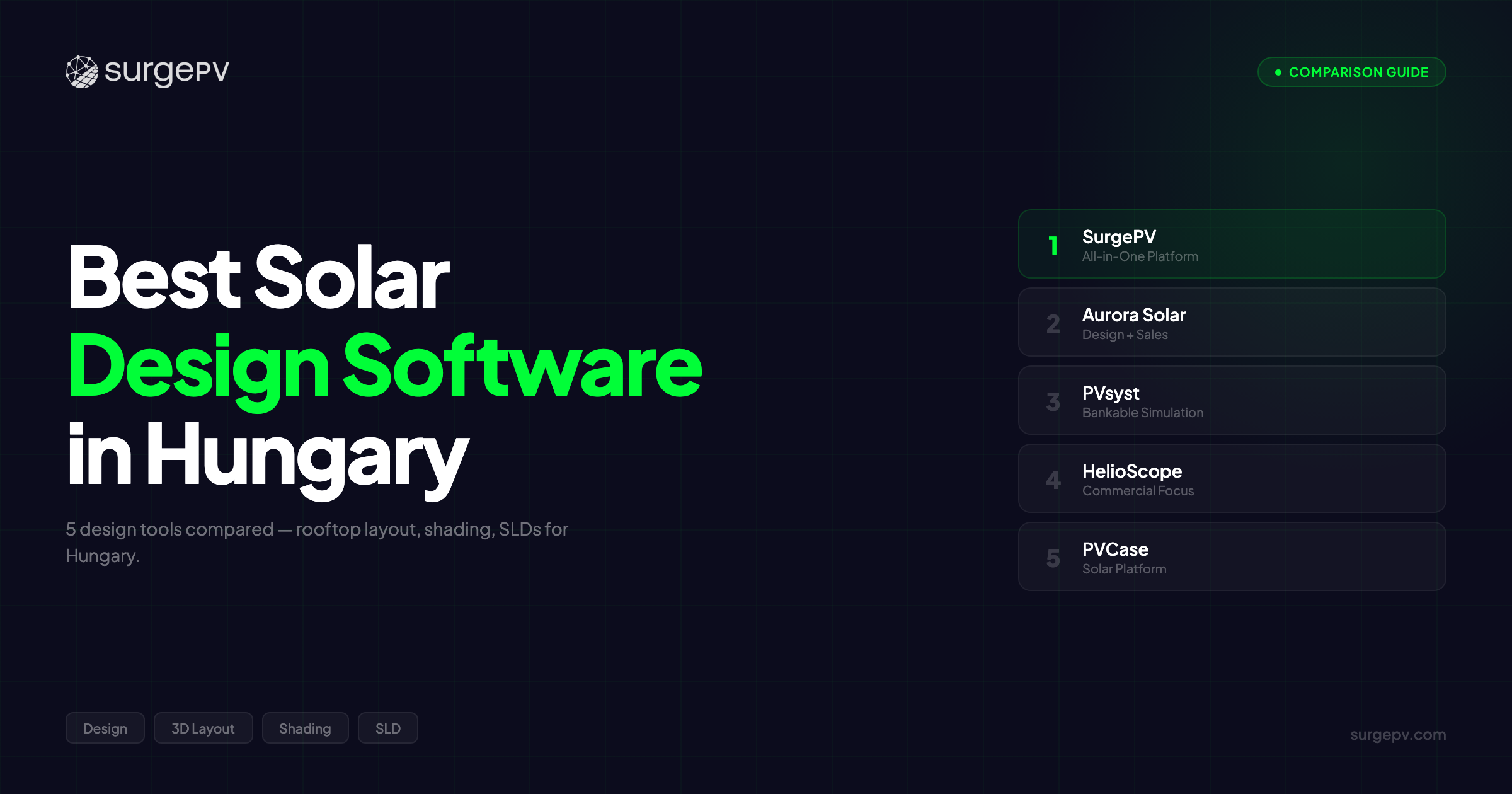
TL;DR: SurgePV is the best overall solar design software for Hungary in 2026 — automated SLD generation for MAVIR compliance, P50/P90 bankable simulations, and proposals in one platform at $1,899/year for 3 users. Aurora Solar leads for residential proposals. PVsyst is the simulation gold standard for METAR auctions. HelioScope suits commercial C&I. PVCase handles utility-scale ground-mount.
Hungary’s solar market is surging. 71% capacity growth in a single year — pushing past 5.3 GW of installed PV by end of 2023 (SolarPower Europe Market Outlook 2024-2028). That’s among the fastest growth rates in Central Europe. And there’s no sign it’s slowing down.
But designing solar systems here gets complicated. MAVIR grid connection documentation. METAR premium auctions. SzEF net metering thresholds. OTEK building codes.
Most solar software tools were built for Western European or US markets — and they don’t account for any of this. The wrong choice costs you hours on every single project.
If you’re designing solar systems in Hungary, you need a platform that handles local grid compliance, produces bankable P50/P90 reports, and keeps costs under control.
We tested and compared the top 5 solar design platforms for the Hungarian market, evaluating each on regulatory compliance, simulation accuracy, electrical engineering capabilities, and pricing.
In this guide, you’ll learn:
- Which platform handles MAVIR/DSO grid connection documentation best
- How pricing compares across tools (from $1,899/year to over $5,800/year)
- Which software produces bankable reports accepted by Hungarian banks (MFB, OTP Bank)
- Our recommendation based on 500+ commercial projects across Europe
Quick Comparison Table
| Software | Best For | SLD Generation | P50/P90 Reports | Starting Price |
|---|---|---|---|---|
| SurgePV | All segments (residential + commercial + utility) | Yes (automated) | Yes (+/-3% vs PVsyst) | $1,899/yr (3 users) |
| Aurora Solar | Residential SzEF projects | No | P50 only | $3,600-6,000/yr |
| PVsyst | METAR simulation-only | No | Yes (gold standard) | $625-1,250/yr |
| HelioScope | Commercial C&I (50 kW-1 MW) | No | Limited | $2,400-4,800/yr |
| PVCase | Utility-scale ground-mount (>1 MW) | Yes (AutoCAD) | Via PVsyst | $3,800-5,800/yr |
Best Solar Design Software in Hungary (Detailed Reviews)
Pro Tip
The key differentiator for Hungarian projects isn’t simulation accuracy alone — it’s whether your software produces MAVIR/DSO-compliant SLDs automatically. Only SurgePV does this natively. Every other platform (except PVCase via AutoCAD) requires a separate CAD workflow, adding 2-3 hours and $2,000/year in tooling.
SurgePV — Best End-to-End Solar Design Platform for Hungary
Best For: EPCs and installers across all segments
Pricing: $1,899/year (3 users); $1,499/user/year (For 3 Users plan)
Onboarding: 2-3 weeks
SurgePV is an end-to-end solar design software that combines layout design, electrical engineering, bankable simulations, and proposal generation in a single cloud-based tool.
For the Hungarian market, that matters more than it might seem.
Most competing platforms force you to switch between 2-3 separate tools for a complete commercial project: design in one tool, export to AutoCAD for single line diagrams (SLDs), then run a separate simulation in PVsyst. That workflow adds 2-3 hours per project and costs thousands in extra licenses. SurgePV eliminates that entirely.
Key Features for Hungary
- Automated SLD generation — Creates code-compliant electrical schematics in 5-10 minutes, meeting MAVIR and DSO documentation requirements. Manual AutoCAD drafting takes 2-3 hours for the same output.
- P50/P75/P90 bankability metrics — Produces the production estimates Hungarian banks (MFB, OTP Bank) and METAR auction evaluators require. Accuracy within +/-3% of PVsyst. Your financing applications include the bankability data lenders actually require — not just optimistic P50 estimates that get rejected.
- 8760-hour shading analysis — Hour-by-hour simulation across the full year, critical for Hungary’s continental climate with variable seasonal irradiance.
- Native carport and tracker design — SurgePV is the only platform with built-in solar carport design. Single-axis and dual-axis tracker support included. With Hungary’s commercial carport installations growing, this is a competitive edge other platforms don’t offer.
- Financial modeling — Supports custom utility rate input, enabling SzEF net metering analysis with Hungary’s tiered pricing structure (36 HUF vs. 70 HUF/kWh).
- Wire sizing and voltage drop calculations — Instant automated calculations per IEC standards, eliminating manual spreadsheet work.
Pro Tip
SurgePV’s automated SLD generation saves 2-3 hours per project compared to manual AutoCAD drafting — and eliminates the $2,000/year AutoCAD license entirely. Book a demo to see it in action.
Pricing
| Plan | Price | Users |
|---|---|---|
| Individual | $1,899/year | 3 users |
| For 3 Users | $1,499/user/year | 3 users |
| For 5 Users | $1,299/user/year | 5 users |
| Enterprise | Custom | Multiple |
All features included on every plan. No hidden fees, no feature gating. See full pricing.
Who SurgePV Is Best for in Hungary
- Commercial EPCs handling 50 kW-10 MW projects needing MAVIR-compliant SLDs
- Residential installers who want design, engineering, and proposals in one tool
- Companies bidding on METAR auctions needing bankable P50/P90 reports
- Teams looking to eliminate AutoCAD dependency and reduce per-project costs
Limitations
- English interface (no Hungarian localization yet)
- Hungarian DSO utility rates require manual input (not pre-loaded)
Real-World Example
A mid-size EPC team in Budapest was spending 2.5 hours per project creating SLDs in AutoCAD. After switching to SurgePV, SLD generation dropped to under 10 minutes. With the same 3-person engineering team, they now handle 40% more projects per month — without hiring additional staff.
Further Reading
For a broader comparison beyond the Hungarian market, see our guide to the best solar design software globally. For SLD generation compared across platforms, see best solar electrical design software. For a full simulation analysis, read our PVsyst review.
SurgePV launched more recently than Aurora or PVsyst — but it has already powered 70,000+ projects globally. The platform was built for the workflow gaps that legacy tools leave open, especially automated electrical engineering, which no other platform offers natively.
Aurora Solar — Best for Hungarian Residential Installers
Best For: Residential installers focused on sub-50 kW SzEF projects
Pricing: $3,600-6,000/year
Aurora Solar is best known for its AI-powered roof modeling and polished sales proposals. It’s the industry leader in the US residential market, and its design tools are strong for rooftop solar layout.
What Works for Hungary
- Industry-leading automatic 3D roof detection speeds up residential design
- Beautiful, client-facing proposals help close deals in the competitive Hungarian residential market
- CRM integrations (Salesforce, HubSpot) streamline sales workflows
Where It Falls Short in Hungary
- No integrated SLD generation — Commercial EPCs needing MAVIR/DSO electrical documentation will need AutoCAD ($2,000/year) as a separate tool
- No carport or tracker design — Limited for Hungary’s utility-scale and commercial segments
- US-centric pricing — $3,600-6,000/year is steep for Central European budgets
- P50 only — No P75/P90 metrics, which Hungarian banks and METAR evaluators typically expect
Best for: Residential installers focused on sub-50 kW SzEF projects who prioritize sales proposals over engineering depth.
For a deeper analysis, read our full Aurora Solar review.
PVsyst — Simulation Gold Standard for METAR Auctions
Best For: Engineers and developers focused on utility-scale METAR projects
Pricing: CHF 600-1,200/year (~$625-1,250/year) plus AutoCAD ~$2,000/year for a complete workflow
PVsyst is the industry reference for bankable energy production estimates. If you’re bidding on a METAR auction or seeking project financing from Hungarian banks, PVsyst reports carry unmatched credibility with evaluators.
What Works for Hungary
- Universally accepted by MFB, OTP Bank, and METAR auction committees
- Detailed loss modeling (temperature, soiling, mismatch, inverter efficiency)
- P50/P90 reports are the gold standard for project financing
- Meteonorm integration includes Hungarian weather data
Where It Falls Short in Hungary
- Not a design platform — PVsyst is simulation-only. You’ll need a separate tool for layout design
- No SLD generation — Electrical documentation requires external CAD tools
- No proposal generation — Cannot produce client-facing sales documents
- Desktop-only — No cloud collaboration, limiting team workflows
Best for: Engineers and developers focused on utility-scale METAR projects where bankable simulations are the primary requirement.
Read our full PVsyst review for a detailed breakdown.
Did You Know?
Hungary’s 2030 National Energy and Climate Plan targets 12 GW of total solar capacity — more than double the current 5.3 GW installed base (IEA PVPS Hungary National Survey).
HelioScope — Fast Commercial Solar Design for Hungary
Best For: Commercial EPCs designing 50 kW-1 MW rooftop systems
Pricing: $2,400-4,800/year
HelioScope is a cloud-based design platform focused on commercial and industrial (C&I) solar projects. Its browser-based tools make it fast to learn and fast to use for mid-scale rooftop work.
What Works for Hungary
- Fast commercial rooftop design in a browser-based interface
- Integrated simulation with credible production estimates
- Supports international locations, including Hungarian weather data
- Team collaboration through cloud-based project sharing
Where It Falls Short in Hungary
- No SLD generation — Like Aurora, commercial projects requiring MAVIR/DSO electrical documentation need external tools
- Limited residential features — Not optimized for the high-volume SzEF residential segment
- Contact-for-pricing model — Typically $2,400-4,800/year, but pricing isn’t transparent upfront
Best for: Commercial EPCs designing 50 kW-1 MW rooftop systems in Hungary who prioritize speed over electrical engineering depth.
See our full HelioScope review for more details.
PVCase — Utility-Scale Design for Hungarian METAR Projects
Best For: Utility-scale EPCs designing over 1 MW ground-mount projects
Pricing: $3,800-5,800/year (PVCase + AutoCAD)
Onboarding: 6-8 weeks
PVCase is an AutoCAD plugin built for utility-scale solar design. Its terrain modeling, grading tools, and tracker layout capabilities make it the go-to for large ground-mount projects.
What Works for Hungary
- Excellent terrain modeling for Hungarian ground-mount projects
- Strong electrical documentation (cable schedules, protection schemes) for MAVIR grid applications
- BIM integration with Revit and Civil 3D
- Optimized for projects over 1 MW — the dominant segment in Hungary (45% of installed capacity)
Where It Falls Short in Hungary
- Requires AutoCAD — $2,000/year license plus PVCase license ($2,000-4,000/year) means total costs of $3,800-5,800/year
- 6-8 week onboarding — Steep learning curve requiring CAD expertise
- No proposal generation — Cannot create client-facing sales documents
- Overkill for residential/small commercial — Not practical for sub-500 kW projects
Best for: Utility-scale EPCs designing over 1 MW ground-mount projects for METAR auctions.
Read our full PVCase review for a detailed analysis.
Comprehensive Comparison: All Features
| Feature | SurgePV | Aurora Solar | PVsyst | HelioScope | PVCase |
|---|---|---|---|---|---|
| Best for | All segments | Residential | Simulation | Commercial | Utility-scale |
| SLD generation | Yes (automated) | No | No | No | Yes (AutoCAD) |
| P50/P90 reports | Yes | P50 only | Yes (gold standard) | Limited | Via PVsyst |
| Carport design | Yes (only platform) | No | No | No | No |
| Tracker support | Yes | No | Simulation only | Limited | Yes |
| Proposal generation | Yes | Yes | No | Basic | No |
| Cloud-based | Yes | Yes | No (desktop) | Yes | No (AutoCAD) |
| Wire sizing | Yes (automated) | No | No | No | AutoCAD-based |
| Pricing/year | $1,899 (3 users) | $3,600-6,000 | $625-1,250 | $2,400-4,800 | $3,800-5,800 |
| Onboarding | 2-3 weeks | 4-6 weeks | 4-6 weeks | 2-3 weeks | 6-8 weeks |
Further Reading
For a broader comparison beyond the Hungarian market, see our guide to the best solar design software globally.
Why Most Solar Design Tools Fail in Hungary
MAVIR/DSO Grid Connection Compliance
Every solar installation in Hungary connects through either MAVIR (the TSO, for utility-scale) or a regional DSO (for commercial and residential). Grid connection applications require technical documentation — including single line diagrams, protection schemes, and inverter specifications (MAVIR Grid Connection Guidelines). Software that generates SLDs automatically — like SurgePV — saves 2-3 hours per project compared to manual AutoCAD drafting. For systems above 500 kW, DSOs require formal grid impact studies.
Bankability for METAR Auctions and Project Financing
METAR is Hungary’s renewable energy premium system. Projects above 1 MW compete in annual auctions for 15-year premium contracts (MEKH Official Guidelines). Winning bids require bankable feasibility studies with IEC-compliant simulations.
Hungarian banks — including MFB and OTP Bank — expect P50/P90 production estimates for financing approvals. PVsyst is universally accepted. SurgePV’s simulations achieve +/-3% accuracy compared to PVsyst.
SzEF Net Metering Optimization
Hungary’s SzEF scheme provides net metering for systems up to 50 kW. The settlement period is annual, and compensation runs at 100% of the retail electricity price — one of the most favorable net metering structures in the EU. Your design software should model self-consumption versus export ratios accurately and help size systems to maximize savings without exceeding the 50 kW threshold.
Hungarian Building Code (OTEK) Compliance
Rooftop installations must comply with OTEK structural requirements — including snow load and wind load calculations specific to Hungary’s continental climate. Design software should produce accurate bill of materials with load specifications for structural engineer approval.
Tiered Pricing and Demand Charge Modeling
Hungarian residential electricity follows a tiered structure: 36 HUF/kWh below 210 kWh/month (subsidized) and 70 HUF/kWh above that threshold (MEKH Tariff Database). Commercial rates range from 45-65 HUF/kWh with demand charges for larger connections. Design software with integrated financial modeling can calculate savings across these tiers accurately.
Weather Data and Snow Loss Modeling
Hungary’s continental climate means hot summers and cold, sometimes snowy winters. Annual irradiance varies significantly by region (1,200-1,400 kWh/m2). Your simulation tool needs accurate local weather data — ideally from Meteonorm or PVGIS — and should account for snow cover losses during winter months.
Which Software Is Right for Your Use Case?
Choosing solar design software depends on your business model, project types, and team size.
| Your Use Case | Best Software | Why | Alternative |
|---|---|---|---|
| Multi-segment EPC (residential + commercial + utility) | SurgePV | End-to-end platform covers all project types, automated SLD generation, P50/P90 bankability, proposals — no tool-switching | PVsyst + AutoCAD (higher cost, longer workflow) |
| Residential-only installer (50+ projects/year) | SurgePV or Aurora | SurgePV: Complete workflow at $1,899/year. Aurora: Best-in-class proposals but $3,600-6,000/year | OpenSolar for budget-conscious teams |
| Commercial C&I specialist (50 kW-1 MW) | SurgePV or HelioScope | SurgePV: Automated SLDs save 2-3 hrs/project. HelioScope: Fast cloud design but requires external CAD | PVsyst + design tool of choice |
| Utility-scale developer (1 MW+ ground-mount) | PVCase or RatedPower | Deep terrain modeling, tracker optimization, civil engineering integration | SurgePV for mixed portfolio (utility + commercial) |
| Engineering firm (simulation-only, no sales) | PVsyst | Gold standard bankability, universally accepted by lenders, deepest technical simulation | SurgePV if you want design + simulation in one tool |
| Startup installer (under 30 projects/year) | OpenSolar or SurgePV | OpenSolar: Lower cost entry point. SurgePV: Better engineering but higher upfront cost | Free tools (PVWatts, SolarEdge Designer) + outsourced engineering |
| Projects requiring bank financing | PVsyst or SurgePV | P50/P90 bankability reports accepted by lenders. PVsyst = universal acceptance, SurgePV = growing acceptance | HelioScope (some lenders, not all) |
Decision Shortcut
If you need electrical engineering (SLDs, wire sizing, code compliance), SurgePV is the only platform that automates this natively. If you’re simulation-only, PVsyst is the gold standard. If you’re residential-focused and need polished client proposals, Aurora’s output is excellent — but the price reflects it.
Design Solar Projects Faster with SurgePV
Complete design-to-proposal workflows with automated electrical engineering and bankable simulations for Hungarian projects.
Book a DemoNo commitment required · 20 minutes · Live project walkthrough
Our Testing Methodology
We evaluated each platform against five weighted criteria specific to the Hungarian market:
- Accuracy and simulation depth (30%) — P50/P90 capabilities, shading analysis precision, loss modeling
- Ease of use (25%) — Onboarding time, interface design, learning curve
- Hungary applicability (20%) — MAVIR/DSO compliance, SzEF modeling, METAR support, local weather data
- Feature depth (15%) — SLD generation, wire sizing, carport/tracker design, proposal tools
- Pricing value (10%) — Annual cost relative to feature set, team size scalability
Testing was conducted between January and February 2026, using real Hungarian project data and regulatory documentation from MEKH and MAVIR.
Transparency Note
SurgePV publishes this content. We are transparent about this relationship. This comparison acknowledges PVsyst as the undisputed gold standard for bankable simulation in Hungary. We do not claim SurgePV replaces PVsyst for METAR institutional financing. We present SurgePV as a complete operational platform with near-PVsyst accuracy plus design, electrical, and proposals in one workflow. See our editorial standards.
Bottom Line: Best Solar Design Software for Hungary
Hungary’s solar market is growing fast — but the regulatory environment (MAVIR, METAR, SzEF, OTEK) makes software selection more consequential than in simpler markets.
For commercial EPCs and multi-segment teams: SurgePV delivers the most complete workflow. Automated SLD generation for MAVIR compliance, P50/P90 simulations for METAR auctions, and integrated proposals for SzEF residential projects — all in one platform at $1,899/year for 3 users.
For residential-only installers: Aurora Solar offers the best proposal design for high-volume SzEF projects, but budget-conscious teams should weigh the $3,600-6,000/year cost against the value.
For simulation-only needs: PVsyst remains the bankability gold standard, especially for METAR auction submissions. Pair it with SurgePV or AutoCAD for a complete design workflow.
For utility-scale specialists: PVCase plus AutoCAD delivers the deepest terrain modeling for large ground-mount projects, though the $3,800-5,800/year cost and 6-8 week onboarding are significant commitments.
The EPCs winning projects in Hungary today produce MAVIR-compliant documentation and bankable simulations faster than their competitors — not the ones still drafting SLDs by hand in AutoCAD. Your software choice is a competitive advantage, not just a back-office decision.
Want to see how SurgePV handles Hungarian project workflows? Book a demo and our team will walk you through a project using your actual site data. Compare pricing — transparent rates, all features included.
Further Reading
For an EPC-focused platform comparison, see best bankable solar simulation software. For a full simulation comparison, see our Aurora Solar review.
When You May Not Need Advanced Solar Software
Professional solar design platforms deliver significant value — but they are not always necessary.
Small residential installers with outsourced engineering
If you install 20-50 residential systems per year and outsource electrical engineering to a third party, paying for full design software may not make sense. Basic tools like PVWatts or manufacturer design apps combined with an external engineering firm (500-1,000 EUR per project) can be more cost-effective than a $1,899-6,000/year software subscription.
Installers using manufacturer-provided designs
Some installers work exclusively with solar distributors who provide turnkey system designs as part of their supply agreements. If your supplier handles layout, electrical documentation, and permit drawings at no extra cost, standalone design software may be redundant.
Service and maintenance-focused companies
If your business focuses on O&M, monitoring, and system maintenance rather than new installations, full design software is overkill. Monitoring platform dashboards and basic electrical schematics are typically sufficient for service work.
Very small projects under 5 kW
For tiny residential systems (1-5 kW), manual calculations and manufacturer spec sheets often suffice. The 2-3 hours saved per project with professional software may not justify the investment if you’re only installing 10-20 micro-systems per year.
When project volume is too low
Design software ROI depends on volume. If you’re completing fewer than 20-30 projects annually, the time savings (2-3 hours per project) may not offset subscription costs. Calculate your break-even point: annual software cost divided by hours saved per project multiplied by hourly labor cost.
Bottom Line on Software ROI
Professional design software makes sense when you’re designing 30+ projects per year, handling commercial/utility-scale work, or need to produce bankable simulations for financing. For smaller operators or niche service businesses, simpler tools may be the better choice.
Frequently Asked Questions
What is the best solar design software in Hungary?
SurgePV is the best overall solar design software for Hungary in 2026. It combines design, automated SLD generation (meeting MAVIR/DSO requirements), P50/P90 bankable simulations, and proposal tools in one cloud-based platform at $1,899/year for 3 users. For simulation-only needs, PVsyst remains the bankability standard.
Is solar design software required by Hungarian law?
Not explicitly. However, MAVIR and regional DSOs require detailed technical documentation — including single line diagrams, protection schemes, and inverter specifications — for grid connection approval. Design software that generates these outputs automatically streamlines the permitting process considerably.
Which solar software do Hungarian EPCs use?
Hungarian EPCs use a mix of tools depending on project scale. SurgePV covers all segments (residential, commercial, utility-scale). PVsyst is standard for bankable simulations on METAR projects. HelioScope is popular for commercial C&I design. PVCase combined with AutoCAD handles utility-scale ground-mount work.
What software is accepted for METAR auction applications?
METAR auctions require bankable P50/P90 production estimates. Solar simulation software like PVsyst produces reports that are universally accepted. SurgePV simulations (+/-3% accuracy versus PVsyst) are increasingly accepted by Hungarian evaluators. HelioScope reports are accepted by some, but not all, auction committees.
How much does solar design software cost in Hungary?
Costs range from $625/year (PVsyst standalone) to $5,800/year (PVCase plus AutoCAD). SurgePV starts at $1,899/year for 3 users with all features included. Aurora Solar costs $3,600-6,000/year. Consider total cost of ownership — tools without SLD generation often require an additional $2,000/year AutoCAD license.
Does SzEF net metering require special design software?
Not specifically, but solar proposal software with financial modeling capabilities simplifies SzEF system design. The 50 kW threshold, annual settlement period, and 100% retail rate compensation all affect system sizing decisions. SurgePV and Aurora Solar both support custom rate modeling for SzEF analysis.
What is the METAR premium system in Hungary?
METAR is Hungary’s market-based renewable energy support scheme. Projects above 1 MW compete in annual auctions for 15-year sliding premium contracts on top of the wholesale electricity price. Recent auctions have awarded premiums averaging approximately 35 EUR/MWh. Bankable P50/P90 simulations are required for auction participation.
Can solar design software handle Hungarian grid connection requirements?
Yes — tools with automated SLD generation produce the electrical documentation MAVIR and DSOs require. SurgePV generates permit-ready SLDs in 5-10 minutes. For systems above 500 kW, additional grid impact studies may be needed regardless of software choice.
Important
All pricing data in this article was verified against official sources as of February 2026. Prices may have changed since publication.
Sources
- SolarPower Europe EU Market Outlook 2024-2028 — Market data and growth projections
- IEA PVPS Hungary National Survey Report — Installed capacity and policy data
- MEKH (Hungarian Energy Regulatory Authority) — Regulatory guidelines and tariff data
- MAVIR Grid Connection Guidelines — Technical requirements for grid connection
- Hungarian Energy Office — METAR Guidelines — Auction rules and premium structure
- MEKH Electricity Tariff Database — Residential and commercial electricity pricing
- GlobalPetrolPrices Hungary — Electricity price data
- SurgePV Product Documentation — Official feature specifications (accessed February 2026)