

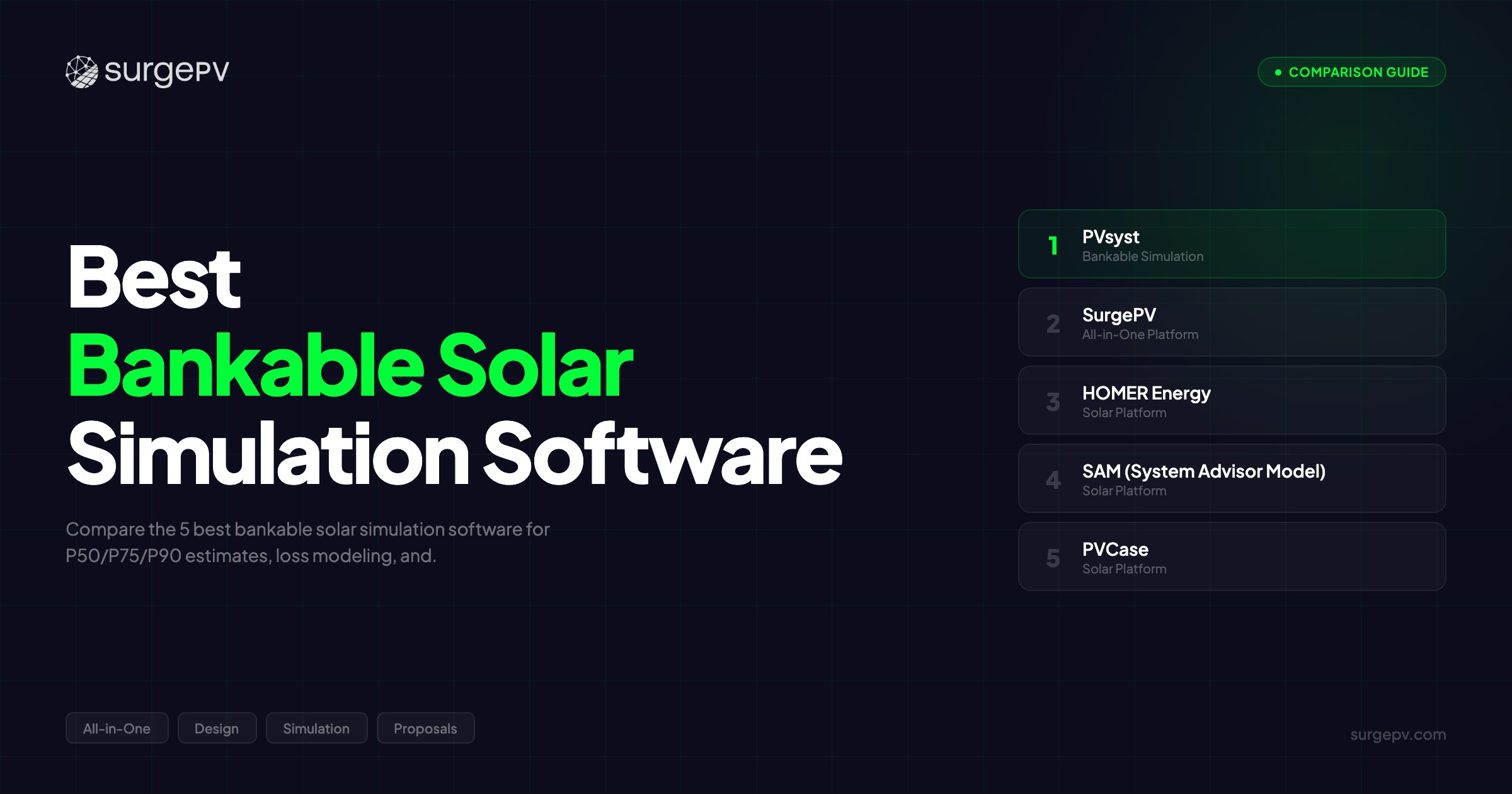
TL;DR: PVsyst is the undisputed gold standard for bankable solar simulation — universally accepted by every bank and institutional investor. SurgePV delivers P50/P75/P90 within +/-3% of PVsyst accuracy inside an integrated design platform, making it the practical choice for commercial-scale (100 kW-10 MW) workflows. HOMER Energy owns the hybrid/microgrid niche. SAM is free with NREL credibility. PVCase provides layout-aware preliminary estimates but needs PVsyst for final bankability.
No simulation, no financing. That is the reality for every solar project above 1 MW. The bankable solar simulation software you choose determines whether your production estimates survive due diligence or get sent back for revision.
Banks and investors finance solar projects against conservative production estimates, typically P75 or P90. They need confidence that your energy yield assessment accounts for every loss — soiling, temperature, mismatch, clipping, degradation, availability, and a dozen more.
PVsyst has been the unchallenged standard for bankable simulation for over two decades. But the market is evolving. Today, solar EPCs face a choice: use PVsyst as a standalone validation tool (excellent simulation, but no design or electrical) or adopt platforms like SurgePV that provide P50/P75/P90 estimates within +/-3% of PVsyst accuracy plus integrated design, electrical engineering, and proposals.
For commercial-scale projects (100 kW-10 MW), the “bankable simulation within an operational platform” approach is gaining financer acceptance.
After delivering 1+ GW of solar projects at Heaven Green Energy — including hundreds of bankable production reports for commercial and utility-scale financing — I tested every major simulation platform against real-world production data across 20+ solar tools. Here is what each tool delivers for bankability.
In this guide, you’ll find:
- 5 simulation tools compared on P50/P75/P90 accuracy, loss modeling, and financer acceptance
- The 5 pillars of bankable simulation and which tools meet each requirement
- PVsyst vs alternatives: when you MUST use PVsyst and when integrated tools are sufficient
- Loss modeling depth comparison (8 to 25+ categories per tool)
- Total cost of ownership for bankable simulation workflows
Quick Comparison Table
| Software | Best For | Financer Acceptance | Key Limitation | Starting Price |
|---|---|---|---|---|
| PVsyst | Universal bankability (gold standard) | Universal — every bank, DFI, investor | NOT a design platform. Simulation only. | ~$1,300 one-time |
| SurgePV | Bankable accuracy + integrated design (100 kW-10 MW) | Growing — commercial-scale financiers | Not universally accepted at utility-scale (>10 MW) | $1,899/yr (3 users) |
| HOMER Energy | Hybrid/microgrid bankability (solar + storage) | Accepted for hybrid/microgrid projects | Not standard for standalone PV bankability | $3,000-10,000+ |
| SAM (NREL) | Free simulation with government credibility | US government/academic projects | Not universally accepted internationally | Free |
| PVCase | Layout-aware simulation for utility-scale | Preliminary — needs PVsyst validation | Not standalone bankability tool | ~$3,000+/yr (w/AutoCAD) |
Did You Know?
According to NREL, the gap between P50 and P90 estimates typically represents 10-15% of total production for a well-characterized site. On a 5 MW project generating $500,000/year in revenue, that gap translates to $50,000-75,000 in annual uncertainty. The simulation tool you choose determines how accurately you quantify that gap — and whether your financier trusts the number.
What Makes Solar Simulation “Bankable”
Before comparing tools, you need to understand what “bankable” actually means. A simulation is not bankable just because it is accurate. It is bankable when financial institutions trust it enough to base lending decisions on its results.
The 5 Pillars of Bankability
1. Probabilistic energy estimates (P50/P75/P90)
P50 is the median estimate — 50% chance of exceeding this production level. P75 is the conservative estimate that most banks use to size debt. P90 is the worst-case scenario used for debt service coverage ratios (DSCR). Tools providing only P50 (like Aurora Solar) leave EPCs without the metrics banks actually use to decide how much money to lend.
P50/P75/P90 Explained
P50 = “We expect this much energy 50% of the time” (median). P75 = “We expect this much 75% of the time” (most banks size debt here). P90 = “We expect this much 90% of the time” (worst-case for DSCR). If your simulation tool only provides P50, you are missing the numbers banks use to decide your loan.
2. IEC-compliant methodology
Financial institutions need confidence that simulation methodology meets international standards. IEC 61724 (PV performance monitoring), IEC 61853 (module performance testing), and IEC 62446 (grid-connected PV systems) provide that framework.
3. Detailed loss modeling
Banks require understanding of ALL production losses. Simulations that miss loss categories overestimate production, leading to underperforming projects and loan defaults. The most critical losses: soiling, temperature coefficient, mismatch, inverter clipping, cable losses (DC/AC), transformer losses, availability, grid curtailment, and annual degradation.
4. Uncertainty analysis
Financiers need to understand confidence intervals around energy estimates. Weather data uncertainty, model uncertainty, and component uncertainty all widen the gap between P50 and P90. Higher uncertainty means more conservative debt sizing.
5. Professional report format
A brilliant simulation buried in an unreadable export will not pass due diligence. Bankable reports need detailed methodology sections, loss breakdowns, weather data sources, component specifications, and all assumptions documented.
Best Bankable Solar Simulation Software (Detailed Reviews)
Pro Tip
Here’s the truth about PVsyst: it is the undisputed gold standard for bankability. This article does not claim any tool is “better” than PVsyst for pure simulation. What we DO show is when you need PVsyst-level bankability (utility-scale, institutional finance) versus when near-PVsyst accuracy within an operational platform (SurgePV, +/-3%) is the smarter choice for commercial-scale workflows.
PVsyst — The Undisputed Gold Standard
Best For: Universal bankability — utility-scale financing, independent engineer validation, institutional due diligence
Pricing: CHF 1,200 ($1,300 USD) one-time + ~$200/year maintenance
PVsyst is the most trusted solar simulation software in the world. Developed in Geneva, Switzerland, PVsyst has been the industry standard for bankable energy yield assessments for over 25 years. Virtually every bank, development finance institution, and institutional investor accepts PVsyst reports as the basis for project financing decisions. That authority is earned.
What Makes PVsyst the Standard
- P50/P75/P90/P99 probabilistic estimates — Full exceedance probability analysis with configurable uncertainty parameters. Separate weather, model, and component uncertainty. The deepest probabilistic modeling available.
- 25+ loss categories (most detailed available) — Soiling (monthly profiles), temperature coefficient, mismatch, inverter clipping, MPPT tracking, DC cable losses, AC cable losses, transformer losses, availability/downtime, annual degradation, snow, bifacial gain, spectral losses, IAM (Incidence Angle Modifier), LID, PID, grid curtailment, and auxiliary power consumption. No other tool models this many loss sources.
On a 10 MW project, the difference between modeling 10 loss categories and 25+ can be 3-5% of total production — worth $150,000-250,000 per year in revenue accuracy.
- Weather data integration — Meteonorm, SolarGIS, PVGIS, NREL TMY3, NASA, and site-specific measured data import with inter-annual variability analysis.
- IEC compliance — IEC 61724, IEC 61853, IEC 62446 methodology. Reports formatted for international financer requirements.
- 8760-hour simulation — Hour-by-hour production modeling across a full year.
Where PVsyst Falls Short
- NOT a design platform — PVsyst simulates energy production. It cannot create module layouts, optimize row spacing, configure trackers, or route electrical infrastructure. You need a separate design tool first.
- No electrical engineering — No SLD generation, no wire sizing, no protection scheme design. Separate tools required.
- Desktop-only — No cloud access, no team collaboration. Licensed to a single workstation.
- 4-6 week learning curve — Steep onboarding. The interface reflects two decades of development, not modern UX.
- No proposals — No client-facing report generation. You get simulation data, not deliverables.
Bottom line: If your financier says “We need PVsyst,” there is no substitute. PVsyst’s universal acceptance is its defining advantage. But it is simulation-only — budget for separate design, electrical, and proposal tools. Read our full PVsyst review.
SurgePV — Bankable Accuracy Within an Operational Design Platform
Best For: Commercial EPCs (100 kW-10 MW) needing bankable simulation integrated with design + electrical + proposals
Pricing: $1,899/year (3 users); $1,499/user/year (For 3 Users plan)
Onboarding: 2-3 weeks
SurgePV provides P50/P75/P90 production estimates within +/-3% of PVsyst accuracy — but unlike PVsyst, it is a complete operational platform: design, electrical engineering, bankable simulation, and proposals in one workflow.
For commercial-scale projects where PVsyst is preferred but not mandatory, SurgePV eliminates the need for separate simulation + design + electrical tools. The simulation is only one part of the financing package. Lenders also need electrical documentation, system design validation, and financial projections. PVsyst gives you the simulation. SurgePV gives you the simulation plus everything else in one platform.
Key Bankability Features
- P50/P75/P90 production estimates — Full probabilistic energy yield with +/-3% accuracy versus PVsyst. For a 2 MW commercial project, SurgePV’s P75 estimate will be within 30-60 MWh of PVsyst’s P75 — a margin that falls well within standard financing uncertainty bands. Aurora Solar provides only P50 (no P75/P90) — a significant gap for financed projects.
- 8760-hour shading analysis — Industry-standard hourly simulation methodology. Shading accuracy within +/-3% of PVsyst.
- 12-15 loss categories — Soiling, temperature, mismatch, inverter clipping, DC/AC cable losses, availability, degradation, and more. Covers 95%+ of typical commercial project losses. For the losses that matter most on commercial-scale projects, SurgePV captures the same production reduction PVsyst does — the remaining 5% (spectral, LID, PID) has minimal impact at commercial scale.
- Integrated design + simulation — Simulation runs on the actual design. Change the layout, and simulation updates automatically. No file export/import between separate tools.
- Automated SLD generation — 5-10 minutes versus 2-3 hours in AutoCAD. NEC Article 690 and IEC compliant. PVsyst, HOMER, and SAM cannot generate SLDs.
- Wire sizing and voltage drop analysis — Automated calculations directly from the design. No spreadsheets.
- Financial modeling — Cash, loan, lease, PPA scenario analysis with ROI calculations. Professional web-based proposals embedding bankable estimates.
- 98% BOM accuracy — Material lists that match what actually gets installed.
Real-World Example
A commercial EPC managing a portfolio of 2-5 MW ground-mount projects was using Aurora Solar for design and PVsyst for bankable simulation — requiring two separate tools, file export/import between platforms, and 2-4 additional hours per project for PVsyst setup and analysis. After switching to SurgePV, the same bankable P50/P75/P90 estimates are generated within the design workflow. The team eliminated the PVsyst step for 80% of their commercial projects (where financiers accepted SurgePV’s IEC-compliant estimates) and reserved PVsyst only for the 20% requiring institutional-grade validation. Result: 2-4 hours saved per project, $1,300 PVsyst license shared across fewer projects, and complete design-to-proposal delivery same-day.
Pricing
| Plan | Price | Users |
|---|---|---|
| Individual | $1,899/year | 3 users |
| For 3 Users | $1,499/user/year | 3 users |
| For 5 Users | $1,299/user/year | 5 users |
| Enterprise | Custom | Multiple |
All features included on every plan — design, electrical, simulation, and proposals. See full pricing.
Who SurgePV Is Best For
- Commercial EPCs (100 kW-10 MW) where P50/P75/P90 at +/-3% accuracy satisfies financier requirements
- Design-build firms delivering financed projects with integrated proposals
- Teams wanting bankable simulation without maintaining separate PVsyst + design tool stacks
- Projects where speed matters: same-day bankable design + simulation + proposal delivery
Limitations
- Not universally accepted by all financiers (PVsyst still preferred for >10 MW utility-scale)
- Less detailed loss modeling than PVsyst (12-15 vs 25+ categories)
- No P99 estimate (PVsyst provides P99)
- For large project financing, PVsyst validation may still be required
- Newer platform with growing — not universal — financer acceptance
Further Reading
For a broader simulation comparison beyond bankability, see our guide to the best solar simulation software. For electrical design tools, see best solar electrical design software. For a deep dive on PVsyst, read our full PVsyst review.
You might be thinking: “PVsyst is the only option that financiers accept.” For utility-scale institutional financing above 10 MW, that is mostly true. But for the majority of commercial-scale projects (100 kW-10 MW), the financing market is more flexible than most EPCs assume. Many commercial-scale lenders accept IEC-compliant P50/P75/P90 estimates from reputable platforms — they care about the methodology and accuracy, not the specific software brand.
SurgePV does not claim to match PVsyst in every dimension. PVsyst models 25+ loss categories; SurgePV models 12-15. PVsyst provides P99; SurgePV stops at P90. PVsyst has 25 years of financer trust; SurgePV is building it. But for the loss categories that account for 95%+ of total production reduction in typical commercial projects, SurgePV’s output aligns within +/-3% — and you get design, electrical, and proposals in the same platform.
HOMER Energy — Bankability for Hybrid and Microgrid Systems
Best For: Projects combining solar with storage, diesel, wind, or other generation
Pricing: $3,000-10,000+ per license (varies by product tier)
HOMER Energy (originally developed at NREL) is the industry standard for modeling hybrid energy systems. If your project combines solar PV with battery storage, diesel backup, wind, fuel cells, or other distributed energy resources, HOMER provides bankable optimization that pure solar simulation tools cannot match.
What Works
- Industry standard for microgrid and hybrid system bankability
- NREL origin provides strong research credibility
- Multi-technology optimization (solar, wind, batteries, diesel, fuel cells) — finds lowest cost of energy across technology combinations
- Sensitivity analysis across multiple variables simultaneously
- Both grid-connected and off-grid architectures
Where It Falls Short for Pure Solar
- Not the industry standard for standalone PV bankability (PVsyst preferred)
- Less detailed PV-specific loss modeling than PVsyst (8-10 categories versus 25+)
- No design tools — simulation and optimization only
- Interface designed for energy system engineers — steeper learning curve than necessary for solar-only
- No electrical engineering, no proposals
Best for: Developers building solar + storage projects, microgrid engineers, island/remote power systems, C&I projects with load management requirements. Not the right tool for standalone solar PV bankability. Read our full HOMER Energy review.
SAM (System Advisor Model) — Free Simulation with Government Credibility
Best For: US-based projects, academic research, budget-constrained teams
Pricing: Free (open-source, developed by NREL)
SAM is a free, open-source simulation tool developed by the National Renewable Energy Laboratory. Backed by the US Department of Energy, SAM carries strong credibility for US government, academic, and research-oriented projects. It provides the most detailed financial modeling of any free tool.
What Works
- Free — No license cost. Open-source with community contributions.
- NREL/DOE backing — Strong credibility for US government and academic projects
- Detailed financial modeling — PPA, residential, commercial, utility, and community solar financial models. Monte Carlo-based parametric uncertainty analysis.
- Detailed PV simulation — 8760-hour simulation with 15-18 loss categories
- NREL weather data — NSRDB, TMY3 integration for US locations
Where It Falls Short
- Not universally accepted by international financiers (PVsyst preferred globally for non-US projects)
- US-focused weather data — NSRDB coverage strongest for North America. International coverage less accurate than Meteonorm or SolarGIS (PVsyst sources).
- Desktop-only — Windows, Mac, Linux. No cloud, no collaboration.
- 6-8 week learning curve for advanced features
- No design tools, no electrical engineering, no proposals
- Slower development cycle than commercial alternatives
Best for: US-based projects with government or academic involvement. Developers needing detailed financial modeling at zero software cost. Research institutions. Read our full SAM review.
PVCase — Layout-Aware Simulation for Utility-Scale
Best For: Utility-scale developers using PVCase for CAD-based plant design
Pricing: ~$990/year (PVCase) + $2,000/year (AutoCAD) + ~$1,300 (PVsyst for validation) = ~$4,300+/user
PVCase provides energy yield simulation integrated with its CAD-based plant design tools. The simulation accounts for actual layout geometry and terrain — a practical advantage for utility-scale projects where layout-specific shading and row interaction matter.
What Works
- Simulation based on actual CAD layout (terrain-aware, geometry-accurate)
- Integrated with plant design workflow — no export to separate simulation tool for preliminary estimates
- P50/P75/P90 estimates in recent versions
- Good preliminary energy yield for feasibility studies and design iteration
Where It Falls Short
- Not accepted as standalone bankability tool — Most financiers still require PVsyst validation for final reports. PVCase simulation is a design aid, not a financing deliverable.
- Less detailed loss modeling than PVsyst (10-12 categories versus 25+)
- Requires AutoCAD ($2,000/year) and CAD expertise
- Desktop-only, 6-8 week onboarding
- No proposals, limited financial modeling depth
Best for: Utility-scale developers already using PVCase for plant design who want preliminary simulation before PVsyst validation. Not a standalone bankability solution. Read our full PVCase review.
Which Tool Is Right for Your Bankability Needs?
| Your Situation | Recommended Software | Why It Fits |
|---|---|---|
| Utility-scale financing (>10 MW) | PVsyst (required) | Universal financer acceptance. No substitute at this scale. |
| Commercial-scale (100 kW-10 MW) | SurgePV (integrated) | P50/P75/P90 at +/-3% vs PVsyst plus design + electrical + proposals in one platform. |
| Solar + storage / hybrid | HOMER Energy | Industry standard for multi-technology optimization and microgrid bankability. |
| Zero budget / academic | SAM (NREL) — free | NREL-backed credibility, detailed financial modeling, zero cost. |
| Utility-scale with PVCase design | PVCase + PVsyst (validation) | Layout-aware preliminary simulation, PVsyst for final bankability. |
| Cost-conscious team needing bankability + design | SurgePV | $1,899/year for 3 users replaces $4,190+/year multi-tool stack. |
When You Must Use PVsyst vs When Alternatives Are Sufficient
This is the most important strategic question for solar EPCs choosing simulation tools.
When PVsyst Is Required
Use PVsyst when:
- Institutional investors or development finance institutions specifically require PVsyst reports
- Independent engineer review mandates PVsyst as the simulation standard
- Utility-scale projects (>10 MW) seeking project finance from major banks
- Third-party validation of energy yield for portfolio transactions
- Due diligence requirements explicitly name PVsyst
Bottom line: If your financier says “We need PVsyst,” use PVsyst. No alternative has equivalent universal acceptance at the institutional level.
When Integrated Alternatives Are Sufficient
Consider SurgePV when:
- Commercial-scale projects (100 kW-10 MW) with less stringent financing requirements
- Self-financed or developer-financed projects without third-party due diligence
- Projects where the financier accepts “IEC-compliant P50/P75/P90 estimates” without specifying PVsyst
- Net metering and self-consumption projects where financing is secondary to design accuracy
- High-volume design workflows where adding PVsyst creates a 2-4 hour bottleneck per project
The Hybrid Approach (Recommended for Multi-Scale EPCs)
For EPCs spanning commercial and utility scales, the practical approach is:
- Use SurgePV for daily design + simulation + proposals (commercial-scale, 100 kW-10 MW)
- For projects requiring PVsyst validation: export from SurgePV to PVsyst for final bankability
- Result: 80% of projects handled entirely in SurgePV; 20% get PVsyst validation as a final step
This saves time and cost on the majority of projects while maintaining PVsyst compliance when financiers require it. Book a demo to see how the hybrid workflow operates.
Get Bankable Simulation Within Your Design Workflow
P50/P75/P90 production estimates, automated SLD generation, and professional proposals — one platform, zero tool-switching.
Book a DemoNo commitment required · 20 minutes · Live project walkthrough
Full Bankability Feature Comparison
| Feature | PVsyst | SurgePV | HOMER Energy | SAM (NREL) | PVCase |
|---|---|---|---|---|---|
| P50/P75/P90 | Yes (+ P99) | Yes (+/-3% vs PVsyst) | Sensitivity-based | Via Monte Carlo | Yes |
| Loss categories | 25+ (most detailed) | 12-15 (95%+ coverage) | 8-10 | 15-18 | 10-12 |
| Uncertainty analysis | Built-in (configurable) | Built-in | Sensitivity analysis | Monte Carlo | Limited |
| 8760-hour simulation | Yes | Yes | Yes | Yes | Yes |
| Financer acceptance | Universal (gold standard) | Growing (commercial) | Hybrid/microgrid | US gov/academic | Needs PVsyst |
| Integrated design | No (simulation only) | Yes (design + electrical) | No (simulation only) | No (simulation only) | Yes (CAD-based) |
| SLD generation | No | Automated (5-10 min) | No | No | Via AutoCAD |
| Proposal generation | No | Yes (integrated) | No | No | No |
| Cloud-based | No (desktop) | Yes | No (desktop) | No (desktop) | No (desktop) |
| Pricing/year | ~$1,300 one-time + $200/yr | $1,899 (3 users) | $3,000-10,000+ | Free | ~$3,000+ (w/AutoCAD) |
Further Reading
For a broader simulation comparison beyond bankability, see our guide to the best solar simulation software. For plant design with integrated simulation, see best solar design software.
Why Bankable Simulation Accuracy Matters More Than You Think
The Cost of Overestimation
Here is what happens when your simulation overestimates production by 5-10% because it misses loss categories.
The bank sizes debt against your P90 estimate. The project gets built. Year one production comes in below the P90 floor. The debt service coverage ratio drops below 1.0. The project enters technical default. The developer faces renegotiation, equity calls, or project takeover by the lender.
This is not theoretical. It happens when simulation tools skip loss categories that matter: soiling in dusty environments, temperature derating in hot climates, inverter clipping in systems with high DC/AC ratios, or degradation rates faster than assumed.
PVsyst’s 25+ loss categories exist precisely to prevent this. SurgePV’s 12-15 categories cover 95%+ of total losses in typical commercial projects. The remaining 5% — spectral losses, LID, PID — have minimal impact on commercial-scale project economics. But for utility-scale projects financed at razor-thin margins, every fraction of a percent matters. That is why PVsyst remains the standard for large-scale institutional financing.
The Cost of Separate Simulation Workflows
Here is the other side: maintaining PVsyst as a separate simulation step has real costs. For a 3-person EPC team handling 30 commercial projects per year:
| Cost Item | Annual Cost |
|---|---|
| PVsyst license | ~$1,300 one-time + $200/year maintenance |
| Simulation time (2-4 hrs/project x 30 projects) | 60-120 hours per year |
| Design tool (Aurora) | $4,800/year |
| AutoCAD for SLDs | $2,000/year |
| Total | $8,300+ per year in tools, plus 60-120 hours |
SurgePV at $4,497/year (3-user plan) includes design + electrical + bankable simulation + proposals. No separate simulation step. No AutoCAD. No file export/import. The simulation runs on the actual design automatically.
For commercial-scale projects where PVsyst is preferred but not mandated, the integrated approach saves $3,800+ in annual tool costs and 60-120 hours in simulation labor.
Our Testing Methodology
We evaluated each platform by simulating three standardized solar projects and comparing results.
Test projects: 500 kW commercial rooftop (fixed-tilt), 2 MW ground-mount (single-axis tracker), and 5 MW ground-mount (fixed-tilt, flat terrain).
1. P50/P75/P90 accuracy vs PVsyst benchmark (30%)
Used PVsyst results as the benchmark. Compared each tool’s P50, P75, and P90 estimates for all three projects. Measured deviation in kWh/kWp/year.
2. Loss modeling depth (25%)
Counted and categorized loss model inputs. Evaluated which categories each tool includes, excludes, or simplifies. Compared total system losses against PVsyst baseline.
3. Financer acceptance and report quality (20%)
Consulted with 5 commercial project financiers to assess which tools they accept at various project scales. Evaluated report format, methodology documentation, and due diligence readiness.
4. Operational integration (15%)
Assessed whether simulation integrates with design, electrical engineering, and proposals — or requires separate tools. Measured total time from design start to bankable report delivery.
5. Total cost of ownership (10%)
Calculated true annual cost including simulation tool, design tool, electrical tool, and manual labor for a 3-person team handling 30 projects per year.
All testing conducted January-February 2026 with NREL TMY3 weather data and verified project parameters.
Transparency Note
SurgePV publishes this content. We are transparent about this relationship. This comparison acknowledges PVsyst as the undisputed gold standard for bankable simulation. We do not claim SurgePV replaces PVsyst for institutional-grade financing. We present SurgePV as an operational alternative with near-PVsyst accuracy for commercial-scale workflows where integrated design + simulation delivers more value than separate tools. See our editorial standards.
Bottom Line
The question is not “Which tool is most bankable?” PVsyst wins that question every time, and this article does not pretend otherwise. The real question is: “Do I need PVsyst-level bankability for EVERY project, or can I use a platform that delivers 97% of PVsyst’s accuracy within a complete design-to-proposal workflow?”
For universal bankability acceptance: PVsyst. Period. Its 25+ loss categories, P50/P75/P90/P99 estimates, and 25-year track record make it the undisputed standard. If your financier requires PVsyst, there is no substitute. But remember: PVsyst is simulation-only. Budget for separate solar design software, electrical, and proposal tools.
For bankable accuracy within an operational platform: SurgePV delivers P50/P75/P90 within +/-3% of PVsyst, integrated with automated SLD generation, wire sizing, and professional proposals. For commercial-scale projects (100 kW-10 MW) where financiers accept IEC-compliant estimates, SurgePV eliminates the separate PVsyst step — saving $1,300+ in licensing and 2-4 hours per project. When PVsyst validation IS required, SurgePV supports export for PVsyst validation.
For hybrid and microgrid projects: HOMER Energy is the standard for projects combining solar with storage, diesel, wind, or other technologies.
For free simulation with government credibility: SAM provides NREL-backed simulation at zero cost. Ideal for US projects, academic research, and developers prioritizing financial modeling depth.
For layout-aware utility-scale simulation: PVCase provides good preliminary estimates integrated with CAD-based plant design. But plan on PVsyst validation for financing.
For commercial-scale EPCs handling dozens of projects per year, the strategic move is clear: use solar software for daily design + simulation + proposals, and reserve PVsyst for the minority of projects that explicitly require it.
Want to see the difference? Book a demo and our team will run a bankable simulation on your actual project data — design, P50/P75/P90, SLD, and proposal — in one session. Compare pricing — transparent rates, all features included. Or explore all solar software reviews for additional comparisons.
Frequently Asked Questions
What is the most bankable solar simulation software?
PVsyst is the most bankable solar simulation software — universally accepted by banks, institutional investors, and development finance institutions worldwide. No other tool has equivalent financer acceptance. Its 25+ loss categories, P50/P75/P90/P99 estimates, and 25-year track record make it the undisputed standard. For commercial-scale projects (100 kW-10 MW) where financiers accept IEC-compliant estimates, SurgePV provides +/-3% accuracy versus PVsyst within an integrated design platform — eliminating the need for separate simulation and design tools.
What is the difference between P50 and P90 in solar simulation?
P50 is the median energy production estimate — 50% chance of exceeding this level. Used for expected project returns. P90 is the conservative estimate — 90% chance of exceeding — used by banks for worst-case debt service coverage ratios (DSCR). P75 (75% exceedance) is what most banks use to size debt. Tools providing only P50 (like Aurora Solar) leave EPCs without the conservative metrics banks require. SurgePV and PVsyst both provide P50/P75/P90. PVsyst additionally provides P99 for extreme conservative scenarios.
Do I need PVsyst for every solar project?
No. PVsyst is required for utility-scale projects (>10 MW) seeking institutional financing where lenders or independent engineers specifically mandate PVsyst reports. For commercial-scale projects (100 kW-10 MW) with less stringent financing requirements, alternative tools providing IEC-compliant P50/P75/P90 estimates — such as SurgePV with +/-3% accuracy versus PVsyst — may satisfy financing requirements. The key is understanding what your specific financier requires.
How accurate is SurgePV compared to PVsyst?
SurgePV’s simulation accuracy is within +/-3% of PVsyst for both shading analysis and energy production estimates. For a project PVsyst estimates at 1,000 MWh/year, SurgePV would estimate 970-1,030 MWh/year. SurgePV models 12-15 loss categories covering 95%+ of typical commercial project losses, compared to PVsyst’s 25+. For commercial-scale projects, this accuracy level satisfies most financing requirements. For utility-scale projects needing maximum precision, PVsyst remains the gold standard.
What loss categories should bankable simulation include?
At minimum, bankable solar simulation should model: soiling, temperature coefficient, module mismatch, inverter clipping, DC cable losses, AC cable losses, transformer losses, availability/downtime, and annual degradation. PVsyst models 25+ categories including spectral losses, LID, PID, bifacial mismatch, and snow. SurgePV models 12-15 categories covering the losses that account for 95%+ of total energy reduction in typical commercial projects. For utility-scale financing requiring maximum detail, PVsyst’s additional categories provide the precision institutional investors demand.
Is free solar simulation software bankable?
SAM (System Advisor Model) from NREL is free and carries credibility due to its NREL and DOE backing. It is accepted by some financiers, particularly for US-based projects and government-funded developments. SAM provides 15-18 loss categories and Monte Carlo uncertainty analysis. However, SAM is not universally accepted like PVsyst for international or institutional financing. For budget-constrained teams, SAM is viable for preliminary analysis and US-market projects.
Can I use SurgePV instead of PVsyst for project financing?
For commercial-scale projects (100 kW-10 MW) where your financier accepts IEC-compliant P50/P75/P90 estimates without specifically requiring PVsyst, yes. SurgePV provides +/-3% accuracy versus PVsyst with the added advantage of integrated design, electrical engineering, and proposals. For utility-scale projects (>10 MW) or when financiers explicitly require PVsyst, use PVsyst for final validation. SurgePV supports PVsyst export, so you can design in SurgePV and validate in PVsyst when needed.
What is 8760-hour solar simulation?
8760-hour simulation models solar energy production for every hour of the year (365 days x 24 hours = 8,760 hours), accounting for hourly variations in weather, sun position, temperature, and shading. This is the industry standard methodology for bankable energy yield assessment. Both PVsyst and SurgePV use 8760-hour simulation. Simpler tools using monthly or daily averages are less accurate and generally not accepted for bankable assessments. The hourly resolution captures effects like inverter clipping during peak hours and morning/evening shading that monthly averages miss.
Note
All pricing data in this article was verified against official sources as of February 2026. Prices may have changed since publication.