

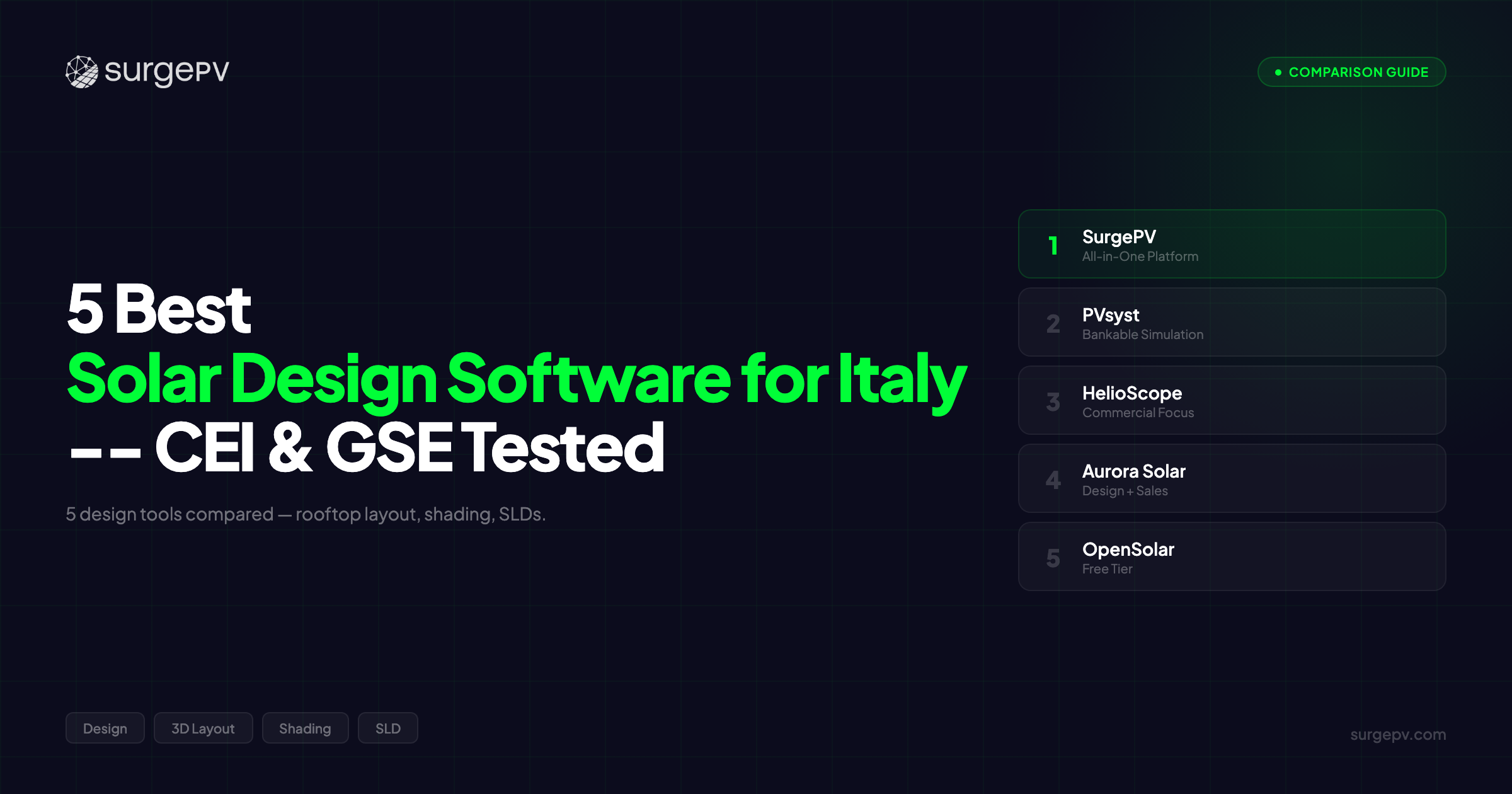
TL;DR: Italy’s 30.3 GW solar market demands design tools that handle CEI 0-21 grid compliance, GSE registration, and post-Scambio sul Posto economics. SurgePV delivers end-to-end design with automated Italian SLD generation at ~EUR 1,750/year. PVsyst remains the bankable standard Italian lenders require. Solarius PV (ACCA) is Italy’s native BIM-integrated solution.
Italy generates more solar power than any country in Europe except Germany.
But after Scambio sul Posto closed to new applicants in January 2025, many Italian installers are still using design tools built for net metering economics that no longer exist. The result: oversized systems, inaccurate ROI projections, and proposals that don’t reflect Ritiro Dedicato surplus compensation rates.
Italy’s 30.3 GW installed base is growing by 5+ GW annually. The shift from SSP to direct self-consumption economics changed what “optimal system design” means. A tool that maximizes annual production will now oversize Italian residential systems. What matters is maximizing self-consumption during daylight hours when electricity costs EUR 0.33/kWh, not maximizing surplus export that earns EUR 0.08-0.10/kWh through Ritiro Dedicato.
That is a 70% difference in value between consumed and exported kWh. Solar design software that does not optimize for this spread will cost Italian homeowners thousands of euros over system lifetime.
And CEI 0-21 compliance is not optional. Italian DSOs — E-Distribuzione (Enel), Areti (Rome), Unareti (Milan), A2A, and regional operators — reject connection applications with non-compliant electrical documentation. A design tool that does not generate CEI-compliant single line diagrams forces Italian EPCs back to manual AutoCAD drafting for 2-3 hours per project.
We tested the top solar design software platforms globally specifically for the Italian market. We evaluated CEI 0-21 compliance capabilities, GSE registration documentation, Italian weather data accuracy, self-consumption optimization for post-SSP economics, bankable P50/P90 reporting that Italian banks accept, and Italian-language support. We ran real projects: residential autoconsumo in Milan, commercial rooftops in Rome, and agrivoltaic designs in Puglia.
For our global comparison covering all markets, see our best solar design software guide. This page focuses specifically on tools for the Italian market.
In this guide, you’ll learn:
- Which 5 platforms handle CEI 0-21 compliance and Italian grid connection best
- How to design for maximum self-consumption under post-SSP economics
- Which tools produce P50/P90 reports that Intesa Sanpaolo and UniCredit accept
- What Italian regulations (CEI 0-21, GSE, ARERA, PNRR agrivoltaic) mean for design
- Italian-native alternatives: Solarius PV, Solergo, SPAC EasySol
- Our recommendation by project type: residential, commercial, utility-scale
Quick Comparison: Top 5 Solar Design Tools for Italy (2026)
| Feature | SurgePV | PVsyst | HelioScope | Aurora Solar | OpenSolar |
|---|---|---|---|---|---|
| Best For | End-to-end Italian EPCs | Utility bankability | Commercial rooftops | High-volume residential | Budget residential |
| CEI 0-21 SLD | Auto-generated (5-10 min) | No (requires AutoCAD) | No (requires AutoCAD) | No | No |
| Italian Language | Yes (interface + proposals) | Partial | English-primary | English-primary | English-primary |
| Self-Consumption | Optimized for post-SSP | Manual configuration | Basic | Basic | Basic |
| Ritiro Dedicato | EUR 0.08-0.10/kWh built-in | Manual input | Manual input | Not native | Not native |
| P50/P90 Bankable | Yes (+/-3% vs PVsyst) | Gold standard | Premium tier | Premium only | No |
| GSE Registration | Documentation support | Reports only | Reports only | No | No |
| Italian DSO Acceptance | E-Distribuzione, Areti tested | Simulation reports only | Simulation reports only | No | No |
| Platform | Cloud | Desktop | Cloud | Cloud | Cloud |
| Price (EUR/year) | ~1,750 (3 users) | ~450-650 | ~3,000-6,000 | ~2,400-9,000+ | Free-590 |
| Our Rating | 9.2/10 | 8.7/10 | 8.3/10 | 7.8/10 | 7.2/10 |
Quick verdict: For Italian EPCs handling residential and commercial projects, SurgePV eliminates the multi-tool workflow (design + AutoCAD + Excel) with CEI 0-21 SLD generation, self-consumption optimization, and Italian proposals in one platform. For utility-scale bankability that Italian banks require, PVsyst remains non-negotiable. HelioScope is strongest for commercial C&I rooftop specialists.
See how SurgePV handles CEI 0-21 compliance for Italian projects — Book a demo
Why Solar Projects in Italy Require Specialized Software
Generic design tools miss what makes the Italian solar market unique. Before comparing specific platforms, here is why Italy demands specialized design capabilities.
CEI 0-21 Grid Compliance Is Non-Negotiable
CEI 0-21 is Italy’s mandatory technical standard for grid connection of active and passive users to low-voltage and medium-voltage distribution networks. Every solar installation connecting to Italian DSOs (E-Distribuzione, Areti, Unareti, A2A, regional operators) must comply.
The standard specifies protection schemes, anti-islanding requirements, interface relay specifications, voltage and frequency limits, and power factor control. Design software must generate single line diagrams showing CEI 0-21 compliant protection devices, interface protection relays, and isolation transformers where required.
Italian DSOs reject connection applications with non-compliant electrical documentation. A design tool that does not generate CEI-compliant SLDs forces you back to 2-3 hours of manual AutoCAD drafting per project. For an EPC handling 15 residential projects monthly, that is 30-45 hours of pure documentation time — an entire work week lost to drawings instead of selling.
Self-Consumption Economics Changed After SSP Closure
Scambio sul Posto (SSP) closed to new applicants on January 1, 2025, under Legislative Decree 199/2021. This changed Italian solar economics.
Under SSP, surplus energy received virtual credit at near-retail rates. Under the new regime, direct self-consumption is valued at full retail (EUR 0.33/kWh for residential), while surplus sold via Ritiro Dedicato earns approximately EUR 0.08-0.10/kWh — under 30% of retail.
A system optimized for maximum annual production will now generate surplus energy worth 70% less than consumed energy. Design tools built for SSP or net metering economics will oversize Italian systems. Correct design now means optimizing panel orientation and system sizing for maximum daytime self-consumption, not maximum total production. An east-west split orientation that reduces total production by 8% but increases self-consumption ratio from 35% to 55% delivers better economics under post-SSP rules.
Post-SSP Economics
After Scambio sul Posto closed on January 1, 2025, Italian solar economics shifted. Self-consumed energy is worth EUR 0.33/kWh (retail) while surplus via Ritiro Dedicato earns EUR 0.08-0.10/kWh. Design tools that optimize for maximum production instead of maximum self-consumption will oversize systems and overestimate ROI by 20-40%. Verify your design software models post-SSP Italian economics correctly.
Bankability for Italian Project Finance
For commercial and utility-scale projects seeking financing from Italian banks (Intesa Sanpaolo, UniCredit, SACE, EIB-backed loans, EBRD), bankable yield reports with P50/P90 metrics and uncertainty analysis are mandatory. Italian lenders have standardized on specific simulation platforms for technical due diligence.
PVsyst is the gold standard. For projects above 1 MW, a PVsyst report is non-negotiable. Some Italian commercial lenders accept alternative platforms with demonstrated accuracy — SurgePV’s +/-3% validation versus PVsyst is gaining acceptance for projects between 100 kW and 1 MW.
No bankable report, no financing. For a 10 MW plant in Puglia seeking EUR 8M in project finance, the simulation report is more important than the panel brand. Italian independent engineers performing due diligence expect PVsyst. Using an unproven platform means explaining accuracy methodology to skeptical lenders when competitors submit standard PVsyst reports.
Agrivoltaic Opportunity (EUR 1.1 Billion PNRR Fund)
Italy’s National Recovery and Resilience Plan (PNRR) allocated EUR 1.1 billion for agrivoltaic projects under Measure M2C2 I1.1. Eligible projects must meet specific design requirements: elevated panel structures with minimum 2.1 meters clearance for agricultural machinery, minimum 70% agricultural land maintenance, row spacing that allows crop cultivation, and minimum 1 MW installed capacity.
Design tools supporting agrivoltaic must handle elevated structures, wide row spacing (reducing land utilization to 30-40% versus typical ground-mount 50-60%), and dual-use land optimization.
Post-Superbonus Price Competition
Italy’s Superbonus 110% tax incentive ended in 2023, and the residential solar market transitioned from subsidy-driven to economics-driven purchasing. Italian homeowners now compare 3-6 proposals, and the installer with the most realistic (not the most optimistic) ROI projection wins the contract.
Design tools that overestimate savings by using retail rates for surplus energy instead of Ritiro Dedicato rates create post-installation customer dissatisfaction when actual electricity bill savings fall 20-30% short of projections.
Local Project Workflow and Technical Requirements
Italian solar projects follow specific workflows and technical standards that design software must accommodate.
Italian Grid Connection Process (3-Step Workflow)
The Italian grid connection process involves three mandatory steps:
Step 1: Richiesta di Connessione — Connection request submitted to the local DSO (E-Distribuzione, Areti, Unareti, etc.) with preliminary electrical documentation including estimated system capacity, installation location, and connection point specifications.
Step 2: Preventivo di Connessione — DSO provides connection quote (STMD or STMG procedure depending on system size) specifying technical requirements, connection costs, and timeline.
Step 3: Attivazione — Final electrical documentation submitted including CEI 0-21 compliant SLD, protection device specifications, and interface relay documentation. DSO inspects and activates connection.
Design software supporting Italian projects should generate documentation compatible with DSO requirements for each step.
GSE Registration for Incentive Programs
GSE (Gestore dei Servizi Energetici) manages Italian renewable energy incentives and registration. While SSP closed to new applicants, GSE still administers Ritiro Dedicato, Comunita Energetiche Rinnovabili (CER), and agrivoltaic PNRR funding.
Design tools should support documentation requirements for GSE registration including system technical specifications, yield forecasts, and certification of Italian-made components where applicable for incentive programs.
Italian Weather Data Requirements
Accurate Italian solar design requires location-specific weather data accounting for Italy’s diverse climate zones. Northern regions (Milan, Turin, Venice) average 1,300-1,400 kWh/m2/year global horizontal irradiance, while southern regions (Sicily, Calabria, Puglia) exceed 1,700-1,900 kWh/m2/year — a 40%+ variation.
Design tools should use PVGIS European irradiance data or Italian national meteorological data rather than generic European averages. Temperature effects are significant — a panel rated at 25C STC operates at 60-70C on a Sicilian rooftop in August, reducing output by 12-15%.
Component Database for Italian Market
Italian solar projects use specific equipment common in the Italian and broader European market. Design tools should include databases of:
- Italian-manufactured inverters: ABB, SMA Italia, Sungrow Italia, Huawei Italia
- Italian-manufactured mounting systems: Convert Italia, Schletter Italia, K2 Systems Italia
- European panel manufacturers common in Italy: Longi Solar, JA Solar, Trina Solar, Canadian Solar, Q CELLS
- Italian module suppliers and distributors for accurate pricing
How We Evaluated These Solar Tools
We evaluated each platform against specific requirements for the Italian solar market:
CEI 0-21 Compliance: Can the tool generate compliant single line diagrams with correct protection schemes accepted by Italian DSOs (E-Distribuzione, Areti, Unareti)?
Italian Regulatory Support: GSE registration documentation, post-SSP self-consumption modeling, Ritiro Dedicato pricing integration, PNRR agrivoltaic design parameters.
Bankability: P50/P90/P99 yield forecasts with uncertainty analysis accepted by Italian lenders (Intesa Sanpaolo, UniCredit, SACE, EIB, EBRD).
Self-Consumption Optimization: Ability to optimize for maximum self-consumption ratio versus maximum production under post-SSP economics where consumed kWh are worth 3x more than exported kWh.
Italian Market Context: Italian-language interface and proposals, EUR pricing, Italian component databases, local weather data (PVGIS).
Workflow Efficiency: Time from site survey to final proposal for typical Italian residential (6 kWp) and commercial (100 kWp) projects.
Top Solar Design Software for Italy
SurgePV — Best End-to-End Platform for Italian EPCs
Rating: 9.2/10 | Price: ~EUR 1,750/year (3 users) | Book a demo | See pricing
SurgePV is a cloud-based, AI-powered solar software combining layout design, electrical engineering, simulation, and professional proposals in one workflow. For Italian EPCs and installers handling residential and commercial projects, it eliminates the multi-tool workflow most competitors require.
Why SurgePV works for Italian projects:
The platform generates CEI 0-21 compliant single line diagrams automatically in 5-10 minutes. That is the defining feature for the Italian market, where every other platform requires 2-3 hours of manual AutoCAD or SPAC EasySol work to produce the electrical documentation Italian DSOs demand.
For a Milan-based EPC handling 20 residential autoconsumo projects monthly, automated SLD generation saves 40-60 hours monthly. That is an entire week of engineering time redirected to selling and project management instead of drafting.
Time savings compound. An installer who can produce a complete proposal — design, electrical, simulation, financial analysis, Italian-language customer presentation — in 45 minutes versus 3-4 hours completes 6x more quotes per day. In Italy’s competitive residential market where homeowners request 4-6 quotes, faster turnaround wins contracts.
SurgePV runs 8760-hour simulation with shading analysis delivering +/-3% accuracy compared to PVsyst. That is bankable accuracy — Italian commercial lenders accept P50/P75/P90 yield forecasts from SurgePV for projects between 100 kW and 1 MW. For utility-scale above 1 MW, pair SurgePV for design with PVsyst for final bankable validation.
For self-consumption optimization under post-SSP Italian economics, SurgePV models direct consumption value (EUR 0.33/kWh residential retail) versus Ritiro Dedicato surplus compensation (EUR 0.08-0.10/kWh). The financial module includes Italian-specific tax benefits: IBI (municipal property tax) reductions, ICIO (construction tax) deductions, and IRPF income tax benefits for residential installations.
The platform generates professional proposals in Italian with EUR pricing, Italian tariff structures, and post-SSP economics. For customer-facing presentations to Italian homeowners and businesses, this matters more than technical specs.
SurgePV also offers native ground-mount and carport design — relevant as Italian commercial carport installations grow at logistics centers, supermarkets, and industrial facilities, and as PNRR agrivoltaic funding drives elevated structure projects.
Real-World Example
A Rome-based installer switched from PVsyst + AutoCAD + Excel to SurgePV for residential projects. Before the switch, producing a complete proposal took 3.5 hours: 1 hour design in a separate tool, 2.5 hours AutoCAD for CEI-compliant SLD, 30 minutes Excel for financial analysis, plus manual assembly of the final proposal document. With SurgePV’s integrated workflow, the same proposal takes 40 minutes: automated design, instant SLD generation, built-in financial analysis with post-SSP Ritiro Dedicato rates, and one-click Italian PDF export. Result: proposal capacity increased from 8 per week to 30 per week with the same engineering headcount. Monthly project closings increased from 12 to 28 because faster turnaround captured more of the homeowners requesting quotes.
Reader objection: “Italian banks only accept PVsyst reports for financing — when does SurgePV work?” You are right for utility-scale above 1 MW. For those projects, use PVsyst for bankable validation. But for residential (3-10 kWp) and most commercial (50-500 kWp), Italian banks do not require PVsyst — they evaluate customer creditworthiness and utility bill verification. SurgePV’s integrated design-to-proposal workflow wins more of these projects faster than specialists using separate tools for each step. For the 1-5 MW range, pair SurgePV (design + SLD) with PVsyst (bankable validation) when lenders require it.
Pros:
- CEI 0-21 compliant SLD generation in 5-10 minutes (vs 2-3 hours AutoCAD)
- AI-powered design with 8760-hour simulation, +/-3% PVsyst accuracy
- P50/P75/P90 bankable yield forecasts accepted by Italian commercial lenders
- Post-SSP self-consumption optimization with Ritiro Dedicato pricing
- Italian-language proposals with IBI/ICIO/IRPF financial modeling
- GSE registration documentation support
- Native ground-mount and carport design for agrivoltaic/commercial
- 70,000+ projects globally, 3-minute average support response
- ~EUR 1,750/year for 3 users — all features included
Cons:
- Less established for utility-scale (over 5 MW) bankability vs PVsyst
- Newer presence in Italy compared to established players like Solarius PV
- Italian DSO acceptance expanding (E-Distribuzione and Areti confirmed, smaller DSOs case-by-case)
- Developing advanced CER (Comunita Energetiche Rinnovabili) multi-user modeling
Best for: Italian installers and EPCs handling residential autoconsumo (3-100 kWp) and commercial rooftop projects (50-1,000 kWp) who want design, CEI-compliant SLD, simulation, and proposals in one cloud platform.
Pro Tip
SurgePV’s generation and financial tool includes post-SSP Italian economics. Model direct self-consumption at retail rates, Ritiro Dedicato surplus at EUR 0.08-0.10/kWh, IBI reductions, ICIO deductions, and IRPF tax benefits — no Excel spreadsheet needed. The financial projections use realistic post-SSP assumptions that prevent the ROI over-optimism that damages customer trust.
Start designing CEI-compliant Italian projects today — Schedule a walkthrough
PVsyst — Gold Standard Simulation for Italian Utility-Scale
Rating: 8.7/10 | Price: ~EUR 450-650/year | PVsyst | PVsyst review
PVsyst is the bankable simulation standard that Italian banks, independent engineers, and project developers expect for utility-scale and large commercial projects. For financing from Intesa Sanpaolo, UniCredit, SACE, or EIB-backed loans, a PVsyst report is effectively mandatory.
Why PVsyst matters for Italian project finance:
The simulation depth is unmatched. PVsyst models detailed loss chains with 15+ configurable factors including temperature losses (critical for Southern Italian high-irradiance regions), soiling losses (relevant in dry Sicilian and Puglian climates), module degradation calibrated to Mediterranean conditions, and shading analysis for complex terrain.
Italian independent engineers performing technical due diligence for lenders expect PVsyst reports. The P50/P90/P99 metrics with uncertainty analysis provide the statistical confidence intervals that Italian project finance requires. When an EPC submits a PVsyst report for a 20 MW plant in Puglia, the lender’s technical consultant knows exactly how to interpret the data — because every other Italian utility-scale project uses the same format.
For a 10 MW ground-mount plant seeking EUR 8M in financing, the bankable report is worth far more than its EUR 450 software cost. No PVsyst report, no financing approval. Italian banks have standardized on PVsyst the same way they standardized on specific legal contract templates. Using a different tool means explaining methodology to skeptical financial analysts when your competitor submitted a standard PVsyst report.
PVsyst uses PVGIS and Meteonorm weather databases with strong coverage of Italian locations. It handles Italian tariff structures for self-consumption analysis, though setup requires manual configuration of consumption profiles, Ritiro Dedicato compensation rates, and post-SSP economics.
Bottom line: PVsyst is a simulation engine, not a design platform. It does not create panel layouts. It does not generate CEI-compliant SLDs. It does not produce customer-facing proposals. For daily Italian workflow, use a design platform like SurgePV or Solarius PV, then export to PVsyst for bankable validation when Italian lenders require it.
Pros:
- Gold standard for bankable reports universally accepted by Italian banks
- Deepest loss chain simulation (15+ configurable factors)
- P50/P90/P99 with uncertainty analysis for project finance
- Strong Italian/Mediterranean weather data via PVGIS and Meteonorm
- Available in Italian language
- Most affordable professional simulation (~EUR 450-650/year)
- Decades of validation and independent engineer acceptance
Cons:
- Simulation only — no design, no SLD, no proposals
- Desktop-only, no cloud collaboration
- Steep learning curve (4-6 weeks to master)
- No automated CEI 0-21 electrical documentation
- Manual setup for Italian self-consumption and Ritiro Dedicato
- Does not model CER (Comunita Energetiche Rinnovabili) without custom configuration
- Not designed for high-volume residential quoting
Best for: Italian utility-scale developers, EPCs, and engineering consultants working on projects above 1 MW who need bankable simulation accepted by Italian lenders and independent engineers. Use PVsyst for bankable validation alongside a design platform for complete workflow.
Further Reading
For detailed PVsyst capabilities, limitations, and Italian project setup, see our PVsyst review.
HelioScope — Commercial Rooftop Design for Italy
Rating: 8.3/10 | Price: ~EUR 3,000-6,000/year | HelioScope | HelioScope review
HelioScope is a cloud-based solar design platform optimized for commercial and industrial rooftop projects. For Italian EPCs specializing in commercial C&I installations (50-1,000 kWp) on industrial warehouses, shopping centers, and logistics facilities, HelioScope provides fast design with strong simulation accuracy.
Why HelioScope works for Italian commercial rooftops:
The platform excels at complex rooftop modeling with multiple roof planes, obstructions, and irregular layouts. Italian commercial buildings — particularly older structures in Rome, Milan, Florence — often have complex rooflines with chimneys, HVAC equipment, elevator shafts, and irregular orientations. HelioScope handles these configurations efficiently.
Simulation quality is bankable. HelioScope delivers P50/P90 yield forecasts accepted by some Italian commercial lenders for mid-scale projects. The 8760-hour simulation with detailed shading analysis uses PVGIS data for Italian locations.
For Italian commercial project workflow, HelioScope provides fast iteration on layout alternatives — useful when commercial clients request multiple configuration options comparing flat versus tilted mounting, different module technologies, or phased installation scenarios.
Here is where it gets limited for Italy.
HelioScope does not generate electrical documentation. For CEI 0-21 compliant SLDs required by Italian DSOs, you need separate AutoCAD or SPAC EasySol. The platform is English-primary with limited Italian support. Financial modeling does not include Italian-specific parameters like IBI, ICIO, or post-SSP Ritiro Dedicato rates — requiring separate Excel analysis. And customer-facing proposals need manual assembly from exported HelioScope data.
For a specialized Italian commercial EPC that already has AutoCAD infrastructure and focuses exclusively on 100-500 kWp rooftop projects, HelioScope is a strong design engine. For full-service EPCs handling residential, commercial, and ground-mount, the multi-tool workflow (HelioScope + AutoCAD + Excel + proposal software) is less efficient than integrated platforms.
Pros:
- Excellent complex commercial rooftop modeling
- Bankable P50/P90 simulation accepted for Italian commercial projects
- Fast cloud-based iteration on layout alternatives
- PVGIS data for Italian locations
- Strong shading analysis for irregular rooflines
- 8760-hour simulation with detailed loss analysis
Cons:
- No CEI 0-21 electrical documentation (requires separate AutoCAD/SPAC EasySol)
- English-primary interface, limited Italian language support
- No Italian financial modeling (IBI, ICIO, Ritiro Dedicato requires manual setup)
- No customer-facing proposal generation
- Premium pricing (~EUR 3,000-6,000/year)
- Not optimized for residential high-volume quoting
- Desktop component required for some advanced features
Best for: Italian commercial solar specialists focusing on C&I rooftop projects (50-1,000 kWp) who already have AutoCAD infrastructure and can handle Italian financial modeling and proposals separately.
Aurora Solar — AI-Powered Residential Rooftop Modeling for Italy
Rating: 7.8/10 | Price: ~EUR 2,400-9,000+/year | Aurora Solar | Aurora Solar review
Aurora Solar is the global leader in AI-powered residential solar design. For high-volume Italian installers processing large numbers of residential autoconsumo quotes in metro areas like Milan, Rome, Naples, Turin, and Florence, Aurora’s speed advantage is real.
Why Aurora has a presence in the Italian residential market:
Aurora’s AI roof detection creates panel layouts in minutes using satellite imagery. The simulation runs 8760-hour shading analysis and generates professional 3D visualization for customer presentations. For an Italian installer quoting 50+ residential projects monthly, that speed translates to faster sales cycles.
The platform is cloud-based with fast onboarding. Aurora’s residential focus aligns with Italy’s growing autoconsumo market where residential installations under 20 kWp represent significant volume.
Here is the challenge for Italian deployment.
Aurora was built for the US market. It does not natively model post-SSP Italian economics. Ritiro Dedicato surplus compensation is not built in. There is no automatic optimization for self-consumption ratio versus total production — the critical distinction in Italian economics where consumed kWh are worth 3x more than exported kWh. IBI and ICIO tax benefit calculations are absent. The interface is primarily English — a limitation for proposals to Italian homeowners who expect documentation in Italian. And there is no CEI 0-21 electrical documentation, requiring separate tools for the SLDs Italian DSOs demand.
Speed without Italian market accuracy creates customer trust problems. If Aurora generates a beautiful 3D proposal that overestimates ROI by 25% because it uses total production optimization instead of self-consumption optimization, that speed advantage turns into post-installation dissatisfaction when electricity bill savings fall short of projections. In Italy’s word-of-mouth residential market, that is a referral-killing mistake.
Pros:
- Industry-leading AI roof detection for fast residential design
- 8760-hour simulation with professional 3D visualization
- Cloud-based, fast onboarding
- Strong brand recognition globally
- Suitable for high-volume residential quoting
- Expanding European presence
Cons:
- No native post-SSP Italian economics (Ritiro Dedicato, self-consumption optimization)
- No CEI 0-21 electrical documentation (requires separate AutoCAD)
- English-primary interface, limited Italian language
- No Italian financial modeling (IBI, ICIO, IRPF requires manual setup)
- Does not optimize for self-consumption ratio
- No GSE registration documentation support
- Premium pricing (~EUR 2,400-9,000+/year)
- Best features locked in highest pricing tiers
Best for: High-volume Italian residential installers in major metro areas (Milan, Rome) who prioritize design speed over Italian regulatory modeling and can handle financial projections and electrical documentation with separate tools.
OpenSolar — Fast Residential Quoting and Sales for Italy
Rating: 7.2/10 | Price: Free to ~EUR 590/year | OpenSolar | OpenSolar review
OpenSolar is a cloud-based solar design and proposal platform with a generous free tier and affordable paid plans. For Italian startups, small installers, or EPCs testing the residential autoconsumo market, OpenSolar provides fast basic design and customer-facing proposals at minimal cost.
Why OpenSolar works for budget-conscious Italian installers:
The free version includes basic design, simulation, and proposal generation — enough for an Italian installer starting in residential solar to produce professional-looking quotes without upfront software investment. Paid plans at EUR 300-590/year add features at prices significantly below competitors.
The platform is cloud-based with simple onboarding. Design workflows are streamlined for speed over precision — appropriate for residential projects where homeowners care more about final price and ROI timeline than technical simulation details.
Here is what is missing for serious Italian deployment.
OpenSolar does not generate CEI 0-21 electrical documentation. There is no P50/P90 bankable simulation — unsuitable for commercial projects or any installation requiring financing. Italian regulatory support is minimal: no post-SSP economics modeling, no Ritiro Dedicato pricing, no IBI/ICIO calculations, no Italian DSO-specific documentation. English-primary interface. And simulation accuracy is basic — suitable for ballpark estimates but not for technical validation.
OpenSolar is a sales tool, not an engineering platform. For Italian installers focused purely on residential volume sales where homeowners select based on price and the installer handles all engineering externally, OpenSolar accelerates quoting. For EPCs that need technical accuracy, bankability, or CEI compliance, it is insufficient.
Pros:
- Free tier available for startups
- Very affordable paid plans (EUR 300-590/year)
- Fast cloud-based quoting for residential
- Simple onboarding
- Suitable for pure sales-focused residential installers
- Customer-facing 3D visualization
Cons:
- No CEI 0-21 electrical documentation
- No bankable P50/P90 simulation
- No post-SSP Italian economics (Ritiro Dedicato, self-consumption optimization)
- Basic simulation accuracy (not suitable for technical validation)
- English-primary interface
- No Italian financial modeling
- No GSE registration support
- Not suitable for commercial or utility-scale
Best for: Italian residential installers prioritizing sales speed and low software cost over technical accuracy, or startups testing the autoconsumo market before investing in professional platforms.
Italian-Native Solar Design Software: Honorable Mentions
Italy has several native design tools widely used by Italian EPCs and installers. While these platforms did not make our top 5 due to limited all-in-one workflow integration, they represent important options for Italian professionals seeking locally-developed solutions.
Solergo by Electro Graphics (Bolzano)
Solergo is Italy’s most widely-used native PV design tool. Based in Bolzano, Electro Graphics offers both a free version (iSolergo) for basic residential projects and professional premium versions for commercial installations. The platform provides full CEI 0-21 compliance, native Italian interface, and strong integration with Italian component databases.
Solergo is particularly popular among small Italian installers and energy cooperatives in Northern Italy. Its strength is regulatory compliance for Italian DSO requirements. The limitation is that Solergo focuses on design and simulation — it lacks integrated proposal generation and customer-facing presentation tools that all-in-one platforms provide.
Solarius PV by ACCA Software (Bagnoli Irpino)
Solarius PV by ACCA Software is a BIM-integrated Italian solar design platform popular among Italian architects, structural engineers, and large engineering firms. ACCA is headquartered in Bagnoli Irpino (Avellino, Campania) and has deep roots in the Italian technical software market.
Solarius PV excels at integrating solar design with building models — relevant for new construction projects where solar is part of comprehensive building design. It provides full Italian standards compliance (CEI 0-21, CEI 64-8), generates Italian electrical documentation, and includes Italian financial analysis.
The platform is strongest for Italian professionals who work across multiple building disciplines and need solar design integrated with architectural and structural BIM workflows. For standalone solar EPCs, the BIM focus may be more than needed. Read our full ACCA Solarius PV review for detailed analysis.
SPAC EasySol by SDProget (Teramo)
SPAC EasySol is a professional Italian CAD-based solar design tool from SDProget in Teramo (Abruzzo). It is strong among Italian engineering firms that use AutoCAD as their primary platform and want solar-specific extensions rather than standalone software.
SPAC EasySol generates CEI-compliant electrical documentation and integrates with AutoCAD workflows for detailed SLD production. Its strength is detailed electrical design; its limitation is that it is a CAD plugin rather than a cloud platform with collaboration and proposal capabilities.
Blumatica Impianti Fotovoltaici (Napoli)
Blumatica Impianti Fotovoltaici is part of the broader Blumatica technical software suite from Naples. It focuses on Italian regulatory compliance and technical calculations for building permit documentation.
The platform is used primarily for compliance documentation rather than daily design workflow. It is strongest for Italian projects requiring detailed municipal permit applications and technical reports for local authorities.
Why these tools did not make the top 5: While all four Italian-native platforms provide strong CEI compliance and Italian regulatory knowledge, they focus on specific workflow stages (design, electrical, compliance) rather than integrated design-to-proposal workflows. For Italian EPCs seeking all-in-one platforms, the top 5 international platforms (especially SurgePV with Italian market features) provide more complete solutions. For Italian professionals who prefer native Italian tools and do not mind multi-software workflows, these platforms are excellent choices.
Detailed Comparison Table for Italy
| Capability | SurgePV | PVsyst | HelioScope | Aurora Solar | OpenSolar | Solarius PV (ACCA) |
|---|---|---|---|---|---|---|
| CEI 0-21 SLD Auto-Generation | Yes (5-10 min) | No | No | No | No | Yes |
| Italian Language | Full | Partial | Limited | Limited | Limited | Native |
| Post-SSP Self-Consumption | Optimized | Manual | Manual | Basic | Basic | Supported |
| Ritiro Dedicato Pricing | Built-in | Manual | Manual | No | No | Supported |
| GSE Registration Docs | Yes | Reports only | Reports only | No | No | Yes |
| P50/P90 Bankability | Yes (commercial) | Yes (all scales) | Yes (commercial) | Premium only | No | Reports |
| Italian Component DB | EUR pricing | Manual | Manual | Manual | Manual | Native |
| IBI/ICIO/IRPF Tax | Built-in | No | No | No | No | Yes |
| Platform Type | Cloud | Desktop | Cloud/hybrid | Cloud | Cloud | Desktop |
| Learning Curve | 2-3 days | 4-6 weeks | 1-2 weeks | 2-4 days | 1 day | 1-2 weeks |
| Customer Proposals | Italian PDF | No | Export data | 3D visual | Basic | Italian PDF |
| Agrivoltaic Design | Native | Manual | Manual | No | No | Manual |
| Price (EUR/year) | ~1,750 (3 users) | ~450-650 | ~3,000-6,000 | ~2,400-9,000+ | Free-590 | Suite pricing |
Which Software Is Right for Your Use Case?
The right tool depends on your company type, project scale, and Italian market focus. Here is a practical decision framework.
For Commercial EPCs (100 kW - 5 MW Projects)
Italian commercial EPCs handling industrial rooftops, shopping centers, logistics facilities, and mid-scale ground-mount need platforms that balance simulation accuracy, CEI compliance, and project finance credibility.
Best choice: SurgePV. Integrated design, automated CEI 0-21 SLD generation, P50/P90 reports accepted by Italian commercial lenders, and Italian proposals in one workflow. For projects above 1 MW requiring traditional bank financing, add PVsyst for bankable validation.
Alternative: HelioScope + PVsyst. If your team specializes exclusively in complex commercial rooftops and already has AutoCAD infrastructure, HelioScope for design + PVsyst for bankability + separate financial modeling works but requires managing three platforms.
For Utility-Scale Developers (Above 1 MW)
Italian utility-scale developers building ground-mount plants in Puglia, Sicily, Sardinia, Lazio, Emilia-Romagna need bankable simulation that Italian lenders and independent engineers accept without question.
Best choice: PVsyst. Non-negotiable for bankable reports. Pair with a design platform (SurgePV for integrated workflow, or AutoCAD-based tools like PVcase for traditional engineering firms) for layout and electrical design, then validate with PVsyst for financing submission.
For agrivoltaic PNRR projects: Add ground-mount design capabilities (SurgePV native, or specialized agrivoltaic layout tools) to meet PNRR elevated structure and 70% agricultural land requirements.
For Residential Installers (Under 20 Projects/Year)
Small Italian residential installers focused on local autoconsumo markets (3-10 kWp systems for homeowners) need tools that minimize software cost while still producing professional proposals.
Best choice: OpenSolar (budget) or SurgePV (professional). OpenSolar’s free tier or EUR 300/year plan works for pure sales-focused installers who handle engineering externally. For installers who want to own the full technical workflow and produce CEI-compliant electrical documentation, SurgePV at EUR 1,750/year for 3 users delivers professional capability at accessible pricing.
Italian-native alternative: Solergo iSolergo (free) for design + manual Excel financial analysis. Works for installers prioritizing Italian-built tools and comfortable with multi-tool workflows.
For Premium Residential Market
High-end Italian residential installers serving premium clients (villas, high-value homes) who expect detailed technical presentation and accurate long-term projections.
Best choice: SurgePV or Aurora Solar. Both provide professional 3D visualization, detailed shading analysis, and customer-facing proposals. SurgePV has stronger Italian financial modeling; Aurora has more polished visual presentation. For premium clients, either works — choose based on whether Italian-language proposals and post-SSP economics accuracy (SurgePV) or pure visual impact (Aurora) matters more to your clientele.
For Agrivoltaic and Energy Community Projects
Italian developers pursuing PNRR agrivoltaic funding (EUR 1.1 billion allocation) or Comunita Energetiche Rinnovabili (CER) projects need specialized capabilities beyond standard residential/commercial design.
Best choice: SurgePV + PVsyst. SurgePV handles elevated structure design, wide row spacing, and dual-use land optimization. PVsyst validates bankable yields for PNRR financing requirements. For CER multi-user modeling, platforms are still developing — expect custom configuration in any tool.
Italian-native alternative: Solarius PV for integrated agrivoltaic structural design with BIM workflows, particularly for projects requiring comprehensive building permit documentation.
Further Reading
See also our comparisons for best solar design software globally, best solar software in Italy, and all solar software comparisons.
Design CEI-Compliant Italian Projects in One Platform
Automated SLD generation, post-SSP self-consumption optimization, and Italian-language proposals — design to permit in under 1 hour.
Book a DemoNo commitment required · 20 minutes · Live project walkthrough
When You May Not Need Advanced Solar Software
Not every Italian solar professional needs dedicated design software. Here are scenarios where simpler tools or outsourcing may be more cost-effective.
Very Small Residential Installers (Under 10 Projects/Year)
If you are an Italian elettricista or small installer handling fewer than 10 residential autoconsumo projects annually, the EUR 1,750-3,000/year cost of professional software may exceed the value. Consider:
- Free tools like OpenSolar or Solergo iSolergo for basic design
- Manual Excel for financial analysis using post-SSP economics
- Outsourcing electrical documentation to a technical consultant who provides CEI-compliant SLDs for EUR 100-200 per project
At 8 projects/year, paying EUR 1,600 for outsourced SLDs (8 x EUR 200) costs less than EUR 1,750 software plus learning time.
Teams Outsourcing Engineering
Some Italian sales-focused installers outsource all technical work to external engineering consultants or use turnkey supplier services. If your business model is pure sales and installation with technical design handled by panel suppliers or third-party engineers, investing in design software does not match your workflow.
Legacy AutoCAD Users With Sunk Costs
Italian engineering firms that have used AutoCAD for 15+ years, employ full-time CAD technicians, and have established SLD production workflows may not benefit from switching to integrated solar platforms. If your AutoCAD infrastructure is already paid for and staffed, the incremental value of automated SLD generation is lower than for firms starting fresh.
Single-Project Developers
If you are developing one large Italian utility-scale plant as a single project (not an ongoing business), consider hiring specialized solar engineering consultants who own professional software rather than purchasing annual licenses you will use once.
Bottom Line: Best Solar Design Software for Italy
Italy’s solar market does not wait. E-Distribuzione’s connection approval timeline is 60-90 days. GSE’s Ritiro Dedicato registration requires technical documentation. And with Italy targeting 79 GW of solar capacity by 2030 under REPowerEU (more than double the current 30.3 GW), the pace of project approvals is accelerating.
For residential and commercial EPCs (3 kWp to 1 MW): SurgePV delivers the best combination of design speed, automated CEI 0-21 SLD generation, post-SSP self-consumption optimization, and Italian-language proposals in one platform. The workflow integration — from site survey to final customer-ready proposal in under 1 hour — wins more contracts faster than specialists managing separate tools for each step.
For utility-scale plants (above 1 MW): PVsyst remains non-negotiable for bankable reports that Italian lenders (Intesa Sanpaolo, UniCredit, SACE, EIB) and independent engineers require. Pair with a design platform (SurgePV for integrated workflow, AutoCAD-based tools for traditional firms) for complete project documentation.
For Italian-native preference: Solarius PV by ACCA Software combines Italian regulatory expertise with BIM integration. Solergo offers free basic and professional versions built specifically for the Italian market. Both require separate proposal tools but provide strong CEI compliance and Italian DSO acceptance.
For bankable commercial projects (100 kW to 5 MW): SurgePV’s P50/P90 accuracy (+/-3% vs PVsyst) is accepted by Italian commercial lenders. For traditional bank financing above 1 MW, validate with PVsyst.
Every week without CEI-compliant SLD automation is another 20-30 hours of manual AutoCAD drafting. Italian homeowners compare 4-6 quotes — the installer who delivers a complete, accurate, Italian-language proposal in 24 hours while competitors take 3-5 days wins the contract.
Italy’s REPowerEU target calls for 79 GW of total solar capacity by 2030 — more than double the current 30.3 GW. Teams still using multi-tool workflows or manual AutoCAD drafting are already falling behind.
Stop manual SLD drafting. Start designing CEI-compliant Italian projects. Book your demo. Compare pricing. Or explore all solar software reviews for additional comparisons.
Transparency Note
SurgePV publishes this content. We are transparent about this relationship. This comparison acknowledges PVsyst as the undisputed gold standard for bankable simulation at utility-scale. We do not claim SurgePV replaces PVsyst for institutional-grade financing. We present SurgePV as an operational alternative for residential and commercial Italian workflows where integrated design + CEI compliance + proposals delivers more value than separate tools. See our editorial standards.
Further Reading
Related guides: Best solar design software globally · PVsyst review · Solarius PV review · HelioScope review · Aurora Solar review
- Best Solar Software in Italy — Full Italian market comparison beyond design tools
- Best All-in-One Solar Design Software — Global all-in-one platform comparison
Frequently Asked Questions
What is the best solar design software for Italy in 2026?
For Italian EPCs and installers, SurgePV is the best end-to-end platform combining design, CEI 0-21 compliant SLD generation, P50/P90 simulation, and professional proposals at approximately EUR 1,750/year for 3 users. PVsyst is the gold standard for utility-scale bankability that Italian banks (Intesa Sanpaolo, UniCredit) require for project financing above 1 MW. HelioScope is strongest for commercial rooftop design. Solarius PV by ACCA Software is Italy’s native BIM-integrated design tool. The best choice depends on project type, scale, and whether you need GSE registration documentation or Italian bank acceptance.
Is CEI 0-21 compliance mandatory for solar projects in Italy?
Yes. CEI 0-21 is mandatory for all grid-connected solar installations in Italy. This technical standard, issued by the Italian Electrotechnical Committee (Comitato Elettrotecnico Italiano), defines the requirements for connecting active and passive users to Italian low-voltage and medium-voltage distribution networks operated by DSOs like E-Distribuzione, Areti, and Unareti. Design software must generate CEI 0-21 compliant electrical documentation including single line diagrams with proper protection schemes, anti-islanding protections, and interface relay specifications that DSOs accept for connection authorization.
Which solar design software do Italian EPCs use most?
Italian EPCs use a mix of international platforms and Italian-native tools. For residential and commercial projects (under 1 MW), common platforms include SurgePV (all-in-one design to proposal), Solarius PV by ACCA Software (Italian-native BIM integration), Solergo by Electro Graphics (free to professional Italian tool), and HelioScope (commercial rooftop focus). For utility-scale plants above 1 MW, PVsyst is the bankable standard. Many Italian EPCs use multiple tools: an Italian platform like Solarius PV or Solergo for initial design and CEI compliance, then export to PVsyst for bankable validation when Italian banks require it.
Can solar design software maximize self-consumption in Italy?
Yes, but only if the software models Italian self-consumption economics correctly. After Scambio sul Posto (SSP) closed to new applicants on January 1, 2025 (Decree 199/2021), Italian residential and commercial installations now rely primarily on direct self-consumption and Ritiro Dedicato for surplus energy at approximately EUR 0.08-0.10/kWh — far below retail electricity rates of EUR 0.33/kWh.
Design software must optimize panel orientation, tilt, and system sizing to maximize daytime self-consumption rather than total annual production. SurgePV models Italian self-consumption ratios with Ritiro Dedicato surplus pricing. Solarius PV and Solergo support Italian tariff structures. Generic tools that optimize for maximum production rather than self-consumption will oversize Italian systems.
What software do Italian banks accept for solar project financing?
For projects above 1 MW seeking financing from Italian banks (Intesa Sanpaolo, UniCredit, SACE, EIB-backed loans, EBRD financing), PVsyst is the de facto standard for bankable yield reports with P50/P90/P99 metrics and uncertainty analysis. Italian lenders and independent engineers have standardized on PVsyst for technical due diligence. For commercial projects between 100 kW and 1 MW, SurgePV’s P50/P90 reports with +/-3% accuracy versus PVsyst are gaining acceptance from some Italian commercial lenders. For residential and small commercial under 100 kW, banks typically do not require specific simulation software — financial analysis focuses on customer creditworthiness and energy bill verification.
How much does solar design software cost in Italy?
Pricing for solar design software serving the Italian market varies widely. Solergo offers a free basic version (iSolergo) with professional licenses at approximately EUR 500-800/year. SurgePV costs approximately EUR 1,750/year for 3 users with design, simulation, SLD, and proposals included. PVsyst costs approximately EUR 450-650/year for a single license (simulation only, no design or SLD). HelioScope starts at approximately EUR 3,000/year. Solarius PV by ACCA is part of ACCA’s software suite (pricing varies). Aurora Solar ranges from EUR 2,400-9,000+/year. For Italian installers handling 20+ residential projects per month, integrated platforms like SurgePV or Solarius PV typically pay for themselves within 2-3 months through time savings on SLD generation and proposal automation.
What is Scambio sul Posto (SSP) and can software still model it?
Scambio sul Posto (SSP) was Italy’s net metering mechanism managed by GSE that allowed prosumers to offset consumed energy with exported solar energy through a virtual credit system. SSP closed to new applicants on January 1, 2025, under Legislative Decree 199/2021 implementing EU Directive 2018/2001. Existing SSP contracts continue until expiration. Design software can still model SSP for existing installations and contract renewals, but new Italian solar projects now use direct self-consumption with surplus sold via Ritiro Dedicato (RID) at wholesale rates, or participate in Comunita Energetiche Rinnovabili (CER). Italian-focused software like SurgePV, Solarius PV, and Solergo have updated their financial models to reflect post-SSP economics.
Can solar design software design agrivoltaic systems in Italy?
Yes. Italy’s PNRR (Piano Nazionale di Ripresa e Resilienza) allocated EUR 1.1 billion for agrivoltaic projects under Measure M2C2 I1.1. Agrivoltaic design in Italy requires elevated panel structures (minimum 2.1 meters clearance) to allow agricultural machinery access, minimum 70% agricultural land maintenance, row spacing for crops, and minimum 1 MW installed capacity to qualify for PNRR funding. SurgePV offers native ground-mount and elevated structure design suitable for agrivoltaic configurations. PVsyst can model agrivoltaic yield with manual layout. HelioScope supports ground-mount design with custom row spacing. Specialized agrivoltaic software exists but general solar design tools can handle the layout if configured for Italian agrivoltaic parameters.
Which Italian-native solar design software tools are available?
Italy has several native solar design tools widely used by Italian EPCs and installers. Solergo by Electro Graphics (Bolzano) is Italy’s most popular PV design platform with both free (iSolergo) and professional versions offering full CEI 0-21 compliance and Italian interface. Solarius PV by ACCA Software (Bagnoli Irpino) provides BIM-integrated design popular among Italian architects and engineers with CEI compliance and Italian standards focus.
SPAC EasySol by SDProget (Teramo) is a professional CAD-based tool strong for detailed electrical documentation. Blumatica Impianti Fotovoltaici (Napoli) offers Italian standards-focused design within the Blumatica technical software suite. These tools offer native Italian regulatory knowledge but typically lack integrated proposal generation available in all-in-one platforms like SurgePV.
Can solar design software replace AutoCAD for Italian electrical documentation?
Yes, partially. SurgePV generates CEI 0-21 compliant single line diagrams automatically in 5-10 minutes, eliminating 2-3 hours of manual AutoCAD drafting per project for most residential and commercial installations. Italian DSOs (E-Distribuzione, Areti, Unareti) accept automated SLD output if it meets CEI standard requirements including proper protection device specifications, anti-islanding protections, and interface relay documentation.
PVsyst and HelioScope do not generate SLDs — they require separate AutoCAD or tools like SPAC EasySol for electrical documentation. Solarius PV generates Italian-compliant electrical diagrams integrated with BIM. For complex utility-scale plants or custom electrical configurations, AutoCAD or specialized electrical CAD tools may still be needed alongside solar software.
Is there an Italian-language solar design software?
Yes. Several platforms offer full Italian-language interfaces and documentation. Solergo by Electro Graphics provides native Italian interface and is built specifically for the Italian market. Solarius PV by ACCA Software is entirely in Italian with Italian regulatory focus. SPAC EasySol by SDProget offers Italian-language CAD-based design.
SurgePV offers Italian-language interface and generates Italian-language proposals suitable for Italian customers. PVsyst supports Italian language for simulation. HelioScope and Aurora Solar are primarily English with limited Italian support. For customer-facing proposals in Italian and documentation for Italian municipalities and DSOs, Solergo, Solarius PV, and SurgePV are the strongest options.
Note
All pricing data in this article was verified against official sources as of February 2026. Prices may have changed since publication.