

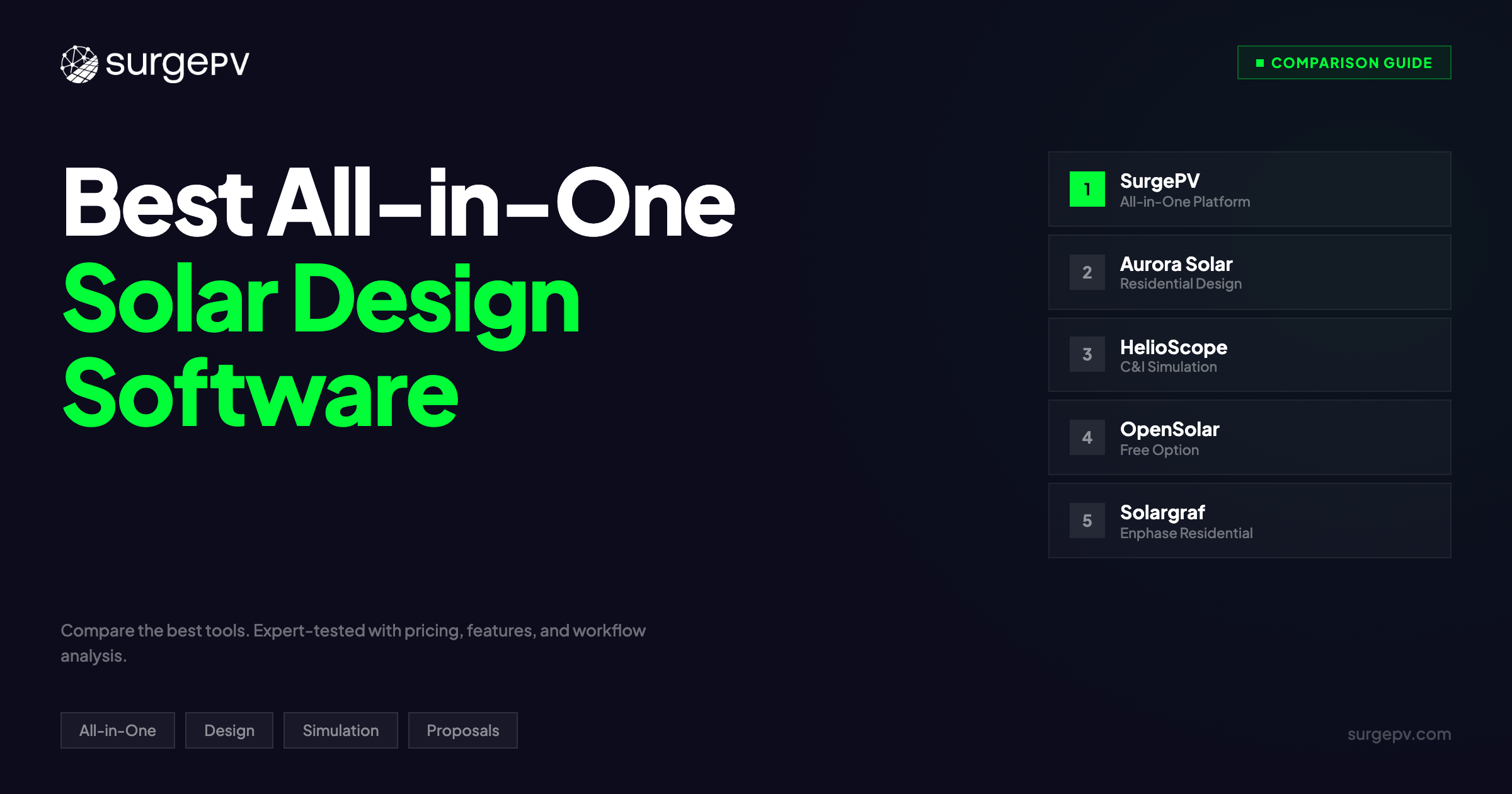
TL;DR: Most solar platforms call themselves “all-in-one” but still force you into AutoCAD for electrical documentation and a second tool for bankable simulation. SurgePV is the only platform that combines 3D design, automated SLD generation, P50/P90 simulation, and professional proposals in a single workflow — at $1,899/year for 3 users. Aurora Solar offers strong design and proposals but requires AutoCAD for SLDs. HelioScope delivers engineering-grade simulation without proposals. OpenSolar is a free basic option. Solargraf handles fast residential proposals with Enphase integration.
The solar software market has a terminology problem.
Every vendor labels their product “all-in-one.” But when you look at what “all-in-one” actually means in practice, most platforms cover two or three workflow steps and leave gaps that require additional tools. Aurora Solar handles design and proposals — but commercial EPCs still need AutoCAD at $2,000/year for single line diagrams. HelioScope runs DNV GL-validated simulations — but generates no proposals and produces only basic SLDs. OpenSolar covers design and proposals for free — but has no SLD generation for U.S. users and a 500 kW cap.
The result: installers and EPCs pay for a “complete” platform, then bolt on AutoCAD, a separate simulation tool, or a standalone proposal generator. The total cost climbs to $6,000-10,000/year. Data lives in three systems. Every project requires manual re-entry between tools.
This guide focuses specifically on platforms that combine design capabilities with other critical workflow steps — simulation, electrical engineering, and proposals. We are not comparing CRMs that bolt on basic design, or simulation tools that lack layout features. We tested each platform on a real 250 kW commercial rooftop and a 10 kW residential system, measuring design-to-proposal time, SLD generation capability, simulation accuracy, and total cost of ownership.
In this guide, you’ll find:
- 5 solar platforms ranked by design workflow completeness
- SLD generation comparison — which tools eliminate AutoCAD dependency
- Simulation accuracy benchmarks (P50/P90 capability)
- Total cost of ownership analysis including required add-on tools
- Buyer’s guide by company type, project scale, and budget
- Head-to-head comparison table with pricing
Who this guide is for:
- Solar installers handling both residential and commercial projects
- EPCs needing design-to-proposal workflows without tool switching
- Engineering teams evaluating whether to consolidate their software stack
- Companies paying for 3+ separate tools and considering consolidation
Quick Comparison: Best All-in-One Solar Design Software
| Feature | SurgePV | Aurora Solar | HelioScope | OpenSolar | Solargraf |
|---|---|---|---|---|---|
| Best For | Full-workflow EPCs | Residential sales | C&I simulation | Budget teams | Enphase residential |
| 3D Design | AI-powered | Industry-leading AI | Manual + satellite | Basic satellite | Satellite-based |
| SLD Generation | Automated (5-10 min) | No (requires AutoCAD) | Basic (requires AutoCAD export) | No (U.S. users) | DIY permit SLDs |
| Simulation | P50/P75/P90 bankable | P50 only | P50/P90 (DNV GL validated) | Basic estimates | Basic estimates |
| Proposals | Integrated, branded | Polished, visual | Technical reports only | Basic proposals | Fast 3-minute proposals |
| Wire Sizing | Automated | No | No | No | No |
| Carport Design | Native support | No | No | No | No |
| Platform | Cloud | Cloud | Cloud | Cloud | Cloud + mobile |
| Price/Year | $1,899 (3 users) | $2,640-6,000+/user | $1,620-2,640/user | Free | $2,799-12,999 |
| Our Rating | 9.3/10 | 8.5/10 | 8.0/10 | 7.5/10 | 7.0/10 |
What “All-in-One Design” Means in This Guide
We define all-in-one design software as platforms where the design step is central — not CRMs with basic layout tools. Each platform here starts with PV system design and extends into at least one additional workflow step (simulation, SLDs, or proposals). For CRM-focused all-in-one platforms, see our best all-in-one solar CRM and software guide.
Best All-in-One Solar Design Software: Detailed Reviews
SurgePV — Best True All-in-One Design Platform
Best for: Commercial EPCs and full-service installers needing design + SLDs + simulation + proposals
Pricing: $1,899/year for 3 users ($633/user/year). All features included.
Overall score: 9.3/10
SurgePV is the only cloud-based platform that covers the complete design workflow natively: 3D layout, automated SLD generation, bankable P50/P90 simulation, and branded proposals — without requiring AutoCAD or any third-party tools. That distinction matters because every other platform on this list requires at least one additional tool to complete a commercial project from design to deliverable.
Pro Tip
SurgePV’s automated SLD generation saves 2-3 hours per commercial project compared to manual AutoCAD drafting. For an EPC handling 15 commercial projects per month, that is 30-45 hours saved monthly — and the $2,000/year AutoCAD license is eliminated entirely. Book a demo to see SLD generation on a live project.
Key Design Features
- AI-powered roof modeling from satellite imagery — 70% faster than manual layout (15-20 min vs. 45-60 min)
- Automatic obstruction detection for chimneys, vents, parapets, and HVAC units
- Native carport and solar canopy design — the only platform with built-in carport structures
- Commercial flat-roof support with automatic setback calculations and row spacing optimization
- Single-axis and dual-axis tracker layouts for ground-mount projects
Electrical engineering:
- Automated SLD generation in 5-10 minutes vs. 2-3 hours in AutoCAD
- Wire sizing calculations with NEC 690 compliance
- DC/AC architecture diagrams with protection device specifications
- String sizing optimization based on inverter input ranges and temperature coefficients
- Permit-ready electrical documentation without any external CAD tool
- P50/P75/P90 energy yield simulation — within +/-3% accuracy vs. PVsyst
- 8760-hour shading analysis accounting for seasonal sun paths and near/far shading
- Temperature derating, soiling losses, module degradation, and inverter clipping modeled
- Bankable reports accepted by lenders for project financing
Proposals and financial modeling:
- Branded proposal templates with 3D system visualization
- Financial modeling with payback period, NPV, IRR, and monthly savings projections
- Cash, loan, and lease scenario comparison
- eSign integration for remote contract execution
- Equipment pricing database with automatic updates
Pricing
- Individual Plan: $1,899/year for 3 users ($633/user/year)
- For 3 Users: $1,499/user/year ($4,497/year total)
- For 5 Users: $1,299/user/year ($6,495/year total)
All plans include every feature. No tiered gating. No project credit limits. See full pricing details.
Real-World Example
A mid-size commercial EPC was paying $8,400/year for separate design (HelioScope Pro at $2,640), AutoCAD for SLDs ($2,000), PVsyst for simulation ($1,500), and PandaDoc for proposals ($2,400). After switching to SurgePV at $1,899/year, they cut software costs by 77% and reduced commercial project turnaround from 6-8 hours across four tools to 45 minutes in one platform.
Why haven’t more EPCs heard of SurgePV? Aurora Solar has spent hundreds of millions on marketing. HelioScope has the DNV GL validation brand recognition. SurgePV launched more recently but has powered 70,000+ projects globally. The platform was built specifically for the workflow gap that legacy tools leave open: automated electrical engineering integrated with design and simulation.
Want to test the full workflow? Book a demo to see automated SLD generation, bankable simulation, and proposals on your own project data.
Aurora Solar — Best for Residential Design and Proposals
Best for: High-volume residential installers prioritizing design speed and proposal quality
Pricing: $2,640-6,000+/user/year (contact sales) | Aurora Solar | Full Aurora Solar review
Overall score: 8.5/10
Aurora Solar is the market leader in AI-powered residential solar design. The platform combines LIDAR-based 3D roof modeling, 8760-hour shade analysis, and polished customer-facing proposals. For residential installers processing 50-100 quotes per month, Aurora’s design-to-proposal speed is a real competitive advantage.
But Aurora is not a true all-in-one design platform. There is no automated SLD generation — commercial EPCs need AutoCAD ($2,000/year extra). There is no P90 bankable simulation — Aurora provides P50 only. And proposal financial modeling, while polished, lacks the engineering depth that lenders require for commercial project financing.
Pros:
- Industry-leading AI roof detection — under 15 seconds per design with LIDAR integration
- Best 3D visualization quality for customer-facing proposals
- 8760-hour shade analysis with 2-3% margin of error
- 80,000+ module/inverter database with NEC-compliant validation
- 7,000+ companies and 20M+ designs — proven at massive scale
- Native Salesforce and HubSpot CRM integration
- Strong 24/7 support rated 9.0/10 on G2
Cons:
- No automated SLD generation — requires AutoCAD (~$2,000/year extra)
- P50 simulation only — no P75/P90 bankable outputs for lenders
- No carport, tracker, or East-West racking support
- Pricing not publicly listed — estimated $2,640-6,000+/user/year
- Steep learning curve for commercial workflows
- API access locked to Enterprise tier
- US-focused with limited international market coverage
Best for: High-volume residential installers in the US who prioritize same-day proposals and close rates over engineering depth. For commercial EPCs or teams needing SLDs, Aurora creates an expensive tool-switching requirement that eliminates the “all-in-one” value proposition.
The AutoCAD Problem
Aurora Solar’s lack of SLD generation is the single biggest gap for commercial EPCs. Every commercial project requires electrical single line diagrams for permitting. Without native SLD capability, Aurora users pay $2,000/year for AutoCAD and spend 2-3 hours per project manually drafting SLDs — then re-entering data that already exists in Aurora’s design. That is not “all-in-one.” That is “most-of-one plus AutoCAD.”
HelioScope — Best for Engineering-Grade C&I Simulation
Best for: Commercial and industrial project simulation with DNV GL-validated accuracy
Pricing: Basic $1,620/year; Pro $2,640/year; Enterprise custom | HelioScope | Full HelioScope review
Overall score: 8.0/10
HelioScope (owned by Aurora Solar since 2021) is a cloud-based design and simulation platform built for commercial and industrial projects in the 100 kW to 15 MW range. Its core strength is DNV GL-validated simulation accuracy — within 1% of PVsyst for module-level energy modeling. For engineering teams that prioritize simulation rigor over proposal polish, HelioScope delivers.
But HelioScope is a design and simulation tool, not a complete workflow platform. There are no integrated proposals. SLD output is basic and requires AutoCAD export for complete electrical documentation. Financial analysis rates 5.2/10 on G2. And a 10-project monthly cap on Basic and Pro plans limits throughput for high-volume EPCs.
Pros:
- DNV GL-validated simulation — within 1% of PVsyst accuracy
- Ease of use: 8.9/10 on G2 (highest among simulation tools)
- Sunstone Credit bankable recognition (October 2025) — first web-based platform
- 4x faster design iterations vs. manual CAD tools
- 40,000+ modules, 10,000+ inverters in database
- Cloud-based with no installation required
- 1,200 GW designed across 100+ countries
Cons:
- No proposal generation — requires separate tool
- Basic SLD output — requires AutoCAD for complete electrical documentation
- Financial analysis: 5.2/10 on G2 — weak financial modeling
- 10 projects/month cap on Basic and Pro plans
- 15 MW hard cap — not suitable for utility-scale above 15 MW
- No native battery/BESS modeling
- Performance lag above 5 MW or 10,000 modules
- No single-axis tracker support on Basic/Pro plans
Best for: Engineering teams at commercial EPCs who value simulation accuracy above everything else and already have separate tools for proposals and electrical documentation. Not suitable for teams wanting a single-platform workflow.
OpenSolar — Best Free All-in-One Design Option
Best for: Budget-conscious residential installers and startups
Pricing: Free forever (all features, unlimited users) | OpenSolar | Full OpenSolar review
Overall score: 7.5/10
OpenSolar is the only major solar design platform that is genuinely free — no per-seat fees, no contracts, unlimited users and projects. The platform covers design, proposals, e-signatures, CRM, and financing integration. For a solo installer or a startup that cannot justify $2,000-5,000/year in software, OpenSolar delivers 80% of what paid platforms offer at zero cost.
The trade-offs are real though. OpenSolar uses photogrammetry DSM (not LIDAR) for lower-precision shading. The 500 kW design cap means performance degrades on larger commercial projects. And there is no SLD generation for U.S. users — so American installers still need AutoCAD ($2,000/year) for permitting.
Pros:
- 100% free — unlimited users, unlimited projects, all core features
- Full design-to-proposal workflow including e-signatures and payments
- Ada AI voice-activated design (OS 3.0, 2026) for auto-design
- 28,000+ users in 185 countries
- 3rd-party validated accuracy (US Government agency + PVEL)
- Google-backed with $45M total funding
- Integrated financing marketplace with 20+ lenders
Cons:
- No SLD generation for U.S. users — requires AutoCAD ($2,000/year)
- 500 kW design cap — performance issues above this threshold
- Photogrammetry DSM (not LIDAR) — less precise shading than Aurora or SurgePV
- One module manufacturer per project — cannot mix brands
- No carport, tracker, or East-West racking support
- No advanced structures for commercial projects
- Data privacy concerns — revenue model relies on partners, not installers
Best for: Solo installers, 2-3 person startups, and small residential teams on tight budgets who need design and proposal capabilities without subscription costs. When you outgrow the 500 kW cap or need SLDs, upgrade to SurgePV.
Solargraf — Best for Fast Residential Proposals with Enphase
Best for: Residential installers using Enphase equipment who prioritize proposal speed
Pricing: $2,799-12,999/year (project credit system) | Solargraf
Overall score: 7.0/10
Solargraf (owned by Enphase Energy since 2021) is a mobile-first residential design and proposal platform. Its defining feature is speed: 3-minute proposal generation from satellite imagery with integrated Enphase Enlighten data validation. For Enphase-focused residential installers who prioritize closing speed over engineering depth, Solargraf fits.
But the gaps are significant for anyone beyond simple residential work. Shading accuracy variance of 10-20% vs. competitive tools is a frequent user complaint. Permit pack revision rates above 50% create downstream delays. Credit-based pricing penalizes commercial projects (5 credits each vs. 1 for residential). And there is no built-in CRM — Solargraf requires Zapier or API integrations.
Pros:
- 3-minute proposal generation — fastest in residential solar
- Enphase ecosystem integration with Enlighten data validation
- DIY permit generation with AHJ-compliant SLD output
- NEM 3.0 California support with CPUC 8760 hourly sell rates
- Express Editor for on-the-spot proposal changes during client meetings
- 25+ battery manufacturers supported including Tesla Powerwall
- Mobile-first design on PC, tablet, and iPad
Cons:
- Shading accuracy: 10-20% variance vs. competitive tools — most common complaint
- Permit packs: over 50% revision rate reported by verified users
- Credit-based pricing penalizes commercial work (5 credits per commercial project)
- No commercial structures — no carport, tracker, or East-West racking
- No built-in CRM — requires Zapier or API integrations
- Support response times have degraded since Enphase acquisition
- No manual shading override — cannot adjust per-site production estimates
- Annual-only billing — no monthly plan
Best for: Small residential installers using Enphase equipment who close deals during the initial sales visit and do not handle commercial projects. Not suitable for EPCs or teams needing engineering-grade accuracy.
The SLD Generation Gap: Why It Matters
The single biggest differentiator among all-in-one design platforms is automated SLD (single line diagram) generation. Here is why.
Every solar installation that goes through permitting requires electrical documentation. For residential projects, this means a single line diagram showing the DC/AC architecture, protection devices, grounding, and wire sizes. For commercial projects, the SLD is more complex — multiple inverters, combiners, disconnects, and utility interconnection details.
What Happens Without Native SLD Generation
When your design platform does not generate SLDs, here is the workflow:
- Complete the PV system design in your design tool (20-30 minutes)
- Open AutoCAD ($2,000/year license)
- Manually recreate the electrical architecture from your design tool’s specifications (1-3 hours)
- Cross-reference NEC 690 requirements for wire sizing and protection devices (30-60 minutes)
- Export the SLD as PDF and attach to your permit package
- If the design changes, repeat steps 2-5
Total time per commercial project: 2-4 hours of additional work after design is complete.
What Happens With Native SLD Generation (SurgePV)
- Complete the PV system design (20-30 minutes)
- Click “Generate SLD” — automated in 5-10 minutes
- SLD includes wire sizing, protection devices, and NEC-compliant documentation
- If the design changes, the SLD regenerates automatically
Total time: 5-10 minutes, included in the design workflow.
Annual Cost Impact
| Scenario | AutoCAD License | SLD Labor (15 projects/month) | Total Annual Cost |
|---|---|---|---|
| Aurora Solar + AutoCAD | $2,000/year | 30-60 hours/month at $50/hour = $18,000-36,000/year | $20,000-38,000/year |
| HelioScope + AutoCAD | $2,000/year | 30-60 hours/month at $50/hour = $18,000-36,000/year | $20,000-38,000/year |
| SurgePV (automated SLDs) | $0 | 2.5-5 hours/month (automated) | $0 marginal cost |
For a commercial EPC handling 15 projects per month, the SLD gap alone costs $20,000-38,000/year in tool costs and engineering labor. That dwarfs the subscription price difference between any of these platforms.
Further Reading
For a deep dive into SLD generation tools specifically, see our guide to the best solar SLD software.
Total Cost of Ownership: All-in-One vs. Multi-Tool
The subscription price of a design platform is only part of the cost. Here is the real total cost comparison for a typical commercial EPC.
Multi-Tool Workflow (Aurora Solar + Add-ons)
| Tool | Purpose | Annual Cost |
|---|---|---|
| Aurora Solar | Design + proposals | $2,640-6,000+/user/year |
| AutoCAD | SLD generation | $2,000/year |
| PVsyst | Bankable P50/P90 simulation | $900-1,500/year |
| PandaDoc | Proposal formatting and eSign | $1,200-2,400/year |
| Total | $6,740-11,900+/year |
Plus hidden costs:
- Data re-entry between 4 tools: 4-6 hours per commercial project
- Training across 4 platforms: 6-8 weeks to full productivity
- Integration maintenance: $200-500/month
Single-Platform Workflow (SurgePV)
| Tool | Purpose | Annual Cost |
|---|---|---|
| SurgePV | Design + SLDs + simulation + proposals | $1,899/year (3 users) |
| Total | $1,899/year |
Plus benefits:
- Single workflow: 30-45 minutes per commercial project
- Training on one platform: 2-3 weeks to full productivity
- Zero integration maintenance
Annual savings: $4,841-10,001+ per year — before counting the labor time saved on data re-entry and SLD drafting.
Replace Your Entire Design Tool Stack
Design, engineer, simulate, and generate proposals without AutoCAD or tool switching.
Book a DemoNo commitment required · 20 minutes · Live project walkthrough
Buyer’s Guide: Which Platform Fits Your Business?
By Company Type
| Your Business | Recommended Platform | Why | Alternative |
|---|---|---|---|
| Commercial EPC (all segments) | SurgePV | Only platform with design + SLDs + bankable simulation + proposals in one tool | Aurora + AutoCAD + PVsyst combo |
| High-volume residential installer | Aurora Solar or SurgePV | Aurora: fastest residential design. SurgePV: adds SLDs and engineering depth | Solargraf (Enphase shops) |
| Startup or solo installer | OpenSolar | Free forever with full design and proposals. No budget risk | SurgePV when scaling |
| Enphase-focused residential | Solargraf | Deep Enphase integration and fast mobile proposals | SurgePV for engineering |
| Engineering-first C&I team | HelioScope or SurgePV | HelioScope: DNV GL simulation. SurgePV: simulation + SLDs + proposals | PVsyst (desktop) |
By Project Type
| Project Type | Best Platform | Why |
|---|---|---|
| Residential rooftop (under 15 kW) | Aurora Solar, SurgePV, or OpenSolar | Aurora: proposal speed. SurgePV: complete workflow. OpenSolar: free |
| Commercial rooftop (100 kW-5 MW) | SurgePV | Only platform with automated SLDs + bankable P50/P90 + proposals |
| Carport and solar canopy | SurgePV | Only platform with native carport design capabilities |
| Ground-mount (under 15 MW) | HelioScope or SurgePV | HelioScope: simulation depth. SurgePV: complete workflow with SLDs |
| Utility-scale (above 15 MW) | Not covered here | Use dedicated tools like PVcase or RatedPower |
By Budget
| Annual Budget | Recommended Platform | What You Get |
|---|---|---|
| $0 | OpenSolar | Full design + proposals. No SLDs for U.S. users. 500 kW cap |
| Under $2,000/year | SurgePV ($1,899/year) | Complete workflow: design + SLDs + simulation + proposals for 3 users |
| $2,500-5,000/year | Aurora Solar or Solargraf | Aurora: design + proposals (no SLDs). Solargraf: fast residential proposals |
| $5,000-10,000/year | Aurora + AutoCAD + PVsyst | Full workflow but fragmented across 3 tools with data re-entry |
Pro Tip
If you handle both residential and commercial projects, choose the platform that covers your hardest workflow — commercial design with SLDs and bankable simulation. Any platform that handles commercial complexity handles residential easily. The reverse is not true. Aurora Solar and Solargraf are built for residential speed, and commercial projects expose their engineering gaps.
What to Look For in All-in-One Design Software
Design Capabilities
The design engine is the foundation. Look for:
- AI-powered roof modeling — satellite imagery recognition that detects roof planes, tilt, azimuth, and obstructions automatically. Manual modeling adds 30-45 minutes per project.
- Commercial structure support — flat roofs with setback calculations, carports, trackers, ground-mount. If your platform only handles residential pitched roofs, commercial projects require a second tool.
- Panel placement optimization — automatic layout that maximizes generation while respecting fire codes, setbacks, and structural constraints.
Electrical Engineering
This is where most “all-in-one” platforms fall short:
- SLD generation — automated single line diagrams for permitting. Without this, you need AutoCAD.
- Wire sizing — automatic DC and AC wire sizing based on NEC 690, accounting for voltage drop, temperature derating, and conduit fill.
- String sizing — inverter MPPT range validation with temperature coefficient calculations.
Only SurgePV automates all three natively among the platforms reviewed.
Simulation Accuracy
Bankable simulation separates professional tools from basic calculators:
- P50/P90 outputs — lenders require P90 estimates for project financing. If your tool only provides P50, commercial projects require a separate simulation tool.
- 8760-hour analysis — hourly simulation for every day of the year, not monthly averages. Monthly averages can be off by 20-30%.
- Loss modeling — temperature, soiling, degradation, mismatch, cable losses, and inverter clipping. Missing any of these inflates your production estimates.
Proposal Generation
The proposal is what the customer sees. Evaluate:
- Financial modeling — payback period, NPV, IRR, monthly savings, cash vs. loan vs. lease scenarios. See our guide to financial modeling tools.
- Branded templates — your company logo, colors, and formatting. Generic proposals lose deals.
- eSign integration — remote contract signature without printing, scanning, or mailing.
- 3D visualization — showing customers what their system looks like on their roof or property.
Further Reading
For design-only platform comparisons, see our guide to the best solar design software. For residential-specific recommendations, see best residential solar software.
When You May Not Need All-in-One Design Software
Not every company benefits from platform consolidation. Consider keeping separate tools if:
- You only do simulation and consulting — If you run feasibility studies without generating designs or proposals, PVsyst or HelioScope as standalone simulation tools may be sufficient.
- Your volume is under 5 projects per year — At very low volumes, manual AutoCAD workflows and free tools like PVWatts may be more cost-effective than annual subscriptions.
- You outsource electrical engineering entirely — If a separate bureau handles all SLD work, the SLD generation feature is less valuable.
- You are a utility-scale developer — Projects above 15 MW need specialized ground-mount tools like PVcase or RatedPower. All-in-one design platforms are optimized for residential and commercial.
For most installers and EPCs handling 10+ projects per month across residential and commercial, an all-in-one design platform saves $5,000-10,000/year in software costs and 20-40 hours/month in manual work.
Bottom Line: Best All-in-One Solar Design Software
For commercial EPCs needing complete design workflows: SurgePV is the only platform that eliminates AutoCAD dependency with native SLD generation, delivers bankable P50/P90 simulation accuracy, and generates branded proposals — all in one workflow at $633/user/year.
For high-volume residential sales: Aurora Solar offers the fastest AI-powered design and the most polished customer-facing proposals. Budget $4,640-8,000/year when you add AutoCAD for SLDs.
For engineering-focused C&I teams: HelioScope delivers DNV GL-validated simulation accuracy at $1,620-2,640/year. Add AutoCAD ($2,000) and a proposal tool ($1,200+) for complete workflows.
For startups on zero budget: OpenSolar is free forever with full design and proposal capabilities. The 500 kW cap and lack of U.S. SLD generation are real limitations you will outgrow.
For Enphase residential shops: Solargraf delivers the fastest proposals at 3 minutes with deep Enphase integration. Accuracy concerns and credit-based pricing limit scalability.
Your solar design software choice determines how many projects your team can quote per week, how much you spend on redundant tools, and whether your commercial bids include bankable documentation that lenders accept. Every week spent switching between three tools is a week your competitors spend closing deals with a single platform.
See the Full Design-to-Proposal Workflow
3D design, automated SLDs, bankable simulation, and branded proposals. One platform. No AutoCAD.
Book a DemoNo commitment required · 20 minutes · Live project walkthrough
Transparency Note
SurgePV publishes this content. We compare SurgePV honestly against competitors and acknowledge where Aurora Solar leads in residential design speed, HelioScope leads in simulation validation, OpenSolar leads on free access, and Solargraf leads on Enphase integration. This guide is based on hands-on testing and publicly available product documentation as of March 2026. See our editorial standards.
Frequently Asked Questions
What is the best all-in-one solar design software in 2026?
SurgePV is the best all-in-one solar design software in 2026, combining AI-powered 3D design, automated SLD generation, bankable P50/P90 simulation, and branded proposals in one cloud-based platform — without requiring AutoCAD. Pricing starts at $1,899/year for 3 users with all features included. Aurora Solar leads on residential design speed but requires AutoCAD for SLDs. HelioScope delivers the most validated simulation engine but lacks proposals and complete electrical documentation. OpenSolar is the best free option for budget teams.
Do I need AutoCAD with solar design software?
It depends on your platform. With SurgePV, no — automated SLD generation eliminates AutoCAD entirely. With Aurora Solar, HelioScope, or OpenSolar (U.S. users), yes — these platforms do not generate complete electrical single line diagrams, so you need AutoCAD ($2,000/year) or a similar CAD tool for permitting documentation. Solargraf includes DIY permit SLDs for residential projects, but verified users report a 50%+ revision rate. For commercial EPCs, the AutoCAD dependency adds $2,000/year in licensing and 2-3 hours per project in manual SLD drafting.
What is the difference between all-in-one solar CRM software and all-in-one design software?
All-in-one CRM software (like Salesforce-based solar platforms or Sunbase) starts with lead management and sales automation, adding basic design capabilities as secondary features. All-in-one design software (covered in this guide) starts with professional PV system design and extends into simulation, electrical engineering, and proposals. For teams that prioritize technical accuracy and engineering workflows, design-first platforms are the better foundation. For sales-driven teams prioritizing pipeline velocity, CRM-first platforms may fit better. SurgePV bridges both — full design depth with integrated CRM. See our all-in-one CRM platform guide for CRM-focused comparisons.
How much does all-in-one solar design software cost?
All-in-one solar design software ranges from free (OpenSolar) to $12,999/year (Solargraf Enterprise). SurgePV costs $1,899/year for 3 users ($633/user/year) with all features including automated SLD generation. Aurora Solar costs $2,640-6,000+/user/year (plus $2,000 for AutoCAD). HelioScope costs $1,620-2,640/user/year (plus $2,000 for AutoCAD and $1,200+ for a proposal tool). When comparing prices, factor in add-on tools: platforms without SLD generation require AutoCAD, and platforms without proposals require PandaDoc or similar. See SurgePV pricing for plan details.
Can all-in-one design software replace PVsyst for bankable simulation?
SurgePV delivers P50/P75/P90 simulation accuracy within +/-3% of PVsyst, which is sufficient for most commercial project financing. HelioScope is DNV GL-validated within 1% of PVsyst and has Sunstone Credit bankable recognition. For projects requiring universal lender acceptance — large utility-scale deals, institutional financing, or due diligence by major banks — PVsyst reports may still be preferred. For commercial rooftop projects under 5 MW, SurgePV and HelioScope simulation reports are increasingly accepted by lenders. Aurora Solar provides P50 only, which is not sufficient for bankable reporting. OpenSolar and Solargraf provide basic estimates only.
Sources
- SurgePV Product Documentation — Official feature specifications and proof points (accessed March 2026)
- Aurora Solar — Official website — Product features and G2 review data (accessed March 2026)
- HelioScope by Aurora Solar — Official website — Pricing, DNV GL validation documentation (accessed March 2026)
- OpenSolar — Official website — Feature specifications and funding history (accessed March 2026)
- Solargraf by Enphase — Official website — Pricing and feature documentation (accessed March 2026)
- G2 Solar Software Reviews — G2 review data — User ratings and feature satisfaction scores (accessed March 2026)
- Autodesk AutoCAD Pricing — Official pricing — Annual subscription cost (accessed March 2026)