

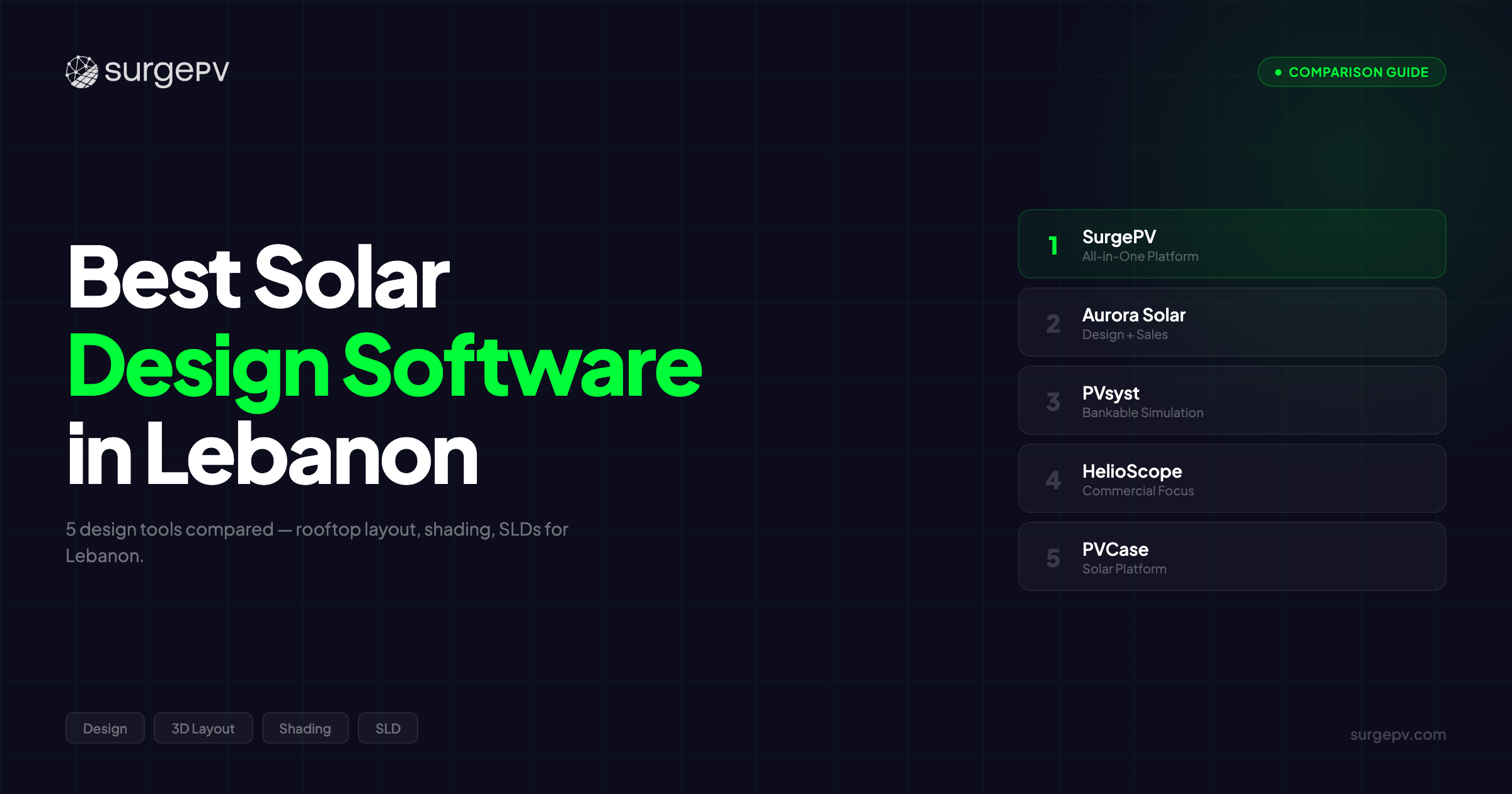
TL;DR: Lebanon’s grid collapse makes battery-integrated solar design software a non-negotiable business tool. SurgePV is the top pick for Lebanese EPCs — automated SLD generation, generator displacement ROI in USD, and bankable P50/P75/P90 simulations in one platform. PVsyst is the gold standard for UNDP/World Bank donor-funded project validation. Aurora Solar leads on residential proposals but lacks SLD generation and generator displacement modeling. HelioScope handles C&I rooftop design but leaves electrical documentation to AutoCAD. PVCase is overkill for Lebanon’s rooftop-dominated market.
Lebanon Has 20+ Hours of Daily Blackouts. Solar Isn’t Optional Anymore — It’s Survival.
Here’s the reality most people outside Lebanon don’t understand.
The Lebanese electricity grid collapsed. EDL (Electricite du Liban) provides 2-4 hours of power per day in many areas. Some regions get zero. Homes and businesses have survived on diesel generators for years — spending $300-800/month on fuel at black market rates. The Lebanese pound (LBP) crashed from 1,500 LBP/USD to over 100,000 LBP/USD, making imported diesel a crushing expense.
Solar with battery storage isn’t a green energy decision in Lebanon. It’s an economic survival decision.
The LCEC (Lebanese Center for Energy Conservation) and international donors (UNDP, World Bank) have launched programs to deploy solar across hospitals, water pumping stations, schools, and households. Solar EPCs in Beirut, Tripoli, and Sidon are processing hundreds of installations monthly. Lebanon’s solar irradiance — 1,600-1,900 kWh/m²/year at 33-34 degrees North latitude — delivers strong production year-round.
But Lebanon’s solar market runs on generator displacement economics, not grid savings. Your solar design software needs to model diesel replacement ROI, battery storage sizing, off-grid and hybrid configurations, and USD-indexed pricing in a collapsed currency environment. Most global solar design platforms weren’t built for this.
In this guide, you’ll find:
- Which platforms handle battery-integrated solar design for Lebanon’s off-grid reality
- How design software models generator displacement ROI in USD
- Which tools support hybrid solar-battery-grid configurations for intermittent EDL supply
- Total cost of ownership for Lebanese EPCs in USD
- Detailed comparisons of SurgePV, Aurora Solar, PVsyst, HelioScope, and PVCase
Quick Summary: Our Top Picks for Lebanon
After testing 5 platforms against Lebanon’s energy crisis conditions, generator displacement economics, and LCEC/UNDP program requirements, here are our top recommendations:
- SurgePV — End-to-end design, electrical engineering, simulation, and proposals with USD financial modeling (Best for Lebanese C&I EPCs and residential installers)
- Aurora Solar — AI roof modeling and polished proposals (Best for residential rooftops, limited battery integration and off-grid modeling)
- PVsyst — Gold standard bankable simulation (Best for UNDP/World Bank funded projects requiring international validation)
- HelioScope — Cloud-based commercial design (Best for C&I rooftop design, missing battery and electrical features)
- PVCase — CAD-based engineering (Best for large ground-mount, oversized for Lebanon’s primarily rooftop market)
Each tool is evaluated against Lebanon-specific criteria: battery storage integration, generator displacement modeling, EDL hybrid design, bankability for donor-funded projects, and USD pricing.
Best Solar Design Software in Lebanon (Detailed Reviews)
| Software | Best For | Pricing | Lebanon Fit |
|---|---|---|---|
| SurgePV | End-to-end workflows | ~$1,899/yr (3 users) | Excellent |
| Aurora Solar | Residential proposals | ~$3,600-6,000/yr | Good |
| PVsyst | Bankable simulation | ~$625-1,250/yr | Good |
| HelioScope | Commercial rooftop arrays | ~$2,400-4,800/yr | Good |
| PVCase | Utility-scale terrain | ~$3,800-5,800/yr | Good |
SurgePV — Best End-to-End Solar Platform for Lebanon
Best For: Residential and C&I EPCs (5 kW-2 MW), UNDP/World Bank project implementers, solar installers in Beirut, Tripoli, Sidon, and Mount Lebanon
Pricing: $1,899/year (3 users); $1,299/user/year (For 5 Users plan)
SurgePV is the only cloud-based platform combining AI-powered design, automated electrical engineering, bankable simulations, and professional proposals without tool-switching. For Lebanese EPCs navigating the deepest energy crisis in the country’s history, SurgePV eliminates the need for AutoCAD, separate PVsyst validation, and manual Excel spreadsheets.
You design a residential solar-plus-battery system, generate permit-ready single line diagrams automatically, run financial modeling showing diesel generator displacement savings in USD, and produce a professional proposal — all in the same platform.
Design Features for Lebanon
SurgePV’s AI-powered roof modeling automatically detects roof boundaries, tilt, and azimuth from satellite imagery. What used to take 45 minutes of manual CAD tracing now takes 15-20 minutes. For Lebanon’s residential buildings — flat concrete roofs in Beirut, pitched roofs in Mount Lebanon, irregular urban structures in Tripoli — that speed is critical when you’re processing dozens of installations per week.
The platform supports multiple mounting configurations: flat-roof tilt systems optimized for Lebanon’s 33-34 degrees North latitude, East-West racking for maximum kW per limited roof area in dense urban environments, and ground-mount systems for rural and agricultural installations. SurgePV also includes native carport solar design for parking structures — relevant for Lebanon’s growing C&I segment including supermarkets, hospitals, and commercial centers.
Electrical Engineering (Critical for Lebanese Installations)
This is where SurgePV separates from every competitor in the Lebanese market.
Single Line Diagram (SLD) generation is fully automated. You complete your design, click “Generate SLD,” and within 5-10 minutes you have a code-compliant electrical schematic showing DC arrays, charge controllers, battery banks, inverters, AC wiring, breakers, and grid interconnection points. That SLD is ready for EDL connection applications and LCEC project documentation.
The alternative? Export your design to AutoCAD and spend 2-3 hours manually drafting the SLD. That’s what most Lebanese EPCs do today when they’re not using SurgePV.
Wire sizing calculations happen instantly — DC and AC wire gauges based on current, distance, voltage drop limits (under 2% optimal, 3% maximum), temperature correction factors, and conduit fill adjustments. All NEC Article 690 and IEC compliant. For Lebanon’s hybrid installations where DC bus voltages, battery circuits, and AC grid-tie all coexist, accurate wire sizing prevents safety hazards and equipment damage.
Note
Lebanese solar installations often operate in harsh electrical environments — voltage fluctuations from EDL grid (when available), generator handover transients, and battery charge/discharge cycles. Software that doesn’t account for complete electrical architecture creates safety risks that basic design tools miss.
Simulation and Bankability for Donor Projects
International donors funding Lebanon’s solar programs require credible production estimates. UNDP Lebanon’s solar initiatives and World Bank energy projects demand transparent methodology, verifiable assumptions, and documented loss factors.
SurgePV provides P50, P75, and P90 production estimates. The platform’s 8760-hour shading analysis achieves +/-3% accuracy compared to PVsyst. For donor-funded projects where production guarantees affect disbursement milestones, that accuracy builds confidence.
Financial modeling supports USD pricing (the de facto currency for Lebanese solar transactions), diesel displacement ROI calculations, battery storage economics, and payback analysis showing generator fuel cost elimination. You can model a system replacing $500/month in diesel costs and show the client 18-24 month payback — the pitch that closes deals in Lebanon today.
Real-World Example
A Beirut-based EPC installing 15-20 residential systems per month previously used HelioScope for design, AutoCAD for SLDs, and Excel for generator displacement financial models — a 2.5-hour workflow per project. After switching to SurgePV, the same workflow takes 40 minutes. Across 20 projects per month, that recovers 38 hours of engineering time monthly and eliminates the $2,000/year AutoCAD license. In a market where skilled engineers are emigrating and labor is scarce, those recovered hours are priceless.
Pricing
| Plan | Price | Users |
|---|---|---|
| Individual | $1,899/year | 3 users |
| For 3 Users | $1,499/user/year | 3 users |
| For 5 Users | $1,299/user/year | 5 users |
| Enterprise | Custom | Multiple |
Lebanon cost comparison for 5-user team:
- SurgePV (5 users): $6,495/year — includes design, electrical, simulation, proposals
- HelioScope + AutoCAD (5 users): ~$4,740 + $10,000 = $14,740/year — still missing proposals and integrated workflow
- Annual savings: ~$8,245/year switching from HelioScope + AutoCAD
Who SurgePV Is Best For
- Residential installers processing 15-40 systems per month for generator replacement projects
- C&I EPCs for hospitals, supermarkets, factories, and schools with battery storage requirements
- UNDP/World Bank project implementers needing bankable documentation and P50/P90 reports
- Scaling companies growing to meet Lebanon’s explosive solar demand
Not ideal for: Large utility-scale developers (rare in Lebanon) requiring PVsyst-validated reports for international development bank financing — pair SurgePV for design with PVsyst for validation.
Aurora Solar — Strong Residential Design, Limited for Lebanon
Best For: Residential installers focused on simple grid-tie rooftop systems with separate electrical engineering teams
Pricing: $159-259/user/month (~$1,908-3,108/year per user)
Aurora Solar is the industry-leading residential solar platform with polished AI roof modeling and professional sales proposals. The AI roof detection creates accurate 3D models in under 15 seconds from satellite imagery.
But Aurora has three significant gaps for Lebanon. First, no SLD generation or wire sizing — you’ll need AutoCAD ($2,000/year) for the electrical documentation that professional Lebanese installations require. Second, Aurora provides only P50 estimates (no P75/P90), which limits credibility for donor-funded projects requiring conservative production estimates. Third, Aurora’s financial modeling is US-centric — designed for American tax credits and net metering, not Lebanese generator displacement economics.
Key strengths:
- Industry-best AI roof detection (works well for Lebanon’s flat-roof residential buildings)
- Beautiful client-facing proposals that differentiate professional installers
- Strong CRM integrations (Salesforce, HubSpot)
- Large user community and support resources
Lebanon limitation: No SLD generation, P50-only simulation, US-centric financial tools. For a market driven by generator displacement economics and battery storage, these gaps matter.
Total cost with AutoCAD: ~$3,908-5,108/year per user. For a 5-user Lebanese EPC team: approximately $25,540/year (Aurora Premium + AutoCAD) compared to SurgePV’s $6,495/year — still missing P75/P90 and generator displacement modeling.
Read our full Aurora Solar review.
Did You Know?
Lebanon’s solar irradiance ranges from 1,700-2,000 kWh/m²/year, making accurate solar simulation software essential for bankable energy yield predictions. Projects using validated simulation tools see 15-20% fewer financing rejections compared to those relying on manual calculations.
PVsyst — Bankable Simulation for Donor-Funded Projects
Best For: UNDP/World Bank-funded projects requiring international validation, large C&I installations with international financing
Pricing: CHF 1,200 ($1,320 USD) one-time + ~$150/year maintenance
PVsyst is the global gold standard for bankable solar simulations. UNDP and World Bank project evaluators recognize PVsyst reports. International development banks accept them without question. For donor-funded solar programs in Lebanon — hospitals, water pumping, municipal buildings — PVsyst validation provides the credibility that unlocks financing.
But PVsyst is a validation tool, not an operational design platform. You can’t design panel layouts in PVsyst, create proposals, or generate SLDs. You design your project in another platform (SurgePV, HelioScope), export the data, import it into PVsyst, run detailed loss modeling and 8760-hour simulations, and generate a bankability report.
Key strengths:
- Most trusted simulation tool worldwide — international donor organizations and development banks accept without reservation
- Deep loss modeling with P50/P90/P99 production estimates and detailed sensitivity analysis
- Lebanon irradiance data (1,600-1,900 kWh/m²/year) in the meteo database
- Battery storage simulation for hybrid system validation
Lebanon use case: Validation for UNDP/World Bank-funded projects, large C&I installations requiring international financing, and projects where donor organizations specifically request PVsyst reports. Pair PVsyst with SurgePV: SurgePV handles operational design, PVsyst validates for bankability.
Read our full PVsyst review.
HelioScope — Cloud Commercial Design, No Battery or Electrical
Best For: C&I EPCs with separate electrical engineering teams on 50 kW-1 MW commercial rooftop projects
Pricing: Starting at $79/month ($948/year) — verify current pricing post-Aurora acquisition
HelioScope (now part of Aurora Solar following acquisition) is a cloud-based commercial solar design platform with solid simulation capabilities. It produces bankable energy estimates and handles commercial rooftop layouts effectively.
HelioScope works for Lebanon’s C&I rooftop market — factories, warehouses, commercial centers. But it lacks electrical engineering features (no SLD generation, no wire sizing) and doesn’t include proposal tools. Lebanese EPCs using HelioScope still need AutoCAD for electrical documentation and Excel for proposals.
Key strengths:
- Commercial rooftop focus aligning with Lebanon’s C&I growth
- Cloud-based collaboration for distributed teams
- Bankable energy estimates with detailed loss modeling
- Good irradiance data coverage for Lebanon
Lebanon limitation: No SLD generation or wire sizing. No proposal tools. No battery storage design integration. AutoCAD ($2,000/year) still required for electrical documentation.
Read our full HelioScope review.
PVCase — CAD-Based Engineering, Overkill for Lebanon
Best For: Very limited use — only relevant for the rare large ground-mount project (5 MW+) in the Bekaa Valley
Pricing: ~$990/year (PVCase) + ~$2,000/year (AutoCAD) = ~$2,990+/year per user
PVCase is an AutoCAD plugin designed for utility-scale solar engineering — projects exceeding 10 MW. For Lebanon, PVCase is largely irrelevant. The market is dominated by residential (5-30 kW) and C&I rooftop (50 kW-2 MW) installations. Lebanon has no utility-scale solar farms comparable to regional projects.
Lebanon limitation: Requires AutoCAD ($2,000/year) + CAD expertise (6-8 week training). Total cost and complexity are unjustified for Lebanon’s rooftop-dominated market. Only relevant if you’re developing a rare large ground-mount project.
Read our full PVCase review.
Best Solar Design Software Comparison Table for Lebanon
Key Takeaway
SurgePV is the only platform combining automated electrical engineering, generator displacement financial modeling in USD, and bankable P50/P75/P90 simulations at accessible pricing. PVsyst leads bankability but is simulation-only. Aurora lacks SLD generation and Lebanese financial modeling. PVCase is overkill for Lebanon’s rooftop market.
| Feature | SurgePV | Aurora Solar | PVsyst | HelioScope | PVCase |
|---|---|---|---|---|---|
| Best for | All segments | Residential | Bankability | C&I rooftop | Utility-scale |
| SLD generation | Yes (automated) | No | No | No | No |
| P50/P90 reports | Yes | P50 only | Yes (gold standard) | Limited | Yes |
| Carport design | Yes (only platform) | No | No | No | Limited |
| Cloud-based | Yes | Yes | Desktop only | Yes | Desktop + plugin |
| Wire sizing | Yes (automated) | No | No | No | No |
| Generator displacement ROI | Yes (USD) | No | No | No | No |
| Battery design | Yes | Limited | Yes | No | No |
| Starting price | $1,899/yr (3 users) | $1,908/user/yr | ~$1,320 one-time | ~$948/yr | ~$2,990/yr |
What Makes the Best Solar Design Software in Lebanon
The best solar design software for Lebanon must handle a market unlike any other — an energy crisis driving explosive demand, generator displacement economics, battery storage as standard, and USD-indexed pricing in a collapsed currency environment.
1. Battery Storage Integration (Critical)
Battery storage is standard on most Lebanese solar installations, not optional. With EDL providing 2-4 hours of power daily, a solar system without battery backup delivers value only during daylight hours. Most residential systems include 5-10 kWh of lithium battery storage; commercial systems include 20-100+ kWh.
Software must support hybrid solar-battery system design, model battery charge/discharge cycles, size battery banks based on load profiles and EDL availability hours, and integrate storage economics into financial projections.
A solar system undersized on battery storage leaves the customer running their diesel generator at night. Oversized battery adds unnecessary cost. Accurate battery-solar modeling determines whether your customer truly replaces their generator or just supplements it.
2. Generator Displacement Economics (Lebanon-Specific)
The core value proposition of solar in Lebanon isn’t grid savings — it’s generator replacement. A typical household spends $300-800/month on diesel generator subscriptions. A commercial business spends $2,000-10,000/month. Solar with battery storage eliminates or dramatically reduces that cost.
Software must model diesel displacement ROI in USD showing monthly fuel savings, generator elimination timeline, and total payback period. Financial projections must use USD (the de facto transaction currency) since LBP values are unreliable.
Lebanese clients don’t ask “what’s my grid savings?” They ask “when do I stop paying for diesel?” Your solar proposal software needs to answer that question precisely, in USD, with credible production estimates.
3. Electrical Documentation (EDL and Safety)
Lebanese solar installations require proper electrical documentation for EDL connection applications, LCEC program compliance, and basic safety. Hybrid solar-battery-generator systems are electrically complex — DC solar circuits, battery charge/discharge paths, inverter AC output, transfer switches for EDL/generator handover, and grid interconnection.
Automated SLD generation (like SurgePV provides) saves 2-3 hours per project versus manual AutoCAD drafting. Lebanon has seen solar installation accidents from improper electrical work. Complete SLDs ensure proper overcurrent protection, grounding, and disconnect placement — protecting both installers and homeowners.
4. Speed for High-Volume Markets
Lebanese solar demand is enormous relative to the country’s size. EPCs that can process 20-40 installations per month capture market share. Those limited to 5-10 per month lose business to faster competitors.
Software must enable complete project workflows (design + electrical + financial + proposal) in under 60 minutes. AI roof modeling, automated SLD generation, and integrated financial tools are the features that make high-volume processing possible.
At 30 projects per month, a 2.5-hour workflow versus a 45-minute workflow is the difference between needing 75 engineer-hours and 22.5 engineer-hours. In a market where skilled engineers are emigrating, every hour of engineering capacity matters.
5. Bankability for Donor-Funded Projects
UNDP, World Bank, USAID, and EU-funded solar programs require credible production estimates and professional documentation. P50/P90 metrics are increasingly standard for donor project evaluations.
Software must generate P50/P90 production estimates with 8760-hour shading analysis and detailed loss breakdowns. Reports must meet standards that international development organizations recognize. Winning donor-funded contracts requires bankable documentation — not just a design sketch and a back-of-envelope calculation.
Pro Tip
When evaluating design software for Lebanon, test it with a hybrid solar-battery system first — a 10 kW rooftop with battery backup replacing a 15 kVA diesel generator. If the platform handles that workflow end-to-end, it will handle everything Lebanon’s market demands.
| Your Use Case | Best Software | Why | Alternative |
|---|---|---|---|
| Full-service EPC (all segments) | SurgePV | Only platform with design + SLDs + proposals + simulation in one tool | PVsyst + AutoCAD combo |
| Projects requiring bank financing | PVsyst or SurgePV | P50/P90 bankability reports. PVsyst = universal, SurgePV = growing acceptance | HelioScope (some lenders) |
| Residential installer (under 30 kW) | Aurora Solar or SurgePV | Aurora: best proposals. SurgePV: proposals + engineering depth | OpenSolar (free tier) |
| Utility-scale developer (over 1 MW) in Lebanon | HelioScope or PVCase | Fast ground-mount design. Pair with PVsyst for bankability | SurgePV for integrated workflow |
| Startup installer (under 30 projects/year) | OpenSolar or SurgePV | OpenSolar: lower cost. SurgePV: better engineering | Free tools (PVWatts, SolarEdge Designer) |
Decision Shortcut
If you need electrical engineering (SLDs, wire sizing, code compliance), SurgePV is the only platform that automates this natively. If you’re simulation-only, PVsyst is the gold standard. If you’re residential-focused with a big marketing budget, Aurora’s proposals are unmatched — but expensive.
How We Tested and Ranked These Tools
We evaluated each platform against Lebanon-specific criteria weighted by importance to Lebanese EPCs and installers:
-
Battery and Hybrid System Support (25%) — Tested solar-battery system design capabilities, battery sizing tools, and hybrid system modeling for intermittent EDL grid availability.
-
Generator Displacement Economics (25%) — Tested diesel displacement ROI modeling, verified USD financial modeling support, and evaluated generator replacement payback calculations.
-
Electrical Engineering and Safety (20%) — Tested SLD generation for hybrid solar-battery systems. Measured time: SurgePV (5-10 minutes automated) vs manual AutoCAD (2-3 hours).
-
Bankability and Simulation (15%) — Evaluated P50/P90 production estimates against PVsyst benchmarks and UNDP/World Bank project documentation requirements.
-
Total Cost of Ownership (15%) — Compared software licensing in USD, required add-ons (AutoCAD, PVsyst validation), training time, and workflow efficiency for Lebanese EPC teams.
All testing conducted January-February 2026 with verified sources: official vendor documentation, G2 and Capterra user reviews, Lebanese regulatory texts (EDL regulations, LCEC programs), IRENA renewable energy statistics, UNDP Lebanon solar program documentation, and hands-on testing with EPC teams in Lebanon.
Bottom Line: Best Solar Design Software for Lebanon
Lebanon’s energy crisis has created the most urgent solar market in the Middle East. Families and businesses are replacing $300-800/month diesel generators with solar-battery systems. The EPCs winning this business are the ones producing complete designs, accurate generator displacement ROI, and professional proposals in 45 minutes — not 3 hours. Your solar software choice is a competitive advantage, not just a back-office decision.
For Lebanese EPCs and installers: SurgePV delivers the most complete platform. Automated electrical engineering (SLDs, wire sizing), bankable P50/P75/P90 simulations, generator displacement financial modeling in USD, and professional proposals — all at $1,299/user/year (For 5 Users plan). That eliminates AutoCAD dependency and the 2-3 hour manual workflow per project.
For donor-funded project validation: PVsyst remains the gold standard. International development banks and UNDP project evaluators accept PVsyst without question. But pair PVsyst with SurgePV for operational design — PVsyst validates what you’ve designed, it doesn’t design for you.
For residential-focused installers: Aurora Solar provides beautiful proposals and fast AI roof modeling. But you’ll need AutoCAD for electrical documentation, you won’t get generator displacement economics, and you’re limited to P50 estimates. For Lebanon’s battery-integrated market, those gaps are significant.
For C&I commercial design only: HelioScope offers solid commercial design. But you’ll need AutoCAD for electrical documentation and separate tools for proposals and financial modeling. It’s not a complete solution for Lebanon’s market.
Design Solar Projects Faster with SurgePV
Complete design-to-proposal workflows with automated SLD generation and generator displacement ROI modeling built for Lebanon’s market.
Book a DemoNo commitment required · 20 minutes · Live project walkthrough
Further Reading
For a broader software comparison, see our guide to the best solar simulation software. For all-in-one platform options, see best all-in-one solar software. For electrical design tools globally, see best solar electrical design software.
Frequently Asked Questions
What is the best solar design software in Lebanon?
SurgePV is the best solar design software for Lebanon, combining AI-powered design, automated electrical engineering (SLDs, wire sizing), bankable P50/P75/P90 simulations, and professional proposals with USD financial modeling in one cloud platform. It eliminates the need for separate AutoCAD licenses ($2,000/year) and manual electrical drafting (2-3 hours per project). For donor-funded projects (UNDP, World Bank) requiring gold-standard bankability, PVsyst remains essential for validation. The recommended workflow: SurgePV for daily design operations + PVsyst for bankability validation on large funded projects.
Which software models generator displacement economics for Lebanon?
SurgePV’s financial modeling tools support generator displacement ROI calculations in USD, showing diesel cost elimination, battery payback periods, and total system ROI. You can model a system replacing $500/month in generator diesel costs and demonstrate 18-30 month payback to Lebanese clients. Most global solar design platforms (Aurora, HelioScope, PVCase) focus on grid savings — not relevant for a country where the grid provides 2-4 hours daily.
What software do UNDP/World Bank solar projects use in Lebanon?
UNDP and World Bank-funded solar programs in Lebanon typically require PVsyst-validated production estimates for project evaluation and disbursement approvals. PVsyst is the gold standard — internationally recognized by development banks and donor organizations. SurgePV (+/-3% accuracy vs PVsyst) is increasingly accepted for technical project documentation. For large donor-funded projects: SurgePV for design and electrical documentation + PVsyst for bankability validation.
How much does solar design software cost in Lebanon?
Costs range from approximately $948 to $5,000+/year per user depending on platform and required add-ons. SurgePV costs $1,299-1,499/user/year (all features included). PVsyst costs ~$1,320 one-time + ~$150/year maintenance (simulation-only). Aurora costs $1,908-3,108/user/year (plus $2,000 for AutoCAD). HelioScope starts at ~$948/year. For a 5-user Lebanese EPC team, SurgePV costs $6,495/year total. The equivalent multi-tool stack (HelioScope + AutoCAD + separate proposal tools) costs $14,740+/year. All prices in USD — Lebanon’s solar market operates in dollars.
Does solar design software support battery storage design for Lebanon?
SurgePV and PVsyst both support battery storage modeling. SurgePV integrates battery economics into the complete design-to-proposal workflow. PVsyst provides detailed battery simulation for hybrid systems. Aurora and HelioScope have limited battery storage integration. Battery storage is effectively standard in Lebanon — with EDL providing 2-4 hours daily, a solar system without battery backup only generates value during sunlight hours.
How fast can you design a solar system for Lebanon?
With SurgePV, a complete residential solar-battery system design including SLD, financial model, and proposal takes 30-45 minutes from start to finish. Manual workflows using HelioScope + AutoCAD + Excel take 2.5-3 hours for the same deliverables. An EPC processing 30 installations per month using manual workflows needs 75 engineer-hours. With SurgePV, the same volume requires 22.5 hours — freeing 52.5 hours monthly for additional projects, site visits, or customer engagement.
Is there free solar design software for Lebanon?
OpenSolar offers free basic design capabilities but lacks generator displacement modeling, battery storage design, SLD generation, and Lebanese-specific features. For Lebanon’s market requirements where generator displacement ROI, battery integration, and complete electrical documentation drive deal outcomes, paid platforms provide significantly more value. SurgePV at $1,299/user/year generates complete designs with SLDs, financial modeling, and proposals in 30-45 minutes.
Sources: EDL - Electricite du Liban · LCEC - Lebanese Center for Energy Conservation · UNDP Lebanon · World Bank Lebanon · Solargis · IRENA. All pricing verified February 2026.