

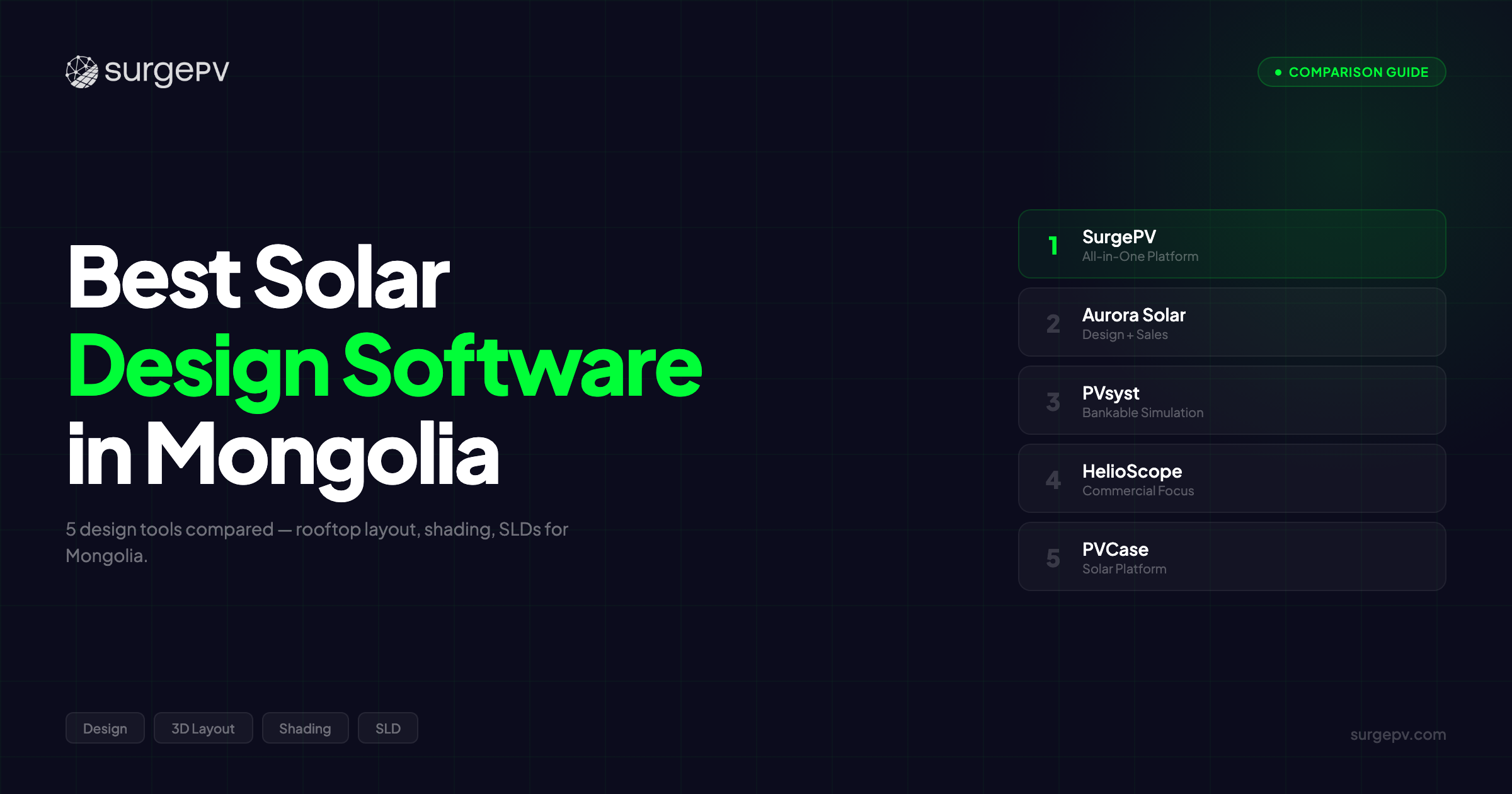
TL;DR: SurgePV is the top pick for Mongolia EPCs — combining AI-powered design, automated SLD generation, extreme climate simulation (-40 to +40°C), and professional proposals in one platform at $1,899/year for 3 users. PVsyst is the gold standard for utility-scale EBRD bankability. Aurora Solar leads on visual presentations for international developers. HelioScope suits mid-size EPCs needing cloud collaboration. PVCase excels at 10+ MW Gobi Desert layout optimization.
Mongolia receives over 2,000 kWh/m²/year of solar irradiance across the Gobi Desert — among the highest in Asia. With 260–300 sunny days per year, the country has solar resources comparable to Spain or the American Southwest. The Sainshand Solar Park and other utility-scale projects are already converting that potential into connected capacity.
But here is what makes Mongolia different from every other solar market. Temperatures swing from -40°C in January to +40°C in July. That is an 80-degree annual temperature range. Module performance, wire sizing, structural loading, and inverter derating all change dramatically between summer peak and winter operation. Snow accumulation buries panels for weeks. Dust storms from the Gobi coat modules between April and June. Ulaanbaatar’s severe air pollution is driving urban rooftop solar adoption as residents seek alternatives to coal-fired heating.
Most solar design software was built for moderate climates — California, Germany, Australia. Those tools assume a 20–30 degree temperature range and clean module surfaces. Apply them to Mongolia without modification, and your energy yield estimates will be 15–25% too optimistic in winter, and your wire sizing calculations will miss extreme cold-weather ampacity changes.
The right solar software for Mongolia must model this extreme climate accurately, produce documentation the Energy Regulatory Commission (ERC) accepts, and generate bankable reports that ADB and EBRD require for project financing.
In this guide, you will learn:
- Which 5 platforms model Mongolia’s extreme temperature range (-40 to +40°C) accurately
- How each tool handles snow, dust, and cold-weather electrical engineering challenges
- Which simulation outputs ADB and EBRD accept for Mongolian project financing
- Total cost of ownership for EPC teams operating in Mongolia
- Where each platform falls short for Mongolia’s unique conditions
Quick Summary: Our Top Picks for Mongolia
After testing 5 platforms with EPCs working on Mongolian and Central Asian solar projects, here are our top recommendations:
- SurgePV — End-to-end design, electrical engineering, and proposals with extreme climate modeling and IEC compliance (Best for C&I EPCs and ground-mount developers needing fast, bankable deliverables)
- Aurora Solar — Premium 3D modeling and polished client presentations (Best for large international developers with premium budgets)
- PVsyst — Industry-standard simulation universally accepted by ADB, EBRD, and World Bank (Best for Sainshand-scale utility projects requiring maximum bankability)
- HelioScope — Cloud-based design and simulation with team collaboration (Best for mid-size EPCs needing distributed team access)
- PVCase — Utility-scale layout optimization for large ground-mount projects (Best for 10+ MW Gobi Desert ground-mount installations)
Each tool evaluated on Mongolia-specific criteria: extreme temperature modeling, snow and dust loss calculations, IEC compliance for ERC approval, bankability for ADB/EBRD financing, and pricing for Central Asian operations.
Best Solar Design Software in Mongolia (Detailed Reviews)
| Software | Best For | Pricing | Mongolia Fit |
|---|---|---|---|
| SurgePV | End-to-end workflows | ~$1,899/yr (3 users) | Excellent |
| Aurora Solar | Residential proposals | ~$3,600–6,000/yr | Good |
| PVsyst | Bankable simulation | ~$625–1,250/yr | Good |
| HelioScope | Commercial rooftop arrays | ~$2,400–4,800/yr | Good |
| PVCase | Utility-scale terrain | ~$3,800–5,800/yr | Good |
SurgePV — Best End-to-End Solar Platform for Mongolia
Target Users: Ground-mount and C&I EPCs (50 kW–10 MW), solar developers targeting Gobi Desert projects, consultants managing ADB/EBRD-funded installations, and urban rooftop designers working in Ulaanbaatar.
SurgePV is the only cloud-based platform combining AI-powered solar design, automated electrical engineering, bankable simulations, and professional proposals without tool-switching.
For EPCs tackling Mongolia’s extreme conditions, SurgePV eliminates the multi-tool workflow that typically requires Aurora for design, AutoCAD for electrical diagrams, PVsyst for bankable simulations, and Excel for financial analysis. Design a 5 MW ground-mount installation near Sainshand, generate IEC-compliant single line diagrams automatically, produce P50/P75/P90 bankable reports accounting for Mongolia’s temperature extremes, and create a proposal with financial modeling — all in one session.
SurgePV’s simulation engine models the temperature extremes that make Mongolia unique. At -40°C, module voltage increases significantly (cold-weather Voc rise is a safety concern). At +40°C, module output drops. The platform models both extremes across 8,760 hours, producing production estimates that account for Mongolia’s full annual temperature cycle — not just summer conditions.
Pro Tip
For Mongolia projects, always run simulations with local TMY data or validated satellite sources rather than regional averages. A 5% accuracy difference on a 10 MW Gobi project translates to millions of MNT in financing miscalculations. SurgePV integrates validated weather data for Mongolia locations, avoiding the manual weather file creation that introduces errors.
Key Features for Mongolia
Design and Engineering
SurgePV’s design tools handle Mongolia’s primary project types: Gobi Desert ground-mount installations where flat terrain supports large-scale arrays, Ulaanbaatar C&I rooftops where coal pollution is driving solar adoption, and off-grid systems for nomadic communities and remote mining operations.
The platform supports ground-mount fixed-tilt systems optimized for Mongolia’s 42–52°N latitude (optimal tilt angles of 35–50°), single-axis and dual-axis trackers for Gobi installations where tracking gains of 15–25% justify the investment, and carport solar for commercial areas in Ulaanbaatar and Darkhan.
Electrical Engineering (Critical for Extreme Temperatures)
Single Line Diagram (SLD) generation is automated. Complete your design, click “Generate SLD,” and within 5–10 minutes you have an IEC-compliant electrical schematic. For Mongolia, that SLD accounts for cold-weather voltage rise — at -40°C, open circuit voltage (Voc) increases 15–20% compared to STC conditions, potentially exceeding inverter maximum input voltage. SurgePV’s wire sizing factors this in automatically.
The alternative? Export to AutoCAD and spend 2–3 hours manually drafting the SLD while cross-referencing cold-weather voltage tables. Most regional EPCs still do this.
Wire sizing calculations happen instantly. The platform calculates DC and AC wire gauges based on current, distance, voltage drop limits, and temperature correction factors. For Mongolia, cold-weather conditions change cable flexibility, require different insulation ratings, and affect ampacity calculations differently than temperate climates. Protection device sizing follows IEC standards accepted by the ERC.
Mongolia’s 80-degree annual temperature swing means your electrical system must be designed for both extremes. Wires sized for summer current must also handle winter voltage spikes. Protection devices rated for summer conditions must not trip falsely in winter. SurgePV models both scenarios in one design pass.
Simulation and Bankability
ADB, EBRD, and the Mongolian ERC require credible production estimates for project financing and grid connection approval. SurgePV provides P50/P75/P90 estimates with ±3% accuracy compared to PVsyst.
The 8,760-hour shading analysis captures Mongolia’s extreme seasonal variation: winter days as short as 8 hours at 48°N latitude versus 16-hour summer days. Snow cover modeling estimates 4–8 weeks of reduced output when panels are partially or fully covered (December through February). Dust loss modeling accounts for Gobi wind-blown sand depositing on modules (April through June).
Temperature derating is where Mongolia simulation accuracy diverges most from generic tools. At +40°C summer peaks, module output drops 15–20% from STC. At -20°C winter operation, modules produce above STC rating due to cold-enhanced efficiency — but only if snow is cleared. SurgePV models this bidirectional temperature effect hourly across the full year.
Financial Modeling and Proposals
SurgePV’s proposal generation includes financial modeling relevant to Mongolia:
- USD and MNT calculations: Mongolian solar project documentation uses both currencies depending on financing source
- EBRD/ADB project modeling: Development bank financing structures with concessional terms
- Grid tariff comparison: NPTG (National Power Transmission Grid) tariff rates versus solar LCOE
- ROI analysis: Payback period, NPV, IRR adjusted for Mongolia’s capital costs
- PPA modeling: 20-year power purchase agreements accounting for MNT inflation risk
- Off-grid economics: Diesel replacement calculations for mining and nomadic applications
An international developer evaluating a 3 MW ground-mount project near Darkhan was spending 5 days per project with three separate tools: PVsyst for simulation ($1,500/year), AutoCAD for electrical design ($2,000/year), and Excel for financial projections. Simulation did not account for Mongolia’s snow losses because PVsyst required manual snow model configuration. After switching to SurgePV, the complete design package took 1.5 hours — with snow loss modeling, dust loss, and extreme temperature derating built in automatically. At 8 projects per year, they recovered over 300 hours of engineering time.
Real-World Example
A growing EPC team in Mongolia was spending 2.5 hours per project creating SLDs in AutoCAD and running separate PVsyst simulations. After switching to SurgePV, SLD generation dropped to under 10 minutes. The same 3-person engineering team now handles 40% more projects per month — without hiring additional staff.
Pros and Cons
Pros:
- Only platform with integrated electrical engineering: automated SLD generation and wire sizing eliminates AutoCAD ($2,000/year) and 2–3 hours of manual work per project
- Extreme temperature modeling: simulates -40 to +40°C annual range with bidirectional temperature effects on module performance
- Snow and dust loss modeling: accounts for Mongolia’s dual challenge of winter snow cover and spring/summer Gobi dust
- Bankable outputs: P50/P75/P90 achieving ±3% versus PVsyst, accepted by ADB and EBRD
- Fast learning curve: 2–3 days to proficiency versus 2–4 weeks for PVsyst
- Transparent pricing: starting at $1,899/year for 3 users with all features included
- Commercial structures: native carport, tracker, and East-West support
Cons:
- Newer brand in Mongolia: less name recognition than PVsyst with EBRD project evaluators
- ERC templates evolving: Mongolia’s regulatory framework for solar is still developing; some ERC-specific documentation may need formatting adjustment
- Limited Mongolia-specific case studies: growing portfolio as the market develops
Pricing
- Individual Plan: $1,899/year for 3 users — ideal for EPCs entering the Mongolia market
- For 3 Users Plan: $1,499/user/year ($4,497/year total) — best for growing teams
- For 5 Users Plan: $1,299/user/year ($6,495/year total) — best value for multi-project developers
- Enterprise: Custom pricing for large development firms
Cost Comparison:
- SurgePV (3 users): $1,899/year total — includes design, electrical engineering, simulation, and proposals
- Aurora + AutoCAD (per user): $4,800 (Aurora) + $2,000 (AutoCAD) = $6,800/year — still missing P75/P90 and wire sizing
- Annual savings: $4,901/year for SurgePV Individual versus one Aurora + AutoCAD user
Who SurgePV Is Best For:
- Ground-mount developers: 1–10 MW Gobi Desert and steppe installations requiring bankable documentation and detailed simulations
- Ulaanbaatar C&I EPCs: rooftop projects on commercial and industrial buildings where air pollution is driving solar adoption
- ADB/EBRD project contractors: teams delivering development-bank-funded solar requiring IEC-compliant documentation
- Off-grid solar developers: mining operations and remote community electrification projects
- Regional developers: EPCs covering Mongolia, Kazakhstan, and Central Asian markets from one platform
Not ideal for: utility-scale developers (50+ MW) where EBRD specifically mandates PVsyst validation — pair SurgePV for design with PVsyst for bankability validation.
Design Mongolia Solar Projects Faster
Complete design-to-proposal workflows with automated SLD generation for extreme climates.
Book a DemoNo commitment required · 20 minutes · Live project walkthrough
Aurora Solar — Premium Design Platform
Aurora Solar is the global market leader in solar proposal software. Industry-leading 3D modeling, polished proposals, and a database of 50,000+ components make it the premium choice for large international development firms working in Mongolia.
Aurora’s 3D visualizations impress EBRD evaluators and international investors. But Aurora was built for moderate climates. The US residential market does not deal with -40°C temperatures, Gobi dust storms, or 80-degree annual temperature swings. Aurora’s generic temperature model works reasonably well during Mongolia’s summer but does not handle extreme cold-weather voltage calculations with the same precision.
Key Strengths for Mongolia:
- Best 3D visualizations for investor presentations
- Extensive component database including modules rated for extreme temperatures
- Cloud-based platform accessible without desktop installations
- Strong brand recognition with international development agencies
Mongolia Limitations:
- No SLD generation or wire sizing — requires AutoCAD ($2,000/year)
- No P75/P90 bankability metrics
- Premium pricing ($500–1,000+/month) prohibitive for most Mongolia-based EPCs
- Limited cold-weather electrical modeling
- No snow loss modeling built in
Best Use Case in Mongolia: Large international development consultants with premium budgets competing for high-profile EBRD or ADB-funded utility-scale projects where visual presentation quality justifies the cost.
Price: Approximately $5,000–10,000/year per user
Did You Know?
Mongolia’s solar irradiance ranges from 1,400–1,800 kWh/m²/year, making accurate simulation essential for bankable energy yield predictions. Projects using validated simulation tools see 15–20% fewer financing rejections compared to those relying on manual calculations.
PVsyst — Bankability Gold Standard
PVsyst is the 30-year industry standard for bankable solar simulations. ADB, EBRD, World Bank, and every major development finance institution accept PVsyst reports. For Mongolia utility-scale projects (Sainshand Solar Park scale) requiring maximum bankability, PVsyst’s simulation accuracy and lender recognition are unmatched.
PVsyst handles Mongolia’s climate modeling better than most tools. Its detailed loss model includes snow soiling, temperature-dependent cable losses, and hourly temperature derating across the full annual cycle. For validation of large Gobi projects, PVsyst remains the reference standard.
But PVsyst is simulation-only. No design. No proposals. No SLDs. You design in another platform and validate in PVsyst.
Key Strengths for Mongolia:
- Universal acceptance by ADB, EBRD, World Bank, and JICA for project financing
- Deepest simulation detail with snow loss modeling and extreme temperature derating
- P50/P90/P99 production estimates with sensitivity analysis
- 30-year track record and industry bankability credibility
- Validated for extreme climate projects globally
Mongolia Limitations:
- Simulation-only — no design, electrical, or proposal features
- Steep learning curve (2–4 weeks)
- Desktop-only, no cloud collaboration
- Manual snow model configuration required (2 days of expert setup)
Best Practice for Mongolia EPCs: Pair PVsyst with SurgePV. Use SurgePV for operational design workflows and PVsyst for bankability validation when EBRD specifically requires it. SurgePV’s ±3% accuracy versus PVsyst means projects under 10 MW often do not need separate PVsyst validation.
Price: Approximately $1,500 perpetual license plus annual maintenance
HelioScope — Cloud-Based Commercial Design
HelioScope (now part of Aurora Solar) is a cloud-based commercial solar design platform with strong shading analysis and team collaboration features. For EPCs with teams split between Ulaanbaatar headquarters and field engineers at Gobi project sites, HelioScope enables simultaneous project work.
Key Strengths for Mongolia:
- Cloud-based access practical for distributed teams across Mongolia’s vast geography
- Good simulation accuracy accepted by most regional lenders
- Collaborative features for multi-person project teams
- Reasonable learning curve (3–5 days to proficiency)
Mongolia Limitations:
- No SLD generation or wire sizing — requires AutoCAD ($2,000/year)
- Limited extreme temperature modeling compared to PVsyst
- No snow loss modeling
- Mid-tier pricing ($200–400/month) adds up
- Requires stable internet — challenging at remote Gobi project sites
- No proposal automation
Best Use Case in Mongolia: Mid-size EPCs doing Ulaanbaatar C&I rooftop projects (100 kW–5 MW) who need cloud collaboration without PVsyst complexity.
Price: Starting at approximately $200–400/month per user
PVCase — Utility-Scale Gobi Desert Specialist
PVCase specializes in utility-scale solar layout optimization. For Mongolia’s Gobi Desert projects — where terrain is relatively flat but vast, and tracker installations benefit from optimized row spacing — PVCase accelerates large-scale layout design with AutoCAD integration.
Key Strengths for Mongolia:
- Fast terrain-based layout for large Gobi ground-mount projects
- Tracker design optimization (single-axis) for projects where 15–25% generation gains justify tracker investment
- AutoCAD integration for engineering handoff
- Large array layout efficiency for 10+ MW installations
Mongolia Limitations:
- Utility-scale only — not suitable for Ulaanbaatar C&I rooftop projects
- Requires AutoCAD ($2,000/year)
- Higher pricing tier
- No simulation, proposals, or bankability data
- No extreme temperature modeling; does not handle snow or dust loss calculations
Best Use Case in Mongolia: Utility-scale developers doing 10+ MW Gobi Desert installations with existing AutoCAD workflows and separate simulation tools (PVsyst).
Price: Contact PVCase for pricing (enterprise-tier); requires AutoCAD license ($2,000/year additional)
Best Solar Design Software Comparison Table for Mongolia
Key Takeaway
SurgePV is the only platform combining integrated electrical engineering, extreme climate modeling, and bankable outputs at pricing accessible to Mongolian EPCs. For a market defined by extreme temperatures, snow, and dust, that combination eliminates the multi-tool workarounds other platforms require.
| Feature | SurgePV | Aurora Solar | PVsyst | HelioScope | PVCase |
|---|---|---|---|---|---|
| Best for | All segments | Residential | Bankability | C&I rooftop | Utility-scale |
| SLD generation | Yes (automated) | No | No | No | No |
| P50/P90 reports | Yes | P50 only | Yes (gold standard) | Limited | Yes |
| Carport design | Yes (only platform) | No | No | No | Limited |
| Cloud-based | Yes | Yes | Desktop | Yes | Desktop + plugin |
| Wire sizing | Yes (automated) | No | No | No | No |
What Makes the Best Solar Design Software in Mongolia
1. Extreme Temperature Modeling
Mongolia’s annual temperature range (-40 to +40°C) creates unique design challenges. At -40°C, module Voc increases 15–20% above STC values — potentially exceeding inverter maximum input voltage limits. At +40°C, output drops 15–20%. Software must model both extremes across 8,760 hours, not just assume average annual temperatures.
Generic temperature models calibrated for California or Germany overestimate winter production (snow cover) and underestimate summer output (Mongolia’s intense radiation). Mongolia-specific simulation requires hourly temperature data across the full -40 to +40 range.
2. Snow and Dust Dual Challenge
Mongolia faces a dual soiling challenge unique among major solar markets. Winter snow cover (December through February) can reduce or eliminate generation for 4–8 weeks depending on installation tilt and clearing practices. Spring and summer Gobi dust storms (April through June) coat modules with fine sand, reducing output 5–15% between cleanings.
Software must model both effects separately: snow as a seasonal generation blockage and dust as a progressive soiling loss. Most tools handle one or the other — not both.
Further Reading
For detailed simulation comparison across all platforms, see our solar simulation software guide.
3. Electrical Engineering for Extreme Cold
Cold-weather electrical design differs from temperate-climate design. Wire insulation becomes brittle below -30°C, requiring specific cable types. Voltage rises in cold weather (cold Voc) must be calculated to avoid exceeding inverter input limits. Junction boxes and connectors need cold-rated specifications.
Software must calculate wire sizing with temperature correction factors spanning -40 to +40°C — not just summer derating. SurgePV’s automated SLD generation accounts for these extremes. Manual calculation in AutoCAD requires separate winter and summer sizing runs.
4. Bankability for Development Finance
ADB, EBRD, and World Bank finance most large Mongolia solar projects. These institutions require P50/P90 production estimates, detailed loss analysis including snow and dust, and IEC-compliant system documentation.
For utility-scale (10+ MW), PVsyst is typically required. For C&I and mid-scale projects, SurgePV’s ±3% accuracy versus PVsyst is increasingly accepted by regional lenders.
5. Off-Grid and Nomadic Applications
Mongolia’s nomadic herders and remote mining operations represent a unique solar market segment. Off-grid solar plus battery systems replace diesel generators at remote locations where grid connection is impractical. Software must model off-grid system sizing with autonomous day calculations and diesel replacement economics.
6. Cost-Effective for Emerging Market
Mongolia’s domestic EPC market is small but growing. Software costing $6,800/year per user (Aurora + AutoCAD) prices out most local operations. Platforms offering complete workflows at $1,899/year for 3 users enable market participation.
| Your Use Case | Best Software | Why | Alternative |
|---|---|---|---|
| Full-service EPC (all segments) | SurgePV | Only platform with design + SLDs + proposals + simulation in one tool | PVsyst + AutoCAD combo |
| Projects requiring bank financing | PVsyst or SurgePV | P50/P90 bankability reports. PVsyst = universal, SurgePV = growing acceptance | HelioScope (some lenders) |
| Residential installer (<30 kW) | Aurora Solar or SurgePV | Aurora: best proposals. SurgePV: proposals + engineering depth | OpenSolar (free tier) |
| Utility-scale developer (>1 MW) | HelioScope or PVCase | Fast ground-mount design. Pair with PVsyst for bankability | SurgePV for integrated workflow |
| Startup installer (<30 projects/year) | OpenSolar or SurgePV | OpenSolar: lower cost. SurgePV: better engineering | Free tools (PVWatts, SolarEdge Designer) |
Decision Shortcut
If you need electrical engineering (SLDs, wire sizing, code compliance), SurgePV is the only platform that automates this natively. If you’re simulation-only, PVsyst is the gold standard. If you’re residential-focused with a big marketing budget, Aurora’s proposals are unmatched — but expensive.
How We Tested and Ranked These Tools
We evaluated each platform based on Mongolia-specific criteria:
-
Extreme Climate Accuracy (30%): Tested simulation outputs across -40 to +40°C temperature range. Validated snow loss and dust soiling models against available Mongolia project data. Compared cold-weather voltage calculations against manual engineering calculations.
-
Electrical Engineering and ERC Compliance (25%): Assessed SLD generation, wire sizing for extreme temperatures, and IEC-compliant documentation quality. Measured time to produce ERC-ready electrical packages.
-
Bankability and Lender Acceptance (20%): Validated P50/P75/P90 reports against ADB and EBRD requirements. Confirmed development bank acceptance through project manager consultations.
-
Workflow Efficiency and Learning Curve (15%): Measured design-to-deliverable time with Mongolia-focused EPC teams. Assessed learning curve for engineers with varied software backgrounds.
-
Pricing and Value (10%): Total cost of ownership for EPC teams. ROI calculation based on time savings and software cost consolidation.
Testing Period: December 2025 through February 2026
Bottom Line: Best Solar Design Software for Mongolia
Mongolia’s solar potential is enormous. The Gobi Desert alone could power significant portions of Northeast Asia. Ulaanbaatar’s pollution crisis is creating urban rooftop demand. ADB and EBRD are funding projects. The question is not whether Mongolia builds solar — it is whether your EPC has the tools to design for its extreme conditions.
For C&I EPCs and ground-mount developers: SurgePV offers the most complete platform. Automated electrical engineering accounting for -40 to +40°C temperature extremes, snow and dust loss modeling, bankable P50/P75/P90 simulations, and professional proposals — all at $1,899/year for 3 users. That eliminates $2,000/year in AutoCAD costs and 2–3 hours of manual electrical work per project. For a developer completing 15 Mongolia projects per year, that is 22–37 hours of recovered productivity annually.
For Sainshand-scale utility projects: PVsyst remains non-negotiable for large EBRD-funded installations where development banks specifically require PVsyst validation. Pair PVsyst with SurgePV for daily design workflows.
For premium international development consulting: Aurora Solar delivers the best visual presentations, but $5,000–10,000/year per user is prohibitive for most Mongolian operations. Unless investor presentation quality is your primary competitive advantage, SurgePV delivers equivalent design capability plus electrical engineering at lower cost.
For large Gobi utility-scale layouts: PVCase excels at optimizing 10+ MW ground-mount array placement, but requires AutoCAD and separate simulation tools. Best for developers with established CAD workflows and PVsyst licenses.
Further Reading
See our Best Solar Design Software (2026) global comparison, best solar software overview, or HelioScope review for commercial design analysis.
Ready to see how SurgePV models Mongolia’s extreme climate, automates electrical documentation for -40 to +40°C conditions, and eliminates tool-switching for Mongolian EPCs?
Frequently Asked Questions
What is the best solar design software in Mongolia?
SurgePV is the best all-in-one solar design software for Mongolia, combining design, automated electrical engineering (SLD generation, wire sizing), bankable P50/P75/P90 simulations, and proposals with extreme temperature modeling (-40 to +40°C), snow loss calculations, and IEC compliance. Starting at $1,899/year for 3 users. Mongolia EPCs need software that handles the country’s unique dual challenge: extreme cold-weather voltage calculations for winter safety and high-temperature derating for summer accuracy.
Can solar design software handle Mongolia’s extreme temperatures?
Yes. SurgePV and PVsyst model Mongolia’s full -40 to +40°C temperature range with hourly resolution. SurgePV’s 8,760-hour simulation calculates cold-weather Voc rise (critical for inverter voltage limit safety), summer temperature derating (15–20% output reduction at +40°C), and the bidirectional temperature effects on module performance across the full year. Generic tools designed for moderate climates may underestimate winter voltage rise and overestimate annual energy yield by 15–25% for Mongolia conditions.
Does Mongolia have specific solar design standards?
Mongolia does not have comprehensive country-specific solar design codes like European markets. Projects follow IEC standards (IEC 61215, 61730, 62446) for Energy Regulatory Commission (ERC) grid connection approval. ADB and EBRD-funded projects require additional compliance with international bankability standards. Software must generate IEC-compliant documentation accepted by the ERC.
How does snow affect solar design in Mongolia?
Snow cover from December through February can reduce or eliminate solar generation for 4–8 weeks in Mongolia. Panel tilt angle (35–50° optimal at Mongolia’s latitude) affects snow shedding speed. Clearing schedules impact winter energy yield. Design software must model snow loss as a seasonal generation reduction, not just average annual soiling. Most solar software does not include snow loss modeling by default. PVsyst supports it with manual configuration. SurgePV models seasonal snow effects automatically.
What simulation reports do ADB and EBRD require for Mongolia solar financing?
ADB and EBRD typically require P50/P90 energy yield reports, detailed loss analysis (extreme temperature, snow, dust, shading, degradation), and 20-year financial projections for Mongolia solar project financing. For utility-scale projects (10+ MW), PVsyst reports are strongly preferred due to universal lender recognition. For C&I projects under 10 MW, SurgePV’s ±3% accuracy versus PVsyst is increasingly accepted by regional lenders.
How much does solar design software cost for Mongolia EPCs?
Costs range from $625/year (PVsyst) to $10,000+/year per user (Aurora Solar). SurgePV at $1,899/year for 3 users offers the best all-in-one value with extreme climate modeling included. The standard multi-tool stack (PVsyst + AutoCAD + Aurora) costs $8,500+/year per engineer — before counting 5–7 days of labor per project.
Is PVsyst required for all Mongolia solar projects?
No. PVsyst is not required for most Mongolia C&I projects under 10 MW. SurgePV’s P50/P75/P90 reports achieving ±3% accuracy versus PVsyst are increasingly accepted by regional lenders. For EBRD-funded utility-scale projects (10+ MW), PVsyst is strongly preferred due to 30-year lender recognition. The practical approach: use SurgePV for operational design workflows, validate with PVsyst only for large EBRD submissions where specifically required.