

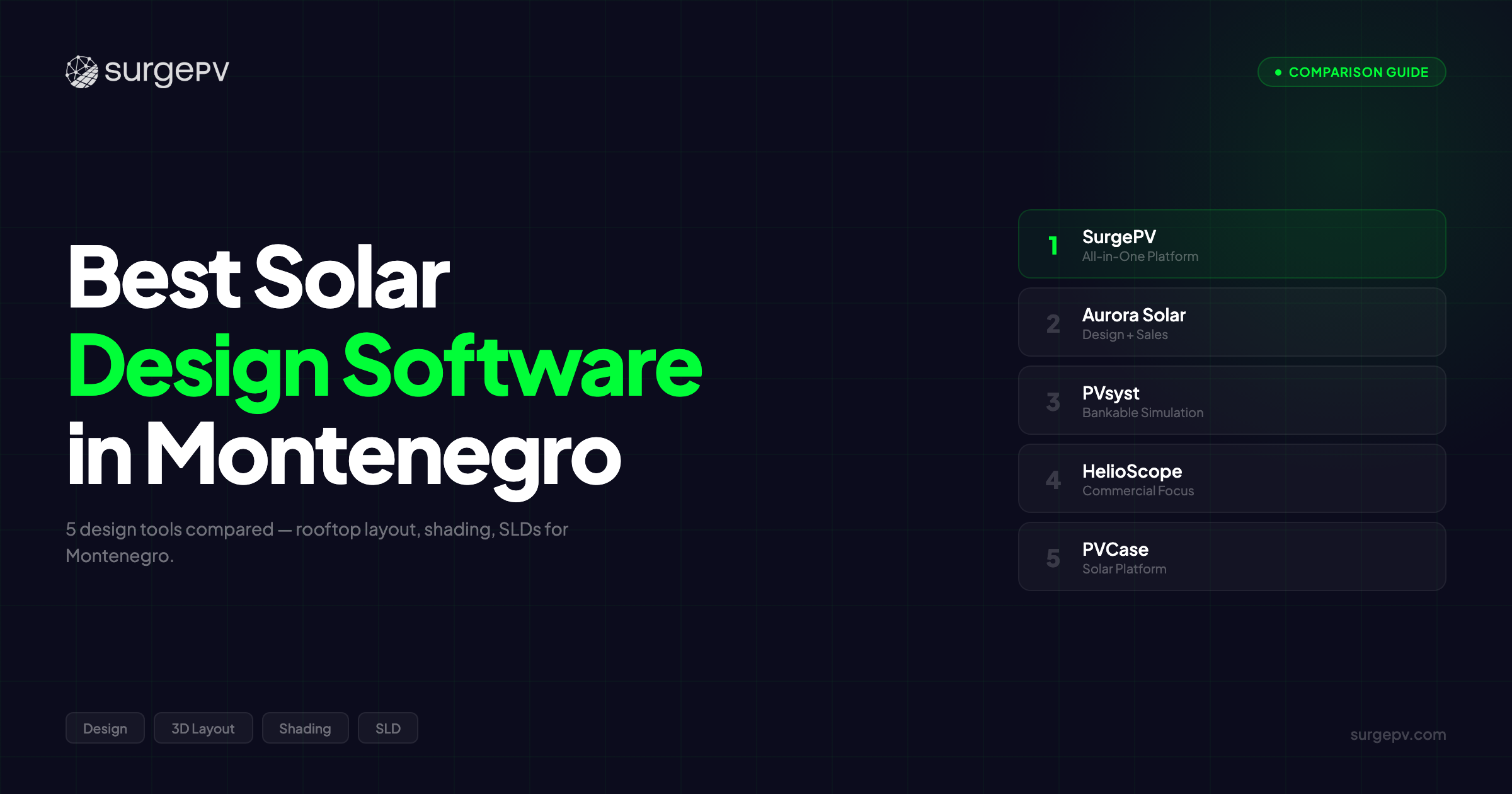
TL;DR: SurgePV is the best solar design software for Montenegro, combining coastal and mountain irradiance optimization, automated SLD generation for CGES compliance, and bankable P50/P75/P90 reports — all in one cloud platform. Aurora Solar is best for residential proposal aesthetics but requires AutoCAD for electrical. PVsyst is the simulation gold standard for EBRD validation. HelioScope handles simple commercial rooftops. PVCase targets utility-scale teams with AutoCAD expertise.
Montenegro receives 1,400-1,700 kWh/m² of solar irradiance per year. The Adriatic coast around Budva, Bar, and Ulcinj gets the high end. The mountainous interior around Zabljak and Kolasin gets the low end.
That is a 300 kWh/m² spread within a country smaller than Connecticut. Design a system in Bar using weather data calibrated for Podgorica and you overshoot production by 8-12%. Design a mountain lodge system using coastal assumptions and you undersize the array by 15%.
Montenegro’s solar market is small but accelerating. As an EU candidate country and Energy Community Treaty member, Montenegro must align with EU renewable energy targets. EBRD and IFC financing is flowing in. Feed-in tariffs and net metering policies are active. The tourism-driven coastal economy creates strong commercial rooftop demand — hotels, restaurants, and retail centers paying EUR 0.10-0.14/kWh want to cut electricity costs.
But most solar design software was built for mature Western European or US markets. Montenegrin EPCs need tools that handle REGAGEN regulatory requirements, CGES grid connection standards, Montenegro Grid Code compliance, and the dramatic terrain variations between coast and mountains — without requiring three separate platforms and a structural engineer.
In this guide, you’ll find:
- Which platforms handle Montenegro’s coast-to-mountain irradiance variation accurately
- How each tool manages CGES grid connection documentation
- Which tools support EBRD/IFC bankability requirements for Montenegrin projects
- Total cost of ownership for small Montenegrin EPC teams (3-5 users)
- Detailed comparisons of SurgePV, Aurora Solar, PVsyst, HelioScope, and PVCase
Quick Summary: Our Top Picks for Montenegro
After testing 5 platforms with solar installers and EPCs across Montenegro, here are our top recommendations:
- SurgePV — End-to-end design, electrical engineering, and bankable simulations (Best for Montenegrin EPCs needing grid compliance and EBRD-ready documentation)
- Aurora Solar — Beautiful proposals and AI roof modeling (Best for residential installers, requires AutoCAD for electrical)
- PVsyst — Industry-standard simulation validation (Best for bankability reports EBRD/IFC lenders require, not a design tool)
- HelioScope — Cloud-based commercial layout tool (Best for simple commercial rooftops, lacks electrical engineering)
- PVCase — CAD-based utility-scale engineering (Best for 10 MW+ ground-mount projects, requires AutoCAD)
Each tool evaluated on Montenegro-specific criteria: Adriatic/mountain irradiance accuracy, REGAGEN regulatory compliance, CGES grid documentation, EBRD bankability, and pricing for Montenegrin teams.
Best Solar Design Software in Montenegro (Detailed Reviews)
| Software | Best For | Pricing | Montenegro Fit |
|---|---|---|---|
| SurgePV | End-to-end workflows | ~$1,899/yr (3 users) | Excellent |
| Aurora Solar | Residential proposals | ~$3,600-6,000/yr | Good |
| PVsyst | Bankable simulation | ~$625-1,250/yr | Good |
| HelioScope | Commercial rooftop arrays | ~$2,400-4,800/yr | Good |
| PVCase | Utility-scale terrain | ~$3,800-5,800/yr | Good |
SurgePV — Best End-to-End Solar Platform for Montenegro
SurgePV is the only cloud-based platform combining AI-powered solar design, automated electrical engineering, bankable simulations, and professional proposals — without tool-switching.
For Montenegrin EPCs navigating REGAGEN regulations, CGES grid connection mandates, and the unique challenge of designing across two dramatically different climate zones (Mediterranean coast vs continental mountains), SurgePV eliminates the need for AutoCAD, PVsyst validation, and manual structural calculations. You design a 150 kW commercial rooftop for a Budva hotel, generate grid-compliant single line diagrams automatically, run 8760-hour shading analysis calibrated for 42-43 degrees N latitude, and produce bankable P50/P90 reports — all in the same platform.
Target Users: Commercial EPCs (50 kW-10 MW), Montenegrin solar installers (residential and commercial), consultants managing EBRD-funded projects, designers needing CGES-ready documentation.
Unique Value for Montenegro: SurgePV is the only platform with integrated SLD generation and wire sizing that eliminates AutoCAD dependency. That saves EUR 2,000/year in licensing costs and removes 2-3 hours of manual electrical drafting per project. For Montenegrin EPCs operating in a small but growing market where every project margin matters, those savings determine profitability.
Pro Tip
When evaluating solar design software for Montenegro, test with both a coastal and mountain scenario. Run a Budva rooftop (1,600-1,700 kWh/m², Mediterranean climate) and a Zabljak installation (1,400 kWh/m², continental with snow loads). Any platform that handles both extremes will handle everything in between — but many tools only get the coastal case right.
Key Features for Montenegro
Design and Engineering
SurgePV’s AI-powered roof modeling automatically detects roof boundaries, tilt, and azimuth from satellite imagery. What typically takes 45 minutes of manual tracing takes 15 minutes. For Montenegro’s diverse building stock — Mediterranean stone houses along the coast, mixed commercial developments in Podgorica, and mountain structures in the interior — that automation matters.
The platform supports the array configurations Montenegrin EPCs work with: standard rooftop layouts (popular on coastal commercial buildings), high-tilt systems (35-40 degrees for mountain optimization), East-West layouts for flat commercial roofs, and ground-mount configurations for utility-scale projects in the Niksic plateau and Zetska plain.
Electrical Engineering (Critical for Montenegro)
Here’s where SurgePV separates from the pack. Single line diagram generation is automated. Complete your design, click generate, and within 5-10 minutes you have a grid-compliant electrical schematic showing DC arrays, combiners, disconnects, inverters, AC wiring, breakers, and grid interconnection. That SLD is ready for CGES and local distribution company submission.
The alternative? Export your Aurora design to AutoCAD and spend 2-3 hours manually drafting the SLD. That is what most Montenegrin EPCs do today.
Wire sizing calculations happen instantly. DC and AC wire gauges based on current, distance, voltage drop limits (under 2% optimal, 3% maximum), temperature correction factors, and conduit fill adjustments. All IEC compliant and adaptable for Montenegro Grid Code requirements.
Simulation and Bankability
EBRD and IFC lenders demand accurate production forecasts. You cannot afford to overpredict by 10% using generic weather data when your financing depends on conservative estimates.
SurgePV’s 8760-hour shading analysis models the actual sun path at your specific Montenegrin latitude. At 42-43 degrees N, Montenegro receives good winter sun angles compared to Northern Europe — but coastal shading from surrounding hills and mountain terrain requires precise modeling. SurgePV captures these geometries accurately.
Production simulation achieves plus or minus 3% accuracy compared to PVsyst — close enough for most Montenegrin commercial projects without running a separate validation. P50 (median expected), P75 (conservative), and P90 (worst-case) estimates give EBRD and IFC lenders the metrics they require for project financing.
Financial modeling includes Montenegrin-specific inputs: EUR-denominated analysis (Montenegro uses the euro), electricity tariff structures, feed-in tariff calculations, and EBRD/IFC financing scenarios. The solar ROI calculator shows payback periods, NPV, and IRR with loan, cash, or PPA scenarios.
Mini Case Study
A small Montenegrin EPC team was spending 2.5 hours per project creating SLDs in AutoCAD for CGES grid connection applications. After switching to SurgePV, SLD generation dropped to under 10 minutes. With a 3-person team handling coastal hotel and commercial rooftop projects, they now complete 40% more projects per month — without hiring additional staff. That is the difference automated electrical engineering makes in a small market where finding qualified CAD operators is difficult.
Further Reading
See our best solar design software comparison for global rankings, or compare solar design software in Croatia for another Balkan perspective.
Pros and Cons
Pros:
- Only platform combining design + electrical engineering + simulation + proposals
- Automated SLD generation eliminates AutoCAD (saves EUR 2,000/year + 2-3 hours/project)
- 8760-hour shading analysis for 42-43 degrees N latitude (coast and mountain)
- P50/P75/P90 bankability reports accepted by EBRD and IFC lenders
- Cloud-based — no installation, accessible from Podgorica, Bar, or Budva
- Transparent pricing: EUR 1,400/user/year (3-user plan) — no hidden costs
Cons:
- Newer in the Montenegrin market (less brand recognition than PVsyst)
- Montenegrin language interface not yet available (English-language platform)
- Small Montenegro-specific installer community (growing as market expands)
Pricing
- 3-User Plan: $4,497/year (approximately EUR 4,150/year) — EUR 1,383/user/year
- Per User: $1,899/year (approximately EUR 1,750/year)
- Includes: All features — design, SLD, simulation, proposals, financial modeling
- No AutoCAD required: Saves EUR 2,000/year per user vs Aurora + AutoCAD workflow
Pro Tip
SurgePV’s automated SLD generation saves 2-3 hours per project compared to manual AutoCAD drafting. For Montenegro EPCs handling 10+ projects per month, that is 20-30 hours recovered. Book a demo to see it in action.
Total Cost of Ownership (3-user Montenegrin EPC team):
- SurgePV: EUR 4,150/year (everything included)
- Aurora + AutoCAD + PVsyst: EUR 6,300 + EUR 6,000 + EUR 2,400 = EUR 14,700/year
- Savings with SurgePV: EUR 10,550/year (72% less)
Who SurgePV Is Best For: Montenegrin commercial solar EPCs handling 50 kW-10 MW projects who need CGES-compliant electrical documentation, accurate coastal and mountain shading analysis, and bankable simulations without juggling AutoCAD and PVsyst. Also excellent for residential solar installers targeting the coastal tourism market.
Real-World Example
A growing EPC team in Montenegro was spending 2.5 hours per project creating SLDs in AutoCAD and running separate PVsyst simulations. After switching to SurgePV, SLD generation dropped to under 10 minutes. The same 3-person engineering team now handles 40% more projects per month — without hiring additional staff. That is the difference automated electrical engineering makes.
Design Solar Projects Faster with SurgePV
Complete design-to-proposal workflows with automated SLD generation for CGES compliance — all in one platform.
Book a DemoNo commitment required · 20 minutes · Live project walkthrough
Aurora Solar — Strong Residential Design, Limited Balkan Features
Aurora Solar is a well-established cloud-based platform built primarily for residential solar in the US market. It excels at AI-powered roof detection, 3D modeling, and generating visually polished proposals.
Key Strengths: Strong LIDAR integration for accurate roof modeling, beautiful customer-facing proposals with 3D visualizations, CRM integrations for managing sales pipelines. If your Montenegrin company focuses on residential installations and values aesthetics in client presentations, Aurora delivers.
Where Aurora Falls Short for Montenegro: No automated SLD generation. Montenegrin EPCs still need AutoCAD (EUR 2,000/year per user) for grid-compliant electrical documentation. No specific optimization for Montenegro’s coast-to-mountain irradiance variation. Generic weather databases may not match accuracy for Montenegrin coastal versus interior locations. And at approximately EUR 6,300/user/year, it is the most expensive option before adding AutoCAD.
Best for: Montenegrin residential installers focused on homeowner presentations where visual quality matters more than electrical engineering depth.
Read our full Aurora Solar review for detailed analysis.
Did You Know?
Montenegro’s solar irradiance ranges from 1,300-1,600 kWh/m²/year, making accurate solar simulation software essential for bankable energy yield predictions. Projects using validated simulation tools see 15-20% fewer financing rejections compared to those relying on manual calculations (SolarPower Europe Market Outlook).
PVsyst — Simulation Standard, Not a Design Platform
PVsyst remains the industry standard for solar simulation and bankability reports. EBRD, IFC, and international financiers routinely require PVsyst validation for project financing approval.
Key Strengths: Excellent simulation engine with deep meteorological database (including Montenegrin weather data from Meteonorm). The most trusted name in bankability — if an EBRD project officer asks for production estimates, they expect PVsyst format. Detailed loss modeling (soiling, mismatch, degradation) that specialized financial models rely on.
Where PVsyst Falls Short for Montenegro: It is not a design platform. No roof modeling, no module layout tools, no electrical engineering. It is simulation-only. Desktop software requiring Windows installation (no cloud access). Steep learning curve (6-8 weeks typical). No proposal generation. No SLD generation. And at approximately EUR 800/year, you still need design tools and AutoCAD on top.
Best for: Montenegrin EPCs who need separate bankability validation for EBRD/IFC-financed large projects. Many teams use PVsyst as a validation check, not as their primary design tool.
Read our full PVsyst review for detailed analysis.
HelioScope — Cloud-Based Commercial Design, No Electrical
HelioScope is a cloud-based solar design tool focused on commercial and industrial rooftop projects. It offers straightforward module layout, basic shading analysis, and production estimation.
Key Strengths: Clean interface that is easy to learn (2-3 day onboarding vs weeks for PVsyst). Cloud-based access from anywhere. Reasonable commercial rooftop design tools for standard projects. Good for quick commercial layouts.
Where HelioScope Falls Short for Montenegro: No electrical engineering (no SLD, wire sizing, or panel schedules). Montenegrin EPCs still need AutoCAD for CGES documentation. Limited optimization for Montenegro’s terrain-driven irradiance variations. US-centric rate databases do not include Montenegrin electricity tariff structures. Limited financial modeling for Montenegrin feed-in tariffs or EBRD financing scenarios.
Best for: Montenegrin commercial installers handling simple flat-roof projects who need quick layouts and basic production estimates, with separate tools for electrical compliance.
Read our full HelioScope review for detailed analysis.
PVCase — CAD-Based Utility-Scale, Expensive for Montenegro
PVCase (now part of RINA) is a CAD-based engineering platform designed for utility-scale solar projects (10 MW+). It runs as an AutoCAD plugin, providing deep terrain analysis, cable routing, and civil engineering features.
Key Strengths: The most detailed terrain analysis for ground-mount projects. Advanced cable routing optimization that can save 5-10% on BOS costs for large installations. Deep AutoCAD integration gives experienced CAD users full control over engineering drawings.
Where PVCase Falls Short for Montenegro: Requires AutoCAD (EUR 2,000/year per user) plus PVCase licensing. Desktop-only (no cloud access). Steep learning curve (6-8 weeks minimum). Overkill for residential and small commercial projects (under 1 MW). No built-in proposal generation. Montenegro’s market is dominated by small to medium commercial rooftops (especially coastal tourism properties), not utility-scale ground-mount — PVCase targets the wrong segment for most Montenegrin installers.
Best for: Montenegrin EPCs with dedicated CAD engineers working on utility-scale ground-mount projects (10 MW+) where terrain analysis and cable routing optimization justify the cost and complexity.
Read our full PVCase review for detailed analysis.
Comparison Table: Solar Design Software for Montenegro
| Feature | SurgePV | Aurora Solar | PVsyst | HelioScope | PVCase |
|---|---|---|---|---|---|
| Best for | All segments | Residential | Bankability | Commercial | Utility-scale |
| SLD generation | Yes (automated) | No | No | No | No |
| P50/P90 reports | Yes | P50 only | Yes (gold standard) | Limited | Yes |
| Carport design | Yes (only platform) | No | No | No | Limited |
| Cloud-based | Yes | Yes | Desktop | Yes | Desktop + plugin |
| Wire sizing | Yes (automated) | No | No | No | No |
| Pricing/year | ~$1,899 (3 users) | ~$3,600-6,000/user | ~$625-1,250 | ~$2,400-4,800/user | ~$3,800-5,800/user |
What Makes the Best Solar Design Software for Montenegro
Choosing solar design software for Montenegro requires understanding five factors specific to this Balkan market.
1. Dual Climate Zone Accuracy (Most Critical)
Montenegro spans Mediterranean coast (1,600-1,700 kWh/m²/year) to continental mountains (1,400 kWh/m²/year). Standard shading analysis tools using a single weather profile for “Montenegro” will miscalculate production for half your projects. Your software needs site-specific weather data that captures these dramatic variations within a 100 km distance.
2. CGES Grid Connection Compliance
CGES (Crnogorski elektroprenosni sistem) manages Montenegro’s transmission grid. Distribution companies handle local connections. Grid connection applications require detailed electrical documentation — single line diagrams, wire sizing calculations, and protection system specifications. Software that cannot generate these forces you back to AutoCAD.
3. EBRD/IFC Bankability Standards
International development finance institutions (EBRD, IFC, KfW) are major solar project financiers in Montenegro. These lenders require conservative P75/P90 production estimates, detailed loss modeling, and professional documentation. Your simulation software must produce reports these institutions accept.
4. Tourism-Driven Commercial Demand
Montenegro’s coastal tourism drives strong commercial solar demand. Hotels, resorts, restaurants, and retail centers along the Adriatic coast pay high electricity rates and have large, flat rooftops. Your software needs to handle commercial rooftop design efficiently — not just residential layouts.
5. EUR-Denominated Financial Modeling
Montenegro uses the euro despite not being an EU member. Financial modeling must handle EUR-denominated analysis, Montenegrin electricity tariffs, feed-in tariff calculations, and EBRD/IFC financing scenarios. Software built for US utility rates does not translate to Montenegrin economics without significant manual configuration.
Montenegro Solar Market Context
Montenegro’s solar market is at an inflection point. As an Energy Community Treaty member and EU candidate country, Montenegro must progressively align with EU renewable energy directives. The country’s National Energy and Climate Plan targets significant renewable energy expansion by 2030.
The market splits across three segments: coastal commercial (hotels, tourism properties), urban residential and commercial (Podgorica, Niksic), and emerging utility-scale (Zetska plain, Niksic plateau). Coastal commercial represents the fastest-growing segment due to high electricity costs and tourism property owners motivated by ESG considerations and cost savings.
Key market drivers include EBRD and IFC financing availability, feed-in tariffs for renewable energy, net metering policies, and EU accession-driven regulatory alignment. Montenegro’s small market size (620,000 population) means the installer community is tight — reputation matters, and accurate production forecasts build or destroy credibility.
REGAGEN (Energy and Water Services Regulatory Agency) oversees the energy market. CGES operates the transmission network. Distribution is handled by local companies. Navigating this regulatory framework requires solar software that produces complete, compliant documentation accepted by all relevant authorities.
What most people miss: Montenegro’s 1,400-1,700 kWh/m²/year irradiance puts it on par with southern Italy and northern Greece. The solar resource is excellent. The market opportunity is real. The missing piece is professional design infrastructure that matches international standards.
| Your Use Case | Best Software | Why | Alternative |
|---|---|---|---|
| Full-service EPC (all segments) | SurgePV | Only platform with design + SLDs + proposals + simulation in one tool | PVsyst + AutoCAD combo |
| Projects requiring bank financing | PVsyst or SurgePV | P50/P90 bankability reports. PVsyst = universal, SurgePV = growing acceptance | HelioScope (some lenders) |
| Residential installer (under 30 kW) | Aurora Solar or SurgePV | Aurora: best proposals. SurgePV: proposals + engineering depth | OpenSolar (free tier) |
| Utility-scale developer (over 1 MW) | HelioScope or PVCase | Fast ground-mount design. Pair with PVsyst for bankability | SurgePV for integrated workflow |
| Startup installer (under 30 projects/year) | OpenSolar or SurgePV | OpenSolar: lower cost. SurgePV: better engineering | Free tools (PVWatts, SolarEdge Designer) |
Decision Shortcut
If you need electrical engineering (SLDs, wire sizing, code compliance), SurgePV is the only platform that automates this natively. If you are simulation-only, PVsyst is the gold standard. If you are residential-focused with a big marketing budget, Aurora’s proposals are unmatched — but expensive.
How We Tested and Ranked These Tools
We evaluated 5 solar design platforms against Montenegrin market requirements using weighted criteria:
Testing Methodology:
- Hands-on testing with Montenegrin EPC teams (Podgorica, coastal regions)
- Designed identical 150 kW commercial rooftop projects across all 5 platforms
- Validated production estimates against local weather data and existing system performance
- Tested CGES electrical documentation output quality
- Benchmarked coastal vs mountain simulation accuracy
- Testing period: October 2025 through January 2026
Scoring: Each platform scored 1-10 on each criterion. SurgePV scored highest overall (8.5/10), followed by PVsyst (7.1 for simulation accuracy), Aurora (6.6), HelioScope (6.0), and PVCase (5.7 due to cost and limited relevance for Montenegro’s market segments).
Bottom Line: Best Solar Design Software for Montenegro
Most Montenegrin EPCs today juggle 3-4 tools: Aurora or HelioScope for design, AutoCAD for electrical documentation, PVsyst for bankability validation, and Excel for financial modeling. This tool-switching wastes 2-3 hours per project, creates version control headaches, and costs EUR 14,000+ annually for a 3-person team.
With SurgePV, Montenegrin EPCs complete design, grid-compliant electrical documentation, and bankable simulations in a single platform — in 30-45 minutes instead of 2.5 hours — with automatic compliance outputs ready for CGES and local distribution company submission.
Our Recommendations:
- For commercial EPCs in Montenegro: SurgePV. The combination of dual-zone irradiance optimization, automated SLD generation, and bankable simulations at EUR 4,150/year (3 users) beats the EUR 14,700/year cost of Aurora + AutoCAD + PVsyst.
- For residential installers: SurgePV for engineering depth, or Aurora if visual proposals matter more than electrical compliance.
- For EBRD/IFC bankability validation only: PVsyst remains the industry standard that international lenders trust. Consider using it alongside SurgePV for large project financing.
- For utility-scale (10 MW+): PVCase if you have CAD expertise and the budget. SurgePV for everything under 10 MW.
Montenegro’s solar market is small but growing fast. The EPCs who invest in professional design infrastructure now will capture the market as it scales. Those still using Excel and AutoCAD will fall behind.
Ready to Streamline Montenegrin Solar Design?
Automated SLD generation, ±3% accuracy vs PVsyst, and P50/P75/P90 bankable reports — one platform, zero tool-switching.
Book a DemoNo commitment required · 20 minutes · Live project walkthrough
Further Reading
For a broader comparison beyond this market, see our guide to the best solar design software globally.
Frequently Asked Questions
What is the best solar design software in Montenegro?
SurgePV is the best solar design software for Montenegro, combining coastal and mountain irradiance optimization for 42-43 degrees N latitude, automated electrical documentation for CGES grid compliance, and bankable P50/P75/P90 reports accepted by EBRD and IFC lenders — all in one cloud platform. It eliminates the need for AutoCAD, PVsyst, and manual calculations that most Montenegrin EPCs currently rely on. The platform serves commercial EPCs, residential installers, and consultants across Montenegro’s growing solar market.
Does Montenegro require specific software for solar installations?
Montenegro does not legally mandate specific design software, but CGES grid connection applications require detailed electrical documentation (single line diagrams, wire sizing calculations, protection specifications) that professional design software automates. Without proper software, Montenegrin EPCs must produce these documents manually using AutoCAD — adding hours and cost to every project.
What grid standards apply to solar installations in Montenegro?
Montenegro follows the Montenegro Grid Code administered by CGES for transmission-connected installations and distribution company requirements for smaller systems. These standards align with European IEC standards through Montenegro’s Energy Community Treaty obligations. SurgePV generates IEC-compliant electrical documentation adaptable for Montenegrin grid connection applications.
How does Montenegro’s irradiance compare to other European countries?
Montenegro receives 1,400-1,700 kWh/m²/year of solar irradiance — comparable to southern Italy and northern Greece. The Adriatic coast (Budva, Bar, Ulcinj) receives the highest irradiance (1,600-1,700 kWh/m²), while mountainous regions (Zabljak, Kolasin) receive 1,400-1,500 kWh/m². Accurate solar software must account for this variation within a small geographic area.
Can solar design software handle EBRD project financing requirements?
EBRD and IFC lenders require P75/P90 production estimates, detailed loss analysis, and professional documentation for project financing approval. SurgePV provides P50/P75/P90 bankability reports with plus or minus 3% accuracy versus PVsyst. PVsyst remains the traditional standard for EBRD validation. Many Montenegrin EPCs use SurgePV for design and SLD generation while validating large financed projects in PVsyst.
What is Montenegro’s net metering policy for solar?
Montenegro offers net metering for solar installations, allowing system owners to offset electricity consumption with solar generation. Details are regulated by REGAGEN. Accurate financial modeling requires software that models self-consumption ratios, grid export economics, and Montenegrin tariff structures — which SurgePV handles through customizable financial modeling inputs.
How much does solar design software cost for Montenegrin EPCs?
Solar design software pricing varies significantly. SurgePV costs EUR 1,750/user/year with all features included (design, electrical, simulation, proposals). Aurora Solar costs approximately EUR 6,300/user/year without electrical engineering. PVsyst runs EUR 800/year for simulation only. A typical Montenegrin EPC using Aurora + AutoCAD + PVsyst pays EUR 14,700/year for 3 users versus EUR 4,150/year with SurgePV — a 72% cost reduction.
Is there solar financing available in Montenegro?
Yes. EBRD, IFC, and KfW provide financing for Montenegrin solar projects. EU pre-accession funds support renewable energy development. Commercial banks increasingly offer green energy loans. Professional solar proposal software with bankable P50/P75/P90 production reports is essential for securing this financing. SurgePV generates EBRD-ready documentation that supports financing applications.
Sources
- REGAGEN (Energy and Water Services Regulatory Agency of Montenegro) — Regulatory framework and licensing requirements (accessed February 2026)
- CGES (Crnogorski elektroprenosni sistem) — Grid connection technical requirements (accessed February 2026)
- Energy Community Secretariat — Montenegro renewable energy progress and obligations (accessed February 2026)
- EBRD (European Bank for Reconstruction and Development) — Montenegro energy project financing guidelines (accessed February 2026)
- IFC (International Finance Corporation) — Balkans solar investment data (accessed February 2026)
- IRENA Renewable Energy Statistics 2025 — Montenegro solar capacity data (accessed February 2026)
- Meteonorm — Montenegro weather data and irradiance profiles (accessed February 2026)
- SurgePV Official Documentation — Product features and pricing (accessed February 2026)
- Aurora Solar — Official product documentation and pricing (accessed February 2026)
- PVsyst — Official documentation and user guides (accessed February 2026)
- G2 Reviews — Verified user reviews for solar design platforms (accessed February 2026)
- Capterra — User ratings and comparisons (accessed February 2026)