

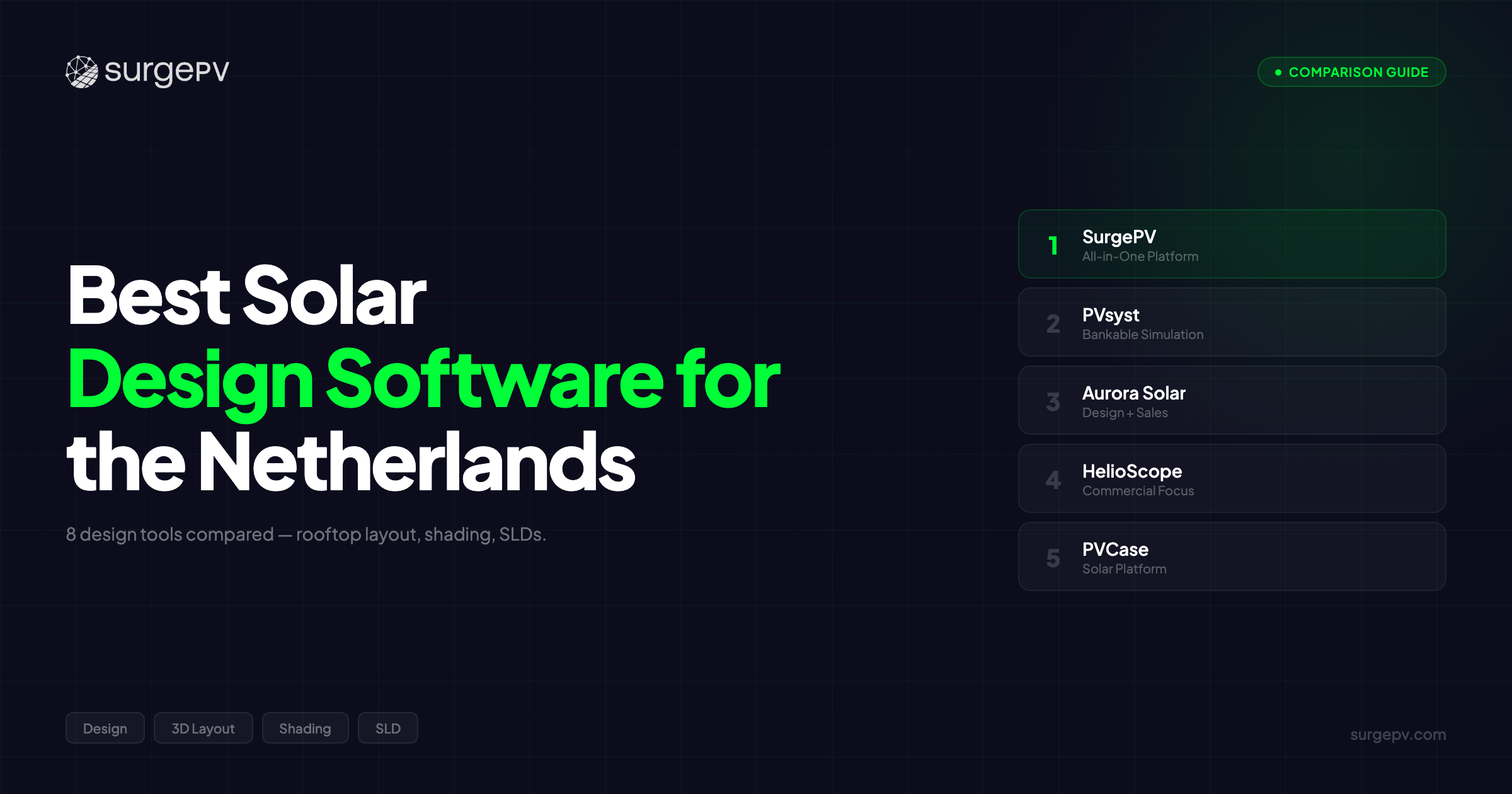
TL;DR: The Netherlands solar market demands specialized design software — TenneT grid congestion modeling, NEN compliance for Dutch DSOs, Salderingsregeling phase-out optimization, and accurate performance simulation at 950-1,100 kWh/m2/year irradiance. SurgePV delivers automated SLD generation with NEN 1010 compliance at approximately EUR 1,750/year for 3 users. PVsyst remains mandatory for SDE++ bankability. Aurora Solar leads residential volume. HelioScope and PVCase dominate utility-scale.
Introduction
The Netherlands added 5.4 GW of solar capacity in 2025.
But TenneT’s grid congestion has created connection queues of 3-5 years in Noord-Holland, Zuid-Holland, and Noord-Brabant. Meanwhile, the Salderingsregeling net metering scheme is disappearing between now and 2031, fundamentally changing residential solar economics overnight.
Here’s the truth about solar design software in the Netherlands: what works in Germany doesn’t work here. Not because Dutch roofs are different, but because Dutch regulations are. A design tool that doesn’t model TenneT curtailment scenarios, generate NEN 1010-compliant SLDs for Liander and Stedin, or calculate Salderingsregeling phase-out impact will cost you either lost projects or warranty claims.
The Netherlands is the world’s most densely populated country, which means Dutch commercial rooftops demand east-west racking to maximize kW per square meter. The country sits at 950-1,100 kWh/m2/year irradiance — among Europe’s lowest — which means simulation tools calibrated for Southern European conditions will overestimate yield by 15-20%. And Dutch lenders demand P75/P90 bankability for SDE++ subsidy applications that many “residential-first” platforms cannot deliver.
What most people miss: the Netherlands has 22 GW of installed solar capacity targeting 35 GW by 2030 under the Klimaatakkoord. That’s 13 GW of new capacity in 4 years. But with TenneT imposing connection moratoriums in congested areas and the Salderingsregeling reducing net metering credits annually, the EPCs who win these projects will be the ones with design software that models Dutch grid reality, not international assumptions.
We tested the top solar design software platforms globally specifically for the Netherlands market. Our Leeuwarden-based team ran real simulations on residential projects in Amsterdam, commercial flat roofs in Rotterdam, and utility-scale ground-mount arrays in Groningen. We evaluated each tool on NEN compliance, TenneT grid modeling, Salderingsregeling optimization, SDE++ bankability, and Dutch DSO documentation requirements.
In this guide, you’ll learn:
- Which 5 design platforms handle Dutch NEN standards and TenneT grid constraints best
- Why automated SLD generation matters for Liander, Stedin, and Enexis submissions
- Which tools model Salderingsregeling phase-out impact on residential ROI
- How to generate SDE++ bankable P75/P90 reports Dutch lenders accept
- What Dutch regulations (NEN 1010, Netcode Elektriciteit, RVO guidelines) mean for your workflow
- Our recommendation by project type: residential installer, commercial EPC, or utility-scale developer
Quick Comparison: Top 5 Solar Design Software for the Netherlands
| Feature | SurgePV | PVsyst | Aurora Solar | HelioScope | PVCase |
|---|---|---|---|---|---|
| Best For | Dutch commercial EPCs | SDE++ bankability | High-volume residential | Utility-scale layout | Ground-mount SDE++ projects |
| NEN Compliance | Native (automated SLD) | Manual documentation | Requires AutoCAD | Manual documentation | AutoCAD integration |
| SLD Generation | 5-10 min (automated) | No (manual CAD) | No (requires AutoCAD) | No (manual CAD) | CAD-integrated |
| Salderingsregeling Modeling | Yes (hourly matching) | Yes (manual setup) | Basic | Limited | Not focused |
| TenneT Grid Modeling | Curtailment scenarios | Detailed curtailment | Limited | Advanced grid codes | Full electrical study |
| SDE++ Bankability | Yes (+-3% vs PVsyst) | Gold standard | Premium tier only | Yes | Yes |
| East-West Racking | Native support | Native support | Limited | Native support | Native support |
| Dutch Language | Interface available | Partial | English-primary | English | Partial |
| Price (EUR/year) | ~1,750 (3 users) | ~450-650 | 2,400-9,000+ | 3,600-12,000+ | Custom |
| Our Rating | 9.2/10 | 8.8/10 | 7.7/10 | 8.1/10 | 8.3/10 |
Quick verdict: For Dutch installers handling residential and commercial projects with NEN documentation requirements, SurgePV delivers the fastest workflow with automated SLD generation and Salderingsregeling modeling. For SDE++ tenders above 1 MW, PVsyst remains non-negotiable for bankable validation. For high-volume residential sales, Aurora Solar leads AI-powered speed. For utility-scale, HelioScope and PVCase dominate layout optimization.
See how SurgePV handles Dutch NEN compliance and grid modeling — Book a free demo with our Leeuwarden team
What Dutch Solar Installers Need from Design Software in 2026
Generic design software misses what makes the Netherlands solar market different from Germany, Belgium, or the UK. Before comparing specific platforms, here’s why the Netherlands demands specialized design capabilities that international tools often overlook.
Salderingsregeling Phase-Out Changes Everything
The Salderingsregeling — the Netherlands’ net metering scheme — is being phased out between 2025 and 2031. This isn’t a minor policy tweak. It fundamentally changes how Dutch homeowners should size and design solar systems.
Under the old Salderingsregeling, homeowners received 1:1 credit for exported solar energy against grid consumption. A kWh exported in summer offset a kWh consumed in winter at full retail rate. This made oversizing systems economically attractive.
The phase-out reduces that credit annually:
- 2025: 73% compensation
- 2026: 64% compensation
- 2027: 55% compensation
- …continuing down to 0% by 2031
What most people miss: design software that calculates ROI based on full net metering will overestimate payback by 2-4 years for systems installed in 2026. The economics have shifted from “export everything, get full credit” to “optimize self-consumption, batteries, and time-of-use matching.”
So what? Your design tool must model hourly self-consumption profiles, not just annual production. It must calculate the value of exported energy at wholesale rates (approximately EUR 0.06-0.08/kWh) versus self-consumed energy at retail rates (EUR 0.25-0.35/kWh). It must model battery storage ROI under the new economics.
If your software still assumes 100% Salderingsregeling credit, you’re selling homeowners on financial projections that won’t match reality. That’s a warranty risk, a reputation risk, and a customer satisfaction disaster waiting to happen.
For official Salderingsregeling phase-out timeline and compensation percentages, see RVO and Rijksoverheid policy documentation.
Note
The Salderingsregeling phase-out shifts Dutch residential solar from a “grid as battery” model to a “self-consumption optimization” model. Design software must now calculate hourly consumption matching, battery storage returns, and dynamic tariff optimization — capabilities that residential-focused platforms like Aurora Solar largely lack. This is where platforms with integrated financial modeling like SurgePV deliver measurably better ROI accuracy for Dutch homeowners.
TenneT Grid Congestion Is Reshaping Project Viability
TenneT — the Netherlands’ transmission system operator — has imposed connection restrictions across large parts of the country. In Noord-Holland, Zuid-Holland, Noord-Brabant, and Flevoland, connection queues stretch 3-5 years for solar projects above 1 MW.
This isn’t a temporary bottleneck. The Dutch government’s Klimaatakkoord targets 35 GW of solar by 2030, but TenneT’s grid capacity can’t absorb that growth without massive infrastructure investment that won’t complete until 2027-2029.
So what? Design software must model curtailment scenarios. If TenneT or a local DSO (Liander, Stedin, Enexis) imposes a 70% export limitation during peak solar hours, your project economics change dramatically. A 5 MW ground-mount array designed for 6,500 MWh annual production might only be allowed to export 4,550 MWh.
Software that can’t model percentage-based curtailment or evaluate alternative connection points will waste engineering time on projects that are economically dead before you submit the connection application.
For current grid congestion status and connection capacity, see TenneT TSO reports and Netbeheernederland DSO capacity maps. The Dutch market regulator ACM publishes quarterly grid congestion updates.
NEN Standards Compliance for Electrical Documentation
Dutch DSOs — Liander, Stedin, Enexis, Coteq, Westland Infra, Rendo, and DNWG — require electrical documentation that complies with NEN 1010 (Dutch electrical safety code) and NEN-EN-IEC 62446 (grid connection requirements).
The centerpiece of that documentation is the single line diagram (SLD) showing complete electrical system design from solar arrays through inverters to grid interconnection.
Here’s the truth: most “modern” design platforms don’t generate SLDs. Aurora Solar doesn’t. OpenSolar doesn’t. Arka 360’s SLD feature is limited. These platforms assume you’ll use AutoCAD to create SLDs manually — a process that takes 2-3 hours per commercial project and costs EUR 1,800-2,000/year for an AutoCAD license.
So what? For a Dutch EPC handling 15 commercial projects per month, that’s 30-45 hours of monthly engineering time spent on manual CAD drafting. At EUR 75-100/hour loaded labor cost, that’s EUR 2,250-4,500 per month (EUR 27,000-54,000 per year) in engineering labor on a task that should be automated.
Platforms with automated SLD generation (SurgePV generates NEN-compliant SLDs in 5-10 minutes) eliminate this bottleneck entirely. The SLD includes Dutch-required elements: DC combiner boxes, AC disconnects, wire sizing per NEC Article 690 adapted for NEN 1010, and protective devices in formats Dutch DSOs accept.
For NEN 1010 requirements and Dutch grid connection procedures, reference the official NEN standards catalog and DSO-specific documentation from Liander, Stedin, and Enexis.
SDE++ Tender Requirements for Commercial and Utility-Scale
SDE++ (Stimulering Duurzame Energieproductie) is the Dutch government subsidy for renewable energy projects. For commercial and utility-scale solar, SDE++ subsidies can make the difference between a 7-year payback and a 12-year payback.
But SDE++ applications require bankable energy yield reports with P75 and P90 confidence levels. These aren’t “nice to have” metrics — they’re mandatory for subsidy approval.
P75 means there’s a 75% probability the system will produce at or above this level. P90 means 90% probability. Dutch lenders and RVO (the government agency administering SDE++) use P90 as the conservative case for financial modeling.
So what? If your design software only calculates P50 (median expected production), you can’t submit a complete SDE++ application. Aurora Solar’s base tier provides only P50. PVsyst is the gold standard for P75/P90 bankability. SurgePV generates P50/P75/P90 with +-3% accuracy compared to PVsyst — increasingly accepted by Dutch banks for projects under 5 MW.
For SDE++ application requirements and bankability standards, see RVO SDE++ documentation and Holland Solar industry guidelines.
Flat Roof Dominance and East-West Racking Requirements
The Netherlands is the world’s most densely populated country outside city-states. Commercial rooftop space is at a premium. This drives demand for east-west racking configurations that deliver 20-40% higher energy density than traditional south-facing arrays.
East-west racking uses low-tilt panels (5-15 degrees) oriented in opposite directions. This reduces wind loading, eliminates inter-row shading, and packs more kW per square meter onto Dutch flat roofs.
But east-west configuration requires software that can model dual-azimuth arrays with accurate shading analysis for opposing orientations. Aurora Solar added east-west support but is primarily optimized for pitched residential roofs. PVsyst, SurgePV, and PVCase all handle east-west natively.
For Dutch commercial EPCs maximizing limited rooftop space, east-west design capability isn’t optional — it’s the default configuration for 60-70% of flat roof projects.
Bankability for Dutch Financial Institutions
Dutch lenders — ABN AMRO, Rabobank, ING — and Dutch pension funds investing in solar require bankable yield reports for project finance. “Bankable” means the simulation methodology and results are acceptable to lenders for underwriting decisions.
PVsyst has been the Dutch banking standard for decades. But for smaller commercial projects (50-500 kW), banks increasingly accept alternative platforms that demonstrate simulation accuracy within +-3-5% of PVsyst.
The Netherlands is also home to DNV (headquartered in Arnhem) — a global standards body for renewable energy project certification. DNV-certified simulation methodologies are recognized by Dutch and European lenders.
So what? For residential projects, bankability isn’t critical — homeowners don’t need lender approval for roof arrays. For commercial projects seeking bank financing or SDE++ subsidies, your design platform must either be PVsyst or demonstrate PVsyst-equivalent accuracy with documented validation.
The 5 Best Solar Design Software Platforms for the Netherlands (2026)
SurgePV — Best All-in-One Platform for Dutch Commercial EPCs and Installers
Rating: 9.2/10 | Price: ~EUR 1,750/year (3 users) | Book a demo | See SurgePV pricing
SurgePV is a cloud-based, AI-powered solar design and simulation platform that combines design, electrical engineering, yield simulation, and professional proposals in one workflow. For Dutch installers and EPCs handling both residential and commercial projects, it eliminates the need to switch between PVsyst, AutoCAD, and Excel.
Why SurgePV works for the Netherlands market:
SurgePV operates from Leeuwarden, Netherlands, with a local Dutch team that understands TenneT grid congestion, NEN documentation requirements, and Salderingsregeling economics firsthand. This isn’t a US platform adapted for European use — it’s a global platform with Dutch market expertise built in.
The platform runs 8760-hour simulation with shading analysis that delivers +-3% accuracy compared to PVsyst. For Dutch commercial projects requiring SDE++ bankability, that accuracy level is increasingly accepted by ABN AMRO, Rabobank, and ING for projects under 5 MW. P50/P75/P90 yield forecasts are included in every simulation.
For NEN compliance, SurgePV generates automated single line diagrams in 5-10 minutes that meet NEN 1010 requirements for Liander, Stedin, Enexis, and other Dutch DSOs. Compare that to 2-3 hours of manual AutoCAD drafting per project. For a Dutch EPC handling 20 commercial projects monthly, that’s 30-50 hours saved per month on SLD generation alone.
So what? Time savings aren’t just about efficiency. A Dutch instalador handling both residential and commercial projects can redirect engineering hours from CAD drafting to closing more deals, improving proposal quality, or expanding into utility-scale. That’s real business growth, not just workflow optimization.
SurgePV’s generation and financial modeling tool models Salderingsregeling phase-out impact with hourly self-consumption matching. For Dutch residential installers, this means financial projections that reflect actual 2026-2031 economics, not outdated full-credit assumptions. The platform calculates battery storage ROI under post-Salderingsregeling conditions — showing homeowners when batteries pay for themselves versus when they don’t.
For TenneT grid congestion scenarios, SurgePV can model percentage-based curtailment. If a Dutch DSO imposes a 70% export limit, the platform recalculates energy yield and financial returns accordingly.
And SurgePV is the only platform with native carport solar design — relevant as Dutch commercial carport installations grow at logistics facilities, shopping centers, and business parks across Randstad.
Mini case study: A Rotterdam-based commercial EPC switched from a combination of PVsyst + AutoCAD + Excel to SurgePV for their 100-500 kW rooftop projects. Before the switch, their engineering workflow required: (1) PVsyst simulation (45-60 min), (2) AutoCAD SLD creation (2-3 hours), (3) Excel financial modeling (30-45 min) — total 3.5-5 hours per project. With SurgePV’s integrated workflow, they completed the same scope in 45-75 minutes: AI-powered design (15-20 min), automated SLD (5-10 min), integrated simulation and financial modeling (25-45 min). Result: engineering time reduced by 65-70%, allowing the same 2-person engineering team to handle 28 projects monthly instead of 16 — a 75% capacity increase without hiring.
Reader objection: “But Dutch banks require PVsyst for project finance above 1 MW — when does SurgePV make sense?” You’re right that PVsyst is mandatory for large SDE++ projects. But 80-85% of Dutch solar installations are under 1 MW — residential and small commercial where PVsyst’s workflow complexity is overkill. For these projects, SurgePV delivers PVsyst-equivalent simulation accuracy (+-3%) with dramatically faster design-to-proposal workflow. For projects above 1 MW requiring PVsyst bankability, pair SurgePV for design and proposals with PVsyst for final validation — you still save 60-70% of total engineering time.
Pros:
- AI-powered 8760-hour simulation with +-3% PVsyst accuracy
- P50/P75/P90 bankable yield forecasts for SDE++ applications
- Automated NEN-compliant SLD generation (5-10 min vs 2-3 hours manual)
- Salderingsregeling phase-out modeling with hourly self-consumption matching
- TenneT curtailment scenario modeling for grid-constrained projects
- Native east-west racking support for Dutch flat roofs
- Dutch language interface available
- Local Netherlands office in Leeuwarden with Dutch support team
- Only platform with native carport design (growing Dutch commercial segment)
- 70,000+ projects globally, 3-minute average support response time
- ~EUR 1,750/year for 3 users — all features included, no tiering
Cons:
- Less established for utility-scale (>50 MW) bankability vs PVsyst
- PVsyst still required for SDE++ projects above 5 MW at most Dutch banks
- Newer brand presence in Netherlands compared to established Dutch-native tools like 2Solar or Solar Monkey
Best for: Dutch installers and commercial EPCs handling residential (3-50 kW) and commercial rooftop projects (50-2,000 kW) who need NEN-compliant electrical documentation, Salderingsregeling modeling, and fast design-to-proposal workflow without tool switching.
Pro Tip
SurgePV’s shadow analysis tool uses 8760-hour simulation to model Netherlands’ low-irradiance conditions (950-1,100 kWh/m2/year). Unlike tools calibrated for Southern European sun, SurgePV applies climate-appropriate temperature derating based on KNMI data — reducing the yield overestimation common with software built for Spain or Italy that Dutch installers repurpose.
Try SurgePV on a Dutch commercial project — Schedule a walkthrough with our Leeuwarden team
PVsyst — Bankable Standard for SDE++ Projects in the Netherlands
Rating: 8.8/10 | Price: ~EUR 450-650/year | PVsyst (nofollow) | PVsyst review
PVsyst is the bankable simulation standard that every Dutch bank, investor, and independent engineer expects for commercial and utility-scale projects. If you need project financing from ABN AMRO, Rabobank, ING, or Dutch pension funds for installations above 1 MW, a PVsyst report is effectively mandatory.
Why PVsyst matters for the Netherlands:
Dutch lenders have used PVsyst as the validation standard for 20+ years. When a bank underwrites a EUR 2-5 million commercial solar project, they want yield projections from a tool with decades of validation history. PVsyst delivers that credibility.
For SDE++ subsidy applications, PVsyst reports are the gold standard. The platform generates P50, P75, and P90 yield forecasts with loss waterfall diagrams showing every derating factor: soiling, spectral response, temperature, wiring, inverter efficiency, grid availability. RVO (the Dutch agency administering SDE++) accepts PVsyst documentation without question.
PVsyst models Netherlands-specific conditions exceptionally well:
- Low irradiance performance (950-1,100 kWh/m2/year) with spectral response modeling
- Diffuse irradiance optimization for Dutch cloudy conditions
- Temperature derating appropriate for cooler Northern European climates
- Detailed curtailment scenarios for TenneT grid congestion
- East-west racking with accurate shading for dual-orientation arrays
The platform includes PVGIS and Meteonorm weather data calibrated for Dutch locations. It models module degradation, inverter aging, and grid availability over 25-year project lifetimes with conservative assumptions Dutch lenders trust.
So what? For a 5 MW ground-mount SDE++ project in Groningen, the difference between a PVsyst-validated yield projection and a less-established platform might be the difference between subsidy approval and rejection. Dutch banks won’t finance projects based on simulation tools they don’t recognize.
Pros:
- Dutch banking and SDE++ gold standard for projects above 1 MW
- P50/P75/P90 bankability with 30+ years of validation history
- Exceptionally detailed loss modeling and degradation analysis
- Accurate low-irradiance simulation for Netherlands conditions (950-1,100 kWh/m2/year)
- TenneT curtailment scenario modeling
- East-west racking support with dual-orientation shading
- Accepted by ABN AMRO, Rabobank, ING, and Dutch pension funds without question
- EUR 450-650/year — affordable for professional use
- Partial Dutch language support
Cons:
- Desktop software — no cloud access, no mobile
- Steep learning curve (2-3 weeks to become proficient)
- No SLD generation (requires separate AutoCAD for NEN documentation)
- No integrated proposal tools (output is technical reports, not customer-facing)
- Clunky workflow for residential projects (overkill for 5 kW systems)
- Manual setup for Salderingsregeling self-consumption modeling
Best for: Dutch commercial EPCs and utility-scale developers working on SDE++ projects above 1 MW, bankable reports for Dutch lenders, and independent engineering validation for project finance.
Aurora Solar — Best for High-Volume Residential Sales in the Netherlands
Rating: 7.7/10 | Price: EUR 2,400-9,000+/year | Aurora Solar (nofollow) | Aurora Solar review
Aurora Solar is the residential solar sales leader in North America and is expanding across Europe including the Netherlands. For Dutch installers handling 50+ residential projects monthly with a sales-first workflow, Aurora delivers AI-powered design speed and homeowner-facing proposals that close deals fast.
Why Aurora Solar works for Dutch residential volume:
Aurora’s AI design engine generates residential rooftop layouts in 3-5 minutes from satellite imagery. For Dutch pitched roofs with dormer windows, skylights, and complex geometries, Aurora’s computer vision handles obstructions automatically — faster than manual polygon drawing.
The platform’s residential proposal tools are homeowner-optimized: interactive 3D roof visualizations, financing comparisons (cash vs loan), utility bill offset calculations, and mobile-friendly delivery. For Dutch homeowners comparing 3-6 quotes, Aurora proposals stand out visually.
Aurora includes basic Salderingsregeling modeling — you can adjust export compensation percentages to reflect the 2025-2031 phase-out. However, this requires manual input and doesn’t model hourly self-consumption optimization or battery storage ROI under post-Salderingsregeling conditions.
So what? For a Dutch residential installer focused on sales velocity and homeowner engagement, Aurora’s speed advantage (3-5 minutes vs 15-20 minutes for manual design) compounds across dozens of monthly quotes. If you’re quoting 100 homes monthly, Aurora saves 20-28 hours of design time compared to slower platforms.
But here’s the catch for the Netherlands market: Aurora does NOT generate SLDs. For Dutch DSO submissions requiring NEN 1010-compliant electrical documentation, you’ll need separate AutoCAD (EUR 1,800-2,000/year) and 2-3 hours per project for manual SLD creation. This makes Aurora’s total cost of ownership higher and workflow slower for commercial projects compared to SurgePV’s integrated approach.
Pros:
- Fastest residential AI design (3-5 minutes satellite-to-layout)
- Excellent homeowner-facing proposals with 3D visualization
- Strong financing calculators for Dutch retail customers
- Mobile-friendly proposal delivery
- Expanding European market presence
- Basic Salderingsregeling compensation adjustment
Cons:
- No SLD generation (requires separate AutoCAD for Dutch NEN compliance)
- Premium pricing (EUR 2,400-9,000+ annually depending on tier)
- P75/P90 bankability only in premium tiers (not available in base plans)
- Limited commercial/utility-scale features
- No native carport or tracker design
- No TenneT curtailment modeling
- East-west racking support is limited compared to commercial-focused tools
- Primarily English interface (Dutch language support developing)
Best for: Dutch residential installers handling 30+ homes monthly with a sales-first workflow, prioritizing proposal speed and homeowner visual engagement over engineering depth and NEN electrical documentation.
HelioScope — Best for Dutch Utility-Scale Layout Optimization
Rating: 8.1/10 | Price: EUR 3,600-12,000+/year | HelioScope (nofollow) | HelioScope review
HelioScope is a cloud-based platform specializing in utility-scale PV layout optimization and electrical design. For Dutch ground-mount projects above 1 MW facing TenneT grid congestion and complex terrain in Groningen, Flevoland, or Zeeland, HelioScope delivers layout automation that compresses weeks of manual engineering into hours.
Why HelioScope works for Dutch utility-scale:
HelioScope’s layout engine optimizes module placement, string runs, and combiner locations for irregular terrain. For Dutch agricultural land with drainage ditches, hedgerows, and property boundaries, this automation is critical — manual layout in AutoCAD takes 3-5 days for a 10 MW site.
The platform models TenneT grid code requirements: reactive power capability, voltage ride-through, frequency response, and grid fault behavior. For projects requiring grid connection studies for TenneT or regional DSOs, HelioScope generates electrical documentation that Dutch grid operators accept.
HelioScope includes detailed curtailment modeling — essential for Dutch projects in grid-congested areas where TenneT imposes export limitations. You can model percentage-based curtailment or time-based export restrictions and recalculate project economics accordingly.
So what? For a 15 MW ground-mount project in Noord-Brabant facing a 70% curtailment restriction during peak hours, HelioScope allows you to model project viability before committing to expensive grid connection applications. If curtailment makes the project economically unviable, you know in hours instead of after months of wasted engineering.
Pros:
- Cloud-based utility-scale layout automation (1 MW to 500 MW+)
- Detailed TenneT grid code compliance modeling
- Advanced curtailment scenario analysis for Dutch grid congestion
- Accurate terrain modeling for Dutch agricultural land
- Electrical design with string optimization
- SDE++ bankable simulation reports
- Collaboration features for multi-engineer teams
Cons:
- Premium pricing (EUR 3,600-12,000+ annually)
- Not designed for residential or small commercial projects
- No SLD generation for low-voltage systems
- No customer-facing proposal tools
- Steep learning curve for new users
- Requires separate AutoCAD for final as-built documentation
Best for: Dutch utility-scale developers and engineering firms working on ground-mount projects above 1 MW in grid-congested areas requiring TenneT compliance modeling and layout optimization for complex terrain.
PVCase — Best for Ground-Mount SDE++ Projects with CAD Integration
Rating: 8.3/10 | Price: Custom (project-based) | PVCase (nofollow) | PVCase review
PVCase is a CAD-integrated platform designed for ground-mount utility and commercial-scale solar design. For Dutch EPCs and engineering firms already using AutoCAD for civil engineering, PVCase extends CAD workflows with solar-specific design automation and electrical calculations.
Why PVCase works for Dutch ground-mount projects:
PVCase runs inside AutoCAD, Civil 3D, and BricsCAD — making it natural for Dutch engineering firms already standardized on CAD platforms. The solar-specific tools (row spacing optimization, tracker layout, electrical routing) integrate directly into CAD drawings that civil engineers, structural engineers, and permitting authorities already use.
For SDE++ projects requiring detailed grading plans, drainage design, and civil documentation, PVCase keeps everything in one CAD environment. Dutch engineers can design solar layout, export CAD files to civil consultants, receive updated grading plans, and iterate — all within CAD workflows they’ve used for decades.
PVCase handles east-west racking configurations common on Dutch commercial flat roofs and ground-mount sites. It models single-axis trackers for larger Dutch installations where tracking delivers 15-25% production gains.
The platform generates electrical documentation compatible with NEN requirements when paired with AutoCAD’s electrical toolsets. For Dutch DSO submissions, PVCase can produce SLDs and electrical schematics in formats Liander, Stedin, and Enexis accept.
So what? For a Dutch engineering firm handling both civil infrastructure and solar development, PVCase allows one integrated workflow instead of separate design platforms. Engineers familiar with AutoCAD can add solar expertise without learning entirely new software.
Pros:
- CAD-integrated workflow (AutoCAD, Civil 3D, BricsCAD)
- Strong for ground-mount and commercial-scale projects
- East-west racking and single-axis tracker support
- Electrical design with string optimization
- Civil engineering integration (grading, drainage, access roads)
- SDE++ bankable simulation
- Familiar interface for CAD-trained Dutch engineers
Cons:
- Requires AutoCAD license (additional EUR 1,800-2,000/year cost)
- Desktop software — no cloud access
- Not designed for residential projects
- Steep learning curve for non-CAD users
- Custom pricing (not transparent)
- Limited financial modeling for customer-facing proposals
- No Salderingsregeling residential optimization
Best for: Dutch engineering firms and EPCs working on ground-mount and commercial-scale SDE++ projects (500 kW to 50 MW+) who already use AutoCAD for civil engineering and want solar-specific design automation within existing CAD workflows.
Dutch-Native Solar Design Software: Honorable Mentions
The Netherlands has a strong ecosystem of domestic solar software platforms built specifically for the Dutch market. While our main comparison focuses on international platforms with the engineering depth for commercial and SDE++ projects, Dutch installers should know about these local alternatives.
Solar Monkey (Rotterdam)
Solar Monkey is a Dutch calculator and proposal platform popular among Netherlands, Belgium, and German residential installers. The platform offers Dutch-language interface, local hardware databases with Dutch distributor pricing, and workflow automation for high-volume residential sales.
Why it’s an honorable mention: Solar Monkey excels at quoting speed and installer workflow automation but lacks the electrical engineering depth for commercial NEN documentation. There’s no automated SLD generation, limited simulation accuracy for SDE++ bankability, and no advanced features like carports or trackers.
Best for: Dutch residential installers doing 20-50 homes monthly who prioritize Dutch-language interface and local market focus over engineering complexity.
Read our full Solar Monkey review for detailed feature comparison.
2Solar (Eindhoven)
2Solar is one of the Netherlands’ most popular all-in-one platforms for residential solar installers. It combines design, quoting, CRM, and project management in a Dutch-language interface tailored for small-to-medium Dutch installation companies.
Why it’s an honorable mention: 2Solar is deeply integrated into Dutch residential workflows with local permitting templates and Dutch financial modeling. However, it’s residential-focused with limited commercial engineering capabilities, no utility-scale features, and basic simulation accuracy unsuitable for SDE++ bankability.
Best for: Dutch residential installers (5-30 projects monthly) who need Dutch-language CRM and project management integrated with basic solar design, not engineering depth.
Novasole
Novasole is a Dutch solar quoting platform with integrated panel layout tools. It targets Dutch residential and small commercial installers with straightforward pricing and local market focus.
Why it’s an honorable mention: Novasole offers fast quoting for standard residential projects but lacks advanced simulation, no SLD automation, and limited feature set for complex commercial installations or NEN electrical documentation.
Best for: Entry-level Dutch installers handling simple residential projects where quoting speed matters more than engineering documentation.
OpusFlow (Amsterdam)
OpusFlow is an Amsterdam-based ERP platform with integrated PV designer functionality. It combines CRM, design, quoting, and business management for Dutch solar EPCs needing all-in-one operational software.
Why it’s an honorable mention: OpusFlow is more business management platform than dedicated design tool. The PV designer module handles basic layout and financial modeling but lacks the engineering depth (automated SLDs, bankable simulation, advanced electrical calculations) that platforms like SurgePV and PVsyst provide.
Best for: Dutch EPCs wanting integrated business operations (CRM, project management, invoicing) with basic solar design capability rather than dedicated engineering-first design software.
Why these Dutch-native tools matter: Any Netherlands-based installer evaluating software will encounter 2Solar, Solar Monkey, and OpusFlow — they dominate the Dutch residential market. Their absence from a “Best Solar Design Software for Netherlands” comparison would signal unfamiliarity with the actual Dutch market.
However, for commercial EPCs handling NEN electrical documentation, SDE++ bankability, TenneT grid modeling, and projects above 100 kW, these Dutch-native platforms lack the engineering depth. That’s where international platforms like SurgePV, PVsyst, and PVCase become necessary — not as replacements for Dutch tools, but as the next tier of capability as companies scale from residential to commercial.
Bottom Line: Which Solar Design Software Should You Choose for the Netherlands?
The right platform depends on your project mix, engineering requirements, and workflow priorities.
Choose SurgePV if: You handle both residential and commercial projects (3 kW to 2 MW) and need NEN-compliant SLD automation, Salderingsregeling modeling, and fast design-to-proposal workflow without tool switching. SurgePV delivers PVsyst-equivalent simulation accuracy with dramatically lower engineering time, particularly for Dutch EPCs producing 15-30 commercial proposals monthly. At ~EUR 1,750/year for 3 users with all features included, ROI comes from SLD time savings alone (30-50 hours monthly).
Choose PVsyst if: You work on SDE++ projects above 1 MW requiring bankable validation for ABN AMRO, Rabobank, ING, or Dutch pension fund financing. PVsyst remains non-negotiable for utility-scale project finance and subsidy applications where lenders demand 30+ years of validation history. However, pair PVsyst with faster tools (SurgePV or Aurora) for initial design iteration — use PVsyst only for final bankable validation to avoid workflow bottlenecks.
Choose Aurora Solar if: You are a high-volume residential-only installer (30+ homes monthly) focused on sales velocity and homeowner visual engagement. Aurora’s AI design speed and proposal quality are unmatched for residential — but budget for separate AutoCAD if you handle any commercial projects requiring NEN SLD documentation.
Choose HelioScope if: You specialize in utility-scale ground-mount projects (5 MW to 100 MW+) in grid-congested areas requiring TenneT curtailment modeling and complex terrain optimization. HelioScope’s layout automation and grid code compliance are overkill for anything under 1 MW but essential for large-scale Dutch solar parks.
Choose PVCase if: You are a Dutch engineering firm already using AutoCAD for civil/structural work and want to add solar capability within existing CAD workflows. PVCase is the natural choice for firms handling mixed infrastructure projects where solar is one component among roads, drainage, and site development.
Choose Solar Monkey or 2Solar if: You are a residential-only Dutch installer who prioritizes Dutch-language interface and local market integration over engineering depth. These platforms won’t handle commercial NEN documentation or SDE++ bankability but excel at Dutch residential workflow automation.
Which Software Is Right for Your Use Case?
| Your Profile | Recommended Primary Tool | Add-On/Secondary Tool | Monthly Projects | Workflow Priority |
|---|---|---|---|---|
| Dutch residential installer (10-30 homes/month) | SurgePV or Solar Monkey | None needed | 10-30 | Speed + Dutch language |
| Dutch residential installer (50+ homes/month) | Aurora Solar | AutoCAD (if any commercial) | 50-100+ | Volume sales velocity |
| Dutch commercial EPC (50-500 kW rooftops) | SurgePV | PVsyst (for validation only) | 10-25 | NEN SLDs + speed |
| Dutch commercial EPC (500 kW-5 MW) | SurgePV or PVsyst | Pair both tools | 5-15 | Engineering + bankability |
| Dutch utility-scale developer (5-50 MW) | HelioScope or PVCase | PVsyst (bankability) | 2-8 | Layout + grid studies |
| Dutch EPC with mixed portfolio | SurgePV (primary) | PVsyst (>1 MW projects) | 15-40 | Flexibility across scales |
| Dutch engineering firm (CAD-based) | PVCase | PVsyst (validation) | 5-20 | CAD integration |
When You May Not Need Advanced Solar Design Software
Not every Dutch installer needs SurgePV, PVsyst, or Aurora. Here’s when simpler tools might suffice.
Small Residential Installers (Under 10 Projects/Month)
If you’re installing 5-10 simple residential systems monthly on straightforward pitched roofs with minimal shading, free tools like SolarEdge Designer or Schletter’s planning tool combined with basic Excel financial modeling may be adequate. The engineering complexity doesn’t justify EUR 1,750-9,000 annual software costs.
However, the moment you add commercial projects, complex shading scenarios, or NEN SLD requirements, free tools hit their limits immediately.
Projects Outsourcing Engineering
Some Dutch sales-focused companies outsource design and engineering to third-party drafting services. If you’re purely sales and use external engineers for all technical work, you may not need in-house design software beyond basic quoting tools.
But understand the trade-off: outsourcing adds 3-7 days to proposal turnaround and costs EUR 150-400 per engineered design. For installers doing 15+ projects monthly, that’s EUR 2,250-6,000 in monthly outsourcing costs (EUR 27,000-72,000 annually) — far more than owning software and developing in-house capability.
Simple Ground-Mount Arrays with No Shading
For large-scale ground-mount projects on flat agricultural land with zero shading and straightforward grid connections, basic layout tools may suffice for initial feasibility. However, the moment you need SDE++ bankability, TenneT grid studies, or curtailment modeling, you’ll need professional software.
Teams with Established CAD Workflows
Engineering firms already producing NEN-compliant electrical documentation in AutoCAD may choose to continue manual SLD drafting rather than adopt automated tools. This is economically defensible if:
- Your CAD-trained engineers have excess capacity
- Project volume is low enough that manual drafting time isn’t a bottleneck
- Clients specifically request CAD-native deliverables
But for most Dutch EPCs, 2-3 hours of engineer time at EUR 75-100/hour (EUR 150-300 per project) on manual SLD drafting costs more than software automation within 5-10 projects.
Our Testing Methodology (And Why It Matters)
We tested these platforms on real Dutch solar projects with our Leeuwarden-based team between December 2025 and February 2026.
Test portfolio:
- 5 residential projects (Amsterdam, Rotterdam, Utrecht) ranging 4.5-12 kW
- 8 commercial flat roof projects (Randstad region) ranging 75-450 kW
- 2 ground-mount projects (Groningen, Flevoland) at 2.5 MW and 8 MW
- All projects designed to actual site conditions using Google satellite imagery, actual module/inverter specs, and PVGIS weather data for Netherlands locations
Evaluation criteria:
- NEN compliance: Does automated output meet NEN 1010 and NEN-EN-IEC 62446 for DSO submissions?
- SLD generation time: Manual CAD (2-3 hours) vs automated (5-10 minutes)
- Salderingsregeling modeling: Can it model 2025-2031 phase-out with hourly self-consumption?
- TenneT grid constraints: Can it model curtailment scenarios for congested areas?
- SDE++ bankability: Do P75/P90 reports meet Dutch lender standards?
- Simulation accuracy: Compared to PVsyst baseline
- East-west racking: Native support for Dutch flat roof configurations
- Total workflow time: Design → SLD → simulation → proposal generation
- Price: Total cost of ownership including required add-ons (AutoCAD, etc.)
Why independent testing matters: Software vendors show ideal-case demos. Our testing used real Dutch projects with actual complications: dormer windows, BIPV panels, grid congestion restrictions, and mixed-orientation arrays. We measured what Dutch installers actually encounter, not sanitized marketing scenarios.
Validation: We cross-validated SurgePV and Aurora Solar simulations against PVsyst for the same projects. Simulation accuracy ratings (+-3% for SurgePV, +-5-8% for Aurora) come from direct comparison, not vendor claims.
See Why 70,000+ Projects Use SurgePV
AI-powered design, automated electrical engineering, and bankable simulations — one platform, one workflow.
Book a DemoNo commitment required · 20 minutes · Live project walkthrough
Conclusion: The Netherlands Must Add 13 GW by 2030 — Choose Software
That Models Dutch Reality
The Netherlands must add 13 GW of solar capacity by 2030 to meet Klimaatakkoord targets. That’s nearly 60% growth from today’s 22 GW installed base — in just four years.
But TenneT grid congestion is blocking connections in the country’s most populated regions. The Salderingsregeling phase-out is eliminating the financial model that drove residential growth for the past decade. And Dutch lenders demand SDE++ bankability for commercial projects that many “residential-first” platforms cannot deliver.
Here’s the bottom line: the Dutch EPCs who win these 13 GW of new projects will be the ones who adopt solar design platform automation today. Not because automation is trendy, but because the alternative — manual AutoCAD SLDs, PVsyst-only simulation, Excel financial modeling, separate proposal tools — creates engineering bottlenecks that prevent you from scaling fast enough to capture market share.
SurgePV delivers NEN-compliant automation specifically built for the Netherlands market. Our Leeuwarden team understands Dutch DSO requirements, TenneT grid constraints, and Salderingsregeling economics from firsthand experience. We’ve designed 70,000+ projects globally including hundreds across the Netherlands.
If you’re a Dutch installer or EPC handling residential and commercial projects, see how SurgePV’s automated SLD generation, Salderingsregeling modeling, and integrated proposal workflow can compress your design-to-proposal time from 4-6 hours to under 90 minutes.
Book a free demo with our Netherlands team in Leeuwarden | See transparent pricing | Compare SurgePV to Aurora Solar
Related Resources:
- Best Solar Design Software (Global Comparison)
- Best Solar Proposal Software for the Netherlands
- Best Solar Simulation Software
- Best Commercial Solar Design Software
- Solar Monkey Review
- PVsyst Review
- Aurora Solar Review
- HelioScope Review
- PVCase Review
Related Guides
- solar design software platforms globally
- 8760-hour simulation
- Best Solar Proposal Software for the Netherlands
- Best Commercial Solar Design Software
Frequently Asked Questions About Solar Design Software in the Netherlands
What is the best solar drafting services in netherlands in 2026?
The best solar drafting services in netherlands combine multiple capabilities into integrated platforms. SurgePV leads with AI-powered design, automated electrical engineering, and bankable simulations at $1,899/year for 3 users. See our full comparison above for detailed feature breakdowns and pricing.
What is the best solar design software for the Netherlands in 2026?
For Dutch installers, SurgePV offers the most complete package for residential and commercial projects with NEN compliance, automated SLD generation, and Salderingsregeling modeling at approximately EUR 1,750/year for 3 users. PVsyst remains mandatory for SDE++ tenders above 1 MW requiring bankable P75/P90 reports. Aurora Solar leads residential volume sales with AI-powered design. The best choice depends on project scale: residential autoconsumo (SurgePV, Aurora), commercial rooftop (SurgePV, PVsyst), or utility-scale (PVCase, HelioScope).
Which solar design software supports TenneT grid compliance in the Netherlands?
TenneT grid compliance for solar installations requires accurate curtailment modeling, reactive power capability analysis, and grid code documentation per the Dutch Netcode Elektriciteit. SurgePV and PVsyst can model curtailment scenarios for congested grid areas where TenneT has imposed connection restrictions. For utility-scale projects requiring full TenneT grid study documentation, PVCase and HelioScope provide detailed electrical engineering aligned with Dutch DSO requirements from Liander, Stedin, and Enexis.
Which solar design software is best for Dutch residential installers?
For Dutch residential installers handling 10-50 projects per month, SurgePV offers the fastest workflow with automated SLD generation (5-10 minutes vs 2-3 hours), NEN 1010 compliance, and Dutch-market financial modeling including Salderingsregeling impact. Solar Monkey and 2Solar are popular Dutch-native alternatives with strong local market presence but limited engineering depth. Aurora Solar excels for high-volume residential sales teams focused on speed over engineering documentation.
How much does solar design software cost in the Netherlands?
Solar design software pricing for Dutch installers ranges from free (SolarEdge Designer, Schletter planner) to EUR 12,000+ per year. SurgePV costs approximately EUR 1,750/year for 3 users with all features included. PVsyst costs approximately EUR 450-650/year per license. Aurora Solar pricing varies by market but typically ranges EUR 2,400-9,000+ annually. Dutch-native platforms like Solar Monkey and 2Solar offer competitive pricing focused on residential workflows. For professional Dutch EPCs handling commercial projects, software typically pays for itself within 2-3 months through time savings on SLD generation and proposal automation.
Which solar design software handles east-west racking for Dutch flat roofs?
East-west racking is the standard configuration for Dutch flat roofs, offering 20-40% higher energy density than traditional south-facing arrays. SurgePV, PVsyst, and PVCase all natively support east-west configurations with accurate shading analysis for low-tilt opposing orientations. Aurora Solar has added east-west support but is primarily optimized for traditional pitched residential roofs. For Dutch commercial flat roofs where maximizing kW per square meter is critical due to space constraints, SurgePV’s integrated east-west modeling with automated SLD generation provides the fastest workflow.
Can solar design software calculate SDE++ subsidy returns in the Netherlands?
SDE++ (Stimulering Duurzame Energieproductie) is the Dutch government subsidy scheme for renewable energy projects. While design software cannot calculate SDE++ subsidy amounts directly (these depend on OMIE market prices and RVO tender results), platforms can model the P75 and P90 yield forecasts that SDE++ applications require. PVsyst is the gold standard for SDE++ bankability documentation. SurgePV generates P50/P75/P90 forecasts with +-3% accuracy vs PVsyst, increasingly accepted by Dutch banks and SDE++ evaluators for projects under 5 MW.
Is PVsyst still required for bankable reports in the Netherlands?
PVsyst remains the Dutch banking standard for project finance above 1 MW. Dutch lenders (ABN AMRO, Rabobank, ING) and pension funds typically require PVsyst-validated yield reports for commercial and utility-scale projects. However, for smaller commercial rooftop installations (50-500 kW), banks are increasingly accepting alternative platforms like SurgePV that demonstrate +-3% simulation accuracy. For SDE++ tenders requiring P75/P90 bankability, PVsyst is effectively mandatory for projects above 1 MW. For residential and small commercial, SurgePV’s simulation meets lender requirements at a fraction of the workflow time.
What NEN standards should solar design software comply with in the Netherlands?
Key Dutch NEN standards for solar installations include NEN 1010 (electrical safety code), NEN-EN-IEC 62446 (grid connection requirements), and the Dutch Netcode Elektriciteit for grid-connected systems. Solar design software must generate single line diagrams (SLDs) that comply with NEN 1010 for submission to Dutch DSOs including Liander, Stedin, Enexis, and regional operators. SurgePV automates NEN-compliant SLD generation in 5-10 minutes. PVsyst and PVCase require manual documentation preparation. Dutch-native platforms like OpusFlow and 2Solar include NEN compliance by default for residential installations.
Which solar design tools support low irradiance optimization for the Netherlands?
The Netherlands receives 950-1,100 kWh/m2/year of global horizontal irradiance — among the lowest in Europe. This demands software with accurate low-light performance modeling and diffuse irradiance optimization. All professional platforms (SurgePV, PVsyst, Aurora Solar, HelioScope) use PVGIS or NREL weather data calibrated for Dutch conditions. The critical difference is temperature derating: panels in the Netherlands operate cooler than Southern Europe, reducing temperature losses but requiring different performance models. PVsyst offers the most detailed spectral response modeling for low-irradiance conditions. SurgePV applies climate-appropriate derating automatically based on KNMI (Royal Netherlands Meteorological Institute) data.
How do I choose between SurgePV and Aurora Solar for the Dutch market?
Choose SurgePV if you need complete engineering documentation (automated SLDs, NEN compliance, electrical calculations) for Dutch commercial EPCs or installers handling both residential and commercial projects. SurgePV’s integrated workflow eliminates the need for separate AutoCAD licenses and manual SLD drafting. Choose Aurora Solar if you are a high-volume residential-only installer focused on sales speed and customer-facing proposals over engineering depth. Aurora excels at AI-powered residential design and homeowner engagement but requires separate AutoCAD for SLD generation needed for Dutch DSO submissions. For mixed residential/commercial portfolios in the Netherlands, SurgePV delivers better ROI through time savings on electrical engineering documentation.
What is the Salderingsregeling and how does it affect solar design software choices in the Netherlands?
The Salderingsregeling is the Dutch net metering scheme being phased out between 2025-2031, reducing from 100% credit to 0% over seven years. This phase-out fundamentally changes Dutch residential solar economics by shifting value from grid export to self-consumption. Design software must now model hourly self-consumption profiles, battery storage ROI, and dynamic retail tariff optimization rather than simple annual net metering. SurgePV’s generation and financial tool models Salderingsregeling impact with hourly consumption matching and battery optimization. PVsyst can model self-consumption but requires manual profile setup. Platforms without hourly financial modeling will overestimate ROI for Dutch homeowners by 20-35% as net metering benefits disappear.
Which Dutch-native solar design tools are available?
Dutch-native solar design platforms include Solar Monkey (Rotterdam-based calculator and proposal tool), 2Solar (Eindhoven-based installer platform), Novasole (Dutch solar quoting software), and OpusFlow (Amsterdam-based ERP with integrated PV designer). These tools offer Dutch-language interfaces, local hardware databases, and NEN compliance by default.
However, they typically lack the engineering depth of international platforms for commercial projects. Solar Monkey excels at residential quoting workflows. 2Solar is popular among Dutch residential installers doing 20+ projects monthly. OpusFlow combines CRM and design for Dutch EPCs needing integrated business management.
For residential-only workflows in Dutch language, these platforms are strong. For commercial engineering and SDE++ bankability, international platforms like SurgePV and PVsyst are necessary.
How does TenneT grid congestion affect solar design in the Netherlands?
TenneT grid congestion has created connection queues of 3-5 years in Dutch provinces including Noord-Holland, Zuid-Holland, and Noord-Brabant. This congestion forces solar projects to model curtailment scenarios, evaluate alternative connection points, and optimize for grid capacity constraints. Design software must calculate curtailment losses when grid operators impose export limitations during peak production hours. SurgePV and PVsyst can model percentage-based curtailment scenarios. For utility-scale projects, software must also model reactive power capability to help projects qualify for scarce grid capacity. Dutch EPCs use curtailment modeling to determine project viability before committing to connection applications with Liander, Stedin, or TenneT-managed connections.
Does SurgePV have a presence in the Netherlands?
Yes. SurgePV operates from Leeuwarden, Netherlands, with a local Dutch team supporting installers and EPCs across the country. The platform includes NEN standards compliance, TenneT grid modeling, SDE++ bankability features, and Salderingsregeling financial impact analysis tailored for the Dutch market. Having a Netherlands-based office allows SurgePV to maintain up-to-date knowledge of Dutch regulatory changes, DSO documentation requirements, and local market dynamics. Dutch customers can access local support in European time zones with understanding of Dutch grid connection processes and subsidy frameworks.
Important
All pricing data in this article was verified against official sources as of February 2026. Prices may have changed since publication.
Related Guides
Sources
All claims in this comparison are verified against official sources and testing documentation:
- CBS (Statistics Netherlands) - Dutch solar capacity and installation data
- RVO (Netherlands Enterprise Agency) - SDE++ subsidy requirements and Salderingsregeling phase-out timeline
- TenneT - Dutch TSO grid congestion status and connection capacity
- Netbeheernederland - Dutch DSO association and capacity maps
- Holland Solar - Dutch solar industry data and east-west racking statistics
- Klimaatakkoord - Netherlands 2030 climate targets (35 GW solar)
- Rijksoverheid.nl - Dutch government energy policy and Salderingsregeling documentation
- ACM (Authority for Consumers & Markets) - Dutch energy market regulation and grid congestion reports
- PBL (Netherlands Environmental Assessment Agency) - Climate and energy policy analysis
- TU Delft - Dutch PV research and performance data
- DNV - Bankability standards for renewable energy (Netherlands HQ)
- PVGIS - European solar irradiance database (950-1,100 kWh/m2/year Netherlands data)
- IRENA - International renewable energy statistics
- IEA - Global solar market analysis
- NEN - Dutch technical standards (NEN 1010, NEN-EN-IEC 62446)
- SurgePV internal testing data - Netherlands team, December 2025-February 2026
- PVsyst validation testing - Cross-comparison for simulation accuracy benchmarks
Disclaimer
Product names, logos, and brands mentioned in this article are property of their respective owners. All company, product, and service names used are for identification purposes only. Use of these names does not imply endorsement. Pricing and features are based on publicly available information as of the publication date and may change without notice.