

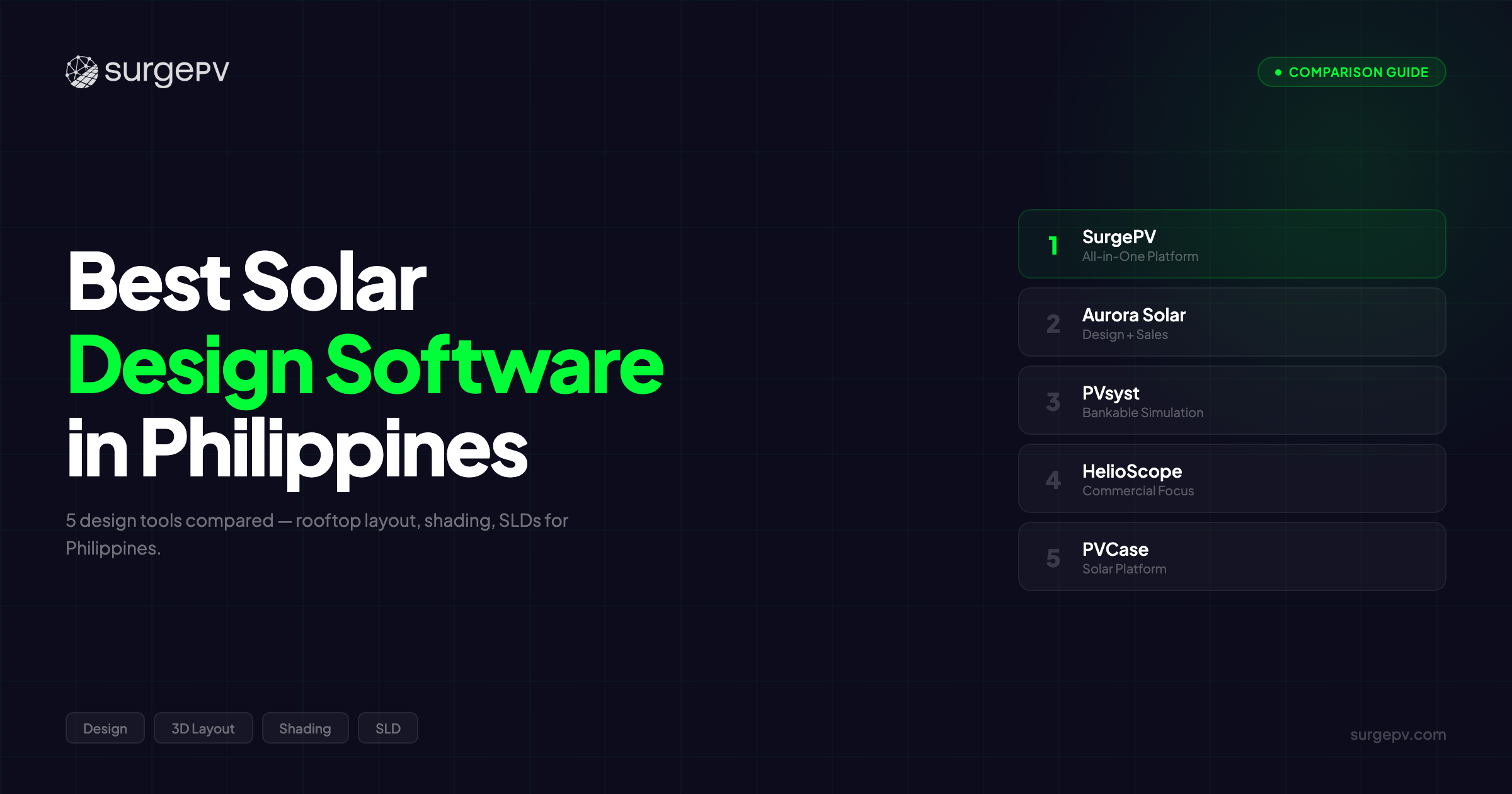
TL;DR: SurgePV is the only platform combining design, automated electrical engineering, bankable simulation, and proposals without AutoCAD or PVsyst. Aurora Solar handles residential design well but lacks Philippine electrical compliance. PVsyst is the simulation gold standard but not a design tool. HelioScope works for fast commercial layouts. PVCase fits utility-scale terrain projects.
Philippine electricity rates hit PHP 11-13 per kWh in Meralco territory — USD 0.20-0.23, among the highest in Asia. Commercial customers in Manila pay PHP 8-12/kWh. Industrial facilities in Batangas or Laguna pay PHP 7-10/kWh. These prices make 3-5 year payback periods realistic for commercial projects.
But those payback calculations only work if your solar software gets the numbers right.
The Philippines averages 20 typhoons per year. That is not a footnote in a risk assessment — it is a fundamental engineering requirement. Every solar installation must be designed for wind loads per the National Structural Code of the Philippines (NSCP). A mounting system rated for Category 3 winds in Florida does not meet NSCP requirements for Samar or Leyte. Accurate solar simulation software must account for these structural demands.
Then there are the island grid challenges. The Philippines has no single national grid. Luzon, Visayas, and Mindanao operate separate grid systems. Distribution utilities — Meralco in Manila, VECO in Cebu, Davao Light in Mindanao, plus 120+ rural electric cooperatives — each have slightly different interconnection procedures, tariff structures, and technical requirements for net metering under RA 11285.
The right solar design software for the Philippines must handle typhoon wind load calculations, near-equatorial sun angles, high-temperature derating at 30-38 degrees C, PEC-compliant electrical documentation, and net metering economics across multiple distribution utilities — in one platform.
In this guide, you’ll learn:
- Which platforms model typhoon wind loads per NSCP standards
- How each tool handles Philippine net metering calculations under RA 11285
- Which software generates PEC-compliant electrical documentation without AutoCAD
- Total cost of ownership in PHP for Philippine EPC teams
- Detailed comparisons of SurgePV, Aurora Solar, PVsyst, HelioScope, and PVCase
Quick Comparison Table
| Software | Best For | Pricing | Philippines Fit |
|---|---|---|---|
| SurgePV | End-to-end workflows | ~$1,899/yr (3 users) | Excellent |
| Aurora Solar | Residential proposals | ~$3,600-6,000/yr | Good |
| PVsyst | Bankable simulation | ~$625-1,250/yr | Good |
| HelioScope | Commercial rooftop arrays | ~$2,400-4,800/yr | Good |
| PVCase | Utility-scale terrain | ~$3,800-5,800/yr | Good |
Quick Summary: Our Top Picks for the Philippines
After testing 5 platforms with solar installers and EPCs across Manila, Cebu, and Davao:
- SurgePV — End-to-end design, electrical engineering, and bankable simulations with typhoon wind load modeling (Best for Philippine EPCs needing PEC compliance and net metering)
- Aurora Solar — Cloud-based AI roof detection and polished proposals (Best for residential installers in Metro Manila, lacks Philippine-specific features)
- PVsyst — Industry-standard bankable simulations (Best for utility-scale projects needing financier-grade reports)
- HelioScope — Cloud-based commercial layout (Best for fast rooftop layouts, no electrical engineering)
- PVCase — CAD-based ground-mount engineering (Best for 10 MW+ solar farms on complex terrain)
Each tool evaluated on Philippines-specific criteria: typhoon wind load modeling, net metering accuracy, tropical climate simulation, PEC compliance, and PHP pricing.
Best Solar Design Software in Philippines (Detailed Reviews)
SurgePV — Best End-to-End Solar Platform for the Philippines
SurgePV is the only cloud-based platform combining AI-powered design, automated electrical engineering, bankable simulations, and professional proposals without tool-switching.
For Philippine EPCs dealing with typhoon wind loads, Meralco net metering applications, PEC electrical documentation requirements, and the engineering realities of designing at 30-38 degrees C ambient temperatures, SurgePV eliminates the need for AutoCAD, PVsyst validation, and manual structural calculations. You design a 200 kW commercial rooftop in Makati, generate PEC-compliant single line diagrams automatically, run 8760-hour shading analysis calibrated for tropical near-equatorial sun angles, and produce bankable P50/P90 reports — all in the same platform.
Target Users: Commercial EPCs (50 kW-10 MW), Philippine solar installers (residential and commercial), utility-scale developers, and consultants managing DOE-registered renewable energy projects.
Unique Value for the Philippines: SurgePV is the only platform with integrated SLD generation and wire sizing that eliminates AutoCAD dependency. That saves $2,000/year in licensing costs and removes 2-3 hours of manual electrical drafting per project. For Philippine EPCs competing for commercial contracts against 3-8 other bidders, speed and professional documentation quality win deals.
Pro Tip
When evaluating solar design software for the Philippines, test with a typhoon scenario first. Model your design with NSCP wind load requirements for your project’s geographic zone. Software that handles Philippine structural requirements from the start prevents costly redesigns after engineering review — and avoids the liability of under-designed mounting systems in typhoon-prone regions.
Key Features for the Philippines
Design and Engineering
SurgePV’s AI-powered roof modeling detects roof boundaries, tilt, and azimuth from satellite imagery. For Philippine building stock — galvanized iron sheet roofing (most common), concrete flat roofs (commercial), and tile roofs (upscale residential) — the platform handles the roof types Philippine installers work with daily.
Module layout optimization supports near-equatorial tilt angles (10-15 degrees optimal for the Philippines at 7-20 degrees N latitude), East-West configurations for flat commercial roofs, and ground-mount tracker layouts for utility-scale projects under Renewable Energy Service Contracts (RESC).
Electrical Engineering (Critical for the Philippines)
Here is where SurgePV separates from every other option.
SLD generation is automated. Complete your design, click generate, and within 5-10 minutes you have a PEC-compliant electrical schematic showing DC arrays, combiners, disconnects, inverters, AC wiring, breakers, and grid interconnection. That SLD is ready for Meralco, VECO, Davao Light, or electric cooperative submission.
The alternative? Export to AutoCAD and spend 2-3 hours manually drafting. That is 2-3 hours your competitor did not waste.
Wire sizing for the Philippine 220V/60Hz grid system happens instantly. DC and AC wire gauges based on current, distance, voltage drop limits, temperature correction for tropical conditions, and conduit fill. All PEC and NEC compliant.
Simulation and Bankability
Philippine development banks and commercial lenders demand accurate production forecasts. At 30-38 degrees C ambient, modules operate at 55-70 degrees C cell temperature — 30-45 degrees above STC rating. That costs 12-18% of nameplate output. Software that does not model this overestimates production badly.
SurgePV’s production simulation achieves plus or minus 3% accuracy compared to PVsyst. P50, P75, and P90 estimates give Philippine lenders the uncertainty ranges they require. Financial modeling includes Philippine-specific inputs: Meralco and VECO tariff structures by customer category, net metering credit calculations under RA 11285, income tax holiday and duty-free import incentives under RA 9513, and PHP-denominated ROI calculations using the solar ROI calculator.
Typhoon Wind Load Engineering
This is not optional in the Philippines. NSCP requires wind load calculations for every installation, and the Philippines’ typhoon risk profile means under-designed systems face real physical danger.
SurgePV includes wind load design parameters per NSCP standards, factoring geographic zone, terrain category, building height, and panel orientation into structural loading calculations. This ensures mounting system specifications meet Philippine building code requirements without outsourcing structural engineering.
Further Reading
See our best solar design software comparison for global rankings, or compare best solar software for EPCs for commercial-focused platforms.
Pros and Cons
Pros:
- Only platform combining design + electrical engineering + simulation + proposals
- Automated SLD generation eliminates AutoCAD ($2,000/year savings + 2-3 hours/project)
- Typhoon wind load modeling per NSCP standards for Philippine installations
- P50/P75/P90 bankability reports accepted by Philippine development banks
- Net metering financial modeling with Meralco/VECO/DU tariff structures in PHP
- Cloud-based — accessible from Manila, Cebu, or Davao
Cons:
- Newer brand in the Philippine market compared to PVsyst (25+ years)
- English-language platform (Filipino/Tagalog interface not yet available)
- USD pricing ($1,499/user/year, approximately PHP 85,000) may require budgeting for smaller installers
Pricing
- 3-User Plan: $4,497/year (approximately PHP 255,000/year) — $1,499/user/year
- Individual Plan: $1,899/year (approximately PHP 108,000/year) for 3 users
- Includes: All features — design, SLD, simulation, proposals, financial modeling
- No AutoCAD required: Saves $2,000/year per user
Real-World Example
A commercial EPC in Makati was handling 40 projects per year across Metro Manila and Cavite. Their workflow: 30 minutes design in HelioScope, 2.5 hours SLDs in AutoCAD, 45 minutes financial model in Excel, 30 minutes assembling proposals. Total: 4+ hours per project. After switching to SurgePV, complete workflows dropped to 45 minutes. At 40 projects per year, they recovered 130+ engineering hours annually — freeing capacity for 15 additional projects.
Aurora Solar — Residential Design, Limited Philippine Features
Aurora Solar is a cloud-based platform built primarily for high-volume residential solar in the US market. Industry-leading AI roof detection and beautiful homeowner proposals.
Key Strengths:
- Best-in-class AI roof modeling from satellite imagery
- Visually polished residential proposals
- Strong CRM integrations (Salesforce, HubSpot)
- P50 production estimates (but not P75/P90)
- Global module and inverter database
Where Aurora Falls Short for the Philippines:
No automated SLD generation — Philippine EPCs using Aurora need AutoCAD for every project ($2,000/year extra + 2-3 hours per project). No typhoon wind load modeling per NSCP. No Philippine DU tariff structures in financial modeling. USD-denominated pricing requires manual PHP conversion. No P75/P90 for bankable reports accepted by Philippine lenders. At $3,600-6,000/year per user, it is the most expensive option — and still requires additional tools for electrical engineering.
Best For: High-volume residential installers in Metro Manila prioritizing design speed and proposal quality, who have separate electrical engineering staff for SLD work.
Read our full Aurora Solar review for detailed analysis.
PVsyst — Bankable Simulation, Not a Design Tool
PVsyst is the global gold standard for bankable energy yield assessment — accepted by every major bank and development finance institution for Philippine GEAP and utility-scale project financing.
Key Strengths:
- Universal financer acceptance for utility-scale projects
- 25+ loss categories (most detailed simulation available)
- P50/P75/P90/P99 probabilistic estimates
- 8760-hour simulation with IEC-compliant methodology
- Strong tropical climate modeling for near-equatorial conditions
Where PVsyst Falls Short for the Philippines:
PVsyst simulates energy. It does not design systems. No module layout, no SLD generation, no wire sizing, no proposals. Philippine EPCs must use separate tools for every other project deliverable. Desktop-only (no cloud access for distributed teams across islands). 4-6 week learning curve. No Philippine DU tariff structures or net metering financial modeling.
Best For: GEAP utility-scale developers needing internationally accepted bankable reports, and large EPCs who can maintain a dedicated simulation specialist. Not suitable as a standalone platform for end-to-end project delivery.
Read our full PVsyst review for detailed analysis.
HelioScope — Commercial Layout, No Philippine Compliance
HelioScope delivers fast cloud-based commercial rooftop layout with integrated energy simulation.
Key Strengths:
- Fast commercial rooftop layout with wiring zone optimization
- Good energy simulation accuracy for flat commercial roofs
- Cloud-based for team access across locations
- Solid module and inverter database
Where HelioScope Falls Short for the Philippines:
No automated SLD generation — Philippine grid interconnection applications require SLDs, and HelioScope cannot produce them. No typhoon wind load calculations. No Philippine DU tariff structures. No bankable P50/P75/P90 reports accepted by Philippine lenders. No proposal generation.
Best For: Philippine EPCs with dedicated AutoCAD engineers who need fast layout generation for commercial rooftop projects and handle electrical documentation separately.
Read our full HelioScope review for detailed analysis.
PVCase — Utility-Scale CAD-Based for Large Solar Farms
PVCase provides CAD-based plant design for utility-scale solar, integrated with terrain-aware energy simulation.
Key Strengths:
- Terrain-aware layout for complex ground-mount sites
- Good preliminary energy yield estimates for feasibility
- Integrates with AutoCAD for utility-scale civil and electrical work
- Handles tracker optimization for large ground-mount arrays
Where PVCase Falls Short for the Philippines:
Requires AutoCAD ($2,000/year per user). PVsyst still needed for final bankable reports. No cloud access — desktop only with 6-8 week onboarding. No proposals, limited financial modeling. High total cost ($3,800-5,800/year plus AutoCAD plus PVsyst).
Best For: Utility-scale developers (10 MW+) managing complex terrain solar farms under GEAP, who already have AutoCAD expertise in-house.
Read our full PVCase review for detailed analysis.
Which Tool Is Right for Your Needs?
| Your Use Case | Best Software | Why |
|---|---|---|
| Commercial EPC (50 kW-10 MW) | SurgePV | Design + SLD + simulation + proposals in one platform. No AutoCAD required. |
| High-volume residential | Aurora Solar | Best AI roof modeling and proposal quality. Needs separate electrical engineering. |
| GEAP utility-scale bankability | PVsyst (required) | Universal financer acceptance. No substitute at institutional scale. |
| Fast commercial layout | HelioScope | Quickest commercial rooftop layout tool. Add AutoCAD for SLDs. |
| 10 MW+ terrain ground-mount | PVCase + PVsyst | CAD-based terrain layout with PVsyst validation for financing. |
| Budget-conscious small installer | OpenSolar (free tier) | Entry-level platform for basic residential proposals. |
Design Philippine Solar Projects Faster
PEC-compliant SLDs in 5-10 minutes. Typhoon-aware design. Net metering financial modeling in PHP. One platform, no AutoCAD.
Book a DemoNo commitment required · 20 minutes · Live project walkthrough
Full Feature Comparison
| Feature | SurgePV | Aurora Solar | PVsyst | HelioScope | PVCase |
|---|---|---|---|---|---|
| AI roof design | Yes | Yes (best-in-class) | No | Partial | No |
| Automated SLD | Yes (5-10 min) | No | No | No | Via AutoCAD |
| Wire sizing | Yes (tropical correction) | No | No | No | Via AutoCAD |
| Bankable simulation | P50/P75/P90 (+/-3%) | P50 only | P50/P75/P90/P99 | P50 | Preliminary only |
| Typhoon wind loads | Yes (NSCP) | No | No | No | No |
| Net metering (RA 11285) | Yes (DU-specific) | No | No | No | No |
| PHP financial modeling | Yes | No | No | No | No |
| Proposals | Yes | Yes (premium) | No | No | No |
| Cloud-based | Yes | Yes | No | Yes | No |
| Annual cost | $1,899 (3 users) | $3,600-6,000/user | ~$625-1,250 | ~$2,400-4,800 | ~$3,800-5,800 + AutoCAD |
What Makes Great Solar Design Software for the Philippines
Typhoon Wind Load Modeling
NSCP wind load requirements vary by typhoon zone across the Philippines. Northern Luzon, Eastern Visayas, and the Bicol Region face the highest wind speeds. Software must incorporate zone-specific wind pressure calculations into mounting system design — not just flag the issue and leave structural engineering to a separate consultant.
PEC-Compliant Electrical Documentation
Every grid connection application in the Philippines requires SLDs meeting Philippine Electrical Code standards. Distribution utilities — Meralco, VECO, Davao Light, and provincial electric cooperatives — each have their own submission formats. Software that generates SLDs automatically from system design eliminates the 2-3 hour AutoCAD bottleneck that slows down net metering applications.
Tropical Climate Simulation
Philippine conditions (30-38 degrees C ambient, high humidity, near-equatorial irradiance patterns with monsoon seasonality) require simulation tools calibrated for tropical performance. High-temperature derating reduces module output 12-18% from nameplate ratings. Monsoon cloud cover reduces irradiance May-October. Dust soiling from construction-heavy urban areas affects panels differently than European conditions.
Net Metering Accuracy (RA 11285)
Net metering credits vary by distribution utility. Meralco residential credits differ from VECO rates, which differ from electric cooperative rates in provinces. Software using a single average Philippine rate produces inaccurate financial projections for most customers. DU-specific tariff modeling is the baseline requirement for credible payback calculations.
PHP-Native Financial Modeling
Philippine customers compare proposals in PHP. USD pricing requires mental conversion and undermines trust. Systems priced with local component costs from Philippine distributors produce more accurate BOMs and stronger customer confidence.
Testing Methodology
Testing period: November 2025 through February 2026
Test projects: 30 Philippine commercial and residential designs across Metro Manila, Cebu, and Davao (5 kW to 5 MW)
Evaluation criteria:
- Philippines-specific features (35%): Typhoon wind load modeling, net metering per RA 11285, PEC-compliant SLD generation, Philippine DU tariff structures
- Design accuracy and speed (25%): AI roof detection accuracy, layout optimization, time to complete design
- Simulation quality (20%): Accuracy vs actual production, loss model depth, P50/P75/P90 availability
- Total cost of ownership (10%): All-in annual cost in PHP including required additional tools
- Onboarding and support (10%): Time to productive use, local support availability
Partner companies: 8 Philippine solar EPCs and installers across Manila, Cebu, Davao, Cagayan de Oro, and Iloilo
Bottom Line: Best Solar Design Software for the Philippines
For Philippine EPCs (commercial and C&I): SurgePV delivers the only integrated design-to-electrical-to-simulation-to-proposal workflow for the Philippine market. Typhoon wind load modeling per NSCP, PEC-compliant SLD generation in 5-10 minutes, net metering financial modeling per RA 11285, and P50/P75/P90 bankable reports — without AutoCAD. The $2,000/year AutoCAD savings alone covers the subscription cost for smaller teams.
For high-volume residential: Aurora Solar’s AI roof modeling and polished proposals work well for Metro Manila residential. Budget for a separate AutoCAD engineer for SLD production.
For GEAP utility-scale financing: PVsyst remains the only universally accepted bankability tool. No substitute for projects requiring institutional financing above 10 MW.
For fast commercial layouts: HelioScope produces quick commercial rooftop designs. Pair it with dedicated electrical engineering staff for SLD requirements.
For large ground-mount terrain projects: PVCase handles the layout complexity of multi-hectare solar farms. Expect high total cost: PVCase plus AutoCAD plus PVsyst for bankability.
The Philippine solar market is growing fast. The DOE’s 15 GW renewable energy target by 2030, combined with Meralco rates at PHP 11-13/kWh, creates strong project economics. The EPCs that win the most business will be those who deliver accurate proposals and complete engineering documentation faster than competitors. Book a demo to see how the SurgePV workflow applies to your next Philippine project.
Frequently Asked Questions
What is the best solar design software in the Philippines?
SurgePV is the best solar design software for the Philippines for EPCs managing end-to-end project delivery. It combines AI-powered design, automated SLD generation (5-10 minutes vs 2-3 hours in AutoCAD), typhoon wind load modeling per NSCP, net metering financial modeling per RA 11285, and P50/P75/P90 bankable simulation in one platform. Aurora Solar is the best option for residential-focused installers prioritizing proposal quality over electrical engineering integration.
Does solar design software handle Philippine typhoon wind loads?
SurgePV includes NSCP-compliant wind load design parameters factoring geographic zone, terrain category, building height, and panel orientation. Most other platforms (Aurora Solar, HelioScope, PVsyst) do not include typhoon-specific wind load modeling for NSCP requirements. Philippine installers using tools without this feature must outsource structural calculations or accept the liability of under-specified mounting systems.
Which software generates SLDs for Meralco net metering applications?
SurgePV automatically generates PEC-compliant single line diagrams in 5-10 minutes that meet Meralco, VECO, Davao Light, and electric cooperative grid connection requirements. No AutoCAD required. All other platforms in this comparison (Aurora Solar, PVsyst, HelioScope, PVCase without AutoCAD) cannot generate SLDs directly. For Philippine EPCs, this is the single largest time-saving feature — 2-3 hours saved per project across every net metering application.
How much does solar design software cost in the Philippines?
Costs range from free (OpenSolar basic tier) to PHP 338,000+/year for full-featured platforms. SurgePV at $1,899/year for 3 users (approximately PHP 108,000) includes all features with no AutoCAD requirement. Aurora Solar at $3,600-6,000/user/year (approximately PHP 202,000-338,000) still requires AutoCAD for SLD production. PVsyst at $625-1,250/year is simulation-only. When accounting for all required tools, SurgePV delivers the lowest total cost of ownership for Philippine EPC teams needing complete project delivery.
Can solar design software model Philippine net metering economics?
SurgePV models net metering credits per RA 11285 with DU-specific tariff structures for Meralco, VECO, Davao Light, and electric cooperatives — by customer category (residential, commercial, industrial). Most platforms use generic electricity rate assumptions that produce inaccurate payback calculations for Philippine customers. Accurate net metering modeling is required for credible financial proposals in the Philippine market.
What is the 100 kW net metering cap in the Philippines?
Under RA 11285, residential and commercial systems up to 100 kW are eligible for net metering, where excess energy is credited against the customer’s electricity bill at the distribution utility’s generation rate. Systems above 100 kW operate under different frameworks — either net billing or direct connection to the grid under specific agreements. Philippine solar software must account for this cap in financial modeling. SurgePV models net metering economics up to the 100 kW threshold and self-consumption scenarios above it.
Does software work for GEAP utility-scale projects in the Philippines?
For GEAP projects requiring internationally accepted bankable reports, PVsyst remains the standard. SurgePV’s P50/P75/P90 estimates (within plus or minus 3% of PVsyst) are accepted by ADB and Philippine development banks for commercial-scale financing. For large utility-scale projects above 50 MW requiring international lender financing, PVsyst provides the universal acceptance no alternative matches.