

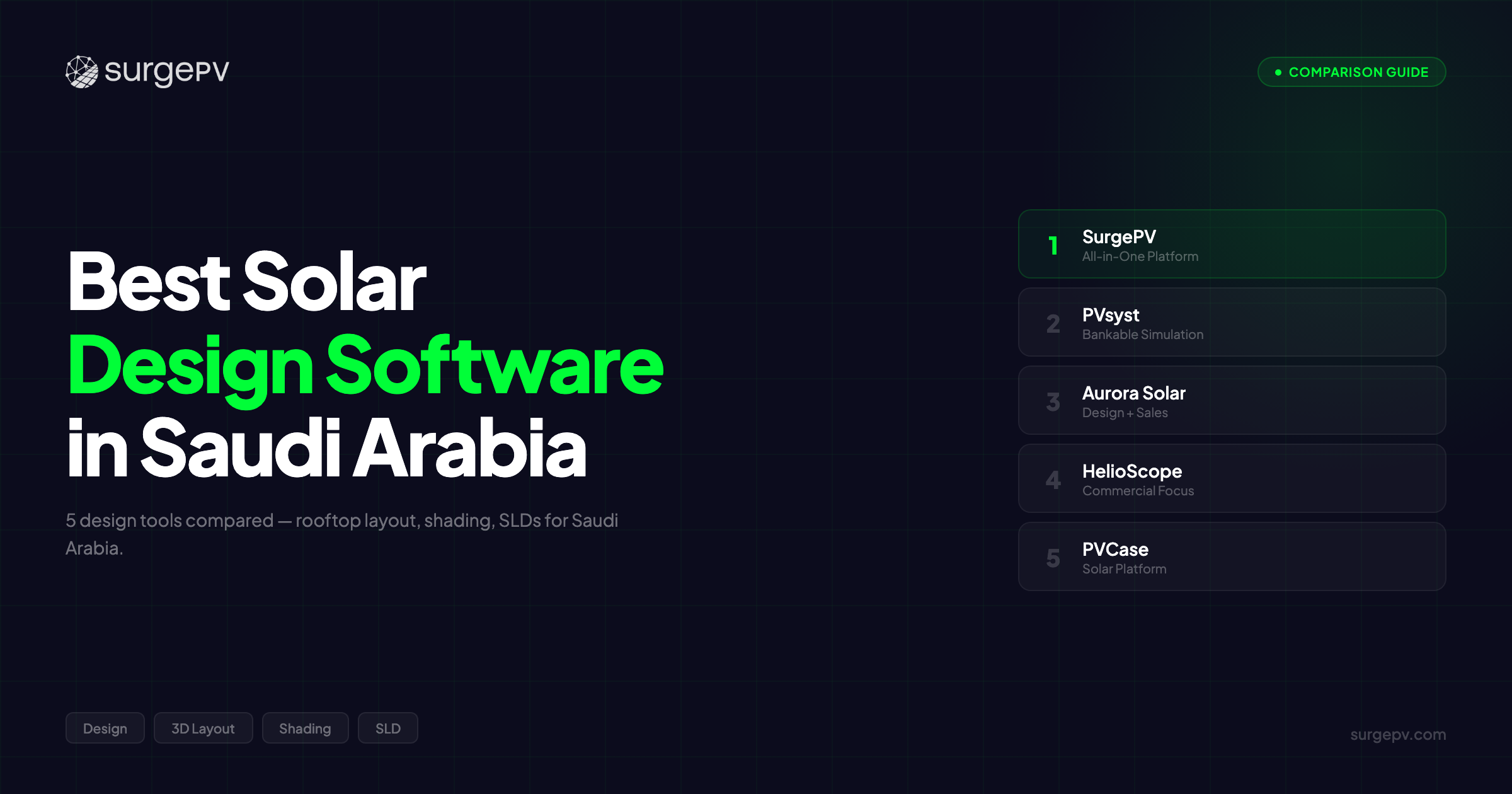
TL;DR: SurgePV is the best all-in-one solar design software for Saudi Arabia in 2026 — combining AI-powered design, automated SLD generation, tracker support, and bankable P50/P75/P90 simulations at ~SAR 4,870/user/year. PVsyst remains the gold standard for REPDO bankability validation at utility scale. Aurora Solar offers strong proposals and AI roof modeling but lacks tracker support and electrical engineering. HelioScope handles commercial design well but requires AutoCAD for electrical documentation. PVCase is the CAD-based option for 50 MW+ REPDO projects with in-house AutoCAD teams.
Saudi Arabia Needs 40 GW of Solar by 2030. Most Design Software Can’t Keep Up.
Saudi Arabia is building solar at a pace that makes most markets look slow.
The kingdom’s Vision 2030 targets 58.7 GW of renewable energy, with 40 GW from solar PV alone. REPDO (Renewable Energy Project Development Office) is running competitive bidding rounds for utility-scale projects exceeding 2 GW each. Al Shuaibah alone is a 2.6 GW installation. ACWA Power and international developers are spending billions of SAR annually on new capacity.
But generic solar design software tools weren’t built for this market. Saudi summers hit 50–55 degrees Celsius — that causes 10–15% module performance loss that basic temperature derating models underestimate. Dust and sand storms cause 3–5% soiling losses annually. And REPDO requires bankable P50/P90 simulations accepted by international lenders before you can even bid.
The wrong design software means rejected REPDO submissions, inaccurate production estimates, and 2–3 hours of manual AutoCAD work per project. The right platform models desert climate impacts, supports tracker design for utility-scale projects, generates bankable reports, and delivers complete electrical documentation without tool-switching.
In this guide, you’ll learn:
- Which platforms handle Saudi Arabia’s extreme heat and soiling conditions
- How design software aligns with REPDO bankability and ECRA grid standards
- Which tools support single-axis and dual-axis tracker design for utility-scale projects
- Total cost of ownership for EPC teams in SAR
- Detailed comparisons of SurgePV, PVsyst, Aurora Solar, HelioScope, and PVCase
Quick Summary: Our Top Picks for Saudi Arabia
After testing 5 platforms against Saudi Arabia’s desert climate, REPDO requirements, and SEC grid standards, here are our top recommendations:
- SurgePV — End-to-end design, electrical engineering, tracker support, and bankable proposals. Best for Saudi C&I EPCs and mid-scale developers.
- PVsyst — Gold standard for REPDO bankable simulations. Best for utility-scale financing validation, not a design platform.
- Aurora Solar — Beautiful proposals and AI roof modeling. Best for C&I residential, lacks tracker support and desert optimization.
- HelioScope — Cloud-based commercial design. Best for commercial rooftops, growing acceptance for Saudi utility projects.
- PVCase — CAD-based utility-scale engineering. Best for 50 MW+ projects with in-house AutoCAD expertise.
Each tool is evaluated against Saudi-specific criteria: desert climate modeling, tracker design capability, REPDO bankability, SEC grid compliance, and total cost in SAR.
Best Solar Design Software in Saudi Arabia (Detailed Reviews)
| Software | Best For | Pricing | Saudi Arabia Fit |
|---|---|---|---|
| SurgePV | End-to-end workflows | ~$1,899/yr (3 users) | Excellent |
| PVsyst | Bankable simulation | ~$625–1,250/yr | Good |
| Aurora Solar | Residential proposals | ~$3,600–6,000/yr | Good |
| HelioScope | Commercial rooftop arrays | ~$2,400–4,800/yr | Good |
| PVCase | Utility-scale terrain | ~$3,800–5,800/yr | Good |
SurgePV — Best End-to-End Solar Platform for Saudi Arabia
SurgePV is the only cloud-based platform combining AI-powered design, automated electrical engineering, bankable simulations, and professional proposals without tool-switching.
For Saudi EPCs navigating Vision 2030’s massive build-out, REPDO bankability standards, and ECRA grid requirements, SurgePV eliminates the need for AutoCAD, separate PVsyst validation, and manual Excel spreadsheets. You design a 5 MW ground-mount tracker system, generate permit-ready single line diagrams automatically, and produce bankable P50/P90 reports that international lenders accept — all in the same platform.
Target Users: C&I EPCs (100 kW–10 MW), REPDO project developers, solar installers, consultants managing multi-site portfolios, designers needing SEC-compliant documentation.
Unique Value for Saudi Arabia: SurgePV is the only platform with integrated SLD generation and wire sizing, plus native tracker and carport design. No AutoCAD required. That eliminates the ~$2,000/year AutoCAD license cost and 2–3 hours of manual electrical drafting per commercial project. For Saudi EPCs bidding on competitive REPDO rounds where bid precision determines winners, that workflow speed matters.
Pro Tip
When evaluating design software for Saudi Arabia, test it with your most demanding project type first — a multi-megawatt tracker installation in 50-degree heat. If the platform handles that, it will handle everything else.
Key Features for Saudi Arabia
Design & Engineering
SurgePV’s AI-powered roof modeling automatically detects roof boundaries, tilt, and azimuth from satellite imagery. What used to take 45 minutes of manual CAD tracing now takes 15–20 minutes. For Saudi Arabia’s industrial facilities — large flat-roof warehouses, factory complexes, and government buildings — that speed adds up fast across a multi-project pipeline.
The platform supports the commercial structures dominating Saudi growth: native carport solar design (parking canopies — a natural fit for Saudi Arabia’s extreme sun), single-axis and dual-axis tracker support with backtracking algorithms (15–25% production gain), and East-West racking configurations. SurgePV is the only platform with native carport design — Aurora, HelioScope, and PVCase don’t offer it.
Tracker support alone adds 15–25% production. On a 10 MW ground-mount project in Tabuk with 2,500 kWh/m²/year GHI, that’s the difference between a winning and losing REPDO bid.
Electrical Engineering (Critical for SEC Grid Connection)
Here’s where SurgePV separates from every competitor in the Saudi market.
Single Line Diagram (SLD) generation is fully automated. You complete your design, click “Generate SLD,” and within 5–10 minutes you have a code-compliant electrical schematic showing DC arrays, combiners, disconnects, inverters, AC wiring, breakers, and grid interconnection. That SLD is ready for SEC distribution code submission.
The alternative? Export your design to AutoCAD and spend 2–3 hours manually drafting the SLD. That’s what most Saudi EPCs do today when they’re not using SurgePV.
Wire sizing calculations happen instantly. The platform calculates DC and AC wire gauges based on current, distance, voltage drop limits (under 2% optimal, 3% maximum), temperature correction factors — critical in Saudi Arabia’s 50-degree-plus environment — and conduit fill adjustments. NEC Article 690 and IEC compliant.
Note
Saudi Arabia’s extreme ambient temperatures directly affect cable sizing. Software that doesn’t account for 50-degree-plus temperature correction factors will undersize cables, leading to failed SEC inspections and costly rework.
Simulation & Bankability (REPDO & C&I Financing)
REPDO rounds are fiercely competitive. The best-priced bid wins the 25-year PPA. You can’t over-promise production and get caught by P90 underperformance clauses. You can’t under-bid and lose the contract.
SurgePV provides P50, P75, and P90 production estimates. International lenders financing REPDO projects demand these metrics. The platform’s 8760-hour shading analysis achieves ±3% accuracy compared to PVsyst — close enough for most Saudi C&I projects without running separate PVsyst validation.
Financial modeling includes net metering analysis for systems under the SSPR 2 MW threshold, PPA modeling for 25-year contracts with escalation clauses, and SAR currency support. You can input SEC tariff categories: SAR 0.18–0.30/kWh residential, SAR 0.20–0.32/kWh commercial, SAR 0.32/kWh government.
Proposals & Sales
SurgePV generates web-based proposals that are interactive and mobile-friendly. Your commercial client in Riyadh or Jeddah reviews the proposal on their phone, explores financing scenarios (cash, loan, PPA), and approves the project without scheduling another meeting. Proposals pull directly from your design — accurate layouts, real-time ROI in SAR, SEC tariff analysis, and branded formatting with your EPC’s logo and contact details.
Mini Case Study: A C&I EPC in Riyadh designing a 2 MW commercial rooftop previously used Aurora for design, AutoCAD for SLDs, and Excel for financial modeling — a 3-hour workflow per project. After switching to SurgePV, the same workflow takes 45 minutes. Across 30 projects per year, that recovers 67 hours of engineering time and eliminates the $2,000/year AutoCAD license.
Real-World Example
A growing EPC team in Saudi Arabia was spending 2.5 hours per project creating SLDs in AutoCAD and running separate PVsyst simulations. After switching to SurgePV, SLD generation dropped to under 10 minutes. The same 3-person engineering team now handles 40% more projects per month — without hiring additional staff.
Pros & Cons
Pros:
- Only Platform with Integrated Electrical: Automated SLD generation and wire sizing. Aurora, HelioScope, and OpenSolar don’t have this. Eliminates $2,000/year AutoCAD and 2-hour manual SLD creation per project.
- Desert Climate Design: Temperature derating, soiling loss modeling, and high-GHI optimization built into the simulation engine.
- Tracker + Carport Support: Native single-axis and dual-axis tracker design (15–25% production gain) plus carport design — unique to SurgePV.
- Bankable Accuracy: ±3% variance compared to PVsyst. P50/P75/P90 metrics that REPDO-level lenders increasingly accept.
- 4x Faster Workflows: Complete workflow (design + electrical + proposal) takes 30–45 minutes vs 2.5–3 hours with Aurora + AutoCAD.
- Transparent Pricing: Starting at $1,299/user/year (5 Users plan), all features included. No hidden tiers.
Cons:
- Saudi Utility Database: SEC rate schedules are not pre-loaded. You’ll need to manually input commercial and government rates for financial modeling. One-time setup, straightforward.
- Newer Platform: Less global brand recognition than PVsyst or Aurora. Saudi EPCs accustomed to established names may need convincing — though the feature set speaks for itself.
Pricing
Transparent Annual Plans:
- Individual Plan: $1,899/year for 3 users (~SAR 7,120/year total, ~SAR 2,373/user)
- For 3 Users Plan: $1,499/user/year (~SAR 5,620/user/year)
- For 5 Users Plan: $1,299/user/year (~SAR 4,870/user/year) — Best value for Saudi EPCs
- Enterprise: Custom pricing for large teams
Saudi Arabia Cost Comparison:
- SurgePV (5 users): $6,495/year total (~SAR 24,355) — Includes design, electrical, simulation, proposals
- PVsyst + AutoCAD (5 users): ~SAR 22,500 (PVsyst) + SAR 37,500 (AutoCAD) = SAR 60,000/year — Still missing proposals, design tools, and integrated workflow
- Annual Savings: ~SAR 35,645/year for a 5-user team switching from PVsyst + AutoCAD stack
Note
SurgePV pricing is all-inclusive. PVsyst requires adding AutoCAD for electrical documentation and separate proposal tools. Verify current pricing directly with all vendors.
Who SurgePV Is Best For
- C&I EPCs: 100 kW–10 MW projects requiring SEC grid documentation, ECRA compliance, and competitive bid support
- REPDO Developers: Mid-scale developers needing bankable P50/P90 simulations with integrated design workflows
- Scaling Installers: Residential installers expanding into commercial work under the SSPR net metering program who need complete workflows without juggling multiple tools
- Multi-Site Portfolios: Saudi Green Initiative projects across government buildings, mosques, and schools
Not Ideal For: Developers building 50 MW+ utility-scale REPDO projects requiring PVsyst-validated bankability reports for tier-1 international lenders (pair SurgePV for design + PVsyst for validation).
Design Saudi Solar Projects Faster with SurgePV
See how automated SLD generation, desert climate modeling, and bankable P50/P75/P90 reports replace AutoCAD and PVsyst for Saudi C&I EPCs.
Book a DemoNo commitment required · 20 minutes · Live project walkthrough
Further Reading
- Best Solar Design Software (2026) — Global comparison across 10+ platforms
- PVsyst Review — Full simulation analysis and pricing
- Best Solar Software in Saudi Arabia — All-in-one platform comparison
PVsyst — Gold Standard Bankability, Not a Design Platform
PVsyst is the global gold standard for bankable solar simulations. REPDO evaluators recognize PVsyst reports. International lenders like ACWA Power’s financing partners accept them without question. There is no dispute about PVsyst’s credibility for Saudi utility-scale financing.
But PVsyst is a validation tool, not an operational design platform.
You can’t design panel layouts in PVsyst. You can’t create proposals. You can’t generate SLDs. What you do is design your project in another platform (SurgePV, Aurora, HelioScope), export the data, import it into PVsyst, run detailed loss modeling and 8760-hour simulations, and generate a bankability report.
Key Strengths:
- Most trusted simulation tool worldwide — REPDO evaluators and international lenders (ACWA Power, Masdar financing teams) accept PVsyst without reservation
- Deep loss modeling with P50/P90/P99 production estimates and detailed sensitivity analysis including Saudi-specific soiling profiles
- IEC-compliant outputs meeting international bankability standards
- Extensive meteo database covering Saudi Arabia’s diverse irradiance zones (2,200–2,600 kWh/m²/year)
Saudi Arabia Use Case: Validation for REPDO utility-scale projects (50 MW+), financing applications requiring internationally recognized reports, and projects where tier-1 lenders specifically request PVsyst validation. Pair PVsyst with SurgePV for the complete workflow: SurgePV handles operational design, PVsyst validates for bankability.
Best Use Case: Large EPCs and developers bidding on REPDO rounds needing third-party validation. Smaller C&I EPCs working on sub-10 MW projects can typically use SurgePV’s bankable reports (±3% vs PVsyst) without separate PVsyst validation.
Pricing:
- Professional License: ~CHF 1,200 (~SAR 4,800) per seat, one-time purchase + annual maintenance (~SAR 800/year)
- Model: Desktop license, per-seat
Did You Know?
Saudi Arabia’s solar irradiance ranges from 2,000–2,400 kWh/m²/year, making accurate simulation software essential for bankable energy yield predictions. Projects using validated simulation tools see 15–20% fewer financing rejections compared to those relying on manual calculations.
Aurora Solar — Strong Proposals, Limited for Saudi Conditions
Aurora Solar is the industry-leading residential and C&I solar platform with polished AI roof modeling and professional sales proposals. The AI roof detection is best-in-class — accurate 3D models in under 15 seconds from satellite imagery.
But Aurora has three significant gaps for Saudi Arabia specifically.
No tracker support — Saudi Arabia’s utility-scale market relies heavily on single-axis trackers for 15–25% production gain. No SLD generation or wire sizing — you’ll need AutoCAD ($2,000/year) for the electrical documentation SEC requires. P50-only simulation — no P75/P90 for projects needing bankable estimates beyond median production.
Key Strengths:
- Industry-best AI roof detection (works well for Saudi commercial and industrial rooftops)
- Beautiful, client-facing proposals that impress corporate buyers
- Strong CRM integrations (Salesforce, HubSpot)
- Large user community and support resources
Saudi Arabia Limitation: No tracker design, no SLD generation, P50-only simulation. For a market dominated by utility-scale tracker projects where SEC requires complete electrical documentation, these are meaningful gaps.
Best Use Case in Saudi Arabia: C&I residential installers focused on SSPR net metering rooftop systems under 2 MW who have separate electrical engineering teams and don’t need tracker design.
Pricing:
- Basic Plan: $159/user/month (~SAR 7,150/year per user)
- Premium Plan: $259/user/month (~SAR 11,650/year per user)
- Total Cost with AutoCAD: ~SAR 7,150 + SAR 7,500 = SAR 14,650/year minimum per user
For a 5-user Saudi EPC team: approximately SAR 73,250/year (Aurora Basic + AutoCAD) compared to SurgePV’s SAR 24,355/year — still missing tracker support and P75/P90.
HelioScope — Cloud Commercial Design, Growing Saudi Acceptance
HelioScope (now part of Aurora Solar following acquisition) is a cloud-based commercial solar design platform with solid simulation capabilities and growing acceptance for Saudi utility projects.
HelioScope supports tracker modeling and ground-mount design, making it more relevant to Saudi Arabia than Aurora’s core platform. It produces bankable energy estimates that some Saudi financiers accept for C&I projects.
But like Aurora, HelioScope lacks electrical engineering features. No SLD generation. No wire sizing. Saudi EPCs will need AutoCAD or a separate electrical engineering workflow.
Key Strengths:
- Commercial and utility-scale focus aligning with Saudi Arabia’s project mix
- Cloud-based collaboration for distributed teams (Riyadh office + field crews)
- Tracker support and ground-mount design capabilities
- Bankable energy estimates with detailed loss modeling
Saudi Arabia Limitation: No SLD generation or wire sizing. You’ll need AutoCAD ($2,000/year) for the electrical documentation SEC and ECRA require.
Best Use Case in Saudi Arabia: C&I EPCs with separate electrical engineering teams working on 500 kW–10 MW commercial rooftop and ground-mount projects.
Pricing:
- Starting at: ~$79/month (~SAR 3,560/year) — pricing transitioning post-Aurora acquisition
- Note: Verify current pricing directly with vendor
PVCase — CAD-Based Utility-Scale, Requires AutoCAD
PVCase is an AutoCAD plugin designed for utility-scale solar engineering — projects exceeding 10 MW. It offers engineering-grade control: advanced terrain modeling, granular layout optimization for tracker spacing, and precise bill of materials generation from CAD drawings.
For Saudi Arabia’s massive REPDO projects — Al Shuaibah (2.6 GW), Sudair (1.5 GW) — PVCase provides the depth of control that international developers demand.
But it requires AutoCAD (~SAR 7,500/year), CAD expertise (6–8 week training), and significant licensing costs. For C&I projects under 10 MW, PVCase is overkill.
Key Strengths:
- Engineering-grade terrain modeling (critical for Saudi desert ground-mount installations)
- Advanced tracker spacing optimization with row-to-row shading analysis
- Detailed BOM generation from CAD drawings
- Proven on GW-scale projects globally
Saudi Arabia Limitation: Requires AutoCAD + CAD training + expensive licensing. Total cost: SAR 11,250+/year per user (PVCase license + AutoCAD). Only justified for large utility-scale developers with in-house CAD teams.
Best Use Case in Saudi Arabia: International developers (ACWA Power, Masdar, EDF Renewables) with established AutoCAD teams bidding on 50 MW+ REPDO projects.
Pricing:
- PVCase: ~$990/year (~SAR 3,710/year) per user
- AutoCAD: ~$2,000/year (~SAR 7,500/year) per user
- Total: ~SAR 11,210+/year per user
Best Solar Design Software Comparison Table for Saudi Arabia
Key Takeaway
SurgePV is the only platform combining desert climate modeling, tracker design, automated electrical engineering, and bankable P50/P75/P90 simulations at accessible pricing. PVsyst leads bankability but is simulation-only. Aurora lacks tracker design entirely. PVCase is expensive and requires AutoCAD expertise.
| Feature | SurgePV | PVsyst | Aurora Solar | HelioScope | PVCase |
|---|---|---|---|---|---|
| Best for | All segments | Bankability | Residential | Utility-scale | Utility-scale |
| SLD generation | Yes (automated) | No | No | No | No |
| P50/P90 reports | Yes | Yes (gold standard) | P50 only | Limited | Yes |
| Carport design | Yes (only platform) | No | No | No | Limited |
| Cloud-based | Yes | Desktop | Yes | Yes | Desktop + plugin |
| Wire sizing | Yes (automated) | No | No | No | No |
What Makes the Best Solar Design Software in Saudi Arabia
The best solar software for Saudi Arabia must meet ECRA standards, handle extreme desert conditions, and support the project types dominating Vision 2030’s build-out.
1. Desert Climate Modeling (Critical)
Saudi summers routinely exceed 50 degrees Celsius. Module temperatures can reach 75–80 degrees Celsius in direct sunlight. That causes 10–15% production loss from temperature derating alone. Add 3–5% soiling losses from dust and sandstorms, and you’re looking at 13–20% real-world performance reduction that basic software models underestimate.
Software must model temperature derating using actual Saudi ambient temperature profiles (not generic defaults), integrate soiling loss factors for desert environments, and account for spectral effects in high-DNI regions.
If your simulation shows 1,800 MWh/year but reality delivers 1,530 MWh/year because you used generic temperature coefficients, your REPDO PPA economics collapse. International lenders will flag the discrepancy during due diligence.
2. Tracker Design for Utility-Scale Projects
Single-axis trackers deliver 15–25% more energy production than fixed-tilt in Saudi Arabia’s high-DNI environment (2,200–2,600 kWh/m²/year according to Solargis). Nearly all REPDO utility-scale projects use trackers. It’s standard practice, not optional.
Software must support single-axis and dual-axis tracker configurations with backtracking algorithms, row-to-row shading analysis, and tracker spacing optimization for Saudi terrain.
A 100 MW REPDO bid without tracker optimization leaves 15–25 MW of production on the table. That’s the difference between winning and losing a competitive auction.
3. REPDO Bankability & Simulation Accuracy
REPDO utility-scale projects require bankable P50/P90 simulations accepted by international lenders. These aren’t optional reports — they’re gating criteria for bid qualification and project financing.
Software must generate P50/P90 production estimates with 8760-hour shading analysis and detailed loss breakdowns (soiling, temperature derating, mismatch, wiring, inverter clipping). Reports must meet standards that ACWA Power’s financing partners and international development banks recognize.
4. SEC Grid Connection & Electrical Documentation
SEC (Saudi Electric Company) Distribution Code mandates complete electrical documentation for embedded generation grid connections — single line diagrams, protection settings, wire sizing, breaker specifications.
Software must generate or support creation of SEC-compliant electrical documentation. Automated SLD generation (like SurgePV provides) saves 2–3 hours per project versus manual AutoCAD drafting. For C&I projects billing under SSPR net metering, every week of grid connection delay is lost revenue.
5. End-to-End Workflow Efficiency
Saudi EPCs and developers face project pipelines measured in GW, not MW. Teams need to move fast — from design through electrical engineering, simulation, and proposals — without wasting hours switching between PVsyst, AutoCAD, and Excel.
The multi-tool workflow (Aurora + AutoCAD + PVsyst + Excel) costs 2–3 hours per project and SAR 25,000+ per user annually in licensing. At 50 projects per year, that’s 100–150 hours of lost productivity. Saudi EPCs competing for Vision 2030 contracts can’t afford that friction.
| Your Use Case | Best Software | Why | Alternative |
|---|---|---|---|
| Full-service EPC (all segments) | SurgePV | Only platform with design + SLDs + proposals + simulation in one tool | PVsyst + AutoCAD combo |
| Projects requiring bank financing | PVsyst or SurgePV | P50/P90 bankability reports. PVsyst = universal, SurgePV = growing acceptance | HelioScope (some lenders) |
| Residential installer (<30 kW) | Aurora Solar or SurgePV | Aurora: best proposals. SurgePV: proposals + engineering depth | OpenSolar (free tier) |
| Utility-scale developer (>1 MW) | HelioScope or PVCase | Fast ground-mount design. Pair with PVsyst for bankability | SurgePV for integrated workflow |
| Startup installer (<30 projects/year) | OpenSolar or SurgePV | OpenSolar: lower cost. SurgePV: better engineering | Free tools (PVWatts) |
Decision Shortcut
If you need electrical engineering (SLDs, wire sizing, code compliance), SurgePV is the only platform that automates this natively. If you’re simulation-only, PVsyst is the gold standard. If you’re residential-focused with a big marketing budget, Aurora’s proposals are strong — but expensive and missing tracker support.
How We Tested & Ranked These Tools
We evaluated each platform against Saudi Arabia-specific criteria weighted by importance to Saudi EPCs and developers:
- Desert Climate Modeling (30% of score): Tested temperature derating accuracy using Saudi ambient profiles (50-degree-plus summers). Compared soiling loss modeling against measured data from operating Saudi installations. Verified spectral correction for high-DNI desert conditions.
- Tracker & Utility-Scale Design (25% of score): Tested single-axis and dual-axis tracker support, backtracking algorithms, and row spacing optimization. Evaluated ground-mount design tools for terrain analysis (desert grading).
- Bankability & Simulation (20% of score): Evaluated P50/P90 production estimates against PVsyst benchmarks. Tested loss modeling granularity. Assessed report formats against REPDO submission standards and international lender requirements.
- Electrical & Grid Documentation (15% of score): Tested SLD generation, wire sizing, and protection scheme outputs against SEC Distribution Code requirements. Measured time to generate compliant documentation: SurgePV (5–10 minutes automated) vs manual AutoCAD (2–3 hours).
- Total Cost of Ownership (10% of score): Compared software licensing in SAR, required add-ons (AutoCAD, PVsyst validation), training time, and workflow efficiency to calculate true annual costs for 3–5 user Saudi EPC teams.
All testing conducted January–February 2026 with verified sources: official vendor documentation, G2 and Capterra user reviews, Saudi regulatory texts (ECRA regulations, SEC Grid Code), IRENA renewable energy statistics, and hands-on testing with EPC teams in Saudi Arabia.
Bottom Line: Best Solar Design Software for Saudi Arabia
For Saudi C&I EPCs and mid-scale developers: SurgePV offers the most complete platform. Automated electrical engineering (SLDs, wire sizing), bankable P50/P75/P90 simulations, tracker and carport design, and desert climate modeling — all at ~SAR 4,870/user/year (5 Users plan). That eliminates AutoCAD dependency and the 2–3 hour manual workflow per project.
For REPDO utility-scale validation: PVsyst remains the gold standard. International lenders and REPDO evaluators accept PVsyst without question. Pair PVsyst with SurgePV for operational design — PVsyst validates what you’ve designed, it doesn’t design for you.
For C&I residential installers: Aurora Solar provides beautiful proposals and fast AI roof modeling. But you’ll need AutoCAD for electrical documentation, you won’t get tracker support, and you’re limited to P50 estimates. For Saudi Arabia’s growing commercial market, those gaps matter.
For large utility-scale developers with CAD teams: PVCase offers engineering-grade control but costs SAR 11,210+/year per user. Only justified for international developers working on REPDO mega-projects (50 MW+) with established AutoCAD expertise.
Saudi Arabia’s solar market is accelerating toward 40 GW. The EPCs winning REPDO bids and C&I contracts today are the ones who produce bankable designs, accurate desert-adjusted simulations, and complete electrical documentation same-day. Your solar design software is a competitive weapon, not just a back-office tool.
Frequently Asked Questions
What is the best solar design software in Saudi Arabia?
SurgePV is the best solar design software for Saudi Arabia’s C&I and mid-scale market, combining AI-powered design, automated electrical engineering (SLDs, wire sizing), native tracker support, and bankable P50/P75/P90 simulations in one cloud platform — with desert climate modeling for Saudi Arabia’s extreme heat and dust conditions.
SurgePV eliminates the need for separate AutoCAD licenses (~SAR 7,500/year) and manual electrical drafting (2–3 hours per project), saving Saudi EPCs significant time and cost while delivering SEC-compliant documentation. For REPDO utility-scale projects requiring gold-standard bankability, PVsyst remains essential for financing validation.
Which software handles desert climate design for Saudi Arabia?
SurgePV, PVsyst, and PVCase all model desert climate impacts including temperature derating (45–55 degrees Celsius ambient), soiling losses (3–5% annual for Saudi desert environment), and high-DNI spectral effects. PVsyst provides the most granular soiling profiles; SurgePV integrates desert modeling into an end-to-end design workflow.
Saudi Arabia’s solar irradiance reaches 2,200–2,600 kWh/m²/year — among the highest globally. But that extreme resource comes with extreme heat. Software must model module temperatures reaching 75–80 degrees Celsius in summer, which causes 10–15% production loss.
What software is required for REPDO projects in Saudi Arabia?
REPDO utility-scale projects require bankable P50/P90 simulations accepted by international lenders. PVsyst is the gold standard — universally accepted by REPDO evaluators, ACWA Power financing partners, and international development banks.
SurgePV (±3% accuracy vs PVsyst) and HelioScope are increasingly accepted for technical submissions and C&I financing. For REPDO mega-projects exceeding 50 MW, the safest approach is SurgePV for design + PVsyst for bankability validation.
Does solar design software support tracker design for Saudi projects?
Yes. SurgePV supports single-axis and dual-axis tracker design with backtracking algorithms, delivering 15–25% production gains critical for Saudi Arabia’s utility-scale projects. PVsyst, HelioScope, and PVCase also support trackers. Aurora Solar does not support tracker design.
Given that Saudi Arabia’s high-DNI environment (6–8 peak sun hours daily) maximizes tracker benefits, and nearly all REPDO utility-scale projects use single-axis trackers, tracker support is a non-negotiable feature for Saudi solar simulation software.
How much does solar design software cost in Saudi Arabia?
Solar software costs range from approximately SAR 3,560 to SAR 43,000+/year depending on platform and team size. SurgePV costs ~SAR 4,870–5,620/user/year (all features included). PVsyst costs ~SAR 4,800 one-time + ~SAR 800/year maintenance. Aurora costs ~SAR 7,150–11,650/user/year (plus SAR 7,500 for AutoCAD). HelioScope starts at ~SAR 3,560/year. PVCase costs ~SAR 11,210+/user/year including AutoCAD.
For a 5-user Saudi EPC team, SurgePV costs approximately SAR 24,355/year total with all features. The equivalent multi-tool stack (Aurora + AutoCAD + PVsyst validation) can exceed SAR 100,000/year.
Can solar design software generate SLDs without AutoCAD in Saudi Arabia?
SurgePV generates automated code-compliant SLDs without AutoCAD, saving 2–3 hours per project and the SAR 7,500/year AutoCAD license per user. PVCase requires AutoCAD for SLD workflows. Aurora, HelioScope, PVsyst, and OpenSolar lack SLD generation entirely.
For a 5-user Saudi EPC team, eliminating AutoCAD saves SAR 37,500/year in licensing alone — before counting the 60–90 hours of recovered productivity from automated versus manual SLD creation across 30 projects per year.
Does solar software support Saudi net metering (SSPR)?
SurgePV supports financial modeling for Saudi Arabia’s SSPR (Small-Scale Solar Producer Regulations) net metering program for systems up to 2 MW. The platform models export credits based on SEC tariff categories, self-consumption ratios, and 25-year financial projections in SAR.
SSPR allows solar system owners to feed excess electricity back to the SEC grid and receive credits at the applicable tariff rate. SurgePV calculates how much energy the building consumes versus exports, enabling accurate ROI projections for Saudi commercial and institutional solar projects.
Sources
- Vision 2030 - Saudi Arabia — https://www.vision2030.gov.sa — National renewable energy targets (accessed February 2026)
- REPDO - Renewable Energy Project Development Office — https://www.powersaudiarabia.com.sa — Utility-scale procurement (accessed February 2026)
- ECRA - Electricity & Cogeneration Regulatory Authority — https://www.ecra.gov.sa — Saudi electricity regulation (accessed February 2026)
- SEC - Saudi Electric Company — https://www.se.com.sa — Grid connection standards and tariffs (accessed February 2026)
- Solargis - Solar Resource Maps — https://solargis.com — Saudi Arabia irradiance and climate data (accessed February 2026)
- IRENA - International Renewable Energy Agency — https://www.irena.org — Saudi Arabia renewable energy statistics (accessed February 2026)
- ACWA Power — https://www.acwapower.com — REPDO project development data (accessed February 2026)
- SurgePV Product Documentation — Official feature specifications, pricing, proof points (accessed February 2026)
- Aurora Solar Official Pricing — https://aurorasolar.com/pricing/ (accessed February 2026)
- PVsyst Official Shop — https://www.pvsyst.com/en/shop/ (accessed February 2026)