

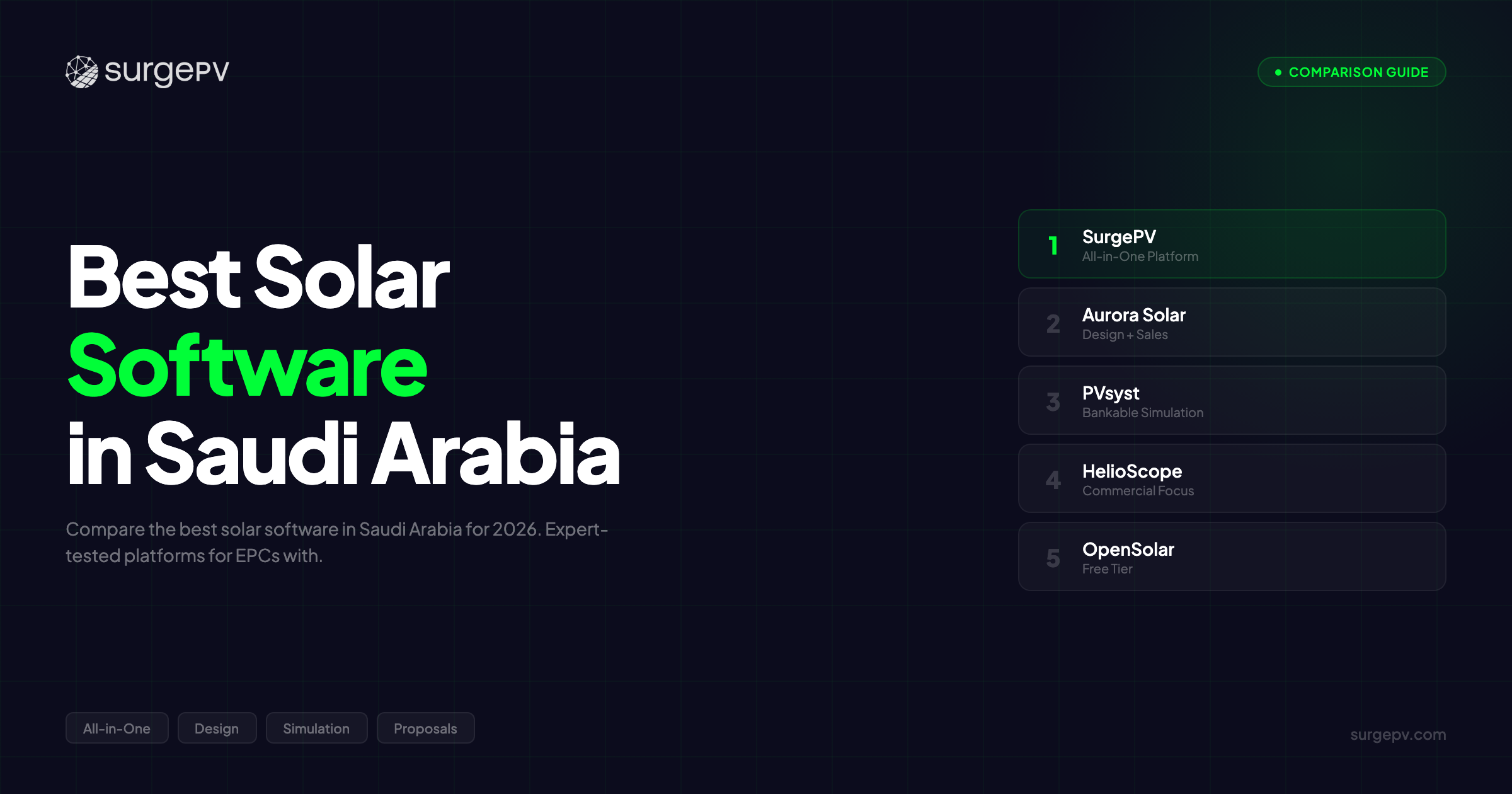
TL;DR: SurgePV is the best all-in-one solar software for Saudi Arabia in 2026 — combining desert climate design, tracker support, automated SLD generation, bankable P50/P75/P90 simulations, and professional proposals with SAR financial modeling at ~SAR 5,620/user/year. It replaces the PVsyst + AutoCAD + Aurora + Excel multi-tool stack costing SAR 19,000–24,000+ per user. PVsyst remains essential for REPDO utility-scale bankability validation. Aurora Solar leads for residential proposals but lacks tracker support and electrical engineering. HelioScope offers solid commercial design without proposals or electrical tools. OpenSolar is the free entry-level option with limited Saudi optimization.
40 GW of Solar. Five Years. And Most Saudi EPCs Are Still Juggling 3–4 Software Tools.
Saudi Arabia’s solar ambition is staggering.
Vision 2030 targets 58.7 GW of renewable energy, with 40 GW from solar PV. The Renewable Energy Project Development Office (REPDO) is awarding GW-scale projects in competitive bidding rounds. Al Shuaibah (2.6 GW), Sudair (1.5 GW), and NEOM’s planned mega-installations are reshaping the global solar market. ACWA Power alone has billions of SAR in active solar development.
The scale is unprecedented. But here’s what’s holding Saudi EPCs back: the software stack.
A typical Saudi EPC uses PVsyst for simulation (SAR 4,800), AutoCAD for electrical engineering (SAR 7,500/year), Aurora or HelioScope for design (SAR 7,150–11,650/year), and Excel for proposals and financial modeling (free, but 2–4 hours per project). That’s four disconnected tools, SAR 19,000–24,000+ per user annually, and hours of manual data transfer between platforms.
The result? Production numbers get transcribed incorrectly. Electrical documentation takes 2–3 hours per project. Financial models break when someone edits the wrong Excel cell. And while your team juggles tools, a competitor using an integrated platform submits their REPDO bid first.
In this guide, you’ll learn:
- Which all-in-one platforms eliminate multi-tool workflows for Saudi EPCs
- How software features align with REPDO bankability, ECRA standards, and SEC grid codes
- Which tools handle Saudi Arabia’s extreme desert conditions (50-degree-plus heat, 3–5% soiling)
- Total cost comparison in SAR for 3–5 user EPC teams
- Detailed comparisons of SurgePV, Aurora Solar, PVsyst, HelioScope, and OpenSolar
Quick Summary: Our Top Picks for Saudi Arabia
After testing 5 platforms against Saudi Arabia’s market requirements, desert conditions, and regulatory framework, here are our top recommendations:
- SurgePV — All-in-one design, electrical, simulation, and proposals. Best for Saudi C&I EPCs wanting one platform for everything.
- Aurora Solar — Industry-leading residential design and proposals. Best for SSPR residential installers, gaps for Saudi C&I and utility.
- PVsyst — Gold standard bankable simulation. Best for REPDO validation, not an operational platform.
- HelioScope — Cloud-based commercial design. Best for C&I rooftop design, missing electrical and proposals.
- OpenSolar — Free design and proposals. Best for budget-conscious teams, limited Saudi optimization.
Each tool is evaluated against Saudi-specific criteria: desert climate handling, Vision 2030 project support, REPDO bankability, SEC compliance, workflow completeness, and pricing in SAR.
Best Solar Software in Saudi Arabia (Detailed Reviews)
SurgePV — Best All-in-One Solar Software for Saudi Arabia
SurgePV replaces the multi-tool stack that most Saudi EPCs struggle with today. Instead of switching between PVsyst (simulation) + AutoCAD (electrical) + Aurora (design) + Excel (proposals), you get one cloud platform that handles the complete workflow: AI-powered design, automated electrical engineering, bankable P50/P90 simulation, and professional proposal generation.
For Saudi Arabia’s Vision 2030 build-out — where EPCs need to process dozens of projects per month across residential, C&I, and mid-scale utility segments — that consolidation isn’t just convenient. It’s a competitive requirement.
Target Users: C&I EPCs (100 kW–10 MW), solar installers (residential and commercial), REPDO project developers, consultants managing multi-site portfolios, government project bidders under the Saudi Green Initiative.
Pro Tip
Before comparing individual features, calculate your current multi-tool cost. Most Saudi EPCs discover they’re spending SAR 19,000–24,000+ per user annually on disconnected software — and still losing 2–3 hours per project to manual workflows between tools.
Key Features for Saudi Arabia
Design & Engineering
SurgePV’s AI-powered design tools handle the full range of Saudi project types. Residential rooftops for the emerging SSPR market. Commercial flat-roof installations on warehouses and factories. Ground-mount systems with tracker support. And native carport solar design for parking structures — a growing segment as Saudi businesses seek shade solutions that also generate power.
AI roof modeling detects roof boundaries, tilt, and azimuth from satellite imagery in 15–20 minutes versus 45–60 minutes of manual CAD work. Module layout optimization maximizes kW per square meter — critical when bidding competitive contracts where every additional kilowatt affects your price-per-watt.
Tracker support includes single-axis (15–25% production gain) and dual-axis with backtracking algorithms. Nearly all Saudi utility-scale projects use trackers to capture the kingdom’s exceptional solar resource (2,200–2,600 kWh/m²/year according to Solargis). SurgePV is the only platform offering native carport design alongside tracker support.
Electrical Engineering (Saudi Arabia’s Biggest Software Gap)
This is where SurgePV stands alone in the Saudi market.
Automated SLD generation: complete your design, generate a code-compliant single line diagram in 5–10 minutes showing DC arrays, combiners, disconnects, inverters, AC wiring, breakers, and grid interconnection. Ready for SEC distribution code submission.
Without SurgePV, Saudi EPCs export their design to AutoCAD (SAR 7,500/year license) and spend 2–3 hours manually drafting the SLD. For a team completing 30 projects per year, that’s 60–90 hours of manual drafting and SAR 37,500 in AutoCAD licenses for a 5-user team.
Wire sizing calculations are instant. DC and AC wire gauges based on current, distance, voltage drop (under 2% optimal), temperature correction factors for Saudi’s 50-degree-plus ambient, and conduit fill adjustments. NEC Article 690 and IEC compliant.
A 5-user Saudi EPC team eliminates SAR 37,500/year in AutoCAD licenses and recovers 300–450 hours annually in manual electrical drafting time. That’s 7–11 weeks of engineering capacity redirected to actual project delivery.
Simulation & Bankability
SurgePV provides P50 (median), P75 (conservative), and P90 (worst-case) production estimates. The 8760-hour shading analysis achieves ±3% accuracy compared to PVsyst.
For Saudi Arabia specifically, the simulation engine accounts for temperature derating (50-degree-plus ambient temperatures causing 10–15% production loss), soiling losses (3–5% annually from desert dust and sandstorms), and high-DNI spectral effects. These aren’t optional adjustments — they’re the difference between an accurate simulation and a 13–20% overestimate.
Financial modeling supports SAR currency, 25-year PPA structures with escalation, SEC tariff categories (residential SAR 0.18–0.30/kWh, commercial SAR 0.20–0.32/kWh, government SAR 0.32/kWh), and SSPR net metering for systems up to 2 MW.
Proposals & Sales
Professional web-based proposals pull directly from your design. No manual data transfer. No copying production numbers from HelioScope into Excel. The proposal reflects your actual engineering work: accurate layouts, desert-adjusted production, SAR-denominated ROI, and interactive financing scenarios (cash, loan, PPA).
For Saudi corporate and government buyers who expect detailed, professional documentation, this is table stakes. An Excel proposal next to a polished SurgePV interactive web proposal — the difference in perceived credibility is significant.
Real-World Example
A Saudi C&I EPC running 40 projects per month previously used four tools: HelioScope (design), AutoCAD (electrical), PVsyst (simulation validation), and Excel (proposals/financials). Total software cost: SAR 22,000/user/year. Average project completion: 3.5 hours. After consolidating to SurgePV, software cost dropped to SAR 5,620/user/year and average project time to 45 minutes. Annual savings for a 5-user team: SAR 81,900 in software + 562 hours in recovered productivity.
Note
”But my team already knows PVsyst and AutoCAD.” Fair point. SurgePV’s onboarding takes 2–3 weeks, compared to the weeks you’ve already invested in current tools. The question isn’t sunk cost — it’s whether spending SAR 22,000/user/year on disconnected tools is sustainable as your project pipeline scales under Vision 2030.
Pros & Cons
Pros:
- True All-in-One: Design + electrical + simulation + proposals in one platform. Eliminates PVsyst + AutoCAD + Aurora + Excel stack.
- Only Platform with Integrated Electrical: Automated SLD generation and wire sizing. Aurora, HelioScope, and OpenSolar lack this entirely.
- Desert Climate Modeling: Temperature derating, soiling loss, and high-DNI optimization built into simulation for Saudi conditions.
- Tracker + Carport: Single-axis and dual-axis tracker design plus native carport design — unique combination.
- Bankable Accuracy: ±3% vs PVsyst. P50/P75/P90 metrics.
- Cost Efficiency: ~SAR 4,870–5,620/user/year replaces SAR 19,000–24,000+ multi-tool stack.
- Cloud-Based: Teams in Riyadh, Jeddah, and field sites collaborate in real-time. No desktop license restrictions.
Cons:
- Saudi Utility Database: SEC rates not pre-loaded. One-time manual configuration required.
- Newer Brand: Less established than PVsyst or Aurora in Saudi market. Growing rapidly but brand recognition takes time.
- REPDO Mega-Projects: For 50 MW+ projects requiring tier-1 lender validation, pair SurgePV with PVsyst for bankability reports.
Pricing
Transparent Annual Plans:
- Individual Plan: $1,899/year for 3 users (~SAR 7,120/year total, ~SAR 2,373/user)
- For 3 Users Plan: $1,499/user/year (~SAR 5,620/user/year)
- For 5 Users Plan: $1,299/user/year (~SAR 4,870/user/year) — Best value for Saudi EPCs
- Enterprise: Custom pricing for large teams
Saudi Arabia Multi-Tool Cost Comparison (5 Users):
- SurgePV: SAR 24,355/year total (complete platform)
- Aurora + AutoCAD: SAR 35,750 + SAR 37,500 = SAR 73,250/year (still missing P75/P90 and tracker support)
- PVsyst + AutoCAD + Aurora: SAR 24,000 + SAR 37,500 + SAR 35,750 = SAR 97,250/year (still missing integrated proposals)
- Annual Savings: SAR 48,895–72,895/year for a 5-user team
Note
Multi-tool cost estimates include Aurora Basic plan pricing, AutoCAD LT annual licensing, and PVsyst professional licenses. Actual costs vary by negotiated rates. Verify current pricing with each vendor.
Who SurgePV Is Best For
- C&I EPCs: Teams handling 100 kW–10 MW projects needing design, electrical, simulation, and proposals in one workflow
- Growing Installers: Companies expanding from residential SSPR into commercial and ground-mount
- Multi-Site Developers: Saudi Green Initiative projects across government facilities, mosques, and schools
- Cost-Conscious Teams: EPCs wanting to eliminate SAR 20,000+/user/year in multi-tool licensing
Not Ideal For: REPDO mega-project developers (50 MW+) needing PVsyst-validated bankability for tier-1 international lenders. Use SurgePV for design + PVsyst for validation.
Further Reading
- Best Solar Design Software in Saudi Arabia — Design tool deep-dive
- Best Solar Proposal Software in Saudi Arabia — Proposal tool comparison
- Aurora Solar Review — Full feature deep-dive
Consolidate Your Saudi Solar Workflow with SurgePV
Replace PVsyst + AutoCAD + Aurora + Excel with one integrated platform — designed for desert conditions, built for speed, priced for scale.
Book a DemoNo commitment required · 20 minutes · Live project walkthrough
Aurora Solar — Leading Residential Platform, Limited Saudi Features
Aurora Solar is the industry’s most recognized residential and light commercial solar platform. The AI roof detection is best-in-class — accurate 3D models from satellite imagery in under 15 seconds. Proposals are polished, professional, and effective for closing residential deals.
Three gaps limit Aurora in Saudi Arabia.
No tracker support — Saudi’s utility-scale market relies on trackers for 15–25% production gains. No SLD generation — you need AutoCAD (SAR 7,500/year) for the electrical documentation SEC requires. P50-only simulation — no P75/P90 for projects needing bankable estimates beyond median production.
Key Strengths:
- Best AI roof detection in the industry (works for Saudi commercial rooftops)
- Beautiful, client-ready proposals
- Strong CRM integrations (Salesforce, HubSpot) for sales-led operations
- Large user community and extensive support
Saudi Arabia Limitations: No tracker design. No SLD generation. P50-only (no P75/P90). USD-centric financial tools without native SAR support. For a market where C&I and utility-scale dominate, these gaps are significant.
Best Use Case in Saudi Arabia: SSPR residential installers (5–10% of Saudi market) focused on net metering systems under 2 MW who prioritize sales presentation quality over engineering depth. Also works for C&I rooftop if you have a separate electrical engineering team and AutoCAD licenses.
Pricing:
- Basic: $159/user/month (~SAR 7,150/year)
- Premium: $259/user/month (~SAR 11,650/year)
- With AutoCAD: Add SAR 7,500/year per user = total SAR 14,650–19,150/year per user
Did You Know?
Saudi Arabia’s solar irradiance ranges from 2,000–2,400 kWh/m²/year, making accurate simulation software essential for bankable energy yield predictions. Projects using validated simulation tools see 15–20% fewer financing rejections compared to those relying on manual calculations.
PVsyst — Simulation Gold Standard, Not Operational Software
PVsyst is the globally recognized standard for bankable solar simulation. REPDO evaluators accept it. ACWA Power’s lenders require it. International development banks trust it. There is no debate about PVsyst’s credibility for financing Saudi utility-scale projects.
PVsyst is a validation tool, not operational software.
No design interface. No proposals. No SLD generation. No client-facing output. You design in another platform, export data to PVsyst, run simulations, and generate engineering reports for financiers. PVsyst validates — it doesn’t do the daily work.
Key Strengths:
- Most trusted simulation tool globally (REPDO, ACWA Power, international lenders accept without question)
- Deep loss modeling including Saudi-specific soiling profiles and temperature derating
- P50/P90/P99 production estimates with sensitivity analysis
- Extensive meteo database covering Saudi Arabia’s irradiance zones
Saudi Arabia Position: Essential for REPDO utility-scale validation. NOT your daily operational platform. The recommended stack: SurgePV (daily design and proposals) + PVsyst (bankability validation for projects requiring tier-1 lender acceptance).
Pricing:
- Professional: ~CHF 1,200 (~SAR 4,800) one-time + ~SAR 800/year maintenance
- Desktop-only, per-seat licensing
HelioScope — Cloud Commercial Design, Missing Electrical and Proposals
HelioScope (now part of Aurora Solar) is a cloud-based commercial design platform with strong simulation capabilities and growing acceptance for Saudi utility projects. It supports tracker modeling and produces bankable energy estimates.
The missing pieces: no SLD generation, no wire sizing, and no proposal tools. Saudi EPCs using HelioScope still need AutoCAD for electrical documentation and Excel or separate tools for proposals.
Key Strengths:
- Commercial and utility-scale design focus (aligns with Saudi project mix)
- Tracker support for ground-mount projects
- Cloud collaboration for distributed teams
- Bankable energy estimates with detailed loss modeling
Saudi Arabia Limitations: No electrical engineering features (SLD, wire sizing). No proposal generation. You’ll need additional tools (AutoCAD + Excel minimum) for a complete workflow — adding cost and manual transfer risk.
Best Use Case in Saudi Arabia: C&I EPCs with separate electrical engineering and sales teams. Pairs well with AutoCAD (electrical) and SurgePV or Excel (proposals). Not a standalone solution.
Pricing:
- Starting at: ~$79/month (~SAR 3,560/year) — pricing transitioning post-Aurora acquisition
- Plus AutoCAD: SAR 3,560 + SAR 7,500 = ~SAR 11,060/year minimum per user
OpenSolar — Free Basic Tool, Limited Saudi Relevance
OpenSolar offers free basic solar design and proposal tools, making it the most accessible entry point for new installers. The platform handles residential and light commercial design with decent proposal output.
For Saudi Arabia, OpenSolar has significant limitations. No desert climate optimization. No tracker support. No SLD generation. No PPA modeling. No SAR currency. No SEC tariff database. The platform is designed for North American and Australian residential markets — not the C&I and utility-scale segments driving Saudi growth.
Key Strengths:
- Free basic plan (lowest barrier to entry)
- Decent residential design and proposals
- Transparent pricing model
Saudi Arabia Limitations: No desert climate modeling. No tracker support. No electrical engineering. No PPA modeling. No SAR support. For Saudi market requirements, free doesn’t mean capable.
Best Use Case in Saudi Arabia: Budget-conscious residential installers testing the SSPR market with simple rooftop systems. Not suitable for C&I, utility-scale, or any project requiring SEC grid documentation.
Pricing: Free basic plan; paid plans from ~$199/month
Best Solar Software Comparison Table for Saudi Arabia
| Software | Design | Electrical (SLD) | Simulation | Proposals | Tracker Support | Desert Climate | Cloud | Pricing (Annual/User) |
|---|---|---|---|---|---|---|---|---|
| SurgePV | Full | Automated | P50/P75/P90 | Professional | Single + Dual | Yes | Yes | ~SAR 4,870–5,620 |
| Aurora Solar | Full | No | P50 only | Professional | No | Basic | Yes | ~SAR 7,150–11,650 |
| PVsyst | No | No | Gold Standard | No | Yes | Detailed | No | ~SAR 4,800 one-time |
| HelioScope | Full | No | Good | No | Yes | Good | Yes | ~SAR 3,560+ |
| OpenSolar | Basic | No | Basic | Basic | No | No | Yes | Free–~SAR 9,000 |
Key Takeaway: SurgePV is the only platform covering all five workflow pillars (design, electrical, simulation, proposals, tracker support) with desert climate optimization. Every other tool requires supplementary software — adding cost, complexity, and manual data transfer risk.
| Feature | SurgePV | Aurora Solar | PVsyst | HelioScope | OpenSolar |
|---|---|---|---|---|---|
| Best for | All segments | Residential | Bankability | Utility-scale | Free tier |
| SLD generation | Yes (automated) | No | No | No | No |
| P50/P90 reports | Yes | P50 only | Yes (gold standard) | Limited | No |
| Carport design | Yes (only platform) | No | No | No | No |
| Cloud-based | Yes | Yes | Desktop | Yes | Yes |
| Wire sizing | Yes (automated) | No | No | No | No |
What Makes the Best Solar Software in Saudi Arabia
Saudi Arabia’s solar market demands software that handles five challenges simultaneously: extreme desert conditions, utility-scale tracker projects, REPDO bankability, SEC grid compliance, and fast sales workflows.
Desert Climate Modeling
Saudi summers routinely exceed 50 degrees Celsius. Module temperatures reach 75–80 degrees Celsius under direct sun. Generic simulation models using 25-degree standard test conditions overestimate production by 10–15%. Add 3–5% annual soiling losses from desert dust, and you’re looking at 13–20% real-world deviation from naive estimates.
Software must model actual Saudi ambient temperature profiles, integrate soiling factors for desert environments, and account for spectral effects in high-DNI regions. Without this, your simulations, proposals, and REPDO bids are all built on inflated numbers.
Further Reading
For a detailed breakdown of solar simulation accuracy across platforms, see our complete solar simulation software comparison.
Tracker Design for Utility-Scale
Single-axis trackers deliver 15–25% more energy in Saudi Arabia’s high-DNI environment. Nearly all REPDO utility-scale projects use them. Software without tracker support can’t compete for the utility-scale contracts driving most of Saudi Arabia’s 40 GW build-out.
Beyond basic tracker modeling, look for backtracking algorithms (shadow avoidance during low sun angles), row spacing optimization for Saudi terrain, and integration with bankable simulation for tracker-specific production estimates.
Learn about SurgePV’s design capabilities
Bankability for REPDO and C&I Financing
REPDO projects require P50/P90 production estimates accepted by international lenders. C&I projects increasingly need bankable reports for Saudi bank financing. Software must generate credible production estimates with detailed loss breakdowns that financiers trust.
PVsyst is the gold standard. SurgePV achieves ±3% accuracy versus PVsyst and is increasingly accepted for C&I financing. For REPDO mega-projects, the safe approach is SurgePV for design + PVsyst for validation.
Explore SurgePV’s bankable simulation
End-to-End Workflow Efficiency
The multi-tool workflow (PVsyst + AutoCAD + Aurora + Excel) costs Saudi EPCs 2–3 hours per project in tool-switching and manual data transfer, plus SAR 19,000–24,000+ per user annually in licensing.
An all-in-one platform reduces that to 30–45 minutes and SAR 4,870–5,620/user/year. At 30–50 projects per month — realistic for an active Saudi EPC — the productivity difference is measured in thousands of recovered engineering hours annually.
Saudi Financial Modeling (SEC, SSPR, PPA)
Saudi Arabia’s financial environment is unique. No income tax for Saudi entities. Subsidized residential electricity rates (SAR 0.18/kWh) that compress solar ROI. Government rates (SAR 0.32/kWh) that create strong ROI. PPA-dominated commercial structures with 25-year escalation.
Software must handle SEC tariff categories, SSPR net metering economics for systems up to 2 MW, PPA modeling with escalation in SAR, and cash/loan scenarios aligned with Saudi banking terms.
| Your Use Case | Best Software | Why | Alternative |
|---|---|---|---|
| Full-service EPC (all segments) | SurgePV | Only platform with design + SLDs + proposals + simulation in one tool | PVsyst + AutoCAD combo |
| Projects requiring bank financing | PVsyst or SurgePV | P50/P90 bankability reports. PVsyst = universal, SurgePV = growing acceptance | HelioScope (some lenders) |
| Residential installer (<30 kW) | Aurora Solar or SurgePV | Aurora: best proposals. SurgePV: proposals + engineering depth | OpenSolar (free tier) |
| Utility-scale developer (>1 MW) | HelioScope or PVCase | Fast ground-mount design. Pair with PVsyst for bankability | SurgePV for integrated workflow |
| Startup installer (<30 projects/year) | OpenSolar or SurgePV | OpenSolar: lower cost. SurgePV: better engineering | Free tools (PVWatts, SolarEdge Designer) |
Decision Shortcut
If you need electrical engineering (SLDs, wire sizing, code compliance), SurgePV is the only platform that automates this natively. If you’re simulation-only, PVsyst is the gold standard. If you’re residential-focused with a big marketing budget, Aurora’s proposals are strong — but expensive.
How We Tested & Ranked These Tools
We evaluated each platform against Saudi-specific criteria weighted by importance to Saudi EPCs:
- Workflow Completeness (30% of score): Assessed how many workflow stages (design, electrical, simulation, proposals) each platform handles natively versus requiring add-on tools. Measured tool-switching time and manual data transfer risk. Calculated total cost of ownership for complete workflows.
- Desert Climate & Saudi Optimization (25% of score): Tested temperature derating accuracy for 50-degree-plus ambient. Verified soiling loss modeling against Saudi measured data. Evaluated tracker design capabilities.
- Bankability & Simulation (20% of score): Evaluated P50/P90 production estimates versus PVsyst benchmarks. Tested report formats against REPDO and Saudi bank requirements. Assessed IRENA-standard compliance.
- SEC Compliance & Grid Documentation (15% of score): Tested SLD generation and electrical documentation against SEC Distribution Code requirements. Measured time to generate grid-compliant documentation. Verified NEC/IEC code compliance.
- Pricing & Saudi Market Value (10% of score): Calculated total cost in SAR including all required add-on tools. Assessed value relative to Saudi EPC team sizes and project volumes.
All testing conducted January–February 2026 with verified sources: vendor documentation, G2 and Capterra reviews, Saudi regulatory texts (ECRA, SEC Grid Code), IRENA statistics, Solargis irradiance data, and hands-on testing with EPC teams across Saudi Arabia.
Bottom Line: Best Solar Software for Saudi Arabia
For C&I EPCs and scaling installers: SurgePV delivers the only true all-in-one platform for Saudi Arabia. Design, automated electrical engineering, bankable simulation, tracker/carport support, and professional proposals with SAR financial modeling — all at ~SAR 4,870/user/year. That replaces a SAR 19,000–24,000+ multi-tool stack and recovers 1.5–2.5 hours per project in eliminated tool-switching.
For REPDO utility-scale validation: PVsyst is non-negotiable for tier-1 lender bankability on mega-projects. But PVsyst validates — it doesn’t design, generate electrical documentation, or create proposals. Pair it with SurgePV for the operational workflow.
For residential-focused sales teams: Aurora Solar provides the best visual proposals and AI roof modeling in the industry. If your Saudi business is primarily SSPR residential and you have in-house AutoCAD expertise, Aurora delivers on the sales side. Just budget SAR 7,500/year extra per user for AutoCAD and accept no tracker support or P75/P90.
For commercial design without proposals: HelioScope offers solid commercial design with tracker support. But you’ll need AutoCAD for electrical documentation and separate tools for proposals. It’s a good design tool — not a complete solution.
Saudi Arabia’s solar build-out is accelerating. The kingdom needs to install 35+ GW of additional solar capacity in under five years. The EPCs and developers winning that business are the ones with professional, bankable output delivered in minutes — not the teams spending half their week on tool-switching, manual drafting, and Excel formatting.
Your solar software stack isn’t a back-office decision. In Saudi Arabia’s competitive solar market, it’s a strategic advantage.
Frequently Asked Questions
What is the best solar software in Saudi Arabia?
SurgePV is the best all-in-one solar software for Saudi Arabia, combining desert climate design, tracker support, automated SLD generation, bankable P50/P75/P90 simulations, and professional proposals with SAR financial modeling at ~SAR 5,620/user/year (For 3 Users plan). It replaces the PVsyst + AutoCAD + Aurora + Excel multi-tool stack that costs SAR 19,000–24,000+ per user.
For REPDO utility-scale bankability, PVsyst remains essential for tier-1 lender validation. The recommended workflow: SurgePV for daily operations + PVsyst for bankability on large projects. For residential-only installers, Aurora Solar offers excellent proposals but lacks tracker support and electrical engineering features.
Which solar software handles Saudi Arabia’s desert climate?
SurgePV, PVsyst, and PVCase model desert climate impacts including temperature derating (45–55 degrees Celsius ambient, 10–15% production loss), soiling losses (3–5% annual from desert dust and sandstorms), and high-DNI spectral effects. PVsyst provides the most granular soiling profiles; SurgePV integrates desert modeling into a complete design-to-proposal workflow.
Software using generic 25-degree standard test conditions overestimates Saudi production by 10–20%. On a 5 MW project, that’s 500–1,000 MWh/year of phantom production — enough to invalidate your financial projections and destroy client trust.
What software is used for REPDO projects?
PVsyst is the gold standard for REPDO utility-scale bankability. International lenders, REPDO evaluators, and ACWA Power financing partners accept PVsyst reports without question. For REPDO mega-projects (50 MW+), PVsyst validation is effectively mandatory.
SurgePV (±3% accuracy versus PVsyst) and HelioScope are increasingly accepted for C&I financing and mid-scale projects. For the complete REPDO workflow: use SurgePV or PVCase for design, then validate with PVsyst for the bankability report that lenders require.
How much does solar software cost in Saudi Arabia?
Costs range from free (OpenSolar basic) to SAR 19,000–24,000+ per user for multi-tool stacks. SurgePV costs ~SAR 4,870–5,620/user/year (all-in-one, no add-ons). PVsyst costs ~SAR 4,800 one-time + SAR 800/year maintenance (simulation-only). Aurora costs ~SAR 7,150–11,650/year plus SAR 7,500 for AutoCAD. HelioScope starts at ~SAR 3,560/year plus add-ons.
For a 5-user Saudi EPC team, SurgePV costs approximately SAR 24,355/year total. The equivalent multi-tool stack (Aurora + AutoCAD + PVsyst + Excel labor) can exceed SAR 97,000/year.
Does solar software support Vision 2030 renewable targets?
Yes. Platforms like SurgePV, PVsyst, and HelioScope support Saudi Arabia’s Vision 2030 targets by enabling efficient design and bankable simulation for the 40 GW solar pipeline. SurgePV’s tracker support and ground-mount design tools directly address the utility-scale and C&I segments driving Vision 2030 deployment.
The scale of Vision 2030 — 40 GW of solar across residential, C&I, and utility-scale — requires software that handles all project types efficiently. All-in-one platforms reduce per-project time, enabling EPCs to scale their pipeline to match the kingdom’s deployment pace.
Which software supports tracker design for Saudi utility projects?
SurgePV supports single-axis and dual-axis tracker design with backtracking algorithms, delivering 15–25% production gains critical for Saudi Arabia’s utility-scale installations. PVsyst, HelioScope, and PVCase also support trackers. Aurora Solar does not offer tracker design.
In Saudi Arabia’s high-DNI environment (6–8 peak sun hours daily per Solargis data), tracker support is effectively mandatory for utility-scale competitiveness. Software without tracker modeling can’t produce competitive REPDO bids or accurate production estimates for ground-mount projects.
Can solar software generate SLDs without AutoCAD in Saudi Arabia?
SurgePV generates automated code-compliant SLDs without AutoCAD, saving 2–3 hours per project and the SAR 7,500/year AutoCAD license per user. PVCase requires AutoCAD for SLD workflows. Aurora, HelioScope, PVsyst, and OpenSolar lack SLD generation entirely.
For a 5-user Saudi EPC team, eliminating AutoCAD saves SAR 37,500/year in licensing alone — before counting the 60–90 hours of recovered productivity from automated versus manual SLD creation across 30 projects per year.
Is there free solar software for Saudi Arabia?
OpenSolar offers free basic design and proposals but lacks desert climate optimization, tracker support, SLD generation, PPA modeling, and Saudi-specific features (SEC tariffs, SAR currency, SSPR net metering). For Saudi market requirements where project accuracy and professional output directly affect deal outcomes, paid platforms provide significantly more value.
SurgePV at ~SAR 4,870/user/year delivers a complete workflow that replaces SAR 19,000–24,000+ in multi-tool licensing. The cost difference is recovered within the first few projects through time savings alone.
Sources
- Vision 2030 - Saudi Arabia — https://www.vision2030.gov.sa — National renewable energy targets (accessed February 2026)
- REPDO - Renewable Energy Project Development Office — https://www.powersaudiarabia.com.sa — Utility-scale procurement rounds (accessed February 2026)
- ECRA - Electricity & Cogeneration Regulatory Authority — https://www.ecra.gov.sa — Saudi electricity regulation (accessed February 2026)
- SEC - Saudi Electric Company — https://www.se.com.sa — Grid standards and tariff structures (accessed February 2026)
- Solargis - Solar Resource Maps — https://solargis.com — Saudi Arabia irradiance and climate data (accessed February 2026)
- IRENA - International Renewable Energy Agency — https://www.irena.org — Saudi renewable energy statistics (accessed February 2026)
- ACWA Power — https://www.acwapower.com — REPDO project development (accessed February 2026)
- SurgePV Product Documentation — Official feature specifications, pricing, proof points (accessed February 2026)
- Aurora Solar Official Pricing — https://aurorasolar.com/pricing/ (accessed February 2026)
- PVsyst Official Shop — https://www.pvsyst.com/en/shop/ (accessed February 2026)