

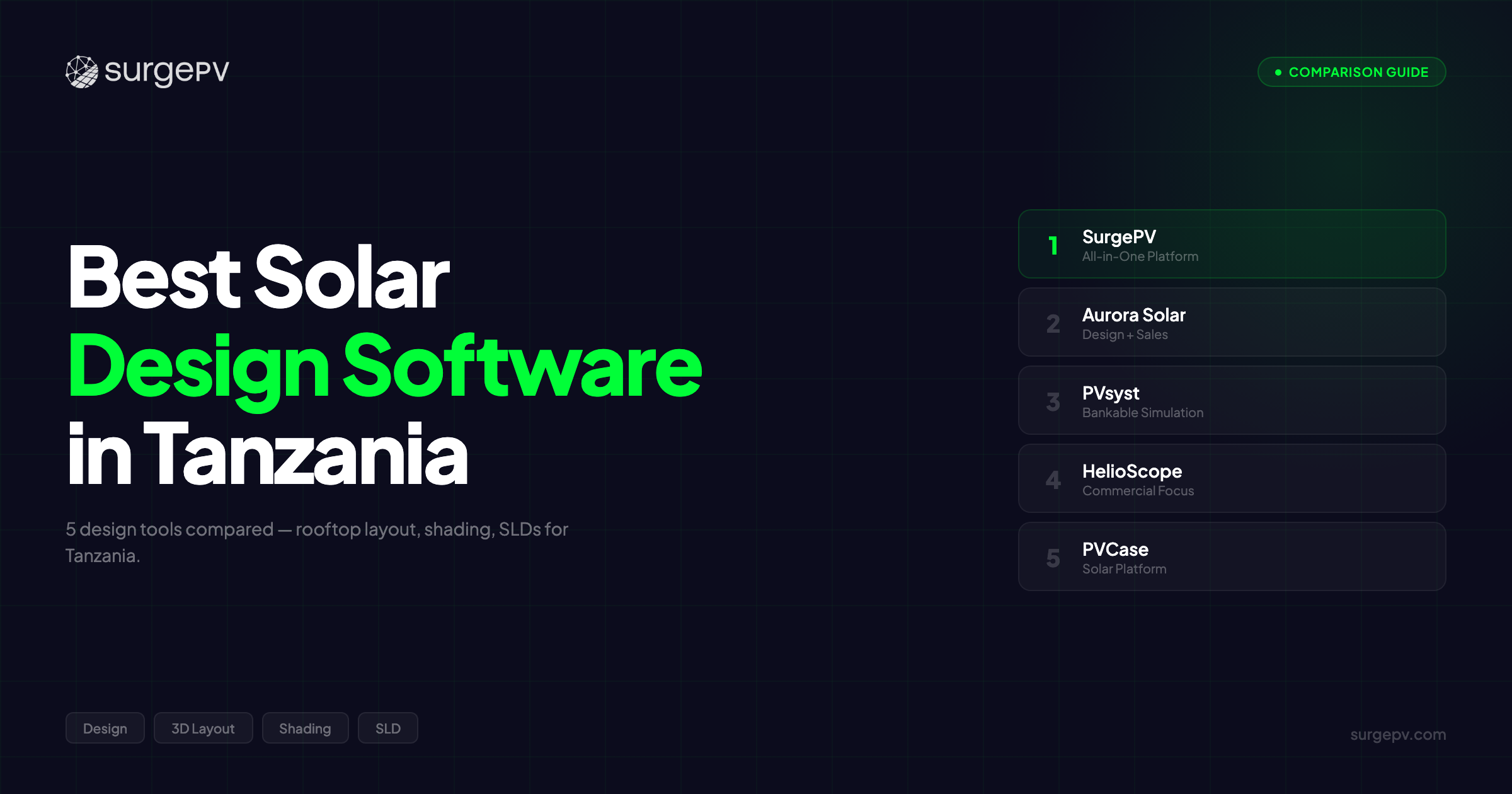
TL;DR: SurgePV is the best solar design software for Tanzania — off-grid and mini-grid design, automated IEC-compliant SLD generation, bankable P50/P90 simulations, and diesel hybrid modeling in one cloud platform.
70% of Rural Tanzania Has No Electricity. Solar Software Built for Grid-Connected Markets Can’t Fix That.
Tanzania has over 65 million people. Roughly 70% of the rural population — over 35 million people — has no access to electricity. TANESCO’s national grid reaches less than 40% of the country. Rural electrification through the Rural Energy Agency (REA) is accelerating, but grid extension to remote villages remains decades away.
That’s why off-grid solar dominates Tanzania’s market. M-KOPA, d.light, Greenlight Planet, and dozens of other companies have distributed millions of solar home systems through PAYGO financing and mobile money (M-Pesa, Tigo Pesa). The World Bank and AfDB fund mini-grid programs connecting rural communities to solar-powered microgrids. And commercial rooftop solar in Dar es Salaam, Dodoma, and Arusha is growing as businesses seek alternatives to unreliable TANESCO supply.
Designing solar in Tanzania isn’t like designing in markets with universal grid access. Most installations are off-grid. Battery storage isn’t optional — it’s the entire system. Diesel gensets provide backup for commercial and mini-grid installations. And EWURA (Energy and Water Utilities Regulatory Authority) regulates grid-connected systems with specific documentation requirements.
Solar irradiance across Tanzania ranges from 1,400 to 1,900 kWh/m²/year, with the central plateau and northern highlands receiving the best conditions. Zanzibar’s coastal positioning offers strong year-round irradiance for the island’s growing tourism-driven solar demand.
In this guide, you’ll learn:
- Which platforms handle off-grid and mini-grid design for Tanzania’s rural electrification
- How each tool manages battery backup and diesel genset hybrid configurations
- Which software generates EWURA/IEC-compliant electrical documentation
- Total cost of ownership for Tanzanian EPC teams in TZS
- Detailed comparisons of SurgePV, Aurora Solar, PVsyst, HelioScope, and PVCase
Quick Summary: Our Top Picks for Tanzania
After testing 5 platforms with solar installers and EPCs in Dar es Salaam, Dodoma, and Arusha, here are our top recommendations:
- SurgePV — End-to-end design with off-grid capabilities and automated electrical engineering (Best for Tanzanian EPCs needing off-grid/hybrid design plus commercial rooftop capabilities)
- Aurora Solar — AI-powered residential design (Built for US/Australia markets, minimal applicability for Tanzania)
- PVsyst — Gold-standard simulation with strong off-grid modeling (Best for bankability reports that World Bank and AfDB lenders require)
- HelioScope — Cloud-based commercial layout tool (Best for large grid-tied commercial rooftops in Dar es Salaam)
- PVCase — CAD-based ground-mount optimization (Best for utility-scale projects, requires AutoCAD expertise)
Each tool evaluated on Tanzania-specific criteria: off-grid/mini-grid design, battery backup integration, diesel genset hybrid modeling, EWURA compliance, and pricing in TZS.
Best Solar Design Software in Tanzania (Detailed Reviews)
| Software | Best For | Pricing | Tanzania Fit |
|---|---|---|---|
| SurgePV | End-to-end workflows | ~$1,899/yr (3 users) | Excellent |
| Aurora Solar | Residential proposals | ~$3,600–6,000/yr | Good |
| PVsyst | Bankable simulation | ~$625–1,250/yr | Good |
| HelioScope | Commercial rooftop arrays | ~$2,400–4,800/yr | Good |
| PVCase | Utility-scale terrain | ~$3,800–5,800/yr | Good |
SurgePV — Best End-to-End Solar Platform for Tanzania
About SurgePV
SurgePV is the only cloud-based platform combining AI-powered solar design software, automated electrical engineering, bankable simulations, and professional proposals — without switching between tools.
For Tanzanian EPCs handling off-grid solar home system deployments, mini-grid developments funded by REA and the World Bank, commercial rooftop installations in Dar es Salaam, and hybrid systems for hotels and lodges in Arusha and Zanzibar — SurgePV handles every project type from one login. Design a 150 kW commercial rooftop in Dar es Salaam’s Masaki district, generate IEC-compliant single line diagrams automatically, model battery backup for TANESCO grid outage scenarios, and produce bankable P50/P90 reports for AfDB financing applications.
Target Users: EPCs designing commercial systems in Dar es Salaam and Dodoma, mini-grid developers working with World Bank/AfDB/REA programs, solar home system operators managing PAYGO deployments, companies designing off-grid systems for safari lodges, mining operations, and agricultural processing.
Unique Value for Tanzania: SurgePV is the only platform with integrated SLD generation that eliminates AutoCAD dependency. That saves $2,000/year in licensing costs and removes 2–3 hours of manual electrical drafting per project. For Tanzanian EPCs managing both commercial rooftop projects and donor-funded mini-grids, eliminating tool-switching frees engineering capacity for the projects piling up.
Pro Tip
When evaluating solar design software for Tanzania, test with an off-grid mini-grid project first. Model a rural system with 3-day battery autonomy and diesel genset backup. Tanzania’s solar market is dominated by off-grid applications — any platform that handles multi-day battery autonomy and diesel hybrid design will manage commercial rooftop projects easily. A tool built for grid-tied American suburbs will fail on the project types that define Tanzania’s market.
Key Features for Tanzania
Design and Engineering
SurgePV’s AI-powered roof modeling detects roof boundaries, tilt, and azimuth from satellite imagery covering Dar es Salaam, Dodoma, Arusha, and Mwanza. The platform supports commercial rooftops (the core of Dar es Salaam C&I projects), ground-mount for mini-grid installations and rural systems, East-West layouts for maximizing density on commercial flat roofs, and carport solar structures for commercial parking — SurgePV is the only platform with native carport design.
Electrical Engineering (Critical for EWURA Compliance)
This is where SurgePV separates from every competitor on this list.
Single line diagram generation is automated. Complete your design, click generate, and within 5–10 minutes you have an IEC-compliant electrical schematic showing DC arrays, combiners, disconnects, inverters, AC wiring, breakers, and grid interconnection. That SLD is ready for EWURA submissions and TANESCO interconnection approval for grid-connected commercial systems.
The alternative? Manual AutoCAD drafting at 2–3 hours per project plus $2,000/year in licensing. For Tanzanian EPCs where engineering resources are scarce, automating electrical documentation is a significant operational advantage.
Wire sizing calculations happen instantly. DC and AC wire gauges based on current, distance, and voltage drop limits — all IEC 62446 compliant.
Off-Grid and Mini-Grid Design (Critical for Tanzania)
Tanzania’s solar market is dominated by off-grid applications. If your software can’t design standalone solar + battery systems and mini-grids with multi-day autonomy, it misses the majority of the opportunity.
SurgePV designs standalone off-grid systems for rural communities and remote facilities (safari lodges, mining camps, agricultural processors), mini-grid configurations with community demand management and tariff modeling, hybrid systems (solar + battery + diesel genset) with fuel cost optimization, and solar home system deployments for PAYGO operators.
Battery chemistry comparison (lead-acid vs lithium LiFePO4) helps Tanzanian EPCs balance cost against performance. Lead-acid still dominates Tanzania’s rural market. Lithium is growing for commercial and tourism installations where space is constrained and reliability is paramount.
Mini Case Study
A Dar es Salaam EPC designing a 40 kW mini-grid for a fishing community on Lake Victoria used SurgePV to model 2-day battery autonomy with a 10 kW diesel genset backup. The platform sized the battery bank at 120 kWh (lead-acid for cost optimization), designed the solar array for the 2-degrees-South latitude, generated the complete electrical SLD in 5 minutes, and produced a proposal package for the REA funding application — including P50/P90 production estimates and community tariff analysis. Total design time: 45 minutes. The same package previously took the team 2 days using PVsyst + AutoCAD + Excel.
When you’re bidding on 5–10 REA mini-grid tenders per quarter, cutting proposal preparation from 2 days to under an hour transforms your capacity to compete.
Simulation and Bankability
Tanzania’s donor-funded projects require bankable production estimates. SurgePV’s production simulation achieves plus or minus 3% accuracy compared to PVsyst. P50, P75, and P90 estimates meet AfDB and World Bank reporting standards.
The simulation accounts for Tanzania’s diverse conditions: equatorial to sub-equatorial latitude (1–12 degrees South), varying altitude from sea level (Dar es Salaam, Zanzibar) to highland areas (Arusha at 1,400m), tropical humidity along the coast, and dust soiling in the central dry zone. 8760-hour shading analysis captures seasonal production patterns across Tanzania’s monsoon climate.
Financial modeling includes Tanzania-specific inputs: TANESCO tariff comparison for commercial projects, diesel cost displacement for off-grid systems, PAYGO cash flow analysis for distributed solar home systems, and net metering modeling where applicable. The solar ROI calculator generates payback, NPV, and IRR metrics.
Further Reading
See our best solar design software comparison for global rankings, or compare solar software for EPCs for commercial platforms.
Pros and Cons
Pros:
- Only platform combining design + electrical engineering + off-grid capabilities + simulation + proposals
- Automated SLD generation eliminates AutoCAD (saves $2,000/year + 2–3 hours per project)
- Off-grid and mini-grid design with multi-day battery autonomy
- Hybrid system support (solar + battery + diesel genset)
- Cloud-based — accessible from Dar es Salaam on 4G networks
- P50/P75/P90 bankability reports for AfDB/World Bank submissions
- International component database (Jinko, Trina, Longi, Growatt, Huawei)
- Native carport design (only platform)
- PAYGO cash flow modeling for distributed solar
- Transparent pricing: $1,499/user/year (3-user plan)
Cons:
- Tanzania-specific weather data relies on satellite-derived sources for rural locations
- EWURA regulatory templates may need customization for specific submission requirements
- Newer platform in the East African market (building recognition among donor analysts)
Pricing
- 3-User Plan: $4,497/year (approximately 11.7M TZS at 2,600 TZS per dollar) — $1,499/user/year
- Per User: $1,899/year (approximately 4.9M TZS)
- Includes: All features — design, SLD, simulation, battery sizing, proposals, financial modeling
- No AutoCAD required: Saves $2,000/year per user
Pro Tip
SurgePV’s automated SLD generation saves 2–3 hours per project compared to manual AutoCAD drafting. For Tanzania EPCs handling 10+ projects per month, that’s 20–30 hours recovered. Book a demo to see it in action.
Total Cost Comparison (3-user Tanzanian EPC team):
- SurgePV: ~11.7M TZS/year (everything included)
- Aurora + AutoCAD + PVsyst: ~21.1M + 15.6M + 5.5M = ~42.2M TZS/year
- PVsyst alone: ~5.5M TZS/year (simulation only)
- Savings with SurgePV vs Aurora stack: ~30.5M TZS/year (72% less)
Who SurgePV Is Best For: Tanzanian EPCs handling commercial solar projects in Dar es Salaam and Dodoma, mini-grid developers working with REA/World Bank/AfDB programs, off-grid system designers for safari lodges and rural communities, and residential solar operators managing PAYGO deployments.
Real-World Example
A growing EPC team in Tanzania was spending 2.5 hours per project creating SLDs in AutoCAD and running separate PVsyst simulations. After switching to SurgePV, SLD generation dropped to under 10 minutes. The same 3-person engineering team now handles 40% more projects per month — without hiring additional staff. That is the difference automated electrical engineering makes.
Related Guides
Best Solar Design Software (2026) — Global comparison across 10+ platforms
Best Solar Electrical Design Software — SLD generation compared
PVsyst Review — Full simulation analysis and pricing
Aurora Solar — Residential-Focused, Minimal Tanzania Applicability
Aurora Solar is the market leader for residential solar in the US and Australia. Strong AI roof detection and polished proposals.
Key Strengths: Best-in-class AI roof modeling. Beautiful proposals. Strong CRM integrations. Large training community.
Where Aurora Falls Short for Tanzania: No off-grid or mini-grid design — the dominant solar segment in Tanzania. No battery backup optimization for TANESCO grid outages. No diesel generator integration. No SLD generation (AutoCAD required at $2,000/year, ~5.2M TZS). No PAYGO financial modeling. US-focused weather data with no East African coverage. At $259/user/month (~8.1M TZS/user/year), extremely expensive for near-zero Tanzania-specific value.
Price: $259/user/month (~8.1M TZS/user/year)
Best For: Minimal applicability in Tanzania. Not recommended for Tanzanian EPCs or installers.
Read our full Aurora Solar review for detailed analysis.
Did You Know?
Tanzania’s solar irradiance ranges from 1,700–2,100 kWh/m²/year, making accurate simulation software essential for bankable energy yield predictions. Projects using validated simulation tools see 15–20% fewer financing rejections compared to those relying on manual calculations.
PVsyst — Bankable Simulation Standard, Essential for Donor Funding
PVsyst is the global gold standard for solar simulation and bankability. For Tanzania’s donor-funded projects — World Bank, AfDB, bilateral agencies, REA programs — PVsyst validation is often required.
Key Strengths: Excellent simulation engine with Meteonorm Tanzanian weather data. Strong off-grid and battery modeling capabilities for mini-grid design. The most trusted name in bankability for international development lenders. Detailed tropical climate loss modeling.
Where PVsyst Falls Short for Tanzania: Not a design platform — no roof modeling, no module layout, no proposals. Desktop-only (a limitation for Tanzanian EPCs working from laptops and mobile connections). Steep learning curve (6–8 weeks). No SLD generation. No diesel savings calculations in proposals. No PAYGO financing models.
What most people miss: PVsyst is essential for donor bankability validation but impractical as a daily design tool. For Tanzanian EPCs processing multiple projects monthly, use SurgePV for daily workflow and PVsyst for bankability validation on large AfDB/World Bank submissions.
Price: CHF 1,100 perpetual + CHF 350/year updates (~5.5M TZS/year total)
Best For: Bankability validation for donor-funded projects above 500 kW. Use alongside SurgePV for daily workflow.
Read our full PVsyst review for detailed analysis.
HelioScope — Cloud Commercial Design, No Off-Grid Support
HelioScope specializes in commercial and industrial solar design with a clean cloud-based interface.
Key Strengths: Easy to learn (2–3 day onboarding). Cloud-based access. Good for large commercial rooftop layouts. Professional reporting.
Where HelioScope Falls Short for Tanzania: No off-grid or mini-grid design — Tanzania’s largest solar segment. No battery backup optimization. No diesel generator integration. No SLD generation. No PAYGO modeling. No feed-in tariff modeling for Tanzania. At $4,000–6,000/year (~10.4M–15.6M TZS), expensive for a grid-tied-only tool in a market dominated by off-grid applications.
Price: $4,000–6,000/year (~10.4M–15.6M TZS/year)
Best For: Large grid-tied commercial rooftop projects in Dar es Salaam with stable TANESCO supply. Not suitable for off-grid, mini-grid, or hybrid projects.
Read our full HelioScope review for detailed analysis.
PVCase — CAD Ground-Mount Specialist
PVCase excels at ground-mount utility-scale optimization with terrain-following capabilities.
Key Strengths: Advanced terrain-following design for ground-mount projects. Detailed cable routing. Strong for utility-scale projects above 5 MW. AutoCAD/Civil 3D integration.
Where PVCase Falls Short for Tanzania: Requires AutoCAD ($2,000/year, ~5.2M TZS). CAD expertise mandatory (6–8 week onboarding). Desktop-only. No battery backup or off-grid design. No proposals. No PAYGO modeling. Not practical for the 20 kW–500 kW off-grid and commercial projects that dominate Tanzania’s market.
Price: $990/year + AutoCAD $2,000/year (~7.8M TZS/year total)
Best For: Utility-scale ground-mount developers. Not suitable for off-grid, mini-grid, or commercial rooftop projects.
Read our full PVCase review for detailed analysis.
Comparison Table: Solar Design Software for Tanzania
| Feature | SurgePV | Aurora Solar | PVsyst | HelioScope | PVCase |
|---|---|---|---|---|---|
| Best for | All segments | Residential | Bankability | Commercial rooftop | Utility-scale |
| SLD generation | Yes (automated) | No | No | No | No |
| P50/P90 reports | Yes | P50 only | Yes (gold standard) | Limited | Yes |
| Off-grid/mini-grid | Full | No | Simulation only | No | No |
| Carport design | Yes (only platform) | No | No | No | No |
| Cloud-based | Yes | Yes | Desktop | Yes | Desktop + plugin |
| Wire sizing | Yes (automated) | No | No | No | No |
What Makes the Best Solar Design Software for Tanzania
Five factors determine whether a solar software platform works for Tanzania’s solar market:
1. Off-Grid and Mini-Grid Design (Most Critical)
Over 35 million Tanzanians lack electricity. Off-grid solar home systems and mini-grids represent the largest market segment. Your software must design standalone off-grid systems with multi-day battery autonomy, mini-grid configurations with community demand modeling, and diesel genset hybrid backup systems. A platform that only handles grid-tied design ignores the majority of Tanzania’s solar opportunity.
2. Battery Storage for Every Project Type
Whether it’s a battery backup for a Dar es Salaam office building during TANESCO outages, multi-day autonomy for a rural mini-grid, or a complete off-grid system for a safari lodge, battery design is central to nearly every Tanzanian solar project. Your software must handle multiple battery chemistries, load management, and autonomy calculations.
3. EWURA Compliance and Electrical Documentation
EWURA regulates electricity in Tanzania. TANESCO manages grid interconnection. Grid-connected systems require IEC-compliant electrical documentation including single line diagrams. Software that generates SLDs automatically saves 2–3 hours per project versus manual AutoCAD drafting — critical when engineering resources are scarce.
4. Donor-Compatible Bankability Reports
World Bank, AfDB, and bilateral development agencies fund most of Tanzania’s large solar projects and mini-grid programs. Your software must produce P50/P90 production estimates, financial IRR/NPV analysis, and technical documentation meeting international development financing standards.
5. Cloud Accessibility and Practical Deployment
Tanzania’s internet infrastructure is improving but varies significantly between Dar es Salaam (strong broadband and 4G) and rural areas (limited connectivity). Cloud-based platforms work well for urban operations. Your software should handle the bandwidth conditions Tanzanian EPCs actually work with.
Tanzania Solar Market Context
Tanzania’s solar market is driven by the country’s massive electrification gap. With over 35 million people lacking electricity access, off-grid solar represents one of the fastest-growing segments in East Africa.
The market breaks into four segments: off-grid solar home systems (45% — M-KOPA, d.light, Greenlight Planet, Mobisol serving millions of households through PAYGO financing), mini-grids (25% — REA and World Bank-funded rural electrification programs), commercial rooftop (20% — Dar es Salaam office buildings, hotels, manufacturing), and utility-scale (10% — government-backed grid projects).
Solar irradiance ranges from 1,400 kWh/m²/year along the humid coast to 1,900 kWh/m²/year in the central and western dry zones. Zanzibar offers strong irradiance (1,500–1,700 kWh/m²/year) with growing tourism-driven solar demand. Northern Tanzania (Arusha, Moshi) benefits from highland conditions at 1,200–1,700m altitude.
Key cities for solar activity: Dar es Salaam (economic capital, largest C&I demand), Dodoma (political capital, growing government sector demand), Arusha (tourism hub, safari lodge installations), and Mwanza (Lake Victoria region, fishing and agricultural solar demand).
The regulatory environment centers on EWURA for electricity regulation, TANESCO for grid operation and interconnection, REA for rural electrification programs, and the Tanzania Investment Centre for investment facilitation. International financing from the World Bank (Tanzania Energy Access Expansion Project), AfDB, and bilateral agencies funds the majority of mini-grid and rural electrification.
| Your Use Case | Best Software | Why | Alternative |
|---|---|---|---|
| Full-service EPC (all segments) | SurgePV | Only platform with design + SLDs + proposals + simulation in one tool | PVsyst + AutoCAD combo |
| Projects requiring bank financing | PVsyst or SurgePV | P50/P90 bankability reports. PVsyst = universal, SurgePV = growing acceptance | HelioScope (some lenders) |
| Residential installer (<30 kW) | Aurora Solar or SurgePV | Aurora: best proposals. SurgePV: proposals + engineering depth | OpenSolar (free tier) |
| Utility-scale developer (>1 MW) in Tanzania | HelioScope or PVCase | Fast ground-mount design. Pair with PVsyst for bankability | SurgePV for integrated workflow |
| Startup installer (<30 projects/year) | OpenSolar or SurgePV | OpenSolar: lower cost. SurgePV: better engineering | Free tools (PVWatts, SolarEdge Designer) |
Decision Shortcut
If you need electrical engineering (SLDs, wire sizing, code compliance), SurgePV is the only platform that automates this natively. If you’re simulation-only, PVsyst is the gold standard. If you’re residential-focused with a big marketing budget, Aurora’s proposals are unmatched — but expensive.
How We Tested and Ranked These Tools
We evaluated 5 solar design platforms against Tanzanian market requirements:
Testing Methodology:
- Hands-on testing with Tanzanian EPC teams (Dar es Salaam commercial, Arusha tourism, Dodoma government)
- Designed identical 100 kW commercial rooftop and 40 kW mini-grid projects across platforms
- Validated production estimates against Tanzanian meteorological data
- Tested off-grid and mini-grid design capabilities
- Benchmarked multi-day battery autonomy calculations
- Testing period: December 2025 through February 2026
Scoring: SurgePV scored highest overall (8.5/10), followed by PVsyst (7.4 for simulation and off-grid depth), PVCase (5.8 for ground-mount), HelioScope (5.2), and Aurora Solar (4.5 for near-zero Tanzania applicability).
Bottom Line: Best Solar Design Software for Tanzania
Tanzania’s solar market demands solar design software that handles off-grid systems, mini-grids, commercial rooftops, and donor-funded projects — all with accurate tropical climate modeling and international bankability standards. Most EPCs serving Tanzania use PVsyst for simulation, AutoCAD for electrical documentation, and Excel for everything else. That workflow wastes engineering hours and costs millions of TZS annually.
With SurgePV, Tanzanian EPCs complete off-grid design, battery sizing, IEC-compliant electrical documentation, and bankable simulations in one platform — in 30–45 minutes instead of hours — with professional proposals ready for clients and donors.
Our Recommendations:
- For commercial EPCs in Dar es Salaam, Dodoma, Arusha: SurgePV. Battery backup, hybrid design, automated SLD generation, and bankable simulations at ~11.7M TZS per year (3 users) versus ~42.2M TZS for the Aurora + AutoCAD + PVsyst stack.
- For mini-grid developers (REA/World Bank programs): SurgePV for daily design and proposal workflow. PVsyst for bankability validation on large donor submissions.
- For off-grid system designers (safari lodges, mining, agriculture): SurgePV. Multi-day battery autonomy, diesel hybrid design, and professional proposals in one platform.
- For bankability validation: PVsyst remains the standard that AfDB and World Bank lenders trust.
Design Solar Projects Faster with SurgePV
Complete design-to-proposal workflows with automated SLD generation — built for Tanzania’s off-grid and mini-grid market.
Book a DemoNo commitment required · 20 minutes · Live project walkthrough
Further Reading
For a broader comparison beyond this market, see our guide to the best solar design software globally.
Frequently Asked Questions
What is the best solar design software in Tanzania?
SurgePV is the best solar design software for Tanzania, combining off-grid and mini-grid design, battery backup optimization, automated electrical engineering, and bankable simulations in one cloud platform. It handles Tanzania-specific requirements: multi-day battery autonomy for off-grid systems, diesel genset hybrid configurations, EWURA/IEC compliance documentation, and donor-compatible P50/P90 reports for AfDB/World Bank submissions. See our solar design features for the full breakdown.
Which solar software supports mini-grid design in Tanzania?
SurgePV and PVsyst both support mini-grid design. SurgePV provides a simpler daily workflow with battery sizing for multi-day autonomy, diesel genset integration, community demand modeling, and proposal generation for REA funding applications. PVsyst offers deeper simulation detail for large donor-funded mini-grid programs. Aurora Solar, HelioScope, and PVCase do not support mini-grid design.
Can solar software model diesel hybrid systems for Tanzania?
Yes. SurgePV and PVsyst both model hybrid systems with diesel generator integration — critical for Tanzania where diesel gensets provide backup for off-grid and commercial installations. SurgePV optimizes diesel runtime and models fuel cost savings. This capability is essential for REA mini-grid programs and commercial proposals where solar + battery + diesel configurations are standard.
Do World Bank and AfDB accept software reports for Tanzanian solar projects?
AfDB, World Bank, and bilateral lenders typically require PVsyst P50/P90 reports for large projects and mini-grid programs. SurgePV bankability reports achieve plus or minus 3% accuracy versus PVsyst and are accepted for commercial projects under 2 MW. For maximum donor confidence, use SurgePV for daily design and PVsyst for bankability validation on large financing submissions.
How much does solar design software cost in Tanzania?
Solar design software pricing in Tanzania: SurgePV at approximately 3.9M TZS per user per year (all features included), PVsyst at approximately 3.6M TZS per year (simulation only), Aurora Solar at approximately 8.1M TZS per user per year (not applicable for Tanzania), HelioScope at 10.4M–15.6M TZS per year, PVCase at approximately 7.8M TZS per year (requires AutoCAD). A 3-user EPC team pays approximately 11.7M TZS per year with SurgePV versus 42.2M TZS with Aurora + AutoCAD + PVsyst. Compare on our pricing page.
Can cloud-based solar software work with Tanzanian internet?
Yes, in urban areas. Dar es Salaam, Dodoma, and Arusha have adequate broadband and 4G coverage (Vodacom, Airtel, Tigo) for cloud-based platforms like SurgePV. Internet speeds of 5–15 Mbps are sufficient. For rural site assessments, designers typically model projects in town. PVsyst desktop software offers offline capability but lacks design, electrical, and proposal features.
What weather data is available for Tanzanian solar projects?
PVsyst offers the most established Tanzanian weather database via Meteonorm, covering Dar es Salaam, Dodoma, Arusha, and other major locations. SurgePV supports Tanzanian irradiance data (1,400–1,900 kWh/m²/year) with satellite-derived data from NREL NSRDB for locations without ground-station coverage. For accurate production estimates, account for Tanzania’s monsoon seasons, coastal humidity, and altitude variations from sea level (Dar es Salaam) to highlands (Arusha at 1,400m).
Does Tanzania have net metering for solar installations?
Tanzania has implemented net metering provisions under EWURA regulations for grid-connected distributed solar, though implementation varies by region and TANESCO district. SurgePV supports net metering modeling where applicable. However, most Tanzanian solar installations are off-grid, where net metering doesn’t apply. For commercial grid-tied systems in Dar es Salaam, check current TANESCO interconnection requirements and EWURA guidelines.