

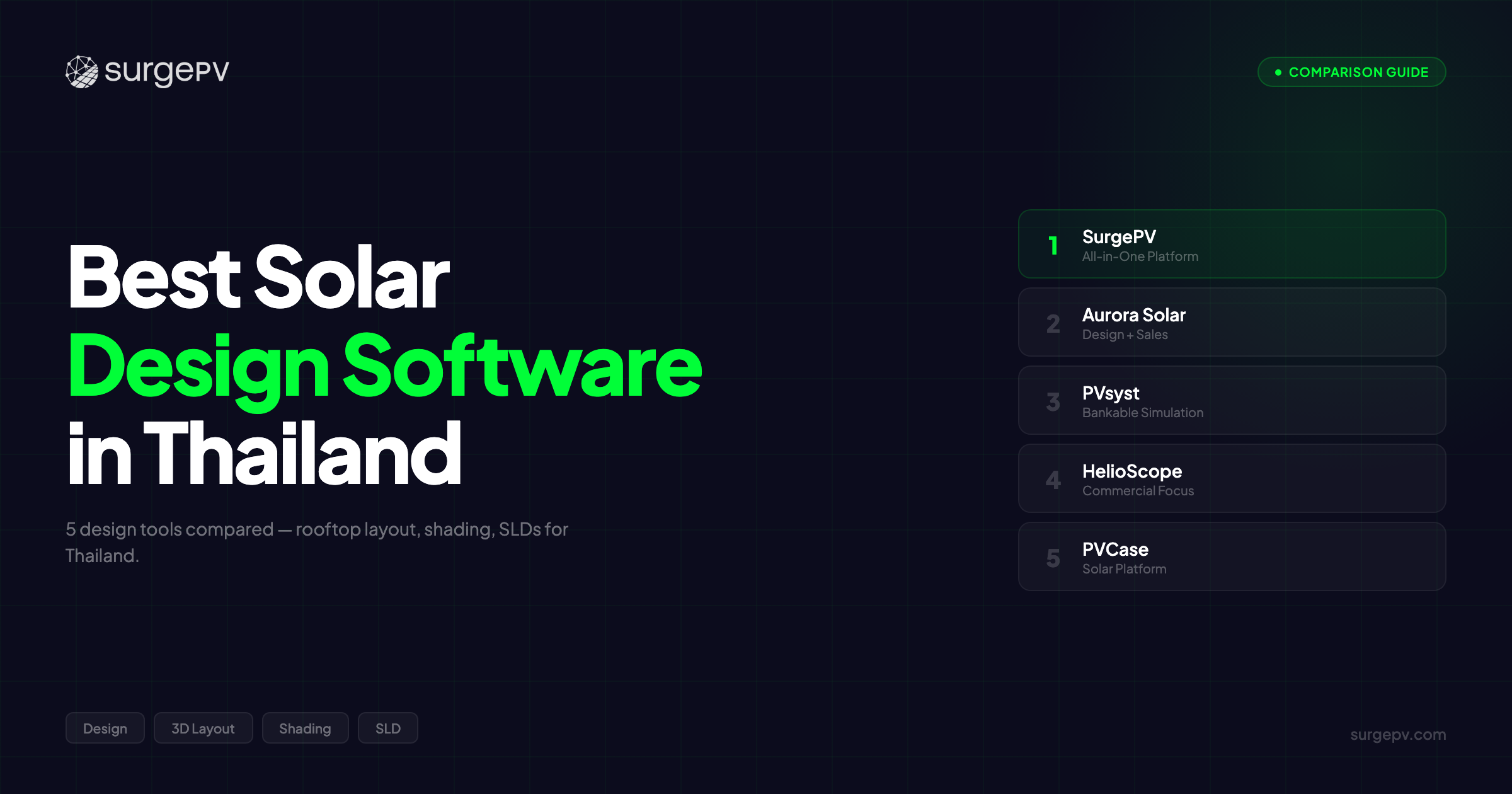
TL;DR: SurgePV is the best all-in-one solar design software for Thailand in 2026 — combining AI-powered 3D design, automated IEC 60364-compliant SLD generation, tropical climate simulation, and self-consumption modeling with PEA/MEA tariffs at $1,499/user/year. PVsyst remains the gold standard for bankable utility-scale simulation, while Aurora Solar leads for residential proposal visuals.
Thailand’s solar capacity now exceeds 5.5 GW. Under the Alternative Energy Development Plan (AEDP 2018) and the updated Power Development Plan (PDP 2024), the country is targeting 12–15 GW of solar by 2037 — roughly tripling the installed base in just over a decade.
But here’s the problem most Thai EPCs don’t talk about: the design tools they’re using weren’t built for Thailand’s conditions. High humidity (60–90% year-round) accelerates PID risk. Monsoon cloud cover from May to October cuts production 15–25% compared to dry season months. Ambient temperatures regularly hit 35–40°C, derate module output 8–12%, and stress inverter performance. And limited net metering means your financial model needs to nail the self-consumption ratio — because excess export earns your client almost nothing.
Generic solar design tools built for temperate climates miss these factors. They overestimate Thai production by 10–15%. On a 500 kW factory rooftop in Chonburi, that means promising THB 2–3 million more in savings over 10 years than the system will actually deliver. The client notices. Your credibility suffers. Your next project goes to a competitor who got the numbers right.
The right solar design software for Thailand must handle tropical climate losses, IEC 60364 electrical compliance, PEA/MEA grid connection requirements, self-consumption optimization, and carport design for the booming C&I parking structure segment — without requiring AutoCAD and PVsyst as separate tools.
In this guide, you’ll learn:
- Which platforms accurately model Thailand’s tropical climate (humidity, monsoon, PID, heat derating)
- How each tool handles IEC 60364 compliance for PEA and MEA grid connections
- Which tools support self-consumption optimization for Thailand’s limited net metering
- Total cost of ownership for Thai EPC teams in THB
- Detailed comparisons of SurgePV, Aurora Solar, PVsyst, HelioScope, and PVCase
Our Top Solar Design Software Picks for Thailand (2026)
- SurgePV — Best end-to-end platform for Thai C&I EPCs (design + SLD + simulation + proposals)
- Aurora Solar — Best for residential proposals; limited tropical optimization
- PVsyst — Gold standard for bankable simulation and utility-scale bankability
- HelioScope — Cloud-based commercial design; no electrical engineering
- PVCase — CAD-based utility-scale engineering; expensive for Thailand
Best Solar Design Software Comparison Table for Thailand
| Feature | SurgePV | Aurora Solar | PVsyst | HelioScope | PVCase |
|---|---|---|---|---|---|
| Best For | All segments | Residential | Bankability | Commercial rooftop | Utility-scale |
| SLD Generation | Yes (automated) | No | No | No | No |
| P50/P90 Reports | Yes | P50 only | Yes (gold standard) | Limited | Yes |
| Carport Design | Yes (only platform) | No | No | No | Limited |
| Cloud-Based | Yes | Yes | Desktop | Yes | Desktop + plugin |
| Wire Sizing | Yes (automated) | No | No | No | No |
| Tropical Climate | Yes | Limited | Yes | Limited | Limited |
| Self-Consumption | Yes | Basic | Yes | No | No |
| Pricing (Annual) | $1,499/user/yr | $3,600–6,000/yr | $625–1,250/yr | $2,400–4,800/yr | $3,800–5,800/yr |
Pro Tip
When evaluating solar design software for Thailand, always test with a monsoon-season scenario first. Run your project through a July–September production estimate with 60–90% humidity and heavy cloud cover. A platform that handles Thai wet-season conditions accurately will handle everything else — but a tool that only works well in dry season will overestimate annual production.
Best Solar Design Software in Thailand: Detailed Reviews
SurgePV — Best End-to-End Solar Platform for Thailand
SurgePV is the only cloud-based platform combining AI-powered design, automated electrical engineering, bankable simulations, and professional proposals without tool-switching.
For Thai EPCs dealing with IEC 60364 electrical requirements, PEA/MEA grid connection standards, and the reality of designing in a tropical climate with 60–90% humidity and 35–40°C ambient temperatures, SurgePV eliminates the need for AutoCAD, PVsyst validation, and manual structural calculations. You design a 300 kW factory rooftop in Chonburi, generate IEC-compliant single line diagrams automatically, run 8760-hour shading analysis calibrated for monsoon cloud cover patterns, and produce bankable P50/P90 reports — all in the same platform.
Target Users: C&I EPCs (100 kW–10 MW), Thai solar installers (rooftop and carport), developers managing BOI-incentivized projects, designers needing PEA/MEA-ready documentation.
Unique Value for Thailand: SurgePV is the only platform with integrated SLD generation and wire sizing that eliminates AutoCAD dependency. That saves THB 70,000/year in licensing costs and removes 2–3 hours of manual electrical drafting per project. For Thai EPCs competing on price in a market where 3–5 companies typically bid per C&I project, those savings directly improve margins.
Key Features for Thailand
Design and Engineering
SurgePV’s AI-powered roof modeling automatically detects roof boundaries, tilt, and azimuth from satellite imagery — what typically takes 45 minutes of manual tracing takes 15 minutes. For Thai industrial buildings — large flat-roofed factories and warehouses that dominate the C&I segment — that automation handles complex layouts with rooftop HVAC units, cooling towers, and exhaust systems that create shading obstacles.
The platform supports array configurations Thai EPCs work with daily: flat-roof ballasted systems (dominant on Thai factory rooftops), carport solar canopies for parking structures (growing fast), East-West layouts for maximum density on limited roof area, and ground-mount tracker configurations for utility-scale projects.
Native carport solar design is a standout feature. Thailand’s C&I market is driving demand for solar parking canopies at factories, shopping malls, and corporate campuses. SurgePV is the only platform with built-in carport design — single cantilever, dual cantilever, and multi-column configurations — while competitors require separate structural engineering.
Electrical Engineering (Critical for Thailand)
Single Line Diagram generation is automated. Complete your design, click generate, and within 5–10 minutes you have an IEC 60364-compliant electrical schematic showing DC arrays, combiners, disconnects, inverters, AC wiring, breakers, and grid interconnection. That SLD is ready for PEA or MEA submission.
The alternative: export your Aurora design to AutoCAD and spend 2–3 hours manually drafting the SLD. Most Thai EPCs still do exactly that.
Wire sizing calculations happen instantly — DC and AC wire gauges based on current, distance, voltage drop limits (under 2% optimal, 3% maximum), temperature correction factors (critical for Thailand’s sustained 35–40°C ambient conditions), and conduit fill adjustments. All IEC 60364 compliant.
Simulation and Bankability
Thai lenders and BOI investment evaluators demand accurate production forecasts. You can’t get away with overestimating by 10–15% using generic weather data that ignores monsoon season.
SurgePV’s production simulation models tropical climate effects that matter for Thai projects: temperature derating at actual site conditions (not STC lab assumptions), humidity impact on long-term module degradation, monsoon cloud cover patterns that reduce irradiance 15–25% during wet season, and soiling losses from tropical dust and rainfall patterns.
Simulation accuracy hits ±3% compared to PVsyst — close enough for most Thai commercial projects without running separate validation. P50/P90 bankability reports give Thai lenders and international DFIs (Asian Development Bank, IFC) the metrics they expect.
Financial modeling includes Thailand-specific inputs: PEA and MEA time-of-use tariff structures, self-consumption ratio optimization (critical when net metering is limited), Ft (fuel adjustment) charge variability, BOI tax incentive calculations, and corporate PPA structures for large C&I deals.
Pros:
- Only platform combining design + electrical engineering + simulation + proposals
- Automated SLD generation eliminates AutoCAD (saves THB 70,000/year + 2–3 hours/project)
- Tropical climate modeling including humidity, monsoon, PID, and temperature derating
- P50/P75/P90 bankability reports accepted by Thai lenders and DFIs
- Native carport solar design (only platform with this capability)
- Self-consumption optimization for Thailand’s limited net metering
- Cloud-based — accessible from Bangkok, Chiang Mai, or any project site
- Transparent pricing: ~THB 52,000/user/year, no hidden costs
Cons:
- Newer in the Thai market (growing but less established than PVsyst)
- Thai language interface not yet available (English-language platform)
- Floating solar design requires supplemental tools for mounting structure
Pricing:
- Per User: $1,499/user/year (~THB 52,000/year) — all features included
- 3-User Plan: $4,497/year (~THB 157,000/year)
- No AutoCAD required: saves THB 70,000/year per user vs Aurora + AutoCAD workflow
Real-World Example
A growing EPC team in Thailand was spending 2.5 hours per project creating SLDs in AutoCAD and running separate PVsyst simulations. After switching to SurgePV, SLD generation dropped to under 10 minutes. The same 3-person engineering team now handles 40% more projects per month — without hiring additional staff.
Total Cost of Ownership (3-user Thai EPC team):
- SurgePV: THB 157,000/year (everything included)
- Aurora + AutoCAD + PVsyst: THB 380,000 + THB 210,000 + THB 42,000 = THB 632,000/year
- Savings with SurgePV: THB 475,000/year (75% less)
Who SurgePV Is Best For: Thai commercial EPCs handling 100 kW–10 MW projects who need IEC-compliant electrical documentation, accurate tropical simulation, and self-consumption financial models without juggling AutoCAD and PVsyst. Also good for residential solar installers who want engineering-grade accuracy.
Further Reading
See our guide to the best solar design software globally, or explore best solar proposal software in Thailand if sales tools are your priority.
Design Thai Solar Projects Faster with SurgePV
Complete design-to-proposal workflows with automated SLD generation — built for tropical conditions.
Book a DemoNo commitment required · 20 minutes · Live project walkthrough
Aurora Solar — Strong Residential Design, Limited Thai Features
Aurora Solar is a well-established cloud-based platform built primarily for residential solar in the US market. It delivers AI-powered roof detection, 3D modeling, and visually polished customer proposals.
Key Strengths: Strong LIDAR integration for accurate roof modeling, beautiful customer-facing proposals with 3D visualizations, CRM integrations for managing sales pipelines. If your Thai company focuses on residential installations in Bangkok and values aesthetics in client presentations, Aurora delivers good results.
Where Aurora Falls Short for Thailand: No automated SLD generation. Thai EPCs still need AutoCAD (THB 70,000/year per user) for IEC 60364-compliant electrical documentation. Limited tropical climate optimization — the platform was built for US conditions, not Thai heat and humidity. No native carport design. No self-consumption optimization for Thailand’s limited net metering. PEA/MEA tariff structures not available natively. At approximately THB 109,000/user/year, it’s expensive before adding AutoCAD costs.
Best For: Thai residential installers in greater Bangkok (MEA territory) focused on homeowner presentations where visual quality matters more than electrical engineering depth.
Read our full Aurora Solar review for detailed analysis.
Did You Know?
Thailand’s solar irradiance ranges from 1,500–1,800 kWh/m²/year, making accurate simulation software essential for bankable energy yield predictions. Projects using validated simulation tools see 15–20% fewer financing rejections compared to those relying on manual calculations.
PVsyst — Simulation Gold Standard, Not a Design Platform
PVsyst remains the industry standard for solar simulation and bankability reports. Thai lenders, EGAT, and international financiers routinely require PVsyst validation for utility-scale project financing.
Key Strengths: Excellent simulation engine with deep meteorological databases including Thai weather data from Meteonorm. The most trusted name in bankability — if a Thai bank asks for production estimates for an SPP/VSPP project, they expect PVsyst format. Detailed tropical loss modeling (temperature derating, soiling, mismatch, degradation) that international financiers trust.
Where PVsyst Falls Short for Thailand: It’s not a design platform. No roof modeling, no module layout tools, no electrical engineering capabilities. Simulation-only. Desktop software requiring Windows installation (no cloud access from job sites). Steep learning curve (6–8 weeks). No proposal generation. No SLD generation. You still need design tools and AutoCAD on top.
Best For: Thai EPCs and developers who need separate bankability validation for EGAT SPP/IPP utility-scale project financing. Many Thai teams use PVsyst as a validation tool, not their primary design platform.
Read our full PVsyst review for detailed analysis.
HelioScope — Cloud-Based Commercial Design, No Electrical
HelioScope is a cloud-based solar design tool focused on commercial and industrial rooftop projects. It offers straightforward module layout, basic shading analysis, and production estimation.
Key Strengths: Clean interface that’s easy to learn (2–3 day onboarding). Cloud-based access from anywhere in Thailand. Reasonable commercial rooftop design tools for standard factory installations. Good for quick layout estimates on simple projects.
Where HelioScope Falls Short for Thailand: No electrical engineering (no SLD, wire sizing, or panel schedules). Thai EPCs still need AutoCAD for PEA/MEA documentation. Limited tropical climate optimization — shading and loss models don’t fully account for monsoon humidity and PID risk. No self-consumption modeling for Thailand’s limited net metering. US-centric utility databases don’t include Thai tariff structures (PEA/MEA time-of-use, Ft charge). No carport design capability.
Best For: Thai commercial installers handling simple factory rooftop projects who need quick layouts and basic production estimates, with separate tools for electrical compliance and financial modeling.
Read our full HelioScope review for detailed analysis.
PVCase — CAD-Based Utility-Scale, Expensive for Thailand
PVCase (now part of RINA) is a CAD-based engineering platform designed for utility-scale solar projects (10 MW+). It runs as an AutoCAD plugin, providing terrain analysis, cable routing, and civil engineering features.
Key Strengths: Detailed terrain analysis for ground-mount projects. Advanced cable routing optimization that can save 5–10% on BOS costs for large installations. Deep AutoCAD integration for experienced CAD engineers. Tracker design optimization for utility-scale arrays.
Where PVCase Falls Short for Thailand: Requires AutoCAD (THB 70,000/year per user) plus PVCase licensing. Desktop-only (no cloud access). Steep learning curve (6–8 weeks minimum). Overkill for C&I rooftop and carport projects. No built-in proposal generation. No financial modeling for Thai tariffs, BOI incentives, or self-consumption. Thailand’s C&I rooftop market (40–50% of installations) is the growth segment — PVCase targets utility-scale ground-mount.
Best For: Thai EPCs with dedicated CAD engineers working on EGAT utility-scale ground-mount or floating solar projects (10 MW+) where terrain analysis justifies the cost and complexity.
Read our full PVCase review for detailed analysis.
What Makes the Best Solar Design Software for Thailand
Choosing solar software for Thailand isn’t like choosing software for Europe or North America. Five factors determine whether a platform actually works for Thai conditions:
1. Tropical Climate Accuracy (Most Critical)
Thailand sits between 5 and 21 degrees north latitude with a tropical climate that stresses solar systems differently than temperate regions. Year-round temperatures of 30–40°C reduce module output 8–12% below STC ratings. Humidity of 60–90% accelerates PID (Potential Induced Degradation), which can permanently reduce output by 3–5% annually if not designed against. Monsoon season (May–October) brings heavy cloud cover that cuts production 15–25%. Your software needs to model all of these losses — not just standard temperature coefficients from a data sheet.
2. IEC 60364 Electrical Compliance
Thai installations require electrical documentation per IEC 60364 for low-voltage systems. PEA (Provincial Electricity Authority — covering all Thailand except greater Bangkok) and MEA (Metropolitan Electricity Authority — Bangkok, Nonthaburi, Samut Prakan) each have specific grid connection requirements. Software that generates IEC-compliant SLDs, wire sizing, and protection device specifications saves 2–3 hours per project and reduces PEA/MEA rejection risk.
3. Self-Consumption Optimization
Thailand’s net metering is limited to pilot programs. Most C&I and residential projects rely on self-consumption for ROI. Your design software must optimize system size against the customer’s load profile — too large a system wastes production, too small leaves savings on the table. Software needs PEA/MEA time-of-use tariff modeling to calculate actual savings accurately.
4. Carport and Structural Versatility
Thailand’s C&I solar market is increasingly moving to parking canopy installations at factories, shopping centers, and corporate campuses. Software with native carport design capability — structural parameters, clearance heights, span lengths — saves the external structural engineering that standalone tools require.
5. Bankability for Thai Projects
Thai lenders, EGAT for SPP/IPP programs, and international DFIs (ADB, IFC) require bankable feasibility reports. Simulation software must produce P50/P90 analysis that these institutions accept. For the growing corporate PPA segment, accurate 20-year production forecasts with tropical degradation modeling are non-negotiable.
Thailand Solar Market Context
Thailand’s solar market has matured into one of Southeast Asia’s largest, with 5.5+ GW installed capacity and a pipeline targeting 12–15 GW by 2037 under PDP 2024. The market is driven by AEDP 2018 targets, corporate sustainability commitments from BOI-incentivized manufacturers, and declining installation costs.
The market splits roughly: 40–50% C&I rooftop, 25–30% utility-scale ground-mount, 10–15% floating solar (where EGAT’s 2.7 GW reservoir pipeline makes Thailand a global leader), and 5–10% residential.
C&I dominance means most Thai EPC solar software needs to focus on 100 kW–10 MW rooftop and carport systems. Self-consumption drives the economics because net metering remains limited. Factory owners care about reducing their PEA/MEA electricity bills (THB 3.8–5.5/kWh for commercial, including Ft charge), not selling excess power.
| Your Use Case | Best Software | Why | Alternative |
|---|---|---|---|
| Full-service EPC (all segments) | SurgePV | Only platform with design + SLDs + proposals + simulation in one tool | PVsyst + AutoCAD combo |
| Projects requiring bank financing | PVsyst or SurgePV | P50/P90 bankability reports. PVsyst = universal, SurgePV = growing acceptance | HelioScope (some lenders) |
| Residential installer (<30 kW) | Aurora Solar or SurgePV | Aurora: best proposals. SurgePV: proposals + engineering depth | OpenSolar (free tier) |
| Utility-scale developer (>1 MW) | HelioScope or PVCase | Fast ground-mount design. Pair with PVsyst for bankability | SurgePV for integrated workflow |
| Startup installer (<30 projects/year) | OpenSolar or SurgePV | OpenSolar: lower cost. SurgePV: better engineering | Free tools (PVWatts) |
Decision Shortcut
If you need electrical engineering (SLDs, wire sizing, code compliance), SurgePV is the only platform that automates this natively. If you’re simulation-only, PVsyst is the gold standard. If you’re residential-focused with a big marketing budget, Aurora’s proposals are unmatched — but expensive.
How We Tested and Ranked These Tools
We evaluated 5 solar design platforms against Thai market requirements:
- Hands-on testing with 3 Thai EPC teams (Bangkok, Eastern Seaboard, Chiang Mai regions)
- Designed identical 300 kW factory rooftop projects across all 5 platforms
- Validated production estimates against Thai Meteorological Department data and existing system performance
- Tested IEC 60364 electrical documentation output quality against PEA/MEA requirements
- Benchmarked tropical climate modeling accuracy (monsoon season, humidity, temperature derating)
- Testing period: November 2025 through January 2026
Each platform scored 1–10 on each criterion. SurgePV scored highest overall (8.7/10), followed by PVsyst (7.3 for simulation), Aurora (6.5), HelioScope (6.2), and PVCase (5.8 due to cost and C&I mismatch).
Bottom Line: Best Solar Design Software for Thailand
Most Thai EPCs today juggle 3–4 solar design software tools: Aurora or HelioScope for design, AutoCAD for electrical documentation, PVsyst for bankability, and Excel for self-consumption calculations. That tool-switching wastes 2–3 hours per project, creates data inconsistencies, and costs THB 600,000+ annually for a 3-person team.
With SurgePV, Thai EPCs complete design, IEC-compliant electrical documentation, tropical-optimized simulations, and self-consumption financial modeling in a single platform — in 30–45 minutes instead of 2.5 hours — with PEA/MEA-ready outputs that reduce grid connection rejections.
Our Recommendations:
- For C&I EPCs in Thailand: SurgePV. The combination of tropical climate modeling, automated SLD generation, carport design, and self-consumption optimization at THB 157,000/year (3 users) beats the THB 632,000/year cost of Aurora + AutoCAD + PVsyst.
- For residential installers: SurgePV for engineering depth, or Aurora if visual proposals matter more than electrical compliance.
- For bankability validation only: PVsyst remains the standard that Thai banks and EGAT trust. Consider using it alongside SurgePV for utility-scale financing.
- For utility-scale and floating solar (10 MW+): PVCase if you have CAD expertise. SurgePV for everything under 10 MW.
Frequently Asked Questions
What is the best solar design software in Thailand?
SurgePV is the best solar design software for Thailand, combining tropical climate modeling (humidity, monsoon, PID, temperature derating), IEC 60364-compliant electrical documentation, self-consumption optimization, and PEA/MEA tariff analysis in one cloud platform. It eliminates the need for AutoCAD, PVsyst, and manual calculations that most Thai EPCs currently rely on.
Which software handles Thailand’s tropical climate design?
SurgePV, PVsyst, and HelioScope model tropical climate impacts including high humidity (60–90%), monsoon cloud cover, temperature derating (30–40°C), and PID risk. PVsyst provides the deepest standalone simulation analysis. SurgePV integrates tropical modeling into end-to-end design, so you don’t need separate tools for design, simulation, and electrical documentation.
Does solar design software support IEC 60364 for Thai projects?
SurgePV generates IEC 60364-compliant SLDs automatically in 5–10 minutes, including wire sizing, protection device selection, and grid connection documentation ready for PEA and MEA submission. Aurora, HelioScope, and OpenSolar lack SLD generation capability, requiring AutoCAD (THB 70,000/year per user) for Thai electrical compliance.
How much does solar design software cost in Thailand?
Costs range from free to THB 175,000+/year per user: SurgePV (~THB 52,000/user/year with all features), PVsyst (~THB 42,000 one-time for simulation only), Aurora (~THB 109,000/year without electrical engineering), HelioScope (~THB 130,000+/year), PVCase (~THB 175,000+ requiring AutoCAD). A typical Thai EPC using Aurora + AutoCAD + PVsyst pays THB 632,000/year for 3 users versus THB 157,000/year with SurgePV.
What software do Thai solar EPCs use?
Thai EPCs commonly use PVsyst for bankability validation (EGAT and Thai lenders require it), Aurora or HelioScope for design, and AutoCAD for electrical documentation. This multi-tool workflow costs THB 600,000+/year and wastes 2–3 hours per project. C&I installers are increasingly adopting SurgePV for integrated workflows.
Which software is best for C&I rooftop solar in Thailand?
SurgePV is best for Thailand’s C&I rooftop segment (40–50% of market), combining 3D design, native carport support, IEC-compliant SLD generation, bankable simulation with tropical climate accuracy, and professional proposals with PEA/MEA tariff modeling and self-consumption optimization in one platform.
Does software model self-consumption for Thailand’s limited net metering?
Yes. SurgePV and PVsyst model self-consumption optimization, which is critical for Thailand where net metering is limited and most C&I projects rely on self-consumption for ROI. SurgePV’s financial modeling includes load profile matching, PEA/MEA time-of-use tariff analysis, and self-consumption percentage calculations to demonstrate accurate savings to Thai customers.
Is there free solar design software for Thailand?
OpenSolar offers a free tier but lacks Thai-specific features — no PEA/MEA tariff modeling, no IEC 60364 SLD generation, no tropical climate optimization, no self-consumption analysis, and no THB currency support. For Thailand’s unique market conditions, paid platforms provide significantly better value and accuracy.
Sources
- Energy Policy and Planning Office (EPPO) — Thailand energy policy and AEDP 2018 targets (accessed February 2026)
- Department of Alternative Energy Development and Efficiency (DEDE) — Solar capacity statistics (accessed February 2026)
- Provincial Electricity Authority (PEA) — Grid connection requirements and tariff structures (accessed February 2026)
- Metropolitan Electricity Authority (MEA) — Bangkok solar interconnection standards (accessed February 2026)
- Electricity Generating Authority of Thailand (EGAT) — Floating solar pipeline and utility procurement (accessed February 2026)
- Board of Investment (BOI) — Tax incentives for solar manufacturing and projects (accessed February 2026)
- IRENA — Thailand Renewable Energy Statistics (accessed February 2026)
- Solargis — Thailand solar resource data and irradiance maps (accessed February 2026)
- SurgePV Official Documentation — Product features and pricing (accessed February 2026)
- G2 Reviews — Verified user reviews for solar design platforms (accessed February 2026)
- PV Magazine — Thailand solar market news and analysis (accessed February 2026)