

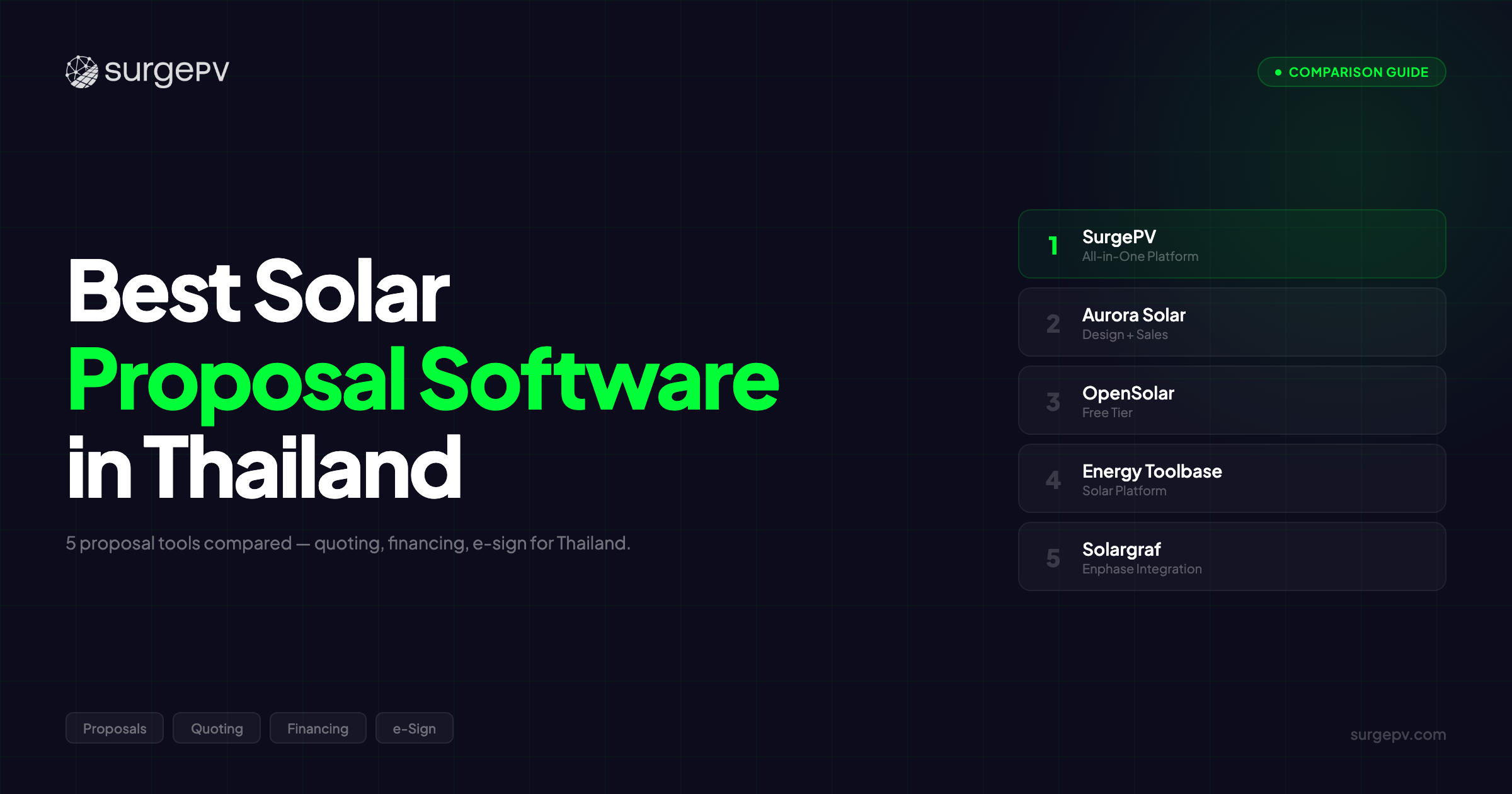
TL;DR: SurgePV is the best solar proposal software for Thailand’s C&I market in 2026 — combining design, simulation, and proposal generation with PEA/MEA tariff analysis, self-consumption modeling, and THB financial projections at $1,499/user/year. Aurora Solar leads for residential visual quality but requires manual adaptation for Thai financials. OpenSolar is the strongest free starting point for small installers.
Thailand’s C&I solar market is one of the most competitive in Southeast Asia. On any given factory rooftop project in the Eastern Seaboard industrial zone, 3–5 EPCs are bidding. The company that delivers a professional, accurate proposal first wins the meeting. The company still assembling their pitch in Excel three days later doesn’t get a second chance.
That’s exactly what’s happening to most Thai solar EPCs. Manual proposal creation takes 4–8 hours. Export designs from one tool, pull simulation data from another, build the financial model in Excel, format everything in PowerPoint, convert savings to THB with PEA or MEA tariffs. By the time you’ve assembled a presentable proposal, your competitor has already closed the deal.
Here’s what makes it worse: Thailand’s limited net metering means your proposal must accurately model self-consumption — not just show a generic “solar savings” number. Thai C&I customers are sophisticated. Factory owners in Chonburi and Rayong track their PEA bills down to the Ft charge adjustment. If your proposal doesn’t match their actual tariff structure, they won’t trust anything else you present.
The right solar proposal software for Thailand must generate professional proposals in minutes (not hours), model self-consumption against PEA/MEA time-of-use tariffs, show curtailment-honest production estimates, and present everything in THB with formatting that impresses corporate decision-makers.
In this guide, you’ll learn:
- Which platforms generate professional Thai solar proposals fastest
- How each tool handles self-consumption and PEA/MEA tariff modeling
- Which tools produce tender-ready documentation for government and corporate RFPs
- Total cost comparison in THB for Thai sales teams
- Detailed comparisons of SurgePV, Aurora Solar, OpenSolar, Energy Toolbase, and Solargraf
Our Top Solar Proposal Software Picks for Thailand (2026)
- SurgePV — Best end-to-end design and proposal platform for Thai C&I EPCs
- Aurora Solar — Polished residential proposals; USD-only financial modeling
- OpenSolar — Free basic proposals for small teams
- Energy Toolbase — Storage-focused proposals; niche use case for Thailand
- Solargraf — Mobile-first residential sales; basic for Thai market
Best Solar Proposal Software Comparison Table for Thailand
| Feature | SurgePV | Aurora Solar | OpenSolar | Energy Toolbase | Solargraf |
|---|---|---|---|---|---|
| Proposal Speed | 15–20 min | 15–20 min | 10–15 min | 20–30 min | 5–10 min |
| THB Currency | Yes | No (USD) | No (USD) | No (USD) | No (USD) |
| PEA/MEA Tariffs | Yes | No | No | No | No |
| Self-Consumption | Full analysis | Limited | Basic | Advanced (storage) | No |
| Design Integration | Built-in | Built-in | Built-in | Separate | Built-in |
| SLD in Proposal | Yes (IEC 60364) | No | No | No | No |
| Bankable P50/P90 | Yes | Limited | Basic | N/A | No |
| Tender Documentation | Full RFP package | Limited | No | Limited | No |
| Pricing (THB/year) | ~52,000/user | ~109,000/user | Free | ~105,000–140,000 | ~35,000–52,000 |
Pro Tip
When presenting solar proposals to Thai C&I customers, always lead with the self-consumption analysis — not the total system production. Thai factory owners care about how much of their PEA/MEA bill the system offsets, not how many kWh the panels produce. SurgePV’s self-consumption modeling gives you that metric front and center.
Best Solar Proposal Software in Thailand: Detailed Reviews
SurgePV — Best End-to-End Design and Proposal Platform for Thailand
SurgePV is the only platform that takes you from site assessment to customer-ready proposal without switching tools. Design the system, run the simulation, and generate a professional proposal — all using the same data, in the same workflow.
For Thai EPCs, this integration matters because proposal accuracy depends on design accuracy. When you export data between disconnected tools, errors creep in. A wrong module count here, an inaccurate production estimate there, and your proposal promises savings that don’t materialize. SurgePV eliminates that risk by keeping design, simulation, and proposal generation in a single platform.
Target Users: C&I EPCs bidding on factory and warehouse projects, developers preparing corporate PPA proposals, residential installers scaling operations, consultants preparing BOI-related feasibility studies.
Unique Value for Thailand: SurgePV generates proposals with PEA and MEA time-of-use tariff analysis, self-consumption ratio optimization, and THB financial projections — all automatically populated from your design and simulation data. No manual data entry. No Excel workarounds.
Key Features for Thailand
Proposal Generation and Branding
SurgePV generates professional PDF and web-based proposals in 15–20 minutes from design completion. Templates include executive summary, system design visualization, production estimates (tropical-adjusted), financial analysis in THB, BOM with pricing, and project timeline. All branded with your company logo and colors.
For corporate C&I deals, proposals include PPA structure options, self-consumption analysis, and BOI incentive eligibility — the details Thai corporate buyers expect.
Self-Consumption Financial Modeling (Critical for Thailand)
Thailand’s limited net metering means most C&I projects justify themselves through self-consumption savings. Your proposal must show: what percentage of the system’s production the factory actually uses on-site, the financial value of that self-consumption at PEA/MEA tariff rates, the impact of time-of-use pricing (peak vs off-peak), and the Ft (fuel adjustment) charge that fluctuates quarterly.
SurgePV models all of this automatically. The solar ROI calculator generates payback period, NPV, and IRR in THB with your customer’s actual load profile and PEA/MEA tariff schedule.
Design Integration
Because proposals pull directly from SurgePV’s design and shading analysis, every number in your proposal matches the engineering data. Module count, string configuration, inverter sizing, production estimates, BOM — all synchronized. Change the design, and the proposal updates automatically.
This eliminates the 30–60 minutes Thai EPCs typically spend cross-checking data between their design tool and proposal template.
Technical Documentation for Tenders
Thai government and corporate tenders require detailed technical packages. SurgePV generates IEC-compliant single line diagrams, equipment specifications, P50/P90 bankability reports, and project timelines that satisfy RFP requirements. Most standalone proposal tools can’t produce these engineering documents.
Pros:
- Complete design-to-proposal workflow in one platform (no tool-switching)
- PEA/MEA time-of-use tariff modeling with Ft charge and self-consumption analysis
- Professional proposals in 15–20 minutes vs 4–8 hours manual
- THB financial projections with PPA, cash, and loan scenarios
- Tender-ready technical documentation (SLD, BOM, P50/P90)
- Cloud-based — sales teams access from anywhere
- Accurate BOM and production from actual design data (no re-entry errors)
Cons:
- Requires design step before proposal (not standalone proposal-only tool)
- Higher entry price than proposal-only tools (but includes design and simulation)
- Thai language proposal templates not yet available (English, suitable for C&I corporate buyers)
Pricing:
- Per User: $1,499/user/year (~THB 52,000/year) — all features included
- 3-User Plan: $4,497/year (~THB 157,000/year)
- Includes design, simulation, SLD generation, proposals, financial modeling
Real-World Example
A mid-sized installer in Thailand was losing C&I bids because proposals took 2–3 days to produce. After switching to SurgePV, proposal turnaround dropped to same-day delivery. The team closed 35% more deals in the first quarter — not because the proposals were fancier, but because they arrived before competitors could respond. Speed wins contracts.
Who SurgePV Is Best For: Thai C&I EPCs who compete on proposal quality and speed. If you’re bidding against 3–5 companies for a 500 kW factory rooftop and need to deliver an accurate, professional proposal with self-consumption analysis in THB within 24 hours, SurgePV is the tool that gets you there.
Further Reading
See our guide to the best solar proposal software globally, or compare best solar design software in Thailand if engineering tools are your priority.
Start Generating Professional Solar Proposals
See how SurgePV creates client-ready proposals in 15–20 minutes with integrated design and PEA/MEA financial modeling.
Book a DemoNo commitment required · 20 minutes · Live project walkthrough
Aurora Solar — Polished Residential Proposals, Limited Thai Support
Aurora Solar delivers the most visually polished customer-facing proposals in the market. The 3D modeling, interactive web proposals, and financing integration create a premium presentation that impresses homeowners.
Key Strengths: Beautiful 3D visualizations showing panels on the customer’s actual roof. Interactive web-based proposals customers can explore on mobile. Built-in CRM for managing sales pipelines. AI roof detection that speeds up the design-to-proposal workflow.
Where Aurora Falls Short for Thailand: All financial modeling is in USD — no PEA/MEA tariff database, no THB currency, no Ft charge modeling. No self-consumption optimization for Thailand’s limited net metering. Financing integrations connect to US lenders, not Thai banks. At ~THB 109,000/year per user, it’s expensive for functionality that requires significant manual adaptation for Thai markets.
Best For: Thai residential installers targeting expat communities or premium customers in Bangkok where visual quality justifies the cost and manual financial adjustments.
Read our full Aurora Solar review for detailed analysis.
Did You Know?
Thailand’s solar irradiance ranges from 1,500–1,800 kWh/m²/year. Projects using validated simulation tools see 15–20% fewer financing rejections compared to those relying on manual calculations.
OpenSolar — Free Basic Proposals, Limited Features
OpenSolar offers free proposal generation for small residential installers. It automates basic proposal creation with financing calculators, customer portals, and e-signature workflows.
Key Strengths: Free pricing makes it accessible for small Thai installers just starting out. Fast residential proposals (10–15 minutes). Built-in loan calculators with customer-facing payment options. E-signature for digital contract execution.
Where OpenSolar Falls Short for Thailand: No PEA/MEA tariff database. No self-consumption modeling for Thai C&I projects. No THB currency support (USD default). Financing integrations don’t support Thai banks. Limited technical documentation — not suitable for government tenders or corporate RFPs. Basic simulation accuracy compared to SurgePV or PVsyst.
Best For: Small Thai residential installers processing fewer than 5 proposals per month who need a free starting point and will manually adjust financial projections.
Read our full OpenSolar review for detailed analysis.
Energy Toolbase — Storage-Focused Proposals, Niche for Thailand
Energy Toolbase specializes in commercial solar+storage proposal generation with advanced tariff analysis and demand charge modeling. It’s built for C&I projects where battery storage reduces peak demand charges.
Key Strengths: Best-in-class battery storage financial modeling. Demand charge reduction analysis for factories with high peak loads. Solar+storage system sizing optimization. Professional presentation for corporate C&I buyers.
Where Energy Toolbase Falls Short for Thailand: Thai tariff structures differ from the US-centric database Energy Toolbase was built around. Self-consumption modeling isn’t tailored for Thai PEA/MEA structures. The battery storage market in Thailand is still emerging — most C&I projects are solar-only. At ~THB 105,000–140,000/year, it’s expensive for a niche use case in the Thai market.
Best For: Thai EPCs specifically selling solar+storage to factories with high demand charges where peak shaving provides significant savings.
Read our full Energy Toolbase review for detailed analysis.
Solargraf — Mobile-First Residential Sales, Basic for Thailand
Solargraf is a mobile-first proposal app designed for residential sales teams who close deals during in-home consultations. Create proposals on a tablet during the customer meeting, show financing options, and capture e-signatures on the spot.
Key Strengths: Generate proposals in 5–10 minutes on a tablet. Simple interface requires minimal training. Built-in loan calculators. E-signature for on-site contract execution.
Where Solargraf Falls Short for Thailand: Very basic technical documentation. No Thai tariff support. No self-consumption modeling. Not suitable for C&I or corporate tenders. Limited simulation accuracy. USD-only financial calculations.
Best For: Thai residential installers with door-to-door sales teams in Bangkok suburban areas where speed of on-site closing matters more than technical depth.
Read our full Solargraf review for detailed analysis.
What Makes the Best Solar Proposal Software for Thailand
Thailand’s solar sales market has specific requirements that generic proposal tools don’t address:
Self-Consumption Financial Modeling (Most Important)
With limited net metering, Thai customers need to see exactly how much of their electricity bill the solar system offsets through self-consumption. Proposals must show: self-consumption percentage, PEA/MEA tariff savings (peak, off-peak, normal rates), Ft charge impact, and payback period based on actual consumption patterns. Tools that only show “total solar production” miss the point. The best solar software integrates self-consumption analysis directly into the proposal workflow.
PEA/MEA Tariff Accuracy
Thailand has two utility authorities with different tariff structures. PEA covers most of Thailand; MEA covers greater Bangkok. Both use time-of-use rates for commercial customers. Proposals that can’t model these tariff structures produce inaccurate savings estimates that erode customer trust.
Professional Presentation for Corporate Buyers
Thai C&I customers — especially multinational manufacturers in the Eastern Seaboard — expect professionally branded proposals with executive summaries, technical specifications, and financial analysis. Government tenders require even more: SLDs, BOMs, project timelines, and warranty documentation. Your proposal tool needs to produce these automatically.
Speed in a Competitive Market
With 3–5 EPCs bidding on every C&I project, the installer who delivers a professional proposal first gets the decision-maker’s attention. Modern solar design software should generate complete documents in under 30 minutes from design completion.
THB Currency and Thai Formatting
Presenting proposals in USD to a Thai factory owner signals that you’re using solar simulation software that wasn’t built for their market. THB currency, Thai date formatting, and local financial assumptions demonstrate market knowledge.
| Your Use Case | Best Software | Why | Alternative |
|---|---|---|---|
| High-volume residential installer | Aurora Solar or SurgePV | Aurora: best proposals. SurgePV: proposals + engineering | Solargraf |
| C&I EPC (100+ kW) | SurgePV | Integrated design + proposals + SLDs in one tool | HelioScope + PVsyst combo |
| Storage + solar specialist | Energy Toolbase | Best financial modeling for battery + solar | SurgePV for design integration |
| Projects requiring lender financing | PVsyst or SurgePV | P50/P90 bankability reports accepted by lenders | HelioScope (some lenders) |
| Startup installer (<30 projects/year) | OpenSolar or SurgePV | OpenSolar: free entry. SurgePV: more features | Free tools + outsourced engineering |
How We Tested and Ranked These Tools
| Criteria | Weight | What We Tested |
|---|---|---|
| Self-Consumption Modeling | 30% | PEA/MEA tariff accuracy, load profile matching, Ft charge |
| Thai Market Integration | 25% | THB currency, Thai tariffs, local financial assumptions |
| Proposal Quality | 20% | Professional output, branding, corporate-ready presentation |
| Design Integration | 15% | Single-platform workflow, data accuracy, BOM sync |
| Pricing and Value | 10% | TCO for 3-user Thai team |
Testing conducted November 2025 through January 2026 with Thai EPC sales teams on actual C&I project proposals.
Bottom Line: Best Solar Proposal Software for Thailand
Most Thai EPCs waste 4–8 hours per proposal assembling data from multiple tools into Excel and PowerPoint. In a market where 3–5 companies bid per project, that delay costs deals.
With SurgePV, Thai sales teams generate professional, self-consumption-optimized proposals in 15–20 minutes — with PEA/MEA tariffs, THB financial projections, and tender-ready documentation built in.
Our Recommendations:
- For C&I EPCs: SurgePV. Integrated design-to-proposal with self-consumption modeling and PEA/MEA tariffs wins more deals faster.
- For residential visual impact: Aurora if you need the best-looking homeowner proposals and can manually adjust for Thai financials.
- For budget-conscious startups: OpenSolar is free to start, though you’ll outgrow it as you scale.
- For solar+storage: Energy Toolbase if battery storage proposals are a significant part of your Thai business.
- For field sales teams: Solargraf if your residential sales process depends on closing during home visits.
Frequently Asked Questions
What is the best solar proposal software in Thailand?
SurgePV is the best solar proposal software for Thailand’s C&I market, combining design, engineering, and proposal generation with self-consumption modeling, PEA/MEA tariff analysis, and THB financial projections at ~THB 52,000/user/year. It reduces proposal time from 4–8 hours (manual) to 15–20 minutes while maintaining accuracy from integrated design and simulation data.
Can software model self-consumption for Thailand’s limited net metering?
Yes. SurgePV and PVsyst optimize self-consumption ratios that drive ROI in Thailand where net metering is limited. SurgePV’s proposals show load profile matching, PEA/MEA time-of-use tariff savings, self-consumption percentage, and the financial impact of the Ft (fuel adjustment) charge — giving Thai customers the accurate savings picture they demand.
Which software supports PEA/MEA tariff analysis?
SurgePV includes Thai tariff analysis for PEA (provincial) and MEA (Bangkok metropolitan) customers, including time-of-use rates (peak, off-peak, normal), demand charges, and the quarterly Ft fuel adjustment charge. Aurora, OpenSolar, Solargraf, and Energy Toolbase default to USD financial models without Thai tariff integration.
How much does solar proposal software cost in Thailand?
Costs range from free to ~THB 140,000/year: SurgePV (~THB 52,000/user/year including design and simulation), Aurora Solar (~THB 109,000/year), Energy Toolbase (~THB 105,000–140,000/year), Solargraf (~THB 35,000–52,000/year), OpenSolar (free). SurgePV includes design integration; others are proposal-focused tools that may require separate design software.
Can proposal software model corporate PPAs for Thailand?
Yes. SurgePV models corporate PPAs with escalation clauses common in Thailand’s growing C&I market, including 10–20 year PPA terms, production guarantees, payment structures in THB, and comparison with PEA/MEA grid electricity costs.
What should a Thai solar proposal include?
A professional Thai solar proposal must include: system design with module layout, self-consumption analysis showing PEA/MEA tariff savings, payback period and ROI in THB, BOM with VAT, performance warranty terms, O&M schedule, and installation timeline. C&I proposals should include PPA options and BOI incentive eligibility. Government tenders require SLDs, detailed equipment specs, and project Gantt charts.
How fast can you generate a solar proposal in Thailand?
SurgePV generates complete proposals in 15–20 minutes from design completion. Manual Excel/PowerPoint assembly takes 4–8 hours. Speed matters in Thailand’s competitive C&I market where 3–5 EPCs typically bid per project, and the first professional proposal often wins the client meeting.
Does software support THB currency for Thai proposals?
SurgePV supports THB (Thai Baht) for proposals with PEA/MEA tariff integration. Aurora Solar, OpenSolar, Energy Toolbase, and Solargraf default to USD, requiring manual currency conversion that introduces errors and looks less professional to Thai buyers.
Sources
- Energy Policy and Planning Office (EPPO) — Thailand energy policy and tariff structures (accessed February 2026)
- Provincial Electricity Authority (PEA) — Grid tariff schedules and connection requirements (accessed February 2026)
- Metropolitan Electricity Authority (MEA) — Bangkok tariff structures and solar interconnection (accessed February 2026)
- Board of Investment (BOI) — Solar project tax incentive programs (accessed February 2026)
- IRENA — Thailand Renewable Energy Market Report (accessed February 2026)
- Solargis — Thailand solar resource data (accessed February 2026)
- SurgePV Official Documentation — Product features and pricing (accessed February 2026)
- G2 Reviews — Verified user reviews for solar proposal platforms (accessed February 2026)
- PV Magazine — Thailand solar industry analysis (accessed February 2026)