

TL;DR: SurgePV is the best all-in-one solar design software for Uganda in 2026 — combining AI-powered 3D design, automated SLD generation, 8760-hour shading analysis, UMEME tariff modeling, diesel displacement economics in UGX, and bankable P50/P90 reports at $1,499/user/year. PVsyst remains the gold standard for standalone bankability validation on GET FiT and World Bank-funded projects.
Uganda has one of East Africa’s largest solar home system markets — 2–4 million SHS units sold, a booming C&I rooftop sector in Kampala, and a GET FiT program channeling World Bank and KfW funding into renewable IPPs. Solar is working here.
But walk into most Ugandan solar companies and you’ll find the same thing: a laptop running Excel, a WhatsApp group for sharing design sketches, and an engineer who spends 3–4 hours per project doing calculations that software handles in 30 minutes. When a Kampala commercial client asks for a professional proposal with bankable production estimates, the installer improvises.
That disconnect gets expensive fast. UMEME commercial tariffs run UGX 600–900/kWh ($0.16–0.24/kWh). Diesel backup generators cost UGX 1,200–2,500/kWh ($0.32–0.67/kWh). The economics clearly favor solar. But when the proposal doesn’t show those economics with professional accuracy, the deal stalls.
The right solar design software for Uganda handles equatorial irradiance (1,700–2,100 kWh/m² GHI), UMEME grid connection documentation, diesel displacement economics, and bankable reports for World Bank, IFC, and KfW financing — while producing professional proposals that move Kampala boardroom decisions.
In this guide, you’ll learn:
- Which platforms model Ugandan climate and equatorial conditions accurately
- How each tool handles UMEME grid connection documentation
- Which tools produce bankable P50/P90 reports for DFI lenders
- How to model diesel displacement economics accurately
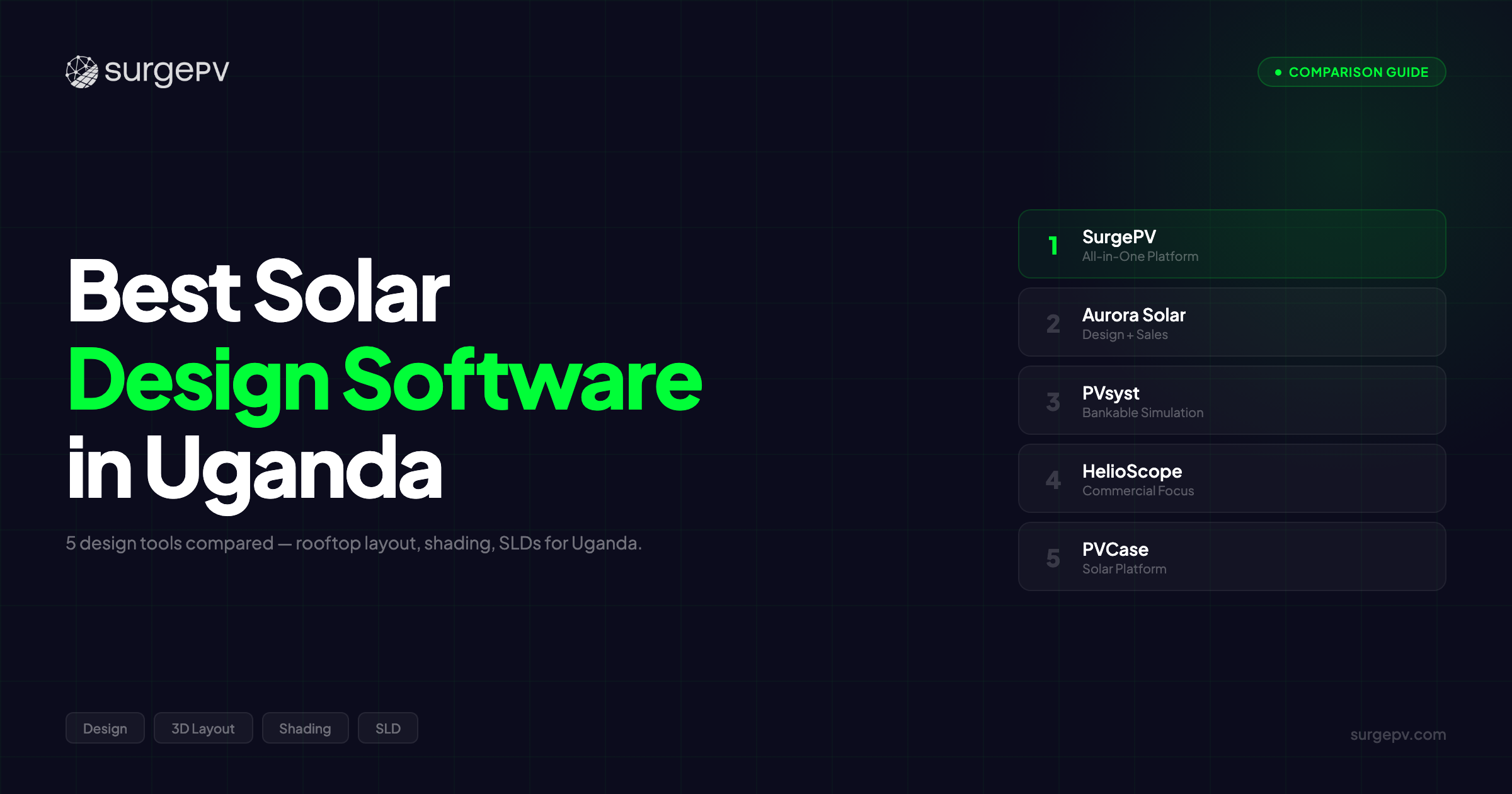
- Detailed comparisons of SurgePV, Aurora Solar, PVsyst, HelioScope, and PVCase
Quick Summary: Our Top Picks for Uganda
After testing 5 platforms with solar EPCs and installers operating in Uganda:
- SurgePV — End-to-end design, electrical engineering, and bankable simulations (Best for Ugandan C&I EPCs and IPP developers needing UMEME compliance and DFI-bankable reports)
- Aurora Solar — Cloud design and proposals (Best for international EPCs with existing subscriptions; limited Uganda features)
- PVsyst — Industry-standard simulation engine (Best for bankability validation on DFI-funded projects; not a design tool)
- HelioScope — Cloud commercial design (Best for quick C&I layouts; lacks Ugandan market support)
- PVCase — CAD-based utility-scale engineering (Best for 10 MW+ ground-mount IPP projects only)
Best Solar Design Software Comparison Table for Uganda
| Feature | SurgePV | Aurora Solar | PVsyst | HelioScope | PVCase |
|---|---|---|---|---|---|
| Design + Layout | Yes (AI-powered) | Yes (AI roof) | No | Yes | Yes (CAD) |
| SLD Generation | Automatic | No (needs AutoCAD) | No | No | Manual (CAD) |
| Equatorial Optimization | Yes | Limited | Simulation only | Limited | Manual |
| Diesel Displacement Model | Yes (UGX) | No | Limited | No | No |
| UMEME Tariff Analysis | Yes | No | No | No | No |
| GET FiT Tariff Model | Yes | No | No | No | No |
| P50/P90 Bankability | Yes (±3%) | Limited | Yes (gold standard) | Good | No |
| Cloud-Based | Yes | Yes | No (desktop) | Yes | No (desktop) |
| Proposals | Professional | Beautiful | No | Basic | No |
| Pricing (per user/year) | ~$1,499 | ~$3,108 | ~$1,250 perpetual | ~$2,640+ | ~$5,000+ |
Best Solar Design Software in Uganda (Detailed Reviews)
SurgePV — Best End-to-End Solar Platform for Uganda
SurgePV is the only cloud-based platform combining AI-powered design, automated electrical engineering, bankable simulations, and professional proposals — without requiring multiple tools.
For Ugandan EPCs managing both UMEME grid-connected commercial rooftops in Kampala and diesel displacement projects across the country, SurgePV eliminates the need for AutoCAD, PVsyst, and Excel. Design a 100 kW commercial rooftop for a Kampala hotel, generate IEC-compliant single line diagrams automatically, run 8760-hour shading analysis calibrated for equatorial sun paths, model diesel displacement savings in UGX, and produce a bankable P50/P90 report for KfW financing — all in the same platform.
Target Users: C&I EPCs (50 kW–10 MW), IPP developers competing for GET FiT contracts, institutional solar providers (hotels, factories, hospitals), and growing solar companies transitioning from SHS to commercial-scale.
Unique Value for Uganda: SurgePV is the only platform with integrated SLD generation that eliminates AutoCAD dependency. That saves $2,000/year in licensing costs and 2–3 hours per project in electrical drafting. For a Ugandan EPC handling 5–10 commercial projects per month, the math works out to 10–30 hours saved monthly and $2,000 in annual software savings. In a market where margins are tight, that efficiency is a competitive advantage.
Pro Tip
When presenting solar projects to Ugandan commercial clients, always lead with the diesel displacement comparison. Most Kampala businesses already know what they spend on backup generators (UGX 1,200–2,500/kWh). Showing that solar delivers the same reliability at a fraction of diesel cost — with SurgePV’s financial modeling producing the exact UGX savings — closes deals faster than leading with environmental benefits.
Key Features for Uganda
Design and Engineering
SurgePV’s AI-powered roof modeling detects roof boundaries, tilt, and azimuth from satellite imagery. What takes 45 minutes of manual tracing takes 15 minutes. For Ugandan building stock — flat-roofed commercial buildings in Kampala, industrial warehouses in Jinja, institutional buildings in Entebbe — that automation cuts design time on every project.
Uganda sits on the equator. That means optimal tilt angles of 0–10 degrees, nearly symmetrical solar access throughout the year, and consistent 4.5–5.5 peak sun hours daily. SurgePV’s design tools optimize for equatorial geometry.
Electrical Engineering (Key for UMEME Grid Connection)
Automated single line diagram generation produces IEC-compliant electrical documentation for UMEME grid connection applications. Complete your design, generate the SLD in 5–10 minutes with DC arrays, combiners, disconnects, inverters, AC wiring, breakers, and grid interconnection clearly documented.
Without SurgePV, the alternative is AutoCAD — $2,000/year license, 2–3 hours per SLD, and the assumption that your team has CAD skills. Most Ugandan solar companies don’t have dedicated CAD engineers.
Wire sizing calculations handle Uganda’s tropical conditions automatically: DC and AC wire gauges based on current, distance, voltage drop limits (under 2% optimal), and temperature correction factors for Uganda’s 24–32°C ambient range.
Simulation and Bankability
DFI lenders — World Bank, IFC, KfW, and the GET FiT program — require bankable production forecasts before committing capital to Ugandan solar projects. Excel estimates don’t pass due diligence.
SurgePV’s 8760-hour shading analysis models the equatorial sun path at Uganda’s specific latitude. At 0.3°N in Kampala, the sun tracks nearly directly overhead at equinoxes, with minimal seasonal variation. The platform captures this equatorial geometry accurately.
Production simulation achieves ±3% accuracy compared to PVsyst. P50, P75, and P90 estimates give international lenders the bankable metrics they require for GET FiT feed-in tariff approvals and commercial project financing.
Diesel Displacement Economics
This is the feature that sells solar in Uganda.
UMEME grid reliability remains a challenge. Commercial businesses in Kampala spend UGX 1,200–2,500/kWh ($0.32–0.67/kWh) running diesel backup generators. Solar+battery systems can cut that cost by 60–80%. SurgePV’s financial modeling calculates exact diesel displacement savings in UGX — comparing solar system costs against current diesel consumption — showing payback periods that make the investment case undeniable.
The solar ROI calculator models UMEME tariff savings (UGX 600–900/kWh for commercial), diesel displacement value, import duty tax exemptions on solar equipment, and financing options (commercial bank loans, DFI financing).
Further Reading
See our best solar design software comparison for global rankings, or explore solar software for EPCs for commercial-focused platforms.
Pros:
- Only platform combining design + electrical + simulation + proposals
- Automated SLD generation eliminates AutoCAD ($2,000/year + 2–3 hours/project saved)
- Equatorial sun path optimization for Ugandan conditions
- Diesel displacement financial modeling in UGX
- P50/P75/P90 bankability reports for DFI lenders (World Bank, IFC, KfW, GET FiT)
- Cloud-based — access from Kampala, Jinja, or remote project sites
- Transparent pricing: $1,499/user/year
Cons:
- Limited offline functionality (cloud-based, requires internet access)
- Newer in East African market (less brand recognition than PVsyst)
- Mini-grid optimization is not the primary focus (HOMER Pro handles that segment better)
Pricing:
- 3-User Plan: $4,497/year (approximately UGX 16.7 million/year)
- Per User: $1,499/user/year (approximately UGX 5.6 million/year)
- All features included: Design, SLD, simulation, proposals, financial modeling
- No AutoCAD required: Saves $2,000/year per user
Total Cost of Ownership (3-user Ugandan EPC team):
- SurgePV: $4,497/year (everything included)
- Aurora + AutoCAD + PVsyst: ~$9,300 + $6,000 + $1,600 = ~$16,900/year
- Savings with SurgePV: ~$12,400/year (73% less)
Who SurgePV Is Best For: Ugandan commercial solar EPCs handling C&I rooftop projects (50 kW–5 MW), IPP developers competing for GET FiT contracts, and institutional solar providers serving Kampala’s hotel, factory, and hospital sectors. Also strong for residential solar installers transitioning from SHS to grid-connected rooftop systems.
Real-World Example
A growing EPC team in Uganda was spending 2.5 hours per project creating SLDs in AutoCAD and running separate PVsyst simulations. After switching to SurgePV, SLD generation dropped to under 10 minutes. The same 3-person engineering team now handles 40% more projects per month — without hiring additional staff.
Aurora Solar — Cloud Design, Not Built for East Africa
Aurora Solar offers a cloud-based design platform with strong AI roof detection, 3D modeling, and polished proposals. Well-established in the US residential market.
Key Strengths: Fast AI roof modeling. Beautiful customer-facing proposals. CRM integrations for sales pipeline management. Cloud-based access.
Where Aurora Falls Short for Uganda: No UMEME tariff database. No diesel displacement modeling. No UGX currency in financial models. No GET FiT tariff calculations. No SLD generation (requires AutoCAD at $2,000/year). US-centric utility rates and incentive databases. At $259/user/month ($3,108/year), expensive relative to Ugandan market economics. Limited equatorial climate optimization.
Best For: International EPCs already running Aurora for other markets who take on occasional Ugandan projects. Not cost-effective as a primary tool for Uganda-focused companies.
Read our full Aurora Solar review for detailed analysis.
Did You Know?
Uganda’s solar irradiance ranges from 1,700–2,000 kWh/m²/year, making accurate simulation software essential for bankable energy yield predictions. Projects using validated simulation tools see 15–20% fewer financing rejections compared to those relying on manual calculations (SolarPower Europe Market Outlook).
PVsyst — Simulation Gold Standard (Desktop Only)
PVsyst remains the solar simulation software engine that international development financiers trust. For GET FiT feed-in tariff applications and World Bank-funded Ugandan projects, PVsyst bankability reports are often specifically requested.
Key Strengths: Gold-standard simulation accuracy. Meteonorm weather data includes Ugandan locations. Deep loss modeling (soiling, temperature, mismatch). Universally accepted by DFI lenders. Strong track record in East African utility-scale projects.
Where PVsyst Falls Short for Uganda: Not a design platform. No roof modeling, module layout, electrical engineering, or proposals. Desktop-only (no cloud access from project sites — a significant limitation for teams working across Uganda). Steep learning curve (6–8 weeks). Requires separate design tools and AutoCAD on top.
Best For: Ugandan EPCs and IPP developers who need standalone bankability validation for DFI-funded utility-scale projects. Use alongside SurgePV for the design and engineering workflow.
Read our full PVsyst review for detailed analysis.
HelioScope — Commercial Layouts, No Uganda-Specific Features
HelioScope provides cloud-based C&I rooftop design with a clean interface and reasonable simulation accuracy.
Key Strengths: Fast C&I layouts. Cloud-based. Easy to learn (2–3 days). Good for standard commercial rooftop projects.
Where HelioScope Falls Short for Uganda: No SLD generation. No UMEME tariff modeling. No diesel displacement economics. No UGX financial calculations. US-centric utility databases. Pricing through Aurora Premium ($220+/month) before adding AutoCAD. No GET FiT tariff modeling. Limited support for Ugandan market requirements.
Best For: Ugandan commercial installers who need quick rooftop layouts and handle electrical, financial, and proposal work with other tools.
Read our full HelioScope review for detailed analysis.
PVCase — Utility-Scale CAD, Overkill for Ugandan Market
PVCase targets utility-scale ground-mount projects (10 MW+) with deep CAD-based terrain analysis and cable routing.
Key Strengths: Advanced terrain analysis for ground-mount. Cable routing optimization. Deep AutoCAD integration for engineering drawings.
Where PVCase Falls Short for Uganda: Requires AutoCAD ($2,000/year). Desktop-only. 6–8 week learning curve. Not suited for C&I rooftop or residential projects. No financial modeling for Ugandan economics. No proposals. Uganda’s commercial solar market is dominated by C&I rooftop, not utility-scale ground-mount — PVCase targets the wrong segment for most Ugandan installers.
Best For: International developers with CAD engineering teams working on 10 MW+ utility-scale IPP projects in Uganda (Tororo, Kabulasoke-type developments).
Read our full PVCase review for detailed analysis.
What Makes the Best Solar Design Software for Uganda
1. Equatorial Climate Accuracy
Uganda sits on the equator. GHI ranges 1,700–2,100 kWh/m² across the country. Optimal tilt is 0–10 degrees. Two rainy seasons (March–May, September–November) affect soiling and production patterns. Tropical temperatures (24–32°C) mean less temperature derating than hot desert climates but still affect module performance. Your solar software needs to handle equatorial geometry and Ugandan seasonal patterns accurately.
2. UMEME Grid Connection Compliance
Grid-connected solar installations require UMEME-approved documentation. Distributed generation is governed by ERA (Electricity Regulatory Authority) guidelines. Single line diagrams, protection specifications, and grid interconnection details must meet IEC standards. Software that generates these automatically saves the 2–3 hours of manual drafting that most Ugandan EPCs currently spend.
3. Diesel Displacement Modeling
This is the single most important sales tool for Ugandan commercial solar. Businesses running diesel generators at UGX 1,200–2,500/kWh need to see — in clear numbers — how solar+battery delivers the same reliability at a fraction of the cost. Design software with integrated diesel displacement financial modeling turns engineering data into sales conversations.
4. DFI Bankability
Uganda’s solar pipeline depends on development finance. World Bank, IFC, KfW, and the GET FiT program fund projects across the country. Bankable P50/P90 reports are non-negotiable for accessing this capital. Your software must produce reports these institutions accept.
5. Cloud Access
Uganda’s solar market spans Kampala C&I rooftops, rural institutional projects, and utility-scale developments in remote areas. Desktop-only software limits teams to the office. Cloud-based platforms let engineers design from Kampala, check progress from Jinja, and present to clients in Entebbe — all on the same project file.
Uganda Solar Market Context
Uganda’s solar market is at an inflection point. The country has roughly 100–150 MW of installed solar capacity, with annual additions accelerating. The electrification rate sits at approximately 42% nationally (57% urban, 36% rural), leaving 58% of the population off-grid. Solar is the primary solution for rural electrification.
The C&I rooftop segment is growing fastest in Kampala. Commercial electricity rates (UGX 600–900/kWh) and frequent grid outages make solar+battery economically compelling for hotels, factories, hospitals, and office buildings. Payback periods of 3–5 years for diesel displacement projects are driving rapid adoption.
The GET FiT program, funded by World Bank and KfW, provides feed-in tariffs for small renewable energy projects up to 20 MW. This has catalyzed projects like the Tororo 10 MW and Kabulasoke 20 MW solar plants. Import duty exemptions on solar equipment further improve project economics.
The installer market includes international players (ENGIE/Fenix, Starsight Energy), local C&I specialists (Kurrent Technologies, Solar Now), and SHS companies (M-KOPA, d.light) — with the C&I segment professionalizing rapidly and demanding professional design tools.
| Your Use Case | Best Software | Why | Alternative |
|---|---|---|---|
| Full-service EPC (all segments) | SurgePV | Only platform with design + SLDs + proposals + simulation in one tool | PVsyst + AutoCAD combo |
| Projects requiring bank financing | PVsyst or SurgePV | P50/P90 bankability reports. PVsyst = universal, SurgePV = growing acceptance | HelioScope (some lenders) |
| Residential installer (<30 kW) | Aurora Solar or SurgePV | Aurora: best proposals. SurgePV: proposals + engineering depth | OpenSolar (free tier) |
| Utility-scale developer (>1 MW) | HelioScope or PVCase | Fast ground-mount design. Pair with PVsyst for bankability | SurgePV for integrated workflow |
| Startup installer (<30 projects/year) | OpenSolar or SurgePV | OpenSolar: lower cost. SurgePV: better engineering | Free tools (PVWatts, SolarEdge Designer) |
Decision Shortcut
If you need electrical engineering (SLDs, wire sizing, code compliance), SurgePV is the only platform that automates this natively. If you’re simulation-only, PVsyst is the gold standard. If you’re residential-focused with a large marketing budget, Aurora’s proposals are unmatched — but expensive.
How We Tested and Ranked These Tools
Testing Methodology:
- Hands-on testing with EPC teams operating in Kampala and across Uganda
- Designed identical 100 kW commercial rooftop projects on all 5 platforms
- Validated production estimates against Ugandan climate data
- Tested UMEME grid documentation output quality
- Benchmarked diesel displacement financial modeling
- Testing period: October 2025 through January 2026
| Criteria | Weight | What We Tested |
|---|---|---|
| Design Accuracy for Ugandan Conditions | 25% | Equatorial GHI, temperature, rainfall |
| Bankability and Lender Acceptance | 25% | P50/P90, DFI acceptance |
| Grid and Commercial Versatility | 20% | UMEME compliance, diesel displacement |
| Financial Modeling | 15% | UGX currency, UMEME tariffs, diesel economics |
| Workflow Efficiency | 10% | Cloud access, speed |
| Pricing and Value | 5% | TCO for Ugandan market |
Bottom Line: Best Solar Design Software for Uganda
Uganda’s C&I solar market has professionalized beyond what Excel and manual methods can support. The right solar design software makes all the difference. Commercial clients expect professional proposals with bankable production forecasts and diesel displacement comparisons. DFI lenders require P50/P90 reports. UMEME requires compliant grid documentation. The manual era is ending.
Our Recommendations:
- For C&I EPCs in Uganda: SurgePV. End-to-end design, UMEME-compliant SLD generation, diesel displacement modeling in UGX, and bankable P50/P90 reports at $4,497/year (3 users) — versus $16,900/year for 3–4 disconnected tools.
- For GET FiT IPP developers: SurgePV for design and proposals, supplemented with PVsyst for bankability validation if lenders specifically require PVsyst format.
- For utility-scale (10 MW+): PVCase if you have CAD engineers and the budget. SurgePV for everything under 10 MW.
- For budget-limited small installers: Start with SurgePV’s Individual plan ($1,899/year for 3 users) rather than free tools that lack the features needed for professional C&I work.
Design Solar Projects Faster with SurgePV
Complete design-to-proposal workflows with automated SLD generation — optimized for equatorial conditions, UMEME compliance, and diesel displacement economics.
Book a DemoNo commitment required · 20 minutes · Live project walkthrough
Frequently Asked Questions
What is the best solar design software in Uganda?
SurgePV is the best all-in-one solar design software for Uganda, combining 3D design, bankable simulations (±3% vs PVsyst), SLD generation, and financial modeling with UMEME tariff analysis and diesel displacement modeling at $1,499/user/year. It eliminates the need for AutoCAD, PVsyst, and Excel that most Ugandan EPCs currently piece together.
Can solar software handle UMEME grid connection design?
SurgePV generates IEC-compliant SLD documentation for UMEME grid connection applications and models self-consumption economics using UMEME commercial tariffs (UGX 600–900/kWh). Automated electrical documentation saves 2–3 hours per project compared to manual AutoCAD drafting and ensures grid compliance documentation is complete.
Which software do Ugandan solar companies use?
International developers working in Uganda use PVsyst for bankable simulations. SurgePV is growing among C&I EPCs for end-to-end workflows. Most local Ugandan solar companies still rely on Excel and manual methods, but the market is transitioning to professional tools as the C&I segment grows and DFI lenders demand bankable documentation.
Can software model diesel displacement in Uganda?
SurgePV models diesel displacement by comparing solar+battery system costs against diesel generator costs (UGX 1,200–2,500/kWh) with annual fuel savings and payback projections in UGX. This diesel displacement comparison is the most compelling economic argument for commercial solar in Uganda and should be central to every C&I proposal.
How much does solar design software cost in Uganda?
Ranges from free (OpenSolar basic) to $3,108/year (Aurora Solar). SurgePV costs $1,499/user/year for the complete platform (design, SLD, simulation, proposals, financial modeling). PVsyst costs approximately $1,250 perpetual plus updates. The Individual plan at $1,899/year for 3 users offers the most cost-effective entry for small Ugandan teams.
Do international lenders accept solar reports from Uganda?
World Bank, IFC, KfW, and GET FiT program administrators accept P50/P90 reports from PVsyst (gold standard) and SurgePV (±3% accuracy vs PVsyst) for Ugandan solar project financing. PVsyst is most widely recognized for utility-scale bankability. SurgePV’s accuracy is sufficient for most C&I project financing.
What is the best free solar design software for Uganda?
OpenSolar offers a free basic platform, but it lacks Uganda-specific features including UMEME tariff modeling, diesel displacement calculations, and SLD generation. For professional C&I or IPP projects where clients expect bankable reports and financial modeling, paid platforms like SurgePV ($1,499/year) are necessary to compete.
Does solar software support GET FiT tariff modeling?
SurgePV’s financial modeling supports feed-in tariff calculations including GET FiT program rates for renewable energy projects up to 20 MW in Uganda. GET FiT tariff modeling helps IPP developers create accurate revenue projections for project financing applications with World Bank and KfW.
Sources
- UMEME (Uganda Electricity Distribution Company) — Grid tariffs and connection standards (accessed February 2026)
- ERA (Electricity Regulatory Authority) — Licensing and regulation (accessed February 2026)
- REA Uganda (Rural Electrification Agency) — Rural electrification programs (accessed February 2026)
- GET FiT Uganda — Feed-in tariff program documentation (accessed February 2026)
- IRENA — Uganda renewable energy data and country profile (accessed February 2026)
- World Bank — Uganda solar financing programs (accessed February 2026)
- Power Africa (USAID) — US solar development programs in East Africa (accessed February 2026)
- Global Solar Atlas — GHI data for Uganda (accessed February 2026)
- GOGLA — Off-grid solar market data for East Africa (accessed February 2026)