

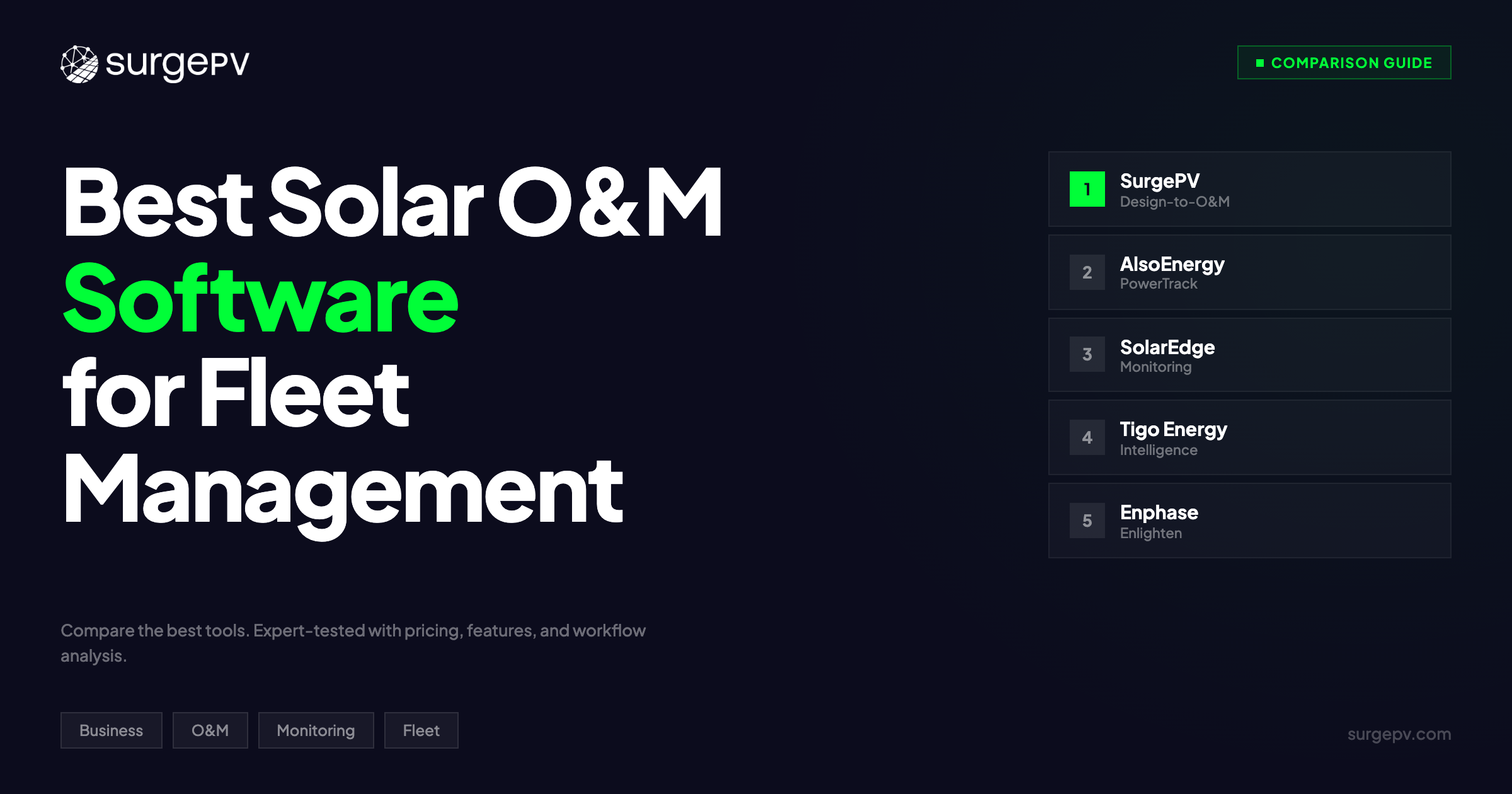
TL;DR: Solar monitoring tells you something is wrong. O&M software fixes it. The difference between the two is the difference between seeing a fault and dispatching a technician with the right parts to resolve it in 4 hours instead of 4 days. SurgePV bridges design-to-O&M with preventive maintenance scheduling and alarm-to-ticket workflows at $1,899/year. AlsoEnergy PowerTrack dominates utility-scale fleet O&M. SolarEdge and Enphase handle single-brand maintenance for their respective hardware. Tigo adds MLPE-level safety compliance and rapid shutdown documentation.
Monitoring Finds the Problem — O&M Software Solves It
Your monitoring dashboard shows a red dot. Inverter #7 at the Riverside commercial installation went offline at 2:14 AM. You get an email alert at 6:30 AM. You open the monitoring app, confirm the fault, and then… what?
You write a note on a sticky pad. You call your field technician. He’s busy on another job. You text him the address. He asks what parts to bring. You don’t know — the monitoring app shows “inverter offline” but not the error code. He drives to the site, reads the error code, drives to the distributor for a replacement board, drives back to the site, and completes the repair six hours after arriving.
Total time from fault to fix: 3 days. Total truck rolls: 2. Total cost: $600 in labor plus lost energy production.
That workflow is broken. It’s broken because monitoring software was never designed to manage field service operations. Monitoring tracks data. O&M software manages the entire lifecycle from fault detection through ticket creation, technician dispatch, parts tracking, repair verification, and warranty documentation.
The distinction matters more as fleets grow. An installer managing 10 systems can handle O&M with spreadsheets and phone calls. An installer managing 100 systems across three states cannot. At portfolio scale, the gap between “we saw the alert” and “we resolved the issue” determines customer retention, warranty compliance, and recurring revenue.
This is why solar software platforms are expanding beyond design and monitoring into full O&M workflow management. The best platforms connect the monitoring layer to field service operations so that a fault detected at 2 AM becomes a dispatched, parts-ready work order by 7 AM.
We tested the top solar O&M platforms for professional installers and EPCs. We evaluated preventive maintenance scheduling, fault-to-ticket automation, truck roll reduction, performance ratio tracking, IEC 61724 compliance, and warranty claim support. We ran real fleet scenarios through each platform to test response times, diagnostic quality, and field technician workflows.
In this guide, you’ll learn:
- Which 5 solar O&M platforms handle fleet maintenance workflows in 2026
- How alarm-to-ticket automation cuts fault resolution time from days to hours
- Why preventive maintenance scheduling reduces emergency truck rolls by 30-40%
- What separates O&M software from monitoring dashboards
- How performance ratio tracking under IEC 61724 supports warranty claims
- Our recommendation by fleet type: residential, commercial, and utility-scale
What to Look for in Solar O&M Software (Buyer’s Guide)
Not all solar software platforms treat O&M as a first-class feature. Many monitoring tools add basic alerting and call it “O&M.” Professional O&M software manages the complete service lifecycle.
Here’s what separates real O&M platforms from monitoring dashboards with alert buttons.
Alarm-to-Ticket Automation
The core feature of O&M software is automatic conversion of monitoring alerts into actionable work orders. When the system detects an inverter fault, the O&M platform should:
- Create a ticket with fault type, error code, timestamp, and site location
- Attach diagnostic data (string voltages, historical performance, weather context)
- Assign the ticket to a technician based on proximity, skill set, and current workload
- Estimate parts requirements based on fault type
- Track time-to-resolution against SLA targets
Without automation, fault detection and ticket creation are manual processes. A monitoring alert arrives at 6 AM. Someone reviews it at 9 AM. A ticket is created at 10 AM. A technician is assigned at 11 AM. He dispatches at 1 PM. The fault that was detected at 6 AM doesn’t get a technician on-site until the afternoon — if you’re lucky.
With alarm-to-ticket automation, the ticket exists within minutes of the fault. The technician receives a mobile notification with full diagnostic context before the office opens.
Preventive Maintenance Scheduling
Reactive maintenance fixes problems after they happen. Preventive maintenance prevents them from happening.
Professional O&M software should schedule:
- Bi-annual inverter inspections — check connections, clean filters, verify firmware
- Annual thermal imaging scans — detect hotspots, cracked cells, and bypass diode failures before they cause string failures
- Quarterly soiling assessments — measure soiling losses and trigger cleaning when losses exceed cost thresholds (typically 5-8%)
- Annual degradation reviews — compare year-over-year performance to catch warranty-claimable degradation early
- Torque checks and connection inspections — prevent arc faults from loose DC connectors
The best platforms generate preventive maintenance calendars automatically based on equipment type, location, and manufacturer recommendations. A SolarEdge installation in Arizona gets quarterly soiling checks. An Enphase installation in Oregon gets annual panel cleaning. The schedule adapts to local conditions without manual configuration.
Preventive maintenance reduces emergency service calls by 30-40%. A loose DC connector found during a scheduled inspection costs $50 to tighten. The same connector found after it causes an arc fault costs $2,000 in panel replacement and a potential fire investigation.
Truck Roll Reduction Through Remote Diagnostics
Every truck roll costs $150-400 depending on distance, technician rate, and time on-site. Reducing unnecessary truck rolls is one of the highest-ROI features in O&M software.
Remote diagnostics enable technicians to investigate faults from the office before dispatching to site. The O&M platform provides:
- String-level voltage and current data over the past 7-30 days
- Weather correlation (was the underperformance during a cloudy period?)
- Historical performance comparison (is this a new fault or ongoing degradation?)
- Inverter error code lookup with manufacturer-recommended resolution steps
- Communication diagnostics (is the inverter truly offline, or is the data logger disconnected?)
A study by the National Renewable Energy Laboratory (NREL) found that 25-35% of O&M site visits are unnecessary — the fault was transient, weather-related, or a communication glitch rather than an equipment failure. Remote diagnostics eliminate those wasted trips.
Performance Ratio Tracking (IEC 61724 Compliance)
O&M contracts often include performance guarantees tied to Performance Ratio (PR). If the contract guarantees 80% PR and the system delivers 72%, the O&M provider is responsible for identifying and resolving the cause.
IEC 61724 standardizes how PR is calculated, ensuring consistent measurement across platforms, projects, and audits. O&M software that follows IEC 61724 provides:
- Weather-corrected PR that separates equipment faults from environmental factors
- Temperature-adjusted yield that accounts for module efficiency loss in hot climates
- Soiling-adjusted baselines that factor in panel cleanliness
- Bankable reporting that lenders and independent engineers accept without reconciliation
Without IEC 61724 compliance, PR calculations vary between platforms. Your O&M software might show 78% PR while the asset owner’s independent engineer calculates 74% using a different methodology. The discrepancy triggers an audit, delays payments, and damages the relationship.
Warranty Claim Management
When equipment fails within the warranty period, manufacturers require documented proof. O&M software should generate warranty claim packages that include:
- Time-stamped fault history showing when the issue began
- Performance data comparing the failed equipment against healthy reference equipment
- Weather-corrected analysis proving the fault is equipment-related
- Degradation rate calculations showing annual decline exceeds manufacturer thresholds
- Maintenance history proving the equipment was properly maintained (manufacturers can deny claims if maintenance was neglected)
The best O&M platforms generate warranty claim packages with one click. You select the failed equipment, the platform compiles all supporting data, and you submit the claim with documentation that manufacturers can’t dispute.
Without this, warranty claims are manual research projects. You pull data from the monitoring app, export it to Excel, calculate degradation rates, cross-reference weather data, and assemble a claim package that takes 4-6 hours per claim. With O&M software, the same process takes 15 minutes.
SLA Tracking and Reporting
O&M service contracts specify response times and resolution targets. Common SLAs include:
- Response time: Acknowledge the fault within 2-4 hours
- Resolution time: Resolve critical faults within 24-48 hours
- Availability guarantee: Maintain 98-99% system uptime annually
- Performance guarantee: Maintain PR above contracted threshold
O&M software tracks every ticket against these SLAs, flagging at-risk tickets before deadlines pass. Monthly SLA reports show the asset owner that your O&M team meets or exceeds contractual obligations.
Without SLA tracking, you’re managing service commitments on spreadsheets. You’ll miss deadlines, breach contracts, and lose O&M renewals.
Monitoring vs. O&M: Why the Distinction Matters
The terms “monitoring” and “O&M” are often used interchangeably. They shouldn’t be. They describe fundamentally different capabilities.
| Capability | Monitoring Software | O&M Software |
|---|---|---|
| Real-time data visualization | Yes | Yes |
| Alert notifications | Yes | Yes |
| Automatic ticket creation | No (manual) | Yes (automated) |
| Technician dispatch | No | Yes (location-based assignment) |
| Parts inventory tracking | No | Yes |
| Preventive maintenance calendars | No | Yes |
| SLA tracking | No | Yes |
| Warranty claim documentation | Basic data export | Automated claim packages |
| Truck roll reduction | Limited | Yes (remote diagnostics workflow) |
| Field technician mobile app | View-only data | Work order management, checklists, photo capture |
Monitoring is a necessary input to O&M. You can’t manage maintenance without performance data. But monitoring alone doesn’t close the loop between “fault detected” and “fault resolved.”
An installer with 30 installations who relies on monitoring-only software manually creates work orders, tracks resolution in spreadsheets, and has no visibility into SLA compliance. An installer with 30 installations using O&M software automates the entire workflow from detection to resolution to warranty documentation.
For more on monitoring-specific capabilities, see our best solar monitoring software comparison.
Top 5 Solar O&M Software Platforms for Fleet Management (2026)
1. SurgePV — Best Integrated Design-to-O&M Platform
Rating: 9.1/10 | Price: ~$1,899/year (3 users) | Book a demo | See SurgePV pricing
SurgePV is a cloud-based solar design, simulation, and O&M platform that connects the entire project lifecycle from initial design through ongoing maintenance. For installers who design systems in SurgePV, the O&M module inherits the original design parameters — expected yield, string configuration, inverter specs, and performance model — creating an automatic baseline for performance monitoring and fault detection.
Why the design-to-O&M connection matters:
Most O&M platforms require you to manually enter system specifications after commissioning. You type in the panel count, inverter model, string configuration, tilt angle, and expected yield. If any of these values are wrong, your performance baselines are wrong, and every alert threshold is miscalibrated.
SurgePV eliminates this step. When you design a system in SurgePV’s solar design tool, the O&M module automatically inherits the design data. The expected yield comes from SurgePV’s bankable P50/P75/P90 simulation, not from a manual estimate. The string configuration matches the actual wiring diagram. The shadow analysis results inform seasonal performance expectations.
This means the O&M baseline is accurate from Day 1. When the system produces 15% below the P50 forecast, SurgePV flags it immediately because it knows exactly what “normal” looks like for that specific system, at that specific location, with that specific shading profile.
O&M workflow features:
- Alarm-to-ticket automation: Monitoring alerts automatically create work orders with fault type, error codes, diagnostic data, and recommended resolution steps
- Preventive maintenance calendars: Automated scheduling based on equipment type, manufacturer recommendations, and local environmental conditions (soiling frequency, temperature extremes)
- Multi-brand fleet management: Aggregate SolarEdge, Enphase, SMA, Fronius, Huawei, and other inverter brands into one portfolio dashboard with standardized KPIs
- Remote diagnostics: String-level data, weather correlation, and historical comparison enable 30-40% truck roll reduction
- Performance ratio tracking: IEC 61724-compliant PR calculations with weather-corrected baselines
- SLA management: Track response time, resolution time, and availability against contractual targets
- Warranty claim support: Generate documentation packages with time-stamped fault history, degradation analysis, and maintenance records
- Financial modeling integration: Compare actual energy production against financial projections to validate payback timelines for customers
Real-World Example
A mid-sized EPC in Texas managing 120 commercial installations across SolarEdge (60 systems), Enphase (35 systems), and SMA (25 systems) consolidated monitoring and O&M into SurgePV. Before consolidation, they managed O&M with three monitoring apps plus a shared spreadsheet for work orders. Average fault-to-resolution time was 72 hours. After migrating to SurgePV, alarm-to-ticket automation reduced average resolution time to 11 hours. Preventive maintenance scheduling caught 23 loose DC connectors during routine inspections that would have caused arc faults. Annual truck rolls dropped 34% due to remote diagnostics filtering out transient and weather-related alerts.
Pros:
- Design-to-O&M integration eliminates manual baseline setup
- Multi-brand fleet monitoring (SolarEdge, Enphase, SMA, Fronius, Huawei, others)
- Alarm-to-ticket automation with technician assignment
- Preventive maintenance calendar with environmental adaptation
- IEC 61724-compliant performance analytics
- Bankable P50/P75/P90 yield forecasts (+/-3% vs PVsyst accuracy)
- Warranty claim documentation generator
- SLA tracking and monthly reporting
- Spanish, German, Italian, French language support
- 70,000+ projects globally, 3-minute average support response
- ~$1,899/year for 3 users (all features included)
Cons:
- Subscription required (not free like hardware-locked platforms)
- Module-level diagnostics depend on inverter data granularity (less granular than SolarEdge optimizer data for non-MLPE systems)
- Newer platform vs. legacy CMMS tools (less brand recognition in utility-scale asset management)
Best for: Installers and EPCs managing multi-brand commercial fleets (30-500 installations) who want design, monitoring, and O&M in one platform. Perfect for companies offering O&M service contracts with performance guarantees across mixed inverter brands.
Pro Tip
SurgePV’s generation and financial modeling tool ties O&M data directly to customer ROI. When you resolve a fault that was costing 12% production loss, you can show the customer the dollar value of your O&M intervention. This data strengthens O&M contract renewal conversations.
2. AlsoEnergy (PowerTrack) — Best for Utility-Scale Fleet O&M
Rating: 8.9/10 | Price: Custom enterprise pricing | AlsoEnergy
AlsoEnergy PowerTrack is the enterprise O&M standard for utility-scale solar plants. Acquired by Stem Inc. (now part of the broader energy intelligence ecosystem), PowerTrack provides the SCADA integration, CMMS workflows, and bankable reporting that asset owners and lenders require for multi-megawatt portfolios.
Why PowerTrack dominates utility-scale O&M:
Utility-scale O&M operates at a different scale than residential or commercial fleet management. A 50 MW plant has thousands of modules, dozens of combiner boxes, multiple inverter stations, a substation, and a grid interconnection point. O&M at this scale requires industrial asset management, not a monitoring dashboard with a ticketing add-on.
PowerTrack functions as a full Computerized Maintenance Management System (CMMS) built specifically for solar. It manages:
- Corrective maintenance: Fault detection, root cause analysis, work order creation, technician dispatch, parts ordering, and repair verification
- Preventive maintenance: Calendar-based and condition-based scheduling for inverter inspections, thermal imaging, vegetation management, tracker maintenance, and panel cleaning
- Predictive maintenance: Machine learning models that analyze performance trends to predict failures before they occur (e.g., identifying inverter capacitor degradation patterns that precede failure by 3-6 months)
- Spare parts inventory: Track parts by site, order replacement components, and ensure technicians arrive with the right parts on the first visit
- Contractor management: For asset owners who outsource O&M, PowerTrack manages contractor SLAs, access control, and performance benchmarking
PowerTrack integrates with all major utility-scale inverter brands — SMA, Huawei, Power Electronics, Sungrow, FIMER, and others. It also connects to weather stations, revenue-grade meters, tracker controllers, and grid SCADA systems.
IEC 61724 compliance is built into every performance calculation. P50/P90 yield reports, availability tracking, and loss waterfall analysis meet the standards that independent engineers and lenders require for project finance reporting.
Pros:
- Full CMMS for solar (corrective, preventive, and predictive maintenance)
- Multi-brand inverter and tracker support for utility-scale
- SCADA integration for grid operators
- IEC 61724-compliant bankable performance reporting
- Spare parts inventory management
- Contractor SLA tracking and benchmarking
- Predictive maintenance via machine learning
- Revenue-grade metering integration for PPA validation
- Multi-user access control for asset owners, O&M contractors, and lenders
Cons:
- Enterprise pricing (custom quotes, typically $10,000-50,000+ annually depending on portfolio size)
- Overkill for residential and small commercial fleets
- Steep learning curve (training required for full CMMS utilization)
- Implementation timeline of 4-8 weeks for large portfolios
- Not designed for installer-customer workflows (asset-owner focused)
Best for: Utility-scale developers, IPPs, and asset managers operating multi-megawatt plants (1+ MW) who need industrial-grade CMMS, bankable reporting, and enterprise O&M workflows. The platform cost is negligible relative to the revenue at stake on large plants.
3. SolarEdge Monitoring — Best O&M for SolarEdge Hardware Fleets
Rating: 8.5/10 | Price: Free with SolarEdge hardware | SolarEdge | SolarEdge review
SolarEdge Monitoring provides module-level fault detection and diagnostic capabilities that simplify O&M for SolarEdge-only fleets. Because every panel has a DC power optimizer, the platform pinpoints faults to the individual module — eliminating string-level guesswork that plagues traditional O&M workflows.
Why SolarEdge simplifies single-brand O&M:
The biggest time sink in solar O&M is fault localization. A string inverter monitoring system tells you “String 3 is underperforming by 20%.” That string has 12 panels. Which one is the problem? Without module-level data, a technician inspects all 12 panels to find the fault. That’s 1-2 hours of on-site diagnostic time per string.
SolarEdge Monitoring eliminates this step. The platform shows real-time production, voltage, and current for every optimizer. If Panel 7 on String 3 is producing 25% below its neighbors, the technician knows exactly which panel to inspect before leaving the office. Diagnostic time drops from hours to minutes.
For O&M workflows, SolarEdge provides:
- Module-level fault detection: Identify underperforming panels, failed optimizers, and degraded modules individually
- Remote firmware updates: Update inverter and optimizer firmware without a site visit
- Rapid shutdown compliance logging: Track every shutdown event for NEC compliance documentation
- Historical performance trends: Compare module performance over months and years to catch gradual degradation
- Mobile app diagnostics: Field technicians view real-time optimizer data from the roof
The platform’s limitation for O&M is the absence of formal work order management. SolarEdge Monitoring sends alerts and provides diagnostic data, but it doesn’t create tickets, assign technicians, track SLAs, or manage spare parts. For SolarEdge-only fleets under 30 installations, this limitation is manageable with manual processes. For larger fleets, you’ll need a separate ticketing system or a platform-agnostic O&M tool.
Pros:
- Module-level fault localization via DC optimizers (pinpoint the exact panel)
- Free with SolarEdge hardware purchase
- Remote firmware updates reduce site visits
- Rapid shutdown compliance documentation
- Mobile app with real-time optimizer diagnostics
- Weather-normalized performance trending
- Integration with SolarEdge commercial energy management
Cons:
- ONLY works with SolarEdge inverters and optimizers (hardware-locked)
- No formal work order or ticket management system
- No preventive maintenance scheduling
- No SLA tracking or warranty claim automation
- No multi-brand fleet aggregation
- Performance ratio calculations don’t follow IEC 61724 standardization
- Residential-focused interface (less suited for large commercial portfolios)
Best for: Installers who exclusively install SolarEdge systems and want module-level O&M diagnostics without paying for third-party software. Works well for residential and small commercial fleets under 30 installations where manual ticket management is still feasible.
4. Tigo Energy Intelligence — Best for MLPE-Level Safety and Compliance O&M
Rating: 8.2/10 | Price: Free with Tigo hardware | Tigo Energy
Tigo Energy Intelligence is the O&M platform for installations equipped with Tigo TS4 module-level power electronics. Tigo’s core differentiation is safety — rapid shutdown compliance, arc fault detection, and module-level disconnect — making it the strongest platform for safety-critical O&M documentation.
Why Tigo leads in safety-focused O&M:
NEC 2017 and 2020 require PV systems to reduce DC voltage to safe levels within 30 seconds of shutdown activation. For installations on schools, hospitals, fire stations, and multi-family housing, rapid shutdown compliance is inspected and documented. If a fire inspector asks for proof that the system meets rapid shutdown requirements, your O&M platform needs to provide it.
Tigo Energy Intelligence logs every rapid shutdown event with:
- Timestamp and trigger source (manual disconnect, inverter fault, grid outage)
- Voltage reduction confirmation for every TS4-equipped module
- Response time verification (time from trigger to safe voltage)
- Historical shutdown event log for compliance audits
Beyond safety, Tigo provides module-level performance monitoring comparable to SolarEdge and Enphase. Every panel equipped with a TS4 optimizer reports real-time production, voltage, and current. This granularity enables precise fault localization for O&M workflows.
Tigo also offers selective deployment. Unlike SolarEdge (which requires an optimizer on every panel), Tigo TS4 units can be installed on specific panels for monitoring and safety purposes while leaving other panels unoptimized. This flexibility reduces costs for large arrays where only perimeter panels or fire-code-required panels need rapid shutdown.
For O&M, Tigo provides fault detection and diagnostic data but lacks formal work order management, preventive maintenance scheduling, and SLA tracking. Like SolarEdge Monitoring, it’s a diagnostic tool rather than a full O&M platform.
Pros:
- Module-level monitoring via Tigo TS4 optimizers
- Rapid shutdown compliance logging and documentation
- Arc fault detection and module-level disconnect
- Free with Tigo hardware purchase
- Selective deployment (optimize specific panels, not the entire array)
- Safety compliance reports for AHJs and fire marshals
- Mobile app with real-time alerts
- DC-coupled battery monitoring (Tigo EI Battery)
Cons:
- ONLY works with Tigo TS4 MLPEs (hardware-locked)
- No formal work order or ticket management
- No preventive maintenance scheduling
- No SLA tracking or contractor management
- Smaller installed base vs. SolarEdge and Enphase (fewer third-party integrations)
- No multi-brand fleet aggregation
- Limited utility-scale features
Best for: Installers working on safety-critical installations (schools, hospitals, multi-family, fire stations) where rapid shutdown compliance documentation is required for inspections and insurance. Strong for jurisdictions with strict NEC 2017/2020 enforcement.
5. Enphase Enlighten — Best O&M for Enphase Microinverter Fleets
Rating: 8.4/10 | Price: Free with Enphase hardware | Enphase
Enphase Enlighten provides module-level O&M diagnostics for Enphase microinverter fleets. Because every panel has its own microinverter, Enlighten identifies faults at the individual module level and provides the diagnostic data technicians need to resolve issues efficiently.
Why Enlighten works for Enphase-only O&M:
Microinverter architecture offers a natural O&M advantage: a failed microinverter doesn’t take down an entire string. If Microinverter #23 on a 40-panel commercial array fails, the other 39 panels continue producing normally. The production loss is limited to one panel (2.5% of the array) instead of an entire string (25-33% on a typical 3-string system).
Enlighten identifies the specific failed microinverter and provides:
- Real-time per-panel diagnostics: Voltage, current, power output, and temperature for every microinverter
- Automatic fault classification: Distinguishes between microinverter failures, communication losses, and panel degradation
- Production benchmarking: Compares each panel’s output against its neighbors and against similar systems in the region
- Enphase warranty integration: For microinverter failures within the 25-year warranty, Enlighten streamlines the RMA (Return Merchandise Authorization) process with pre-populated failure data
- Battery and EV charger monitoring: Track Encharge battery and EV charger performance alongside solar production
Enlighten’s O&M limitation is similar to SolarEdge and Tigo: it provides diagnostics and alerting but doesn’t include formal work order management, preventive maintenance scheduling, or SLA tracking. Enphase has improved its installer tools over recent years, adding fleet-level views and batch diagnostics, but the platform remains diagnostic-focused rather than a full O&M workflow manager.
The RMA integration is a standout O&M feature. When a microinverter fails, Enlighten pre-populates the warranty claim with serial number, installation date, fault history, and diagnostic data. This reduces warranty claim processing time from days to hours — a meaningful time savings for installers processing multiple claims monthly.
Pros:
- Module-level fault detection via microinverters (every panel independently monitored)
- Free with Enphase hardware purchase
- Streamlined RMA process for microinverter warranty claims
- Production benchmarking against regional peers
- Battery (Encharge) and EV charger integration
- Clean, intuitive interface with fleet-level view
- Mobile app with real-time notifications
- 25-year microinverter warranty simplifies long-term O&M planning
Cons:
- ONLY works with Enphase microinverters (hardware-locked)
- No formal work order or ticket management system
- No preventive maintenance scheduling
- No SLA tracking or contractor management
- No multi-brand fleet aggregation
- Limited commercial/utility-scale O&M features (residential-focused)
- Performance analytics weaker than utility-grade platforms
Best for: Installers who exclusively install Enphase microinverters and want module-level O&M diagnostics with streamlined warranty claims. Works well for residential and small commercial Enphase fleets where the 25-year microinverter warranty simplifies long-term maintenance planning.
Solar O&M Software Comparison Table
| Feature | SurgePV | AlsoEnergy PowerTrack | SolarEdge Monitoring | Tigo Energy Intelligence | Enphase Enlighten |
|---|---|---|---|---|---|
| O&M Focus | Full lifecycle (design-to-O&M) | Full CMMS | Diagnostics + alerts | Safety compliance + diagnostics | Diagnostics + warranty RMA |
| Alarm-to-Ticket | Yes (automated) | Yes (enterprise CMMS) | No (alerts only) | No (alerts only) | No (alerts only) |
| Preventive Maintenance | Yes (calendar + condition-based) | Yes (calendar + predictive) | No | No | No |
| SLA Tracking | Yes | Yes | No | No | No |
| Warranty Claim Automation | Yes | Yes | Manual | Manual | Streamlined RMA |
| Multi-Brand Support | Yes (all major brands) | Yes (utility-scale brands) | SolarEdge only | Tigo only | Enphase only |
| Module-Level Diagnostics | Via inverter data | Via combiner box monitoring | Yes (optimizers) | Yes (TS4 MLPEs) | Yes (microinverters) |
| IEC 61724 Compliance | Yes | Yes | No | No | No |
| Spare Parts Tracking | Basic | Yes (full inventory) | No | No | No |
| Fleet Scale | 30-500 installations | 1+ MW plants | Residential/small commercial | Residential/commercial | Residential/small commercial |
| Pricing | $1,899/year (3 users) | Custom ($10,000-50,000+/yr) | Free (with hardware) | Free (with hardware) | Free (with hardware) |
Quick verdict: For multi-brand commercial fleets that need integrated O&M workflows, SurgePV provides the best value with alarm-to-ticket automation, preventive maintenance, and SLA tracking at $1,899/year. For utility-scale plants requiring industrial CMMS capabilities, AlsoEnergy PowerTrack is the enterprise standard. For single-brand fleets, SolarEdge, Enphase, and Tigo provide free module-level diagnostics that handle basic O&M — but you’ll outgrow them when your fleet crosses 30+ installations or you start offering formal O&M service contracts.
Building an O&M Revenue Stream: From Cost Center to Profit Center
Most installers treat O&M as a cost. The system is installed, the customer is happy, and you move to the next project. Maintenance happens when the customer calls to complain.
This approach leaves recurring revenue on the table and exposes you to warranty liability.
The O&M Contract Model
Professional O&M contracts convert maintenance from a reactive cost into a predictable revenue stream. A typical residential O&M contract includes:
- Annual inspection: Visual check, thermal imaging, connection torque verification, inverter health check
- Performance monitoring: Continuous monitoring with guaranteed response times
- Performance guarantee: Maintain PR above a contracted threshold (typically 75-80%)
- Priority service: SLA-backed response times for fault resolution
- Warranty management: File and track manufacturer warranty claims on behalf of the customer
Pricing varies by system size and scope:
| System Size | Annual O&M Contract Value | 10-Year Revenue |
|---|---|---|
| Residential (5-15 kW) | $300-600/year | $3,000-6,000 |
| Small commercial (50-200 kW) | $1,500-4,000/year | $15,000-40,000 |
| Large commercial (500 kW-2 MW) | $8,000-20,000/year | $80,000-200,000 |
| Utility-scale (5+ MW) | $40,000-100,000+/year | $400,000-1,000,000+ |
An installer with 100 residential O&M contracts at $400/year generates $40,000 in annual recurring revenue. That revenue compounds as you add new installations. By Year 5, the O&M contract portfolio can represent 20-30% of total company revenue.
Why O&M Software Makes This Possible
You can’t scale O&M contracts with spreadsheets. At 10 contracts, manual tracking works. At 50, it’s fragile. At 100, it breaks.
O&M software enables scaling because it automates the workflows that would otherwise require additional staff:
- Preventive maintenance scheduling runs automatically
- Fault detection and ticket creation happen without human intervention
- SLA tracking ensures you meet contractual obligations
- Performance reporting generates customer-facing reports monthly
- Warranty claims are documented and filed efficiently
The $1,899/year cost of a platform like SurgePV is paid back by three residential O&M contracts. Everything beyond that is profit margin on the software investment.
Turn Your Fleet Into Recurring Revenue
Design, monitor, and maintain solar installations in one platform. Alarm-to-ticket automation, preventive maintenance, and SLA tracking included.
Book a DemoNo commitment required · 20 minutes · Live project walkthrough
How to Choose the Right O&M Platform for Your Fleet
The right O&M software depends on fleet size, brand composition, and service model.
Single-Brand Residential Fleet (Under 30 Installations)
If you install only SolarEdge, Enphase, or Tigo, the hardware-locked monitoring platform handles basic O&M diagnostics for free. Module-level fault detection, remote diagnostics, and alert notifications cover the essentials.
At this scale, manual ticket management (email, spreadsheet, phone call) is manageable. You don’t need a formal CMMS or alarm-to-ticket automation.
Recommendation: Use SolarEdge Monitoring, Enphase Enlighten, or Tigo Energy Intelligence. Invest in dedicated O&M software when your fleet exceeds 30 installations or you start offering formal O&M contracts.
Multi-Brand Commercial Fleet (30-500 Installations)
Once your fleet includes multiple inverter brands and exceeds 30 installations, hardware-locked monitoring creates portfolio fragmentation. You’re checking three or four apps daily, managing tickets in spreadsheets, and missing SLA deadlines because no single platform tracks the full workflow.
SurgePV aggregates all brands into one dashboard and provides the alarm-to-ticket automation, preventive maintenance scheduling, and SLA tracking that multi-brand commercial O&M requires. At $1,899/year for 3 users, the cost is justified by time savings alone.
Recommendation: SurgePV for multi-brand commercial fleets offering O&M service contracts.
Utility-Scale Portfolio (1+ MW Plants)
Utility-scale O&M requires industrial CMMS capabilities: spare parts inventory, contractor management, predictive maintenance, SCADA integration, and bankable IEC 61724 reporting. AlsoEnergy PowerTrack is the industry standard.
The enterprise pricing ($10,000-50,000+/year) is standard project cost for plants generating $1-10 million+ in annual revenue.
Recommendation: AlsoEnergy PowerTrack for utility-scale. Accept the enterprise pricing as operational expense.
Safety-Critical Installations
For schools, hospitals, and multi-family buildings where rapid shutdown compliance is documented and inspected, Tigo Energy Intelligence provides the best safety-focused O&M documentation.
Recommendation: Tigo Energy Intelligence for safety-critical projects, supplemented with a platform-agnostic O&M tool for fleet-wide maintenance management.
Further Reading
For monitoring capabilities that feed O&M workflows, see best solar monitoring software. For project management tools that complement O&M, see best solar project management software. For ERP systems that manage the full business lifecycle alongside O&M, see best solar ERP software.
Frequently Asked Questions
What is solar O&M software and how is it different from monitoring?
Solar O&M (Operations and Maintenance) software manages the entire maintenance lifecycle for solar installations: fault detection, ticket creation, technician dispatch, preventive maintenance scheduling, SLA tracking, and warranty claim management. Monitoring software tracks performance data and sends alerts. O&M software acts on those alerts by automating work orders, assigning technicians, and tracking resolution. Think of monitoring as the diagnostic layer and O&M as the action layer. For a deeper comparison of monitoring tools, see our best monitoring software guide.
What is the best solar O&M software for fleet management in 2026?
For multi-brand commercial fleets (30-500 installations), SurgePV provides the best value with integrated design-to-O&M workflows, alarm-to-ticket automation, and preventive maintenance at $1,899/year for 3 users. For utility-scale plants (1+ MW), AlsoEnergy PowerTrack is the enterprise CMMS standard. For single-brand fleets under 30 installations, SolarEdge Monitoring, Enphase Enlighten, and Tigo Energy Intelligence provide free module-level diagnostics that cover basic O&M needs.
How does preventive maintenance scheduling reduce O&M costs?
Preventive maintenance catches problems before they cause failures. A loose DC connector found during a scheduled inspection costs $50 to tighten. The same connector after it causes an arc fault costs $2,000+ in panel replacement. NREL research shows that preventive maintenance programs reduce unplanned downtime by 30-40% and extend equipment lifespan. O&M software automates scheduling based on equipment type, manufacturer recommendations, and local conditions — a SolarEdge system in dusty Arizona gets quarterly soiling checks while an Enphase system in rainy Oregon gets annual panel cleaning.
What is IEC 61724 and why does it matter for solar O&M?
IEC 61724 is the international standard for PV system performance monitoring. It defines how to calculate Performance Ratio, Specific Yield, System Availability, and system losses using standardized methods. For O&M, IEC 61724 compliance matters because performance guarantees in O&M contracts are typically measured using PR. If your solar software calculates PR differently than the asset owner’s independent engineer, you’ll spend weeks reconciling data instead of resolving issues. IEC 61724-compliant platforms like SurgePV and AlsoEnergy PowerTrack ensure everyone uses the same formulas.
How much can solar O&M contracts generate in recurring revenue?
Residential O&M contracts typically generate $300-600/year per system. Small commercial contracts range from $1,500-4,000/year. Large commercial and utility-scale contracts can exceed $20,000-100,000+/year. An installer managing 100 residential O&M contracts at $400/year generates $40,000 in annual recurring revenue. O&M software like SurgePV ($1,899/year) pays for itself with just 3-5 residential contracts, making the remaining 95+ contracts pure margin on the software investment.
Transparency Note
SurgePV publishes this content. We are transparent about this relationship. This comparison acknowledges AlsoEnergy PowerTrack as the utility-scale O&M standard, SolarEdge Monitoring and Enphase Enlighten as strong single-brand diagnostic tools, and Tigo Energy Intelligence as the safety compliance leader. SurgePV is positioned as the integrated design-to-O&M solution for multi-brand commercial fleets, not a replacement for enterprise CMMS in utility-scale or for free hardware-locked platforms in single-brand scenarios. See our editorial standards.
Sources
IEC 61724-1:2021 — Photovoltaic system performance — Part 1: Monitoring (IEC Webstore). NREL — Best Practices for Operation and Maintenance of Photovoltaic and Energy Storage Systems, 3rd Edition (NREL). NEC 2020 Article 690.12 — Rapid Shutdown of PV Systems on Buildings. SolarEdge, Enphase, AlsoEnergy, and Tigo product documentation and specifications as of March 2026.
Note
All pricing data in this article was verified against official sources as of March 2026. Prices may have changed since publication.