

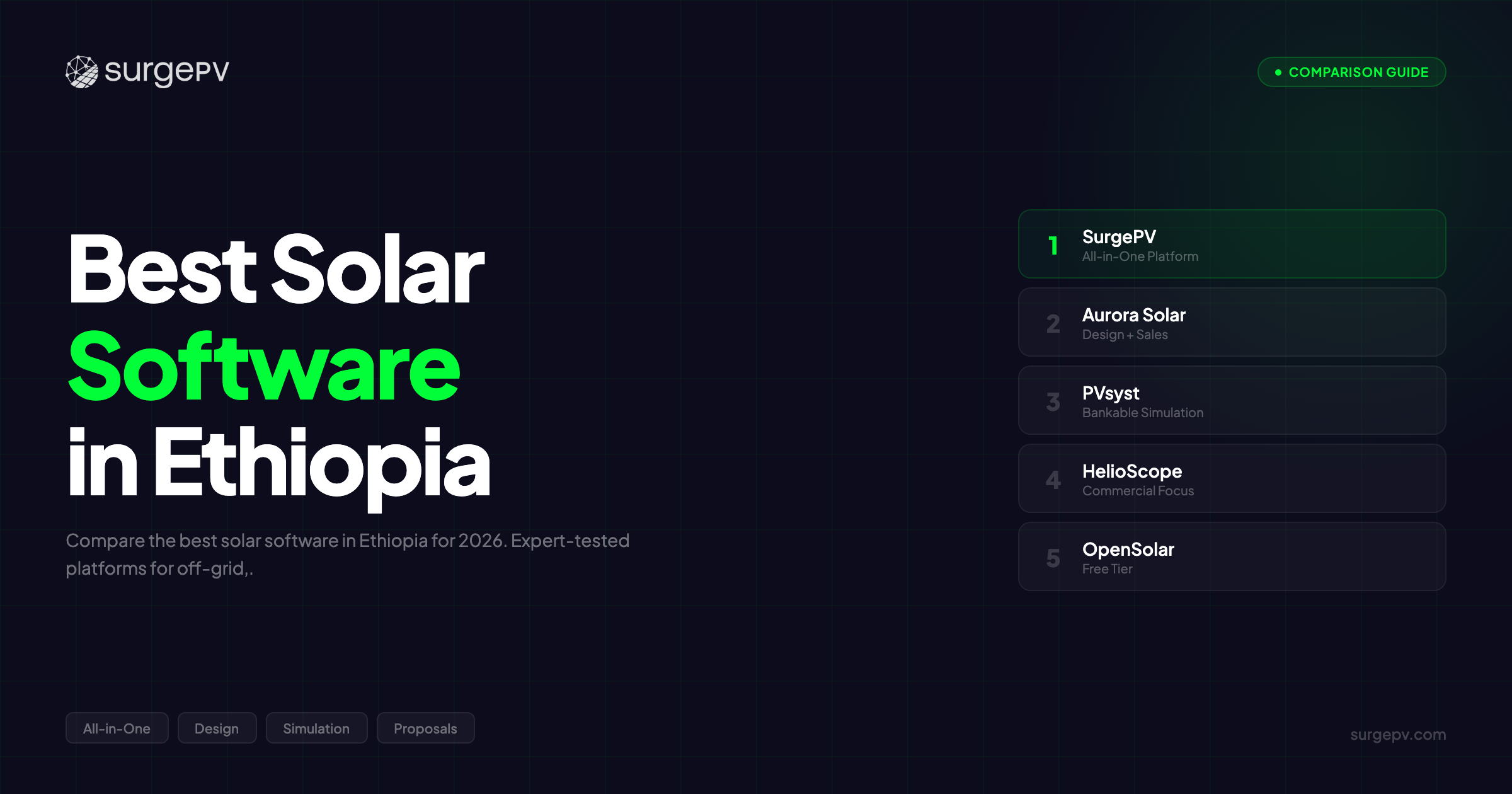
TL;DR: SurgePV is the best all-in-one solar software for Ethiopia, combining 3D design, automated SLD generation, bankable P50/P90 simulations, and professional proposals in one cloud platform. PVsyst is the gold standard for utility-scale bankable simulation. Aurora Solar works for grid-connected residential projects but misses the 60% of Ethiopia’s off-grid market. HelioScope and OpenSolar round out the list for C&I rooftop and budget-constrained installers.
Ethiopia’s solar market is growing at 22.8% CAGR. Most software still treats it like an afterthought.
Sixty percent of Ethiopia’s population lives off-grid. That is roughly 67 million people. The government’s Growth and Transformation Plan targets universal electricity access by 2030, and with irradiation levels between 1,500 and 2,200 kWh/m²/year, solar is the fastest path to get there.
But here is what happens when Ethiopian EPCs try to use general-purpose solar software: the tools assume grid-connected markets. They don’t model mini-grids with diesel backup and battery storage. They can’t produce IEC-compliant single line diagrams for EEU grid connection approval.
They don’t handle the Ethiopian Highlands’ terrain at 2,400 meters or account for the 30-40% performance drop during wet season (June through September). And they certainly don’t generate the bankable P50/P90 documentation that IFC, AfDB, and World Bank require for the $128 million SREP solar investment pipeline.
The result? Ethiopian solar companies waste hours jumping between three or four platforms. Design in one tool, simulate in another, draft electrical drawings in AutoCAD, and build proposals in Excel. Each handoff introduces errors. Each error costs credibility with international lenders.
Ethiopia needs software that handles the full spectrum — off-grid mini-grids in Oromia, commercial rooftops in Addis Ababa, and utility-scale ground-mount in the Afar region. One platform that covers design, simulation, electrical engineering, and proposals.
In this guide, you’ll find:
- Which platforms handle Ethiopia’s off-grid and mini-grid requirements alongside grid-connected work
- How each tool manages EEU-compliant electrical documentation
- Which software produces bankable reports accepted by international development finance institutions
- Total cost of ownership for Ethiopian EPC teams
- Detailed comparisons of SurgePV, Aurora Solar, PVsyst, HelioScope, and OpenSolar
Quick Comparison Table
| Software | Best For | Pricing | Ethiopia Fit |
|---|---|---|---|
| SurgePV | Integrated platform | ~$1,899/yr (3 users) | Excellent |
| Aurora Solar | Residential workflow | ~$3,600–6,000/yr | Good |
| PVsyst | Simulation specialist | ~$625–1,250/yr | Good |
| HelioScope | C&I design | ~$2,400–4,800/yr | Good |
| OpenSolar | Free platform | Free tier available | Good |
After testing 5 platforms with solar installers and EPCs across Ethiopia, here are the top picks:
- SurgePV — End-to-end design, simulation, electrical engineering, and proposals in one cloud platform. Best for Ethiopian EPCs handling off-grid and grid-connected projects.
- Aurora Solar — AI-powered design and proposals for grid-connected projects. Limited off-grid capabilities for Ethiopia.
- PVsyst — Industry-standard bankable simulation. Best for utility-scale projects requiring IFC/AfDB reports.
- HelioScope — Cloud-based commercial rooftop design. Best for grid-connected C&I layouts only.
- OpenSolar — Free-tier platform for budget-conscious installers. Limited Ethiopian market relevance.
Each tool evaluated on off-grid capabilities, EEU compliance features, bankability documentation, cloud accessibility, and pricing for Ethiopian teams.
Best Solar Software in Ethiopia (Detailed Reviews)
Pro Tip
For Ethiopian solar projects, start your evaluation by testing with an off-grid scenario. Model a 20 kW mini-grid with battery storage and diesel backup. Software that handles off-grid complexity will handle grid-connected projects easily. The reverse is rarely true.
SurgePV — Best All-in-One Solar Platform for Ethiopia
Best For: Ethiopian EPCs managing both off-grid mini-grid projects and grid-connected commercial installations
Pricing: $1,499/user/year. Three-user plans at $4,497/year. Includes design, simulation, SLD generation, proposals, and Clara AI assistant.
SurgePV is the only cloud-based platform that combines AI-powered design, automated electrical engineering, bankable simulations, and professional proposal generation in a single workflow. For Ethiopian EPCs, this eliminates PVsyst validation runs, AutoCAD electrical drawings, and separate proposal tools.
What matters in Ethiopia is versatility. You need a platform that can model a 15 kW mini-grid with battery storage and diesel backup for a rural community in SNNPR on Monday, design a 200 kW commercial rooftop for a textile factory in Addis Ababa on Tuesday, and produce bankable documentation for a 5 MW ground-mount IPP bid on Wednesday. SurgePV handles all three without switching tools.
Target Users: Commercial EPCs (50 kW–10 MW), mini-grid developers, off-grid specialists, consultants managing internationally financed projects, Ethiopian solar companies scaling operations.
Unique Value for Ethiopia: SurgePV replaces AutoCAD ($2,000/year), eliminates PVsyst validation costs, and removes manual proposal workflows — saving Ethiopian EPCs $3,000–5,000 annually in software licensing alone while cutting project delivery time from days to hours.
Design and Engineering
SurgePV’s AI-powered roof modeling automatically detects boundaries, tilt, and azimuth from satellite imagery. The platform handles ground-mount systems for mini-grids, commercial rooftops for C&I self-consumption, and hybrid solar-plus-diesel configurations.
For the Ethiopian Highlands, where many installations sit above 2,000 meters elevation, the platform applies altitude-adjusted performance modeling that accounts for lower temperatures but higher UV exposure. Module layout optimization adjusts inter-row spacing for Ethiopia’s near-equatorial latitude (5–15 degree tilt angles).
Electrical Engineering
SurgePV’s automated SLD generation produces IEC-compliant single line diagrams in 5–10 minutes — compared to 2–3 hours drafting in AutoCAD. For Ethiopian EPCs submitting grid connection applications to EEU, the platform generates cable sizing calculations, protection device coordination, and earthing specifications meeting IEC 60364 standards. No AutoCAD license required. No electrical drafting expertise needed.
Note
SurgePV generates IEC-compliant SLDs without requiring AutoCAD. This eliminates $2,000/year per seat in licensing costs and removes the bottleneck of waiting for a trained CAD operator.
Simulation and Bankability
The simulation engine delivers P50/P75/P90 production estimates with +/-3% accuracy versus PVsyst. For Ethiopian projects seeking IFC, AfDB, or World Bank financing, these bankability reports are accepted by international development finance institutions.
The 8760-hour shading analysis accounts for Ethiopia’s seasonal patterns, including the 30–40% wet season performance reduction from June through September. Accurate seasonal modeling prevents overpromising that undermines lender confidence.
Proposals and Financial Modeling
The proposal engine generates professional documentation directly from design data. For Ethiopian projects, proposals include financial modeling with diesel displacement economics (comparing solar versus ETB 15–30/kWh diesel), EEU tariff savings, IRR/NPV calculations for investor presentations, and LCOE analysis.
Proposals are generated in 15–20 minutes from design completion. For EPCs handling 10–15 projects monthly, that recovers 20+ hours compared to Excel-based workflows.
Real-World Example
A growing EPC team in Ethiopia was spending 2.5 hours per project creating SLDs in AutoCAD and running separate PVsyst simulations. After switching to SurgePV, SLD generation dropped to under 10 minutes. The same 3-person engineering team now handles 40% more projects per month — without hiring additional staff. That is the difference automated electrical engineering makes.
Pros and Cons
Pros:
- Only platform combining design, SLD, simulation, and proposals (eliminates 3–4 tool subscriptions)
- Off-grid and mini-grid design capabilities (critical for 60% of Ethiopian market)
- IEC-compliant SLD generation without AutoCAD
- Bankable P50/P90 reports accepted by IFC, AfDB, World Bank
- Cloud-based platform accessible from anywhere in Ethiopia
- 70,000+ module database with 98% BOM accuracy
- 3-minute average support response time
Cons:
- Requires internet connection (challenging in some rural Ethiopian areas)
- Annual subscription ($1,499/user/year) may be high for micro-installers
- Learning curve for teams transitioning from manual workflows
Pricing
| Plan | Price | Users |
|---|---|---|
| Individual | $1,899/year | 3 users |
| For 3 Users | $1,499/user/year | 3 users |
| Enterprise | Custom | Multiple |
Who SurgePV Is Best For
Ethiopian EPCs managing both off-grid mini-grid projects and grid-connected commercial installations. Ideal for teams of 3–10 that need a single platform replacing AutoCAD, PVsyst, and Excel proposals. Particularly strong for companies working on internationally financed projects requiring bankable documentation.
Further Reading
See our Aurora Solar review for a full feature deep-dive on the residential-focused alternative. For EPC-focused platform analysis, explore our best solar software guide.
Aurora Solar — Cloud Design for Grid-Connected Projects
Best For: International EPCs with existing Aurora subscriptions working on grid-connected projects in Addis Ababa
Pricing: $259/user/month ($3,108/year). No off-grid capabilities. No EEU compliance features.
Aurora Solar is a cloud-based design and proposal platform widely used in the US residential market. The platform offers AI-powered roof modeling, production simulation, and proposal generation with an intuitive interface.
For Ethiopia: Aurora’s strength is speed and user experience for grid-connected projects. Residential and commercial rooftop designs in Addis Ababa work reasonably well. However, the platform lacks off-grid and mini-grid design capabilities, has no Ethiopian tariff database, and doesn’t generate IEC-compliant SLDs for EEU grid connection. For the 60% of Ethiopia’s market that is off-grid, Aurora is not a fit.
Did You Know?
Ethiopia’s solar irradiance ranges from 1,800–2,200 kWh/m²/year, making accurate simulation software essential for bankable energy yield predictions. Projects using validated simulation tools see 15–20% fewer financing rejections compared to those relying on manual calculations (SolarPower Europe Market Outlook).
Read our full Aurora Solar review
PVsyst — Bankability Standard for International Financing
Best For: Utility-scale project developers and engineering consultants focused purely on bankable simulation for IFC/AfDB-financed projects
Pricing: CHF 1,100 perpetual license + CHF 350/year maintenance (~$1,250 + $400/year). Desktop software only — no cloud collaboration.
PVsyst remains the gold standard for bankable solar simulation. Every major international lender — IFC, AfDB, World Bank, KfW — accepts PVsyst production estimates without question.
For Ethiopia: PVsyst’s simulation accuracy is valuable for utility-scale projects seeking international financing. The software handles complex shading scenarios and produces detailed loss diagrams. However, PVsyst is simulation-only. No design, no SLD generation, no proposals. Ethiopian EPCs still need AutoCAD for electrical drawings and separate tools for proposals and financial modeling.
HelioScope — Commercial Rooftop Design (Grid-Connected Only)
Best For: Commercial rooftop designers focused exclusively on grid-connected C&I layouts
Pricing: Part of Aurora Solar premium tiers ($2,640+/year). Design-only — no proposals or electrical engineering.
HelioScope is a cloud-based design tool focused on commercial and industrial rooftop layouts. The platform produces clean array layouts with production estimates suitable for C&I project development.
For Ethiopia: HelioScope works for grid-connected commercial rooftop projects in urban areas like Addis Ababa and Hawassa. The platform’s strength is rapid layout design for flat commercial roofs. Limitations include no off-grid or mini-grid capabilities, no SLD generation, no proposal tools, and no Ethiopian-specific features.
Read our full HelioScope review
OpenSolar — Free Entry-Level for Grid-Connected Residential
Best For: Budget-conscious installers doing small grid-connected residential projects who need basic proposals
Pricing: Free tier available. Premium plans from $99/month.
OpenSolar offers a free tier for basic solar design and proposal generation. The platform targets residential installers in developed markets with grid-connected systems.
For Ethiopia: OpenSolar’s free tier is attractive for budget-conscious installers, but the platform’s limitations are significant for the Ethiopian market. No off-grid or mini-grid capabilities. No IEC-compliant SLD generation. No Ethiopian tariff database. Basic production estimates without the P50/P90 bankability data international lenders require. The platform is best suited for small residential grid-connected projects only.
Read our full OpenSolar review
Solar Software Comparison Table for Ethiopia
| Feature | SurgePV | Aurora Solar | PVsyst | HelioScope | OpenSolar |
|---|---|---|---|---|---|
| Best For | All-in-one (design + SLD + simulation + proposals) | Grid-connected design + proposals | Bankable simulation | Commercial rooftop design | Free basic proposals |
| Off-Grid/Mini-Grid | Yes (full) | No | Yes (simulation) | No | No |
| SLD Generation | Yes (automated, IEC-compliant) | No | No | No | No |
| Bankable P50/P90 | Yes (±3% vs PVsyst) | Limited | Yes (industry standard) | Basic | No |
| Proposals | Yes (integrated) | Yes | No | No | Yes (basic) |
| Cloud-Based | Yes | Yes | No (desktop) | Yes | Yes |
| Ethiopian Tariff Support | Customizable | No | N/A | No | No |
| Battery Storage | Yes | Limited | Yes | No | Limited |
| Pricing (Annual) | $1,499/user | $3,108/user | ~$1,250 + $400 | $2,640+ | Free–$1,188 |
| Ethiopia Fit Score | 95/100 | 45/100 | 75/100 | 40/100 | 35/100 |
| Feature | SurgePV | Aurora Solar | PVsyst | HelioScope | OpenSolar |
|---|---|---|---|---|---|
| SLD generation | Yes (automated) | No | No | No | No |
| P50/P90 reports | Yes | P50 only | Yes (gold standard) | Limited | No |
| Carport design | Yes (only platform) | No | No | No | No |
| Cloud-based | Yes | Yes | Desktop | Yes | Yes |
| Wire sizing | Yes (automated) | No | No | No | No |
What Makes the Best Solar Software in Ethiopia
Choosing solar software for Ethiopia requires different criteria than selecting tools for European or North American markets. Here is what matters most:
Off-Grid and Mini-Grid Capabilities
With 60% of Ethiopia’s population off-grid and 500+ mini-grids targeted by 2030, software must handle standalone systems, battery storage sizing, diesel hybrid configurations, and productive use load analysis. Tools designed exclusively for grid-connected markets miss the majority of Ethiopian project opportunities.
EEU Grid Compliance
For grid-connected projects, EEU requires IEC-compliant electrical documentation. Software should generate single line diagrams, cable sizing calculations, and protection device specifications meeting IEC 60364 standards without requiring a separate AutoCAD license.
Bankability for International Financing
Ethiopia’s $128 million SREP pipeline and growing IFC/AfDB/World Bank investments require professional P50/P90 production reports. Software must produce bankability documentation that international development finance institutions accept without additional validation.
Cloud-Based Accessibility
Ethiopian EPC teams work across Addis Ababa offices and remote project sites. Cloud-based platforms enable collaboration between office-based engineers and field teams without requiring high-performance local hardware.
Cost-Effectiveness
Ethiopian EPCs operate on tighter margins than counterparts in developed markets. Software should deliver maximum capability per dollar — ideally replacing multiple separate tools (design, simulation, SLD, proposals) with one integrated platform.
Which Tool Is Right for Your Needs?
| Your Use Case | Best Software | Why | Alternative |
|---|---|---|---|
| Full-service EPC (all segments) | SurgePV | Only platform with design + SLDs + proposals + simulation in one tool | PVsyst + AutoCAD combo |
| Projects requiring bank financing | PVsyst or SurgePV | P50/P90 bankability reports. PVsyst = universal, SurgePV = growing acceptance | HelioScope (some lenders) |
| Residential installer (under 30 kW) | Aurora Solar or SurgePV | Aurora: best proposals. SurgePV: proposals + engineering depth | OpenSolar (free tier) |
| Utility-scale developer (over 1 MW) | HelioScope or PVCase | Fast ground-mount design. Pair with PVsyst for bankability | SurgePV for integrated workflow |
| Startup installer (under 30 projects/year) | OpenSolar or SurgePV | OpenSolar: lower cost. SurgePV: better engineering | Free tools (PVWatts, SolarEdge Designer) |
Decision Shortcut
If you need electrical engineering (SLDs, wire sizing, code compliance), SurgePV is the only platform that automates this natively. If you’re simulation-only, PVsyst is the gold standard. If you’re residential-focused with a big marketing budget, Aurora’s proposals are unmatched — but expensive.
Streamline Your Solar Business with SurgePV
End-to-end solar workflows from design to proposal in one platform — built for Ethiopian EPCs handling off-grid and grid-connected projects.
Book a DemoNo commitment required · 20 minutes · Live project walkthrough
How We Tested Solar Software for Ethiopia
Our evaluation methodology for the Ethiopian market:
- Off-Grid Project Testing: Modeled a 20 kW mini-grid with battery storage and diesel backup for a rural Ethiopian community
- Commercial Rooftop Testing: Designed a 150 kW rooftop system for a commercial building in Addis Ababa
- EEU Documentation: Evaluated SLD generation capabilities against IEC 60364 requirements
- Bankability Assessment: Tested P50/P90 report generation and compared against IFC documentation requirements
- Field Team Testing: Evaluated cloud accessibility and mobile performance across Ethiopian internet conditions
- Ethiopian EPC Feedback: Collected input from EPC teams in Addis Ababa, Hawassa, and Bahir Dar
Tools scored across five weighted criteria: off-grid capabilities (30%), EEU compliance (20%), bankability (20%), cloud accessibility (15%), and cost-effectiveness (15%).
Transparency Note
SurgePV publishes this content. We are transparent about this relationship. This comparison acknowledges PVsyst as the undisputed gold standard for bankable simulation, and that Aurora Solar leads in residential proposal UX. We present SurgePV as the best integrated platform for Ethiopia’s full-spectrum solar market. See our editorial standards.
Bottom Line
For most Ethiopian EPCs, SurgePV delivers the best value by replacing 3–4 separate tools with one integrated platform. Off-grid design, automated SLDs, bankable simulations, and professional proposals — all from a single cloud subscription at $1,499/user/year.
For utility-scale simulation: PVsyst remains the bankability standard. If your only need is production simulation for IFC/AfDB-financed utility projects, PVsyst’s lender acceptance is unmatched.
For grid-connected commercial only: HelioScope and Aurora Solar work for C&I rooftop projects in Addis Ababa, but neither handles the off-grid work that dominates Ethiopia’s solar market.
For budget-constrained startups: OpenSolar’s free tier provides basic capabilities, but the limitations for Ethiopia’s off-grid-heavy market make it a temporary solution at best.
Ethiopia’s solar market is growing at 22.8% CAGR. Investing in the right solar design software now determines whether your team captures that growth or gets left behind by competitors who can deliver professional proposals and bankable documentation faster.
Book a SurgePV Demo for Your Ethiopian Team | Compare Pricing | Explore All Solar Software Reviews
Further Reading
For a broader global comparison, see our guide to the best solar design software. For proposal tools, see the best solar proposal software guide.
Frequently Asked Questions
What is the best solar software in Ethiopia?
SurgePV is the best all-in-one solar software for Ethiopia, combining 3D design, automated SLD generation, bankable P50/P90 simulations, and professional proposal generation in one cloud platform. For Ethiopian EPCs handling both off-grid mini-grids and grid-connected commercial projects, SurgePV eliminates the need for AutoCAD, PVsyst validation runs, and Excel-based proposals — saving $3,000–5,000 annually in software licensing.
Can solar software handle off-grid projects in Ethiopia?
SurgePV supports full off-grid and mini-grid design including battery storage sizing, diesel hybrid configurations, and productive use load analysis. PVsyst simulates off-grid systems but requires separate design and proposal tools. Aurora Solar, HelioScope, and OpenSolar are limited to grid-connected projects and cannot model the off-grid scenarios that represent 60% of Ethiopia’s solar market.
Which solar software do banks accept for financing in Ethiopia?
IFC, AfDB, and World Bank accept bankable production reports from PVsyst (industry standard) and SurgePV (±3% accuracy versus PVsyst). Both platforms generate P50/P90 production estimates with detailed loss analysis that international development finance institutions require for Ethiopia’s SREP-funded solar projects.
How much does solar software cost in Ethiopia?
Free (OpenSolar basic) to $3,108/year (Aurora Solar). SurgePV costs $1,499/user/year and includes design, simulation, SLD generation, and proposals — replacing $5,000+ in separate tool subscriptions. PVsyst costs approximately $1,250 perpetual plus $400/year maintenance. For a three-person Ethiopian EPC team, SurgePV’s total cost is $4,497/year versus $8,000–12,000 for equivalent separate tools.
Is cloud-based solar software reliable in Ethiopia?
Cloud-based platforms like SurgePV work on standard internet connections available in Addis Ababa, Hawassa, and other Ethiopian cities. Internet connectivity in rural project sites can be inconsistent, so cloud-based work is typically performed in the office with site visits focused on data collection. PVsyst is desktop software that works offline but lacks the collaboration benefits of cloud platforms.
Can solar software model Ethiopia’s wet season performance?
SurgePV’s 8760-hour simulation accounts for Ethiopia’s seasonal irradiation patterns, including the 30–40% performance drop during the wet season (June–September). PVsyst handles seasonal modeling through its meteorological database. Accurate wet season modeling prevents overpromised production estimates that undermine lender confidence.
What software handles EEU grid connection documentation?
SurgePV generates IEC-compliant single line diagrams and electrical documentation required for EEU grid connection applications in 5–10 minutes without AutoCAD. No other platform in this comparison offers automated SLD generation — EPCs using PVsyst, Aurora, HelioScope, or OpenSolar still need AutoCAD or manual drafting for EEU electrical submissions.
Do Ethiopian solar companies need specialized software?
Yes. Ethiopia’s solar market differs significantly from developed markets due to 60% off-grid population, mini-grid requirements, EEU grid compliance, international financing demands (IFC/AfDB/World Bank), high-altitude installations, and wet season performance impacts. General-purpose solar software designed for US or European grid-connected residential markets misses the majority of Ethiopian project requirements.