

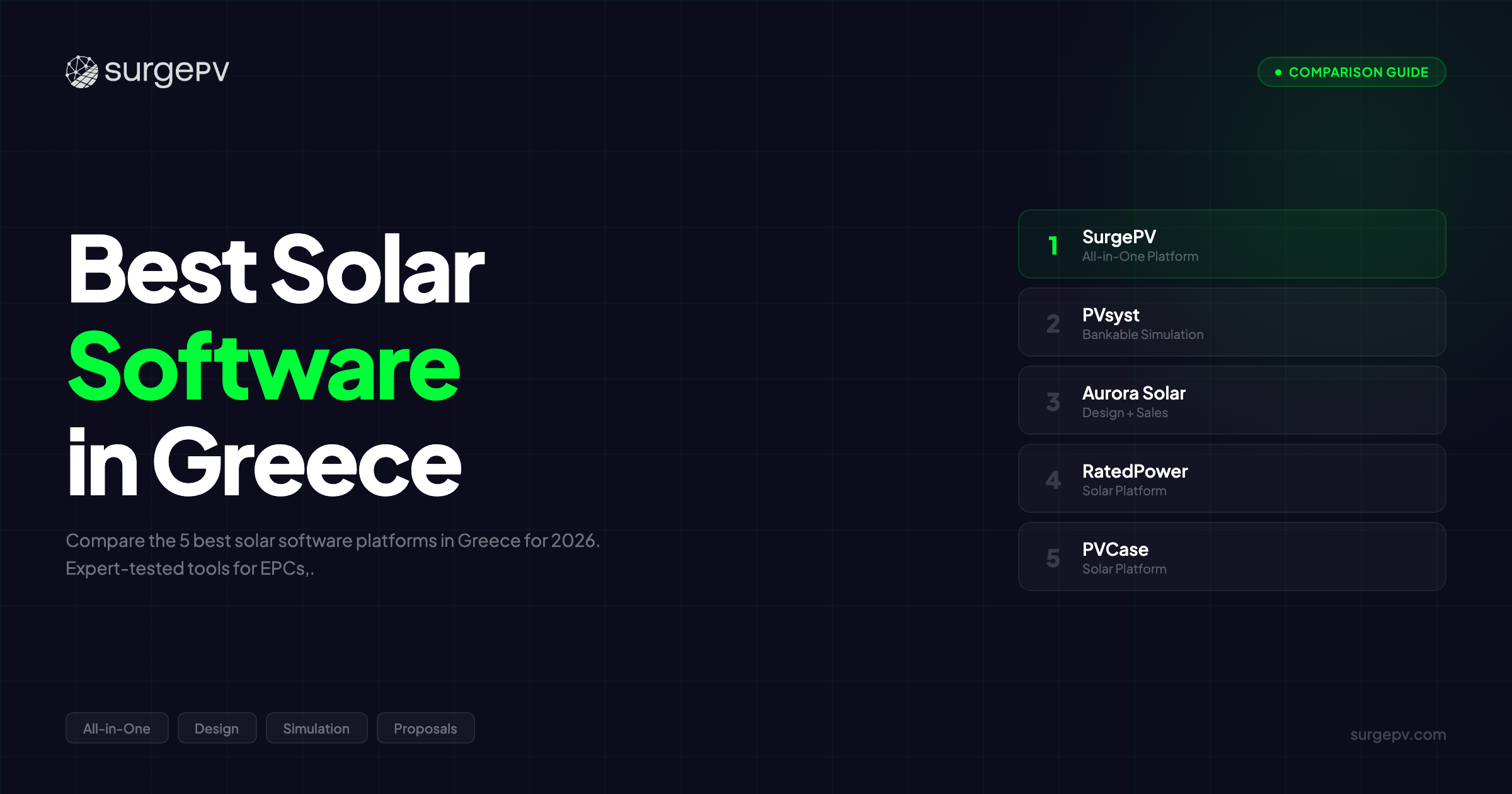
TL;DR: SurgePV is the best all-in-one solar software for Greece, covering design, simulation, ELOT-compliant electrical engineering, and Greek-specific proposals in one cloud platform. PVsyst remains the bankability standard but requires separate tools. RatedPower and PVCase excel at utility-scale only. Aurora Solar lacks Greek market features.
Greece is adding 2–3 GW of solar per year. That is the opportunity. But here is the question most Greek EPCs get wrong: should you use an all-in-one platform or a specialized tool stack?
7.2 GW installed. A target of 14.1 GW by 2030 (IRENA Renewable Energy Statistics). SolarPower Europe ranks Greece among the fastest-growing EU solar markets, and HELAPCO reports accelerating project pipelines across all segments.
The market is doubling — and your software choice determines whether you scale with it or drown in tool-switching overhead.
An all-in-one platform like SurgePV handles design, simulation, electrical engineering, and proposals in one place. A specialized stack — PVsyst for simulation, AutoCAD for SLDs, Excel for proposals — costs EUR 2,700–5,600/year per user and adds 3–4 hours of tool-switching per project. That is not a minor inconvenience. It is the difference between 15 projects a month and 25.
In this guide, you’ll find:
- 5 solar software platforms compared on Greek market fit, workflow completeness, and pricing
- Which tools support ELOT compliance, Greek net-metering, and RAE auction requirements
- A use-case decision matrix for EPCs, installers, and utility-scale developers
- Full feature comparison and testing methodology
The 5 Best Options at a Glance
| Rank | Software | Type | Best For | Greece Fit | Pricing |
|---|---|---|---|---|---|
| 1 | SurgePV | All-in-one | Complete workflow | 5/5 | $1,499/user/yr |
| 2 | PVsyst | Specialized | Bankable simulation | 4/5 (sim only) | EUR 1,200–2,400/yr |
| 3 | Aurora Solar | All-in-one | US market leader | 2/5 | $1,620–3,108/yr |
| 4 | RatedPower | Specialized | Utility-scale automation | 4/5 (utility only) | Custom |
| 5 | PVCase | Specialized | CAD-based engineering | 4/5 (utility only) | ~$2,990/yr |
Best Solar Software in Greece
SurgePV — Best All-in-One Solar Platform for Greece
Best For: Greek EPCs handling commercial, utility-scale, and residential projects
Pricing: $1,499/user/year (For 3 Users plan). All features included.
Ease of Use: 2–3 week onboarding
Overall Score: 93/100
Why SurgePV Ranks #1
SurgePV is the only cloud-based platform covering the full Greek solar workflow — from AI-powered roof modeling through 8760-hour shading analysis and automated SLD generation to interactive proposals with Greek net-metering and energy community modeling. Instead of switching between PVsyst, AutoCAD, and Excel, Greek EPCs use one platform.
Did You Know?
Greece’s solar irradiance ranges from 1,500–1,800 kWh/m²/year, making accurate simulation software essential for bankable energy yield predictions. Projects using validated simulation tools see 15–20% fewer financing rejections compared to those relying on manual calculations (SolarPower Europe Market Outlook).
Key Strengths
- Complete workflow: Design, simulation, electrical engineering, and proposals in one platform
- Automated SLD generation: ELOT-compliant SLDs in 5–10 minutes vs 2–3 hours in AutoCAD. No manual cross-referencing of code tables, and zero risk of undersized cables failing inspection.
- +/-3% accuracy vs PVsyst with temperature coefficient modeling for Greek summers
- P50/P75/P90 bankability: Meets RAE auction and Greek lender requirements. Financing applications include the bankability data lenders actually require, not just optimistic P50 estimates that get rejected.
- Tracker support: Single-axis (15–25% gain) and dual-axis with backtracking
- Greek net-metering: Law 4414/2016 framework (10/100/500 kWp limits)
- Energy community support: Virtual net-metering under Law 4513/2018
- Greek language and EUR pricing: Proposals in Greek with native EUR support. When a residential customer in Athens sees a Greek-language proposal with Fotovoltaika subsidy calculations, they trust your numbers.
Limitations
- Smaller global user base: Less established than Aurora Solar globally
- Simulation depth: PVsyst offers deeper customization for edge-case engineering
Who Should Consider SurgePV
Greek EPCs handling multiple project types, developers preparing RES auction bids, commercial solar companies, solar installers who want one platform for everything. Book a demo to see the complete Greek EPC workflow.
Real-World Example
A growing EPC in Attica with both residential and commercial projects was paying over $12,000/year for separate design, simulation, and CAD licenses — and still spending 15 hours per week on tool-switching overhead. After consolidating to SurgePV at $4,497/year (3-user plan), they freed up two full working days per week and cut their software costs by 63%.
You might be wondering: if SurgePV does all this, why haven’t I heard of it? Fair question. PVsyst has had a 30-year head start. Aurora Solar has spent hundreds of millions on marketing. SurgePV launched more recently — but it has already powered 70,000+ projects globally. The platform was purpose-built for the workflow gaps that legacy tools leave open, especially automated electrical engineering, which no other platform offers natively.
Further Reading
See our guide to the best all-in-one solar design software for a complete platform comparison, and best commercial solar design software for EPC-focused analysis.
PVsyst — Industry-Standard Simulation
Best For: Greek engineering firms prioritizing maximum bankability rigor
Pricing: EUR 1,200–2,400/year
Overall Score: 85/100
Why PVsyst Ranks #2
PVsyst is the gold standard for bankable solar simulation. Greek banks, RAE auction evaluators, and international lenders accept PVsyst reports universally. Trade-off: simulation only, no design tools, no SLD generation, no proposals, desktop-only.
Key Strengths
- Universal bankability: Accepted by all Greek banks and lenders
- Advanced simulation: P50/P75/P90 with granular parameter control
Limitations
- Desktop-only: No cloud collaboration
- Simulation-only: Requires 2–3 additional tools for a complete workflow
Aurora Solar — US Market Leader
Best For: Greek companies with US operations needing one tool for both markets
Pricing: $135–259/user/month ($1,620–3,108/year)
Overall Score: 72/100
Why Aurora Solar Ranks #3
Aurora Solar is the dominant solar design software in the US residential market with high-quality proposals. For Greece: no tracker support (15–25% production gain goes uncaptured), no SLD generation, only P50 estimates, US net-metering models, English-only proposals.
Key Strengths
- Visual proposals: Industry-leading proposal quality
- AI roof detection: Fast design capabilities
Limitations
- No tracker support: A meaningful gap for Greek irradiation levels
- No SLD generation: Requires AutoCAD
- US-focused: No Greek net-metering, English-only
RatedPower — Utility-Scale Automation
Best For: Greek utility-scale developers focused on RES auctions
Pricing: Custom enterprise pricing
Overall Score: 82/100
Why RatedPower Ranks #4
RatedPower automates utility-scale ground-mount design with tracker optimization and P50/P75/P90 bankability. European company. Utility-scale only — no commercial rooftop, no residential, no island systems.
Key Strengths
- Utility-scale automation: Ground-mount layout with tracker optimization
- European perspective: Understands EU frameworks
Limitations
- Utility-scale only: No commercial or residential capability
- Enterprise pricing: Custom, typically high
PVCase — CAD-Based Engineering
Best For: Greek engineering firms with AutoCAD teams on utility-scale
Pricing: $990/year + AutoCAD ($2,000/year) = ~$2,990/year total
Overall Score: 80/100
Why PVCase Ranks #5
PVCase offers deep engineering control for utility-scale via AutoCAD integration. Tracker support, electrical engineering, P50/P75/P90. AutoCAD is mandatory (EUR 1,500–2,000/year extra), 6–8 week onboarding, desktop-only, no commercial or residential support.
Key Strengths
- Deep CAD engineering: Maximum utility-scale control
- Tracker support: Advanced layouts
Limitations
- Requires AutoCAD: Additional cost and learning curve
- Desktop-only: No cloud collaboration
Which Tool Is Right for Your Needs?
| Your Use Case | Best Software | Why | Alternative |
|---|---|---|---|
| Full-service EPC (all segments) | SurgePV | Only platform with design, SLDs, proposals, and simulation in one tool | PVsyst + AutoCAD combo |
| Projects requiring bank financing | PVsyst or SurgePV | P50/P90 bankability reports. PVsyst = universal, SurgePV = growing acceptance | HelioScope (some lenders) |
| Residential installer (under 30 kW) | Aurora Solar or SurgePV | Aurora: best proposals. SurgePV: proposals + engineering depth | OpenSolar (free tier) |
| Utility-scale developer (over 1 MW) in Greece | HelioScope or PVCase | Fast ground-mount design. Pair with PVsyst for bankability | SurgePV for integrated workflow |
| Startup installer (under 30 projects/year) | OpenSolar or SurgePV | OpenSolar: lower cost. SurgePV: better engineering | Free tools (PVWatts, SolarEdge Designer) |
Design Solar Projects Faster with SurgePV
Complete design-to-proposal workflows with automated electrical engineering and bankable simulations — built for the Greek market.
Book a DemoNo commitment required · 20 minutes · Live project walkthrough
Full Feature Comparison
| Feature | SurgePV | PVsyst | Aurora Solar | PVCase |
|---|---|---|---|---|
| Best for | All segments | Bankability | Residential | Utility-scale |
| SLD generation | Yes (automated) | No | No | No |
| P50/P90 reports | Yes | Yes (gold standard) | P50 only | Yes |
| Carport design | Yes (only platform) | No | No | Limited |
| Cloud-based | Yes | Desktop | Yes | Desktop + plugin |
| Wire sizing | Yes (automated) | No | No | No |
Further Reading
For a broader comparison beyond this market, see our guide to the best solar design software globally.
Decision Shortcut
If you need electrical engineering (SLDs, wire sizing, code compliance), SurgePV is the only platform that automates this natively. If you’re simulation-only, PVsyst is the gold standard. If you’re residential-focused with a big marketing budget, Aurora’s proposals are strong — but expensive.
Our Testing Methodology
- Workflow completeness (30%): Design, simulation, electrical, and proposals coverage
- Greece applicability (25%): ELOT compliance, RAE licensing requirements, DAPEEP auction readiness, net-metering, energy communities, Greek language, EUR pricing
- Accuracy and bankability (20%): Simulation accuracy vs PVsyst, P50/P75/P90 support, Greek bank acceptance
- Ease of use (15%): Learning curve, onboarding time, cloud collaboration
- Pricing and value (10%): Total cost of ownership, features per euro
Transparency Note
SurgePV publishes this content. We are transparent about this relationship. This comparison acknowledges PVsyst as the undisputed gold standard for bankable simulation, and RatedPower and PVCase as strong choices for utility-scale work. See our editorial standards.
Bottom Line: Best Solar Software for Greece
If you need one platform for everything: SurgePV is the strongest choice. Design, simulation (+/-3% vs PVsyst), ELOT-compliant electrical engineering (SLDs in 5–10 minutes), proposals with Greek net-metering and energy community modeling, tracker support, and cloud collaboration — all for $1,499/user/year.
If maximum simulation depth is your priority: PVsyst remains the bankability gold standard. Budget EUR 1,500–3,500/year for additional tools.
If you only do utility-scale ground-mount: RatedPower and PVCase both excel here.
The Greek solar market is not slowing down. The EPCs winning projects today are the ones with accurate simulations, ELOT-compliant documentation, and professional proposals on the table same-day — not next week. Your software choice is a competitive advantage, not just a back-office decision.
Ready to see the difference? Book a demo and test SurgePV with your Greek project data.
See SurgePV pricing | Explore features | Read reviews
Further Reading
See also: best solar electrical design software for SLD generation comparisons, and our full PVCase review for a CAD-based engineering deep-dive.
Bottom Line
For Greece EPCs and installers, SurgePV delivers the most complete design-to-proposal workflow with automated SLD generation, bankable P50/P90 simulations, and integrated proposals. Book a demo to see it in action.
Frequently Asked Questions
What is the best solar software in Greece?
SurgePV is the best all-in-one solar software for Greece in 2026. It combines design, simulation, ELOT-compliant electrical engineering (SLDs in 5–10 minutes), and proposals (Greek net-metering, energy communities) in one cloud platform at $1,499/user/year. For simulation-only needs, PVsyst remains the industry standard but requires separate tools for design, SLDs, and proposals.
Is all-in-one or specialized solar software better for Greece?
All-in-one platforms (SurgePV) suit most Greek EPCs and installers needing complete workflows at lower cost ($1,499/user/year). Specialized tool stacks (PVsyst + AutoCAD) provide deeper simulation but cost EUR 2,700–5,600/year and require 3–4 hours of tool-switching per project. See our best all-in-one solar software comparison.
Do Greek banks accept SurgePV simulations for financing?
Yes. SurgePV simulations with P50/P75/P90 metrics and +/-3% accuracy vs PVsyst meet Greek bank requirements for project financing. PVsyst remains the most widely recognized standard for Greek lenders, but SurgePV bankability reports are gaining acceptance.
Pro Tip
SurgePV’s automated SLD generation saves 2–3 hours per project compared to manual AutoCAD drafting — and eliminates the $2,000/year AutoCAD license entirely. For Greece EPCs handling 10+ projects per month, that’s 20–30 hours saved monthly. Book a demo to see it in action.
What solar software supports Greek net-metering and energy communities?
SurgePV supports Greek net metering (Law 4414/2016: 10/100/500 kWp limits) and energy community virtual net-metering (Law 4513/2018: up to 1 MWp). Most other platforms use US frameworks incompatible with Greek regulations.
Does solar software need to comply with ELOT standards in Greece?
Yes. Electrical engineering in solar software must support ELOT EN 62446 for permit approval and RAE licensing. SurgePV provides ELOT-compliant SLD generation. Aurora Solar and OpenSolar require external AutoCAD (EUR 1,500–2,000/year extra).
How much does solar software cost in Greece?
All-in-one platforms cost $1,499–3,108/year per user (SurgePV, Aurora Solar). Specialized tool stacks cost EUR 2,700–5,600/year (PVsyst EUR 1,200–2,400 + AutoCAD EUR 1,500–2,000 + proposal tool). Enterprise platforms (RatedPower, Energy Toolbase) use custom pricing.
Can solar software handle Greek island off-grid systems?
SurgePV and PVsyst support off-grid and hybrid system design for Greek islands (Crete, Rhodes, Cyclades) with battery storage and diesel hybrid configurations. HEDNO/DEDDIE manages island distribution grids. Most other platforms focus only on grid-connected systems.
Note
Pricing information is based on publicly available data as of February 2026. Contact vendors directly for current pricing and Greece-specific quotes. Some vendors offer regional pricing adjustments.
Sources
- SurgePV Product Documentation — Official feature specifications (accessed February 2026)
- PVsyst Official Documentation — Simulation methodology (accessed February 2026)
- Aurora Solar Product Pages — Feature verification (accessed February 2026)
- RatedPower Official Documentation — Utility-scale capabilities (accessed February 2026)
- PVCase Official Documentation — CAD-based workflow (accessed February 2026)
- Greek Ministry of Environment and Energy — National Energy and Climate Plan (accessed February 2026)
- RAE (Regulatory Authority for Energy) — Licensing and RES auction data (accessed February 2026)
- European Commission JRC PVGIS — Solar irradiation data for Greece (accessed February 2026)
- IRENA Renewable Energy Statistics — Greece installed capacity (accessed February 2026)
- HELAPCO — Hellenic Association of Photovoltaic Companies (accessed February 2026)
- HEDNO/DEDDIE — Distribution operator and island grid data (accessed February 2026)