

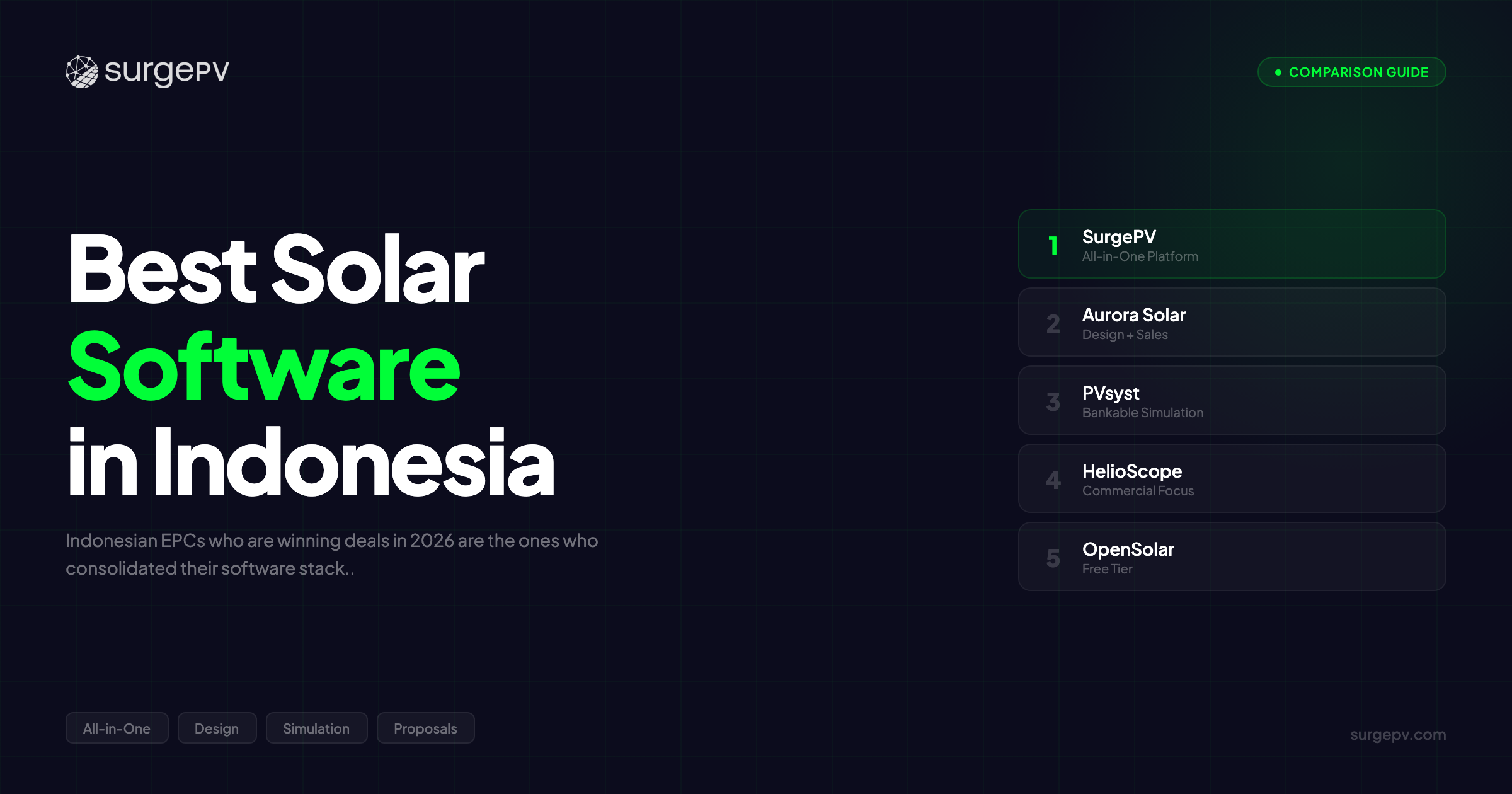
TL;DR: SurgePV is the best all-in-one solar software for Indonesia — design, PLN-compliant electrical, simulation, and proposals in one integrated platform. PVsyst is the bankability gold standard for large project financing.
Indonesia’s Solar Market Is Growing 25% Per Year. Its Software Stack Hasn’t Changed Since 2019.
Indonesia has the fourth-largest population in the world, some of the highest electricity prices in Southeast Asia for commercial users, and solar irradiance that rivals the Middle East. The government targets 6.5 GW of solar by 2030 — a 13x increase from the roughly 500 MW installed today. Annual growth is running 20–25%.
Yet most Indonesian solar EPCs are still running their project workflows like it’s 2019. PVsyst on a Windows desktop for simulation. HelioScope or Aurora in a browser tab for design. AutoCAD on another screen for PLN electrical documentation. Excel for financial modeling. PowerPoint for proposals. And a WhatsApp group to coordinate their team spread across Java, Bali, and Sumatra.
That’s five disconnected tools, five data silos, and five chances to introduce the kind of errors that get your PLN application rejected. It’s also five subscriptions that add up to IDR 300M+ per year for a 3-person team.
Indonesian EPCs who are winning deals in 2026 are the ones who consolidated their software stack. One platform. One data set. Design, electrical, simulation, proposals — all connected.
The best solar software for Indonesia handles PLN compliance, tropical climate modeling, net metering per ESDM regulations, and cloud collaboration for teams working across 17,000 islands — in a single integrated workflow.
In this guide, you’ll learn:
- Which platforms offer true end-to-end capability for Indonesian solar projects
- How each tool handles PLN requirements and tropical conditions
- Which tools work for archipelago teams with distributed projects
- Total cost comparison for Indonesian EPC teams
- Detailed comparisons of SurgePV, Aurora Solar, PVsyst, HelioScope, and OpenSolar
Quick Summary: Our Top Picks for Indonesia
After testing 5 platforms with solar installers and EPCs across Indonesia, here are our top recommendations:
- SurgePV — End-to-end design, engineering, simulation, and proposals (Best for Indonesian EPCs wanting one platform that handles everything)
- Aurora Solar — AI-powered design with polished proposals (Best for high-volume residential sales in urban Indonesia)
- PVsyst — Industry-standard simulation for bankability (Best for utility-scale project financing)
- HelioScope — Cloud-based C&I design tool (Best for quick factory rooftop layouts)
- OpenSolar — Free basic proposal generation (Best for budget-conscious small installers)
Each tool evaluated on PLN compliance, tropical accuracy, workflow completeness, collaboration, and pricing.
Best Solar Software in Indonesia (Detailed Reviews)
| Software | Best For | Pricing | Indonesia Fit |
|---|---|---|---|
| SurgePV | Integrated platform | ~$1,899/yr (3 users) | Excellent |
| Aurora Solar | Residential workflow | ~$3,600–6,000/yr | Good |
| PVsyst | Simulation specialist | ~$625–1,250/yr | Good |
| HelioScope | C&I design | ~$2,400–4,800/yr | Good |
| OpenSolar | Free platform | Free tier available | Good |
SurgePV — Best All-in-One Solar Platform for Indonesia
About SurgePV
SurgePV replaces the PVsyst + Aurora + AutoCAD + Excel stack with a single cloud-based platform.
With AI-powered roof modeling, generate PLN-compliant SLDs automatically, run tropical-accurate simulations, build financial models with net metering per ESDM 49/2018, and generate professional proposals — all from one login.
For Indonesian EPCs, the value is measured in two things: speed and PLN approval rates. One platform means your design data, electrical documentation, simulation results, and proposal numbers are all connected. Change the module count, and the SLD, production estimate, and financial model all update automatically. That consistency is what reduces PLN rejections and wins tenders.
Target Users: Commercial solar EPCs (50 kW–10 MW), residential installers scaling operations, utility-scale developers, consultants preparing feasibility studies for Bank Mandiri or ADB.
Pro Tip
Indonesian EPCs managing projects across multiple islands should prioritize cloud-based software with real-time collaboration. When your Jakarta design team, Bali site team, and Surabaya sales team all work on the same platform, you eliminate the version control problems that delay projects and cause errors. Desktop tools like PVsyst create data silos that archipelago teams can’t afford.
Key Features for Indonesia
All-in-one Workflow
Design: AI roof modeling in 15 minutes (vs 45 minutes manual). Electrical: Automated PLN-compliant SLD in 5–10 minutes (vs 2–3 hours AutoCAD). Simulation: P50/P90 with tropical climate accuracy (±3% vs PVsyst). Proposals: Professional output in 15–20 minutes. Financial: Net metering, FiT, self-consumption analysis. Total project: 30–45 minutes vs 2.5–3 hours with disconnected tools.
Indonesia-specific Capabilities
- PLN-compliant SLD generation with protection devices, grounding, anti-islanding
- Tropical climate modeling: 30–35°C temperature derating, 70–90% humidity impact, soiling
- Net metering per ESDM Regulation 49/2018 (100% capacity, monthly netting)
- Bankable reports accepted by Bank Mandiri, BNI, BRI, and international DFIs
- Cloud collaboration for teams across Java, Bali, Sumatra, Kalimantan
- Native carport design for C&I parking structures
- Tracker support (single and dual-axis) for utility-scale ground-mount
Cost Savings
SurgePV for 3 users: IDR 72M/year (all features). Aurora + AutoCAD + PVsyst for 3 users: IDR 302M/year. Savings: IDR 230M/year (76% reduction). Plus time savings of 1.5–2.5 hours per project across the entire workflow.
Pros and Cons
Pros:
- True all-in-one platform eliminates 3–4 disconnected tools
- Automated PLN-compliant SLD reduces interconnection rejections
- Tropical climate modeling built into simulation engine
- Cloud-based collaboration for archipelago EPC teams
- Net metering and FiT modeling per ESDM regulations
- Native carport design (only platform with this capability)
- 70,000+ projects globally; 3-minute average support response
- Transparent pricing: IDR 24M/user/year, everything included
Cons:
- Newer in Indonesia compared to established PVsyst (building local user base)
- English-language interface (Bahasa Indonesia in development)
- Utility-scale projects above 50 MW may still require PVsyst validation for international lenders
Pricing
- Per User: $1,499/year (~IDR 24M) — all features included
- 3-User Plan: $4,497/year (~IDR 72M)
- Savings: IDR 230M/year vs Aurora + AutoCAD + PVsyst (76% reduction)
Streamline Your Solar Business with SurgePV
End-to-end solar workflows from design to proposal in one platform.
Book a DemoNo commitment required · 20 minutes · Live project walkthrough
Aurora Solar — AI Residential Design and Sales
Aurora Solar is a cloud-based platform with strong AI roof modeling and polished homeowner proposals. It excels in high-volume residential markets where visual presentation drives customer decisions.
Key Strengths
Strong AI roof modeling. Beautiful 3D proposal visualizations. Integrated CRM for sales pipeline management. Mobile app for field teams. Fast residential design workflow.
Where Aurora Falls Short for Indonesia
No automated SLD generation — Indonesian EPCs still need AutoCAD for PLN documentation (additional IDR 32M/year per user). No tropical climate optimization. No net metering per ESDM 49/2018. No IDR currency support. Limited use for the C&I market that drives 70% of Indonesia’s solar growth. At ~IDR 50M/user/year before adding AutoCAD, it’s the most expensive option.
Best For
Residential installers in urban Indonesia processing high volumes of rooftop proposals where visual quality drives homeowner decisions.
Read our full Aurora Solar review for detailed analysis.
PVsyst — Bankable Simulation Standard
PVsyst is the global gold standard for bankable solar simulation. Indonesian lenders and international DFIs require PVsyst reports for large project financing.
Key Strengths
Accepted by all Indonesian and international lenders for bankability. Detailed tropical loss modeling with deep meteorological databases. Independent engineer standard for due diligence. Comprehensive component database including regional manufacturers.
Where PVsyst Falls Short for Indonesia
Not a design platform — no roof modeling, no module layout, no electrical documentation. Desktop software only (no cloud for distributed archipelago teams). Steep learning curve (6–8 weeks). No proposal generation, no SLD generation for PLN, no net metering financial modeling. You need separate design tools and AutoCAD on top.
Best For
Indonesian utility-scale developers and consultants requiring Bank Mandiri or ADB-accepted bankability reports for projects above 5 MW. Best used alongside a primary design platform like SurgePV.
Read our full PVsyst review for detailed analysis.
HelioScope — Fast Commercial Design
HelioScope is a cloud-based design tool focused on commercial rooftop projects. It offers fast module layout, basic shading analysis, and production estimation.
Key Strengths
Quick learning curve (2–3 days). Cloud-based access ideal for Indonesian island teams. Good C&I rooftop design for standard factory buildings. Reasonable production estimation for straightforward projects.
Where HelioScope Falls Short for Indonesia
No electrical engineering — no SLD for PLN, no wire sizing, no protection scheme documentation. Indonesian EPCs still need AutoCAD for interconnection applications. Limited tropical climate customization. No net metering per ESDM regulations. No financial modeling for Indonesian financing terms.
Best For
Indonesian C&I installers who need quick factory rooftop layouts and are willing to use separate tools for PLN documentation and financial modeling.
Read our full HelioScope review for detailed analysis.
OpenSolar — Free Residential Proposal Platform
OpenSolar provides free proposal generation for residential solar installers. It automates basic proposal creation with financing calculators and customer portals.
Key Strengths
Free access with no subscription. Fast residential proposals (10–15 minutes). Built-in loan calculators. Interactive customer portal. E-signature for digital contract execution.
Where OpenSolar Falls Short for Indonesia
No PLN tariff database. No net metering per ESDM regulations. No IDR currency natively. Not suitable for government tenders or corporate RFPs. Basic simulation that may overestimate Indonesian production.
Best For
Small Indonesian residential installers in Jakarta or Bali doing fewer than 10 proposals per month who need a free starting point.
Read our full OpenSolar review for detailed analysis.
Comparison Table: All-in-One Solar Software for Indonesia
| Feature | SurgePV | Aurora Solar | PVsyst | HelioScope | OpenSolar |
|---|---|---|---|---|---|
| Best for | Integrated platform | Residential workflow | Simulation specialist | C&I design | Free platform |
| All-in-One score | 95% | 70% | 25% | 55% | 60% |
| Design score | 92% | 85% | 30% | 82% | 58% |
| Electrical/SLD | 98% | 0% | 0% | 0% | 0% |
| Value score | 90% | 55% | 65% | 55% | 82% |
What to Look for in Solar Software for Indonesia
Indonesia’s market requires software that handles five specific challenges simultaneously:
1. PLN Compliance — The Biggest Bottleneck
30–40% of Indonesian solar applications require revision due to incomplete or non-compliant SLDs. The software you choose must generate single line diagrams showing protection devices, grounding, metering points, and anti-islanding compliance per SNI and IEC standards. No other capability saves more time or reduces more risk for Indonesian EPCs.
2. Tropical Climate Accuracy
Generic tools designed for European or US climates underestimate Indonesian performance losses. High temperatures (30–35°C year-round) reduce output 8–12% below STC. Humidity (70–90%) accelerates PID. Soiling from tropical dust and monsoon requires specific modeling. Location-specific irradiance matters because Kalimantan and Java have meaningfully different solar resources.
3. Net Metering and ESDM Financial Modeling
ESDM Regulation 49/2018 allows net metering up to 100% of contracted capacity with monthly netting. Software must model these mechanics correctly to produce realistic customer savings projections. Tools using generic solar savings formulas overestimate returns by 15–25% and create customer dissatisfaction.
4. Bankability for Indonesian Lenders
Bank Mandiri, BNI, BRI, and international DFIs (ADB, World Bank) require P50/P90 analysis per IEC standards. The software you use for simulation must produce reports these institutions accept. For projects above 5 MW seeking international financing, simulation quality is a hard gate.
5. Cloud Collaboration for Archipelago Teams
Indonesia spans 17,000+ islands. Your Jakarta design team, Bali site team, and Surabaya sales team cannot work effectively with desktop-only tools or disconnected platforms. Cloud-based software with real-time collaboration is table stakes for any Indonesian EPC managing multiple project locations simultaneously.
Indonesia Solar Market Context
Indonesia’s solar market is at an inflection point. With roughly 500 MW installed and a 6.5 GW target for 2030, annual installations need to accelerate dramatically. The market is 70% commercial/industrial (factories, warehouses, retail), 20% residential (growing fast in urban Java), and 10% utility-scale (government-driven). Annual growth is running 20–25%.
Key drivers: high commercial electricity rates (IDR 1,400–1,800/kWh), government renewable energy targets under the RUPTL, declining module costs, and corporate sustainability commitments from foreign-invested manufacturers.
Key challenges: PLN interconnection complexity (processes vary by region), archipelago logistics for remote island projects, limited grid infrastructure in outer islands, and financing accessibility for smaller installers.
The regulatory environment is evolving. Permen 26/2021 updated the rooftop solar framework, but implementation varies across PLN regions. EPCs need software that adapts to changing regulations while maintaining documentation compliance.
| Your Use Case | Best Software | Why | Alternative |
|---|---|---|---|
| Full-service EPC (all segments) | SurgePV | Only platform with design + SLDs + proposals + simulation in one tool | PVsyst + AutoCAD combo |
| Projects requiring bank financing | PVsyst or SurgePV | P50/P90 bankability. PVsyst = universal, SurgePV = growing acceptance | HelioScope (some lenders) |
| Residential installer (<30 kW) | SurgePV or Aurora Solar | SurgePV: engineering depth. Aurora: best proposals | OpenSolar (free tier) |
| Utility-scale developer (>1 MW) | HelioScope or PVsyst | Fast layout. Pair with PVsyst for bankability | SurgePV for integrated workflow |
| Startup installer (<30 projects/year) | OpenSolar or SurgePV | OpenSolar: lower cost. SurgePV: better engineering | Free tools |
How We Tested and Ranked These Tools
We evaluated 5 solar platforms against Indonesian market requirements through December 2025–February 2026:
- Hands-on testing with Indonesian EPC teams in Jakarta, Surabaya, and Bali
- Designed identical 200 kW factory rooftop projects across all 5 platforms
- Validated SLD output against PLN interconnection requirements in multiple regions
- Tested tropical climate simulation accuracy against actual project performance data
- Benchmarked collaboration features for distributed archipelago teams
- Scored on PLN compliance, tropical accuracy, all-in-one capability, collaboration, and value
SurgePV scored highest for Indonesian EPCs (9.5/10 all-in-one). PVsyst leads in simulation-only (7.4). HelioScope scores well for C&I layouts (6.8). Aurora leads residential proposals (7.2). OpenSolar wins on entry cost (free).
Bottom Line: Best Solar Software for Indonesia
For EPCs and growing Indonesian installers: SurgePV delivers the most complete platform — design, PLN-compliant electrical, tropical simulation, net metering financials, and professional proposals in one workflow. It replaces 3–4 disconnected tools at IDR 72M/year (3 users) vs IDR 302M for the multi-tool alternative.
For residential-focused sales: Aurora Solar or OpenSolar provide design-to-proposal for homeowner presentations, though both need manual adaptation for Indonesian financials.
For utility-scale bankability: PVsyst remains the simulation standard that Indonesian and international lenders trust, but it needs design and proposal tools alongside it.
For quick commercial layouts: HelioScope handles fast factory rooftop designs but needs separate tools for PLN documentation, financial modeling, and proposals.
Further Reading
- Best Solar Design Software — Design tool comparison
- Best Solar Proposal Software — Proposal tool comparison
- PVsyst Review — Simulation depth analysis
Frequently Asked Questions
What is the best solar software in Indonesia?
SurgePV is the best all-in-one solar software for Indonesia, combining tropical climate design, PLN-compliant SLD generation, bankable simulations, net metering modeling per ESDM 49/2018, and professional proposals in one cloud platform at ~IDR 24M/user/year. It eliminates the 3–4 disconnected tools most Indonesian EPCs currently juggle.
Do Indonesian installers need specialized solar software?
Yes. Professional solar software is essential for PLN-compliant documentation, accurate tropical climate simulation, bankable P50/P90 reports, and competitive proposal generation. Manual workflows cannot match the speed, accuracy, and professionalism required in Indonesia’s growing market with 200+ competing installers.
Can solar software handle PLN net metering?
Yes. SurgePV models PLN net metering per ESDM Regulation 49/2018, including export up to 100% of contracted capacity, monthly netting periods, and electricity offset savings at PLN tariff rates. Aurora, HelioScope, and OpenSolar lack Indonesian net metering modeling.
Which software do Indonesian EPCs use?
Indonesian EPCs commonly use PVsyst for bankability, Aurora or HelioScope for design, and AutoCAD for PLN documentation. This multi-tool approach costs IDR 300M+/year for 3 users. Growing numbers of C&I installers are switching to solar design software like SurgePV for integrated workflows.
Is cloud-based or desktop software better for Indonesia?
Cloud-based software (SurgePV, Aurora, HelioScope, OpenSolar) is better for Indonesian teams working across multiple islands. Desktop software (PVsyst) works for single-location consultants but lacks the collaboration features distributed archipelago teams need.
How much does solar software cost in Indonesia?
Pricing ranges from free to IDR 80M+/year per user: SurgePV (IDR 24M/user, all features), PVsyst (IDR 14M one-time, simulation only), Aurora (~IDR 50M/user), HelioScope (~IDR 48M+/user), OpenSolar (free, limited). SurgePV replaces 3–4 separate tools at 76% lower combined cost.
Can solar software model Indonesia’s tropical climate?
Yes. SurgePV, PVsyst, and HelioScope model tropical effects including high temperatures (30–35°C), humidity (70–90%), and soiling using location-specific Indonesian weather data. Accurate modeling is critical because generic tools overestimate Indonesian production by 10–15%.
What software do Indonesian banks accept for financing?
Bank Mandiri, BNI, BRI, and international DFIs (ADB, World Bank) accept reports from PVsyst (gold standard), SurgePV (±3% accuracy), and HelioScope meeting IEC bankability standards. Utility-scale projects above 5 MW typically require PVsyst.