

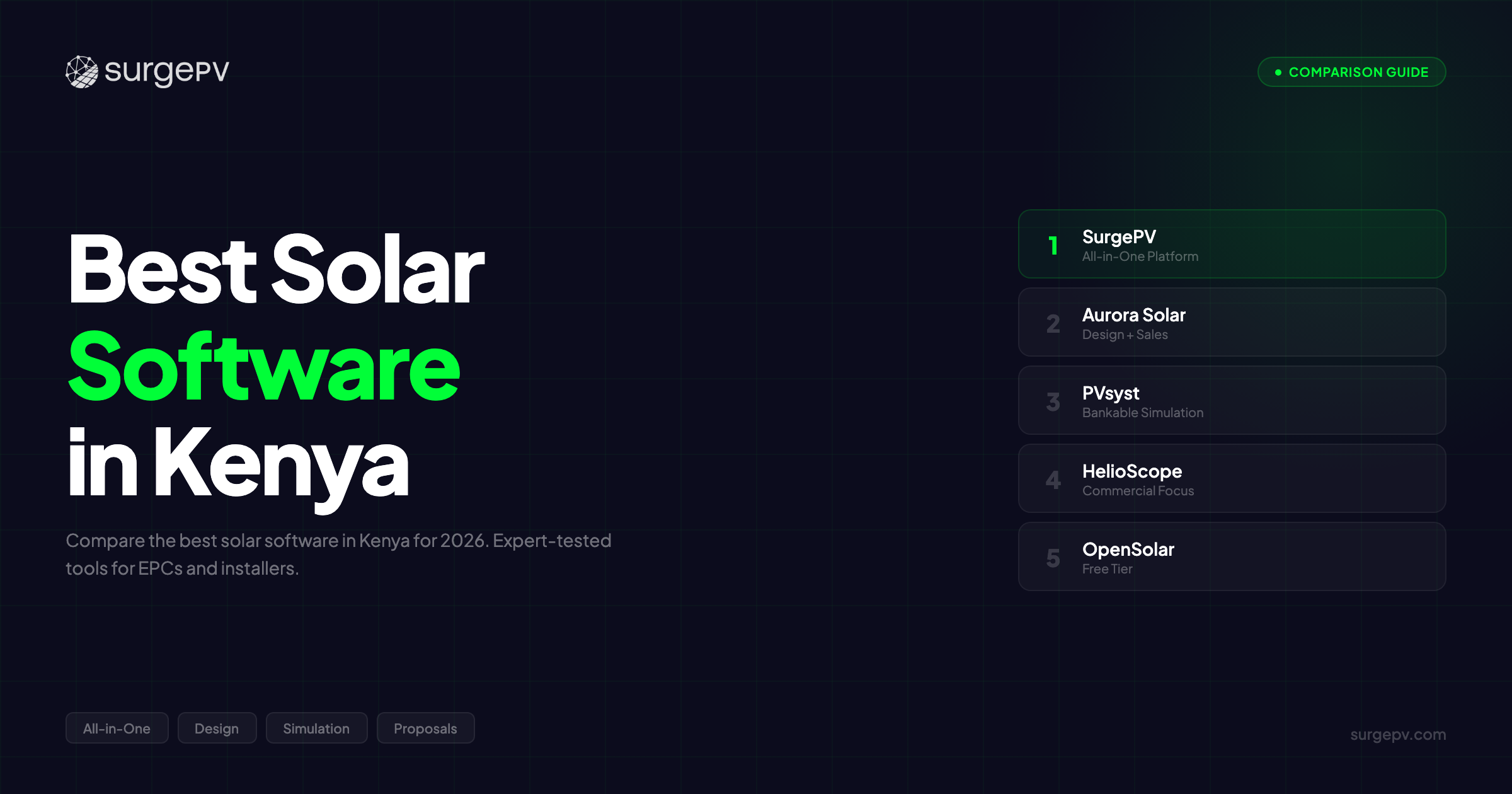
TL;DR: SurgePV is the best all-in-one solar software for Kenya — design, simulation, and proposals in one integrated platform supporting Kenya’s renewable energy targets.
Kenya Has the Solar Resource. It Needs the Software to Match.
Kenya sits directly on the equator with 1,500 to 2,200 kWh/m²/year of solar irradiance. That’s among the best solar resources on the African continent. The country added over 300 MW of distributed solar capacity in 2025, and commercial solar is growing at 25–35% annually.
The problem most Kenyan EPCs face: the solar software market was built for California and Germany. Not for Nairobi.
Kenyan solar projects look fundamentally different from Western installations. Flower farms in Naivasha install 500 kW ground-mount systems to eliminate diesel costs. Shopping malls in Nairobi need hybrid systems because KPLC grid reliability drops below 85% in some areas. M-KOPA and PAYGO providers distribute millions of solar home systems through mobile payment financing. And the Garissa 50 MW solar plant shows what utility-scale looks like in East Africa.
Each of these project types needs different software capabilities. A flower farm design needs ground-mount optimization and diesel comparison. A Nairobi commercial project needs battery backup for grid outages and electrical SLD documentation for EPRA compliance. A PAYGO installer needs fast proposals with mobile payment financing models.
In this guide, you’ll learn:
- Which platforms handle the full spectrum of Kenyan solar project types
- How each tool manages off-grid, hybrid, and grid-tied system design
- Which software generates EPRA/IEC-compliant documentation
- Total cost of ownership for Kenyan EPC teams in KES
- Detailed comparisons of SurgePV, Aurora Solar, PVsyst, HelioScope, and OpenSolar
Quick Summary: Our Top Picks for Kenya
After testing 5 platforms with solar installers and EPCs across Nairobi, Mombasa, and Kisumu, here are our top recommendations:
- SurgePV — End-to-end design, engineering, simulation, and proposals with off-grid/hybrid capabilities (Best for Kenyan EPCs needing one platform for everything)
- Aurora Solar — AI-powered residential design with polished proposals (Best for high-end residential projects, limited off-grid and hybrid support)
- PVsyst — Gold-standard simulation and bankability (Best for validating large projects for AfDB/IFC financing, simulation only)
- HelioScope — Cloud-based commercial layout tool (Best for simple grid-tied commercial rooftops)
- OpenSolar — Affordable cloud-based design and proposals (Best for small residential installers on tight budgets)
Each tool evaluated on Kenya-specific criteria: off-grid/hybrid capabilities, battery backup design, diesel savings modeling, EPRA compliance, proposal generation, and pricing in KES.
Best Solar Software in Kenya (Detailed Reviews)
| Software | Best For | Pricing | Kenya Fit |
|---|---|---|---|
| SurgePV | Integrated platform | ~$1,899/yr (3 users) | Excellent |
| Aurora Solar | Residential workflow | ~$3,600–6,000/yr | Good |
| PVsyst | Simulation specialist | ~$625–1,250/yr | Good |
| HelioScope | C&I design | ~$2,400–4,800/yr | Good |
| OpenSolar | Free platform | Free tier available | Good |
SurgePV — Best All-in-One Solar Platform for Kenya
About SurgePV
SurgePV is the only cloud-based platform that combines AI-powered solar design, automated electrical engineering, bankable simulations, battery backup optimization, and professional proposal generation — without switching between tools.
For Kenyan EPCs, that means one platform handles every project type in your pipeline: the 300 kW commercial rooftop in Nairobi’s Westlands, the 1 MW ground-mount for a Naivasha flower farm, the residential hybrid system in Mombasa, and the mini-grid design for a rural community project. Design, engineer, simulate, and propose — all from one login.
Target Users: Commercial EPCs handling 50 kW–2 MW projects, solar installers serving Nairobi’s growing residential market, consultants managing agricultural and industrial solar projects, companies designing off-grid and mini-grid systems for rural electrification.
Pro Tip
When evaluating solar software for Kenya, don’t just test with a simple grid-tied project. Run a commercial hybrid system through the platform — battery backup for KPLC grid outages, diesel genset integration, IEC compliance documentation, and diesel savings financial modeling. Any platform that handles Kenyan hybrid conditions will handle simpler projects easily. But a tool built for stable grids will fail on the projects that make up the bulk of Kenya’s commercial market.
Key Capabilities for Kenya
Design and Engineering
SurgePV’s AI-powered roof modeling detects roof boundaries, tilt, and azimuth from satellite imagery across Kenyan cities. The platform handles every array configuration Kenyan EPCs work with: flat commercial rooftops, ground-mount installations for agricultural facilities, East-West layouts for maximizing density, and carport solar structures — SurgePV is the only platform with native carport design.
Automated single line diagram generation produces IEC-compliant electrical documentation in 5–10 minutes. That SLD is ready for EPRA submissions and KPLC interconnection approval. The alternative — manual AutoCAD drafting at 2–3 hours per project plus 260,000 KES annual licensing — is what most Kenyan EPCs are still doing today.
Wire sizing calculations happen instantly. DC and AC wire gauges based on current, distance, and voltage drop limits. All IEC 62446 compliant.
Battery Backup and Off-Grid Design
SurgePV handles the full spectrum of Kenyan battery and off-grid requirements. For commercial projects in Nairobi, model 2–4 hours of battery backup during KPLC outages with hybrid inverter configurations and critical load separation. For off-grid installations, size battery banks for multi-day autonomy with diesel genset integration.
Battery chemistry comparison (lead-acid vs lithium LiFePO4) helps Kenyan EPCs match technology to budget. Lead-acid holds market share in rural off-grid installations. Lithium is increasingly preferred for space-constrained commercial installations in Nairobi’s industrial area.
Mini case study: A Mombasa EPC managing 30 commercial solar projects per month — ranging from 75 kW office buildings to 500 kW industrial facilities — was using Aurora for design, AutoCAD for electrical documentation, PVsyst for simulation, and Excel for battery sizing and diesel comparison. Monthly engineering time: 180+ hours across 3 engineers.
After switching to SurgePV, the same 30 projects took 75 hours total. The team freed up 105 hours per month — enough capacity to take on 15 additional projects without hiring. AutoCAD licensing eliminated (260,000 KES/year saved). Diesel comparison proposals went from manual Excel calculations to automated output.
At current Kenyan EPC billing rates, 105 freed hours translates to either significant cost savings or 50% more project capacity with the same team.
Simulation and Bankability
Production simulation achieves ±3% accuracy compared to PVsyst. P50, P75, and P90 estimates give AfDB and IFC lenders the conservative metrics they require. The simulation accounts for Kenya’s equatorial conditions: near-zero seasonal tilt variation, high-altitude irradiance gains in highland areas, dust soiling patterns, and temperature coefficients for the 15–30°C range.
8760-hour shading analysis captures the year-round production pattern that Kenya’s equatorial position creates — minimal seasonal variation but important hour-by-hour modeling for commercial peak demand optimization.
Financial Modeling and Proposals
Diesel savings calculations at 180–220 KES per liter. Net metering modeling under EPRA regulations. PAYGO cash flow analysis for distributed solar. PPA modeling for C&I off-taker agreements. The solar ROI calculator shows payback periods, NPV, and IRR tailored to Kenyan market economics.
Professional, interactive proposals viewable on any device — including mobile. For Kenyan sales teams presenting in boardrooms, factory floors, or agricultural field offices, mobile-friendly proposals on Safaricom 4G are a practical requirement.
Further Reading
See our best solar software comparison for global rankings, or compare solar design software in Kenya for engineering-focused analysis.
Pros and Cons
Pros:
- Only platform combining design + electrical engineering + simulation + battery + proposals
- Automated SLD generation eliminates AutoCAD (saves $2,000/year + 2–3 hours per project)
- Battery backup sizing for KPLC grid outage scenarios
- Off-grid and hybrid system support (grid + battery + diesel genset)
- Native carport design (only platform)
- Cloud-based — runs on Nairobi 4G networks
- P50/P75/P90 bankability reports for AfDB/IFC submissions
- Diesel savings financial modeling
- PAYGO cash flow analysis for distributed solar
- Transparent pricing: $1,499/user/year (3-user plan)
Cons:
- Newer brand in East Africa (building recognition versus established PVsyst)
- Weather data strongest for major Kenyan cities; rural areas use satellite-derived data
- EPRA regulatory templates may need customization for specific county requirements
Pricing
- 3-User Plan: $4,497/year (~580,000 KES) — $1,499/user/year
- Per User: $1,899/year (~245,000 KES)
- Includes: Everything — design, SLD, simulation, battery, proposals, financial modeling
Total Cost Comparison (3-user Kenyan EPC team):
- SurgePV: ~580,000 KES/year (all features)
- Aurora + AutoCAD + PVsyst: ~3.6M KES/year
- Savings with SurgePV: ~3.0M KES/year (83% less)
Who SurgePV Is Best For: Kenyan commercial solar EPCs who need one platform for design, engineering, simulation, battery backup, off-grid capabilities, diesel comparison, and proposals. Also strong for residential solar installers and agricultural solar consultants.
Aurora Solar — Strong Design, Limited Kenya Applicability
Aurora Solar is the US residential solar market leader. AI roof modeling, 3D visualizations, and polished proposals make it effective in stable-grid residential markets.
Key Strengths: Best-in-class AI roof modeling. Visually stunning proposals. Strong US residential financing integrations. Large user community and training resources.
Where Aurora Falls Short for Kenya: No battery backup optimization for KPLC grid outage scenarios. No off-grid or hybrid system support. No diesel generator integration. No SLD generation (AutoCAD required, adding 260,000 KES per year). No PAYGO financial modeling. Expensive ($5,000+ per year) before adding AutoCAD costs. US-focused weather data and component databases.
Best For: Limited applicability in Kenya. Potentially suitable for high-end residential projects in areas with stable KPLC grid access. Not recommended for most Kenyan EPCs.
Read our full Aurora Solar review for detailed analysis.
PVsyst — Simulation Standard, Not a Complete Platform
PVsyst is the global gold standard for bankable solar simulation. International financiers (AfDB, IFC, World Bank) routinely require PVsyst validation for large project financing.
Key Strengths: Deepest simulation engine available. 25+ loss categories. P50/P75/P90/P99 estimates. Strong off-grid and battery modeling. Universal financer acceptance. Kenyan weather data from Meteonorm.
Where PVsyst Falls Short for Kenya: Simulation only — no roof modeling, no module layout, no proposal generation. Desktop software requiring Windows installation. Steep 6–8 week learning curve. No SLD generation. At 230,000 KES per year, you’re paying for simulation while still needing separate tools for everything else.
What most people miss: PVsyst is built for validation, not daily workflow. For Kenyan EPCs processing 20–40 projects monthly, running every project through PVsyst is impractical. The smarter approach: use SurgePV for daily design and engineering, then validate large projects (500 kW+) with PVsyst for AfDB or IFC submissions.
Best For: Bankable feasibility studies for large C&I and utility-scale projects (above 500 kW) requiring international development financing. Use alongside SurgePV for daily workflow.
Read our full PVsyst review for detailed analysis.
HelioScope — Cloud Commercial Design, No Off-Grid
HelioScope specializes in commercial and industrial solar design with clean interfaces and solid loss modeling.
Key Strengths: Easy-to-learn cloud platform (2–3 day onboarding). Good for large commercial rooftop layouts. Strong loss waterfall analysis. Professional investor-facing reports.
Where HelioScope Falls Short for Kenya: Limited battery backup optimization. No diesel generator integration. No off-grid support. No SLD generation (AutoCAD required for EPRA documentation). No PAYGO financial modeling. At $4,000–6,000/year (516,000–774,000 KES), expensive for a tool that can’t handle Kenya’s hybrid systems.
Best For: Large commercial rooftop projects (above 500 kW) for industrial clients with stable KPLC grid access. Not viable for the hybrid system market that dominates Kenyan EPC pipelines.
Read our full HelioScope review for detailed analysis.
OpenSolar — Budget-Friendly, Basic Features
OpenSolar is a cloud-based solar design software with a free tier, making it accessible to small installers starting out.
Key Strengths: Free tier available. Cloud-based with mobile access. Basic design and proposal functionality. Reasonable for simple residential grid-tied projects.
Where OpenSolar Falls Short for Kenya: Limited battery backup capabilities. No diesel comparison. No PAYGO financing. No SLD generation for EPRA compliance. Basic simulation accuracy that may not satisfy lender requirements. Feature set appropriate for small residential projects, not the C&I hybrid systems that drive Kenyan EPC revenue.
Best For: Small residential installers on tight budgets handling simple grid-tied systems. Not suitable for C&I or hybrid system design.
Read our full OpenSolar review for detailed analysis.
Full Platform Comparison
| Feature | SurgePV | Aurora Solar | PVsyst | HelioScope | OpenSolar |
|---|---|---|---|---|---|
| Integrated platform | Yes (all-in-one) | Partial | No | Partial | Partial |
| SLD generation | Yes (automated) | No | No | No | No |
| P50/P75/P90 simulation | Yes | P50 only | Yes (gold standard) | Limited | No |
| Battery backup design | Yes | No | Yes | No | Limited |
| Off-grid support | Yes | No | Yes | No | Limited |
| Diesel comparison | Yes | No | No | No | No |
| PAYGO financing | Yes | No | No | No | No |
| Cloud-based | Yes | Yes | No (desktop) | Yes | Yes |
| Pricing/yr (KES approx.) | 245,000/user | 645,000+/user | 81,000+ | 310,000+/user | Free–60,000 |
Kenya Solar Market Context
Kenya is East Africa’s solar powerhouse. The country targets 2,036 MW of solar by 2030 under its updated Least Cost Power Development Plan, with distributed C&I solar growing at 25–35% annually.
The market splits roughly:
- 40% commercial/industrial (office parks, flower farms, tea estates, manufacturing)
- 30% residential distributed (M-KOPA, PAYGO solar home systems)
- 20% mini-grids and off-grid (rural electrification through REA programs)
- 10% utility-scale (Garissa 50 MW and similar internationally financed projects)
Key cities for solar activity: Nairobi (economic hub, highest C&I demand), Mombasa (coastal industrial zone), Kisumu (western Kenya commercial center), and Nakuru (Rift Valley agricultural processing). The flower export industry around Lake Naivasha is one of Africa’s most concentrated C&I solar markets — farms need reliable power for cold storage, and diesel costs eat into export margins.
The regulatory framework centers on EPRA for electricity regulation, KPLC for grid interconnection and net metering, KETRACO for transmission, and the Rural Electrification Agency for off-grid programs. International financing from the World Bank, IFC, AfDB, and bilateral agencies funds the majority of utility-scale and mini-grid projects.
Note
Kenya’s solar market is maturing fast. The tools that worked five years ago — AutoCAD for electrical, PVsyst for simulation, Excel for everything else — can’t keep pace with a market growing at 25–35% annually. EPCs using a single integrated platform deliver proposals faster, reduce engineering errors, and scale capacity without proportional headcount increases. The math on tool consolidation isn’t just about software cost — it’s about operational efficiency in a market that rewards speed.
Choosing the Right Solar Software for Your Kenya Operations
| Your Situation | Recommended Software | Why |
|---|---|---|
| Full-service EPC (all segments) | SurgePV | Only platform with design + SLDs + simulation + battery + proposals in one tool |
| Projects requiring international financing | PVsyst + SurgePV | PVsyst for bankability validation; SurgePV for daily design workflow |
| Residential installer | SurgePV or OpenSolar | SurgePV for engineering depth; OpenSolar if budget is the primary constraint |
| Agricultural solar (flower farms, tea estates) | SurgePV | Ground-mount design, diesel comparison, battery backup, and proposals integrated |
| Utility-scale developer (>1 MW) | HelioScope + PVsyst | Commercial layout tool paired with bankability validation |
Streamline Your Solar Business with SurgePV
End-to-end solar workflows from design to proposal — design, simulate, and propose in one platform built for Kenya’s market.
Book a DemoNo commitment required · 20 minutes · Live project walkthrough
Bottom Line: Best Solar Software for Kenya
Kenya’s solar market demands software that handles the full spectrum of project types — from Nairobi commercial hybrid systems to Naivasha flower farm ground-mounts to rural mini-grids. Most Kenyan EPCs today piece together 3–4 tools, wasting time and money while introducing errors at every handoff point.
SurgePV gives Kenyan EPCs one platform for design, electrical engineering, simulation, battery backup, off-grid capabilities, diesel comparison, and professional proposals — at a fraction of the cost of tool-stacking.
Our Recommendations:
- For commercial EPCs: SurgePV. One platform for hybrid design, electrical documentation, diesel savings proposals, and bankable simulations at 580,000 KES per year (3 users) versus 3.6M KES for the Aurora + AutoCAD + PVsyst stack.
- For bankability validation: PVsyst remains the AfDB/IFC standard. Use it alongside SurgePV for projects above 500 kW.
- For budget-conscious residential installers: OpenSolar for basic grid-tied systems if budget is the primary constraint.
- For agricultural solar (flower farms, tea estates): SurgePV. Ground-mount design, battery backup, diesel comparison, and professional proposals for the agricultural C&I segment.
Further Reading
See our guides to the best solar design software globally, best solar proposal software, and our full PVsyst review for simulation analysis.
Frequently Asked Questions
What is the best solar software in Kenya?
SurgePV is the best solar software for Kenya, combining design, electrical engineering, simulation, battery backup optimization, off-grid/hybrid capabilities, diesel savings modeling, and professional proposals in one cloud platform. It handles the full spectrum of Kenyan project types — from Nairobi commercial hybrid systems to agricultural ground-mounts to mini-grid designs. See our detailed solar software features for the global comparison.
Do I need different software for different project types in Kenya?
Not with SurgePV. The platform handles commercial rooftop design, ground-mount for agricultural installations, battery backup for hybrid systems, off-grid configurations, and professional proposals — all from one login. Most other platforms require 2–4 separate tools: one for design, AutoCAD for electrical documentation, PVsyst for simulation, and Excel for financial modeling and proposals.
Which solar software handles off-grid design in Kenya?
SurgePV and PVsyst both handle off-grid system design. SurgePV provides a simpler daily workflow with battery sizing, diesel genset integration, and off-grid proposal generation. PVsyst offers deeper off-grid simulation detail but requires desktop installation and lacks design, electrical, and proposal capabilities. Aurora Solar, HelioScope, and OpenSolar have limited or no off-grid design support.
How much does solar software cost for Kenyan EPCs?
Solar software pricing in Kenya: SurgePV at approximately 193,000 KES per user per year (all features included), PVsyst at approximately 181,000 KES per year (simulation only), OpenSolar at 153,000–463,000 KES per year (basic features), HelioScope at 516,000–774,000 KES per year (commercial design only), and Aurora Solar at 401,000+ KES per user per year (residential focused). A 3-user Kenyan EPC team pays approximately 580,000 KES per year with SurgePV versus 3.6M KES per year with Aurora + AutoCAD + PVsyst. Compare all options on our pricing page.
Can solar software model Kenya’s equatorial conditions?
Yes. SurgePV and PVsyst account for Kenya’s equatorial positioning (0–5 degrees North) — minimal seasonal sun path variation, high-altitude irradiance gains, and near-optimal tilt angles close to zero. The 8760-hour shading analysis captures these equatorial factors accurately. Major Kenyan cities have TMY weather data available, with satellite-derived data for rural locations.
Which solar software supports M-KOPA style PAYGO financing?
SurgePV supports PAYGO cash flow modeling for Kenya’s distributed solar market — the mobile payment financing model pioneered by M-KOPA that has brought solar to millions of Kenyan households. Western proposal tools (Aurora, Solargraf) focus on US-style loan and lease financing that doesn’t apply to Kenya’s PAYGO ecosystem.
Do AfDB and IFC lenders accept software reports from Kenyan solar projects?
AfDB, IFC, and World Bank lenders typically require PVsyst P50/P90 reports for projects above 500 kW. SurgePV bankability reports achieve ±3% accuracy versus PVsyst and are accepted for commercial projects under 2 MW. For maximum lender confidence, use SurgePV for daily design and PVsyst for final bankability validation on large, donor-financed submissions.
Is cloud-based solar software practical for Kenyan operations?
Yes. Kenya has one of Africa’s strongest mobile internet infrastructures, with Safaricom and Airtel providing 4G coverage across major cities and towns. Cloud-based platforms like SurgePV work effectively on typical Kenyan internet speeds (5–25 Mbps). For EPCs working from Nairobi offices or visiting sites across the country, cloud-based software accessible from any device is more practical than desktop-only alternatives.
Sources
- Energy and Petroleum Regulatory Authority (EPRA) — Grid connection regulations and licensing (accessed February 2026)
- Kenya Power and Lighting Company (KPLC) — Tariff schedules, grid reliability data, and net metering guidelines (accessed February 2026)
- Kenya National Energy Policy — Renewable energy targets and regulatory framework (accessed February 2026)
- Rural Electrification Agency (REA) — Off-grid and mini-grid programs (accessed February 2026)
- World Bank — Kenya Off-Grid Solar Access Project and energy reports (accessed February 2026)
- IFC (International Finance Corporation) — East Africa solar investment data (accessed February 2026)
- African Development Bank (AfDB) — Kenya renewable energy financing (accessed February 2026)
- IRENA — Kenya Renewable Energy Statistics 2025 (accessed February 2026)
- NREL NSRDB — Kenyan solar irradiance database (accessed February 2026)
- M-KOPA Solar — Distributed solar and PAYGO market data (accessed February 2026)
- SurgePV Official Documentation — Product features and pricing (accessed February 2026)
- G2 Reviews — Verified user reviews for solar platforms (accessed February 2026)