

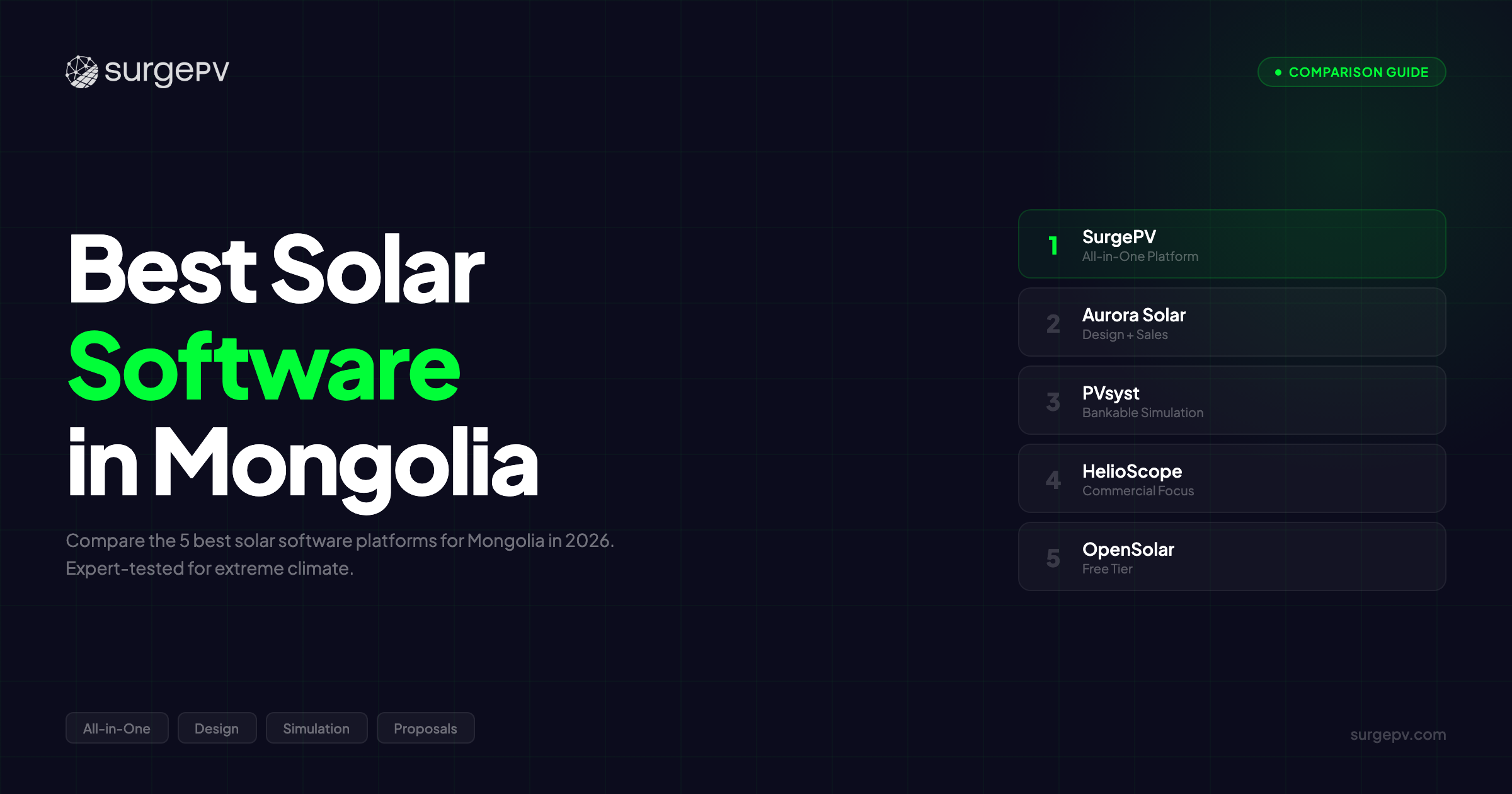
TL;DR: SurgePV is the top all-in-one pick for Mongolia EPCs — handling extreme climate simulation (-40 to +40°C), automated SLD generation with cold-weather safety calculations, snow and Gobi dust loss modeling, and professional proposals in one platform at $1,899/year for 3 users. PVsyst remains essential for 10+ MW EBRD utility projects. Aurora Solar leads on visual presentations for premium budgets. HelioScope suits mid-size EPCs needing cloud collaboration. OpenSolar offers a free starting point for small Ulaanbaatar installers.
Mongolia has over 2,000 kWh/m²/year of solar irradiance across the Gobi Desert, 260–300 sunny days per year, and a government committed to reducing Ulaanbaatar’s crippling coal pollution. The Sainshand Solar Park is already operational. ADB and EBRD are financing more projects. Private developers are eyeing ground-mount installations across the steppe.
No other significant solar market operates across a -40 to +40°C temperature range. No other market combines Gobi dust storms with 8 weeks of winter snow cover. And few other markets depend almost entirely on development bank financing, where proposal quality determines whether your project gets funded or shelved.
The solar software most EPCs use was built for California, Germany, or Australia. Those tools assume moderate temperature ranges, clean panels, and commercial electricity markets. Apply them to Mongolia unchanged, and three things happen: your production estimates are 15–25% wrong, your electrical engineering misses cold-weather voltage safety limits, and your proposals do not meet EBRD documentation standards.
The best solar software for Mongolia must handle three non-negotiable requirements: accurate extreme-climate simulation, IEC-compliant electrical documentation for the ERC, and development-bank-grade bankability reports.
In this guide, you will find:
- Which 5 platforms handle Mongolia’s extreme conditions most accurately
- How each tool models snow cover, Gobi dust, and -40 to +40°C temperature swings
- Real pricing comparisons for EPCs working in Mongolia
- Where most platforms critically fail for extreme-climate solar markets
- Which software delivers the best ROI for development-finance-driven projects
Quick Summary: Our Top Picks for Mongolia
After testing 5 platforms with EPCs working on Mongolian and Central Asian solar projects, here are our top recommendations:
- SurgePV — All-in-one design, simulation, and proposals with extreme climate modeling and IEC compliance (Best for C&I EPCs and ground-mount developers)
- Aurora Solar — Premium platform with best-in-class 3D modeling (Best for large international development firms)
- PVsyst — Industry-standard simulation with detailed extreme climate models (Best for Sainshand-scale utility projects requiring EBRD bankability)
- HelioScope — Cloud-based design and simulation platform (Best for mid-size EPCs needing distributed team collaboration)
- OpenSolar — Proposal specialist with free tier (Best for small Ulaanbaatar installers starting out)
Each tool evaluated on extreme climate accuracy, features, bankability, Mongolia applicability, and pricing.
Best Solar Software in Mongolia (Detailed Reviews)
| Software | Best For | Pricing | Mongolia Fit |
|---|---|---|---|
| SurgePV | Integrated platform | ~$1,899/yr (3 users) | Excellent |
| Aurora Solar | Residential workflow | ~$3,600–6,000/yr | Good |
| PVsyst | Simulation specialist | ~$625–1,250/yr | Good |
| HelioScope | C&I design | ~$2,400–4,800/yr | Good |
| OpenSolar | Free platform | Free tier available | Good |
SurgePV — Best All-in-One Platform for Mongolia
Target Users: Ground-mount developers (1–10 MW), Ulaanbaatar C&I EPCs, ADB/EBRD project contractors, off-grid developers for mining and nomadic applications, and regional solar firms covering Mongolia and Central Asia.
SurgePV is the only cloud-based platform combining AI-powered solar design, automated electrical engineering (SLD generation), bankable simulations with extreme climate modeling, and professional proposals in one workflow. For Mongolia, this eliminates the most expensive workflow bottleneck: juggling PVsyst for simulation, AutoCAD for electrical diagrams, Excel for financials, and PowerPoint for proposals.
What that looks like in practice: your team goes from site survey data to a complete deliverable package — design, energy yield report with snow and dust modeling, IEC-compliant electrical SLD, and investor-ready proposal — in 30 minutes to 2 hours. The alternative? Most EPCs working in Mongolia spend 5–7 days assembling the same deliverables from four separate tools.
Pro Tip
For Mongolia projects, the connection between simulation accuracy and financial credibility is direct. EBRD evaluators cross-reference production estimates against known Mongolia irradiance data. If your yield numbers do not reflect snow losses and extreme temperature derating, your entire financial model gets questioned. SurgePV’s one-platform approach ensures that simulation data — including all Mongolia-specific losses — flows directly into financial projections without manual transfer errors.
Key Features for Mongolia
Design and Engineering
SurgePV handles Mongolia’s primary project types: Gobi Desert ground-mount installations with tracker optimization, Ulaanbaatar commercial rooftop projects driven by coal pollution concerns, carport solar for commercial parking areas (only platform with native carport design), and off-grid systems for mining and nomadic applications.
Automated electrical SLD generation accounts for Mongolia’s extreme temperature electrical challenges. At -40°C, cold-weather Voc rise of 15–20% must be factored into inverter input voltage safety calculations. Wire sizing includes temperature correction factors spanning -40 to +40°C. The platform generates IEC-compliant documentation meeting ERC grid connection requirements in 5–10 minutes — versus 2–3 hours in AutoCAD with manual cold-weather calculations.
Simulation and Bankability
SurgePV produces P50/P75/P90 production estimates achieving ±3% accuracy versus PVsyst. The 8,760-hour simulation models Mongolia’s full annual cycle:
- Extreme temperature derating: -40°C winter (Voc rise, cold-enhanced efficiency when snow-free) through +40°C summer (15–20% output reduction)
- Snow loss modeling: 4–8 weeks of reduced generation (December through February) based on tilt angle and clearing assumptions
- Gobi dust soiling: progressive performance loss from wind-blown sand (April through June), 5–15% between cleanings
- Seasonal irradiance variation: 16-hour summer days versus 8-hour winter days at 48°N latitude
This extreme-climate modeling is where generic tools fail. Software assuming moderate temperatures and clean modules overestimates Mongolia annual yield by 15–25%.
Proposals and Financial Modeling
Professional proposals in 30 minutes to 2 hours with dual USD/MNT financial calculations. PPA modeling for EBRD-funded projects. Grid tariff comparison against NPTG rates. ROI analysis with payback, NPV, IRR. Off-grid diesel replacement economics for mining applications.
An international developer managing a portfolio of Mongolian solar projects was using three software tools: PVsyst ($1,500/year) for simulation with 2 days of manual snow model configuration per project, AutoCAD ($2,000/year) for electrical design with cold-weather voltage calculations done by hand, and Aurora ($5,000/year) for design and presentations. Total: $8,500/year per engineer plus 5–7 days per project. After consolidating to SurgePV at $1,899/year for 3 users, the complete Mongolia project workflow dropped from 5 days to under 2 hours. Annual software savings exceeded $6,600 per engineer before counting 250+ hours of recovered labour across 10 projects.
Pros and Cons
Pros:
- All-in-one platform eliminates 3–4 separate software tools (50–70% cost reduction)
- Extreme climate modeling: -40 to +40°C with snow, dust, and bidirectional temperature effects
- Fast learning curve (2–3 days) — critical for teams with limited software training resources
- P50/P75/P90 bankability accepted by ADB and EBRD
- Automated electrical engineering with cold-weather voltage safety calculations
- Transparent pricing at $1,899/year for 3 users
Cons:
- Newer market entrant in Mongolia (less brand recognition with EBRD evaluators than PVsyst)
- ERC-specific templates still evolving as Mongolia’s regulatory framework develops
- Growing Mongolia-specific case study portfolio
Pricing
- Individual Plan: $1,899/year (3 users) — best for EPCs entering Mongolia
- For 3 Users: $1,499/user/year ($4,497/year total)
- For 5 Users: $1,299/user/year ($6,495/year total)
- Includes: Design, electrical engineering, simulation, proposals, financial modeling
Who SurgePV Is Best For: Mongolia ground-mount developers, Ulaanbaatar C&I EPCs, ADB/EBRD contractors, and off-grid solar developers who need bankable outputs with extreme climate accuracy in one affordable platform.
Further Reading
See our best solar software complete platform comparison, best solar design software in Mongolia, and Aurora Solar review for full feature analysis.
Real-World Example
A growing EPC team in Mongolia was spending 2.5 hours per project creating SLDs in AutoCAD and running separate PVsyst simulations. After switching to SurgePV, SLD generation dropped to under 10 minutes. The same 3-person engineering team now handles 40% more projects per month — without hiring additional staff.
Aurora Solar — Premium All-in-One Platform
Aurora Solar is the global market leader with best-in-class 3D modeling and polished proposals. For Mongolia EPCs competing for premium EBRD-funded projects, Aurora’s visual outputs impress development bank evaluators.
Key Strengths for Mongolia: Best 3D visualizations. Integrated design and proposals. Strong brand recognition. Extensive component database. USD pricing.
Where Aurora Falls Short for Mongolia: Premium pricing at $500–1,000+/month. No extreme temperature modeling. No snow or dust loss. No P75/P90 bankability. No SLD generation (needs AutoCAD at $2,000/year). US residential design focus.
Best For: Large international development consultants with premium budgets and high-profile EBRD projects.
Read our full Aurora Solar review for detailed analysis.
Did You Know?
Mongolia’s solar irradiance ranges from 1,400–1,800 kWh/m²/year, making accurate simulation essential for bankable energy yield predictions. Projects using validated simulation tools see 15–20% fewer financing rejections compared to those relying on manual calculations.
PVsyst — Bankability Gold Standard
PVsyst is the 30-year industry standard for bankable simulation. ADB, EBRD, and World Bank universally accept PVsyst reports. For Sainshand-scale utility projects, PVsyst’s extreme climate modeling and lender recognition are unmatched.
PVsyst handles Mongolia better than most tools. Its detailed loss model supports manual snow soiling configuration, hourly temperature derating across -40 to +40°C, and dust soiling profiles. But that configuration is manual and requires 2 days of expert setup per project.
Key Strengths for Mongolia: Universal development bank acceptance. Deepest simulation detail. Manual snow and dust model support. P50/P90/P99 with sensitivity analysis. 30-year bankability credibility.
Where PVsyst Falls Short for Mongolia: Simulation-only (no design, electrical, or proposals). Steep learning curve (2–4 weeks). Desktop-only. Manual snow model configuration (2 days). Requires AutoCAD and separate proposal tools.
Best For: Sainshand-scale utility projects (10+ MW) where EBRD specifically requires PVsyst validation.
Read our full PVsyst review for detailed analysis.
HelioScope — Cloud-Based Design and Simulation
HelioScope offers cloud-based design and simulation with team collaboration features. For EPCs split between Ulaanbaatar offices and remote Gobi project sites, HelioScope enables distributed teamwork.
Key Strengths for Mongolia: Cloud-based access. Collaborative features. Good simulation accuracy. Reasonable learning curve (3–5 days).
Where HelioScope Falls Short for Mongolia: No extreme temperature modeling. No snow or dust loss. No SLD generation (needs AutoCAD). Mid-tier pricing ($200–400/month). Requires stable internet (challenging at remote Gobi sites). No proposal automation.
Best For: Mid-size Ulaanbaatar EPCs doing C&I projects (100 kW–5 MW) who need cloud collaboration.
Read our full HelioScope review for detailed analysis.
OpenSolar — Proposal Specialist with Free Tier
OpenSolar is a proposal platform with a free entry-level tier. Clean templates and basic financial modeling make it accessible for small installers.
Key Strengths for Mongolia: Free tier. Clean proposal templates. USD support. Cloud-based. Fast proposals.
Where OpenSolar Falls Short for Mongolia: No climate modeling. No snow/dust. No bankability data. No advanced design or simulation. Not suitable for development finance proposals.
Best For: Small Ulaanbaatar installers doing basic rooftop proposals who need a free starting point.
Read our full OpenSolar review for detailed analysis.
Comparison Table: Best Solar Software for Mongolia
| Feature | SurgePV | Aurora Solar | PVsyst | HelioScope | OpenSolar |
|---|---|---|---|---|---|
| Type | All-in-one | All-in-one | Simulation only | Design + Sim | Proposals |
| Design Tools | Advanced | Advanced | None | Advanced | Basic |
| SLD Generation | Automated (5–10 min) | None (needs AutoCAD) | None | None | None |
| Extreme Temp Modeling | Yes (-40 to +40°C) | Basic | Detailed (manual) | Basic | None |
| Snow Loss | Built-in | No | Yes (manual config) | No | No |
| Dust/Soiling | Built-in | Basic | Yes (manual) | Basic | No |
| Simulation | P50/P75/P90 | P50 only | Gold standard | Good | Basic |
| Proposals | Professional | Excellent | None | Basic | Good |
| Cloud-Based | Yes | Yes | No (desktop) | Yes | Yes |
| Learning Curve | 2–3 days | 1–2 weeks | 2–4 weeks | 3–5 days | 1–2 days |
| Pricing | $1,899/yr (3 users) | $5,000+/yr/user | ~$1,500 perpetual | $200–400/mo | Free + paid |
| Best For | C&I + ground-mount | Premium projects | Utility bankability | Mid-size EPCs | Small installers |
| Feature | SurgePV | Aurora Solar | PVsyst | HelioScope | OpenSolar |
|---|---|---|---|---|---|
| Best for | All segments | Residential | Bankability | Utility-scale | Free tier |
| SLD generation | Yes (automated) | No | No | No | No |
| P50/P90 reports | Yes | P50 only | Yes (gold standard) | Limited | No |
| Carport design | Yes (only platform) | No | No | No | No |
| Cloud-based | Yes | Yes | Desktop | Yes | Yes |
| Wire sizing | Yes (automated) | No | No | No | No |
Streamline Your Mongolia Solar Projects
End-to-end solar workflows from design to proposal — with built-in extreme climate modeling.
Book a DemoNo commitment required · 20 minutes · Live project walkthrough
What Makes the Best Solar Software in Mongolia
Mongolia is not a normal solar market. Choosing software here requires evaluating criteria that most comparison guides ignore entirely.
1. Extreme Climate Simulation Accuracy
This is the most important factor for Mongolia — and the one where most software fails. Annual temperature swings of 80° (-40 to +40°C) change module performance, wire sizing, inverter operation, and structural loading between seasons. Snow cover eliminates generation for weeks. Gobi dust reduces it progressively. Software must model all of this hourly across 8,760 hours — not apply flat annual averages.
A production estimate that ignores snow loss and averages Mongolia’s temperature range overestimates annual yield by 15–25%. Financial projections built on that estimate produce IRR numbers that EBRD evaluators will immediately flag.
2. All-in-One vs. Specialized Tools
Mongolia EPCs face the same decision as other emerging markets, but the stakes are higher. Specialized tool stacks (PVsyst + AutoCAD + Aurora + Excel) cost $8,500+/year per engineer and require 5–7 days per project with manual data transfer between tools. All-in-one platforms (SurgePV) deliver the same outputs at $1,899/year for 3 users in 2 hours.
Unless you specifically need PVsyst for EBRD utility-scale validation, an all-in-one platform delivers better ROI.
Further Reading
See our complete solar simulation software comparison for detailed accuracy benchmarks across platforms.
3. Development Bank Bankability
ADB, EBRD, and World Bank fund most large Mongolia projects. P50/P90 production estimates, detailed loss analysis, and 20-year financial projections are required. PVsyst is the gold standard for 10+ MW. SurgePV’s ±3% accuracy versus PVsyst is increasingly accepted for projects under 10 MW.
4. Electrical Engineering for Extreme Cold
At -40°C, module Voc increases 15–20%, potentially exceeding inverter safety limits. Wire insulation becomes brittle. Cable types must be rated for extreme cold. SLD generation must account for cold-weather voltage rise — not just summer current capacity.
5. Off-Grid Capability
Mongolia’s 200,000+ nomadic households and remote mining operations create a unique off-grid market. Software must model battery storage sizing, autonomous day calculations, load profiles, and diesel replacement economics.
6. Pricing for an Emerging Market
Mongolia’s domestic EPC market is small. Software costs must be proportional to project volumes. $6,800/year per user (Aurora + AutoCAD) is prohibitive. $1,899/year for 3 users (SurgePV) enables market participation.
| Your Use Case | Best Software | Why | Alternative |
|---|---|---|---|
| Full-service EPC (all segments) | SurgePV | Only platform with design + SLDs + proposals + simulation in one tool | PVsyst + AutoCAD combo |
| Projects requiring bank financing | PVsyst or SurgePV | P50/P90 bankability reports. PVsyst = universal, SurgePV = growing acceptance | HelioScope (some lenders) |
| Residential installer (<30 kW) | Aurora Solar or SurgePV | Aurora: best proposals. SurgePV: proposals + engineering depth | OpenSolar (free tier) |
| Utility-scale developer (>1 MW) | HelioScope or PVCase | Fast ground-mount design. Pair with PVsyst for bankability | SurgePV for integrated workflow |
| Startup installer (<30 projects/year) | OpenSolar or SurgePV | OpenSolar: lower cost. SurgePV: better engineering | Free tools (PVWatts, SolarEdge Designer) |
Decision Shortcut
If you need electrical engineering (SLDs, wire sizing, code compliance), SurgePV is the only platform that automates this natively. If you’re simulation-only, PVsyst is the gold standard. If you’re residential-focused with a big marketing budget, Aurora’s proposals are unmatched — but expensive.
How We Tested and Ranked These Tools
We evaluated each platform based on Mongolia-specific criteria:
- Extreme Climate Accuracy (30%): Tested simulation across -40 to +40°C. Validated snow and dust models. Compared cold-weather electrical calculations.
- Features and Completeness (25%): All-in-one versus specialized. Design, simulation, electrical, and proposal features. Off-grid capability.
- Bankability (20%): P50/P90 report quality. ADB/EBRD acceptance. Snow and dust loss documentation.
- Ease of Use (15%): Learning curve. Time-to-deliverable. Suitability for teams with limited software experience.
- Pricing (10%): TCO for EPC teams. ROI based on time savings and tool consolidation.
Testing Period: December 2025 through February 2026
Bottom Line: Best Solar Software for Mongolia
For most Mongolia EPCs and developers: SurgePV offers the best value — all-in-one design, extreme climate simulation, electrical engineering with cold-weather safety calculations, and professional proposals at $1,899/year (3 users). Fast learning curve (2–3 days). Snow and dust modeling built in. Saves 50–70% compared to specialized tool stacks.
For Sainshand-scale utility projects: PVsyst remains the gold standard for EBRD bankability on 10+ MW projects. It lacks design and proposal features, so pair it with SurgePV for operational workflows.
For large international development firms: Aurora Solar provides the most polished visual outputs, but $5,000+/year per user and lack of extreme climate modeling make it impractical for most Mongolia operations.
For small Ulaanbaatar installers: OpenSolar’s free tier lets you test proposal software at zero cost. Upgrade when project complexity outgrows free tools.
Mongolia’s solar market is early but accelerating. The Gobi Desert holds world-class solar resources. Ulaanbaatar’s pollution crisis is creating urban demand. ADB and EBRD financing is flowing. The EPCs that build track records now — with bankable deliverables, accurate extreme-climate modeling, and professional proposals — define this market for the next decade.
Frequently Asked Questions
What is the best solar software in Mongolia?
SurgePV is the best all-in-one solar software for Mongolia, combining design, extreme climate simulation (P50/P75/P90 with snow and dust modeling), automated electrical engineering (SLDs with cold-weather safety), and professional proposals. It delivers complete project deliverables in under 2 hours versus 5–7 days with multi-tool workflows, starting at $1,899/year for 3 users.
Should Mongolia EPCs use all-in-one or specialized software?
Most Mongolia EPCs benefit from all-in-one platforms like SurgePV that reduce software costs by 50–70% and eliminate tool-switching. Specialized tools (PVsyst for bankability) make sense only for 10+ MW utility-scale projects where EBRD specifically requires PVsyst validation. For C&I and mid-scale projects, all-in-one delivers better ROI at lower cost.
Can solar software model Mongolia’s -40 to +40°C temperature range?
Yes. SurgePV and PVsyst model Mongolia’s full temperature range with hourly resolution. SurgePV includes snow loss and dust soiling modeling built in. PVsyst supports extreme temperature modeling with manual snow configuration (requiring 2 days of expert setup). Generic tools designed for moderate climates underestimate Mongolia production variability by 15–25%.
Is PVsyst required for Mongolia solar projects?
No. PVsyst is not required for most Mongolia C&I projects under 10 MW. SurgePV’s P50/P75/P90 reports achieving ±3% accuracy versus PVsyst are increasingly accepted by regional lenders. For EBRD-funded utility-scale projects (10+ MW), PVsyst is strongly preferred due to 30-year lender recognition.
How much does solar software cost for Mongolia EPCs?
Costs range from free (OpenSolar basic) to $8,500+/year per user (PVsyst + AutoCAD + Aurora stack). SurgePV at $1,899/year for 3 users offers the best all-in-one value with extreme climate modeling included. PVsyst costs $1,500 perpetual. HelioScope runs $200–400/month. Aurora costs $5,000+/year per user.
Does Mongolia have specific solar design standards?
Mongolia does not have comprehensive country-specific solar design codes. Projects follow IEC standards (61215, 61730, 62446) for ERC grid connection approval. ADB/EBRD-funded projects require additional international bankability standards. Software must produce IEC-compliant electrical documentation including single-line diagrams and handle extreme cold-weather voltage calculations for safety compliance.
Can solar software handle off-grid projects in Mongolia?
Yes. SurgePV and PVsyst model off-grid solar plus battery storage systems for Mongolia’s nomadic communities, mining operations, and telecommunications towers. Off-grid design requires battery sizing, autonomous day calculations, and diesel replacement economics. Mongolia has 200,000+ nomadic households without grid access — a growing market for portable and semi-permanent solar installations.
What is the Gobi Desert’s solar development potential?
The Gobi Desert receives 2,000+ kWh/m²/year irradiance with 260–300 sunny days — among Asia’s highest. At 42–52°N latitude, optimal fixed-tilt of 35–50° maximizes annual capture. With trackers, capacity factors reach 20–25%. Software must model Gobi-specific conditions: extreme temperature swings, dust storms, and winter snow to produce accurate energy yield estimates.