

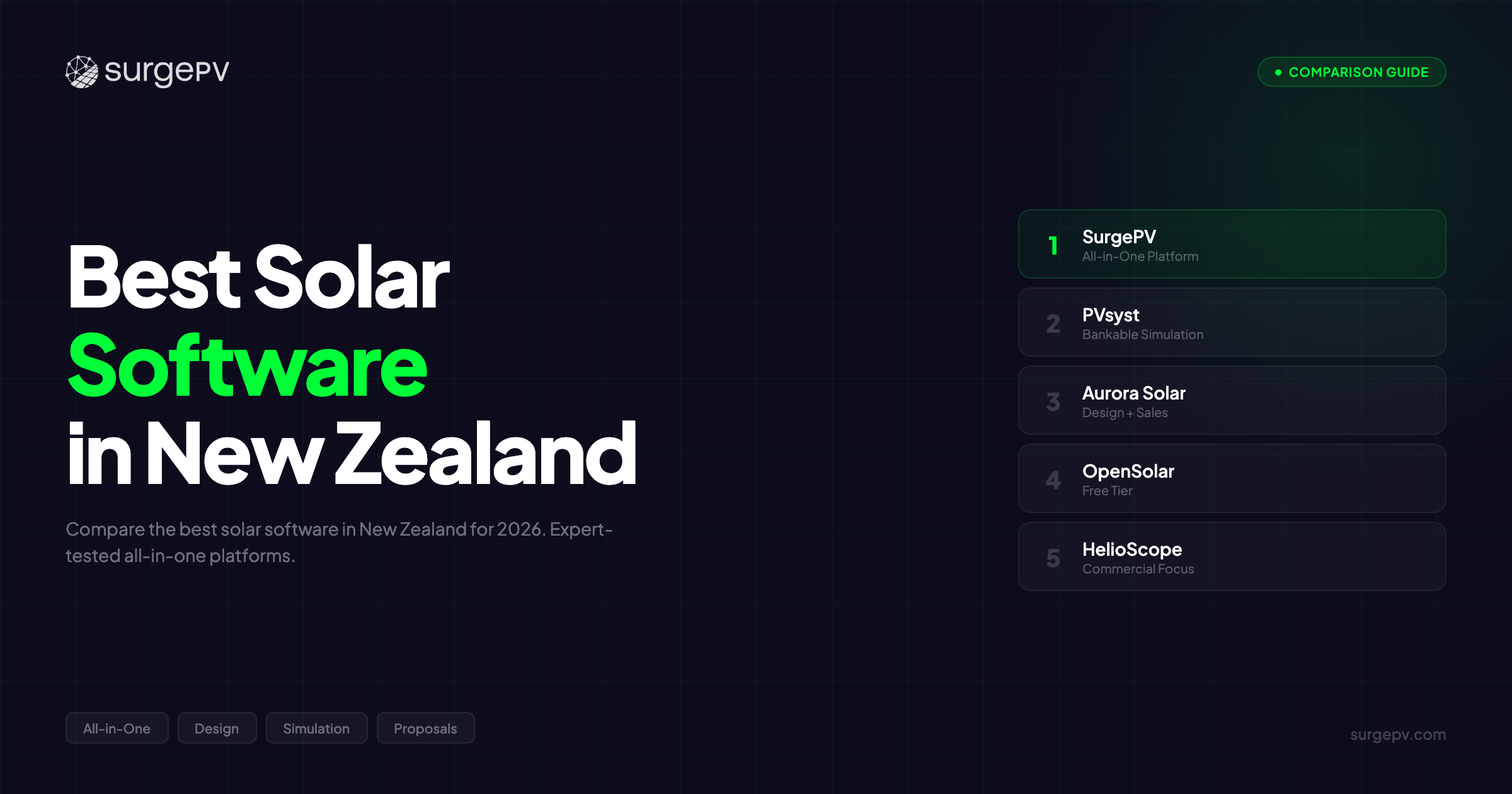
TL;DR: SurgePV is the best all-in-one solar software for New Zealand, combining AS/NZS compliant design, P50/P75/P90 bankable simulation, automated electrical engineering (SLDs, wire sizing), and NZ-ready proposals with 40+ retailer tariff plans, lines company charges, and ANZ/ASB financing integration. PVsyst remains the gold standard for utility-scale bankability. Aurora Solar suits established residential teams with premium budgets. OpenSolar is the free entry point for small installers. HelioScope works for utility-scale developers who prioritize cloud-based design.
New Zealand’s solar market is expanding 35%+ annually. Auckland installers are booking residential systems months in advance. Canterbury solar farms are scaling. Wellington commercial rooftop projects are multiplying. The opportunity is real.
But here is the bottleneck that slows every NZ solar business: the tools. A typical NZ installer uses one tool for design, switches to PVsyst for simulation, opens a separate program for electrical calculations (AS/NZS 3000 wire sizing, SLD generation), then builds proposals in yet another tool. Four software subscriptions. Manual data transfer between each. Every time someone re-enters a number, there is a chance for error.
The cost adds up. Not just in subscriptions — which can easily exceed NZD $1,500/month for a multi-tool stack — but in time. A commercial project that takes 3 days through a fragmented workflow could take 30-45 minutes through an integrated one.
The best solar software for New Zealand must address what makes this market different: AS/NZS compliance (3000:2018, 4777.2:2020), NZD pricing with 15% GST, tariff libraries covering 20+ electricity retailers, lines company charge variations, and bankability standards that NZ financiers accept.
In this guide, you’ll find:
- Which 5 platforms align best with NZ solar business needs
- How each tool handles AS/NZS compliance and NZ-specific requirements
- Where all-in-one platforms beat specialized tool stacks (and where they don’t)
- Real pricing comparisons for NZ solar businesses
- Which software fits your business size and project type
Quick Summary: Our Top Picks for New Zealand
After testing 5 platforms with solar businesses across New Zealand, here are our top recommendations:
| Software | Best For | Pricing | New Zealand Fit |
|---|---|---|---|
| SurgePV | Integrated platform | ~$1,899/yr (3 users) | Excellent |
| PVsyst | Simulation specialist | ~$625-1,250/yr | Good |
| Aurora Solar | Residential workflow | ~$3,600-6,000/yr | Good |
| OpenSolar | Free platform | Free tier available | Good |
| HelioScope | C&I design | ~$2,400-4,800/yr | Good |
- SurgePV — All-in-one design, simulation, electrical, and proposals with AS/NZS compliance (Best for most NZ solar businesses from residential to commercial)
- PVsyst — Industry-standard simulation accepted by all NZ financiers (Best for utility-scale projects requiring ANZ/ASB/Westpac financing)
- Aurora Solar — Premium residential design and proposals (Best for established residential teams with premium budgets)
- OpenSolar — Affordable proposal and basic design tools (Best for small residential installers under 100 systems/year)
- HelioScope — Cloud-based utility-scale design and simulation (Best for utility-scale developers doing 5+ MW projects)
Each tool evaluated on ease of use, AS/NZS compliance, NZ-specific features, bankability, and value.
Best Solar Software in New Zealand (Detailed Reviews)
SurgePV — Best All-in-One Platform for NZ Solar Businesses
Target Users: Residential installers scaling to commercial, commercial solar EPCs (50 kW-5 MW), multi-office NZ companies, and solar businesses wanting one platform instead of four.
SurgePV integrates solar design, automated electrical engineering (AS/NZS 3000 SLDs, wire sizing), bankable P50/P75/P90 simulations, and professional proposals in one cloud-based platform. For NZ solar businesses, this means one subscription replaces four — and the data flows automatically between every stage.
What does that look like in practice? A sales rep enters a customer address. The design engine pulls satellite imagery and models the roof. The shadow analysis runs 8,760 hours of sun position data. The simulation generates bankable production estimates. Electrical calculations size wires and generate AS/NZS-compliant SLDs. And the proposal pulls all of this into a branded PDF with NZD pricing, 15% GST, the customer’s Genesis or Contact Energy tariff, and ANZ GreenLoan monthly payments.
Total time: 30-45 minutes. Total tools: one.
Pro Tip
NZ’s AS/NZS 3000:2018 wire sizing and AS/NZS 4777.2 inverter compliance requirements add engineering hours to every project. SurgePV automates these calculations, reducing what typically takes 2-3 hours of manual work to minutes. That time savings multiplied across 200+ projects per year is significant.
Key Features for New Zealand
AS/NZS Compliance
Automated AS/NZS 3000:2018 SLD generation produces electrical documentation that EWRB-registered electricians and local councils accept. AS/NZS 4777.2:2020 compliant inverter library ensures grid-connected systems meet Transpower and lines company distributed generation requirements. Wire sizing calculations follow NZ standards with voltage drop verification.
NZ Financial Modeling
Native NZD with automatic 15% GST. Tariff library covering 40+ NZ retailer plans (Genesis, Contact, Meridian, Mercury, Powershop, Flick, Electric Kiwi). Lines company network charges for Vector, Orion, Powerco, Wellington Electricity, and Unison. The financial modeling tool generates 25-year projections with NPV, IRR, LCOE, and payback.
ANZ GreenLoan, ASB Energy Loan, and Harmoney financing calculators show monthly payment versus savings comparisons that close residential deals. For commercial projects, the tool models demand charge reduction, net metering benefit, and export revenue at retailer-specific buy-back rates.
Bankable Simulation
P50/P75/P90 production estimates achieving ±3% accuracy versus PVsyst. NIWA weather data integration for NZ-specific solar resource assessment. For commercial projects seeking ANZ, ASB, or Westpac financing, bankable reports include uncertainty analysis and exceedance probability.
Proposal Generation
Professional NZ-branded proposals in 15-20 minutes. Customizable templates with your company identity, 3D roof visualizations, financial charts, equipment specifications, and legal disclaimers aligned with NZ Consumer Guarantees Act requirements. E-signature capability for online acceptance. Multi-site portfolio proposals for commercial chains.
Pros and Cons
Pros:
- All-in-one replaces 3-4 separate tools (saves 50-70% on software costs)
- AS/NZS 3000/4777.2 compliance automated
- NZ-specific: NZD, GST, 40+ tariff plans, lines company charges, NZ financing
- P50/P75/P90 bankability for ANZ/ASB/Westpac acceptance
- 30-45 minute complete workflow (design + electrical + simulation + proposal)
- Cloud-based from Auckland to Invercargill
Cons:
- More capability than needed for very small residential-only operations
- AS/NZS updates require periodic platform updates
- Newer entrant compared to PVsyst’s 30-year track record with banks
Pricing
- Individual Plan: $1,899/year (3 users) — approximately NZD $3,100/year
- For 3 Users: $1,499/user/year ($4,497/year total) — approximately NZD $7,400/year
- For 5 Users: $1,299/user/year ($6,495/year total) — approximately NZD $10,700/year
Compare to a typical multi-tool NZ stack: Aurora ($5,000+/yr) plus PVsyst ($2,800 NZD perpetual + maintenance) plus AutoCAD ($2,000/yr) = NZD $10,000+/year for one user.
Real-World Example
A growing EPC team in New Zealand was spending 2.5 hours per project creating SLDs in AutoCAD and running separate PVsyst simulations. After switching to SurgePV, SLD generation dropped to under 10 minutes. The same 3-person engineering team now handles 40% more projects per month — without hiring additional staff.
Further Reading
Best Solar Software (2026) — Complete platform comparison. Aurora Solar Review — Full feature deep-dive.
PVsyst — Best for Bankable Simulation
PVsyst is the 30-year industry standard for solar simulation, accepted by every major financier worldwide. For NZ utility-scale projects requiring ANZ, ASB, Westpac, or CEFC financing, PVsyst’s bankability reputation is unmatched.
Key Strengths for NZ: Gold standard for bank financing (most trusted by ANZ/ASB/Westpac). Detailed P50/P90 simulation with uncertainty analysis. NIWA weather data support. Suitable for utility-scale projects (5-50 MW Canterbury and Northland solar farms). Detailed loss analysis covering temperature, soiling, shading, and mismatch.
Where PVsyst Falls Short for NZ: Simulation-only (no design, electrical, or proposal tools). Steep learning curve requiring engineering background. Desktop software (not cloud-based, limits field access and team collaboration). Expensive at approximately NZD $2,800 perpetual license plus annual maintenance. Outdated interface.
Best For: Engineering consultancies (Aurecon, Beca), utility-scale developers building 5-50 MW solar farms where ANZ/ASB financing requires PVsyst-level simulation credibility.
Read our full PVsyst review for detailed analysis.
Did You Know?
New Zealand’s solar irradiance ranges from 1,300-1,600 kWh/m²/year, making accurate simulation software essential for bankable energy yield predictions. Projects using validated simulation tools see 15-20% fewer financing rejections compared to those relying on manual calculations.
Aurora Solar — Best for Residential Sales
Aurora Solar is the global market leader in residential solar sales software. Its professional proposals, AI-powered design, and CRM integration support high-close-rate sales processes for established NZ residential installers.
Key Strengths for NZ: Professional proposal quality (high reported close rates). Good sales CRM features for pipeline management. Mobile app for site visits. Brand recognition in AU/NZ market.
Where Aurora Falls Short for NZ: Expensive at USD $250-500/month (NZD $400-800+). Limited AS/NZS 3000 automation (manual compliance work). Residential focus (less suitable for commercial EPCs). Limited NZ tariff library. No native NZD support. No automated SLD generation (requires AutoCAD at $2,000/year additional).
Best For: Established NZ residential installers doing 200+ systems per year with budget for premium tools and separate engineering capability.
Read our full Aurora Solar review for detailed analysis.
OpenSolar — Best Budget Option
OpenSolar provides affordable cloud-based design and proposal tools with AU/NZ market awareness. Its free tier and low-cost paid plans give small NZ installers a starting point for professional proposals.
Key Strengths for NZ: Low cost starting free with paid plans at NZD $100-200/month. Basic design and proposal features. AU/NZ user base with local support. Cloud-based and mobile-friendly. NZD and GST support.
Where OpenSolar Falls Short for NZ: Basic simulation accuracy (not bankable for large projects). Limited AS/NZS automation. No commercial multi-site support. Limited NZ tariff depth. No lines company charge automation.
Best For: Small NZ residential installers doing under 100 systems per year on tight budgets. Good starting point before investing in paid platforms.
Read our full OpenSolar review for detailed analysis.
HelioScope — Best for Utility-Scale
HelioScope offers advanced utility-scale design and simulation with PVsyst-comparable accuracy. Its cloud-based platform suits NZ solar farm developers who need team collaboration without desktop software constraints.
Key Strengths for NZ: Excellent for utility-scale projects (5-50 MW). PVsyst-comparable simulation accuracy. Good for Northland and Canterbury solar farm development. Cloud-based team collaboration.
Where HelioScope Falls Short for NZ: Expensive at USD $500+/month (NZD $800+). Overkill for residential and small commercial. Limited AS/NZS automation. US-centric requiring NZ customization. No proposal tools or SLD generation.
Best For: Utility-scale NZ developers building 5+ MW solar farms where cloud-based simulation and team collaboration are priorities.
Read our full HelioScope review for detailed analysis.
Comparison Table: Best Solar Software for New Zealand
| Feature | SurgePV | PVsyst | Aurora Solar | OpenSolar | HelioScope |
|---|---|---|---|---|---|
| Design Tools | Advanced | None | Good | Basic | Advanced |
| SLD Generation | Automated AS/NZS | None | None (needs AutoCAD) | None | None |
| Simulation | P50/P75/P90 | Gold standard | Basic | Basic | P50/P90 |
| Proposals | Professional NZ | None | Excellent | Good | Basic |
| AS/NZS 3000 | Automated | None | Manual | Manual | Manual |
| NZ Tariff Library | 40+ plans | None | Limited | 10+ plans | None |
| Cloud-Based | Yes | No (desktop) | Yes | Yes | Yes |
| NZD Pricing | ~$250-350/mo | NZD $2,800 perpetual | $400-800/mo | $100-200/mo | $800+/mo |
| Best For | All NZ businesses | Bankability/Utility | Residential teams | Budget/Small | Utility-scale |
How to Choose Solar Software for Your NZ Business
By Business Size
Small installers (under 100 systems/year): Start with OpenSolar (free/low cost) or SurgePV (more features, moderate cost). Avoid PVsyst or HelioScope — overkill and overpriced for your volume.
Mid-size installers (100-500 systems/year): SurgePV. The all-in-one workflow saves hundreds of hours annually. AS/NZS compliance automation pays for itself within the first month.
Large EPCs (500+ systems/year): SurgePV for daily workflows, plus PVsyst for utility-scale projects where bank financing requires the simulation gold standard.
By Project Type
Residential: SurgePV, Aurora (premium), or OpenSolar (budget). NZ tariff accuracy and financing integration matter most.
Commercial (50 kW-5 MW): SurgePV. AS/NZS compliance, bankable simulation, and professional proposals in one platform. Multi-site portfolio capability for retail chains.
Utility-scale (5+ MW): PVsyst or HelioScope for simulation. SurgePV for design and proposals. Consider dual-platform approach for largest projects.
By Budget
Under NZD $200/month: OpenSolar
NZD $200-500/month: SurgePV (best value)
NZD $500-1,500/month: SurgePV plus PVsyst for maximum capability
NZ-Specific Software Requirements
AS/NZS Standards Compliance
NZ solar installations must comply with AS/NZS 3000:2018 (wiring rules), AS/NZS 4777.2:2020 (grid connection of inverter systems), and AS/NZS 5033 (installation and safety of PV arrays). Software that automates wire sizing, SLD generation, and inverter compliance checking reduces engineering hours and errors. SurgePV is the only platform in this comparison with automated AS/NZS compliance features.
NZ Pricing and Tariffs
The NZ electricity market has 20+ retailers with varied tariff structures. Proposals must model the customer’s specific plan. Lines company charges vary by network area and materially impact savings projections. Software must handle NZD currency, 15% GST, export tariff rates (NZD $0.07-0.17/kWh by retailer), and electricity price escalation assumptions.
Bankability for NZ Financiers
Commercial and utility-scale projects seeking ANZ, ASB, Westpac, or CEFC financing require P50/P90 bankability reports. PVsyst is universally accepted. SurgePV’s P50/P75/P90 reports (±3% versus PVsyst) are accepted by most regional lenders for C&I projects. For the largest utility-scale developments, PVsyst remains the standard.
Which Software for Which Use Case
| Your Use Case | Best Software | Why | Alternative |
|---|---|---|---|
| Full-service EPC (all segments) | SurgePV | Only platform with design + SLDs + proposals + simulation in one tool | PVsyst + AutoCAD combo |
| Projects requiring bank financing | PVsyst or SurgePV | P50/P90 bankability reports. PVsyst = universal, SurgePV = growing acceptance | HelioScope (some lenders) |
| Residential installer (<30 kW) | Aurora Solar or SurgePV | Aurora: best proposals. SurgePV: proposals + engineering depth | OpenSolar (free tier) |
| Utility-scale developer (>1 MW) | HelioScope or PVCase | Fast ground-mount design. Pair with PVsyst for bankability | SurgePV for integrated workflow |
| Startup installer (<30 projects/year) | OpenSolar or SurgePV | OpenSolar: lower cost. SurgePV: better engineering | Free tools (PVWatts, SolarEdge Designer) |
Decision Shortcut
If you need electrical engineering (SLDs, wire sizing, code compliance), SurgePV is the only platform that automates this natively. If you’re simulation-only, PVsyst is the gold standard. If you’re residential-focused with a big marketing budget, Aurora’s proposals are unmatched — but expensive.
How We Tested and Ranked These Tools
We evaluated each platform against NZ-specific criteria with installers in Auckland, Wellington, and Christchurch:
| Criteria | Weight | What We Tested |
|---|---|---|
| Ease of Use | 25% | Time to proficiency, learning curve, mobile access |
| Features and Completeness | 25% | Design, simulation, electrical, proposals, project management |
| AS/NZS Compliance | 15% | Wire sizing automation, SLD generation, inverter library |
| NZ Market Features | 15% | NZD, GST, tariff library, financing integration |
| Bankability | 10% | P50/P90 accuracy, lender acceptance |
| Pricing and Value | 10% | TCO for typical NZ business, ROI timeline |
Testing period: November 2025 through January 2026.
Bottom Line: Best Solar Software for New Zealand
For most NZ solar businesses: SurgePV. All-in-one platform with AS/NZS compliance, NZ tariff library, financing integration, and bankable simulation at NZD $250-350/month. Replaces 3-4 separate tools and saves 50-70% on software costs.
For utility-scale bankability: PVsyst. The 30-year gold standard for ANZ/ASB/Westpac project financing. Requires separate design and proposal tools but remains essential for 5+ MW solar farm developments.
For budget-conscious small installers: OpenSolar. Free tier for basic proposals and design. Good starting point before the business outgrows its limitations.
Streamline Your Solar Business with SurgePV
End-to-end solar workflows from design to proposal in one platform — built for New Zealand.
Book a DemoNo commitment required · 20 minutes · Live project walkthrough
Further Reading
See our guide to the best solar design software globally, or compare the best solar proposal software for global rankings.
Frequently Asked Questions
What is the best solar software in New Zealand?
SurgePV is the best all-in-one solar software for New Zealand, combining AS/NZS compliant design, P50/P75/P90 bankable simulation, automated electrical engineering (SLDs, wire sizing), and NZ-ready proposals with 40+ retailer tariff plans, lines company charges, and ANZ/ASB financing integration.
Do NZ solar businesses need AS/NZS compliance in their software?
Yes. AS/NZS 3000:2018 wire sizing and AS/NZS 4777.2:2020 inverter compliance are required for NZ grid-connected solar. Software automating these calculations (SurgePV) saves 2-3 hours per project compared to manual methods. Non-compliant designs get rejected by inspectors and councils.
Is PVsyst necessary for NZ solar projects?
Not for most. C&I projects (50 kW-5 MW) can use SurgePV bankable reports accepted by regional lenders. Utility-scale projects (5+ MW) seeking ANZ, ASB, or Westpac financing typically require PVsyst due to its 30-year reputation. Smaller residential projects do not need PVsyst-level simulation.
How much does solar software cost for NZ businesses?
Costs range from free (OpenSolar basic) to NZD $800+/month (HelioScope). SurgePV at approximately NZD $250-350/month offers the best all-in-one value. A typical multi-tool stack (Aurora + PVsyst + AutoCAD) costs NZD $10,000+/year for one user. SurgePV replaces all three at a fraction of the cost.
Should I use all-in-one or separate specialist tools?
Most NZ solar businesses benefit from all-in-one platforms (SurgePV) that reduce costs, eliminate data re-entry, and ensure consistency between design and proposals. Separate tools make sense only for utility-scale developers who need PVsyst bankability plus specialized design tools.
Can solar software handle NZ electricity tariffs?
SurgePV supports 40+ NZ retailer plans (Genesis, Contact, Meridian, Mercury, Powershop) plus lines company charges (Vector, Orion, Powerco). Most other platforms require manual tariff entry and do not automate lines company charges, which can affect savings projections by 10-20%.
What bankability standards do NZ lenders require?
ANZ, ASB, and Westpac typically require P50/P90 production estimates for commercial financing. PVsyst is universally accepted. SurgePV’s reports (±3% versus PVsyst) are accepted by most regional lenders for C&I projects. For the largest utility-scale projects, dual-platform validation (SurgePV design plus PVsyst simulation) provides maximum lender confidence.
How do I choose software for NZ commercial solar?
For commercial projects (50 kW-5 MW), prioritize: AS/NZS 3000 compliance (automated SLD generation), bankable P50/P90 simulation, multi-site portfolio capability, NZ tariff modeling, and professional proposals. SurgePV covers all of these in one platform, making it the strongest commercial option.