

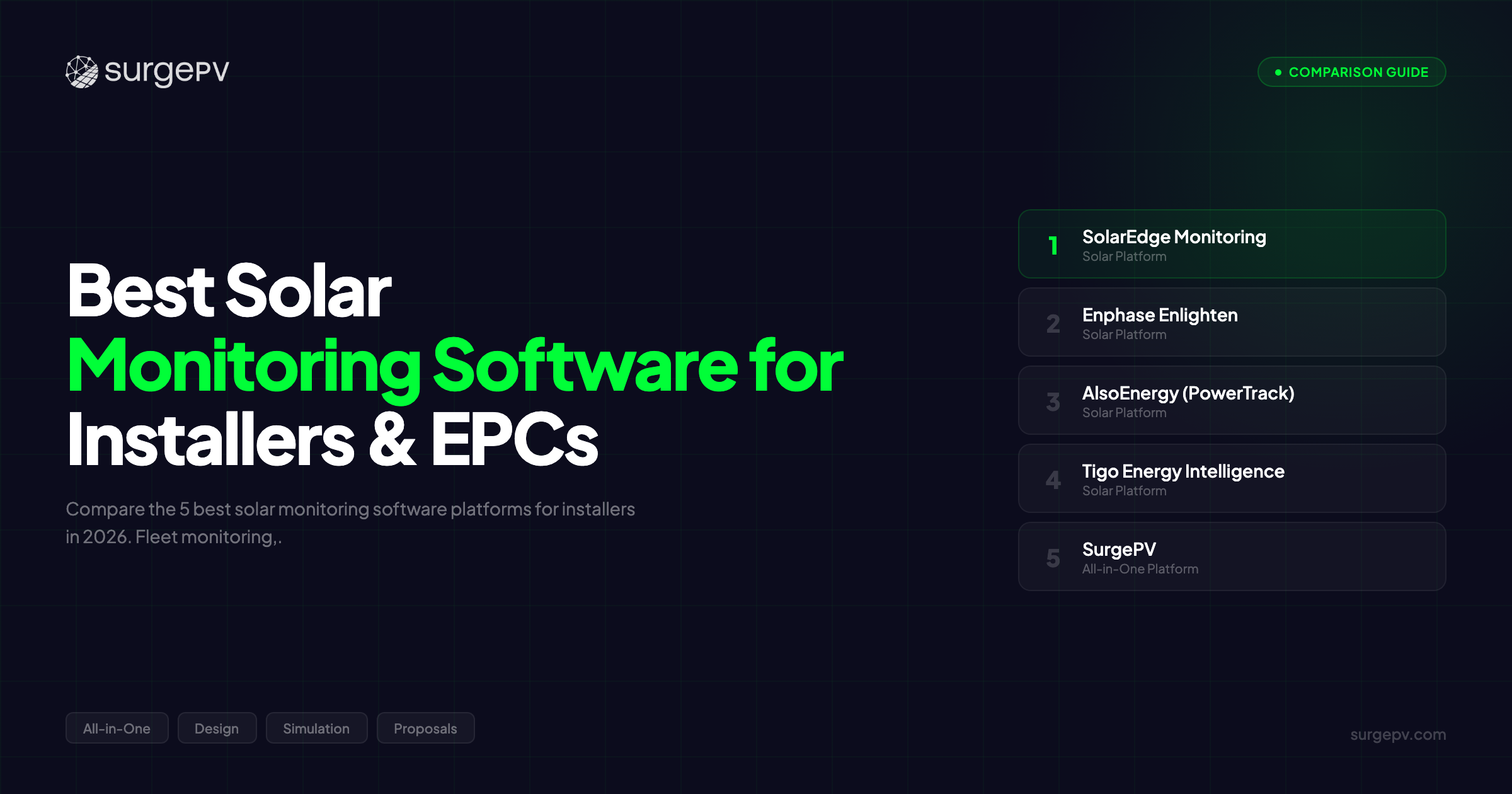
TL;DR: Your inverter manufacturer gives you free monitoring, but it only works with THEIR hardware. For installers managing SolarEdge, Enphase, SMA, and Fronius across 50+ installations, platform-agnostic monitoring eliminates blind spots. SurgePV aggregates all brands into one dashboard with O&M ticketing at $1,899/year. SolarEdge Monitoring and Enphase Enlighten excel for single-brand fleets. AlsoEnergy dominates utility-scale. Tigo leads in safety monitoring.
Your Install Is Done — Now the Real Work Starts
Your install is done.
The customer is happy. The system is live. Production looks good. You collect the final payment and move to the next job.
Three weeks later, the customer calls. Their system has been producing 30% less than promised for the past 14 days. They’re angry. They want answers. You scramble to check the inverter app, only to discover a string failure that happened the day after commissioning.
You missed it because you were checking five different monitoring apps for 80 installations across four inverter brands. By the time you caught it, you’d lost two weeks of production data, customer trust, and the warranty claim window.
Here’s the truth: installation is where most solar design software companies focus their energy. But monitoring is where installers keep customers profitable — and where the recurring revenue opportunity lives. Every installation requires ongoing monitoring. O&M contracts, performance guarantees, warranty validation, and degradation tracking all depend on reliable, real-time monitoring data.
The challenge for professional installers is this: inverter manufacturers give you free monitoring. But it’s hardware-locked. SolarEdge Monitoring only tracks SolarEdge systems. Enphase Enlighten only tracks Enphase. If you’ve installed SolarEdge on 30 residential projects, Enphase on 20 commercial rooftops, SMA on 15 industrial sites, and Fronius on 10 carports, you’re managing four separate monitoring apps with no unified view of fleet health.
That’s where platform-agnostic solar software monitoring changes the game. A single dashboard that aggregates SolarEdge, Enphase, SMA, Fronius, Huawei, and other brands into one portfolio view eliminates blind spots, reduces response time from days to hours, and enables O&M workflows that turn monitoring into recurring revenue.
We tested the top solar monitoring software platforms for professional installers and EPCs. We evaluated multi-brand compatibility, alerting capabilities, O&M integration, performance analytics, and pricing. We ran real installations through each platform to test fault detection, degradation analysis, and portfolio-scale visibility.
In this guide, you’ll learn:
- Which 5 solar monitoring platforms installers trust for fleet management
- Why hardware-locked monitoring fails at portfolio scale
- How platform-agnostic monitoring eliminates the 5-app juggling act
- What KPIs professional monitoring software should track (Performance Ratio, IEC 61724 compliance)
- How monitoring feeds O&M ticketing to reduce truck rolls and improve response times
- Our recommendation by fleet composition: single-brand vs. multi-brand portfolios
What to Look for in Solar Monitoring Software (Buyer’s Guide)
Not all solar monitoring software is built for professional installers. Homeowner monitoring apps show pretty graphs. Professional monitoring platforms prevent revenue loss.
Here’s what separates consumer-grade monitoring from professional fleet management tools.
Multi-Brand Inverter Compatibility
The first question: does the monitoring platform only work with one inverter brand, or can it aggregate data from multiple manufacturers?
Hardware-locked monitoring is free with equipment purchase but creates portfolio fragmentation. If you install SolarEdge on Project A, Enphase on Project B, and SMA on Project C, you’ll toggle between SolarEdge Monitoring, Enphase Enlighten, and SMA Sunny Portal to check system health. Each app has different interfaces, different KPI definitions, and different alert thresholds.
Platform-agnostic monitoring integrates with SolarEdge, Enphase, SMA, Fronius, Huawei, and other major brands via APIs or direct inverter connections. You get one login, one dashboard, one alert system, and unified performance benchmarking across your entire fleet.
An installer managing 100 mixed-brand installations saves 2-3 hours weekly by eliminating app-switching. That’s 120+ hours per year redirected from administrative overhead to billable work.
Alerting and Fault Detection
Real-time alerts are the difference between catching a fault in hours vs. weeks.
Professional monitoring software should send alerts for:
- Inverter offline (communication loss)
- String underperformance (specific string producing 15%+ below expected)
- Ground faults and arc faults
- Weather-corrected underperformance (system underperforming even after accounting for clouds)
- Degradation thresholds (annual performance drop exceeding normal 0.5-0.7%/year)
The best platforms let you customize alert thresholds by project type. A residential 5 kW system might trigger an alert at 20% underperformance. A utility-scale 50 MW plant might alert at 5% because every percentage point represents tens of thousands of dollars in lost revenue.
Portfolio-Scale Dashboard
Can you see 100 installations at a glance, or do you need to click into each system individually?
Portfolio dashboards show:
- Fleet-wide performance ratio compared to expected
- Active alerts across all sites
- Top underperformers (bottom 10% by performance ratio)
- Energy production by site, region, or inverter brand
- SLA compliance (how many tickets resolved within service-level agreements)
The best dashboards let you drill down from portfolio level to site level to string level in three clicks.
O&M Integration
Monitoring detects problems. O&M systems fix them. The integration between the two determines response speed.
Alarm-to-ticket workflows convert monitoring alerts into work orders automatically. When the monitoring platform detects an inverter offline, it creates an O&M ticket, assigns it to a technician, and tracks time-to-resolution.
An installer without alarm-to-ticket automation relies on manual monitoring checks. A fault detected on Wednesday might not generate a work order until Friday. With automation, the ticket is created within minutes of the alert, and a technician is dispatched the same day.
Advanced platforms also support remote diagnostics. Before sending a technician to the site, the monitoring system provides string-level data, inverter error codes, and historical performance trends. This reduces unnecessary truck rolls by 30-40% because you can rule out transient issues (cloud cover, temporary shading) remotely.
Performance Analytics (IEC 61724 Compliance)
IEC 61724 is the international standard for PV system performance monitoring. It defines how to measure performance ratio, specific yield, and system losses in a standardized way.
Why this matters: if your monitoring platform calculates performance ratio differently than your lender’s independent engineer, you’ll spend weeks reconciling data during project finance audits. IEC 61724 compliance ensures everyone uses the same formulas.
Professional monitoring platforms track:
- Performance Ratio (PR): Actual energy yield vs. expected yield after accounting for temperature, soiling, and inverter losses
- Specific Yield (kWh/kWp): Energy produced per installed kilowatt-peak
- System Availability: Percentage of time the system is operational
- Degradation Rate: Annual performance decline (normal is 0.5-0.7%/year; higher rates indicate warranty claims)
- Soiling Losses: Production loss due to dust, dirt, snow, and environmental factors
Platforms that follow IEC 61724 generate bankable reports that lenders, insurers, and independent engineers accept without question.
Mobile Access and API
Can your field technicians access monitoring data from their phones? Can you pull performance data into your ERP or CRM via API?
Mobile apps enable on-site diagnostics. A technician dispatched to investigate an underperforming system can view real-time string data, historical performance, and alert history from the roof.
APIs enable integrations with solar CRM software, ERPs, and business intelligence tools. You can automate monthly performance reports to customers, trigger billing based on actual energy production, and build dashboards that combine monitoring data with financial data.
The Hidden Cost of Single-Brand Monitoring Lock-In
Free monitoring sounds great until you install your second inverter brand.
SolarEdge gives you SolarEdge Monitoring free with every inverter. Enphase includes Enphase Enlighten. SMA provides SMA Sunny Portal. Fronius offers Fronius Solar.web. Every major manufacturer bundles monitoring with hardware because they want to lock you into their ecosystem.
The problem emerges at portfolio scale.
You install SolarEdge on 40 residential projects because your customers demand optimizer-level safety. You install Enphase on 25 commercial rooftops because those buildings have complex shading that benefits from microinverters. You install SMA on 15 ground-mount arrays because those projects need string inverter cost efficiency. You install Fronius on 10 carport installations because Fronius inverters integrate well with DC-coupled storage.
Now you’re monitoring 90 installations across four apps:
- SolarEdge Monitoring for the 40 SolarEdge systems
- Enphase Enlighten for the 25 Enphase systems
- SMA Sunny Portal for the 15 SMA systems
- Fronius Solar.web for the 10 Fronius systems
Each app has different login credentials. Each defines performance metrics differently. Each sends alerts to different email addresses or phone numbers. Each requires separate training for your O&M team.
You spend 15-20 minutes every morning checking four dashboards to understand fleet health. Over a year, that’s 90+ hours of administrative overhead. And you’ll still miss faults that happen between your daily checks because you’re not monitoring continuously.
The aggregator solution eliminates portfolio fragmentation. Platform-agnostic monitoring connects to all four brands via APIs, standardizes KPI definitions, consolidates alerting into one system, and provides a single source of truth for fleet performance.
Bottom line: hardware-locked monitoring is free, but it costs you in time, missed faults, and customer dissatisfaction. Platform-agnostic monitoring charges a subscription fee but eliminates blind spots, reduces response time, and turns monitoring into a profit center through O&M contracts.
Further Reading
Once monitoring detects a fault, your O&M system takes over. See our best solar O&M software comparison to understand how the best platforms close the loop between fault detection and field service.
Top 5 Solar Monitoring Platforms for Installers (2026)
SolarEdge Monitoring — Best Native Device-Level Visibility
Rating: 8.6/10 | Price: Free with SolarEdge hardware | SolarEdge | SolarEdge review
SolarEdge Monitoring is the gold standard for device-level visibility on SolarEdge installations. Because SolarEdge uses DC power optimizers on every panel, the monitoring platform tracks performance at the module level, not just the string level.
Why SolarEdge Monitoring works for single-brand fleets:
You see real-time production, voltage, and current for every optimizer. If Panel 47 on Roof 3 is underperforming by 15%, SolarEdge Monitoring tells you exactly which panel has the problem. You don’t troubleshoot the entire string — you replace one panel.
This module-level granularity is unmatched by string inverter monitoring, which only shows aggregate string performance. If a string produces 20% less than expected, you need to physically inspect every panel in that string to find the faulty one. SolarEdge eliminates the guesswork.
The platform includes mobile apps for iOS and Android, real-time alerts for inverter faults and optimizer failures, historical performance data with customizable date ranges, and weather-normalized performance analysis.
For safety-critical installations, SolarEdge Monitoring also tracks rapid shutdown compliance. When the system detects a fault or receives a shutdown command, the optimizers reduce DC voltage to safe levels within seconds. The monitoring platform logs every rapid shutdown event for safety compliance documentation.
Module-level visibility reduces diagnostic time from hours to minutes. A technician dispatched to investigate underperformance knows which specific panel to replace before leaving the office.
Pros:
- Module-level performance tracking via DC optimizers
- Free with SolarEdge hardware purchase
- Rapid shutdown compliance monitoring
- Mobile app with real-time alerts
- Weather-normalized performance analysis
- Inverter firmware updates via cloud
- Integration with SolarEdge commercial energy management
Cons:
- ONLY works with SolarEdge inverters and optimizers (hardware-locked)
- No multi-brand fleet aggregation
- Limited O&M ticketing capabilities (basic alerts only, no work order management)
- Residential-focused interface (less suited for utility-scale portfolios)
- Performance ratio calculations don’t follow IEC 61724 standardization
Best for: Installers who exclusively install SolarEdge systems and need module-level diagnostics without paying for third-party monitoring. Perfect for residential fleets where safety and granular fault detection justify the optimizer premium.
Enphase Enlighten — Best for Microinverter Fleet Insight
Rating: 8.5/10 | Price: Free with Enphase hardware | Enphase
Enphase Enlighten delivers module-level monitoring for Enphase microinverter installations. Because every panel has its own microinverter, Enlighten shows real-time production, voltage, and current for every module in the array.
Why Enlighten works for Enphase-only fleets:
Microinverter monitoring eliminates the string-level aggregation problem. If one panel underperforms, it doesn’t drag down an entire string. Enlighten identifies the exact underperforming panel and alerts you to the fault.
The platform excels at monitoring complex installations with partial shading, multiple roof planes, and varied orientations. Because each microinverter reports independently, you can see how shading affects individual panels throughout the day. This granularity is critical for commercial rooftops with HVAC equipment, vents, and irregular shading patterns.
Enlighten also tracks Enphase Encharge battery systems and Enphase EV chargers, providing a complete energy ecosystem view. For installers offering solar + storage + EV charging, Enlighten consolidates all three into one monitoring interface.
The platform includes MyEnlighten mobile app, real-time alerts for microinverter faults, production benchmarking against similar systems, and lifetime energy production tracking.
Pros:
- Module-level performance tracking via microinverters
- Free with Enphase hardware purchase
- Excellent for shading analysis and irregular roof layouts
- Battery and EV charger integration (Encharge and EV chargers)
- Production benchmarking against similar-sized systems
- Clean, intuitive interface for homeowner access
- Mobile app with real-time notifications
Cons:
- ONLY works with Enphase microinverters (hardware-locked)
- No multi-brand fleet aggregation
- Limited commercial/utility-scale features (residential-focused)
- Basic O&M capabilities (alerts only, no ticketing)
- Weaker performance analytics vs. utility-grade platforms
Best for: Installers who exclusively install Enphase microinverters and need module-level visibility across complex residential and small commercial rooftops. Ideal for shading-heavy installations where microinverter independence justifies the cost premium.
AlsoEnergy (PowerTrack) — Best for Utility-Scale Monitoring
Rating: 8.8/10 | Price: Custom enterprise pricing | AlsoEnergy
AlsoEnergy PowerTrack is the utility-scale monitoring standard. If you’re developing, owning, or operating multi-megawatt solar plants, PowerTrack provides the enterprise-grade monitoring, SCADA integration, and bankable reporting that lenders and independent engineers require.
Why PowerTrack dominates utility-scale:
Utility-scale plants have different monitoring requirements than residential installations. You need SCADA integration for grid operators, multi-user access control for asset owners and O&M contractors, revenue-grade metering for PPA validation, and IEC 61724-compliant performance reporting for project finance.
PowerTrack delivers all of these. The platform integrates with inverter brands across the industry — SMA, Huawei, Power Electronics, Sungrow, and others — providing multi-brand monitoring in a single dashboard. For a 100 MW plant with 50 MW of SMA inverters and 50 MW of Huawei inverters, PowerTrack aggregates data from both manufacturers without forcing you to check two separate portals.
The platform tracks performance ratio, specific yield, grid availability, curtailment events, and transformer losses with IEC 61724 standardization. It generates P50/P90 reports that independent engineers use for bankability assessments.
PowerTrack also includes advanced diagnostics: string-level fault detection via combiner box monitoring, thermal imaging integration for hotspot detection, and soiling analysis via reference cells.
For O&M workflows, PowerTrack provides work order management, SLA tracking, spare parts inventory, and preventive maintenance calendars. The platform converts performance alerts into field service tickets automatically, reducing response time from days to hours.
Pros:
- Multi-brand inverter support (SMA, Huawei, Power Electronics, Sungrow, etc.)
- Enterprise-grade SCADA integration for grid operators
- IEC 61724-compliant performance reporting
- Bankable P50/P90 yield reports for project finance
- Advanced diagnostics (string-level, thermal imaging, soiling analysis)
- Integrated O&M work order management and SLA tracking
- Revenue-grade metering for PPA validation
- Multi-user access control for asset owners and contractors
Cons:
- Enterprise pricing (custom quotes, typically $10,000+ annually for large plants)
- Overkill for residential and small commercial installations
- Steeper learning curve vs. residential monitoring apps
- Limited customer-facing proposal features (asset-owner focused, not installer-customer)
- Requires professional installation and configuration
Best for: Utility-scale developers, IPPs, and asset managers operating multi-megawatt plants who need bankable performance reporting, SCADA integration, and enterprise O&M workflows. Perfect for installations above 1 MW where monitoring cost is negligible compared to revenue at stake.
Tigo Energy Intelligence — Best for Safety + Fault Detection
Rating: 8.3/10 | Price: Free with Tigo hardware | Tigo Energy
Tigo Energy Intelligence is the monitoring platform for Tigo TS4 module-level power electronics (MLPEs). Tigo specializes in rapid shutdown, module-level monitoring, and safety features, making it the go-to choice for safety-critical installations.
Why Tigo leads in safety monitoring:
Tigo’s core value proposition is rapid shutdown compliance. Under NEC 2017/2020 requirements, PV systems must reduce DC voltage to safe levels within 30 seconds of shutdown activation. Tigo TS4 optimizers provide this safety feature, and Tigo Energy Intelligence logs every shutdown event for compliance documentation.
For installations on schools, hospitals, multi-family housing, and other high-occupancy buildings, rapid shutdown compliance is non-negotiable. Tigo’s monitoring platform tracks shutdown response time, verifies that every optimizer reduces voltage correctly, and generates compliance reports for AHJs and fire marshals.
Beyond safety, Tigo Energy Intelligence provides module-level monitoring similar to SolarEdge and Enphase. You see real-time production, voltage, and current for every panel equipped with a TS4 optimizer. This granularity enables precise fault detection and diagnostic data for field technicians.
The platform also supports Tigo’s Energy Intelligence (EI) Battery monitoring for DC-coupled storage systems.
Pros:
- Module-level monitoring via Tigo TS4 optimizers
- Rapid shutdown compliance tracking and documentation
- Free with Tigo hardware purchase
- Safety features for high-occupancy buildings
- Mobile app with real-time alerts
- DC-coupled battery monitoring (Tigo EI Battery)
- Fault detection with module-level granularity
Cons:
- ONLY works with Tigo TS4 MLPEs (hardware-locked)
- Smaller installed base vs. SolarEdge and Enphase (fewer integrations)
- Limited utility-scale features (residential/commercial focus)
- No multi-brand fleet aggregation
- Basic O&M capabilities (alerts only, no ticketing)
Best for: Installers working on safety-critical installations (schools, hospitals, multi-family) where rapid shutdown compliance justifies Tigo’s MLPE premium. Perfect for jurisdictions with strict NEC 2017/2020 enforcement.
SurgePV — Best for Multi-Brand Fleet Monitoring and O&M
Rating: 9.0/10 | Price: ~$1,899/year (3 users) | Book a demo | See SurgePV pricing
SurgePV is a cloud-based, AI-powered solar design, simulation, and monitoring platform that eliminates the multi-app juggling act for installers managing mixed-brand fleets. If you’ve installed SolarEdge on some projects, Enphase on others, SMA on commercial jobs, and Fronius on ground-mount arrays, SurgePV aggregates all of them into a single portfolio dashboard.
Why SurgePV works for multi-brand fleets:
The platform integrates with SolarEdge, Enphase, SMA, Fronius, Huawei, and other major inverter manufacturers via APIs and direct data connections. You get one login, one dashboard, and unified alerting across your entire fleet.
Here’s what that means in practice: an installer managing 50 SolarEdge systems, 30 Enphase systems, and 20 SMA systems no longer toggles between SolarEdge Monitoring, Enphase Enlighten, and SMA Sunny Portal. SurgePV shows all 100 systems in one portfolio view with standardized performance metrics, unified alert thresholds, and consolidated performance benchmarking.
The monitoring dashboard tracks performance ratio, specific yield, system availability, degradation trends, and weather-corrected underperformance. It follows IEC 61724 methodologies for standardized KPI calculations, ensuring bankable reporting that lenders accept.
Standardized KPIs mean you can compare a SolarEdge residential system in Phoenix against an Enphase commercial rooftop in Seattle using the same performance ratio formula. Without standardization, you’re comparing apples to oranges because SolarEdge calculates PR differently than Enphase.
SurgePV also integrates monitoring with O&M workflows. When the platform detects an inverter offline or string underperformance, it automatically creates an O&M ticket, assigns it to a technician based on location and workload, and tracks time-to-resolution. This alarm-to-ticket automation reduces average response time from 48-72 hours (manual detection) to 4-6 hours (automated ticketing).
The platform includes built-in performance forecasting, comparing actual production against simulated yield to identify underperformance early. If a system produces 15% less than the simulation predicted, SurgePV flags it for investigation, catching degradation, shading changes, and equipment faults before they become warranty claims.
For installers offering O&M contracts, SurgePV turns monitoring into recurring revenue. You can bundle monitoring + O&M ticketing + preventive maintenance into annual service contracts, generating $500-1,500/year per installation in ongoing revenue.
Real-World Example
A California-based installer managing a 75-installation portfolio across SolarEdge (40 systems), Enphase (25 systems), and SMA (10 systems) consolidated monitoring into SurgePV. Before consolidation, they checked three separate apps daily, spending 15-20 minutes each morning on manual monitoring. With SurgePV’s unified dashboard, morning monitoring time dropped to 3-5 minutes. The automated alarm-to-ticket workflow reduced average fault response time from 56 hours to 8 hours. The result: faster fault detection, improved customer satisfaction, and 90+ hours of annual time savings — equivalent to 2+ weeks of engineering capacity redirected to billable design work.
Reader objection: “But my inverter manufacturer already gives me free monitoring. Why pay for SurgePV?” Hardware-locked monitoring is free for a single brand but creates blind spots at portfolio scale. If you only install SolarEdge, SolarEdge Monitoring is the right choice. But if you install SolarEdge on some projects, Enphase on others, and SMA or Fronius on commercial jobs, you need platform-agnostic monitoring to avoid managing 3-4 separate apps. The subscription cost ($1,899/year for 3 users) pays for itself in time savings within 2-3 months for installers managing 30+ mixed-brand installations.
Pros:
- Multi-brand monitoring (SolarEdge, Enphase, SMA, Fronius, Huawei, others)
- Unified portfolio dashboard for mixed-brand fleets
- IEC 61724-compliant performance analytics
- Bankable P50/P75/P90 yield forecasts (+/-3% vs PVsyst accuracy)
- Automated alarm-to-ticket O&M workflows
- Performance vs. forecast comparison (actual vs. simulated yield)
- Built-in SLD generation (5-10 min vs 2-3 hours manual)
- Spanish, German, Italian, French language support
- 70,000+ projects globally, 3-minute average support response
- ~$1,899/year for 3 users (all features included)
Cons:
- Subscription required (not free like hardware-locked monitoring)
- Less granular than SolarEdge/Enphase for module-level diagnostics (depends on inverter data granularity)
- Newer platform vs. established players (less brand recognition in some markets)
Best for: Installers and EPCs managing multi-brand commercial fleets (30-500 installations) who want monitoring, O&M ticketing, and portfolio analytics in one platform. Perfect for installers offering O&M service contracts and performance guarantees across mixed inverter brands.
Pro Tip
SurgePV’s generation and financial modeling tool combines monitoring data with financial projections. Compare actual energy production against financial forecasts to validate payback timelines and catch underperformance that impacts customer ROI.
Solar Monitoring Software Comparison Table
| Feature | SolarEdge Monitoring | Enphase Enlighten | AlsoEnergy PowerTrack | Tigo Energy Intelligence | SurgePV |
|---|---|---|---|---|---|
| Inverter Brands | SolarEdge only | Enphase only | Multi-brand (SMA, Huawei, etc.) | Tigo-equipped only | Multi-brand (all major) |
| Portfolio Scale | Residential/small commercial | Residential | Utility-scale (1+ MW) | Residential/commercial | Commercial fleets (30-500 sites) |
| Module-Level Monitoring | Yes (optimizers) | Yes (microinverters) | Yes (with compatible hardware) | Yes (Tigo optimizers) | Via inverter data (depends on brand) |
| O&M Ticketing | Basic alerts | Basic alerts | Yes (enterprise) | Basic alerting | Yes (alarm-to-ticket) |
| Multi-Site Dashboard | Limited (residential focus) | Limited | Yes (utility-scale) | Limited | Yes (portfolio view) |
| Weather Correlation | Basic | Basic | Advanced | Basic | Yes (IEC 61724) |
| Mobile App | Yes | Yes | Yes | Yes | Yes |
| Pricing Model | Free (with SolarEdge) | Free (with Enphase) | Enterprise (custom) | Free (with Tigo) | $1,899/year (3 users) |
| Best For | SolarEdge-only fleets | Enphase-only fleets | Utility-scale plants (1+ MW) | Safety-focused installations | Multi-brand commercial fleets |
Quick verdict: For single-brand residential fleets, hardware-locked monitoring (SolarEdge, Enphase, Tigo) provides excellent module-level visibility at no cost. For utility-scale plants, AlsoEnergy PowerTrack is the enterprise standard. For installers managing multi-brand commercial fleets, SurgePV eliminates portfolio fragmentation with unified monitoring and O&M integration.
Solar Monitoring KPIs Every Installer Should Track
Professional solar monitoring isn’t about pretty graphs showing daily energy production. It’s about tracking the KPIs that validate performance guarantees, identify degradation trends, and prevent revenue loss.
Here are the six performance metrics every installer should monitor.
Performance Ratio (PR)
Performance Ratio is the single most important KPI in solar monitoring. It answers the question: “How much energy did the system actually produce compared to what it should have produced under ideal conditions?”
The formula: PR = (Actual Energy Yield) / (Expected Energy Yield after temperature, soiling, and inverter losses)
A well-designed system in a clean environment typically achieves 75-85% PR. Lower PR indicates underperformance due to shading, soiling, equipment faults, or degradation.
If you guarantee 80% PR in your contract and the system only achieves 70%, you’re on the hook for warranty claims. Monitoring PR monthly lets you catch problems early.
Specific Yield (kWh/kWp)
Specific Yield measures energy production per installed capacity. It’s calculated as: Specific Yield = (Total Energy Produced in kWh) / (System Size in kWp)
A 10 kWp system in Arizona might produce 1,800-2,000 kWh/kWp annually. The same system in Seattle might produce 1,200-1,400 kWh/kWp due to lower irradiance.
Specific yield enables apples-to-apples comparisons between systems of different sizes and locations. You can benchmark a 5 kW residential system against a 500 kW commercial system using specific yield.
System Availability
System Availability measures uptime: what percentage of time was the system operational and producing energy?
The formula: Availability = (Operational Hours) / (Total Daylight Hours) x 100
A system with 99% availability was down for fewer than 90 hours per year. A system with 90% availability was offline for 900+ hours, likely due to extended inverter failures, grid outages, or undetected faults.
Availability below 95% signals reliability problems that damage customer trust and warranty claims.
Degradation Rate
All solar panels degrade over time. Normal degradation is 0.5-0.7% per year. A system producing 10,000 kWh in Year 1 should produce approximately 9,930 kWh in Year 2 and 9,860 kWh in Year 3.
Degradation rates above 1% per year indicate manufacturing defects, poor installation quality, or environmental stress (high heat, soiling, moisture ingress).
Panel warranties typically guarantee under 0.7% annual degradation for 25 years. If your monitoring data shows 1.5% annual degradation, you have warranty claim documentation to demand panel replacement.
Soiling Losses
Soiling losses measure production reduction due to dust, dirt, pollen, bird droppings, and environmental contaminants on panels.
In dry, dusty climates (Arizona, Nevada, Middle East), soiling losses can reach 5-10% monthly without cleaning. In rainy climates (Pacific Northwest, Northern Europe), rainfall naturally cleans panels and soiling losses stay below 2%.
Monitoring platforms that track soiling losses help you schedule cleaning interventions cost-effectively. If soiling reaches 8%, the cost of cleaning is justified by the production recovery.
Weather-Corrected Performance
Raw energy production varies with weather. A cloudy week produces less energy than a sunny week. Weather-corrected performance separates weather effects from system problems.
The monitoring platform compares actual production against expected production based on measured irradiance. If irradiance is 20% below average but production is 40% below average, the system has a fault independent of weather.
This KPI prevents false alarms. Without weather correction, you’d investigate every cloudy week as a potential system fault.
Note
IEC 61724 standardizes how to calculate all six KPIs. Platforms that follow IEC 61724 generate bankable reports that lenders, insurers, and independent engineers accept. Platforms that use proprietary formulas create data reconciliation headaches during project finance audits.
What Most Installers Get Wrong About Solar Fleet Monitoring
Monitoring mistakes cost installers money, customer trust, and warranty claim battles. Here are the four most common mistakes and how to avoid them.
Relying on Inverter Apps Instead of Portfolio Platforms
Most installers start with hardware-locked monitoring because it’s free. You install SolarEdge on Project A, so you use SolarEdge Monitoring. You install Enphase on Project B, so you use Enphase Enlighten. This works until you’re managing 30-50 installations across multiple brands.
The mistake: treating each installation as a standalone monitoring task instead of managing a fleet.
You spend 15-20 minutes every morning checking four different apps. You miss alerts because each app has different notification settings. You can’t benchmark SolarEdge performance against Enphase performance because the apps calculate metrics differently.
The fix: consolidate monitoring into a platform-agnostic tool that aggregates all brands, standardizes KPIs, and provides unified alerting. The subscription cost pays for itself in time savings within 2-3 months for installers managing 30+ mixed-brand systems.
Ignoring Degradation Trends
Degradation happens slowly. A system produces 0.5-0.7% less every year. Over five years, that’s a 2.5-3.5% cumulative decline. Most installers don’t track it until a customer complains about poor performance.
The mistake: treating degradation as an acceptable loss instead of a trackable, warranty-claimable issue.
If your monitoring platform shows 1.5% annual degradation instead of the normal 0.7%, you have a manufacturing defect covered by panel warranties. But if you don’t track degradation annually, you won’t catch it until Year 5 when the customer notices poor performance. By then, the warranty claim is complicated by five years of missing data.
The fix: monitor annual degradation rate for every installation. Set alerts when degradation exceeds 1% annually. Use the data to file warranty claims early.
Manual Monitoring at Scale
Manual monitoring works for 10 installations. You check the apps every morning, verify production looks normal, and move on. Manual monitoring fails at 50+ installations.
The mistake: not automating alert-to-ticket workflows.
A fault occurs on Wednesday morning. You check the app Thursday morning during your daily manual review. You create a service ticket Friday. A technician dispatches the following Monday. The customer has been offline for five days because your manual monitoring process has a 24-48 hour detection lag.
The fix: automated monitoring with alarm-to-ticket workflows. When the system detects an inverter offline, it creates an O&M ticket immediately, assigns it to a technician based on location, and tracks time-to-resolution. Response time drops from days to hours.
Treating Monitoring as a Cost Center Instead of a Revenue Opportunity
Most installers view monitoring as a free add-on bundled with hardware. They don’t charge for it. They don’t use it to build recurring revenue.
The mistake: missing the O&M contract opportunity.
Every installation requires ongoing monitoring and maintenance. Customers who receive annual service contracts (monitoring + preventive maintenance + performance guarantees) pay $500-1,500/year per system. Over 10 years, that’s $5,000-15,000 in recurring revenue per installation. Installers who don’t offer O&M contracts leave that revenue on the table.
The fix: bundle monitoring with O&M service contracts. Charge an annual fee that covers monitoring, bi-annual site inspections, and performance guarantee validation. Position it as proactive maintenance that protects customer investment.
Monitoring + O&M: How the Best Platforms Close the Loop
Monitoring detects problems. O&M fixes them. The integration between monitoring and O&M workflows determines response speed and customer satisfaction.
Here’s how the best platforms close the loop.
Alarm-to-Ticket Workflows
Advanced monitoring platforms convert alerts into work orders automatically. When monitoring detects an inverter offline, it doesn’t just send an email. It creates an O&M ticket with:
- Alert type (inverter offline, string underperformance, ground fault)
- Timestamp and duration
- System location and access instructions
- Historical performance data for diagnostics
- Recommended troubleshooting steps
The ticket is assigned to a field technician based on proximity, skill set, and current workload. The technician receives a mobile notification with all diagnostic data before leaving the office.
Automated ticketing reduces response time from 24-72 hours (manual detection and work order creation) to 2-6 hours (immediate ticket creation upon alert).
Remote Diagnostics Before Truck Rolls
Not every alert requires a site visit. Cloud-based monitoring enables remote diagnostics that eliminate 30-40% of unnecessary truck rolls.
Example: monitoring detects a 20% string underperformance. Before dispatching a technician, the monitoring platform shows:
- String voltage and current over the past 7 days
- Weather data during the underperformance period
- Historical performance comparison
The data reveals that underperformance occurred during three consecutive cloudy days. When irradiance returned to normal, string performance returned to baseline. This is a weather event, not a system fault. No truck roll needed.
Without remote diagnostics, you’d dispatch a technician who drives 45 minutes to the site, inspects the string, finds no fault, and drives back. That’s a $200-300 wasted service call.
Degradation Detection vs. Acute Faults
Monitoring platforms need to differentiate slow degradation from acute equipment failures. A 15% performance drop overnight indicates an inverter fault or string failure. A 15% performance drop over three years indicates normal degradation.
The best platforms track baseline performance over time and flag anomalies. If a system that consistently produced 95% of expected yield suddenly drops to 80%, the monitoring system triggers an acute fault alert. If the same system declines from 95% to 93% over 12 months, it flags gradual degradation for warranty documentation.
Warranty Claim Data Support
When you file a warranty claim for underperforming panels or failed inverters, manufacturers require proof. Anecdotal evidence (“the customer says it’s not working well”) doesn’t hold up. Data wins warranty claims.
Monitoring platforms provide:
- Time-stamped performance history showing when underperformance began
- Comparative data (underperforming string vs. normal strings on the same system)
- Weather-corrected analysis proving the fault is equipment-related, not weather-related
- Degradation rate calculations showing annual decline exceeds warranty thresholds
With this data, warranty claims are approved in weeks instead of months.
For a complete breakdown of how monitoring feeds O&M field service workflows, see our best solar O&M software comparison.
How to Choose the Right Monitoring Platform for Your Business
The best monitoring platform depends on your fleet composition, project scale, and business model.
Here’s a decision framework by installer type.
SolarEdge-Only Residential Installer
If you exclusively install SolarEdge systems and your portfolio is 90%+ residential (3-15 kW per system), SolarEdge Monitoring is the right choice. It’s free, it provides module-level diagnostics, and it integrates seamlessly with SolarEdge inverters and optimizers.
The tradeoff: you’re locked into SolarEdge hardware. If you want to offer Enphase on a shading-heavy project or SMA on a commercial job, you’ll need a second monitoring platform.
Recommendation: Start with SolarEdge Monitoring. When your fleet grows to include other brands, migrate to platform-agnostic monitoring.
Enphase-Only Residential Installer
If you exclusively install Enphase microinverters for residential and small commercial projects, Enphase Enlighten is the best free option. It provides module-level visibility, handles complex shading scenarios, and integrates with Enphase batteries and EV chargers.
The tradeoff: same hardware lock-in as SolarEdge. If you branch into string inverters for cost-sensitive projects, you’ll need a second monitoring app.
Recommendation: Use Enphase Enlighten for Enphase-only fleets. Consolidate to platform-agnostic monitoring when you add other inverter brands.
Utility-Scale Developer
If you develop, own, or operate utility-scale plants (1+ MW), AlsoEnergy PowerTrack is the industry standard. It provides multi-brand support, SCADA integration, bankable performance reporting, and enterprise O&M workflows.
The cost (custom enterprise pricing, typically $10,000+/year for large plants) is negligible compared to revenue at stake. A 50 MW plant generates $3-5 million in annual revenue. Monitoring cost represents 0.2-0.4% of revenue.
Recommendation: AlsoEnergy PowerTrack for utility-scale. Accept the enterprise pricing as standard project cost.
Safety-Critical Installations
If you specialize in schools, hospitals, multi-family housing, or other high-occupancy buildings where rapid shutdown compliance is critical, Tigo Energy Intelligence provides the best safety monitoring.
Tigo logs every rapid shutdown event, verifies voltage reduction response time, and generates compliance reports for AHJs. This documentation protects you from liability in fire safety investigations.
Recommendation: Tigo Energy Intelligence for safety-critical projects. Consider it a safety insurance policy.
Multi-Brand Commercial Fleet (30-500 Installations)
If you install SolarEdge on some projects, Enphase on others, SMA on commercial jobs, and Fronius on ground-mount arrays, and your portfolio exceeds 30 installations, platform-agnostic monitoring eliminates portfolio fragmentation.
SurgePV aggregates SolarEdge, Enphase, SMA, Fronius, Huawei, and other brands into one dashboard. You get unified alerting, standardized KPIs, and automated O&M ticketing. At $1,899/year for 3 users, the cost pays for itself in time savings within 2-3 months.
Recommendation: SurgePV for multi-brand commercial fleets. The subscription cost is justified by time savings, faster fault detection, and O&M contract revenue.
See Multi-Brand Fleet Monitoring in Action
SolarEdge, Enphase, SMA, Fronius, and Huawei — one dashboard, unified alerting, automated O&M ticketing.
Book a DemoNo commitment required · 20 minutes · Live project walkthrough
Further Reading
For CRM tools that complement monitoring, see best solar CRM software. For O&M platforms that close the loop on fault detection, see best solar O&M software comparison. For a deep dive on SolarEdge, read our full SolarEdge review.
Frequently Asked Questions
What is the best solar monitoring software for installers in 2026?
For installers managing multi-brand commercial fleets, SurgePV offers the best value with integrated monitoring, O&M ticketing, and bankable P50/P90 reports at ~$1,899/year for 3 users. For SolarEdge-only fleets, SolarEdge Monitoring provides free device-level visibility. For Enphase-only installations, Enphase Enlighten delivers comprehensive microinverter monitoring. For utility-scale plants, AlsoEnergy PowerTrack is the industry standard. For safety-critical installations with rapid shutdown monitoring, Tigo Energy Intelligence excels.
What is the difference between hardware-locked and platform-agnostic monitoring?
Hardware-locked monitoring software only works with one inverter brand. SolarEdge Monitoring requires SolarEdge inverters. Enphase Enlighten requires Enphase microinverters. Platform-agnostic monitoring aggregates data from multiple inverter brands into a single dashboard. SurgePV, for example, integrates with SolarEdge, Enphase, SMA, Fronius, Huawei, and other major brands. For installers managing mixed-brand fleets, platform-agnostic monitoring eliminates the need to check five different apps for portfolio-wide visibility.
What is PV monitoring software and why do installers need it?
PV monitoring software tracks real-time and historical performance data from solar installations. Installers need it to detect faults before customers call, validate warranty claims with data, demonstrate performance guarantees, identify degradation trends, and build recurring O&M revenue. Without monitoring, a 15% underperformance issue might go undetected for months, costing the customer thousands in lost energy revenue and destroying installer credibility.
Which solar monitoring platforms support multi-brand inverter fleets?
SurgePV supports multi-brand monitoring across SolarEdge, Enphase, SMA, Fronius, Huawei, and other major inverter manufacturers in a single portfolio dashboard. AlsoEnergy PowerTrack also offers multi-brand support for utility-scale installations. SolarEdge Monitoring, Enphase Enlighten, SMA Sunny Portal, and Fronius Solar.web are hardware-locked and only monitor their respective brand.
How much does solar monitoring software cost?
Hardware-locked monitoring is typically free with equipment purchase (SolarEdge Monitoring, Enphase Enlighten, Tigo Energy Intelligence). Platform-agnostic monitoring ranges from $1,899/year (SurgePV for 3 users) to $10,000+ annually for enterprise utility-scale platforms. AlsoEnergy PowerTrack uses custom enterprise pricing. For installers managing 30+ installations, dedicated monitoring software pays for itself within 2-3 months through faster fault detection and reduced support costs.
What KPIs should solar monitoring software track?
Professional solar monitoring software should track Performance Ratio (PR, actual vs. expected yield after losses), Specific Yield (kWh per kWp installed), System Availability (uptime percentage), Degradation Rate (annual performance decline), Soiling Losses (dirt and environmental impact), Weather-Corrected Performance (separating weather from system issues), and Fault Detection Metrics (string-level failures, inverter errors). IEC 61724 compliance ensures standardized performance monitoring.
Can I monitor SolarEdge and Enphase systems in one dashboard?
Yes. Platform-agnostic monitoring software like SurgePV aggregates data from multiple inverter brands into a unified dashboard. This is critical for installers who install SolarEdge on some projects, Enphase on others, and SMA or Fronius on commercial jobs. Without aggregation, you’d need to check SolarEdge Monitoring, Enphase Enlighten, SMA Sunny Portal, and Fronius Solar.web separately, creating blind spots and inefficiency.
What is IEC 61724 and how does it relate to solar monitoring?
IEC 61724 is the international standard for PV system performance monitoring. It defines standardized methods for measuring irradiance, temperature, energy yield, performance ratio, and system losses. Professional monitoring software that follows IEC 61724 ensures bankable reporting, consistent KPI definitions across projects, and data quality that lenders and independent engineers accept for project finance.
How does solar monitoring software integrate with O&M workflows?
Advanced monitoring platforms convert performance alerts into O&M tickets automatically. When monitoring detects a fault (inverter offline, string underperformance, ground fault), it creates a work order in the O&M system with diagnostic data. This alarm-to-ticket workflow reduces response time from days to hours, enables remote diagnostics before truck rolls, tracks SLA compliance, and provides warranty claim documentation. The best platforms integrate monitoring dashboards directly with field service scheduling.
How does SurgePV handle multi-brand solar fleet monitoring?
SurgePV aggregates monitoring data from SolarEdge, Enphase, SMA, Fronius, Huawei, and other major inverter brands into a single portfolio dashboard. It provides unified alerting, performance benchmarking across different brands, consolidated O&M ticketing, and portfolio-wide KPI tracking. For an installer with 50 SolarEdge systems, 30 Enphase systems, and 20 Fronius systems, SurgePV eliminates the need to toggle between three separate monitoring apps.
Transparency Note
SurgePV publishes this content. We are transparent about this relationship. This comparison acknowledges SolarEdge Monitoring, Enphase Enlighten, AlsoEnergy PowerTrack, and Tigo Energy Intelligence as strong platforms for their respective use cases. SurgePV is positioned as the multi-brand aggregation solution, not a replacement for hardware-locked monitoring in single-brand fleets. See our editorial standards.
Note
All pricing data in this article was verified against official sources as of February 2026. Prices may have changed since publication.