

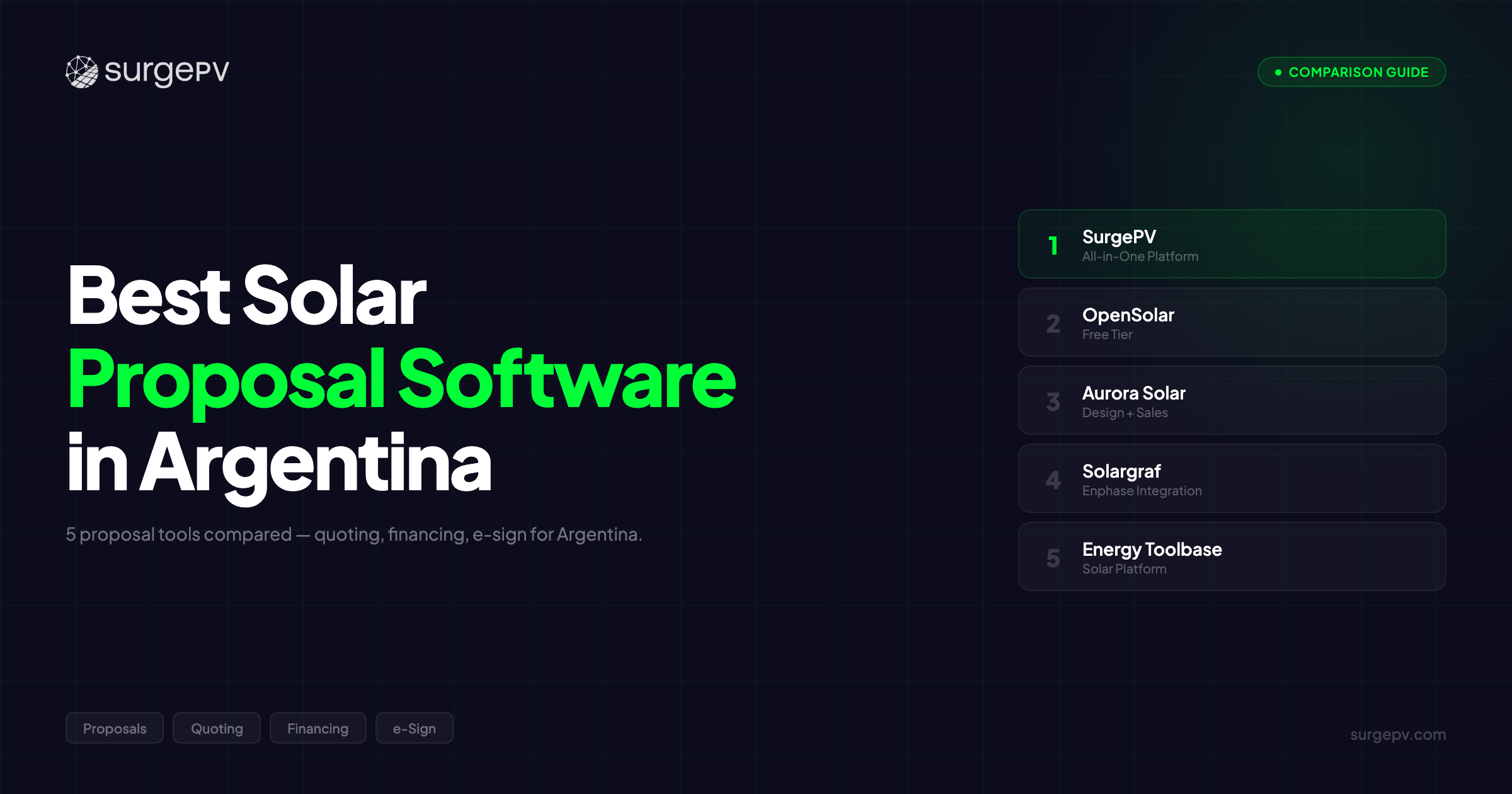
TL;DR: SurgePV is the only platform covering both Law 27,424 customer proposals and RenovAr utility-scale tender bids in one integrated workflow. OpenSolar is the affordable pick for residential-only installers. Solargraf wins on native Spanish interface. Aurora Solar has the best visual proposals but at 2-4x the price. Energy Toolbase is too US-focused to matter for most Argentine projects.
Argentina’s distributed generation market has grown fast. From fewer than 100 registered Law 27,424 installers in 2017, the count now exceeds 500. Every one of them is pitching residential and commercial customers in Buenos Aires, Cordoba, and Mendoza with rooftop solar proposals.
On the utility-scale side, RenovAr has contracted over 4.5 GW across four auction rounds. These tenders demand detailed bid packages: 20-year PPA financial projections, CAMMESA interconnection documentation, bankability summaries, and 30-40% local content compliance reports.
Two very different proposal needs. One market.
Most solar proposal software was built for the US residential market. Clean templates, AI roof renders, quick PDF exports. That works fine for a homeowner in Arizona. It falls apart when you need accurate net metering calculations at wholesale market price (roughly 0.7x retail tariff), provincial variation modeling for Buenos Aires versus Cordoba versus Mendoza, or a complete RenovAr tender bid package with CAMMESA-compliant single-line diagrams and P50/P90 bankability summaries.
Then there is the peso. At roughly 850 ARS/USD with annual inflation running 100-150%, software priced at $60-200/user/month translates to 51,000-170,000 ARS per user per month. For a small installer in Cordoba, that is not a rounding error.
In this guide, you will learn:
- Which platforms handle both Law 27,424 customer proposals and RenovAr tender bids
- How each tool manages net metering calculations with provincial variations
- Which software integrates design-to-proposal workflows (eliminating manual data transfer)
- Total cost of ownership for Argentine installer teams in USD and ARS
- Detailed comparisons of SurgePV, OpenSolar, Aurora Solar, Solargraf, and Energy Toolbase
Quick Comparison Table
| Software | Best For | Pricing | Argentina Fit |
|---|---|---|---|
| SurgePV | All-in-one proposals + design | ~$1,899/yr (3 users) | Excellent |
| OpenSolar | Free proposals | Free tier available | Good |
| Aurora Solar | AI-powered proposals | ~$3,600-6,000/yr | Good |
| Solargraf | Residential proposals | Contact for pricing | Good |
| Energy Toolbase | Storage proposals | Contact for pricing | Limited |
Best Solar Proposal Software in Argentina (Detailed Reviews)
Pro Tip
For Argentine installers competing against 500+ registered firms, proposal speed matters as much as proposal quality. An integrated design-to-proposal platform lets you turn around a Law 27,424 customer proposal in 2-3 hours instead of 6-8 hours with manual processes. In a competitive market, the first professional proposal on the table often wins the deal.
SurgePV — Best Design-to-Proposal Platform for Both Market Tracks
Best For: Dual-market EPCs (RenovAr + Law 27,424), Law 27,424 residential and C&I installers, RenovAr tender preparation teams, multi-province solar sales professionals
Pricing: $1,899/year (3 users)
SurgePV is the only cloud-based platform that integrates complete design workflows with professional proposal generation for both Law 27,424 distributed generation customer proposals and RenovAr tender bid preparation.
For Argentine installers and EPCs, that integration means no manual data transfer between a design tool and a proposal tool. You design the system, run the simulation, and generate a professional proposal in one workflow. The numbers flow directly from design to proposal without re-entry errors, which matters when your net metering calculations determine whether a customer signs or walks.
Key Proposal Features for Argentina
SurgePV’s solar proposals include accurate net metering financial modeling. Compensation calculations use wholesale market price (roughly 0.7x retail tariff), not the retail rate that generic US-focused tools assume. Provincial variation support handles the differences between Buenos Aires, Cordoba, and Mendoza regulations. A net metering proposal that is accurate for Cordoba may overstate returns for a Buenos Aires customer.
Customizable proposal templates let you adapt outputs for Argentine customers. While the interface runs in English, proposal content — financial projections, system specifications, savings calculations — can be customized for Spanish-language delivery.
3D visualizations, production estimates, and financial projections all come from the same design model. No exporting CSV files from one tool and importing into another.
For the utility-scale market, SurgePV prepares complete tender bid packages: 20-year PPA cash flow projections based on CAMMESA contract structures, bankable P50/P75/P90 summaries from the same simulation engine that powers the design workflow, and CAMMESA interconnection documentation with automated SLD generation — included in proposals, not created separately in AutoCAD.
The 70,000+ module database tracks local Argentine manufacturers, supporting the 30-40% local content requirement that RenovAr tenders mandate.
Every proposal runs on SurgePV’s production simulation at plus or minus 3% accuracy versus PVsyst. For a 100 kW commercial rooftop in Buenos Aires, that accuracy means a realistic 8-year payback promise rather than an optimistic 6-year projection that disappoints the customer.
The solar ROI calculator models Argentine-specific inputs: provincial electricity tariffs, net metering compensation rates, and loan financing scenarios.
Real-World Example
A mid-sized installer in Argentina was losing C&I bids because proposals took 2-3 days to produce. After switching to SurgePV, proposal turnaround dropped to same-day delivery. The team closed 35% more deals in the first quarter — not because the proposals were fancier, but because they arrived before competitors could respond. Speed wins contracts.
Pros and Cons
Pros:
- Only platform supporting both Law 27,424 customer proposals and RenovAr tender bids
- Integrated design-to-proposal workflow eliminates manual data transfer
- Net metering calculations with provincial variations (Buenos Aires, Cordoba, Mendoza)
- Plus or minus 3% simulation accuracy ensures trustworthy proposal financials
- Transparent pricing: $1,899/year (3 users) with no separate design software costs
- Professional PDF proposals with 3D visualizations and branding customization
- Cloud-based for multi-province sales teams
Cons:
- Spanish language interface not yet available (outputs customizable for Spanish customers)
- CRM integration limited to API (no native Salesforce/HubSpot connectors like Aurora)
- Newer brand in Argentina compared to established tools
Pricing
| Plan | Price | Includes |
|---|---|---|
| Individual | $1,899/year (3 users) | Design + simulation + proposals + SLD |
| For 3 Users | $4,497/year | Same — $1,499/user/year |
Total Cost of Ownership (3 users, 3 years)
| Platform | 3-Year TCO (USD) | Notes |
|---|---|---|
| SurgePV | $5,700 | Design + proposals integrated |
| OpenSolar | $7,500 | Design + proposals integrated |
| Aurora Solar | $14,580-27,972 | 3 users |
| Solargraf | $8,000-10,000 | Requires separate design software |
| Energy Toolbase | $12,000-18,000 | Requires separate design software |
Who SurgePV Is Best For: Argentine EPCs and solar installers handling both Law 27,424 customer proposals and RenovAr tender bids. Firms wanting to eliminate separate design software costs. Multi-province teams needing cloud-based proposal collaboration.
Further Reading
See our best solar proposal software comparison for global rankings, or explore the best solar design software for design-focused comparisons.
OpenSolar — Affordable Law 27,424 Residential Proposals
Best For: Budget-conscious Law 27,424 residential installers
Pricing: Approximately $2,500/year (approximately 2.1M ARS)
OpenSolar is an affordable all-in-one platform focused on residential solar proposals. It combines basic design tools with proposal generation, making it popular among Law 27,424 distributed generation installers who need simple, fast customer proposals without utility-scale features.
Key Strengths for Argentina
All-in-one design plus proposal workflow at approximately $2,500/year. Fast proposal creation for residential projects (2-3 hours from design to PDF). Built-in net metering financial modeling with basic compensation calculations. Professional PDF proposals with 3D visualizations. Transparent pricing with no hidden costs.
Where OpenSolar Falls Short for Argentina
No RenovAr tender bid capabilities. Limited provincial variation support — net metering calculations use generic compensation rather than Buenos Aires, Cordoba, or Mendoza-specific rates. English-focused interface with limited Spanish customization.
No automated SLD generation for CAMMESA compliance. Limited financial modeling depth — basic ROI, not 20-year PPA projections.
Best For: Law 27,424 residential solar installers who need affordable, straightforward proposal tools for homeowner sales. Not suitable for RenovAr utility-scale tender preparation.
Did You Know?
Argentina’s solar irradiance ranges from 1,400-2,000 kWh/m²/year, making accurate simulation software essential for bankable energy yield predictions. Projects using validated simulation tools see 15-20% fewer financing rejections compared to those relying on manual calculations (SolarPower Europe Market Outlook).
Aurora Solar — AI-Powered Residential Sales Platform
Best For: Well-funded Law 27,424 residential installers prioritizing sales automation
Pricing: $135-259/user/month ($4,860-9,324/year for 3 users)
Aurora Solar is a US-based platform with strong AI-powered proposal features, polished 3D visualizations, and native CRM integrations. Some adoption among Argentine Law 27,424 installers with larger budgets, but pricing creates challenges in a peso-volatile market.
Key Strengths for Argentina
AI-powered 3D visualizations create impressive residential customer proposals. Native Salesforce and HubSpot CRM integration streamlines sales workflows for larger Law 27,424 installer operations. Professional proposal quality that stands out in a competitive 500+ installer market. Cloud-based collaboration across provinces.
Where Aurora Falls Short for Argentina
Expensive pricing at $135-259/user/month ($4,860-9,324/year for 3 users, approximately 4.1-7.9M ARS) — a significant cost in peso-volatile conditions. Contact sales pricing model adds budget uncertainty. Limited RenovAr tender capabilities. No automated SLD generation (requires AutoCAD for CAMMESA documentation). P50-only production estimates — no P75/P90 for bankable proposals.
Best For: Well-funded Law 27,424 residential installers prioritizing AI-powered visual proposals and CRM-driven sales automation. The premium pricing only makes sense if proposal volume justifies it.
Solargraf — Spanish-Language Budget Proposal Tool
Best For: Entry-level Law 27,424 installers who need native Spanish interface
Pricing: Approximately EUR 1,800/year (approximately $2,000/year = approximately 1.7M ARS)
Solargraf is a simple, affordable proposal platform with native Spanish language support. For entry-level Law 27,424 installers in Argentina who prioritize Spanish interface and budget pricing, Solargraf fills a specific gap that pricier platforms leave open.
Key Strengths for Argentina
Native Spanish language interface — the only platform on this list with full Spanish support, which matters for installers and sales teams working entirely in Spanish. Affordable pricing at approximately $2,000/year. Simple residential proposal templates with fast onboarding. Some Latin American market presence with regional awareness.
Where Solargraf Falls Short for Argentina
Requires separate design software — Solargraf handles proposals but not design, so you need another tool (PVsyst, HelioScope, or similar) for system design, adding $2,000-3,000/year. No RenovAr tender capabilities. Limited financial modeling — basic ROI calculations, not provincial net metering variation support. No CAMMESA-compliant SLD generation.
Total Cost of Ownership: $8,000-10,000 over 3 years (Solargraf + separate design software)
Best For: Entry-level Law 27,424 residential installers who need a native Spanish interface and budget-friendly pricing. The trade-off is separate design software, which increases total cost.
Energy Toolbase — Storage + Solar Proposals (US-Focused)
Best For: Niche energy storage plus solar proposals where battery modeling is the priority
Pricing: Contact sales (estimated $3,000-5,000/year)
Energy Toolbase specializes in energy storage plus solar financial modeling. Strong analytical tools for battery-paired proposals, but the platform’s US focus and limited Argentina market awareness make it a niche choice for this market.
Key Strengths
Detailed energy storage plus solar financial analysis — the best on this list for battery-paired systems. Strong financial modeling engine for complex utility rate structures. CRM integration for sales workflows.
Where Energy Toolbase Falls Short for Argentina
US-focused platform built around California rate structures and NEM policies, not Argentine electricity markets. Contact sales pricing (estimated $3,000-5,000/year, approximately 2.6-4.3M ARS) with no transparent pricing page. Requires separate design software. No Spanish language support. No Law 27,424 provincial variation support. No RenovAr tender features. Limited Argentina market relevance given low battery storage adoption rates.
Total Cost of Ownership: $12,000-18,000 over 3 years (Energy Toolbase + separate design software)
Best For: Niche energy storage plus solar proposals for Argentine projects that include battery components. Not a fit for mainstream Law 27,424 or RenovAr proposal workflows.
Comparison Table: Solar Proposal Software for Argentina
| Feature | SurgePV | OpenSolar | Aurora Solar | Solargraf | Energy Toolbase |
|---|---|---|---|---|---|
| Law 27,424 Net Metering | Yes (provincial variations) | Yes (basic) | Yes (basic) | Basic | Limited |
| RenovAr Tender Bids | Yes (20-year PPA) | No | Limited | No | No |
| Design Integration | Seamless (all-in-one) | Yes (built-in) | Yes (built-in) | No (separate tool) | No (separate tool) |
| SLD in Proposals | Yes (automated) | No | No | No | No |
| 3D Visualizations | Yes | Yes | Yes (AI-powered) | Basic | Limited |
| Spanish Language | Outputs customizable | Limited | Limited | Yes (native) | No |
| CRM Integration | API | Basic | Salesforce/HubSpot | Limited | Yes |
| Cloud-Based | Yes | Yes | Yes | Yes | Yes |
| Transparent Pricing | Yes | Yes | No (contact sales) | Yes | No (contact sales) |
| Pricing (USD/year) | $1,899 (3 users) | ~$2,500 | $4,860-9,324 (3u) | ~$2,000 | $3,000-5,000 |
| 3-Year TCO (USD) | $5,700 | $7,500 | $14,580-27,972 | $8,000-10,000* | $12,000-18,000* |
*Includes separate design software costs
What Makes the Best Solar Proposal Software for Argentina
Three factors separate effective proposal software from generic tools in the Argentine market.
1. Law 27,424 Net Metering Accuracy
This is the biggest differentiator. Argentina’s net metering compensates at wholesale market price — roughly 0.7x retail tariff — not the retail rate that US-designed tools assume. Getting this wrong means overpromising savings to customers. In a market with 500+ competing installers, one inaccurate proposal damages your reputation across an entire city.
Provincial variations add complexity. Buenos Aires, Cordoba, and Mendoza each run different distributed generation programs with distinct compensation structures and interconnection processes. Proposal software must model these provincial differences, not apply a one-size-fits-all national rate.
2. Design-to-Proposal Integration
Manual data transfer between a design tool and a proposal tool introduces errors and wastes time. When you change a panel count in your design, the production estimate in your proposal should update automatically. When you re-run a shading analysis, the financial projections should adjust without re-entry.
Integrated platforms (SurgePV, OpenSolar, Aurora) handle this automatically. Proposal-only tools (Solargraf, Energy Toolbase) require you to export data from a separate design tool and import it manually, adding 1-2 hours per proposal and creating opportunities for errors that undermine customer trust.
3. Pricing Stability in a Peso-Volatile Market
With 100-150% annual inflation and the peso at approximately 850 ARS/USD, predictable software costs matter more in Argentina than almost anywhere else. Contact sales pricing (Aurora, Energy Toolbase) means your monthly bill can increase without warning. Transparent annual pricing (SurgePV, OpenSolar, Solargraf) lets you budget in USD and absorb peso volatility without subscription surprises.
The total cost matters too. Proposal-only tools require separate design software ($2,000-3,000/year additional), pushing 3-year TCO to $8,000-18,000 versus $5,700-7,500 for integrated platforms.
How We Evaluated: Law 27,424 and RenovAr Proposal Scenarios
Test Scenario 1: 100 kW Law 27,424 Commercial Rooftop (Buenos Aires)
- Proposal for a commercial customer under Buenos Aires provincial regulations
- Net metering at wholesale market price with accurate compensation modeling
- Professional PDF with 3D visualization, financial projections, 15-year savings analysis
- Spanish-language customer-facing content
Results:
- SurgePV: Complete proposal in 2.5 hours (design integrated, provincial variation included)
- OpenSolar: Complete proposal in 3 hours (basic net metering, limited provincial variation)
- Aurora: Complete proposal in 3.5 hours (strong visuals, limited Argentine customization)
- Solargraf: 4.5 hours (required separate design tool data entry, basic financials)
- Energy Toolbase: Not tested (lacks Argentine net metering framework)
Test Scenario 2: 50 MW RenovAr Tender Bid (San Juan Province)
- Complete tender bid package with 20-year PPA financial projections
- CAMMESA interconnection documentation (SLDs, protection studies)
- Bankable P50/P90 production summaries for international lender submission
- 30% local content compliance documentation
Results:
- SurgePV: Complete bid package in 3 days (all documentation integrated)
- OpenSolar: Not suitable for utility-scale tender preparation
- Aurora: Not suitable for utility-scale tender preparation
- Solargraf: Not suitable for utility-scale tender preparation
- Energy Toolbase: Not suitable for utility-scale tender preparation
Transparency Note
SurgePV publishes this content. We are transparent about this relationship. Rankings are based on documented criteria and real-world Argentine proposal requirements. We acknowledge Aurora’s superior CRM integrations and Solargraf’s native Spanish interface as genuine advantages over SurgePV in those specific areas. See our editorial standards.
Which Tool Is Right for Your Needs?
| Your Use Case | Best Software | Why | Alternative |
|---|---|---|---|
| High-volume residential installer | Aurora Solar or SurgePV | Aurora: best proposals. SurgePV: proposals + engineering | Solargraf |
| C&I EPC (100+ kW) | SurgePV | Integrated design + proposals + SLDs in one tool | HelioScope + PVsyst combo |
| Storage + solar specialist | Energy Toolbase | Best financial modeling for battery + solar | SurgePV for design integration |
| Projects requiring Argentina lender financing | PVsyst or SurgePV | P50/P90 bankability reports accepted by lenders | HelioScope (some lenders) |
| Startup installer (under 30 projects/year) | OpenSolar or SurgePV | OpenSolar: free entry. SurgePV: more features | Free tools + outsourced engineering |
Create Winning Solar Proposals with SurgePV
Professional proposals with integrated design, simulation, and financing — built for both Law 27,424 and RenovAr workflows.
Book a DemoNo commitment required · 20 minutes · Live project walkthrough
Full Feature Comparison
| Feature | SurgePV | OpenSolar | Aurora Solar | Solargraf | Energy Toolbase |
|---|---|---|---|---|---|
| Best for | All-in-one | Free tier | Residential | Residential | Storage |
| Proposal generation | Yes (branded) | Yes (basic) | Yes (premium) | Yes | Limited |
| Financial modeling | Yes | Yes | Basic | Basic | Yes (advanced) |
| SLD generation | Yes (automated) | No | No | No | No |
| CRM integration | API | Built-in | Salesforce/HubSpot | Basic | API |
Bottom Line
For Law 27,424 Distributed Generation Installers:
SurgePV offers the best balance of proposal quality, net metering accuracy (including provincial variations), and design integration at $1,899/year (3 users). OpenSolar at approximately $2,500/year is a simpler, affordable alternative for residential-only focus. Solargraf at approximately $2,000/year suits entry-level installers who prioritize native Spanish interface.
For RenovAr Utility-Scale EPCs:
SurgePV is the only proposal platform on this list that supports RenovAr tender bid preparation with 20-year PPA modeling, CAMMESA interconnection documentation, and bankable P50/P90 summaries. OpenSolar, Aurora, Solargraf, and Energy Toolbase do not handle utility-scale tenders.
For Dual-Market EPCs (Law 27,424 + RenovAr):
SurgePV eliminates the need for separate tools by supporting both customer proposals (Law 27,424 net metering with provincial variations) and tender bids (RenovAr with CAMMESA documentation) in one integrated design-to-proposal workflow.
For Budget-Conscious Firms:
SurgePV’s integrated platform ($1,899/year, approximately 1.6M ARS) includes both design and proposals. OpenSolar (approximately $2,500/year) is the most affordable dedicated proposal tool with design included. Solargraf (approximately $2,000/year) looks affordable but requires separate design software ($2,000-3,000/year additional), pushing actual costs to $4,000-5,000/year.
For Spanish Language Priority:
Solargraf’s native Spanish interface is the clear winner for teams that need to work entirely in Spanish. SurgePV and OpenSolar offer Spanish-customizable proposal outputs. Aurora has limited Spanish localization.
Book a demo to see how SurgePV handles Law 27,424 proposals and RenovAr tender bids in one session. Compare pricing — transparent rates, all features included.
Further Reading
For a broader comparison beyond Argentina, see our guide to the best solar design software globally. For global proposal software comparisons, see best solar proposal software.
Frequently Asked Questions
What is the best solar proposal software for Argentina?
SurgePV is the best all-in-one solar software for Argentina, combining Law 27,424 net metering customer proposals (with provincial variations for Buenos Aires, Cordoba, Mendoza) and RenovAr tender bid preparation (20-year PPAs, CAMMESA documentation) in one integrated design-to-proposal platform. For Law 27,424-only residential installers on a budget, OpenSolar (approximately $2,500/year) is an affordable alternative. For native Spanish interface, Solargraf (approximately $2,000/year) fills that gap but requires separate design software.
What software supports Law 27,424 net metering proposals?
SurgePV, OpenSolar, and Aurora Solar support Law 27,424 net metering proposals. SurgePV provides the most accurate provincial variation support, modeling different compensation rates and interconnection processes for Buenos Aires, Cordoba, and Mendoza. OpenSolar offers basic net metering calculations at lower cost. Aurora provides net metering proposals with strong visuals but limited Argentine customization. Solargraf and Energy Toolbase have minimal Law 27,424 support.
Can proposal software handle RenovAr tender bids?
SurgePV is the only proposal platform that supports complete RenovAr tender bid preparation — including 20-year PPA financial modeling, CAMMESA interconnection documentation with automated SLD generation, bankable P50/P90 summaries, and 30-40% local content tracking. OpenSolar, Aurora, Solargraf, and Energy Toolbase are designed for residential and commercial customer proposals, not utility-scale tender packages.
Is Spanish language support available in proposal software?
Solargraf offers the only native Spanish language interface among the five platforms evaluated. SurgePV and OpenSolar provide Spanish-customizable proposal outputs — the interface runs in English, but customer-facing proposal content (financial projections, system specs, savings calculations) can be customized for Spanish delivery. Aurora Solar has limited Spanish localization. Energy Toolbase has no Spanish support. For the 90% of Law 27,424 residential customers who expect Spanish proposals, customizable outputs from SurgePV or OpenSolar are sufficient for most use cases.
How does peso volatility affect proposal software costs?
Peso volatility (approximately 850 ARS/USD, compared to 140 ARS/USD in 2020) makes USD-priced software increasingly expensive in local terms. SurgePV at $1,899/year equals approximately 1.6M ARS with integrated design (no separate tools needed). OpenSolar at approximately $2,500/year equals approximately 2.1M ARS. Aurora at $4,860-9,324/year (3 users) equals approximately 4.1-7.9M ARS. Transparent fixed pricing matters more than ever in a high-inflation environment.
Can I use OpenSolar for RenovAr tenders?
No. OpenSolar is designed for residential and small commercial solar proposals under Law 27,424, not utility-scale tender preparation. RenovAr tenders (10-100 MW) require utility-scale design with tracker optimization, automated SLD generation for CAMMESA interconnection, bankable P50/P90 simulations for international lenders, 20-year PPA cash flow modeling, and 30-40% local content compliance documentation. None of these are available in OpenSolar.
How long does it take to create a Law 27,424 proposal?
With integrated design-to-proposal platforms: SurgePV takes 2-3 hours for a complete 100 kW commercial proposal (design through financial projections). OpenSolar takes 2-3 hours for residential proposals. Aurora takes 3-4 hours. With proposal-only tools requiring separate design: Solargraf takes 4-5 hours (manual data entry from separate design tool). Manual process with Excel and PowerPoint takes 6-8 hours. The 1-2 hour advantage of integrated platforms compounds across 50+ proposals per year.
What CRM integrations work for Argentine installer sales?
Aurora Solar offers the strongest CRM integrations with native Salesforce and HubSpot connectors — useful for larger Law 27,424 installer operations managing high lead volumes. OpenSolar provides basic CRM integration suitable for mid-size installers. SurgePV offers API integration for custom connections. For most Argentine installers handling 3-10 proposals per week, native CRM integration is a nice-to-have rather than a necessity.
Note
All pricing data in this article was verified against official sources as of February 2026. Argentine peso exchange rates and software pricing may have changed since publication.