

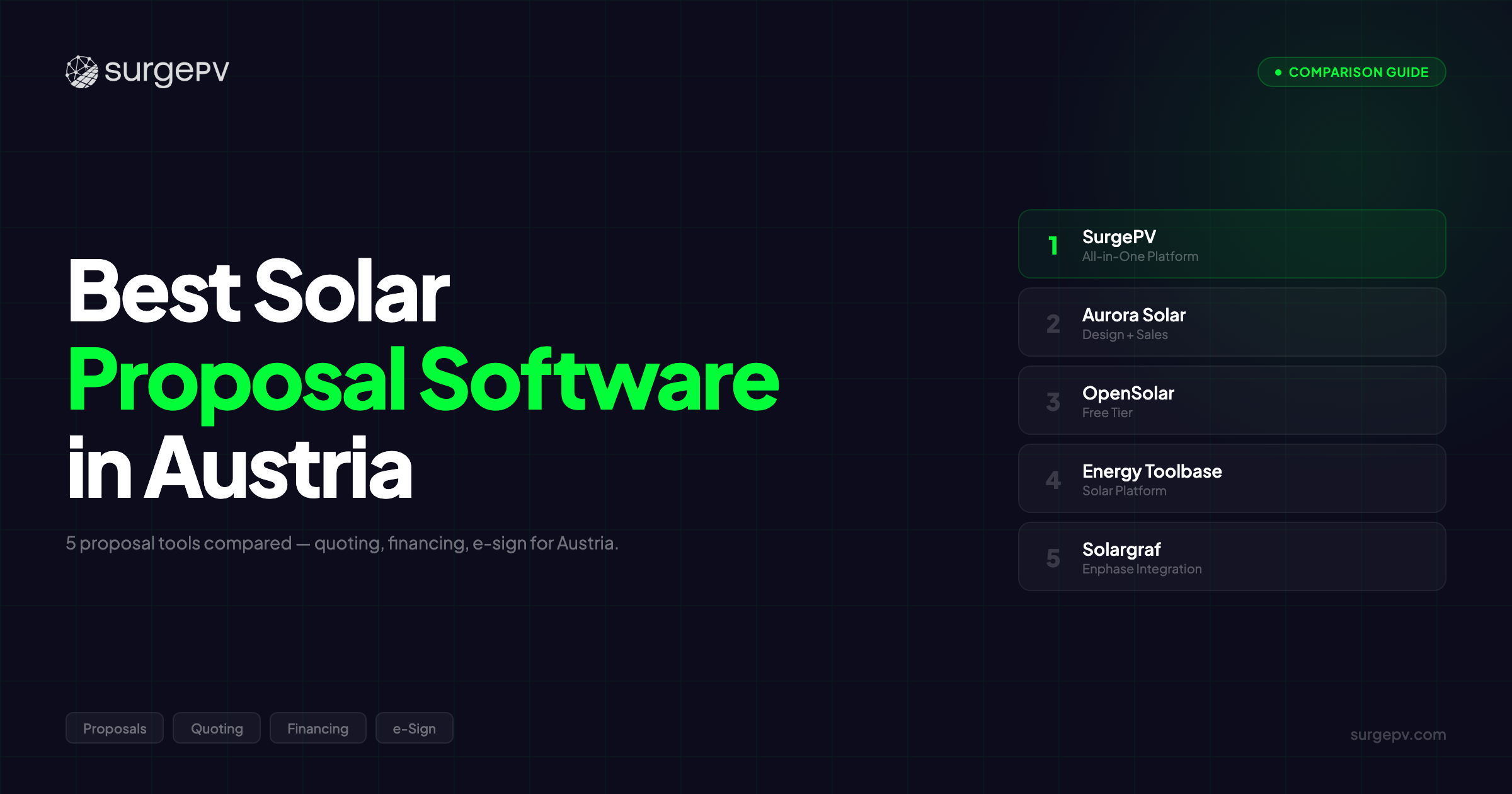
TL;DR: SurgePV is the most complete solar proposal software for Austrian installers — automated EAG grant calculations, Austrian electricity rates, German language support, and professional proposals in 10–15 minutes from an integrated design-to-proposal workflow. Aurora Solar delivers polished proposals but requires manual EAG entry and lacks German language support. OpenSolar is the budget-friendly entry point. Energy Toolbase and Solargraf round out the field for specialist use cases.
Speed wins solar deals. A customer in Salzburg requests a proposal on Monday morning. By the time you have manually calculated EAG grants, entered Austrian electricity rates, and exported a PDF from a tool built for the American market, two competitors have already sent their quotes.
That is not an exaggeration. That is the Austrian solar proposal market in 2026.
Austrian installers compete against 5–10 other quotes on every project. Customers are financially sophisticated. They expect itemized costs, accurate feed-in tariff modeling, EAG grant deductions, and realistic payback periods — all in a clean, professional, German-language proposal.
Here is the problem: most solar proposal software was built for the US market. No EAG grant calculator. No Austrian electricity rate database. No German language support. Financial models that still reference the US federal tax credit. That does not work in Austria.
We tested 5 solar proposal platforms specifically for the Austrian market. This guide breaks down which tools handle EAG grants, Austrian pricing, self-consumption analysis, and professional German proposals — and which ones fall short.
In this guide, you’ll find:
- 5 tools compared on EAG grant automation, German language support, and Austrian market fit
- The features that win deals in Austria’s competitive proposal market
- Use-case recommendations by installer type and project volume
- Real pricing in EUR for each platform
Best Solar Proposal Software in Austria: Detailed Reviews
SurgePV — Best All-in-One Platform for Austrian Installers
Best for: Solar installers (residential + commercial), sales teams, EPCs
Pricing: EUR 633–1,299/user/year. All features included.
SurgePV is a cloud-based solar design and proposal software built for Austrian installers and sales teams who need professional proposals directly integrated with accurate system design. Unlike proposal-only tools that require separate design software, SurgePV delivers a complete design-to-proposal workflow with EAG grant calculations, Austrian electricity rate modeling, and German language support — all in 10–15 minutes.
Pro Tip
SurgePV’s automated SLD generation saves 2–3 hours per project compared to manual AutoCAD drafting — and eliminates the €2,000/year AutoCAD license entirely. For Austria EPCs handling 10+ projects per month, that’s 20–30 hours saved monthly. Book a demo to see it in action.
Key Features for Austria
Design-to-proposal workflow:
- Integrated design — Complete system layout, electrical engineering, and BOM feed directly into the proposal
- 70% faster — 15–30 minutes from site visit to sent proposal
- No data re-entry — System specs, costs, and energy production auto-populate from the design stage. One click. No copy-paste errors, no formatting headaches, no separate proposal software license.
Austrian market features:
- EAG grant calculator — Automatic calculation and deduction of federal investment grants (EUR 200–250/kWp)
- Bundeslaender subsidies — Regional incentive database covering Vienna, Salzburg, Upper Austria, and more
- Austrian electricity rates — Regional rate database (EUR 0.25–0.35/kWh residential)
- German language — Full German interface and proposal templates. When 95%+ of your customers speak German, an English-only proposal is a trust-killer.
- Self-consumption modeling — Hour-by-hour load matching showing value difference between self-consumed and exported energy. When self-consumed kWh are worth 5x more than exported kWh, this number closes deals.
- Multiple scenarios — Cash purchase, green loans (Erste Bank, Raiffeisen rates at 2–4%), leasing (7–15 years)
- 25-year projections — Lifetime savings with 3–5% annual electricity rate escalation. Austrian customers want to see the full picture, not just Year 1 savings — this is what separates a professional proposal from a basic quote.
- ROI calculations — Payback period (typical 8–12 years in Austria), IRR, NPV
- Feed-in tariff modeling — Marktpraemie (EUR 0.05–0.08/kWh) vs. self-consumption value (EUR 0.28–0.32/kWh saved)
Pricing
- Individual Plan: EUR 1,899/year for 3 users (EUR 633/user/year)
- For 3 Users: EUR 1,499/user/year (EUR 4,497/year total)
- For 5 Users: EUR 1,299/user/year (EUR 6,495/year total)
All plans include every feature. No tiered gating. See full pricing details.
Real-World Example
A residential installer in Vienna generating 80+ proposals per month was juggling three tools — design software, simulation software, and spreadsheets for financials. Each proposal took 3–4 hours. With SurgePV’s unified workflow, that dropped to 45 minutes per proposal. Same-day proposals instead of next-week follow-ups. Their close rate improved because in solar sales, speed wins deals.
You might be wondering: if SurgePV does all this, why haven’t I heard of it? Fair question. PVsyst has had a 30-year head start. Aurora Solar has spent hundreds of millions on marketing. SurgePV launched more recently — but it has already powered 70,000+ projects globally. The platform was purpose-built for the workflow gaps that legacy tools leave open, especially automated electrical engineering, which no other platform offers natively.
Want to see how SurgePV handles Austrian proposals? Book a demo to test EAG grant calculations and German-language proposal generation with your own project data.
Further Reading
- Best Solar Proposal Software (2026) — Global comparison
- Aurora Solar Review — Proposal features deep-dive
- Best Solar Simulation Software — Bankability comparison
Aurora Solar — Beautiful Proposals for International Teams
Best for: International solar companies with operations across multiple countries
Pricing: EUR 4,800–6,000/year
Aurora Solar delivers some of the most visually polished solar proposals in the industry, combining advanced 3D roof models with professional financial presentations.
Austria limitations:
- NO EAG grant calculator or templates (requires manual entry)
- US-centric financial models (not applicable in Austria)
- No German language interface (English only)
- Missing self-consumption optimization critical for Austrian value calculations
Did You Know?
Austria’s solar irradiance ranges from 1,050–1,250 kWh/m²/year, making accurate simulation essential for bankable energy yield predictions. Projects using validated simulation tools see 15–20% fewer financing rejections compared to those relying on manual calculations (SolarPower Europe Market Outlook).
OpenSolar — Budget-Friendly Proposal and CRM Platform
Best for: Budget-conscious residential installers
Pricing: EUR 1,000–2,000/year
OpenSolar offers an affordable entry point for small installers who need basic proposal generation without enterprise pricing.
Austria limitations:
- NO EAG grant calculator
- Limited design tools (no SLD generation)
- No German language support (English only)
- Tier-based feature gating
Energy Toolbase — Battery Storage Specialist with Proposals
Best for: Commercial installers selling solar + battery storage systems
Pricing: EUR 3,000–5,000/year
Energy Toolbase is the leading battery storage analysis and proposal platform. It excels at complex battery modeling but is overkill for standard solar-only projects, which make up roughly 90% of Austria’s market.
Austria limitations:
- Expensive (EUR 3,000–5,000/year)
- NO EAG grant calculator or Austrian incentive templates
- No German language interface
- Battery-focused (overkill for solar-only)
Solargraf — Fast Proposal-Only Tool for High-Volume Sales
Best for: High-volume residential sales teams (100+ projects/year)
Pricing: EUR 1,200–2,000/year
Solargraf is a specialized proposal tool focused on speed and simplicity. It handles proposal generation only — no design tools, no engineering features.
Austria limitations:
- NO design tools (proposals only)
- NO EAG grant calculator
- US-centric (Austrian rates require manual entry)
- No German language support
The Feature Gap That Costs You Deals
EAG Grant Calculation and Austrian Incentive Automation
Austrian customers expect proposals to show EAG investment grants (OeMAG-administered) automatically deducted from the system cost: EUR 200–250/kWp for residential, EUR 150–200/kWp for commercial. Manual grant calculation takes 5–10 minutes per proposal and introduces errors.
Self-Consumption Analysis (Critical for Austrian ROI)
According to E-Control data, Austria’s high electricity prices (EUR 0.28–0.32/kWh) and low feed-in tariffs (Marktpraemie at EUR 0.05–0.08/kWh) make self-consumption the primary value driver. Self-consumed energy is worth 5x more than exported energy. Austrian customers care about self-consumption percentage, not total generation.
Professional European Proposal Design
Austrian customers prefer clean, professional, understated proposals with technical accuracy, itemized costs, and realistic payback periods. An English-only proposal with American-style marketing language loses to a clean German-language proposal from a local competitor.
Multiple Financing Scenarios
Austrian customers compare financing options carefully: cash purchase (50–60% of residential), green loans at 2–4% interest (Erste Bank, Raiffeisen, BAWAG), and leasing for commercial projects (7–15 years). PV Austria market data shows proposals featuring only cash scenarios miss 40–50% of customers. With IRENA projecting continued Austrian solar growth, accurate financial modeling is more important than ever.
Further Reading
For a broader comparison beyond this market, see our guide to the best solar simulation software globally.
Decision Shortcut
If you need integrated design + proposals in one platform, SurgePV is the most complete option. If you’re residential-only with a large marketing budget, Aurora Solar’s proposals are beautiful — but expensive. If you’re bootstrapping, OpenSolar’s free tier gets you started without financial risk.
Which Software Is Right for Your Use Case?
| Your Situation | Recommended Software | Why It Fits |
|---|---|---|
| High-volume residential installer | Aurora Solar or SurgePV | Aurora: best proposals. SurgePV: proposals + engineering |
| C&I EPC (100+ kW) | SurgePV | Integrated design + proposals + SLDs in one tool |
| Storage + solar specialist | Energy Toolbase | Best financial modeling for battery + solar |
| Projects requiring Austria lender financing | PVsyst or SurgePV | P50/P90 bankability reports accepted by lenders |
| Startup installer (under 30 projects/year) | OpenSolar or SurgePV | OpenSolar: free entry. SurgePV: more features |
| Your Situation | Recommended Software | Why It Fits |
|---|---|---|
| Commercial installer (5–20 projects/month) | SurgePV, Aurora Solar | Balance between design accuracy and proposal speed; integrated workflow reduces tool-switching |
| Residential-focused installer | SurgePV, Aurora Solar, OpenSolar | Fast proposals with professional templates |
| Battery storage specialist | SurgePV, Energy Toolbase | Advanced battery sizing, self-consumption modeling, and financial analysis |
| Small team (1–3 people) | SurgePV, OpenSolar | All-in-one platforms reduce software stack complexity and training time |
| Budget-conscious startups | OpenSolar, Solargraf | Low-cost or free entry points for teams with limited project volume |
Bottom Line: Best Solar Proposal Software for Austria
For Austrian installers needing all-in-one workflows: SurgePV offers the most complete platform with integrated design, automated EAG grant calculations, Austrian electricity rate database, German language support, and professional proposals in 10–15 minutes. The EUR 633–1,299/user/year pricing includes full design features (SLD generation, shading analysis, simulation).
For international teams with existing Aurora workflows: Aurora Solar delivers polished proposals but requires manual EAG grant entry and lacks German language support at EUR 4,800+/year.
For budget-conscious residential installers: OpenSolar provides affordable proposal + basic design at EUR 1,000–2,000/year but lacks Austrian market automation.
The Austrian solar market is not slowing down. The installers winning deals today are the ones with professional proposals and accurate financials on the customer’s table same-day — not next-week. Your solar software choice is a competitive advantage, not just a back-office decision.
Generate Professional Austrian Proposals in 10 Minutes
EAG grant-ready proposals with accurate system design, self-consumption analysis, and German language support.
Book a DemoNo commitment required · 20 minutes · Live project walkthrough
Further Reading
- Best All-in-One Solar Design Software — Complete platform comparison
- OpenSolar Review — Budget proposal tool analysis
When You May Not Need Advanced Solar Software
Not every solar project in Austria requires comprehensive design and simulation platforms. Consider simpler alternatives if:
- Small residential projects with standard layouts — Basic design tools or manufacturer calculators may suffice for simple rooftop arrays under 10 kW with no shading or complexity.
- Engineering is outsourced — If your company uses external engineering services, you may only need proposal and CRM tools rather than full design platforms with electrical documentation.
- Very limited project volume — Teams handling fewer than 5–10 projects per year may find that manual workflows and spreadsheet modeling are more cost-effective than software subscriptions.
- Non-technical sales teams — Sales-focused companies without in-house engineers may only require proposal generation tools rather than technical design software.
Most EPCs, developers, and medium-to-large installers in Austria benefit from integrated platforms that reduce manual work and improve accuracy. At 20+ proposals per month, the time savings from automated workflows typically pay for software costs within the first month.
Bottom Line
For Austria EPCs and installers, SurgePV delivers the most complete design-to-proposal workflow with automated SLD generation, bankable P50/P90 simulations, and integrated proposals — all at EUR 1,899/year for 3 users. Book a demo to see it in action.
Frequently Asked Questions
What is the best solar proposal software in Austria?
SurgePV is the best all-in-one solar proposal software for Austria, combining integrated design, automated EAG grant calculations, Austrian electricity rate database, German language support, and professional proposals in 10–15 minutes — without tool switching. SurgePV eliminates manual EAG grant calculations (saves 5–10 minutes per proposal), uses accurate regional electricity rates, and generates German language proposals that build trust with Austrian customers.
Does solar proposal software calculate EAG grants automatically?
SurgePV automatically calculates EAG investment grants (EUR 200–250/kWp residential, EUR 150–200/kWp commercial) and regional Bundeslaender subsidies. Aurora Solar, OpenSolar, Energy Toolbase, and Solargraf do NOT support Austrian grant automation. SurgePV’s calculator detects customer location, system size, and project type to automatically deduct applicable subsidies from proposal costs.
How long does it take to generate a solar proposal in Austria?
With all-in-one platforms like SurgePV or Aurora Solar, proposal generation takes 10–20 minutes from design to sent PDF/web link. Proposal-only tools like Solargraf are faster (5–10 minutes) but require pre-completed design data. Same-day proposal delivery wins 30–40% more projects in Austria’s competitive market.
Is German language important for solar proposals in Austria?
Yes. German language proposals are critical for Austrian customer trust and professionalism. SurgePV offers a full German interface and proposal templates. Aurora Solar, OpenSolar, Energy Toolbase, and Solargraf are English-only. Austrian customers (95%+ German-speaking) expect professional German proposals with correct terminology.
What financing options should Austrian solar proposals include?
Austrian proposals should include cash purchase, green loans (2–4% interest, 5–10 years), and leasing (7–15 years) scenarios side-by-side. SurgePV, Aurora Solar, and Energy Toolbase support multiple financing options. 50–60% of Austrian residential customers choose cash purchase, while 40–50% prefer green loans from Erste Bank, Raiffeisen, or BAWAG.
Do I need separate design software for solar proposals in Austria?
No, if you use all-in-one platforms like SurgePV or Aurora Solar that include design + proposal features. Yes, if you use proposal-only tools like Solargraf. All-in-one platforms save 10–15 minutes per proposal versus 30–45 minutes with separate tools.
How accurate are ROI calculations in Austrian solar proposals?
ROI accuracy depends on using correct Austrian electricity rates (EUR 0.25–0.35/kWh residential), EAG grants (EUR 200–250/kWp), and self-consumption modeling. SurgePV includes an Austrian rate database with regional variation. Typical Austrian residential payback periods are 8–12 years (cash purchase) or 10–14 years (green loan). Proposals using generic rates from other markets produce inaccurate ROI and reduce customer trust.
What is self-consumption and why does it matter for Austrian proposals?
Self-consumption is solar energy used directly by the customer (avoiding EUR 0.28–0.32/kWh utility cost) rather than exported to the grid (earning EUR 0.05–0.08/kWh feed-in tariff). In Austria, self-consumed kWh are worth 5x more than exported kWh, making self-consumption percentage the primary ROI driver. SurgePV models self-consumption automatically with hour-by-hour analysis.
Transparency Note
SurgePV publishes this content. We are transparent about this relationship. Pricing information is based on publicly available data as of February 2026. Contact vendors directly for current pricing and Austria-specific quotes. Some vendors offer regional pricing adjustments. See our editorial standards.
Sources
- SurgePV Product Documentation — Official feature specifications and proof points (accessed February 2026)
- EAG / Klimafonds — Official website — Investment grant programs and subsidy requirements (accessed February 2026)
- BMK (Austrian Federal Ministry for Climate Action) — Official website — Solar incentive programs and market statistics (accessed February 2026)
- E-Control Austria — Official website — Austrian energy regulator, electricity rates (accessed February 2026)
- PV Austria — Official website — Austrian solar market analysis (accessed February 2026)
- Aurora Solar, OpenSolar, Solargraf Official Documentation — Proposal features and pricing (accessed February 2026)
- G2 Reviews — Verified user reviews for solar proposal software (accessed February 2026)
- Capterra Reviews — User ratings and feedback for solar proposal software (accessed February 2026)