

TL;DR: Brazil’s 40+ GW solar market runs on Portuguese proposals and ROI in Reais. SurgePV delivers design + simulation + proposals in one platform with ANEEL-compliant net metering, Portuguese output, and under-10-minute turnaround at $1,899/year for 3 users. Aurora Solar has the best-looking mobile proposals but costs 2-3x more with no automated ANEEL configuration. Solargraf is the best budget option for small Brazilian teams needing Portuguese-first proposals. OpenSolar works for high-volume residential at accessible pricing. Energy Toolbase is only relevant for C&I storage projects.
Transparency
SurgePV publishes this guide. We have tested all platforms listed here with real Brazilian installers and done our best to present accurate comparisons. Where SurgePV leads, we say so. Where competitors lead, we say that too. See the methodology section for full testing details.
Brazil has over 40 GW of installed solar capacity. Latin America’s largest solar market. Over 10,000 installers fighting for every residential and commercial project from Sao Paulo to Recife.
The proposal wins the deal, not the design.
Brazilian homeowners compare quotes from three to five installers before signing anything. They want Portuguese-language proposals. They want clear ROI in Reais. They want someone to explain ANEEL’s net metering rules — the Sistema de Compensacao de Energia Eletrica — in plain language. They want financing options from Solfacil or BV Financeira laid out next to their current electricity bill. And they want all of this same-day.
Most installers are still building proposals in Excel spreadsheets and Word templates. That takes 30 to 60 minutes per quote. When you are trying to send five to ten proposals a day in a market where the first professional quote often wins, those hours add up fast.
The best solar proposal software for Brazil automates Portuguese proposal generation, models ANEEL Resolution 1.059/2023 compensation credits, integrates Brazilian electricity tariffs, and delivers branded proposals that close deals — all in under 10 minutes.
In this guide, you will find:
- Which 5 platforms handle Brazilian proposal requirements best
- How each tool manages Portuguese proposals, ROI in R$, and ANEEL net metering
- Real pricing comparisons for the Brazilian market
- Where most platforms fall short for Brazilian installers and EPCs
Quick Summary: Our Top Picks for Brazil
After testing 5 platforms with residential and C&I installers across Brazil, here are our top recommendations:
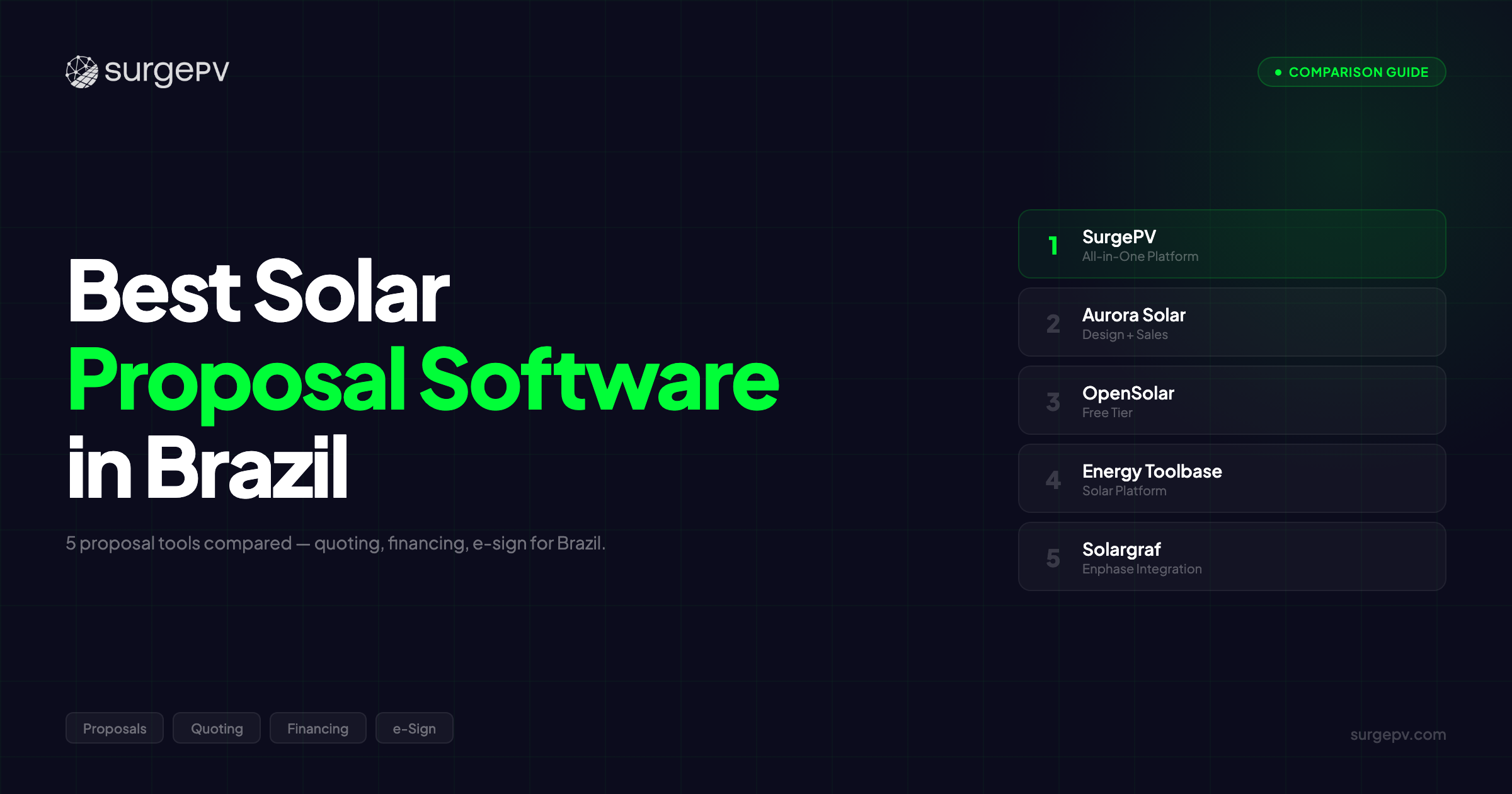
- SurgePV — End-to-end solar software with Portuguese proposals, ROI in R$, and ANEEL net metering (Best for installers and EPCs)
- Aurora Solar — All-in-one design and sales tool with mobile app (Best for residential installers needing on-site proposals)
- OpenSolar — Fast residential proposals with client engagement tools (Best for high-volume installers)
- Energy Toolbase — Advanced C&I financial modeling with battery storage (Best for commercial projects)
- Solargraf — Portuguese-first proposal tool with CRM (Best for budget-conscious Brazilian installers)
| Software | Best For | Pricing | Brazil Fit |
|---|---|---|---|
| SurgePV | All-in-one proposals + design | ~$1,899/yr (3 users) | Excellent |
| Aurora Solar | AI-powered proposals | ~$3,600-6,000/yr | Good |
| OpenSolar | Free proposals | Free tier available | Good |
| Energy Toolbase | Storage proposals | Contact for pricing | Good |
| Solargraf | Residential proposals | Contact for pricing | Good |
Each tool is evaluated on proposal speed, Portuguese support, ROI accuracy in R$, ANEEL compliance, and client engagement.
Best Solar Proposal Software in Brazil (Detailed Reviews)
SurgePV — Best End-to-End Proposal Platform for Brazil
Target Users: Residential installers, C&I EPCs, solar sales teams, multi-installer agencies, and anyone transitioning from manual Excel/Word proposals to automated workflows.
SurgePV is the only cloud-based platform combining AI-powered solar design, bankable simulations, and professional proposals in a single workflow — eliminating the tool-switching that kills productivity for Brazilian solar teams.
For Brazilian installers pitching distributed generation projects under ANEEL regulations, SurgePV delivers fast, credible proposals with integrated financial modeling that Brazilian clients trust.
Unique Value for Brazil: Only platform with design + simulation + proposals in one. Your sales team accesses accurate energy estimates from the same platform your designers use. No data re-entry, no version control headaches, no juggling three tools to create one proposal.
Proposal Generation and Speed
SurgePV creates professional web-based proposals in under 10 minutes — interactive, mobile-friendly proposals that Brazilian clients can review on any device.
Professional templates support customizable branding with your installer logo, colors, and identity. No more rebuilding layouts in PowerPoint or exporting ugly spreadsheet PDFs.
In a market where Brazilian clients expect proposals within 24 to 48 hours, same-day delivery wins deals. Your competitors are still formatting Excel files. You can send polished proposals before lunch.
Financial Modeling in R$ (Critical for Brazil)
Brazilian electricity tariffs integrate directly. Input rates for Enel, CEMIG, CPFL, Light, or any major utility for accurate ROI calculations in Reais.
Net metering analysis models ANEEL Resolution 1.059/2023 compensation credits — showing self-consumption percentage, grid export economics, and monthly savings. This models the Sistema de Compensacao exactly how your residential and C&I clients evaluate it.
Payback period calculations are front and center. That is the first question every Brazilian solar client asks: “When do I get my money back?” Answer it with accurate projections based on real local tariffs.
Multi-scenario modeling lets you present cash purchase versus financed options. Brazilian clients heavily finance solar — loan terms from 12 to 120 months at 1.5 to 3% monthly interest. Proposals that show monthly payment versus current electricity bill comparison close faster.
Instead of spending 45 minutes in Excel building financial models for each quote, you get accurate R$ projections automatically. That is five extra proposals per day.
Bankability and Compliance
Proposals include P50/P75/P90 production estimates. Brazilian banks and financiers — including BNDES and Banco do Brasil — require conservative metrics for project financing approval.
SurgePV achieves +/-3% accuracy versus PVsyst. Financiers trust these reports for distributed generation project financing.
ANEEL Resolution 1.059/2023 compliance is built in. Net metering calculations update automatically to reflect the latest GD rules, including micro and mini distributed generation classifications.
ICMS tax exemptions are reflected in financial models where applicable by state. CONFINS/PIS federal tax considerations are included in the ROI projections.
Sales and Client Engagement
Visual storytelling with 3D roof renderings, satellite imagery, and energy production graphs. Brazilian clients compare proposals visually — polished presentations win over spreadsheet exports.
Before-and-after bill comparison charts show current electricity bill versus post-solar bill with net metering credits. This is the most persuasive element in a Brazilian solar proposal.
Digital signature integration speeds up closing. Proposal tracking shows when clients open proposals and which sections they view — giving your sales team actionable insights.
Mobile-responsive design means your sales professionals can present proposals on tablets during on-site client meetings. Generate and present on the spot, close same-day.
Real-World Example
A mid-size installer team in Sao Paulo was spending 45 minutes per residential proposal in Excel — calculating net metering credits manually, formatting documents in Word, then converting to PDF. After switching to SurgePV, proposal generation dropped to under 10 minutes per project. With the same 4-person sales team, they now send 3x more proposals per week without hiring additional staff.
Pros and Cons
Pros:
- All-in-one platform: Design, simulation, and proposals in one workflow (no tool-switching for Brazilian teams)
- Portuguese proposal templates: 100% translated, professional Brazilian Portuguese
- Fast turnaround: Under 10 minutes per proposal versus 30 to 60 minutes with manual tools
- ANEEL-compliant: Net metering calculations per Resolution 1.059/2023 built in
- ROI accuracy in R$: Uses Brazilian electricity tariffs and financing terms
- Bankable reports: P50/P75/P90 estimates accepted by Brazilian lenders
- Transparent pricing: $1,899/year for 3 users, all features included
Cons:
- Portuguese UI partially complete: Proposal outputs fully translated, engineering interface still in English
- Battery storage proposals still expanding: Basic battery support, advanced C&I storage features coming
- Financing API integration developing: Solfacil and BV direct API integrations under development (manual input available now)
Pricing
Transparent Annual Plans:
Pro Tip
SurgePV’s automated SLD generation saves 2-3 hours per project compared to manual AutoCAD drafting. For Brazil EPCs handling 10+ projects per month, that’s 20-30 hours recovered. Book a demo to see it in action.
- Individual Plan: $1,899/year for 3 users ($633/user/year)
- For 3 Users Plan: $1,499/user/year
- For 5 Users Plan: $1,299/user/year (Best value for Brazilian sales teams)
- Enterprise: Custom pricing for large teams
Brazil Value Proposition:
- SurgePV (5-user sales team): $6,495/year — Design + simulation + proposals included
- Aurora Solar (5-user): Estimated $9,540 to $15,540/year — Proposals and design, but ANEEL net metering requires manual configuration
- Annual Savings: $3,045 to $9,045/year for a Brazilian EPC with 5-person team
Who SurgePV Is Best For
Perfect For:
- Residential installers needing fast Portuguese proposals for distributed generation projects
- C&I EPCs requiring detailed financial models and ANEEL-compliant proposals
- Sales teams needing mobile proposal generation for on-site client meetings
- Multi-installer agencies managing proposals for multiple brands
- Installers transitioning from manual Excel/Word proposals to automated workflows
Not Ideal For: Utility-scale developers (100+ MW) needing maximum PVsyst-validated bankability for international lenders.
Further Reading
- Best Solar Proposal Software (2026) — Global comparison across 10+ platforms
- SurgePV Financial Modeling — Bankable simulation and ROI features
Aurora Solar — Best for Mobile On-Site Sales in Brazil
Aurora Solar is a leading all-in-one solar design and sales platform with strong proposal capabilities. Popular with Brazilian residential installers who need mobile on-site proposal generation during client meetings.
Aurora’s iPad and tablet app allows sales teams to design and present proposals during client visits — a genuine advantage in Brazil’s face-to-face sales culture. The visual proposal design is polished and modern.
Key Strengths:
- Mobile app for on-site sales: iPad/tablet app allows same-day proposal generation during client visits
- Portuguese proposal templates: Fully translated proposals for Brazilian clients
- Fast residential proposals: Generate residential quotes (3 to 10 kW) in under 15 minutes
- Visual proposal design: Professional layouts with 3D roof renderings and energy production charts
- CRM integrations: Native Salesforce and HubSpot connections for pipeline management
- Client portal: Clients view and accept proposals online with digital workflows
Limitations:
- ANEEL Resolution 1.059/2023 net metering calculations require manual configuration (not automated like SurgePV)
- Premium pricing: $1,908 to $3,108/year per user (2 to 3x SurgePV for similar proposal features)
- No integrated electrical engineering: Requires AutoCAD for SLD generation ($2,000/year additional)
- Brazilian component database smaller than PVsyst or SurgePV
- Financing integration manual: No Solfacil or BV API integration
Best Use Case in Brazil: Residential installers with premium budgets who prioritize mobile on-site proposal capabilities and visual design. Large EPCs willing to invest in polished sales tools.
Price: $1,908 to $3,108/year per user (Basic to Premium plans)
Read our full Aurora Solar review for a complete analysis.
Did You Know?
Brazil’s solar irradiance ranges from 1,500-2,200 kWh/m²/year, making accurate simulation software essential for bankable energy yield predictions. Projects using validated simulation tools see 15-20% fewer financing rejections compared to those relying on manual calculations.
OpenSolar — Best for High-Volume Residential Installers in Brazil
OpenSolar is a fast, user-friendly proposal platform designed for residential installers generating high volumes of quotes. Growing adoption in Brazil’s distributed generation market, particularly among installers sending five to ten proposals per day.
Strong e-signature integration and web proposals deliver professional client presentation at accessible pricing. But limited financial modeling depth and no bankable simulation integration restrict applicability for larger commercial projects.
Key Strengths:
- Fast residential proposals: Generate proposals in under 10 minutes with templates
- Portuguese support: Proposal templates available in Portuguese
- Client engagement: Online proposal viewing, system option comparison, and digital contract signing
- ROI calculators: Payback, savings, and bill reduction calculations in R$
- Template library: Pre-built proposal templates speed up customization
- CRM included: Lead management and customer relationship tracking
Limitations:
- Design tools basic: Not as advanced as SurgePV or Aurora for complex rooftops
- ANEEL net metering calculations manual: No automated Resolution 1.059/2023 support
- Brazilian electricity tariffs require manual input (not pre-loaded by utility)
- No mobile app: Web-only platform limits on-site proposal generation
- No electrical engineering: SLD generation requires separate tools
Best Use Case in Brazil: High-volume residential installers (5 to 10+ proposals per day) needing fast, repeatable proposal workflows for standardized systems (3 to 6 kW). Budget-conscious teams prioritizing speed over advanced financial modeling.
Price: Approximately $300 to $600/month
Read our full OpenSolar review for details.
Energy Toolbase — Best for C&I and Battery Storage Proposals in Brazil
Energy Toolbase is a financial modeling and proposal platform focused on commercial solar and battery storage projects. Used by Brazilian C&I EPCs and developers working on larger commercial rooftop and ground-mount systems.
Advanced IRR, NPV, and LCOE calculations make it the strongest option for complex commercial financial models. But the platform is overkill for residential distributed generation projects, which represent 60%+ of Brazil’s solar market.
Key Strengths:
- Advanced financial modeling: IRR, NPV, LCOE calculations for C&I projects (100 kW to 5+ MW)
- Battery storage proposals: Model solar + storage systems with demand charge reduction analysis
- Utility rate modeling: Brazilian C&I electricity tariffs (demand charges, time-of-use rates, bandeira tarifaria adjustments)
- Professional design: Polished proposals for large commercial clients
- Bankability credentials: Credible for Brazilian bank and financier submissions
Limitations:
- Not optimized for residential: Minimum project size typically 50+ kW (misses Brazil’s dominant residential GD segment)
- ANEEL net metering not the focus: Designed for C&I self-consumption rather than residential distributed generation credits
- Interface in English only: No Portuguese UI or proposal templates
- Higher pricing: Designed for C&I deal sizes, expensive relative to residential-focused tools
- Complex learning curve: 3 to 4 weeks onboarding
Best Use Case in Brazil: C&I EPCs designing 100+ kW commercial rooftop systems or solar + storage projects with complex financial models requiring bank-grade documentation.
Price: Custom pricing (contact sales for current rates)
Read our full Energy Toolbase review for a complete analysis.
Solargraf — Best Budget-Friendly Proposal Tool for Brazil
Solargraf is a proposal and CRM platform designed with Brazilian installers in mind. Portuguese-first features and ANEEL compliance make it attractive for cost-conscious teams that need functional proposals without the price tag of international platforms.
Fast proposal generation — 5 to 10 minutes for standard residential systems. The learning curve is minimal, which matters when you are onboarding new sales reps in a fast-growing Brazilian installer.
Key Strengths:
- Built for Brazil: Designed with local installer workflows in mind
- Portuguese interface and proposals: 100% Portuguese (UI and proposal outputs)
- ANEEL net metering: Built-in Resolution 1.059/2023 compensation credit calculations
- Brazilian electricity tariffs: Pre-loaded tariffs for major utilities (Enel, CEMIG, CPFL, Light)
- CRM integration: Proposal software combined with basic lead management
- Affordable pricing: Lower cost than international tools
Limitations:
- Design tools basic: Requires separate CAD or rooftop design software for complex layouts
- No mobile app: Web-only platform
- Financing integration manual: No Solfacil or BV Financeira APIs
- Professional design less polished: Basic PDF layout compared to SurgePV or Aurora’s interactive proposals
- No electrical engineering: SLD generation not included
- No bankable simulation: P50/P75/P90 reports not available
Best Use Case in Brazil: Budget-conscious residential installers needing Portuguese-first proposal tools with ANEEL compliance. Small to mid-size companies (2 to 15 people) focused on residential distributed generation.
Price: Lower cost than international tools (contact for current R$ pricing)
Read our full Solargraf review for more details.
Further Reading
- Best Solar Proposal Software (2026) — Global comparison across all platforms
- SurgePV for Commercial Solar — Commercial solar solutions overview
Best Solar Proposal Software Comparison Table for Brazil
| Feature | SurgePV | Aurora Solar | OpenSolar | Energy Toolbase | Solargraf |
|---|---|---|---|---|---|
| Proposal Speed | Under 10 min | Under 15 min | Under 10 min | 20-30 min | 5-10 min |
| Portuguese Proposals | 100% translated | Yes (templates) | Yes (templates) | English only | 100% Portuguese |
| ANEEL Net Metering | Automated | Manual config | Manual | C&I focused | Built-in |
| ROI in R$ | Yes (utility-specific) | Yes (manual input) | Yes (manual input) | Yes (C&I tariffs) | Yes (pre-loaded) |
| Financing Integration | Manual (APIs developing) | Manual | Manual | N/A | Manual |
| Bankable Reports | P50/P75/P90 | P50 only | Basic | Advanced | No |
| Pricing (Annual) | $1,299-1,899/user | $1,908-3,108/user | ~$300-600/month | Custom pricing | Contact for R$ pricing |
Key Takeaway: SurgePV balances full-stack features (bankable integration, Portuguese proposals, ANEEL compliance, design + simulation + proposals) with transparent pricing. Solargraf offers the best budget Portuguese-first option. Aurora leads on mobile sales aesthetics but at premium pricing.
| Feature | SurgePV | Aurora Solar | OpenSolar | Energy Toolbase | Solargraf |
|---|---|---|---|---|---|
| Best for | All-in-one | Residential | Free tier | Storage | Residential |
| Proposal generation | Yes (branded) | Yes (premium) | Yes (basic) | Limited | Yes |
| Financial modeling | Yes | Basic | Yes | Yes (advanced) | Basic |
| SLD generation | Yes (automated) | No | No | No | No |
| CRM integration | API | Salesforce/HubSpot | Built-in | API | Basic |
Create Winning Solar Proposals in Brazil with SurgePV
Professional Portuguese proposals with integrated design, ANEEL-compliant net metering, and ROI in R$ — all in under 10 minutes.
Book a DemoNo commitment required · 20 minutes · Live project walkthrough
What Makes the Best Solar Proposal Software in Brazil
The best solar proposal software for Brazil must meet these criteria specific to the Brazilian distributed generation market. Generic proposal tools designed for North American or European markets miss critical requirements.
1. Portuguese Language Support (Non-Negotiable)
Brazilian clients expect professional proposals in Portuguese. Not machine-translated Portuguese — proper Brazilian Portuguese with correct technical terminology.
Software must provide proposal templates with terms like “Sistema de Compensacao de Energia Eletrica” for net metering, “Geracao Distribuida” for distributed generation, and “Periodo de Retorno” for payback period.
Bottom line: English-language proposals or poorly translated documents hurt credibility. When clients compare quotes from three to five installers, unprofessional language loses the deal before they even look at pricing.
2. ROI Calculations in Reais (R$)
Financial modeling must use Brazilian currency and real market conditions. System cost, monthly savings, and payback period all calculated in R$ using actual electricity tariffs from the client’s specific utility — whether that is Enel in Sao Paulo, CEMIG in Minas Gerais, or CPFL in Campinas.
The bandeira tarifaria (tariff flag system) adds complexity. Green, yellow, and red flags change monthly electricity costs. Software that accounts for average bandeira impacts provides more accurate 25-year ROI projections.
What most people miss: Brazilian clients make buying decisions almost entirely based on payback period. If your proposal says 4.2 years and your competitor says 4.8 years, you win — assuming both look equally professional. Accurate R$ modeling is not optional.
3. ANEEL Net Metering Compliance
Proposals must clearly explain Brazil’s net metering system under ANEEL Resolution 1.059/2023. The Marco Legal da Geracao Distribuida (2022 regulatory framework) changed the rules, and many clients still don’t fully understand how compensation credits work.
Software must model micro versus mini GD classifications, state-specific ICMS tax exemptions, and the transition tariff (Fio B) that applies to new systems.
Learn more about net metering.
4. Financing Integration
Brazilian solar is heavily financed. According to ABSOLAR, the majority of residential installations involve financing through providers like Solfacil, BV Financeira, Banco do Brasil, or Caixa Economica.
Proposals must show monthly loan payment versus current electricity bill. When the monthly solar payment is lower than the current bill from day one, the close rate goes up. Software that integrates financing calculators — even with manual rate input — speeds up this critical comparison.
5. Proposal Speed (Under 10 Minutes Target)
Brazilian installers face extreme competitive pressure. The market has 10,000+ active installers. Clients request quotes from multiple companies and often sign with the first professional-looking proposal that arrives.
Solar design software that generates complete proposals — design, simulation, financial model, and Portuguese output — in under 10 minutes gives installers a genuine competitive advantage. Manual workflows taking 30 to 60 minutes per quote cannot keep pace.
6. Professional Visual Design
This matters more in Brazil than many installers realize. Clients compare proposals visually before they compare numbers. A branded, designed proposal with 3D roof renderings, energy production charts, and clean layout signals professionalism and reliability.
Spreadsheet exports and basic Word documents lose to competitors with interactive web proposals. Your proposal design is your first impression — and in a market with 10,000 competitors, first impressions close deals.
| Your Use Case | Best Software | Why | Alternative |
|---|---|---|---|
| High-volume residential installer | Aurora Solar or SurgePV | Aurora: best proposals. SurgePV: proposals + engineering | Solargraf |
| C&I EPC (100+ kW) | SurgePV | Integrated design + proposals + SLDs in one tool | HelioScope + PVsyst combo |
| Storage + solar specialist | Energy Toolbase | Best financial modeling for battery + solar | SurgePV for design integration |
| Projects requiring Brazil lender financing | PVsyst or SurgePV | P50/P90 bankability reports accepted by lenders | HelioScope (some lenders) |
| Startup installer (<30 projects/year) | OpenSolar or SurgePV | OpenSolar: free entry. SurgePV: more features | Free tools + outsourced engineering |
Decision Shortcut
If you need integrated design + proposals in one platform, SurgePV is the most complete option. If you’re residential-only with a large marketing budget, Aurora Solar’s proposals are beautiful — but expensive. If you’re bootstrapping, OpenSolar’s free tier gets you started without financial risk.
How We Tested and Ranked These Tools
We evaluated each platform based on criteria tailored to the Brazilian solar proposal market:
1. Proposal Speed and Efficiency (30%)
Hands-on testing with residential installers in Sao Paulo and C&I EPCs in Minas Gerais. Time-to-first-proposal benchmarks for typical 5 kW residential and 500 kW C&I systems. Revision speed when clients request system size changes.
2. Portuguese Language Quality (25%)
Verified translation accuracy with native Brazilian Portuguese speakers. Tested technical terminology correctness. Evaluated proposal professionalism — machine-translation errors versus professional language.
3. Financial Modeling Accuracy (20%)
Tested ROI calculations against manual calculations using Brazilian tariffs from ANEEL-regulated utilities. Verified net metering credit calculations per Resolution 1.059/2023. Cross-checked payback periods with real project data.
4. Client Engagement and Design (15%)
Tested proposal visual design quality. Evaluated mobile responsiveness and client portal features. Checked digital signature integration and contract workflows.
5. Pricing and Value for Brazilian Market (10%)
Cost versus features analysis. ROI on software investment for typical Brazilian installer handling 100 to 200 proposals per year. Contract flexibility and free trial availability.
All testing conducted between December 2025 and February 2026 with Brazilian residential and C&I installers in Sao Paulo, Minas Gerais, and Rio Grande do Sul.
Bottom Line: Best Solar Proposal Software for Brazil
For residential installers and EPCs: SurgePV offers the most complete proposal platform for Brazil — Portuguese templates, ANEEL-compliant net metering, ROI in R$, and under-10-minute turnaround. The all-in-one design platform eliminates tool-switching between design, simulation, and proposals. At $1,899/year for 3 users, it is the strongest value for Brazilian solar teams.
For installers needing mobile on-site sales: Aurora Solar provides iPad/tablet apps for same-day proposal generation during client visits. The visual design is industry-leading. But premium pricing ($1,908 to $3,108/year per user) and manual ANEEL configuration make it expensive for most Brazilian installers.
For high-volume residential installers: OpenSolar offers fast template-based workflows and e-signature integration at accessible pricing. Good for standardized residential systems. But limited design tools and manual net metering calculations restrict its usefulness for complex projects.
For C&I EPCs with commercial pipelines: Energy Toolbase excels at complex financial modeling and battery storage proposals. It is overkill for residential distributed generation — Brazil’s dominant market segment — and the English-only interface limits client-facing use.
For budget-conscious Brazilian installers: Solargraf provides Portuguese-first features and ANEEL compliance at the lowest price point. If you need basic, functional proposals in Portuguese and you are watching every Real, Solargraf gets the job done. But basic design tools and limited bankability make it a starting platform, not a scaling platform.
The Brazilian solar market is not slowing down. ABSOLAR data shows continued growth in distributed generation. The installers winning deals today are the ones with professional Portuguese proposals and accurate R$ financials on the client’s table same-day. Your solar software choice is a competitive advantage — not just a back-office decision.
Further Reading
For a broader comparison beyond this market, see our guide to the best solar design software globally.
Frequently Asked Questions
What is the best solar proposal software in Brazil?
SurgePV is the best all-in-one solar proposal software for Brazil, combining Portuguese proposal templates, ANEEL-compliant net metering calculations, ROI in R$, and under-10-minute proposal turnaround — all in one platform with transparent pricing ($1,899/year for 3 users).
SurgePV eliminates tool-switching for Brazilian sales teams by integrating design, simulation, and proposals. This speeds up competitive sales cycles and supports Brazilian bank financing approvals with bankable P50/P75/P90 estimates.
Do I need special software to create solar proposals in Brazil?
No, but professional proposal software increases close rates compared to manual Excel or Word proposals.
Brazilian clients compare quotes from three to five installers. Professional software delivers polished, branded proposals with accurate ROI calculations and ANEEL explanations that outperform manual spreadsheet quotes. Installers using automated solar proposal tools close deals faster because they deliver professional presentations same-day.
Can solar proposal software calculate net metering for Brazil?
Yes. SurgePV and Solargraf automatically calculate ANEEL Resolution 1.059/2023 net metering compensation credits. Aurora Solar and OpenSolar support net metering modeling but require manual configuration of Brazilian parameters.
Net metering calculations vary by system size, utility, and state ICMS regulations. Automated tools reduce errors and clearly explain compensation credits in proposals. Learn about net metering.
Which proposal software works in Portuguese for Brazil?
SurgePV, Aurora Solar, OpenSolar, and Solargraf all offer Portuguese proposal templates for Brazilian clients.
SurgePV and Solargraf provide 100% Portuguese proposals with Brazilian technical terminology. Aurora and OpenSolar offer Portuguese templates that may require some customization. Energy Toolbase is English-only. For client-facing proposals in Brazil, Portuguese output is non-negotiable.
How long does it take to generate a solar proposal in Brazil?
With automated software, solar proposals take 5 to 15 minutes. Manual Excel or Word proposals take 30 to 90 minutes per quote.
SurgePV generates complete proposals — design, simulation, ROI, Portuguese output — in under 10 minutes. Solargraf achieves 5 to 10 minutes for simple residential systems. Manual workflows take 30 to 60 minutes for residential, 90+ minutes for C&I projects. See SurgePV’s proposal features.
Can proposal software integrate Brazilian solar financing?
Most tools include built-in loan calculators, but direct API integrations with Brazilian financing providers (Solfacil, BV Financeira) are still developing across all platforms.
SurgePV and competitors offer manual loan calculators where installers input financing terms (interest rates, loan duration, down payment). Proposals can show monthly payment versus current electricity bill — the comparison that closes deals.
How much does solar proposal software cost in Brazil?
Solar proposal software pricing ranges from approximately R$500/month (budget tools) to R$3,000+/month (premium platforms) depending on features and team size.
SurgePV offers transparent pricing at $1,899/year for 3 users ($633/user/year) with all features included. Aurora Solar costs $1,908 to $3,108/year per user. Solargraf offers lower pricing targeted at the Brazilian market. Get SurgePV pricing.
Can I generate solar proposals on mobile in Brazil?
Yes. Aurora Solar has dedicated iPad/tablet apps for on-site proposal creation. SurgePV’s web platform is mobile-responsive and works on tablets and phones via browser. OpenSolar, Energy Toolbase, and Solargraf are web-only.
Mobile access speeds up sales cycles in Brazil’s face-to-face sales culture. Generating proposals during site visits allows same-day delivery and digital signature. Explore mobile sales tools.
Sources
- SurgePV Product Documentation — Official feature specifications, pricing, and Brazilian market capabilities (accessed February 2026)
- Aurora Solar Official Website — https://aurorasolar.com — Product features, pricing, and mobile app documentation (accessed February 2026)
- OpenSolar Official Website — https://www.opensolar.com — Proposal features, templates, and pricing (accessed February 2026)
- Energy Toolbase Official Website — https://www.energytoolbase.com — C&I financial modeling and battery storage proposals (accessed February 2026)
- Solargraf Official Website — https://solargraf.com — Brazilian market features and ANEEL compliance (accessed February 2026)
- ANEEL (Agencia Nacional de Energia Eletrica) — https://www.aneel.gov.br — Resolution 1.059/2023 distributed generation regulations, net metering rules (accessed February 2026)
- ABSOLAR (Associacao Brasileira de Energia Solar Fotovoltaica) — https://www.absolar.org.br — Brazilian solar market data, installation statistics, distributed generation growth (accessed February 2026)
- Solfacil — https://www.solfacil.com.br — Brazilian solar financing terms and integration capabilities (accessed February 2026)
- Interviews with Brazilian Installers — Hands-on testing and workflow validation with residential and C&I installers in Sao Paulo, Minas Gerais, and Rio Grande do Sul (December 2025 - February 2026)