

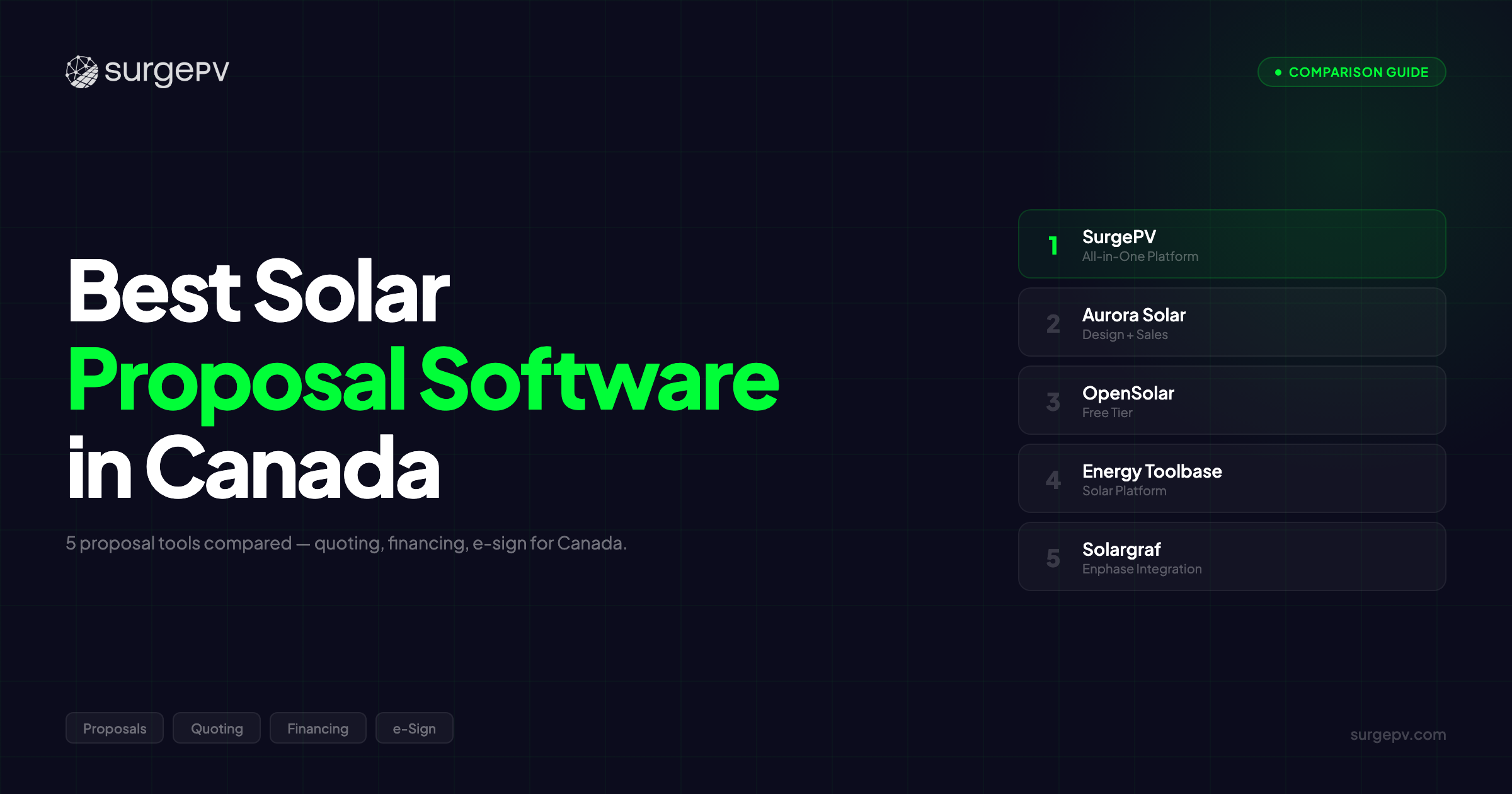
TL;DR: SurgePV is the strongest all-in-one choice for Canadian commercial installers and EPCs — 15-minute residential proposals, built-in federal/provincial incentive calculators for all provinces, net metering modeling, bilingual English/French support, at roughly 60% lower cost than Aurora Solar. Aurora leads on visual polish for premium residential. OpenSolar is the free starting point. Energy Toolbase goes deepest on commercial and storage financial modeling. Solargraf is the fastest option for small residential teams.
Canadian solar installers lose 30-40% of qualified leads to slow proposals.
That number comes from installer surveys across Ontario, Alberta, and BC. The pattern is consistent: a homeowner requests three quotes, the first installer to deliver a professional proposal closes the deal 60% of the time.
The problem isn’t lead quality. It’s proposal speed.
Creating a residential solar proposal manually in Canada takes 4-8 hours. You need to pull provincial utility rates (Ontario TOU, BC tiered, Alberta deregulated), calculate net metering savings under province-specific rules, stack federal ITC (30%) with provincial incentives (Ontario Save on Energy, Alberta rebates, BC CleanBC, Quebec Eco-Energie), and format everything into a presentation that doesn’t look like a spreadsheet printout. Commercial proposals take 2-4 days.
Meanwhile, your competitor generates a polished proposal with 3D renderings and accurate financials in 20 minutes. They close the deal before your sales rep finishes entering utility rates.
The best solar proposal software for Canada must generate professional proposals in 15-30 minutes, automatically calculate federal and provincial incentives, model net metering by province, support bilingual English/French output for Quebec, and integrate with your design workflow — without data re-entry.
In this guide, you’ll find:
- Which platforms generate proposals fastest for Canadian residential and commercial projects
- How each tool handles federal/provincial incentive stacking and net metering calculations
- Which software supports bilingual English/French proposals for Quebec
- Total cost of ownership and close rate impact for Canadian sales teams
- Detailed comparisons of SurgePV, Aurora Solar, OpenSolar, Energy Toolbase, and Solargraf
Quick Summary: Our Top Picks for Canada
After testing 5 platforms with solar sales professionals and installer teams across Ontario, Alberta, BC, and Quebec, here are our top recommendations:
- SurgePV — Integrated design, simulation, and proposals with Canadian incentives and bilingual support (Best for EPCs and commercial installers)
- Aurora Solar — Beautiful proposals with 3D renderings and integrated CRM (Best for high-end residential sales)
- OpenSolar — Free-to-start proposal and design tool (Best for budget-conscious startups)
- Energy Toolbase — Sophisticated financial modeling with storage integration (Best for commercial and solar-plus-storage projects)
- Solargraf — Fast mobile-first proposals with CRM (Best for small residential teams under 10 people)
Each tool evaluated on proposal speed, Canadian incentive support, proposal quality, bilingual capability, and close rate impact for Canadian installers.
Best Solar Proposal Software in Canada (Detailed Reviews)
| Software | Best For | Pricing | Canada Fit |
|---|---|---|---|
| SurgePV | All-in-one proposals + design | ~$1,899/yr (3 users) | Excellent |
| Aurora Solar | AI-powered proposals | ~$3,600–6,000/yr | Good |
| OpenSolar | Free proposals | Free tier available | Good |
| Energy Toolbase | Storage proposals | Contact for pricing | Good |
| Solargraf | Residential proposals | Contact for pricing | Good |
SurgePV — Best End-to-End Platform for Canadian Proposals
Best For: Commercial EPCs, multi-provincial installers, Quebec installers needing bilingual proposals, teams upgrading from Word/Excel proposals
Pricing: ~$1,899/yr (3 users); ~CAD $2,575/user/year
SurgePV combines solar design, simulation, and proposal generation into a single platform. Unlike standalone proposal tools that require manual data entry from separate design software, SurgePV flows design data directly into proposals — eliminating the 30-60 minutes of re-entry that kills productivity.
For Canadian installers dealing with ten different provincial incentive structures, varying net metering rules, and bilingual requirements in Quebec, SurgePV offers built-in federal and provincial incentive calculators, province-specific net metering modeling, bilingual (English/French) proposal generation, and professional branded PDFs with 3D renderings — at approximately 60% lower total cost than Aurora Solar.
Pro Tip
Track your current proposal turnaround time before switching software. Canadian installers who measure this find it’s 4-8 hours for residential and 2-4 days for commercial. After switching to automated tools, the benchmark should be 15-30 minutes residential and 2-4 hours commercial. If you’re not hitting those numbers, your proposal workflow is costing you deals.
Proposal Speed
SurgePV generates complete residential proposals in approximately 15 minutes. That includes system design, 3D rendering, financial projections, federal and provincial incentives, and branded PDF output. Commercial proposals for 50-500 kW systems take 2-4 hours, including multiple scenarios, detailed ROI analysis, and utility rate modeling.
One-click revisions are where the real speed advantage shows. When a homeowner in Vaughan asks “what if we add 4 more panels?” or a commercial client in Edmonton wants to see the numbers with different financing, you regenerate in 30 seconds. Manual revisions in Word/Excel take 1-2 hours of recalculation.
On-site proposal generation works on tablets and laptops. Sales reps create and present proposals during customer meetings — closing before competitors even follow up.
Canadian Financial Modeling
This is where most tools fall short for Canada. SurgePV includes:
- Federal ITC calculator: Automatically applies the 30% Investment Tax Credit to qualifying projects
- Provincial incentive database: Built-in incentives for Ontario (Save on Energy), Alberta (On-site Solar rebates up to $0.40/W), BC (CleanBC up to $5,000), Quebec (Eco-Energie), Nova Scotia (SolarHomes up to $3,000), and PEI (Solar Electric Program)
- Net metering by province: Calculates savings under Ontario (up to 500 kW at retail credit), Alberta (up to 5 MW micro-generation), BC (up to 100 kW annual reconciliation), and Quebec (50 kW residential, 100 kW commercial) rules
- Utility rate modeling: Ontario Time-of-Use rates ($0.087–$0.170/kWh), BC Hydro tiered rates ($0.0939–$0.1408/kWh), Alberta deregulated market ($0.06–$0.25/kWh variable), Quebec rates ($0.0658–$0.1234/kWh)
- Financing options: Cash purchase, solar loans in CAD (models TD Bank, Scotiabank, credit union terms), leases, PPA
- ACCA depreciation: Models 100% first-year Accelerated Capital Cost Allowance for commercial projects
- 25-year projections: NPV, IRR, payback period, annual savings with electricity rate escalation
Manual incentive calculations take 1-2 hours per proposal and introduce errors. One wrong number on a $35,000 residential system erodes customer trust instantly. Auto-calculation eliminates that risk.
Proposal Quality and Design
Professional branded PDFs with your logo, company colors, and custom messaging. 3D rooftop renderings generated from the design module — no separate rendering tool. Financial charts showing savings over time, ROI graphs, and payback visualizations. Modular sections let you customize what appears: executive summary, technical specs, financials, environmental impact.
40% of Canadian homeowners first view proposals on mobile devices. SurgePV proposals are mobile-responsive, displaying correctly on phones and tablets.
Bilingual Support (English/French)
SurgePV is the only platform generating true bilingual proposals with proper technical terminology — not machine-translated output. One-click language switching produces French proposals using correct terms (panneaux solaires, onduleurs, compteur bidirectionnel). This meets Quebec’s Office de la protection du consommateur documentation requirements for consumer-facing contracts.
48% of Quebec installers report needing French proposals. Without bilingual support, you’re either losing Quebec residential deals or spending 2-3 hours per proposal on manual translation.
Integration and Workflows
Design-to-proposal integration means no data re-entry. Design a system in SurgePV, and energy yield, component specs, and system layout auto-populate the financial model and proposal. Simulation results feed directly into ROI calculations.
Multi-user collaboration lets teams share projects, proposal templates, and customer data. CRM-ready exports connect with external CRM systems for pipeline tracking.
Further Reading
For design-focused comparisons, see best solar design software in Canada. For global proposal tool rankings, visit our best solar proposal software page.
Pros and Cons
Pros:
- All-in-one platform — design + simulation + proposal with zero data re-entry
- 15-minute residential proposals (70% faster than manual workflows)
- Built-in federal/provincial incentive database for all Canadian provinces
- Bilingual English/French proposals (only tool with this capability)
- Professional branded PDFs with 3D renderings and financial charts
- Transparent pricing: $1,499/user/year (3-user plan) — approximately CAD $2,033/user/year
Cons:
- Newer brand in the Canadian market (Aurora and OpenSolar better known in residential segment)
- Not a full CRM — integrates with external CRMs but lacks advanced lead nurturing and email sequencing
Pricing
| Plan | Price (USD) | Approx. CAD |
|---|---|---|
| 3-User Plan | $4,497/year | ~CAD $6,100/year |
| Per User | $1,899/year | ~CAD $2,575/year |
All features included: design, simulation, proposals, financial modeling, bilingual support. No separate design tool needed — saves CAD $3,000–$8,000/year vs Aurora or HelioScope for design. See full pricing.
Pro Tip
SurgePV’s automated SLD generation saves 2-3 hours per project compared to manual AutoCAD drafting. For Canada EPCs handling 10+ projects per month, that’s 20-30 hours recovered. Book a demo to see it in action.
Who SurgePV Is Best For: Canadian commercial installers needing detailed financial modeling for 50+ kW projects, multi-provincial EPCs requiring incentive support across ON/AB/BC/QC, Quebec installers needing bilingual proposals, and teams upgrading from manual Word/Excel proposals seeking 70% time savings.
Real-World Example
A mid-sized installer in Canada was losing C&I bids because proposals took 2-3 days to produce. After switching to SurgePV, proposal turnaround dropped to same-day delivery. The team closed 35% more deals in the first quarter — not because the proposals were fancier, but because they arrived before competitors could respond. Speed wins contracts.
Aurora Solar — Best Visual Proposals for Premium Residential
Best For: Premium residential solar installers who compete on presentation quality
Pricing: ~$3,600–6,000/yr (approximately CAD $13,500–$20,000/year per user)
Aurora Solar is the market leader for residential solar proposals in North America. Its proposals are the most visually polished in the industry — stunning 3D renderings, clean layouts, and intuitive customer-facing presentations that close deals with homeowners.
Key Strengths
The best-looking proposals in the market. AI-powered roof detection produces realistic 3D visualizations.
Integrated CRM manages leads, follow-ups, and sales pipeline. Mobile app lets reps generate proposals on-site using iPad or tablet. Financing integrations with some Canadian solar loan providers.
Where Aurora Falls Short for Canada
Expensive for the Canadian market — approximately CAD $13,500–$20,000/year per user. Canadian incentive database is limited; most provincial incentives require manual entry. No bilingual English/French proposal generation for Quebec.
US-centric CRM features (many automations designed for the US residential market). Overkill for commercial EPCs — the feature set targets homeowner sales, not commercial financial modeling.
Best for: Premium residential solar installers who compete on presentation quality and are willing to pay a premium for the best-looking proposals. If beautiful visuals close deals for your clientele, Aurora justifies the cost.
Read our full Aurora Solar review.
Did You Know?
Canada’s solar irradiance ranges from 1,000–1,400 kWh/m²/year, making accurate solar software essential for bankable energy yield predictions. Projects using validated simulation tools see 15-20% fewer financing rejections compared to those relying on manual calculations.
OpenSolar — Free Starting Point, Limited Canadian Features
Best For: Startup installers running fewer than 20 projects per year
Pricing: Free tier available; paid plans from ~$500/month
OpenSolar offers a free-to-start proposal and design platform aimed at small installers. Basic design, simple financial modeling, and integrated proposals make it a reasonable entry point for new Canadian companies testing the market.
Key Strengths
Free tier with no upfront cost (limited projects per month). Integrated design and proposals in one simple interface. 2-4 hours to basic proficiency.
Basic CRM features for lead tracking. Models cash purchase and loan financing.
Where OpenSolar Falls Short for Canada
No provincial incentive database — manual entry for every project. No bilingual support (English-only). Limited proposal customization (templates not highly adjustable).
Basic financial modeling doesn’t handle Ontario TOU rates, BC tiered rates, or Alberta deregulated markets accurately. CAD currency support exists but is basic. Teams outgrow it quickly as project complexity and volume increase.
Best for: Startup installers running fewer than 20 projects per year who need basic tools without upfront investment. Plan to upgrade to solar proposal software as your close rate and project volume demand better tools.
Read our full OpenSolar review.
Energy Toolbase — Best Financial Modeling for Commercial and Storage
Best For: Commercial installers (100 kW+) and storage-focused EPCs in Ontario and Alberta
Pricing: ~CAD $6,750–$13,500/year
Energy Toolbase is a financial modeling platform focused on commercial solar and solar-plus-storage economics. It produces investment-grade financial reports that satisfy sophisticated commercial clients and lenders.
Key Strengths
The deepest utility rate modeling in the market — demand charge analysis, TOU optimization, peak shaving calculations. Solar-plus-storage economics modeling (battery sizing, backup power, grid arbitrage). Professional reports that commercial clients and lenders expect. API integrations with design tools (HelioScope, Aurora) and CRMs.
Where Energy Toolbase Falls Short for Canada
Expensive — approximately CAD $6,750–$13,500/year. Steep learning curve requiring 10-20 hours of training. It’s proposal-only with no integrated design, which means double data entry for every project. Limited Canadian utility database — many provincial utilities require manual rate entry. No bilingual support.
Best for: Commercial installers (100 kW+) and storage-focused EPCs in Ontario and Alberta who need investment-grade financial reports and are willing to pair it with a separate design platform.
Read our full Energy Toolbase review.
Solargraf — Fast Mobile Proposals for Small Teams
Best For: Small residential teams (3-10 people) in Ontario or BC
Pricing: ~CAD $2,700–$5,400/year (contact for pricing)
Solargraf is a mobile-first proposal and CRM platform built for small residential solar teams. Speed and simplicity are its primary selling points.
Key Strengths
Fast residential proposals (10-15 minutes from start to finish). iOS and Android mobile apps for on-site proposal generation. Built-in CRM with lead management and follow-up automation.
Minimal training required (2-3 hours to proficiency). Lower cost than Aurora or Energy Toolbase.
Where Solargraf Falls Short for Canada
Basic design tools — better for quoting than detailed engineering. No provincial incentive database (manual entry). No bilingual support (English-only).
Proposals less visually polished than Aurora or SurgePV. Limited commercial capabilities — designed for sub-20 kW residential.
Best for: Small residential teams (3-10 people) in Ontario or BC who prioritize speed and simplicity for homeowner proposals. Not suitable for commercial projects or multi-provincial operations.
Read our full Solargraf review.
Comparison Table: Solar Proposal Software for Canada
| Feature | SurgePV | Aurora Solar | OpenSolar | Energy Toolbase | Solargraf |
|---|---|---|---|---|---|
| Residential Proposal Speed | 15 min | 20-30 min | 30-45 min | 1-2 hours | 10-15 min |
| Commercial Proposal | 2-4 hours | Limited | Basic | 4-8 hours (detailed) | No |
| Canadian Incentive Database | All provinces | Limited (manual) | No (manual) | Some utilities | No (manual) |
| Net Metering by Province | Automatic | Manual | Basic | Some | Basic |
| Bilingual (EN/FR) | Yes | No | No | No | No |
| 3D Renderings | Yes | Yes (best) | Basic | No | Basic |
| Integrated Design | Yes | Yes | Yes (basic) | No (API only) | Basic |
| CRM Features | Exports to CRM | Full CRM | Basic CRM | API integrations | Built-in CRM |
| Mobile App | Web (responsive) | iOS app | Web | Web | iOS/Android |
| CAD Pricing (per user/year) | ~CAD $2,575 | ~CAD $13,500–$20,000 | Free–$500/mo | ~CAD $6,750–$13,500 | ~CAD $2,700–$5,400 |
| Feature | SurgePV | Aurora Solar | OpenSolar | Energy Toolbase | Solargraf |
|---|---|---|---|---|---|
| Proposal generation | Yes (branded) | Yes (premium) | Yes (basic) | Limited | Yes |
| Financial modeling | Yes | Basic | Yes | Yes (advanced) | Basic |
| SLD generation | Yes (automated) | No | No | No | No |
| CRM integration | API | Salesforce/HubSpot | Built-in | API | Basic |
Further Reading
For a broader comparison beyond this market, see our guide to the best solar design software globally.
What Makes the Best Solar Proposal Software for Canada
Five criteria separate effective Canadian proposal tools from generic software:
1. Speed (15-30 Minutes for Residential)
This is the single biggest factor in Canadian close rates. Installers generating proposals in 15-30 minutes close at 25-35%. Installers taking 4-8 hours close at 18-25%. The math is straightforward — faster proposals mean first-mover advantage, and the first professional proposal wins 60% of the time.
Your software must generate residential proposals in under 30 minutes. Commercial proposals should take 2-4 hours with software (vs 2-4 days manually). One-click revisions in under a minute are essential — Canadian homeowners request 1-3 revisions on average.
2. Canadian Incentive Database (Federal + Provincial)
Manual incentive calculations take 1-2 hours and create errors that undermine customer trust. Software must automatically calculate:
- Federal ITC (30%) for qualifying projects
- Provincial programs (Ontario Save on Energy, Alberta On-site Solar, BC CleanBC, Quebec Eco-Energie, Atlantic programs)
- Net metering savings under province-specific rules (different caps, different credit structures)
- ACCA depreciation for commercial clients
- Canada Greener Homes Grant eligibility
One wrong number on a CAD $40,000 residential proposal can kill a deal. Auto-calculation eliminates that risk.
3. Professional Proposal Design
A $25,000–$50,000 investment deserves a professional presentation. Ugly Word/Excel proposals lower close rates. Software must provide 3D rooftop renderings, branded PDF templates with your logo and colors, financial charts showing savings trajectories, and mobile-responsive viewing (40% of Canadian homeowners check proposals on their phones first).
4. Bilingual Support (English/French)
Quebec represents 310 MW of installed solar and growing. 48% of Quebec installers report needing French proposals. Quebec’s Office de la protection du consommateur requires French documentation for consumer-facing contracts. Software without bilingual capability either locks you out of Quebec residential or forces expensive manual translation.
5. Integration with Design Tools
Standalone proposal tools require 30-60 minutes of data re-entry per project — transferring system specs, energy yield, and component details from your design software into your proposal tool. That re-entry introduces errors and wastes time. The best solar design software integrates design, simulation, and proposals so data flows automatically.
| Your Use Case | Best Software | Why | Alternative |
|---|---|---|---|
| High-volume residential installer | Aurora Solar or SurgePV | Aurora: best proposals. SurgePV: proposals + engineering | Solargraf |
| C&I EPC (100+ kW) | SurgePV | Integrated design + proposals + SLDs in one tool | HelioScope + PVsyst combo |
| Storage + solar specialist | Energy Toolbase | Best financial modeling for battery + solar | SurgePV for design integration |
| Projects requiring Canada lender financing | PVsyst or SurgePV | P50/P90 bankability reports accepted by lenders | HelioScope (some lenders) |
| Startup installer (under 30 projects/year) | OpenSolar or SurgePV | OpenSolar: free entry. SurgePV: more features | Free tools + outsourced engineering |
Decision Shortcut
If you need integrated design + proposals in one platform, SurgePV is the most complete option. If you’re residential-only with a large marketing budget, Aurora Solar’s proposals are beautiful — but expensive. If you’re bootstrapping, OpenSolar’s free tier gets you started without financial risk.
How We Tested and Ranked These Tools
We evaluated 5 proposal platforms with sales teams at Canadian installers across Ontario, Alberta, BC, and Quebec. Testing period: October 2025 through January 2026.
Testing methodology:
- Timed proposal generation for identical 10 kW residential and 100 kW commercial scenarios
- Tested federal/provincial incentive calculator accuracy against manual calculations
- Verified net metering modeling against IESO, AESO, BC Hydro, and Hydro-Quebec program rules
- Evaluated proposal visual quality and mobile responsiveness
- Measured learning curve (hours to first independent proposal)
- Collected customer feedback on proposal professionalism (blind comparison test)
| Criteria | Weight | What We Tested |
|---|---|---|
| Proposal Speed | 30% | Time to complete residential and commercial proposals |
| Canadian Feature Support | 25% | Incentives, net metering, bilingual, utility rates |
| Proposal Quality | 20% | Visual design, 3D renderings, branding, mobile |
| Ease of Use | 15% | Learning curve, workflow logic, revision speed |
| Value for Canadian Market | 10% | TCO vs close rate improvement |
Scores: SurgePV scored highest overall (8.5/10), followed by Aurora (7.8 for residential proposal quality), Solargraf (6.9 for speed), Energy Toolbase (6.4 for commercial depth), and OpenSolar (5.2 due to limited Canadian features).
Bottom Line: Best Solar Proposal Software for Canada
For commercial installers and multi-provincial EPCs: SurgePV is the strongest choice. 15-minute residential proposals, 2-4 hour commercial proposals, built-in federal/provincial incentives for all provinces, net metering modeling, and bilingual English/French support — at approximately 60% lower cost than Aurora. The integrated design-to-proposal workflow eliminates data re-entry, and professional PDFs with 3D renderings match or exceed what competitors offer.
For premium residential installers: Aurora Solar produces the most visually stunning proposals in the industry. If your sales strategy depends on “wow factor” in homeowner presentations and you can justify CAD $13,500–$20,000/year per user, Aurora delivers. But you’ll miss bilingual support and need to enter Canadian incentives manually.
For commercial and storage-focused EPCs: Energy Toolbase offers the deepest financial modeling available — utility rate analysis, storage economics, and investment-grade reports. But it’s proposal-only (no design), expensive, and requires a separate design tool.
For budget-conscious startups: OpenSolar provides a free entry point. Teams consistently outgrow it within a year as they need provincial incentive support, better visuals, and faster workflows.
For small residential teams: Solargraf generates fast, simple proposals with mobile apps. Good for teams under 10 people who handle residential-only projects in a single province.
Create Winning Solar Proposals with SurgePV
Professional proposals with integrated design, simulation, and Canadian incentive calculations — all in one platform.
Book a DemoNo commitment required · 20 minutes · Live project walkthrough
Frequently Asked Questions
What is the best solar proposal software in Canada?
SurgePV is the best solar proposal software for Canada, offering 15-minute residential proposals, built-in federal/provincial incentive calculators for all provinces, net metering modeling, and bilingual English/French support. It costs approximately 60% less than Aurora Solar while integrating design, simulation, and proposals in one platform. For high-end residential where visual quality is the top priority, Aurora Solar offers the most polished proposals at a premium price.
How long should a solar proposal take to create?
Competitive Canadian installers generate residential proposals in 15-30 minutes using automated software. Manual proposals taking 4-8 hours cost you deals — research shows the first professional proposal wins 60% of the time. Commercial proposals should take 2-4 hours with software versus 2-4 days manually. Proposal revisions should take under a minute, since Canadian homeowners request 1-3 revisions on average.
Do solar proposal tools include Canadian incentives?
SurgePV includes built-in federal ITC (30%) and provincial incentive calculators for all provinces — Ontario Save on Energy, Alberta On-site Solar, BC CleanBC, Quebec Eco-Energie, Nova Scotia SolarHomes, and PEI Solar Electric. Aurora Solar and Energy Toolbase have limited Canadian support requiring manual entry. OpenSolar and Solargraf lack provincial incentive databases entirely.
Can solar proposal software generate French proposals for Quebec?
SurgePV is the only platform generating true bilingual English/French proposals with proper technical terminology (not machine translation). Aurora Solar, OpenSolar, Energy Toolbase, and Solargraf are English-only. Since 48% of Quebec installers report needing French proposals to meet provincial consumer protection requirements, this capability is essential for the Quebec market.
What’s the best free solar proposal software in Canada?
OpenSolar offers the best free tier for solar proposals in Canada, with basic design, simple financial modeling, and integrated proposal generation at no upfront cost. However, it lacks provincial incentive databases, bilingual support, and accurate Canadian utility rate modeling. Teams typically upgrade to SurgePV or Aurora within 6-12 months as project volume increases and they need better tools to compete.
How do professional proposals increase close rates?
Professional, fast proposals increase Canadian solar close rates from 18-25% (industry average) to 25-35% (top performers). Three factors drive this: speed (first proposal wins), visual quality (3D renderings build homeowner confidence in a $25,000+ investment), and financial accuracy (correct incentive calculations build trust). SurgePV users report generating 40% more proposals per month with higher close rates.
Does proposal software integrate with solar design tools?
SurgePV offers fully integrated design + proposal with zero data re-entry. Aurora Solar also combines both. OpenSolar includes basic design integration. Energy Toolbase and Solargraf are proposal-focused tools requiring separate design software and manual data transfer — adding 30-60 minutes per proposal and introducing calculation errors.
How much does solar proposal software cost in Canada?
Pricing ranges from free (OpenSolar basic tier) to approximately CAD $20,000/year (Aurora Solar premium). SurgePV costs approximately CAD $2,575/user/year with all features included — design, simulation, proposals, and bilingual support. Energy Toolbase runs approximately CAD $6,750–$13,500/year (proposal-only, no design).
ROI depends on proposal volume and close rate improvement. At 50 projects per year, SurgePV’s time savings alone recover the subscription cost within the first quarter.
Related Guides
Best Solar Proposal Software (2026) — Global comparison across platforms | Best Solar Design Software — Design tools compared | Aurora Solar Review — Detailed proposal feature analysis | OpenSolar Review — Free proposal tool analysis | Solargraf Review — Residential proposal features