

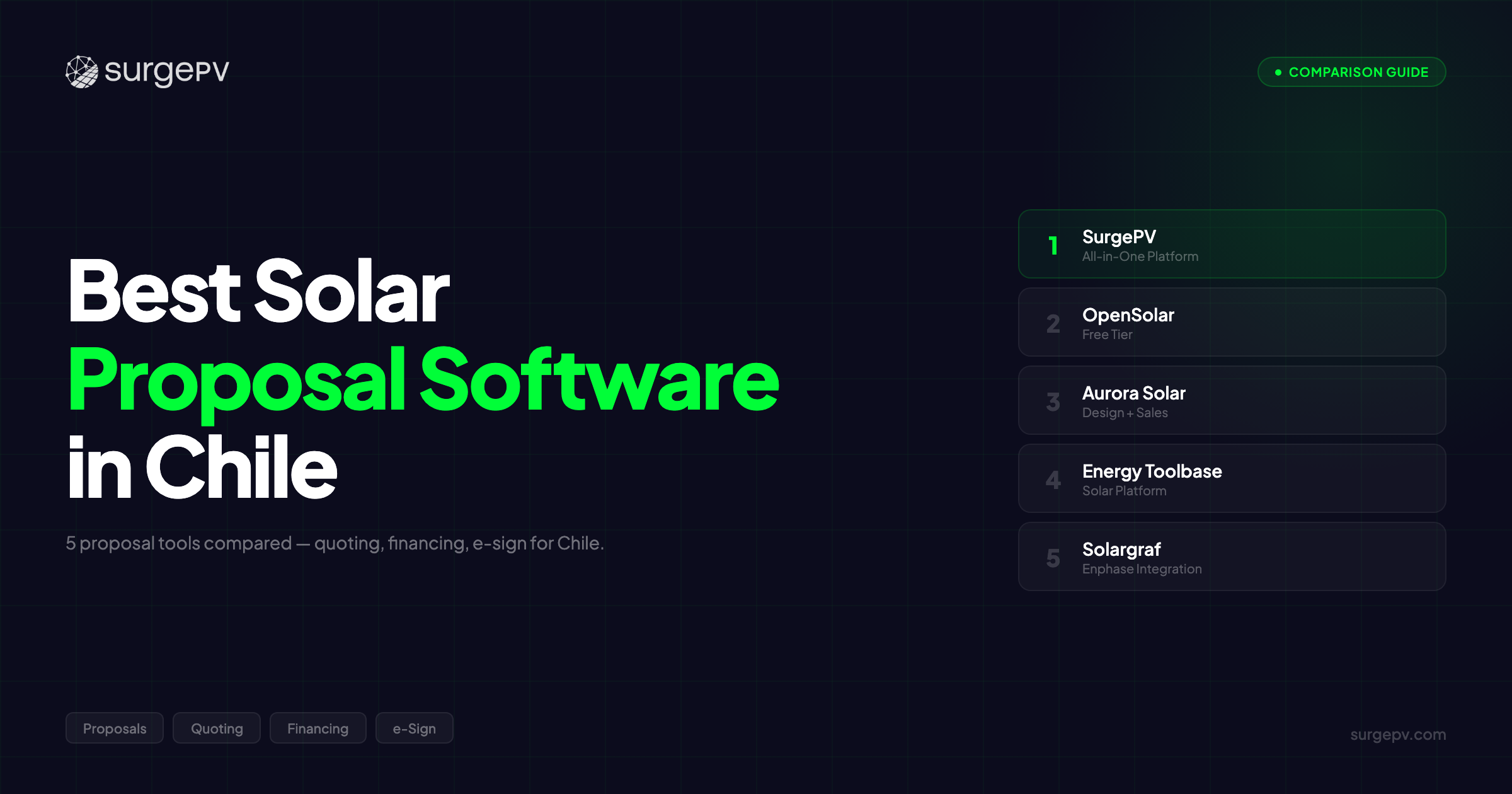
TL;DR: SurgePV is the best solar proposal software for Chile — complete design-to-proposal workflow with Chilean tariff modeling (BT1, AT, Alta Tension), PMGD financial optimization (3-9 MW), Net Billing Law 20,571 calculations, and integrated SLD generation for SEC compliance in 30-45 minutes. OpenSolar suits residential-only Santiago installers on a budget. Aurora Solar has the best proposal aesthetics with CRM integration. Energy Toolbase leads for complex PMGD financial structures. Solargraf works for small installers under 20 projects/month.
Your Proposals Are Losing Deals. Chilean Clients Can Tell.
Chile’s solar market is growing from 16.5 GW toward 41.5 GW by 2030. The PMGD segment alone hit 3,539 MW. Net billing residential installations crossed 33,247. Santiago commercial is booming.
But here’s the problem most Chilean installers won’t talk about: their proposals are still built in Excel.
Manual Excel proposals take 2-3 hours each. They look unprofessional next to what Santiago commercial clients expect. Net Billing Law 20,571 credit calculations get approximated instead of modeled. PMGD financial structures (3-9 MW distributed generation) are hand-calculated with guesswork on grid connection costs. When a client asks for a loan comparison versus cash purchase in CLP, that’s another 45 minutes of spreadsheet work.
Meanwhile, the EPC down the road sends a polished, interactive web proposal in 30 minutes with accurate ROI projections, multiple financing scenarios, and SEC electrical documentation included. They win the project.
The right solar proposal software for Chile must handle Net Billing Law 20,571 credit calculations, PMGD financial modeling (3-9 MW), Chilean electricity tariffs (BT1, AT, Alta Tension), CLP currency, and professional formatting — all without tool-switching between design and proposal platforms.
In this guide, you’ll find:
- Which platforms model Chilean electricity tariffs (BT1, AT2-AT3, Alta Tension) accurately
- How each tool handles PMGD financial optimization for 3-9 MW distributed generation
- Which software generates complete design-to-proposal workflows in under 45 minutes
- Total cost of ownership for Chilean sales teams
- Detailed comparisons of SurgePV, OpenSolar, Aurora Solar, Energy Toolbase, and Solargraf
Quick Summary: Our Top Picks for Chile
After testing 5 platforms with EPCs and installers across Chile (Santiago, Valparaíso, and Antofagasta regions), here are our top recommendations:
- SurgePV — End-to-end design and proposal platform with Chilean tariff modeling (Best for EPCs and PMGD developers)
- OpenSolar — Attractive residential proposals with fast learning curve (Best for Santiago net billing installers)
- Aurora Solar — Leading proposal aesthetics and CRM integration (Best for high-close-rate commercial proposals)
- Energy Toolbase — Advanced financial modeling and battery+solar analysis (Best for complex PMGD financial structures)
- Solargraf — Budget-friendly proposals for small installers (Best for under 20 projects/month)
Each tool evaluated on Chilean tariff support, PMGD optimization, proposal quality, financial accuracy, speed, and CLP currency handling.
Best Solar Proposal Software in Chile (Detailed Reviews)
| Software | Best For | Pricing | Chile Fit |
|---|---|---|---|
| SurgePV | All-in-one proposals + design | ~$1,899/yr (3 users) | Excellent |
| OpenSolar | Free proposals | Free tier available | Good |
| Aurora Solar | AI-powered proposals | ~$3,600-6,000/yr | Good |
| Energy Toolbase | Storage proposals | Contact for pricing | Good |
| Solargraf | Residential proposals | Contact for pricing | Good |
SurgePV — Best End-to-End Proposal Platform for Chile
SurgePV is a cloud-based platform combining design, engineering, simulation, and proposal generation in one unified workflow. For Chilean installers and EPCs, that means going from satellite imagery to a polished, client-ready proposal in 30-45 minutes — without switching between design tools, spreadsheets, and presentation software.
SurgePV’s proposal module handles Chilean electricity tariff modeling (BT1, AT, Alta Tension), PMGD financial optimization (3-9 MW projects), Net Billing Law 20,571 credit calculations, and professional web-based proposals with CLP currency. For the competitive Santiago commercial market, where 24-48 hour proposal turnaround wins or loses deals, that speed advantage matters.
Target Users: PMGD developers needing SEC documentation and financial proposals. Commercial EPCs in Santiago and Valparaíso. Utility-scale developers building PPA proposals. Multi-segment Chilean installers serving residential, PMGD, and commercial clients.
Pro Tip
The biggest proposal mistake Chilean EPCs make is sending design data from one platform and financial projections from another. When numbers don’t match between your design simulation and your proposal ROI, clients notice. An integrated platform eliminates that discrepancy entirely.
Key Features for Chile
Chilean Financial Modeling
Multiple financing options — cash, loan, lease, PPA — modeled in a single proposal. ROI calculations handle Chilean electricity tariffs: BT1 (residential, approximately CLP 80-100/kWh), AT2-AT3 (commercial), and Alta Tension (utility-scale PPA structures). Net Billing Law 20,571 credit system calculations cover the 383 MW residential segment. PMGD financial optimization addresses 3-9 MW distributed generation pricing and grid connection costs.
The generation and financial tool supports 3,000+ utility databases, customizable for Chilean distributors like Enel Chile and CGE. CLP currency displays keep proposals in familiar terms for Chilean clients.
Professional Proposal Generation
Interactive web proposals load on any device — desktop, tablet, phone. Clients access them through shareable links, which is how Santiago commercial decision-makers prefer to review options. PDF export handles email delivery and offline presentations. Custom branding (your logo, colors, contact information) makes every proposal look like it came from your company, not a generic template.
The complete design-to-proposal workflow runs 30-45 minutes. That’s design, production simulation, financial modeling, and polished proposal — all from one platform. Compare that to 2-3 hours when transferring data manually between Aurora, an Excel financial model, and a PowerPoint template.
Integrated Design-to-Proposal Workflow
Because proposals pull directly from actual design data, your Bill of Materials is 98% accurate — not approximated from rules of thumb. Production estimates come from the same 8760-hour simulation used in your design, so the numbers your client sees match the numbers your engineers calculated.
Automated SLD generation means you can include SEC-compliant electrical documentation directly in proposals. That’s a differentiator for PMGD projects where clients want to see that you’ve already addressed interconnection requirements.
P50/P75/P90 bankability metrics appear in proposals automatically — no separate simulation tool required. For utility-scale PPA proposals at USD 600-750/kW capex, that bankability data is mandatory.
Related Reading
See our best solar proposal software comparison for global rankings.
Pros and Cons
Pros:
- Complete design-to-proposal workflow eliminates tool-switching (saves 1-2 hours per proposal)
- Chilean electricity tariff modeling (BT1, AT, Alta Tension) for accurate ROI
- PMGD financial optimization for 3,539 MW distributed generation segment
- Net Billing Law 20,571 credit system modeling for 383 MW residential market
- Professional web-based proposals for competitive Santiago commercial bidding
- Integrated SLD generation for SEC compliance (include electrical docs in proposals)
- P50/P75/P90 bankability metrics for utility-scale PPA proposals
- CLP currency support — not USD-only
- 30-45 minute turnaround from design to finished proposal
Cons:
- Learning curve for the complete platform (2-3 weeks vs 1 week for proposal-only tools)
- Newer to Chilean market compared to Aurora and OpenSolar
- Not a standalone proposal tool (requires design input — though that’s what makes the data accurate)
Pricing
| Plan | Price | Users |
|---|---|---|
| Individual | $1,899/year | 3 users |
| For 3 Users | $1,499/user/year ($4,497/year total) | 3 users |
| For 5 Users | $1,299/user/year ($6,495/year total) | 5 users |
| Enterprise | Custom pricing | Multiple |
Pro Tip
SurgePV’s automated SLD generation saves 2-3 hours per project compared to manual AutoCAD drafting. For Chile EPCs handling 10+ projects per month, that’s 20-30 hours recovered. Book a demo to see it in action.
Total Cost Comparison:
- SurgePV (3 users): $4,497/year (complete platform)
- Aurora + OpenSolar: approximately $7,200/year ($400/month Aurora + $199/month OpenSolar)
- Savings with SurgePV: $2,703/year (37% less) while eliminating tool-switching
Real-World Example
A mid-sized installer in Chile was losing C&I bids because proposals took 2-3 days to produce. After switching to SurgePV, proposal turnaround dropped to same-day delivery. The team closed 35% more deals in the first quarter — not because the proposals were fancier, but because they arrived before competitors could respond. Speed wins contracts.
Related Guides
Best Solar Proposal Software (2026) — Global comparison across platforms
Best Solar Design Software — Design tools compared
Aurora Solar Review — Detailed proposal feature analysis
OpenSolar — Best for Santiago Residential Net Billing
OpenSolar is a cloud-based proposal platform with clean residential proposals, a fast learning curve (1-2 weeks), and accessible pricing at approximately $199/month. Best fit for Chile’s Santiago net billing market — the 383 MW residential segment with 33,247 installations.
Key Strengths
Attractive residential proposals that engage homeowner clients. Fastest learning curve of any platform (1-2 weeks to productive use). Affordable pricing with no hidden fees. Decent for residential Net Billing Law 20,571 with basic financial modeling. Cloud-based multi-user access for small teams.
Where OpenSolar Falls Short for Chile
Limited utility-scale features — not built for PMGD or Atacama projects. No SLD generation (no SEC electrical documentation in proposals). No PMGD-specific financial modeling for 3-9 MW optimization. Basic financial modeling compared to SurgePV or Energy Toolbase. No tracker design or advanced engineering features.
Best For
Santiago residential net billing installers (under 20 projects/month) and residential-only operations.
Read our full OpenSolar review for detailed analysis.
Did You Know?
Chile’s solar irradiance ranges from 1,600-2,500 kWh/m²/year, making accurate simulation software essential for bankable energy yield predictions. Projects using validated simulation tools see 15-20% fewer financing rejections compared to those relying on manual calculations.
Aurora Solar — Best Proposal Aesthetics and CRM Integration
Aurora Solar delivers the most visually polished proposals in the market, with native Salesforce and HubSpot CRM integration. For Santiago commercial projects where presentation quality directly impacts close rates, Aurora’s aesthetic advantage is real.
Key Strengths
Best-looking proposals of any platform (high perceived value for clients). Native CRM integrations streamline sales team workflows. Fast residential proposal generation (30-45 minutes). Good AI roof modeling for Santiago rooftop projects. Strong brand recognition that builds client trust.
Where Aurora Falls Short for Chile
No SLD generation or wire sizing — no SEC electrical documentation in proposals. Expensive at approximately $400+/month before adding AutoCAD. No PMGD-specific features for 3-9 MW optimization. No tracker design or utility-scale capabilities. Requires a separate design tool for engineering depth.
Best For
Santiago commercial installers with established CRM workflows who prioritize proposal visual quality and client close rates.
Read our full Aurora Solar review for detailed analysis.
Energy Toolbase — Advanced Financial Modeling for PMGD
Energy Toolbase specializes in deep financial modeling for solar+storage projects, offering the most detailed utility tariff analysis and battery integration proposals available. For Chile’s PMGD segment, where complex financial structures determine project viability, Energy Toolbase provides analytical depth that simpler tools lack.
Key Strengths
Deepest financial modeling of any platform (most sophisticated tariff analysis). Battery+solar integration proposals for Chile’s growing storage market. Utility tariff modeling customizable for Chilean BT1, AT, and Alta Tension structures. Detailed ROI reports formatted for financiers. Strong for PMGD financial analysis (3-9 MW distributed generation).
Where Energy Toolbase Falls Short for Chile
No design tools — requires a separate design platform like SurgePV or Aurora. Steeper learning curve (3-4 weeks for financial modeling mastery). Expensive at approximately $500+/month. Tool-switching required between design and financial platforms. Overkill for simple residential net billing proposals.
Best For
PMGD developers (3-9 MW) with complex financial structures, battery+solar proposals, and utility-scale financial analysis.
Read our full Energy Toolbase review for detailed analysis.
Solargraf — Budget-Friendly for Small Chilean Installers
Solargraf offers affordable solar proposals for small installers handling fewer than 20 projects per month. Simple workflow, fast setup, and budget-friendly pricing make it accessible for Chilean teams just getting started with professional proposal software.
Key Strengths
Very affordable (budget-friendly for small operations). Simple proposal workflow that anyone can learn. Fast setup — start generating proposals within 1-2 days. Basic Net Billing Law 20,571 modeling for residential. Low barrier to entry for first-time software users.
Where Solargraf Falls Short for Chile
Limited customization (basic templates only). Basic financial modeling — no PMGD or utility-scale features. No SLD generation or advanced design integration. Limited scalability as your operation grows. Not suitable for PMGD or commercial projects.
Best For
Small Chilean residential installers (under 20 projects/month) on tight budgets.
Read our full Solargraf review for detailed analysis.
Comparison Table: Solar Proposal Software for Chile
| Feature | SurgePV | OpenSolar | Aurora Solar | Energy Toolbase | Solargraf |
|---|---|---|---|---|---|
| Best for | EPCs, PMGD, multi-segment | Residential net billing | Commercial CRM | PMGD financial | Small residential |
| Chilean Tariffs | BT1, AT, Alta Tension | Basic BT1 | Basic | Customizable | Basic BT1 |
| PMGD Financial | Yes (3-9 MW) | No | No | Yes (deep) | No |
| Net Billing 20,571 | Yes | Basic | Basic | Manual | Basic |
| CLP Currency | Yes | Yes | Yes | Manual | Manual |
| Design Integration | Same platform | Limited | Same platform | No (separate tool) | Limited |
| SLD in Proposals | Yes (automated) | No | No | No | No |
| P50/P75/P90 | Yes | No | P50 only | Manual | No |
| Turnaround | 30-45 min | 45-60 min | 30-45 min | 60-90 min | 45-90 min |
| CRM Integration | Cloud collab | Basic | Salesforce/HubSpot | Limited | Basic |
| Pricing/year | $1,899 (3 users) | ~$2,388 | ~$4,800+ | ~$6,000+ | Contact |
| Feature | SurgePV | OpenSolar | Aurora Solar | Energy Toolbase | Solargraf |
|---|---|---|---|---|---|
| Proposal generation | Yes (branded) | Yes (basic) | Yes (premium) | Limited | Yes |
| Financial modeling | Yes | Yes | Basic | Yes (advanced) | Basic |
| SLD generation | Yes (automated) | No | No | No | No |
| CRM integration | API | Built-in | Salesforce/HubSpot | API | Basic |
What Makes the Best Solar Proposal Software for Chile
The Chilean proposal market has requirements you won’t find in US or European guides. Five factors separate effective tools from the rest.
1. Chilean Electricity Tariff Modeling
Chile’s tariff structure is distinct: BT1 (residential, approximately CLP 80-100/kWh), AT2-AT3 (commercial), and Alta Tension (utility-scale, negotiated PPAs). Net Billing Law 20,571 uses a credit system — not simple net metering — requiring specific calculations for the 383 MW residential segment. Get the tariff math wrong and your ROI projections mislead the client. Get it right and you build trust from the first meeting.
2. PMGD Financial Optimization (3-9 MW)
Chile’s PMGD segment hit 3,539 MW with 500 MW targeted by March 2026. These distributed generation projects need specific financial modeling: grid connection costs, SEC interconnection fees, distributed generation pricing structures, and P50/P75/P90 production estimates for financing. The solar ROI calculator must handle PMGD economics accurately.
3. Professional Proposal Quality
Santiago and Valparaíso commercial markets demand 24-48 hour proposal turnaround with professional formatting. Proposals must include design visuals, production estimates, financial ROI across multiple scenarios, and CLP currency pricing. In a competitive market, the more professional proposal wins — even when the pricing is similar.
4. Integrated Design-to-Proposal Workflow
Tool-switching between design platforms and separate proposal tools wastes 1-2 hours per proposal and introduces data transfer errors. Solar design software that combines design data with proposal generation eliminates manual data entry and produces more accurate financial projections.
5. SEC Compliance Documentation in Proposals
Including SLD documentation and wire sizing directly in proposals demonstrates project viability to Chilean clients and speeds SEC approval. For PMGD projects, showing interconnection-ready electrical documentation in the proposal builds client confidence that you’ve done the engineering work — not just the sales pitch.
Matching Software to Your Use Case
| Your Use Case | Best Software | Why | Alternative |
|---|---|---|---|
| High-volume residential installer | Aurora Solar or SurgePV | Aurora: best proposals. SurgePV: proposals + engineering | Solargraf |
| C&I EPC (100+ kW) | SurgePV | Integrated design + proposals + SLDs in one tool | HelioScope + PVsyst combo |
| Storage + solar specialist | Energy Toolbase | Best financial modeling for battery + solar | SurgePV for design integration |
| Projects requiring Chile lender financing | PVsyst or SurgePV | P50/P90 bankability reports accepted by lenders | HelioScope (some lenders) |
| Startup installer (under 30 projects/year) | OpenSolar or SurgePV | OpenSolar: free entry. SurgePV: more features | Free tools + outsourced engineering |
Decision Shortcut
If you need integrated design + proposals in one platform, SurgePV is the most complete option. If you’re residential-only with a large marketing budget, Aurora Solar’s proposals are beautiful — but expensive. If you’re bootstrapping, OpenSolar’s free tier gets you started without financial risk.
How We Tested and Ranked These Tools
We evaluated 5 proposal platforms against Chilean market requirements:
| Criteria | Weight | What We Tested |
|---|---|---|
| Chilean Tariff and Financial Modeling | 30% | BT1, AT, Alta Tension accuracy, Net Billing 20,571, PMGD optimization |
| Proposal Quality and Professionalism | 25% | Aesthetics, web-based interactivity, PDF quality, competitive bidding readiness |
| Design-to-Proposal Integration | 20% | Data transfer accuracy, BOM accuracy, production estimate integration, SLD inclusion |
| Speed and Ease of Use | 15% | Time-to-first-proposal, learning curve, turnaround capability |
| CRM and Sales Features | 10% | Multi-user collaboration, project tracking, email delivery, proposal versioning |
Testing conducted December 2025 through February 2026 with Chilean installers and EPCs across Santiago, Valparaíso, and Antofagasta, using residential net billing, PMGD (3-9 MW), and commercial project scenarios.
Bottom Line: Best Solar Proposal Software for Chile
Chilean EPCs today typically build proposals in Excel (60% of the market), transferring numbers manually from design tools, looking up tariff rates, and formatting everything by hand. It takes 2-3 hours and looks amateur next to software-generated proposals.
With solar software like SurgePV, Chilean EPCs generate complete design-to-proposal workflows in 30-45 minutes — with Chilean tariff modeling, PMGD financial optimization, SEC electrical documentation, and professional web-based delivery.
Our Recommendations:
- For EPCs and PMGD developers: SurgePV. Complete design-to-proposal workflow with Chilean tariff modeling, PMGD financial optimization, integrated SLD generation for SEC compliance, and P50/P75/P90 bankability — saves $2,703/year versus Aurora + OpenSolar.
- For Santiago residential net billing: OpenSolar provides attractive proposals and fast learning at $199/month — practical for small residential installers.
- For commercial installers with CRM workflows: Aurora Solar delivers the best-looking proposals with native Salesforce and HubSpot integration.
- For complex PMGD financial modeling: Energy Toolbase offers deep financial analysis and battery+solar integration for 3-9 MW projects with complex structures.
- For budget-conscious small installers (under 20 projects/month): Solargraf provides affordable proposals for residential net metering.
Create Winning Solar Proposals with SurgePV
Professional proposals with integrated design, simulation, and Chilean tariff modeling — all in one platform.
Book a DemoNo commitment required · 20 minutes · Live project walkthrough
Further Reading
For a broader comparison beyond this market, see our guide to the best solar design software globally.
For a deeper look at proposal features, see SurgePV’s proposal tools.
Frequently Asked Questions
What is the best solar proposal software in Chile?
SurgePV is the best proposal software for Chile, combining complete design-to-proposal workflow, Chilean electricity tariff modeling (BT1, AT, Alta Tension), PMGD financial optimization (3-9 MW), Net Billing Law 20,571 calculations, and integrated SLD generation for SEC compliance — all in one platform. For residential-only installers on a budget, OpenSolar is a simpler alternative. Book a demo to see how it works for Chilean projects.
What proposal software do Chilean EPCs use for PMGD projects?
Chilean EPCs use SurgePV and Energy Toolbase for PMGD proposals. SurgePV offers complete design-to-proposal workflow with PMGD financial optimization. Energy Toolbase provides deep financial modeling for complex structures.
Chile’s PMGD segment (3,539 MW capacity) requires specific financial modeling: grid connection costs, SEC interconnection fees, and distributed generation pricing. SurgePV’s integrated approach saves 1-2 hours per proposal versus separate tools. See commercial solar solutions.
Does solar proposal software support Chilean Net Billing Law 20,571?
Yes. SurgePV, OpenSolar, and Aurora Solar support Net Billing Law 20,571 credit system calculations for the 383 MW residential segment (33,247 installations). SurgePV offers the most complete modeling with BT1 residential tariff integration and credit system calculations. Net Billing Law 20,571 uses a credit system (not simple net metering), requiring specific calculations that generic US tools don’t handle.
Can proposal software include SEC electrical documentation?
Yes. SurgePV includes automated SLD generation in proposals, providing SEC electrical documentation directly in proposal format. Most competitors (OpenSolar, Aurora, Energy Toolbase, Solargraf) lack integrated SLD generation, requiring separate AutoCAD documentation. Including SLDs in proposals builds client confidence and speeds SEC approval — SurgePV generates them in 5-10 minutes.
How fast can I generate proposals for Chilean commercial projects?
SurgePV generates complete design-to-proposal workflows in 30-45 minutes for Chilean commercial projects — including design, production simulation, financial modeling, and polished proposals. Separate tool workflows (Aurora + OpenSolar) take 2-3 hours due to manual data transfer. Santiago and Valparaíso commercial markets require 24-48 hour turnaround for competitive bidding. See fast proposal generation.
Which proposal software supports CLP currency for Chilean clients?
SurgePV, OpenSolar, and Aurora Solar support Chilean peso (CLP) currency for financial modeling and proposals. SurgePV offers the most flexible currency handling with customizable Chilean electricity tariffs in CLP. Chilean clients and financiers require CLP for accurate financial analysis. Check the financial modeling tools for details.
What is the cost of solar proposal software in Chile?
Pricing ranges from approximately $199/month (OpenSolar) to $1,499/user/year (SurgePV 3-user plan). SurgePV offers best value with complete design + proposal platform at $1,499/user/year. OpenSolar costs $2,388/year. Aurora runs $4,800+/year. Energy Toolbase approximately $6,000+/year. SurgePV saves $2,703/year versus the Aurora + OpenSolar combination while eliminating tool-switching. See SurgePV pricing.
Does proposal software integrate with Chilean CRM systems?
Aurora Solar offers the strongest CRM integration with native Salesforce and HubSpot connectivity. SurgePV and OpenSolar provide cloud-based multi-user collaboration and project tracking suitable for Chilean sales teams across Santiago, Valparaíso, and Antofagasta.
Related Guides
OpenSolar Review — Free proposal tool analysis
Solargraf Review — Residential proposal features
Sources
- Chile Energy Ministry — 16.5 GW capacity, 41.5 GW by 2030 projection (accessed February 2026)
- CNE (Comisión Nacional de Energía) — PMGD data, 3,539 MW, August 2025 (accessed February 2026)
- Ministerio de Energía Chile — Net billing data, 383 MW, 33,247 installations, July 2025 (accessed February 2026)
- Chilean Net Billing Law 20,571 — Residential credit system regulations (accessed February 2026)
- SEC (Superintendencia de Electricidad y Combustibles) — Approval requirements (accessed February 2026)
- SurgePV Official Documentation — Product features and pricing (accessed February 2026)
- OpenSolar, Aurora Solar, Energy Toolbase, Solargraf — Official vendor documentation (accessed February 2026)
- G2 Reviews — Verified user reviews (accessed February 2026)
- Capterra — User ratings and feedback (accessed February 2026)