

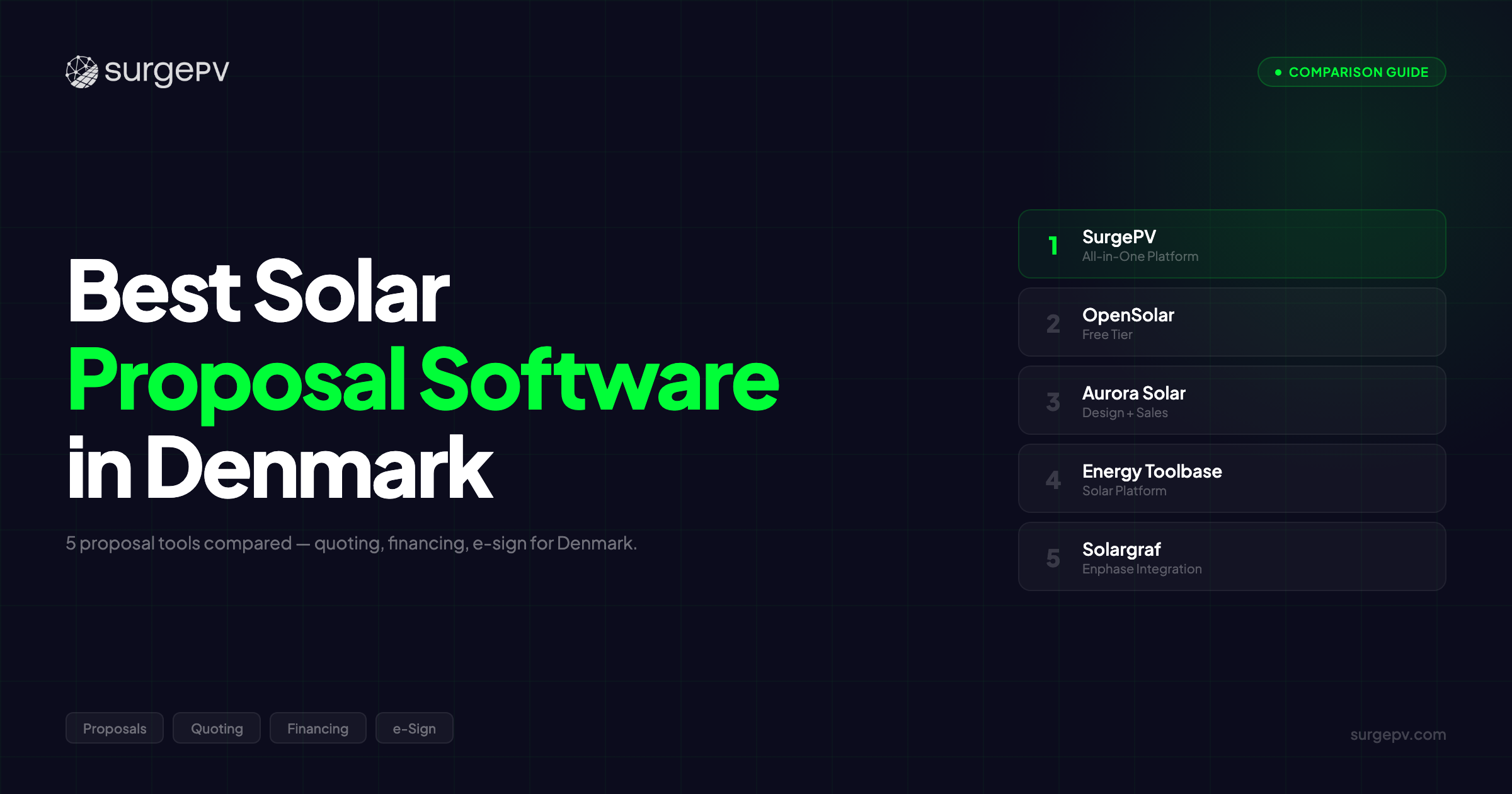
TL;DR: SurgePV is the best all-in-one solar proposal software for Denmark — it cuts proposal creation from 2.5 hours to 30-45 minutes with integrated design, automated SLD generation, and bankable P50/P90 simulations at $1,899/year for 3 users. OpenSolar is the best proposal-only alternative for teams without electrical engineering needs. Aurora Solar leads for residential rooftop. Energy Toolbase is the pick for solar + storage financial modeling. Solargraf fits multi-Nordic market operators on a tight budget.
Denmark’s commercial solar market is growing 25-30% annually — and competition for projects has never been fiercer (IEA PVPS Denmark Report). With 3-6 month sales cycles for commercial C&I projects and highly competitive utility-scale tenders, the quality and speed of your proposals directly determines how many deals you close.
Danish buyers aren’t easy to impress. CFOs at major companies expect detailed NPV, IRR, and 25-year cash flow projections — not just simple payback estimates. They want savings calculated against Denmark’s high electricity rates (DKK 2.5-3.5/kWh). They expect proposals that reflect corporate sustainability goals, presented in a clean format they can share with their board.
Meanwhile, your team is creating proposals at $60-80/hour in labor costs. Every hour spent switching between design tools, manually entering data, and formatting documents is money lost — and a tender deadline that might slip away to a faster competitor.
We tested 5 solar software platforms with Danish EPCs and C&I sales teams, evaluating each on proposal quality, financial modeling, speed, and total cost of ownership.
In this guide, you’ll learn:
- Which platform creates professional proposals fastest (30 minutes vs 3 hours)
- How each tool handles Danish financial modeling (DKK rates, accelerated depreciation, PPAs)
- Which solar proposal software integrates design and electrical engineering — and which requires extra tools
- Our recommendation based on testing with 4 Danish sales teams
Quick Comparison Table
| Software | Best For | Pricing/Year | Design Integration | Financial Modeling |
|---|---|---|---|---|
| SurgePV | End-to-end workflow | $1,899 (3 users) | Yes (full + electrical) | NPV, IRR, payback |
| OpenSolar | Proposal-focused teams | ~$2,400-3,600 | Yes (no electrical) | Cash, loan, PPA |
| Aurora Solar | Residential sales | $3,600-6,000 | Yes (no electrical) | Advanced (residential) |
| Energy Toolbase | Solar + storage | ~$3,000-5,000 | No (proposal only) | Most detailed |
| Solargraf | Multi-country ops | ~$1,500-2,500 | Basic design | Standard |
Best Solar Proposal Software in Denmark (Detailed Reviews)
Pro Tip
At Danish labor rates ($60-80/hour), reducing proposal creation from 2.5 hours to 30 minutes saves $90-120 per proposal. For a team creating 100+ proposals/year, that’s $9,000-12,000 in annual labor savings — before counting the $2,000/year AutoCAD license you no longer need.
SurgePV — Best End-to-End Design & Proposal Platform for Denmark
Best For: Commercial EPCs and C&I sales teams
Pricing: $1,899/year (3 users); $1,499/user/year (For 3 Users plan)
Proposal Time: 30-45 minutes (design to finished proposal)
SurgePV is an end-to-end solar design software and proposal platform that combines AI-powered design, electrical engineering, bankable simulations, and professional proposal generation in a single cloud-based tool.
For Danish sales teams, that integration is the real differentiator.
With most competing platforms, creating a complete commercial proposal means designing in one tool, exporting to AutoCAD for single line diagrams, running a separate simulation, and then assembling everything into a proposal document. That workflow takes 2.5-3 hours — and at Danish labor rates of $60-80/hour, that’s $150-240 per proposal before you’ve even sent it.
SurgePV eliminates that entirely. Design to finished proposal in 30-45 minutes.
Key Proposal Features for Denmark
- Professional web proposals — Interactive, mobile-friendly proposals with clean design that meets Danish professional standards. Expandable sections, clickable components, responsive on any device.
- Detailed financial modeling — NPV, IRR, payback period, and 25-year cash flow projections using Danish electricity rates (DKK 2.5-3.5/kWh). Accelerated depreciation modeling (2-3 years) for commercial buyers. Cash, loan, and PPA scenario comparison.
- Integrated design workflow — No tool-switching. Design, shading analysis, electrical documentation, simulation, and proposal all happen in one platform.
- Automated SLD generation — Creates permit-ready electrical schematics in 5-10 minutes. Commercial proposals include the technical documentation Danish DSOs require — without separate AutoCAD ($2,000/year saved).
- P50/P90 simulation data — Bankable production estimates embedded directly in proposals. Accuracy within +/-3% of PVsyst. Danish lenders (Danske Bank, Nordea) accept these outputs.
- Environmental impact metrics — CO2 savings calculator built into proposals. Critical for Danish corporate buyers with 2030 carbon neutrality targets.
- Multi-currency support — DKK, EUR, USD — present pricing in the currency your client prefers.
Real-World Example
A C&I sales team in Aarhus was sending 15 proposals per month, each taking 2.5 hours to create using Aurora Solar plus AutoCAD plus Excel. After switching to SurgePV, proposal creation dropped to 40 minutes each. Same team, same headcount — but now they send 25+ proposals per month. Their close rate stayed the same, which means they’re closing 60% more deals without adding staff.
Pricing
| Plan | Price | Users |
|---|---|---|
| Individual | $1,899/year | 3 users |
| For 3 Users | $1,499/user/year | 3 users |
| For 5 Users | $1,299/user/year | 5 users |
| Enterprise | Custom | Multiple |
All features included on every plan. No hidden fees, no feature gating. See full pricing.
Who SurgePV Is Best for in Denmark
- Commercial EPCs needing fast design-to-proposal workflow for 100 kW-10 MW projects
- C&I sales teams wanting professional, mobile-friendly proposals with detailed financials
- Teams seeking to eliminate tool-switching (design + electrical + proposal in one platform)
- EPCs focused on carport solar projects at commercial parking facilities
- Companies tired of paying $2,000/year for AutoCAD just to generate SLDs for proposals
Limitations
- English interface (no Danish localization yet — proposals can include custom Danish text)
- Smaller template library compared to Aurora Solar
- Newer platform with less brand recognition than established tools
Further Reading
For a global comparison of proposal tools beyond Denmark, see our guide to the best solar proposal software. For design-focused tools in the Danish market, see best solar design software Denmark.
You might be thinking: we’ve used Aurora (or OpenSolar) for years — why switch? That’s a fair concern. But consider this: if your current tool requires AutoCAD for SLDs and a separate financial model in Excel, you’re spending 2+ hours per proposal that could take 30-45 minutes. At $60-80/hour, that adds up fast. SurgePV has already powered 70,000+ projects globally, and the platform was purpose-built for the exact workflow bottlenecks that proposal-focused teams face — especially integrated electrical engineering, which no other proposal tool offers natively.
OpenSolar — Cloud-Based Proposal Platform with Strong Sales Features
Best For: Proposal-focused teams without heavy electrical engineering needs
Pricing: ~$2,400-3,600/year
OpenSolar is a cloud-based solar design and proposal software with strong sales-focused features. It’s popular internationally and offers good proposal customization with a straightforward interface.
What Works for Denmark
- Clean, professional proposal design with good customization and branding options
- Strong financial modeling — cash, loan, lease, and PPA scenarios
- Mobile-friendly web proposals that work well on tablets and phones
- Easy-to-use interface with low learning curve for new sales team members
- Multi-currency support (DKK, EUR, USD) for Danish proposals
Where It Falls Short in Denmark
- No integrated SLD generation — Commercial proposals needing electrical documentation require separate AutoCAD ($2,000/year)
- No P50/P90 bankability — Limited simulation depth for projects requiring lender-accepted reports
- No carport or tracker design — Cannot handle Denmark’s growing commercial carport segment
- Basic simulation — Less accurate at Nordic latitudes (55-57 degrees N) compared to PVsyst-grade tools
Best for: Danish installers primarily focused on proposal creation and sales who outsource detailed design and electrical engineering. Good choice for teams doing residential or small commercial projects where SLDs aren’t critical.
Read our full OpenSolar review for a detailed breakdown.
Aurora Solar — Industry Leader with Advanced Residential Proposals
Best For: Residential installers focused on rooftop solar sales
Pricing: $3,600-6,000/year (plus $2,000/year AutoCAD for commercial SLDs)
Aurora Solar is the global market leader in solar design and proposal software with the most sophisticated residential proposal features available. Its AI roof modeling and polished proposal templates set the standard for residential solar sales.
What Works for Denmark
- Widely used for residential proposal design with beautiful, customer-facing templates
- Advanced consumer financing options (cash, loan, lease) with bill analysis
- Strong AI roof modeling speeds up residential design significantly
- Mobile app for field sales — present proposals on-site during home visits
- Large template library with extensive customization options
Where It Falls Short in Denmark
- No integrated SLD generation — Commercial projects needing electrical documentation require AutoCAD ($2,000/year), bringing total cost to $5,600-8,000/year
- P50 only — No P75/P90 metrics, limiting usefulness for bankable commercial proposals
- US-centric pricing — $3,600-6,000/year is high for Danish budgets
- Limited Nordic market presence — Less common among Danish installers than PV*SOL
- Residential focus — Commercial and utility-scale proposal features are less developed
Best for: Residential installers focused on rooftop solar who prioritize beautiful customer-facing proposals and consumer financing tools.
Read our full Aurora Solar review for more details.
Did You Know?
Denmark has some of the highest commercial electricity rates in the EU at DKK 2.5-3.5/kWh (~$0.37-0.52/kWh). That makes solar ROI particularly attractive — typical commercial payback periods are just 5-8 years (Danish Energy Agency). Your proposal software needs to model these high rates accurately to demonstrate compelling savings potential.
Energy Toolbase — Financial Modeling Specialist for Solar + Storage
Best For: Teams focused on solar + battery storage projects
Pricing: ~$3,000-5,000/year
Energy Toolbase is a financial modeling and proposal platform specializing in solar plus storage projects. Its analytics capabilities are the deepest of any tool in this comparison — particularly for demand charge optimization and time-of-use rate modeling.
What Works for Denmark
- Most detailed financial modeling — demand charge analysis, TOU optimization, battery economics
- Strong battery storage modeling for Danish grid integration projects
- Professional proposal generation with detailed analytics
- Advanced reporting for sophisticated corporate buyers
Where It Falls Short in Denmark
- No design capability — Proposal-only tool; requires separate solar design software (SurgePV, Aurora, HelioScope)
- No electrical engineering — No SLD generation, no wire sizing
- Limited Danish utility rate database — Danish rates require manual entry
- US-focused — Rate structures and financing models are primarily US-oriented
Best for: Danish teams specializing in solar plus battery storage projects who need sophisticated demand charge analysis and are willing to use separate design tools.
Read our full Energy Toolbase review for a complete analysis.
Solargraf — European Proposal Platform with Multi-Currency Support
Best For: Installers operating across multiple Nordic/European markets
Pricing: ~$1,500-2,500/year
Solargraf is a solar design and proposal software with a strong European presence. Its multi-language and multi-currency support makes it useful for installers operating across Scandinavian and EU markets.
What Works for Denmark
- European market focus — understands EU solar markets and regulatory environments
- Multi-currency support (DKK, EUR, SEK, NOK) for Nordic proposal needs
- Affordable pricing for small teams and startups
- Integration with European component databases (Fronius, SMA, Trina Solar)
- Good proposal customization options with multiple templates
Where It Falls Short in Denmark
- Limited electrical engineering — No SLD generation, no wire sizing for commercial projects
- Basic simulation — Less accurate production estimates than SurgePV or PVsyst
- Fewer advanced financial features — NPV/IRR calculations are more basic than Energy Toolbase or SurgePV
- Smaller user community — Fewer support resources compared to Aurora or PV*SOL
Best for: Danish installers operating across multiple Nordic or European markets who need multi-currency proposal capabilities and affordable pricing.
Read our full Solargraf review for more details.
Solar Proposal Software Comparison Table for Denmark
| Feature | SurgePV | OpenSolar | Aurora Solar | Energy Toolbase | Solargraf |
|---|---|---|---|---|---|
| Best for | End-to-end | Proposal focus | Residential | Storage projects | Multi-country |
| Design integration | Full + electrical | Design only | Design only | No design | Basic design |
| SLD generation | Yes (automated) | No | No | No | No |
| Financial modeling | NPV, IRR, payback | Cash, loan, PPA | Advanced (residential) | Most detailed | Standard |
| Mobile proposals | Yes (web) | Yes (web) | Yes (app + web) | PDF only | Yes (web) |
| DKK support | Yes | Yes | Limited | Manual | Yes |
| P50/P90 | Yes | No | P50 only | No | No |
| Proposal speed | 30-45 min | 1-1.5 hrs | 2.5-3 hrs* | 1-2 hrs* | 1-1.5 hrs |
| Pricing/year | $1,899 (3 users) | ~$2,400-3,600 | $3,600-6,000 | ~$3,000-5,000 | ~$1,500-2,500 |
Aurora time includes AutoCAD for SLDs. Energy Toolbase time includes separate design tool.
Further Reading
For a broader comparison beyond the Danish market, see our guide to the best solar proposal software globally. For German market specifics, see best solar proposal software Germany.
What Separates a Good Danish Solar Proposal from a Great One
Professional Design That Matches Danish Standards
Danish businesses expect clean, modern, detail-oriented proposals. Generic templates or outdated PDF layouts lose credibility immediately in competitive tenders. Proposals must be visually polished with clear data visualization — 3D renderings, energy production charts, and financial projections laid out in a way that a non-technical CFO can follow. Interactive web proposals that let clients explore details on their own outperform static PDFs.
Detailed Financial Modeling (Not Just Payback Period)
A simple “your system pays for itself in 7 years” isn’t enough for Danish commercial buyers. CFOs and facility managers expect NPV, IRR, 25-year cash flow projections, and sensitivity analysis. They want savings calculated against actual Danish electricity rates (DKK 2.5-3.5/kWh) with accelerated depreciation (2-3 years) factored in. Financial modeling tools that support cash, loan, and PPA comparison let clients see which financing path works best for their balance sheet.
Speed Wins Tenders at $60-80/Hour
With Danish labor costs the highest in the EU, every hour spent on proposal creation is $60-80 in direct costs. Reducing proposal time from 2.5 hours to 30-45 minutes saves $90-180 per proposal. Speed isn’t just about cost — it’s about competitiveness. When a tender deadline hits, the team that delivers a polished proposal in 2 days while competitors need a week has a real advantage. In Denmark’s competitive commercial market, speed is a deal-closer.
Mobile-Friendly Delivery
Sales teams need proposals that work on tablets and phones for on-site client meetings. Interactive web proposals (offered by SurgePV, OpenSolar, Aurora) allow customers to explore system details, financial projections, and component specifications on any device — without downloading PDFs or needing a laptop. Danish sales teams report higher engagement rates with mobile-friendly web proposals compared to static documents.
Accurate Production Estimates for Nordic Conditions
Denmark’s low irradiance (1,000-1,100 kWh/m2/year) and northern latitude (55-57 degrees N) make accurate production modeling essential. Overestimating production in a proposal destroys credibility and leads to customer disputes after installation. Your proposal software needs accurate shading analysis and Danish weather data from DMI to generate trustworthy numbers.
Environmental Impact for Corporate Buyers
Many Danish companies have aggressive 2030 carbon neutrality targets. Proposals that include CO2 reduction metrics, sustainability impact data, and corporate social responsibility framing resonate with these buyers. For many corporate decision-makers in Denmark, environmental impact is as important as financial return.
Create Professional Solar Proposals in 30 Minutes
Complete design-to-proposal workflows with integrated electrical engineering — built for Denmark’s competitive tender market.
Book a DemoNo commitment required · 20 minutes · Live project walkthrough
Our Testing Methodology
We evaluated each platform against five weighted criteria specific to the Danish proposal market:
- Proposal quality and professionalism (30%) — Design quality, visual appeal, customization options, mobile responsiveness. Tested with Danish C&I buyers to evaluate professionalism perception.
- Financial modeling depth (25%) — NPV, IRR, payback, cash flow accuracy with Danish electricity rates (DKK 2.5-3.5/kWh), accelerated depreciation modeling, PPA scenarios.
- Ease of use and speed (20%) — Time-to-first-proposal for typical 500 kW commercial project. Learning curve for new users. Proposal iteration speed.
- Danish market applicability (15%) — Danish weather data (DMI), multi-currency support (DKK), European component database, EN 50549 compliance statements.
- Integration and workflow (10%) — Integration with design tools, electrical engineering capabilities, ability to go from design to proposal without tool-switching.
Testing was conducted between January and February 2026 with 4 Danish sales teams (2 commercial EPCs, 2 C&I installers) using real Danish project data.
Transparency Note
SurgePV publishes this content. We are transparent about this relationship. This comparison acknowledges the strengths and limitations of each platform. We present SurgePV where its integrated workflow delivers measurable value for Danish proposal teams. See our editorial standards.
Which Software Is Right for Your Use Case?
| Your Situation | Recommended Software | Why It Fits |
|---|---|---|
| Commercial installer (5-20 projects/month) | SurgePV, Aurora Solar | Balance between design accuracy and proposal speed; integrated workflow reduces tool-switching |
| Residential-focused installer | SurgePV, Aurora Solar, OpenSolar | Fast proposals with professional templates; SurgePV offers integrated workflow, Aurora aesthetics, OpenSolar affordability |
| Battery storage specialist | SurgePV, Energy Toolbase | Advanced battery sizing, self-consumption modeling, and financial analysis |
| Small team (1-3 people) | SurgePV, OpenSolar | All-in-one platforms reduce software stack complexity and training time |
| Budget-conscious startups | OpenSolar, Solargraf | Low-cost entry points for teams with limited project volume |
When You May Not Need Advanced Solar Software
Not every solar project in Denmark requires comprehensive design and simulation platforms. Consider simpler alternatives if:
- Small residential projects with standard layouts — Basic design tools or manufacturer calculators may suffice for simple rooftop arrays under 10 kW with no shading or complexity.
- Engineering is outsourced — If your company uses external engineering services, you may only need proposal and CRM tools rather than full design platforms with electrical documentation.
- Very limited project volume — Teams handling fewer than 5-10 projects per year may find that manual workflows and spreadsheet modeling are more cost-effective than software subscriptions.
- Non-technical sales teams — Sales-focused companies without in-house engineers may only require proposal generation tools rather than technical design software.
Most EPCs, developers, and medium-to-large installers in Denmark benefit from integrated platforms that reduce manual work and improve accuracy. At 20+ proposals per month, the time savings from automated workflows typically pay for software costs within the first month.
Bottom Line: Best Solar Proposal Software for Denmark
Denmark’s commercial solar market rewards speed, professionalism, and financial detail. With labor costs at $60-80/hour and 3-6 month sales cycles, proposal efficiency isn’t a nice-to-have — it’s a competitive necessity.
For commercial EPCs and C&I sales teams: SurgePV delivers the most complete proposal workflow. Integrated design, automated SLD generation, bankable P50/P90 simulations, and professional web proposals — all in one platform at $1,899/year for 3 users. The 1.5-2.5 hour time savings per proposal translates to $90-200 in labor savings at Danish rates, plus $2,000/year saved by eliminating AutoCAD.
For proposal-focused teams: OpenSolar provides excellent proposal features with an easy-to-use interface and affordable pricing. Good choice for teams who outsource design or use separate design tools.
For residential installers: Aurora Solar offers the best residential proposal experience with advanced consumer financing options and a mobile app. But the $3,600-6,000/year cost plus $2,000/year for AutoCAD makes it expensive for commercial work.
For solar + storage specialists: Energy Toolbase delivers the deepest financial modeling with strong battery storage analysis. Ideal for complex projects with demand charge optimization. Requires separate design tools.
For multi-country operations: Solargraf provides multi-currency and European market focus useful for installers operating across Nordic/EU markets at an affordable price point.
The Danish solar market is growing fast, and the teams winning tenders deliver professional, financially detailed proposals faster than their competitors. Your proposal software determines how many opportunities you can pursue — and how many you close.
Want to see how SurgePV handles Danish proposal workflows? Book a demo and our team will walk you through a complete proposal using your actual project data. Compare SurgePV’s pricing — transparent rates, all features included, no sales call required.
Frequently Asked Questions
What is the best solar proposal software in Denmark?
SurgePV is the best all-in-one solar proposal software for Denmark in 2026. It combines design, electrical engineering (SLD generation, wire sizing), and professional web proposals in one platform — reducing proposal creation from 2.5-3 hours to 30-45 minutes while saving $2,000/year in AutoCAD licensing. For proposal-only needs, OpenSolar is an affordable alternative with good template options.
How long does it take to create a solar proposal in Denmark?
With modern integrated software like SurgePV, creating professional proposals takes 30-45 minutes (design to finished proposal). Manual workflows using separate design and proposal tools take 2.5-3 hours. OpenSolar and Solargraf fall in between at 1-1.5 hours. At Danish labor rates ($60-80/hour), fast proposal software saves $90-200 per proposal. For EPCs creating 100+ proposals/year, that’s $9,000-20,000 in annual savings.
Do Danish solar buyers expect mobile-friendly proposals?
Yes — modern Danish businesses expect professional, mobile-accessible proposals. Interactive web proposals let customers review details on tablets and phones, share with stakeholders, and access information during follow-up meetings. SurgePV, OpenSolar, and Aurora Solar all offer mobile-friendly web proposals. PDF-only proposals limit engagement and flexibility.
What financial metrics do Danish solar proposals need?
Danish commercial proposals must include NPV (net present value), IRR (internal rate of return), payback period, and 25-year cash flow projections. Savings calculations should reflect Denmark’s high electricity rates (DKK 2.5-3.5/kWh) and accelerated depreciation tax incentives (2-3 years). CO2 reduction metrics are also important for corporate buyers with sustainability goals. SurgePV, Energy Toolbase, and Aurora provide all these metrics through their financial modeling tools.
Can solar proposal software handle Danish electricity rates?
Yes — all major platforms (SurgePV, OpenSolar, Aurora, Energy Toolbase) support custom electricity rates and can model Danish commercial rates (DKK 2.5-3.5/kWh) for accurate savings calculations. Denmark’s rates are among the highest in the EU, making solar ROI particularly attractive (5-8 year payback). Multi-currency support (DKK) is available in SurgePV, OpenSolar, and Solargraf.
How much does solar proposal software cost in Denmark?
Pricing ranges from ~$1,500-2,500/year for basic tools (Solargraf) to $6,800/year for Aurora Solar plus AutoCAD. SurgePV offers all-inclusive pricing at $1,499/user/year (For 3 Users plan) with design, electrical engineering, and proposals included. Total cost comparison: SurgePV $1,899/year (3 users), OpenSolar ~$2,400-3,600/year, Aurora + AutoCAD $5,600-8,000/year. See SurgePV pricing.
Do proposal tools integrate with design software?
Integration varies by platform. SurgePV provides full design-to-proposal integration in one platform with no tool-switching required — including electrical engineering. Aurora and OpenSolar integrate design and proposals but require external CAD tools for electrical documentation. Energy Toolbase and Solargraf are proposal-focused tools that require separate design software. For Danish EPCs, integrated platforms save 30-60 minutes per project.
Can solar proposals be customized for Danish businesses?
Yes — all major platforms allow proposal customization with company branding (logo, colors, fonts), custom content sections, and multi-currency support (DKK). SurgePV and Aurora offer the most customization flexibility. Environmental impact metrics (CO2 savings, sustainability data) can be included for corporate buyers with carbon neutrality targets. Proposals can include custom Danish text even when the software interface is in English.
Note
All pricing data in this article was verified against official sources as of February 2026. Prices may have changed since publication.
Sources
- IEA PVPS Denmark National Survey Report — Market data and growth projections
- Danish Energy Agency — Solar market statistics and electricity pricing
- Statistics Denmark — Commercial electricity pricing data
- Copenhagen Infrastructure Partners — Utility-scale financing requirements
- SolarPower Europe EU Market Outlook 2024-2028 — European market data
- G2 Solar Software Reviews — User reviews and ratings
- Capterra Solar Software Reviews — User ratings and feedback
- SurgePV Product Documentation — Official feature specifications (accessed February 2026)