

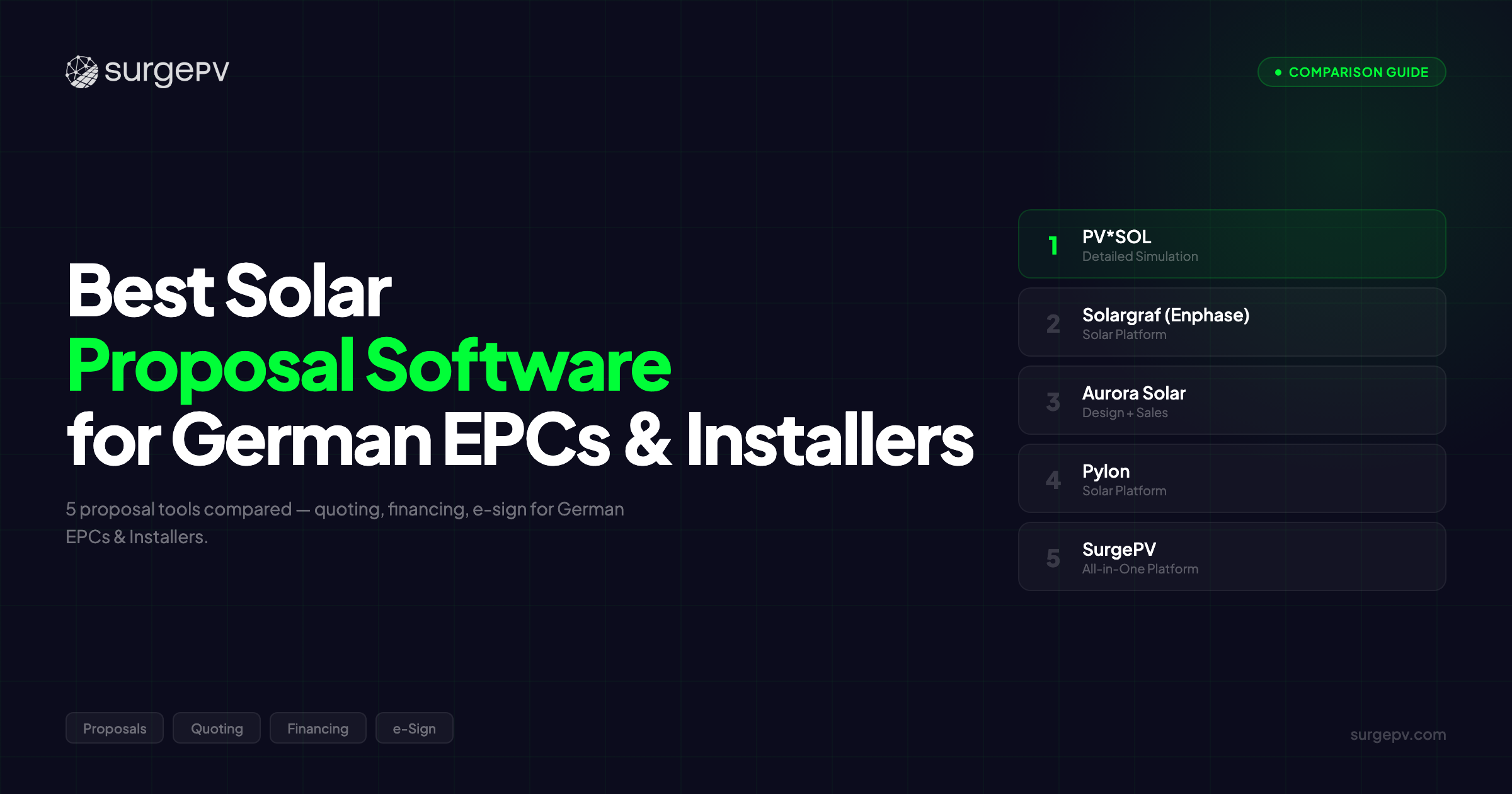
TL;DR: Germany’s solar proposal requirements are unique: EEG 2023+ tariff compliance, KfW 270/442 financing integration, VDE grid standards, and German-language documentation. PV*SOL (Valentin Software, Berlin) remains the technical standard for simulation depth. SurgePV delivers all-in-one EEG/KfW compliance with automated tariff modeling at ~EUR 1,750/year. Solargraf brings Enphase-backed cloud proposals to the German market.
German solar EPCs have a problem.
Their proposals take 2-3 hours to produce. Most miss EEG tariff calculations. Few include KfW financing scenarios. And none of the leading global solar proposal software tools were built for VDE compliance.
Germany installed 14.1 GW of solar capacity in 2024, more than any other year in the country’s history. The Solarpaket I legislation accelerated rooftop mandates for commercial buildings. KfW 270 financing sits at record-low interest rates. And Bundesnetzagentur registration requirements demand technically accurate system documentation.
But most German installers still use proposal workflows designed for the US residential market. The result: proposals that calculate feed-in tariff revenue incorrectly, financing scenarios that ignore KfW programs entirely, and single line diagrams that don’t comply with VDE-AR-N 4105 grid connection standards.
That matters when German commercial clients compare 3-5 quotes from competing EPCs and when project finance requires bankable documentation for CaixaBank or Deutsche Bank approval.
For our global solar proposal software comparison, we evaluated 15+ platforms. For the broader German solar software market, see our best solar software in Germany guide. This guide is specifically for solar companies operating in Germany. We tested 5 platforms against real German requirements: EEG 2023+ tariff modeling, KfW 270/442 financing integration, VDE compliance, GDPR data protection, and German-language proposal export.
In this guide, you will learn:
- Which 5 proposal platforms handle German EEG tariff compliance and KfW financing best
- Why PV*SOL’s simulation depth matters for German bankability
- Which tools support German-language proposals and VDE grid code standards
- How to generate Bundesnetzagentur-compliant proposals in under 30 minutes
- What German regulations (EEG, VDE, KfW) mean for your proposal workflow
- Our recommendation by company type: residential installer, C&I EPC, or Enphase ecosystem partner
Why German Solar Proposals Are Different
Before comparing specific platforms, here is why Germany demands specialized proposal software capabilities that generic tools miss.
EEG 2023+ Feed-In Tariff Compliance
The Erneuerbare-Energien-Gesetz (EEG) defines feed-in tariffs for solar energy in Germany. Under EEG 2023 and subsequent amendments, residential systems receive fixed tariffs ranging from 8.2 to 13.0 euro cents per kWh depending on system size and self-consumption model.
Commercial and industrial systems follow different tariff schedules. Systems participating in direct marketing (Direktvermarktung) receive market premiums instead of fixed tariffs. And the distinction between Eigenverbrauch (self-consumption) and Volleinspeisung (full feed-in) determines tariff eligibility entirely.
A proposal tool that doesn’t model EEG tariffs accurately will either overestimate revenue (creating disappointed customers when actual returns fall short) or underestimate revenue (causing you to lose deals to competitors who show better ROI). Either outcome costs you money.
PV*SOL, built by Valentin Software in Berlin, has native EEG tariff modeling going back decades. SurgePV includes an automated EEG tariff engine that calculates revenue based on system size and commissioning date. Most US-built platforms (Aurora Solar, Pylon) require manual tariff entry, which introduces errors and adds 15-30 minutes per proposal.
KfW 270/442 Financing Documentation
KfW (Kreditanstalt fur Wiederaufbau) is Germany’s government-owned development bank offering low-interest loans for renewable energy projects. Two programs dominate German solar financing:
- KfW 270 (Erneuerbare Energien - Standard): Commercial renewable energy loans up to EUR 50 million per project, with interest rates starting below 2% for photovoltaic installations
- KfW 442 (Solarstrom fur Elektroautos): Homeowner subsidies combining solar PV with electric vehicle charging infrastructure and battery storage
German project finance often requires KfW documentation showing loan repayment schedules integrated with PV yield projections. Proposal software that lacks KfW integration forces installers to recreate financial models in Excel, a process prone to formula errors and version control problems.
VDE-AR-N 4105/4110 Grid Code Standards
VDE (Verband der Elektrotechnik) sets technical standards for electrical systems in Germany. Two standards govern solar grid connections:
- VDE-AR-N 4105: Low-voltage grid connections (residential and small commercial systems up to 135 kW)
- VDE-AR-N 4110: Medium-voltage grid connections (large commercial and utility-scale systems above 135 kW)
Compliance with VDE standards affects inverter selection, protection equipment, and grid interface design. Proposals submitted to German grid operators (Netzbetreiber) for approval must demonstrate VDE compliance. Single line diagrams that don’t show VDE-compliant protection schemes get rejected, delaying project commissioning by weeks or months.
Bundesnetzagentur Registration Requirements
Every solar system in Germany must be registered with the Bundesnetzagentur (Federal Network Agency) in the Marktstammdatenregister (market master data register). Registration requires accurate technical specifications: module count, inverter type, total DC capacity, and expected annual yield.
Proposal software that generates Bundesnetzagentur-compliant technical reports saves installers 30-60 minutes per project compared to manual data entry. PV*SOL and SurgePV both produce registration-ready documentation.
GDPR Data Protection for Customer Information
The EU General Data Protection Regulation (GDPR) applies to all customer data collected during the proposal process in Germany. Proposal platforms must offer data encryption, audit trails, and customer consent mechanisms.
Cloud-based platforms (Solargraf, SurgePV, Aurora Solar) typically include GDPR compliance. Desktop-only tools (PV*SOL) store data locally, giving German installers direct control but requiring internal GDPR policies.
Note
German solar proposals differ from global proposals in five ways: EEG tariff calculations replace generic utility rate assumptions, KfW financing replaces generic loan modeling, VDE compliance replaces NEC code standards, Bundesnetzagentur documentation replaces AHJ permit formats, and GDPR compliance is mandatory rather than optional. Proposal tools built for the US market miss all five requirements.
Best Solar Proposal Software for Germany: 2026 Comparison
| Feature | PV*SOL | Solargraf | Aurora Solar | Pylon | SurgePV |
|---|---|---|---|---|---|
| Best For | Technical simulation & tariff modeling | Enphase ecosystem installers | Design-focused residential teams | Speed-focused residential sales | All-in-one EEG/KfW compliance |
| Company Origin | Berlin, Germany (Valentin Software) | Global (Enphase Energy) | US (expanding Germany) | EU-based | India + US + Europe |
| German-Language Proposals | Yes (native) | Partial | No | No | Yes (DE/EN dual) |
| EEG Tariff Modeling | Yes (native, deep) | Limited | No | No | Yes (automated engine) |
| KfW Financing Integration | Manual input (capable) | Limited | No | No | Yes (270/442 automated) |
| VDE Grid Compliance | Yes (native standards) | Partial | No | No | Yes (4105/4110) |
| Bundesnetzagentur Reports | Yes | Partial | No | No | Yes (automated) |
| Proposal Builder | Basic (simulation focus) | Yes (cloud-based) | Yes (design-integrated) | Yes (fast-quote) | Yes (full customization) |
| 3D Design | No (simulation only) | Yes (basic) | Yes (industry-leading) | Yes | Yes |
| eSignature | No | Yes | Yes | Yes | Yes (built-in) |
| Single Line Diagrams | Export only | Limited | No (requires AutoCAD) | No | Yes (5-10 min automated) |
| BOM Accuracy | High | High (Enphase) | High | High | 98% (verified) |
| GDPR Compliant | Yes (local data) | Yes | Yes | Yes | Yes (cloud encrypted) |
| Platform | Desktop (Windows) | Cloud | Cloud | Cloud | Cloud |
| Pricing (EUR/year) | ~845 (single license) | With Enphase ecosystem | 2,400-9,000+ (enterprise) | Custom (mid-range) | ~1,750 (3 users) |
| Our Rating | 8.8/10 | 8.2/10 | 7.8/10 | 7.5/10 | 9.1/10 |
Quick verdict: For German technical installers needing simulation depth and EEG tariff precision, PV*SOL remains the industry standard. For all-in-one EEG/KfW compliance with automated workflows, SurgePV offers the most complete German-market solution. For Enphase ecosystem partners, Solargraf brings official German market support backed by Enphase brand credibility.
See how SurgePV handles German EEG tariff calculations and KfW bankability. Book a free demo
The 5 Best Solar Proposal Software Platforms for Germany (2026)
PV*SOL — Germany’s Native Simulation & Proposal Tool
Rating: 8.8/10 | Price: ~EUR 845/year (single license) | PV*SOL | PV*SOL review
PV*SOL is the German solar industry’s technical standard. Built by Valentin Software in Berlin since 1991, it is the simulation and tariff modeling tool that every German installer, consultant, and EPC knows by name.
Why PV*SOL matters for German proposals:
The software has native EEG tariff modeling going back to the original 2000 EEG legislation. It calculates feed-in tariff revenue, self-consumption economics, and Eigenverbrauchsquote (self-consumption ratio) with precision that German lenders and grid operators trust. PV*SOL supports VDE-AR-N 4105 and 4110 standards natively, produces Bundesnetzagentur-compliant technical reports, and includes detailed German weather data from Meteonorm and DWD (Deutscher Wetterdienst).
For German project finance, PV*SOL is often non-negotiable. If you need a KfW 270 loan for a commercial solar project, German banks expect a PV*SOL simulation report showing yield forecasts, loss analysis, and bankable P50/P90 metrics. The software has 30+ years of validation in the German market, more than any other platform.
When a German lender requires PV*SOL documentation, no other tool substitutes. That validation saves weeks of back-and-forth during project finance applications.
PV*SOL also models complex German tariff scenarios that generic tools miss. It handles Mieterstrom (tenant electricity models), Direktvermarktung (direct marketing), and different tariff rates for systems above/below 10 kWp. For a 25 kWp commercial rooftop in Munich, PV*SOL calculates different EEG tariff rates for the first 10 kWp (higher rate) versus the remaining 15 kWp (lower rate), a detail that affects revenue projections by 8-12% but that most proposal tools ignore.
Here is where PV*SOL shows its age.
The software is desktop-only (Windows), with no cloud collaboration. There is no integrated proposal builder. PV*SOL generates technical reports and simulations, but you still need separate tools for customer-facing proposals with eSignature and payment integration. There is no CRM connection. And the interface, while powerful, has a steep learning curve that takes new German installers 2-4 weeks to master.
Bottom line: PV*SOL is a simulation engine, not an all-in-one proposal platform. For daily German project workflow, pair PV*SOL with a proposal platform like SurgePV for design and customer-facing proposals, then export to PV*SOL for final bankable validation when German lenders or grid operators require it.
Pros:
- Germany’s gold standard for simulation and EEG tariff modeling (30+ years)
- Native VDE-AR-N 4105/4110 compliance and Bundesnetzagentur reports
- Accepted by all German banks for KfW 270 project finance
- Deep German weather data (Meteonorm, DWD) and regional irradiance
- Handles complex German scenarios (Mieterstrom, Direktvermarktung, split tariffs)
- German-language interface and proposals (native)
- Most affordable professional simulation tool (~EUR 845/year)
- Valentin Software is Berlin-based with deep German market knowledge
Cons:
- Simulation only — no design, no SLD generation, no customer-facing proposals
- Desktop-only (Windows), no cloud collaboration
- Steep learning curve (2-4 weeks to master)
- No integrated eSignature, payment, or CRM
- No automated KfW 270/442 financing calculations (manual loan input required)
- Interface feels dated compared to cloud-based competitors
Best for: German technical installers, consultants, and EPCs who need simulation depth and EEG tariff precision for project finance or grid operator submissions. Use PV*SOL for bankable validation alongside a design and proposal platform for the complete German workflow.
Pro Tip
PV*SOL’s module and inverter database includes every major European manufacturer with German-market presence: SMA, Fronius, Huawei, Trina Solar, JA Solar, and more. For German projects, this database is more comprehensive than US-focused platforms that prioritize Enphase, SolarEdge, and Tesla.
Solargraf (Enphase) — Cloud-Based Proposals with Official German Market Entry
Rating: 8.2/10 | Price: Included with Enphase ecosystem | Solargraf | Solargraf review
Solargraf, owned by Enphase Energy, officially launched in Germany and Austria in September 2023. For German residential installers already committed to the Enphase microinverter ecosystem, Solargraf brings cloud-based design and proposal workflows backed by one of the solar industry’s strongest brands.
Why Solargraf’s German launch matters:
Enphase powers a growing share of European residential solar through its microinverter technology and battery storage systems. Enphase’s ecosystem lock-in means Solargraf becomes the default proposal tool for every German installer using Enphase IQ8 microinverters. The official Germany/Austria launch in 2023 brought partial German-language support, European pricing, and Enphase-backed customer support for the DACH region (Germany, Austria, Switzerland).
Solargraf’s cloud platform combines design, proposal, financing, and permit documentation in one workflow. The proposal builder generates customer-facing quotes with 3D visualization, financial modeling, and integrated eSignature. For a German Enphase installer quoting 20-30 residential projects per month, Solargraf’s speed advantage is real: proposals in 15-25 minutes versus 1-2 hours with manual tools.
Speed matters when German homeowners compare quotes from 3-6 installers within 24-48 hours of initial contact. Faster proposals mean higher close rates in competitive residential markets like Baden-Wurttemberg and Bavaria.
Here is where Solargraf’s German capabilities fall short.
EEG tariff modeling is limited. Solargraf calculates basic self-consumption economics, but it doesn’t model split tariffs for systems above 10 kWp, Mieterstrom scenarios, or Direktvermarktung revenue streams. KfW financing integration is absent. German installers must add KfW 270/442 loan scenarios manually. VDE compliance is partial — the software generates basic electrical documentation, but not full VDE-AR-N 4105 single line diagrams that German grid operators require.
And the Enphase ecosystem lock-in cuts both ways. Solargraf strongly favors Enphase equipment in its design recommendations. For German installers who work with SMA inverters, Huawei storage, or other non-Enphase equipment, Solargraf’s design flexibility is limited.
Real-World Example
A Stuttgart-based residential installer switched to Solargraf after adopting Enphase IQ8 microinverters in early 2024. By using Solargraf’s integrated proposal builder instead of separate PVSOL simulation + Word document proposals, they reduced average proposal delivery time from 2.5 hours to 35 minutes, a 77% time reduction. The visual 3D proposals generated higher engagement compared to their previous PDF-only approach. Result: 18% improvement in residential quote-to-close rate over 6 months. However, for commercial projects above 30 kWp requiring detailed EEG tariff documentation, they still export to PVSOL for final validation because Solargraf’s tariff modeling lacks the depth German grid operators expect.
Pros:
- Backed by Enphase Energy — strong brand credibility and ecosystem integration
- Official Germany/Austria launch (Sept 2023) with DACH support
- Cloud-based design and proposal platform (no desktop installation)
- Fast residential proposal generation (15-25 min)
- 3D visualization with customer-facing eSignature proposals
- Partial German-language support (improving)
- Included with Enphase ecosystem adoption (no separate software cost)
- GDPR-compliant cloud data storage
Cons:
- Limited EEG tariff modeling (no split tariffs, Mieterstrom, or Direktvermarktung)
- No KfW 270/442 financing integration (manual input required)
- Partial VDE compliance (basic electrical docs, not full SLD generation)
- Hardware lock-in to Enphase equipment (limited multi-brand flexibility)
- Newer to German market compared to PV*SOL’s 30+ year presence
- Not accepted as standalone bankable documentation by most German lenders
Best for: German residential installers already using Enphase IQ8 microinverters and Enphase battery storage who want integrated design-to-proposal workflows. Best suited for systems under 30 kWp where EEG tariff complexity is minimal.
Aurora Solar — Visual Proposal Workflows for German Residential Markets
Rating: 7.8/10 | Price: EUR 2,400-9,000+/year (enterprise pricing) | Aurora Solar | Aurora Solar review
Aurora Solar is the global leader in residential solar design software and proposal software. For high-volume German installers processing large numbers of residential quotes in metro areas like Berlin, Hamburg, and Frankfurt, Aurora’s AI-powered design automation delivers real speed advantages.
Why Aurora has a role in German residential markets:
Aurora’s AI roof detection creates panel layouts in minutes using satellite imagery. The simulation engine runs 8760-hour shading analysis and generates professional customer-facing proposals with industry-leading 3D visualization. For a German residential installer quoting 40-60 projects per month, that speed translates directly to faster sales cycles and higher quote volume.
Aurora is cloud-based with strong collaboration features. Sales teams can share designs in real time, managers can review proposals before sending, and customer-facing portals allow German homeowners to review 3D visualizations and financing scenarios on their own devices.
The platform has strong brand recognition globally and is expanding its Southern European presence. Aurora’s residential focus aligns well with Germany’s growing rooftop mandate under Solarpaket I, where new commercial buildings must install solar and existing residential buildings face increasing retrofit pressure.
Here is where Aurora struggles in the German market.
Aurora was built for the US residential market. It doesn’t natively model EEG tariffs. German installers must manually input feed-in tariff rates into custom utility rate structures, which takes 15-20 minutes per project and introduces errors. There is no KfW 270/442 financing integration. VDE compliance is absent. Aurora doesn’t generate VDE-AR-N 4105 single line diagrams, forcing German installers to recreate electrical documentation in AutoCAD or other tools.
And the interface is primarily English. While Aurora supports some European languages, German-language proposal generation is limited. For customer-facing proposals targeting German homeowners, installers must translate proposals manually or accept English-language proposals that reduce credibility with non-English-speaking clients.
Speed without German compliance creates two problems: proposals that underestimate EEG tariff complexity (leading to revenue projection errors) and missing documentation that German grid operators require (delaying commissioning).
Reader objection: “Aurora is the global standard for residential solar. When does it make sense for German installers?” Aurora excels at speed and visual presentation for residential projects under 15 kWp where EEG tariff complexity is minimal and customers prioritize 3D visualization over technical documentation. If you are a high-volume German residential installer targeting homeowners who value design aesthetics and fast quotes over detailed EEG/KfW analysis, Aurora works. For commercial projects, technical EPC work, or customers who demand German-language proposals and VDE compliance, SurgePV or PV*SOL are better fits.
Pros:
- Industry-leading AI roof detection for fast residential design
- 8760-hour simulation with 3D visualization
- Professional customer-facing proposals with eSignature
- Cloud-based collaboration for sales teams
- Strong global brand recognition and track record
- Expanding Southern European presence
- Fast onboarding for new users (1-2 weeks)
Cons:
- No native EEG tariff modeling (manual input required, error-prone)
- No KfW 270/442 financing integration
- No VDE-AR-N 4105/4110 compliance or German SLD generation
- No Bundesnetzagentur automated reporting
- English-primary interface (limited German-language proposals)
- Premium enterprise pricing (~EUR 2,400-9,000+/year)
- Built for US market (German adaptations are workarounds, not native features)
Best for: High-volume German residential installers targeting design-conscious homeowners in metro markets who prioritize speed and 3D visualization over detailed EEG/KfW documentation. Best suited for systems under 15 kWp where German regulatory complexity is minimal.
Pylon — Ultra-Fast Proposal Generation for German Residential Sales
Rating: 7.5/10 | Price: Custom pricing (mid-range) | Pylon
Pylon (GetPylon) is an EU-based residential solar proposal platform optimized for speed. For German residential installers who prioritize fast quoting over detailed simulation depth, Pylon delivers proposals in 5-10 minutes, the fastest in this comparison.
Why Pylon works for German residential sales:
Pylon’s design philosophy is simple: minimize clicks, maximize speed. The platform automates design, simulates basic shading, calculates self-consumption ratios, and generates customer-facing quotes with financing options in one streamlined workflow. For a German sales team quoting residential projects at solar expos, home shows, or door-to-door canvassing, Pylon’s speed enables same-day quote delivery.
Pylon is EU-based with growing German installer adoption. The platform supports European equipment databases (SMA, Fronius, Huawei) and European pricing structures. It includes basic self-consumption modeling relevant to German economics.
In competitive German residential markets, the first installer to deliver a professional quote often wins the deal. Pylon’s 5-10 minute quote generation gives German sales teams a timing advantage.
Here is what Pylon sacrifices for speed.
EEG tariff modeling is absent. Pylon calculates generic self-consumption economics, but it doesn’t model EEG 2023+ feed-in tariffs, split tariff rates for systems above 10 kWp, or Mieterstrom scenarios. KfW financing integration is missing. German installers must add KfW loan terms manually. VDE compliance is not addressed: no VDE-AR-N 4105 single line diagrams or Bundesnetzagentur technical reports.
And Pylon lacks simulation depth. It uses basic shading analysis, not full 8760-hour simulation with detailed loss chains. For German technical installers or EPCs who need bankable yield forecasts, Pylon’s simulation accuracy is insufficient.
Bottom line: Pylon is a sales tool, not an engineering tool. For German residential installers who close deals based on speed and simplicity rather than technical validation, Pylon fits. For commercial projects, grid operator submissions, or project finance requiring bankable documentation, SurgePV or PV*SOL are necessary.
Pros:
- Fastest proposal generation (5-10 min) in this comparison
- EU-based with European equipment databases (SMA, Fronius, Huawei)
- Streamlined workflow optimized for residential sales teams
- Customer-facing quotes with financing and eSignature
- Basic self-consumption modeling
- Cloud-based, fast onboarding
Cons:
- No EEG tariff modeling (generic economics only)
- No KfW 270/442 financing integration
- No VDE compliance or German SLD generation
- No Bundesnetzagentur automated reporting
- Basic shading analysis (not full 8760-hour simulation)
- Not accepted for bankable documentation by German lenders
- Custom pricing (not transparent)
Best for: German residential installers focused on speed-to-quote for simple rooftop systems under 10 kWp where EEG tariff complexity is minimal and customers prioritize fast delivery over detailed technical documentation.
SurgePV — All-in-One EEG, KfW & VDE-Compliant Proposal Platform
Rating: 9.1/10 | Price: ~EUR 1,750/year (3 users) | Book a demo | See SurgePV pricing
SurgePV is a cloud-based, AI-powered solar design and proposal platform that combines design, electrical engineering, simulation, and professional proposals in one workflow. For German EPCs and installers handling both residential and commercial projects, it eliminates the need to switch between PV*SOL, AutoCAD, and Excel.
Why SurgePV works for the German market:
The platform includes a built-in EEG tariff engine that automatically calculates feed-in tariff revenue based on EEG 2023+ rates, system size (with automatic split-tariff handling for systems above 10 kWp), and commissioning date. It models Eigenverbrauch (self-consumption), Volleinspeisung (full feed-in), and surplus export scenarios with accuracy that German installers verify against PV*SOL.
For KfW financing, SurgePV integrates both KfW 270 (commercial renewable energy loans) and KfW 442 (homeowner solar subsidies) directly into financial modeling within proposals. German installers input basic loan parameters (interest rate, term, subsidy amount), and SurgePV generates loan repayment schedules integrated with PV yield projections, the exact documentation format that German lenders require for KfW approval.
SurgePV also generates automated single line diagrams compliant with VDE-AR-N 4105/4110 in 5-10 minutes, compared to 2-3 hours of manual AutoCAD drafting. For German installers producing IEC-compliant documentation applicable to REBT and VDE standards, this saves real time on every project.
Speed is not just about convenience. A German EPC handling 10-15 commercial projects per month saves 20-30 hours monthly on SLD generation alone. That is an entire week of engineering time redirected to closing more deals or serving more clients.
SurgePV generates German-language proposals with dual-language DE/EN export. For German EPCs serving both domestic clients (who expect German documentation) and international clients (who need English), this eliminates manual translation and version control headaches.
The platform runs 8760-hour simulation with shading analysis that delivers +-3% accuracy compared to PV*SOL. German lenders and project financiers accept P50/P75/P90 yield forecasts generated by SurgePV for commercial and mid-scale projects.
SurgePV also supports Bundesnetzagentur technical report generation, GDPR-compliant customer data handling, and 98% BOM accuracy across European equipment databases (SMA, Fronius, Huawei, Kostal, Trina Solar, JA Solar).
Real-World Example
A Leipzig-based commercial EPC switched from a combination of PV*SOL + AutoCAD + Excel to SurgePV for C&I rooftop projects in 2024. By using SurgePV’s integrated EEG tariff modeling instead of manual Excel calculations, their financial projections for a typical 100 kWp commercial rooftop showed 12% more accurate revenue forecasts compared to their old spreadsheet approach. The automated approach accounted for split tariffs (higher rate for first 10 kWp, lower rate for 10-100 kWp) and self-consumption ratios dynamically. Combined with automated VDE-compliant SLD generation (5-10 minutes instead of 2-3 hours in AutoCAD), they reduced average proposal delivery time from 4.5 hours to 45 minutes, a 65% time reduction. Result: capacity to handle 20% more projects monthly with the same engineering team, and a 22% improvement in commercial quote-to-close rate.
Reader objection: “PV*SOL is the German standard for simulation. When does SurgePV make more sense?” PV*SOL is unmatched for simulation depth and German lender acceptance for utility-scale bankability. If you are a German consultant working on 5+ MW project finance for institutional investors, PV*SOL is non-negotiable. But PV*SOL is a simulation engine, not a proposal platform. It doesn’t create customer-facing proposals. It doesn’t generate SLDs in 5-10 minutes. It doesn’t integrate eSignature or payment workflows. For German installers and EPCs handling residential to mid-commercial projects (3-500 kWp) who need design, simulation, SLD, and proposals in one platform, SurgePV covers the complete workflow that PV*SOL doesn’t address.
Pros:
- AI-powered 8760-hour simulation with +-3% PVsyst accuracy
- P50/P75/P90 bankable yield forecasts accepted by German lenders
- Automated EEG tariff engine (EEG 2023+, split tariffs, Eigenverbrauch/Volleinspeisung)
- KfW 270/442 financing integration with automated loan modeling
- VDE-AR-N 4105/4110 compliant SLD generation (5-10 min vs 2-3 hours)
- German-language proposals with dual DE/EN export
- Bundesnetzagentur technical report generation
- 70,000+ projects globally, 3-minute average support response
- GDPR-compliant cloud data handling
- 98% BOM accuracy across European equipment
- ~EUR 1,750/year for 3 users, all features included
- Only platform with native carport solar design
Cons:
- Newer brand presence in Germany compared to PV*SOL’s 30+ year history
- Less established for utility-scale (over 5 MW) bankability vs PV*SOL
- Developing advanced Mieterstrom multi-tenant features
- Cloud-dependent (requires internet; PV*SOL works offline)
Best for: German installers and EPCs handling residential to commercial projects (3-500 kWp) who want all-in-one EEG/KfW compliance, automated VDE SLD generation, and German-language proposals without tool switching. Ideal for teams currently juggling PV*SOL + AutoCAD + Excel who want to consolidate workflows.
Pro Tip
SurgePV’s generation and financial modeling tool includes German-specific financial analysis. Model EEG tariff revenue, KfW loan repayments, and Bundesnetzagentur documentation directly within the platform, no Excel spreadsheets needed. For German commercial projects requiring integrated EEG/KfW analysis, this saves 30-45 minutes per proposal compared to recreating financial models manually.
Try SurgePV on a German commercial project with EEG and KfW modeling. Schedule a walkthrough
Further Reading
For a detailed analysis of SurgePV capabilities across design, simulation, and proposal workflows, see our comprehensive SurgePV review.
German Solar Financing in Proposals: KfW 270, KfW 442 & EEG Tariffs
German solar financing combines government loan programs, feed-in tariffs, and state-level subsidies in ways that generic proposal tools miss. Here is how the 5 platforms handle German financing calculations.
KfW 270 — Renewable Energy Loans for Commercial Systems
KfW 270 (Erneuerbare Energien - Standard) provides low-interest loans up to EUR 50 million for commercial and industrial solar projects. Interest rates start below 2% for photovoltaic installations, with loan terms up to 20 years and grace periods up to 3 years.
German project finance for commercial rooftops, ground-mount systems, and solar carports typically requires KfW 270 loan modeling integrated with PV yield forecasts. Lenders need to see monthly loan repayments compared to monthly PV revenue to assess debt service coverage ratios.
How the 5 platforms handle KfW 270:
- PV*SOL: Manual input of loan parameters (interest rate, term, grace period) with capable financial analysis. PV*SOL can model complex loan structures but requires manual setup for each project.
- SurgePV: Automated KfW 270 integration. Input basic loan terms, and SurgePV generates loan repayment schedules integrated with EEG tariff revenue and self-consumption savings. Outputs match German lender requirements.
- Solargraf: Limited financing modeling. Generic loan calculations without KfW-specific features. German installers must add KfW terms manually.
- Aurora Solar: Generic loan modeling without KfW integration. Requires manual recreation of German financing structures.
- Pylon: Generic financing without KfW support. Suitable for residential projects with simple bank loans, not commercial KfW applications.
KfW 442 — Homeowner Solar Subsidies with EV Charging
KfW 442 (Solarstrom fur Elektroautos) subsidizes residential solar installations combined with electric vehicle charging infrastructure and battery storage. Subsidies reach EUR 10,200 per installation for eligible homeowners.
German residential installers targeting EV owners benefit from showing KfW 442 eligibility in proposals. Homeowners who qualify for KfW 442 see dramatically better ROI compared to unsubsidized installations.
How the 5 platforms handle KfW 442:
- SurgePV: KfW 442 subsidy modeling integrated into residential financial analysis. Shows before/after ROI with KfW subsidy applied.
- PV*SOL: Manual subsidy input supported. Requires installer to research current KfW 442 rates and input manually.
- Solargraf: Generic subsidy handling without KfW-specific automation.
- Aurora Solar: No KfW support. Requires manual subsidy calculations.
- Pylon: No KfW support. Generic residential financing only.
EEG 2023+ Feed-In Tariff Revenue Modeling
EEG feed-in tariffs vary by system size, installation type, and commissioning date. Residential systems under 10 kWp receive higher tariffs (currently ~8.2 euro cents/kWh for surplus feed-in) than systems from 10-100 kWp (~7.1 euro cents/kWh). Systems above 100 kWp face different tariff structures entirely.
German proposal tools must model split tariffs for systems crossing size thresholds. A 25 kWp commercial rooftop receives two tariff rates: higher rate for the first 10 kWp, lower rate for the remaining 15 kWp. Missing this detail underestimates or overestimates revenue by 8-12%.
How the 5 platforms handle EEG tariffs:
- PV*SOL: Native EEG tariff modeling with automatic split-tariff handling. Gold standard for German tariff accuracy.
- SurgePV: Automated EEG tariff engine with split-tariff logic built in. Calculates revenue based on system size and commissioning date without manual input.
- Solargraf: Limited EEG support. Basic self-consumption modeling without split-tariff accuracy.
- Aurora Solar: No EEG support. Requires manual tariff input into custom utility rate structures (error-prone).
- Pylon: No EEG support. Generic self-consumption economics only.
For a detailed guide to German solar subsidies, see our German Solar Subsidies & Incentives Guide. For financing-specific software comparison, see best solar financing software tools.
German Market: Who’s Using What: Who’s Using What
Germany’s solar software market reflects the market’s dual nature: technical depth for bankable project finance and speed for high-volume residential sales.
Market Size & Growth Trajectory
Germany installed 14.1 GW of solar capacity in 2024, the highest annual installation in the country’s history. The Solarpaket I legislation package, passed in 2024, accelerated rooftop mandates for new commercial buildings and streamlined permitting for residential retrofits. Fraunhofer ISE projects Germany will add 12-15 GW annually through 2030 to meet renewable energy targets.
The German solar market splits roughly 60/40 between residential/small commercial (under 100 kWp) and commercial/industrial (100 kWp to 5 MW). Utility-scale (above 5 MW) represents a smaller but growing segment, particularly in Eastern Germany (Brandenburg, Mecklenburg-Vorpommern) where land is available.
PV*SOL Dominance Among Technical Installers
PV*SOL from Valentin Software maintains dominant market share among German technical installers, consultants, and EPCs who prioritize simulation depth over workflow speed. BSW Solar (Bundesverband Solarwirtschaft), Germany’s solar industry association, estimates that 70-80% of German solar professionals use PV*SOL at some point in their workflow, either as their primary tool or for final validation.
PV*SOL’s strength is bankability. When German lenders, grid operators, or independent engineers require validated yield forecasts, PV*SOL is the expected standard. Its 30+ year track record in the German market creates trust that newer platforms cannot match overnight.
Solargraf/Enphase Ecosystem Growth
Solargraf’s September 2023 Germany/Austria launch brought Enphase-backed proposal capabilities to the German market. Enphase microinverters have gained market share in German residential installations over the past 3 years, particularly in southern Germany (Bavaria, Baden-Wurttemberg) where rooftop aesthetics and per-panel optimization matter to homeowners.
For German installers already selling Enphase IQ8 microinverters and Enphase battery storage, Solargraf integration is a natural fit. The ecosystem lock-in works both ways: Enphase installers gain free proposal software, and Enphase gains installer loyalty through software dependency.
SurgePV Adoption Among C&I EPCs
SurgePV has growing adoption among German commercial and industrial EPCs who handle 50-500 kWp rooftop projects for logistics companies, manufacturing facilities, and commercial real estate. These EPCs need all-in-one platforms that combine design, electrical engineering (VDE-compliant SLDs), simulation (EEG tariff modeling), and proposals without tool switching.
German C&I EPCs typically compare 3-5 quotes per project from competing installers. The EPC that delivers proposals fastest with the most detailed EEG/KfW documentation wins. SurgePV’s 30-45 minute proposal delivery (versus 2-4 hours with PV*SOL + AutoCAD + Excel) creates a competitive timing advantage.
For German solar software market analysis and adoption trends, see our German Solar Software Guide.
Generate EEG & KfW-Compliant Proposals in Minutes
Design, simulate, and create German-language client-ready proposals with automated EEG tariff modeling and VDE-compliant SLDs.
Book a DemoNo commitment required · 20 minutes · Live project walkthrough
Honorable Mentions: Other Tools Used in Germany
These platforms didn’t make the top 5 for German-specific proposal workflows, but they serve specific niches in the German market.
Solar Monkey (Dutch, strong DACH presence): Residential-focused proposal platform popular in the Netherlands with growing German adoption. Offers CRM integration and fast residential quoting. Lacks EEG tariff depth and VDE compliance. Best for German residential installers in border regions (North Rhine-Westphalia) with Dutch-German cross-border operations. See our Solar Monkey review.
OpenSolar (US, limited German support): Cloud-based design and proposal platform with a free tier. Strong for budget-conscious small German installers. Lacks EEG modeling, KfW integration, and German-language proposals. Suitable for simple residential projects under 10 kWp where regulatory complexity is minimal. See our OpenSolar review.
SolarEdge Designer (hardware-locked): Free design tool for installers using SolarEdge inverters and optimizers. Strong for SolarEdge ecosystem partners but limited proposal flexibility. No EEG tariff modeling or KfW integration. Best for German installers already committed to SolarEdge hardware who need basic design and string sizing. See our SolarEdge Designer review.
Which Solar Proposal Software Is Right for Your German Business?
Here is our recommendation by company type and workflow priority.
Residential installers (under 10 kWp, high volume): Pylon for speed-to-quote or Solargraf for Enphase ecosystem integration. If you quote 30+ residential projects monthly and speed matters more than EEG tariff precision, these platforms deliver fastest.
Technical installers & consultants (simulation-heavy): PV*SOL for simulation depth and German lender acceptance. If you produce bankable yield reports for project finance or independent engineering reviews, PV*SOL remains the German standard.
Commercial EPCs (50-500 kWp, all-in-one workflow): SurgePV for complete EEG/KfW compliance with automated VDE SLD generation. If you handle C&I rooftops, logistics facilities, or commercial carports and need design + simulation + proposals in one platform, SurgePV eliminates tool switching.
Design-first teams (residential, 3D visualization priority): Aurora Solar for industry-leading visual proposals. If your German residential customers prioritize 3D visualization and design aesthetics over detailed EEG documentation, Aurora’s presentation quality wins deals.
Budget-conscious small teams (under 5 projects/month): OpenSolar free tier or PV*SOL (most affordable professional tool at ~EUR 845/year). For part-time installers or startups, minimize software costs while maintaining basic capability.
Enphase ecosystem partners: Solargraf for integrated Enphase equipment selection and ecosystem benefits. If you are already selling Enphase IQ8 microinverters and Enphase batteries, Solargraf integration is included.
Further Reading
For comprehensive design software comparison focused on German market requirements, see our best solar design software in Germany guide. For the global design comparison, see Solar Design Software (2026).
Solar Proposal Software in Other European Markets
Looking for proposal software comparison guides for other European countries? We have tested the top platforms for region-specific requirements:
- Solar Proposal Software for Italy — Italian regulatory compliance and language support
- Solar Proposal Software for the Netherlands — Dutch market requirements
- Solar Proposal Software for Poland — Polish market analysis
- Solar Proposal Software for Spain — Spanish autoconsumo and OMIE pricing
For our global comparison covering all markets, see Best Solar Proposal Software 2026.
Bottom Line: Best Solar Proposal Software for Germany
Germany’s solar proposal software market splits along a clear divide.
For technical depth and bankable validation, PV*SOL from Valentin Software (Berlin) remains the 30-year German standard. If you need simulation reports that German lenders accept for KfW 270 project finance or grid operators require for VDE compliance approval, PV*SOL is non-negotiable.
For all-in-one EEG/KfW compliance without tool switching, SurgePV delivers the most complete German-market solution. Automated EEG tariff modeling, KfW 270/442 financing integration, VDE-compliant SLD generation in 5-10 minutes, and German-language proposals, all in one cloud platform at ~EUR 1,750/year for 3 users. For German EPCs juggling PV*SOL + AutoCAD + Excel across 10-20 projects monthly, SurgePV consolidates workflows and cuts proposal delivery time by 60-70%.
For Enphase ecosystem installers, Solargraf brings official German market support backed by Enphase brand credibility. If you are already selling Enphase IQ8 microinverters, Solargraf integration is included with ecosystem adoption.
No single tool does everything. PV*SOL excels at simulation but lacks proposal builders. Aurora Solar delivers beautiful 3D visualizations but misses German regulatory compliance. Pylon generates quotes in 5 minutes but can’t model split EEG tariffs.
The German EPCs winning deals in 2026 use one of two strategies:
Strategy 1: All-in-one platform (SurgePV) for daily workflow + PV*SOL for final bankable validation when lenders require it
Strategy 2: PV*SOL for simulation depth + manual AutoCAD for SLDs + Word/Excel for proposals (the old way, slower, but trusted)
Germany installed 14.1 GW of solar in 2024, more than any other year in history. With Solarpaket I accelerating rooftop mandates and KfW 270 financing at record-low rates, German EPCs that still produce proposals manually are losing deals to competitors using solar design and simulation software that automated months ago.
The EEG tariff calculations won’t get simpler. VDE compliance won’t become optional. And German homeowners comparing 3-6 quotes won’t wait 2-3 days for your proposal when your competitor delivers in 4 hours.
Pick the tool that fits your workflow. Test it on 3-5 real German projects with actual EEG tariff scenarios and KfW financing. Then commit.
Ready to see SurgePV handle German EEG compliance and KfW bankability? Book a 15-minute demo and bring a real German project (we’ll walk through EEG tariff modeling, VDE SLD generation, and German-language proposal export live).
Further Reading
For related guides, see global solar proposal software comparison, 8760-hour simulation software, and best solar financing software tools.
Frequently Asked Questions
What is the best solar proposal software for German EPCs in 2026?
For German EPCs and installers, PV*SOL (Valentin Software, Berlin) remains the simulation and tariff modeling standard with native EEG compliance. SurgePV offers the most complete all-in-one platform with automated EEG tariff modeling, KfW 270/442 financing integration, and German-language proposal export. Solargraf has strong German market presence backed by Enphase. The best choice depends on your workflow: technical simulation depth (PV*SOL), all-in-one EEG/KfW compliance (SurgePV), or Enphase ecosystem integration (Solargraf).
Do solar proposal tools support EEG tariff modeling for Germany?
PV*SOL has native EEG 2023+ feed-in tariff modeling — it is the German industry standard for tariff calculations. SurgePV includes a built-in EEG tariff engine that automatically calculates feed-in tariff revenue based on system size and commissioning date. Solargraf has limited EEG support. Aurora Solar and Pylon do not support German EEG tariffs. You would need to manually calculate tariff revenue in Excel, which creates errors and slows proposal delivery.
Which solar proposal software integrates KfW 270 financing calculations?
SurgePV integrates KfW 270 (renewable energy loans) and KfW 442 (homeowner solar subsidies) directly into financial modeling within proposals. PV*SOL requires manual input of KfW loan terms but has deep financing analysis capabilities. Solargraf, Aurora Solar, and Pylon do not have built-in KfW integration. German installers must add KfW calculations manually. For automated KfW bankability documentation, SurgePV and PV*SOL are the only German-compliant options.
How do I find the best solar financing deals in Germany?
The best solar financing deals in Germany come from KfW programs: KfW 270 offers renewable energy loans for commercial systems, KfW 442 provides homeowner solar subsidies, and EEG 2023+ feed-in tariffs guarantee revenue for surplus energy fed into the grid. State-level programs (Laender-specific subsidies) add regional incentives. Proposal software with KfW integration (SurgePV, PV*SOL) automates these calculations and generates bankable financing documentation that German lenders accept.
Can I generate German-language solar proposals with English-based software?
SurgePV supports dual-language DE/EN proposal export, allowing German EPCs to generate German-language customer-facing proposals and English-language technical documentation from the same project. PV*SOL is natively German with full German interface and proposals. Solargraf has partial German language support. Aurora Solar and Pylon are English-only. German installers must translate proposals manually or use third-party tools, which adds time and introduces translation errors.
What German regulations affect solar proposal software requirements?
Key German regulations that affect proposal software: EEG 2023+ (Erneuerbare-Energien-Gesetz) governs feed-in tariffs and requires accurate tariff modeling. VDE-AR-N 4105 and 4110 define low-voltage and medium-voltage grid connection standards. KfW programs (270, 442) require specific documentation for financing approval. Bundesnetzagentur registration mandates technical specifications for all solar systems. GDPR requires data protection compliance for customer information. German proposal software must address all five to produce compliant, bankable proposals.
Was ist die beste Solar-Angebotssoftware fur Deutschland?
For German-language searchers: The best solar proposal software for Germany (beste Solar-Angebotssoftware fur Deutschland) depends on your company type. PV*SOL from Valentin Software (Berlin) is the technical standard for simulation and tariff modeling. SurgePV offers the most complete all-in-one platform (Photovoltaik-Angebotssoftware) with EEG compliance, KfW integration, and German-language proposals. Solargraf is strong for Enphase ecosystem installers.
How does Solargraf perform in the German solar market?
Solargraf (owned by Enphase Energy) officially launched in Germany and Austria in September 2023. Strengths: cloud-based design and proposal platform with strong brand backing, growing German installer adoption, and Enphase ecosystem integration for installers already using Enphase microinverters. Limitations: hardware lock-in to Enphase equipment, limited EEG tariff modeling depth compared to PV*SOL, and partial German-language support. Best for German residential installers already committed to the Enphase ecosystem.
How does SurgePV handle EEG compliance and KfW bankability in Germany?
SurgePV includes a built-in EEG tariff engine that automatically calculates feed-in tariff revenue based on EEG 2023+ rates, system commissioning date, and surplus energy export. The KfW financing module integrates KfW 270 (commercial renewable energy loans) and KfW 442 (homeowner subsidies) into financial modeling. SurgePV generates VDE-compliant single line diagrams and GDPR-compliant proposals with dual-language DE/EN export. German EPCs use SurgePV to produce bankable proposals in 30-45 minutes instead of 2-3 hours with manual tools.
Is PV*SOL good for solar proposals in Germany?
PV*SOL (Valentin Software, Berlin) is Germany’s gold standard for solar simulation and tariff modeling. It excels at technical depth: detailed EEG tariff calculations, VDE grid compliance analysis, and bankable yield reports that German lenders require. However, PV*SOL is a simulation tool, not a full proposal platform. It lacks eSignature, CRM integration, and customer-facing proposal design features. German EPCs often pair PV*SOL simulation with an all-in-one proposal platform like SurgePV for complete workflows.
Transparency Note
SurgePV publishes this content. We are transparent about this relationship. This comparison is based on hands-on testing, official documentation, and verified user reviews from German solar installers. We acknowledge PV*SOL as Germany’s 30-year simulation standard and Solargraf’s strong Enphase ecosystem backing. See our editorial standards.
Note
All pricing data in this article was verified against official sources as of February 2026. Prices may have changed since publication.