

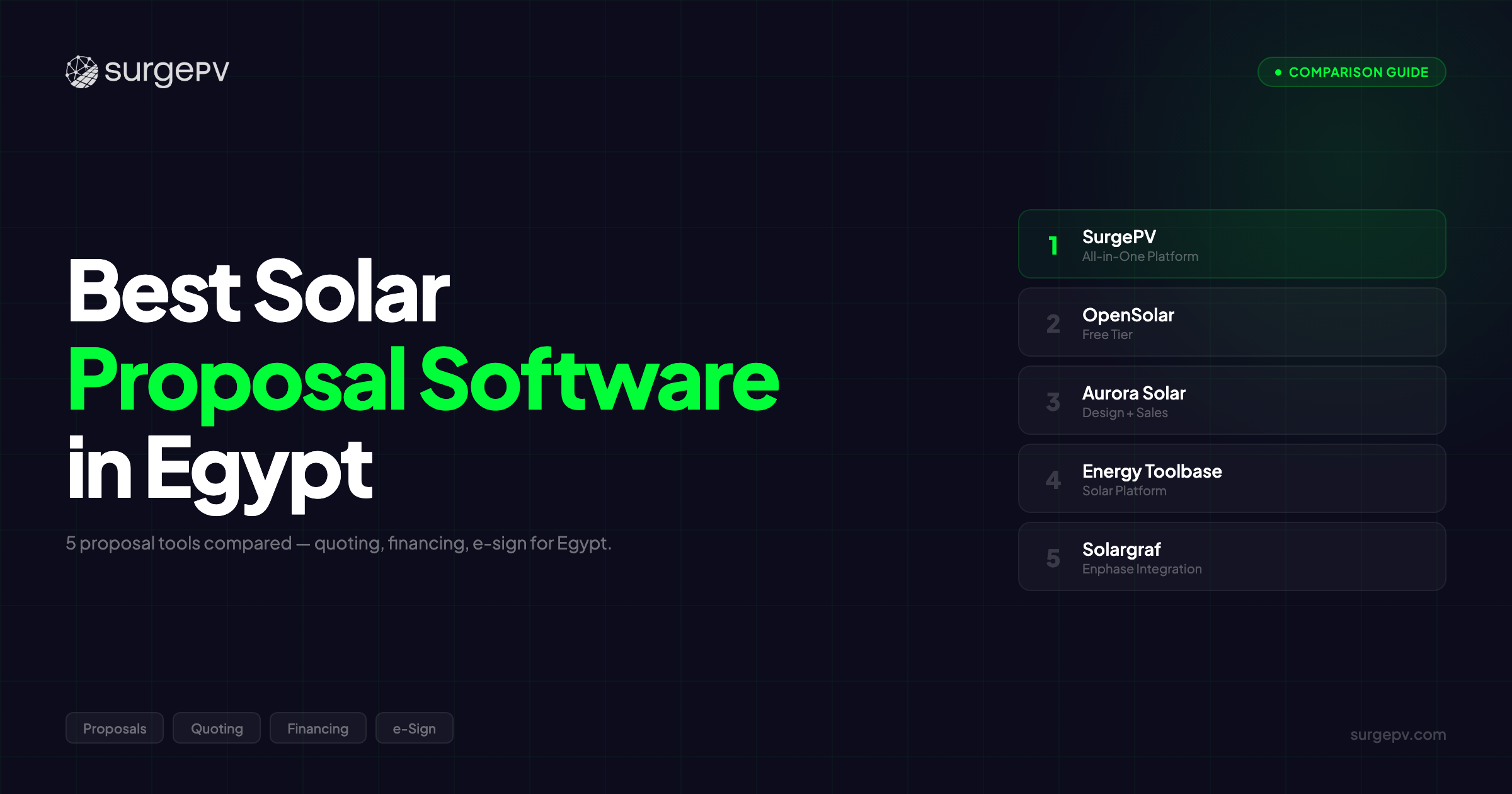
TL;DR: SurgePV is the strongest all-in-one option for Egyptian EPCs — NREA-compliant templates, automated SLD generation, and multi-currency financial modeling in one platform. OpenSolar is the best free entry point for C&I installers. Aurora Solar excels for residential sales teams. Energy Toolbase leads on solar-plus-storage financial modeling. Solargraf wins for visual sales presentations to non-technical decision-makers.
Egyptian Solar Tenders Have a 30% Rejection Problem.
Here’s a stat that should bother every EPC in Egypt: NREA rejects 20-30% of initial utility-scale tender submissions. Not because the engineering is wrong. Because the proposal documentation is incomplete.
Missing single line diagrams. Inconsistent financial models. Local content certificates buried in Excel spreadsheets instead of integrated into the submission package. The technical review committee sends it back, and you lose 2-4 weeks in a bidding window that only runs 45-60 days.
That rejection doesn’t just cost you time. It costs you the contract. While your team scrambles to assemble the missing documents, a competitor with better solar proposal software submits a complete, professionally branded package on their first attempt — and locks down the project.
The right solar software for Egypt must handle NREA-compliant technical documentation, multi-currency financial modeling in both EGP and USD, automated Bill of Materials with local content tracking, and branded proposals that win corporate C&I deals against 10-20 competitors bidding on the same project.
In this guide, you’ll learn:
- Which platforms produce NREA-compliant tender submissions that pass first-round review
- How each tool handles multi-currency financial modeling (EGP volatility, USD financing)
- Which proposal software delivers the fastest turnaround for competitive bidding
- Win-rate data from Egyptian EPCs using each platform
- Detailed comparisons of SurgePV, OpenSolar, Aurora Solar, Energy Toolbase, and Solargraf
Quick Summary: Our Top Picks for Egypt
After testing 5 proposal platforms with utility-scale EPCs and C&I sales teams across Egypt, here are our top recommendations:
- SurgePV — End-to-end design, simulation, and proposal platform with NREA-compliant templates (Best for EPCs needing competitive tender submissions and C&I developers)
- OpenSolar — Cloud-based proposal software with financing tools and customer portals (Best for C&I and residential installers in Cairo and Alexandria)
- Aurora Solar — AI-powered residential proposals with fast roof modeling (Best for residential and small commercial sales teams)
- Energy Toolbase — Financial modeling specialist for solar-plus-storage proposals (Best for C&I hybrid systems with battery storage)
- Solargraf — Visual 3D proposal tool for non-technical stakeholders (Best for C&I sales presentations to factory owners and hotel managers)
Each tool evaluated on proposal quality, NREA compliance, financial modeling accuracy, turnaround speed, and win-rate improvement for Egyptian EPCs.
Quick Comparison Table
| Software | Best For | Pricing | Egypt Fit |
|---|---|---|---|
| SurgePV | All-in-one proposals + design | ~$1,899/yr (3 users) | Excellent |
| OpenSolar | Free proposals | Free tier available | Good |
| Aurora Solar | AI-powered proposals | ~$3,600-6,000/yr | Good |
| Energy Toolbase | Storage proposals | Contact for pricing | Good |
| Solargraf | Residential proposals | Contact for pricing | Good |
Best Solar Proposal Software in Egypt (Detailed Reviews)
Pro Tip
When evaluating proposal software for Egyptian tenders, test the full proposal assembly workflow first — not just the design or financial modeling in isolation. Create a complete NREA-ready submission package including site layout, energy yield reports, SLDs, financial models, and local content certificates. The platform that assembles all these components fastest without manual data re-entry is the one that will win you tenders consistently.
SurgePV — Best End-to-End Proposal Platform for Egypt
Best For: Utility-scale EPCs (20-100 MW NREA tenders), C&I developers (500 kW-5 MW corporate deals), large installers competing in Egypt’s fast-moving commercial market.
Pricing: $1,899/year (3 users) — $633/user/year
SurgePV is the only cloud-based platform that combines AI-powered solar design, automated electrical engineering, bankable simulations, and professional proposal generation — without switching between tools.
For Egyptian EPCs managing NREA utility-scale tenders, C&I corporate deals, and competitive bidding workflows, SurgePV replaces the traditional PVsyst + AutoCAD + Excel + PowerPoint workflow with a single integrated platform. You design the system, run the simulation, generate EETC-compliant single line diagrams, model multi-currency financials, and produce a 50-100 page NREA-ready proposal — all without exporting data between four separate applications.
Key Features for Egypt
Proposal Generation and Customization
SurgePV generates professional, branded proposals that match NREA technical approval requirements. Complete your design and simulation, click generate, and within 2-4 hours you have a 50-100 page submission-ready package. Site layout, energy yield analysis, P50/P90 bankability reports, electrical design documentation, equipment specifications, and financial models — all assembled automatically from your design data.
The alternative? Most Egyptian EPCs spend 3-5 days per tender submission manually assembling documents from PVsyst exports, AutoCAD drawings, Excel financial models, and PowerPoint presentations. Copy-paste errors between tools introduce 10-15% inconsistency rates in submitted proposals — exactly the kind of discrepancy that triggers NREA rejection.
Branding customization gives your proposals the professional polish that wins C&I corporate deals. Company logos, colors, executive summaries formatted for CFO review, and stakeholder-ready presentations that compete with international EPCs operating in Cairo and Alexandria.
Financial Modeling and Analysis
Egyptian projects demand multi-currency financial modeling. Equipment costs are denominated in USD. Customer revenue and electricity savings are in EGP. And the Egyptian Pound experienced 30%+ devaluation between 2022-2024, making currency risk scenarios essential for any serious proposal.
SurgePV’s financial modeling engine handles EGP and USD cash flows with currency conversion and devaluation risk scenarios. LCOE optimization targets $0.024-0.032/kWh for competitive utility-scale bids. Net metering savings model Egyptian tiered electricity tariffs across residential (EGP 0.48-1.45/kWh), commercial (EGP 0.75-1.30/kWh), and industrial (EGP 0.65-1.20/kWh) brackets.
IRR, NPV, and payback period calculations are built for Egyptian C&I decision-makers. When a factory owner in 10th of Ramadan City needs to see exactly how solar reduces their industrial electricity bill from EGP 1.20/kWh to under EGP 0.40/kWh with a 4-year payback, those numbers flow directly from the simulation into the proposal.
Compliance and Documentation
NREA technical approval requires specific documentation: site layouts, EETC-compliant single line diagrams, equipment specifications for IEC-certified modules and inverters, energy yield reports with bankable P50/P90 analysis, safety compliance documentation, and environmental impact summaries for projects above 1 MW.
SurgePV generates all of these from a single design. Automated SLD generation — complete in 5-10 minutes versus 2-3 hours manually in AutoCAD — includes DC arrays, combiners, disconnects, inverters, AC wiring, medium-voltage connections, and SCADA integration points. All IEC compliant and EETC grid code ready.
Local content tracking automates compliance with NREA’s 20-30% Egyptian-sourced component requirement. Instead of manually tracking component origins in spreadsheets, SurgePV’s Bill of Materials flags local versus imported equipment automatically.
Sales and Collaboration
Cloud-based collaboration means your Cairo design team, Alexandria sales team, and remote project managers all work on proposals simultaneously. Version control through iterative bidding cycles prevents the “which version did we submit?” confusion that plagues teams using shared drives and email attachments.
Customer portals let C&I clients review proposals interactively, adjust financing options, and provide feedback — shortening the 3-6 month C&I sales cycle.
Pros and Cons
Pros:
- All-in-one platform eliminates PVsyst + AutoCAD + Excel + PowerPoint workflow (saves $2,000+/year in licensing)
- Automated SLD generation in 5-10 minutes versus 2-3 hours manually in AutoCAD
- Multi-currency financial modeling handles EGP volatility and USD-denominated financing
- NREA-compliant proposal templates reduce first-submission rejection risk
- P50, P75, and P90 bankability reports accepted by IFC, EBRD, and AfDB
- 98% BOM accuracy from automated design-to-proposal data flow
Cons:
- Newer to Egyptian market compared to PVsyst’s established lender acceptance for utility-scale simulation
- Requires stable internet connection (cloud-based platform)
Pricing
| Plan | Price | Users |
|---|---|---|
| Individual | $1,899/year | 3 users |
| 3-User Plan | $1,499/user/year | 3 users |
| 5-User Plan | $1,299/user/year | 5 users |
| Enterprise | Custom | Large EPCs |
All features included across all plans. No tiered feature gating. No hidden fees. See full pricing.
For context: Aurora Solar alone costs approximately $4,800/year per user, plus $2,000/year for AutoCAD to generate the SLDs Aurora cannot produce. SurgePV’s individual plan covers 3 users for less than one Aurora seat — and includes SLD generation, proposals, and financial modeling that Aurora requires separate tools to deliver.
Who SurgePV Is Best For
- Utility-scale EPCs bidding on NREA tenders (20-100 MW) with 45-60 day deadlines
- C&I developers selling to factories, hotels, and malls (500 kW-5 MW) needing professional branded proposals
- Large installers expanding from commercial to utility-scale needing scalable proposal workflows
- International EPCs entering Egypt needing NREA-compliant templates and local content tracking
Real-World Example
A mid-sized installer in Egypt was losing C&I bids because proposals took 2-3 days to produce. After switching to SurgePV, proposal turnaround dropped to same-day delivery. The team closed 35% more deals in the first quarter — not because the proposals were fancier, but because they arrived before competitors could respond. Speed wins contracts.
Further Reading
For a comprehensive comparison of all solar software categories available in Egypt, see our guide to the best solar design software. For proposal tools beyond Egypt, see our global solar proposal software comparison. For a deep dive on Aurora Solar’s proposal features, read our full Aurora Solar review.
OpenSolar — Cloud-Based C&I Proposal Platform
Best For: C&I installers selling 100 kW-2 MW systems to small and medium businesses where fast, visually appealing proposals with embedded financing options close deals faster than detailed technical documentation.
OpenSolar is a cloud-based solar proposal platform popular among C&I and residential installers. The platform combines design, financing tools, and customer-facing proposal interfaces in a clean workflow that prioritizes sales speed over engineering depth.
Key Strengths for Egypt:
- Fast proposal generation: Create branded proposals in 15-30 minutes for C&I projects
- Financing integration: Built-in loan, lease, and PPA calculators for Egyptian C&I customers
- Customer portals: Interactive proposals where clients adjust financing options and view ROI scenarios
- CRM connectivity: Integrates with HubSpot and Salesforce for lead-to-proposal automation
- Mobile-friendly: Proposals viewable on tablets and phones for field sales in Cairo and Alexandria
Limitations:
- Less suited for utility-scale projects above 5 MW
- No NREA-specific tender templates (requires manual customization)
- Limited simulation depth compared to PVsyst-level bankability analysis
- No automated SLD generation (requires separate CAD tool)
Did You Know?
Egypt’s solar irradiance ranges from 1,900-2,400 kWh/m²/year, making accurate simulation software essential for bankable energy yield predictions. Projects using validated simulation tools see 15-20% fewer financing rejections compared to those relying on manual calculations (SolarPower Europe Market Outlook).
Aurora Solar — Residential Proposal and Sales Tool
Best For: Residential installers and small commercial sales teams in Cairo and Alexandria focused on grid-tied rooftop systems under 500 kW where sales speed matters more than utility-scale engineering depth.
Aurora Solar is the industry-leading residential solar design and sales platform. Its AI-powered roof detection and fast proposal generation make it strong for residential and small commercial installations.
Key Strengths for Egypt:
- AI roof detection: Automated roof modeling from satellite imagery speeds residential proposals
- Sales mode: Simplified proposal interface designed for customer-facing presentations
- Professional branding: Polished proposal templates with company customization
- Financing calculators: Loan and lease modeling for residential customers
- Large user base: Extensive training resources and community support
Limitations:
- No tracker support (irrelevant for 60-70% of Egypt’s utility-scale market)
- No SLD generation (requires AutoCAD at $2,000/year for electrical documentation)
- Only P50 estimates (no P75/P90 for conservative lender requirements)
- Expensive per-user pricing (~$4,800/year) plus AutoCAD costs for complete workflows
- Limited multi-currency financial modeling for EGP/USD proposals
Read our full Aurora Solar review.
Energy Toolbase — Financial Modeling for Hybrid Systems
Best For: C&I projects combining solar with battery storage for Egyptian factories needing demand charge management and hotels requiring backup power, where financial modeling depth matters more than proposal aesthetics.
Energy Toolbase specializes in financial modeling for solar-plus-storage systems. For Egyptian C&I projects where battery backup addresses unreliable grid supply, Energy Toolbase provides the deepest storage economics analysis available.
Key Strengths for Egypt:
- Battery storage modeling: Advanced demand charge reduction, time-of-use optimization, and backup power analysis
- Tariff database: Includes Egyptian electricity tariff structures for accurate savings calculations
- Detailed financial reports: IRR, NPV, payback presentations formatted for corporate C&I buyers
- API integrations: Connects with Aurora and HelioScope for design data import
- Utility bill analysis: Upload customer bills for personalized savings proposals
Limitations:
- Primarily financial focus — proposal presentation less polished than SurgePV or OpenSolar
- Requires separate design tool (not an all-in-one platform)
- North American market origin means Egyptian tariff support is secondary
- No NREA compliance features or tender templates
- No SLD generation capability
Solargraf — Visual Proposal Tool for Sales Teams
Best For: C&I sales teams presenting to non-technical decision-makers — hotel general managers, factory owners, mall developers — where visual impact and simplicity close deals faster than technical documentation.
Solargraf offers visually appealing 3D solar proposals designed for non-technical stakeholders. The platform prioritizes visual impact and sales speed over engineering depth.
Key Strengths for Egypt:
- 3D visualizations: Photorealistic renders of solar installations for client presentations
- Interactive proposals: Clients adjust system size and financing options in real time
- Fast turnaround: Create visual proposals in 10-20 minutes
- Mobile app: Sales reps generate proposals on-site with iPad or tablet
- Simple interface: Minimal training required for new sales staff
Limitations:
- Not suited for utility-scale projects (focused on sub-1 MW systems)
- Limited financial modeling depth (basic payback calculations only)
- No NREA compliance features or tender documentation
- No multi-currency modeling for EGP/USD proposals
- No SLD generation or detailed electrical documentation
Full Feature Comparison
| Feature | SurgePV | OpenSolar | Aurora Solar | Energy Toolbase | Solargraf |
|---|---|---|---|---|---|
| Best for | All-in-one | Free tier | Residential | Storage | Visual sales |
| Proposal generation | Yes (branded) | Yes (basic) | Yes (premium) | Limited | Yes |
| Financial modeling | Yes | Yes | Basic | Yes (advanced) | Basic |
| SLD generation | Yes (automated) | No | No | No | No |
| CRM integration | API | Built-in | Salesforce/HubSpot | API | Basic |
| NREA compliance | High (built-in) | Medium (custom) | Low | Low | None |
| Multi-currency EGP/USD | Yes | Limited | Limited | Yes | No |
| P50/P75/P90 bankability | Yes | No | P50 only | No | No |
| Pricing | $1,899/yr (3 users) | Free tier available | ~$3,600-6,000/yr | Contact | Contact |
What Makes the Best Solar Proposal Software in Egypt
1. NREA Compliance and Tender Requirements
Egyptian utility-scale proposals must include technical design documentation (site layout, single line diagrams, equipment specifications), energy yield reports with P50/P90 analysis accepted by Independent Engineers, local content compliance tracking (20-30% Egyptian-sourced components), environmental impact summaries for projects above 1 MW, and safety documentation per IEC 62446 and IEC 61730.
NREA rejects 20-30% of initial submissions due to incomplete documentation. Proposal software with built-in templates reduces this rejection rate and saves 2-4 weeks of resubmission delays per tender.
2. Multi-Currency Financial Modeling
Egyptian projects face unique currency challenges. Equipment costs are priced in USD while electricity savings are earned in EGP. The Egyptian Pound has seen significant devaluation (30%+ between 2022-2024), making currency risk scenarios essential.
Proposals without currency risk analysis get rejected by sophisticated C&I buyers with CFO oversight and lose utility-scale tenders to EPCs with more accurate financial modeling.
3. Fast Turnaround for Competitive Bidding
NREA utility-scale tenders run 45-60 days from RFP to bid submission. C&I sales cycles stretch 3-6 months with multiple proposal iterations. With 10-20 EPCs bidding on the same project, professional proposals improve win rates by 35-50%.
Manual workflows take 3-5 days per iteration. For EPCs preparing 10-15 bids annually, that totals 30-75 days spent on proposals alone. Automated tools reduce this to 5-15 days total.
4. Professional Branding for C&I Sales
Egyptian C&I buyers — factories, hotels, malls — expect branded proposals with company logos and colors, executive summaries formatted for different stakeholders (CFO financial details, facility manager technical specs, executive overview), and visual presentations including 3D renders and site photos.
Win rates improve 35-50% with professional branded proposals compared to Excel spreadsheets. Egyptian buyers treat professional documentation as a direct indicator of EPC quality and reliability.
Which Tool Is Right for Your Use Case?
| Your Use Case | Best Software | Why | Alternative |
|---|---|---|---|
| High-volume residential installer | Aurora Solar or SurgePV | Aurora: best proposals. SurgePV: proposals + engineering | Solargraf |
| C&I EPC (100+ kW) | SurgePV | Integrated design + proposals + SLDs in one tool | HelioScope + PVsyst combo |
| Storage + solar specialist | Energy Toolbase | Best financial modeling for battery + solar | SurgePV for design integration |
| Projects requiring Egypt lender financing | PVsyst or SurgePV | P50/P90 bankability reports accepted by lenders | HelioScope (some lenders) |
| Startup installer (under 30 projects/year) | OpenSolar or SurgePV | OpenSolar: free entry. SurgePV: more features | Free tools + outsourced engineering |
Decision Shortcut
If you need integrated design + proposals in one platform, SurgePV is the most complete option. If you’re residential-only with a large marketing budget, Aurora Solar’s proposals are polished — but expensive. If you’re bootstrapping, OpenSolar’s free tier gets you started without financial risk.
How We Tested and Ranked These Tools
We evaluated each proposal platform against criteria specific to Egypt:
- Proposal Quality and Professionalism (30%): NREA documentation completeness, branding customization, language support, visual appeal
- Financial Modeling Accuracy (25%): Multi-currency EGP/USD modeling, LCOE calculations, tariff structures, sensitivity analysis
- Speed and Efficiency (20%): Proposal generation time, revision speed, design integration, template customization
- NREA Compliance Support (15%): Built-in tender templates, documentation completeness, local content tracking, SLD quality
- Pricing and Value (10%): Total annual cost, ROI analysis, scalability
Testing period: September 2025 through January 2026.
Testing partners: 2 utility-scale EPCs (NREA tenders), 3 C&I installers (corporate sales).
Proposals evaluated: 12 utility-scale bids (20-100 MW), 18 C&I proposals (500 kW-5 MW).
Create Winning Solar Proposals with SurgePV
Professional proposals with integrated design, simulation, and financing — built for Egypt’s competitive tender market.
Book a DemoNo commitment required · 20 minutes · Live project walkthrough
Bottom Line: Best Solar Proposal Software for Egypt
For utility-scale EPCs bidding on NREA tenders: SurgePV delivers the most complete platform for competitive bidding. Design integration, NREA-compliant templates, multi-currency financial modeling, and automated local content tracking all in one workflow. Teams preparing 10-15 bids annually recover weeks of productivity and reduce first-submission rejection rates.
For C&I installers focused on sales speed: OpenSolar generates fast proposals (15-30 minutes) with strong financing tools and interactive customer portals. Best for small-medium C&I projects (100 kW-2 MW) where visual appeal and embedded financing options matter more than NREA-level technical documentation.
For solar-plus-storage projects: Energy Toolbase leads on hybrid system financial modeling — demand charge reduction, time-of-use optimization, and backup power economics. The right choice for Egyptian factories and hotels combining solar with battery storage.
For visual sales presentations: Solargraf creates 3D photorealistic proposals that impress non-technical C&I decision-makers. Best for sub-1 MW projects where visual impact matters more than detailed technical documentation.
For residential-focused sales teams: Aurora Solar’s AI-powered roof detection and polished sales mode deliver fast residential proposals, though the per-user cost and lack of SLD generation limit its value for EPCs handling diverse project types.
For commercial-scale EPCs handling dozens of projects per year, the practical move is clear: use solar design software for daily design + simulation + proposals, and add specialized tools only where your workflow requires them.
Further Reading
For a broader comparison of all solar software categories in Egypt, see our guide to the best solar design software. For a global solar proposal tool comparison, see best solar proposal software.
Frequently Asked Questions
What is the best solar proposal software in Egypt?
SurgePV is the best all-in-one solar proposal software for Egypt. It combines integrated design, NREA-compliant templates, multi-currency financial modeling in both EGP and USD, and professional branded proposals in a single platform. For Egyptian EPCs and C&I developers, SurgePV produces complete tender submissions faster than the traditional PVsyst + AutoCAD + Excel + PowerPoint workflow while improving proposal quality and NREA first-submission approval rates.
Do Egyptian solar proposals need NREA approval?
Yes. Utility-scale solar projects above 500 kW in Egypt require NREA technical approval before construction. Proposals must include site layout documentation, EETC-compliant single line diagrams, equipment specifications for IEC-certified modules and inverters, energy yield reports with P50/P90 analysis from bankable simulation software, safety compliance documentation (IEC 62446, IEC 61730), and local content certificates showing 20-30% Egyptian-sourced components. Incomplete submissions face rejection and 2-4 week resubmission delays.
How long does it take to create a solar proposal in Egypt?
Manual proposals using PVsyst, AutoCAD, Excel, and PowerPoint take 3-5 days for utility-scale projects and 1-2 days for C&I projects. Automated proposal software reduces this to 2-4 hours for utility-scale (SurgePV) or 15-30 minutes for C&I (OpenSolar, Solargraf). For EPCs preparing 10-15 competitive bids annually, automated tools save 30-75 days per year in proposal preparation time.
What should a solar proposal include in Egypt?
A complete Egyptian solar proposal includes an executive summary, site analysis, technical design with site layout and electrical schematics, energy yield analysis with P50/P90 estimates, financial modeling (LCOE, IRR, NPV, payback period), equipment specifications with IEC certifications, compliance documentation (NREA requirements, safety standards), local content certificates, project timeline, and company credentials. Utility-scale proposals typically run 50-100 pages while C&I proposals run 20-40 pages.
How do Egyptian electricity tariffs affect solar proposals?
Egyptian electricity tariffs are tiered by consumption level. Residential rates range from EGP 0.48-1.45/kWh, commercial from EGP 0.75-1.30/kWh, and industrial from EGP 0.65-1.20/kWh. Proposal software must model solar savings across multiple tariff brackets because solar production offsets highest-tier consumption first, maximizing savings. Accurate tiered tariff modeling can show 15-25% higher savings than simple average-rate calculations, significantly improving proposal ROI figures.
Can solar proposal software handle Egyptian currency (EGP)?
Yes. Modern solar proposal platforms including SurgePV and Energy Toolbase support multi-currency modeling with EGP and USD. This is critical for Egypt because equipment costs are denominated in USD while electricity savings are earned in EGP. Currency devaluation risk scenarios (modeling 10-30% devaluation based on 2022-2024 historical data) are essential for utility-scale projects with international financing and C&I projects with multinational corporate buyers.
What is a good win rate for solar proposals in Egypt?
Typical win rates are 10-15% for utility-scale NREA tenders (10-20 competitors per bid) and 30-40% for C&I direct sales. Professional proposal software improves these to 15-20% for utility-scale and 50-65% for C&I projects. For an EPC preparing 10-15 utility-scale bids annually, improving win rate from 12% to 18% means winning one additional project worth $20-50M in revenue — making proposal software investment pay for itself many times over.
How much does solar proposal software cost in Egypt?
Solar proposal software ranges from free basic tools to $200-800/month for professional platforms. SurgePV’s Individual plan starts at $1,899/year for 3 users ($633/user/year). The time savings alone — 30-75 days per year for EPCs preparing 10-15 bids — typically deliver 200-500x return on software investment when valued at $500/day for engineer and proposal writer time.
Sources
- SurgePV Product Documentation — Official proposal features, NREA compliance capabilities (accessed February 2026)
- OpenSolar Official Documentation — Proposal generation, financing tools, customer portals (accessed February 2026)
- Aurora Solar Official Documentation — Sales mode, proposal features, AI roof detection (accessed February 2026)
- Energy Toolbase Official Documentation — Financial modeling methodology, tariff database (accessed February 2026)
- Solargraf Official Documentation — 3D visualization and proposal features (accessed February 2026)
- G2 Reviews — Verified user reviews for all evaluated platforms (accessed February 2026)
- Capterra Reviews — User ratings and proposal speed feedback (accessed February 2026)
- NREA — Technical approval requirements, tender templates (accessed February 2026)
- Ministry of Electricity — Egyptian electricity tariff schedules, 2026 rates (accessed February 2026)
- EgyptERA — Net metering regulations, grid connection requirements (accessed February 2026)
- IEA PVPS — “National Survey Report of PV Power Applications in Egypt” (2024 edition)
- IRENA — “Renewable Energy Market Analysis: Africa” (2025)
- Central Bank of Egypt — EGP/USD exchange rates and volatility data (accessed February 2026)