

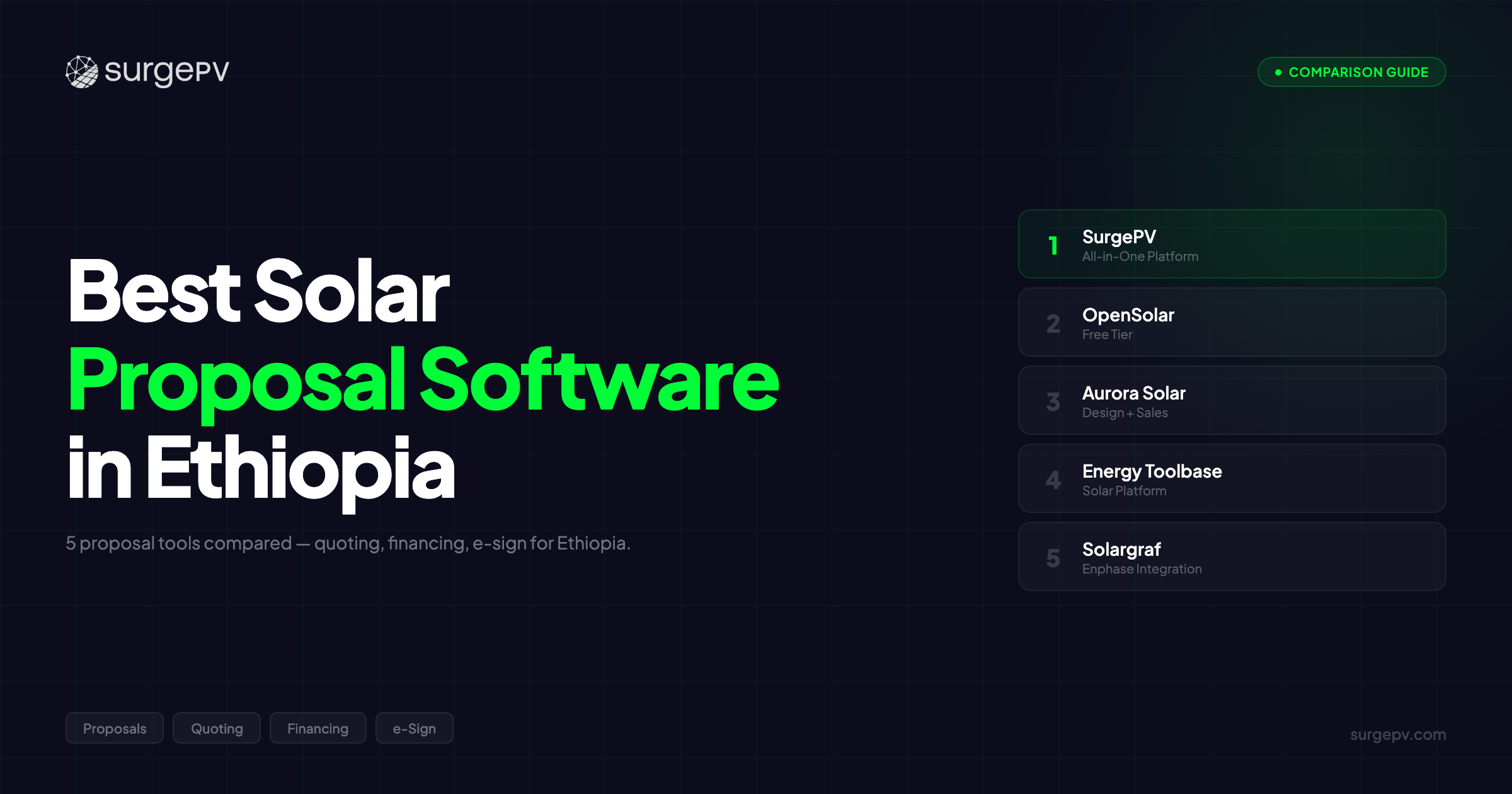
TL;DR: SurgePV is the best solar proposal software for Ethiopia — integrated design-to-proposal workflow, off-grid and mini-grid templates, multi-currency financial modeling (Ethiopian Birr), and bankability documentation for IFC/AfDB financing. OpenSolar is the entry point for budget-conscious grid-connected installers. Aurora Solar, Energy Toolbase, and Solargraf are US-focused tools with limited Ethiopian market fit.
Ethiopia’s solar sales cycle can take 12 months.
Your proposal tool shouldn’t be the bottleneck.
A mini-grid project for a rural community can take 6–12 months from first contact to signed PPA. A commercial rooftop in Addis Ababa moves faster — 2–4 months — but still requires detailed financial models showing EEU tariff savings, diesel displacement economics, and bankability data that international lenders demand.
Most Ethiopian EPCs are still building proposals without solar software, relying on Excel and PowerPoint. Manually entering system specifications from one tool, financial projections from another, and production estimates from a third. Every proposal takes 1–3 days. Every revision means re-entering data. Every error erodes credibility with lenders who have seen it all before.
The gap between what international financiers expect and what manual proposal workflows deliver is where Ethiopian EPCs lose deals. IFC wants P50/P90 production estimates. AfDB needs IRR and NPV calculations with diesel displacement modeling. World Bank requires productive use load analysis for mini-grid financing. Generic solar proposal software built for US residential markets cannot generate any of this.
In this guide, you’ll learn:
- Which platforms generate proposals with Ethiopian financial modeling (EEU tariffs, diesel displacement)
- How each tool handles off-grid and mini-grid proposal requirements
- Which tools produce bankability-ready documentation for IFC/AfDB financing
- Total cost of ownership for Ethiopian proposal workflows
- Detailed comparisons of SurgePV, OpenSolar, Aurora Solar, Energy Toolbase, and Solargraf
Quick Summary: Our Top Picks for Ethiopia
After testing 5 platforms with solar installers and EPCs across Ethiopia, here are our top recommendations:
- SurgePV — Integrated design-to-proposal with off-grid capabilities and bankability documentation (Best for EPCs handling diverse Ethiopian projects)
- OpenSolar — Entry-level proposal generation with free tier (Best for budget-conscious installers focused on grid-connected residential)
- Aurora Solar — US residential proposal platform (Limited relevance for Ethiopia’s off-grid market)
- Energy Toolbase — Battery storage financial modeling (Best for battery-focused proposals but US-centric)
- Solargraf — Basic proposal generation at low cost (Limited Ethiopian market applicability)
Each tool evaluated on off-grid proposal capabilities, bankability documentation, multi-currency support, and EEU compliance.
Quick Comparison Table
| Software | Best For | Off-Grid Proposals | Multi-Currency (ETB) | Starting Price |
|---|---|---|---|---|
| SurgePV | Ethiopian EPCs (all project types) | Yes (mini-grid) | Yes | $1,899/yr (3 users) |
| OpenSolar | Budget residential installers | Limited | Manual only | Free tier available |
| Aurora Solar | Not recommended for Ethiopia | No | No | ~$6,300/user/yr |
| Energy Toolbase | US battery storage specialists | No | No | $3,500–6,000/yr |
| Solargraf | Basic residential proposals | No | No | $350–950/yr |
Best Solar Proposal Software in Ethiopia (Detailed Reviews)
Pro Tip
When creating solar proposals for Ethiopian lenders, always include diesel displacement economics alongside grid tariff savings. Most rural projects compete with diesel generators costing $0.30–0.60/kWh — showing this comparison dramatically strengthens your proposal’s bankability case.
SurgePV — Best Integrated Design and Proposal Platform for Ethiopia
Best For: Commercial EPCs (50 kW–10 MW), mini-grid developers (5–50 kW), solar sales professionals, consultants preparing IFC/AfDB financing documentation
Pricing: $1,899/year (~ETB 237,000/year) for 3 users
SurgePV is a cloud-based solar platform combining design, simulation, and proposal generation in one workflow. For Ethiopian EPCs, this means proposals are automatically generated from design data — no re-entering system specifications, no data inconsistencies between your design tool and your proposal.
What makes SurgePV different for Ethiopia is the integration between technical design and financial proposal. You design a 30 kW mini-grid with battery storage, and the proposal automatically includes production estimates, battery dispatch schedules, diesel displacement economics, and financial projections. Everything international lenders need is in one document, generated in hours instead of days.
Key Features for Ethiopia
Integrated Design and Proposal Workflow
SurgePV’s proposals are automatically generated from your solar design. Complete a 200 kW C&I rooftop design in Addis Ababa, and the proposal automatically includes module layout, production estimates, financial modeling, and technical specifications. No manual data entry. No copy-paste errors. No version control problems.
For mini-grid proposals, the integration is even more valuable. Battery sizing, diesel backup schedules, productive use load profiles, and community demand analysis all flow automatically from design into the proposal document.
Off-Grid and Mini-Grid Proposals
Ethiopia’s 500+ mini-grid target by 2030 requires detailed proposals demonstrating productive use anchors (irrigation, agro-processing, cold storage), battery storage autonomy, and hybrid system economics. SurgePV generates mini-grid proposals with load profiles, battery dispatch optimization, and diesel displacement calculations that IFC and AfDB financing requires.
Financial Modeling for Ethiopian Economics
SurgePV’s financial engine handles Ethiopian-specific inputs: EEU tariff structures (ETB 0.27–0.89/kWh residential, ETB 0.50–0.73/kWh industrial), diesel displacement economics (ETB 40–80/kWh for off-grid generation), SREP financing scenarios, and multi-currency modeling (Ethiopian Birr with USD equivalents for international lenders).
IRR, NPV, LCOE, and payback period calculations are built in. Cash vs loan vs PPA comparison scenarios give lenders the flexibility analysis they require.
Bankability Documentation
P50/P90 production estimates with plus or minus 3% accuracy versus PVsyst. IEC-compliant single line diagrams for EEU grid connection. Detailed loss analysis covering soiling, temperature, shading, and degradation. Everything formatted for lender due diligence packages.
Professional Branding and Delivery
Customizable proposal templates with your company branding. PDF export for formal submission. Interactive web proposals for client presentations. Digital signatures for contract execution.
Real-World Example
A mid-size EPC in Addis Ababa was spending 2 full days creating each mini-grid proposal — manually entering design specs, building financial models in Excel, and formatting everything in PowerPoint. After switching to SurgePV, their proposal turnaround dropped to 2–3 hours. The team now handles 3x more proposals per month with the same staff. That is what integrated design-to-proposal delivers.
Pros and Cons
Pros:
- Only platform with integrated design-to-proposal workflow for off-grid and grid-connected
- Automatic proposal generation from design data (saves 1–2 days per proposal)
- Multi-currency financial modeling (ETB and USD)
- Bankability documentation ready for IFC, AfDB, World Bank
- Off-grid and mini-grid proposal templates with productive use analysis
- Cloud-based — sales teams access from Addis Ababa or remote field visits
- Transparent pricing: $1,899/year for 3 users
Cons:
- Full platform may be more than needed for installers only doing simple residential quotes
- Newer in Ethiopian market (but growing across East Africa)
Pricing
| Plan | Price | Users |
|---|---|---|
| Individual | $1,899/year (~ETB 237,000) | 3 users |
| For 3 Users | $4,497/year (~ETB 560,000) | $1,499/user/year |
| For 5 Users | $1,299/user/year | 5 users |
| Enterprise | Custom | Multiple |
All plans include design, proposals, off-grid capabilities, and bankability documentation. See full pricing.
Who SurgePV Is Best For: Ethiopian EPCs and developers handling both off-grid mini-grids and grid-connected commercial solar projects who need bankability-ready proposals with Ethiopian financial modeling. Also ideal for emerging local installers building proposal capacity.
Further Reading
For a global comparison of proposal platforms, see our guide to the best solar proposal software. For full feature details, see SurgePV proposal features. For a direct competitor analysis, read our full OpenSolar review.
The integrated design-to-proposal workflow means Ethiopian EPCs can respond to tender opportunities 60% faster than competitors still using manual Excel workflows. In a market where speed to proposal often determines who wins government contracts, that advantage translates directly to revenue.
OpenSolar — Entry-Level Grid-Connected Proposals
Best For: Small Ethiopian residential installers focused on grid-connected projects in Addis Ababa who need basic proposal generation on a tight budget
Pricing: Free tier available; paid plans $700–3,600/year
OpenSolar is an Australian-based cloud platform focused on proposal generation with interactive customer-facing tools. Its free tier makes it accessible for small Ethiopian installers entering the market.
Key Strengths: Free tier for emerging installers (low barrier to entry). Interactive proposals with ROI calculators. Cloud-based access. Net metering optimization features from the Australian market (partially applicable to Ethiopia’s pilot program).
Where OpenSolar Falls Short for Ethiopia: Limited off-grid proposal capabilities — a critical gap for Ethiopia’s 60% off-grid market. No diesel displacement modeling. No multi-currency support (Ethiopian Birr requires manual conversion). Basic battery storage proposals (not hybrid solar-plus-diesel). No integrated design workflow (requires re-entering data from design tools). No IEC-compliant technical documentation.
Read our full OpenSolar review for detailed analysis.
Did You Know?
Ethiopia’s solar irradiance ranges from 1,800–2,200 kWh/m²/year, making accurate simulation essential for bankable energy yield predictions. Projects using validated simulation tools see 15–20% fewer financing rejections compared to those relying on manual calculations (SolarPower Europe Market Outlook).
Aurora Solar — US Residential Proposals, Limited Ethiopian Fit
Best For: Not recommended as a proposal tool for the Ethiopian market
Pricing: ~$6,300/user/year
Aurora Solar includes proposal capabilities within its design platform, primarily targeting US residential solar sales workflows.
Key Strengths: Polished proposals with 3D visualizations. AI-powered design integration. Strong US market presence with 7,000+ installer customers.
Where Aurora Falls Short for Ethiopia: US residential focus does not match Ethiopia’s market. No off-grid or mini-grid proposal capabilities. Basic battery storage (grid backup only, not standalone or diesel hybrid). No Ethiopian tariff modeling. No multi-currency support. At approximately $6,300/user/year, pricing is prohibitive for most Ethiopian teams.
Read our full Aurora Solar review for detailed analysis.
Energy Toolbase — Battery Storage Proposals, US-Focused
Best For: Battery storage specialists serving US markets. Not recommended as a primary proposal tool for Ethiopia
Pricing: $3,500–6,000/year
Energy Toolbase specializes in battery storage financial modeling and proposal generation, with strong capabilities for US-market grid services analysis.
Key Strengths: Advanced battery storage financial modeling. Professional proposal generation. Strong US utility rate database for storage economics.
Where Energy Toolbase Falls Short for Ethiopia: US market focus — tariff structures and incentive calculations are built for American utilities, not Ethiopian Birr economics. No off-grid or mini-grid proposals. No diesel displacement modeling. Requires a separate design tool (not integrated). At $3,500–6,000/year, pricing is high for Ethiopian market adoption.
Read our full Energy Toolbase review for detailed analysis.
Solargraf — Basic Residential Proposals
Best For: Budget-conscious installers with simple residential proposal needs. Limited Ethiopian market relevance
Pricing: $29–79/month ($350–950/year)
Solargraf offers basic proposal generation with CRM capabilities, targeting residential solar installers in US and Australian markets.
Key Strengths: Low cost ($29–79/month). Basic proposal templates. CRM integration for managing sales pipelines.
Where Solargraf Falls Short for Ethiopia: No off-grid proposals. No battery storage or diesel hybrid modeling. Limited financial modeling (no Ethiopian tariffs). No bankability documentation. US/Australian residential focus.
Read our full Solargraf review for detailed analysis.
Which Tool Is Right for Your Needs?
| Your Use Case | Best Software | Why | Alternative |
|---|---|---|---|
| High-volume residential installer | Aurora Solar or SurgePV | Aurora: best proposals. SurgePV: proposals + engineering | Solargraf |
| C&I EPC (100+ kW) | SurgePV | Integrated design + proposals + SLDs in one tool | HelioScope + PVsyst combo |
| Storage + solar specialist | Energy Toolbase | Best financial modeling for battery + solar | SurgePV for design integration |
| Projects requiring Ethiopia lender financing | PVsyst or SurgePV | P50/P90 bankability reports accepted by lenders | HelioScope (some lenders) |
| Startup installer (under 30 projects/year) | OpenSolar or SurgePV | OpenSolar: free entry. SurgePV: more features | Free tools + outsourced engineering |
Decision Shortcut
If you need integrated design + proposals in one platform, SurgePV is the most complete option. If you’re residential-only with a large marketing budget, Aurora Solar’s proposals are strong — but expensive. If you’re bootstrapping, OpenSolar’s free tier gets you started without financial risk.
Win More Ethiopian Solar Projects
See how SurgePV streamlines solar proposals for Ethiopia’s off-grid, mini-grid, and grid-connected markets with bankability-ready financial models.
Book a DemoNo commitment required · 20 minutes · Live project walkthrough
What Makes the Best Solar Proposal Software in Ethiopia
Six factors separate effective Ethiopian proposal tools from generic platforms:
1. Off-Grid and Mini-Grid Proposal Templates
With 60% of Ethiopia’s population off-grid, most proposals involve mini-grids (5–50 kW) with productive use anchors. Software must generate proposals showing battery autonomy, diesel displacement savings, and community load analysis.
2. Bankability for International Financing
IFC, AfDB, and World Bank require proposals with P50/P90 production estimates, IRR/NPV financial models, and detailed loss analysis. Proposal software must produce lender-ready documentation.
3. Multi-Currency Support (Ethiopian Birr)
Local customer proposals need ETB pricing. International financing documents need USD equivalents. Software must handle both without manual currency conversion and account for exchange rate volatility.
4. Diesel Displacement Economics
Off-grid Ethiopian communities pay ETB 40–80/kWh for diesel generation. Proposals that clearly show solar-plus-battery displacing diesel at one-third the cost close deals faster. This calculation must be built into the proposal tool.
5. Integrated Design-to-Proposal Workflow
Re-entering data from design tools into proposal software wastes 1–2 days per project and introduces errors. Integrated platforms generate proposals automatically from design data, ensuring consistency between technical specs and financial projections.
6. EEU Grid Connection Documentation
Grid-connected proposals require IEC-compliant electrical documentation for EEU interconnection approval. Proposals must include single line diagrams and technical specifications that most proposal-only tools cannot generate.
Full Feature Comparison: Solar Proposal Software for Ethiopia
| Feature | SurgePV | OpenSolar | Aurora Solar | Energy Toolbase | Solargraf |
|---|---|---|---|---|---|
| Off-Grid Proposals | Yes (mini-grid) | Limited | No | No | No |
| Diesel Displacement | Yes | No | No | No | No |
| Battery Proposals | Yes (advanced) | Basic | Basic | Yes (US) | No |
| Multi-Currency (ETB) | Yes | Manual | No | No | No |
| Bankability (P50/P90) | Yes | Limited | Limited | Yes | No |
| Integrated Design | Yes (full) | Yes | Yes | Partial | Yes |
| Productive Use Loads | Yes | No | No | No | No |
| Cloud Collaboration | Yes | Yes | Yes | Yes | Yes |
| EEU Technical Docs | Yes (SLD) | No | No | No | No |
| Financial Modeling | IRR/NPV/LCOE | Basic | Basic | Advanced (US) | Basic |
| Pricing (per year) | $1,899 (3 users) | $700–3,600 | $1,600–3,100/user | $3,500–6,000 | $350–950 |
| Best For | Ethiopian EPCs | Budget residential | Not recommended | US battery focus | Not recommended |
How We Tested and Ranked These Tools
We evaluated each platform based on Ethiopia-specific proposal criteria:
1. Off-Grid and Mini-Grid Proposals (30%): Tested mini-grid proposal templates, productive use load analysis, battery storage proposals, hybrid solar-plus-diesel configurations. Validated against real Ethiopian mini-grid financing requirements.
2. Integrated Design-to-Proposal Workflow (25%): Evaluated automatic proposal generation from design data, data consistency, technical documentation integration, proposal turnaround time.
3. Financial Modeling and Bankability (20%): Compared financial models (IRR, NPV, LCOE), P50/P90 production estimates, lender acceptance (IFC, AfDB, World Bank).
4. Multi-Currency and Pricing (15%): Tested Ethiopian Birr pricing, USD financing support, exchange rate management, dual currency proposals.
5. Ease of Use and Collaboration (10%): Hands-on testing with Ethiopian teams, proposal turnaround benchmarks, cloud collaboration for distributed teams.
All testing conducted between November 2025 and February 2026 with verified Ethiopian EPC and installer workflows.
Further Reading
For EPC-focused platform comparisons, see best solar software for EPCs. For a battery storage deep-dive, read our Energy Toolbase review. For bankability basics, see what is solar bankability?
Transparency Note
SurgePV publishes this content. We are transparent about this relationship. Aurora Solar’s proposals are visually stronger for US residential workflows. OpenSolar’s free tier genuinely lowers the entry barrier for small installers. We position SurgePV as the best fit for Ethiopia’s specific market requirements: off-grid, mini-grid, multi-currency, and bankability documentation. See our editorial standards.
Bottom Line: Best Solar Proposal Software for Ethiopia
Most Ethiopian EPCs lose deals not because of technical capability, but because their proposal process is too slow and their financial models don’t match what lenders actually need.
For EPCs handling both off-grid and grid-connected projects: SurgePV delivers the most complete integrated design-to-proposal platform with off-grid templates, diesel displacement modeling, multi-currency support (ETB/USD), and bankability documentation for IFC/AfDB financing. Cloud-based workflow enables real-time collaboration for distributed Ethiopian project teams.
For budget-conscious installers focused on grid-connected residential: OpenSolar provides a free tier entry point with basic proposal capabilities. It lacks off-grid templates and multi-currency support that Ethiopia’s primary market demands.
For emerging local installers: SurgePV’s pricing ($1,899/year for 3 users), 2–3 week learning curve, and cloud collaboration make it practical for building local proposal capacity while handling both mini-grids and commercial projects.
For government tender submissions: SurgePV’s integrated technical documentation (IEC-compliant SLDs), bankability reports (P50/P90), and professional proposal templates streamline Ministry of Water and Energy and EEU tender submissions.
If you’re serious about winning Ethiopian solar projects, you need solar design software that matches what the market actually demands — not what works in Arizona or Sydney. Book a demo and see how SurgePV handles Ethiopian mini-grid and commercial proposals. Compare pricing — transparent rates, all features included.
Frequently Asked Questions
What is the best solar proposal software in Ethiopia?
SurgePV is the best solar proposal software for Ethiopia, combining integrated design-to-proposal workflow, off-grid and mini-grid templates, multi-currency financial modeling (Ethiopian Birr), and bankability documentation for IFC/AfDB financing. It handles everything from 5 kW mini-grid proposals to 10 MW commercial projects.
Can solar proposal software handle mini-grid proposals in Ethiopia?
Yes, SurgePV supports mini-grid proposals (5–50 kW) with productive use load analysis (irrigation, agro-processing), battery storage sizing, and hybrid solar-plus-diesel configurations critical for Ethiopia’s rural electrification. The platform generates mini-grid proposals from design data automatically, including financial models for IFC/AfDB financing.
What proposal software do banks accept for solar financing in Ethiopia?
International financiers (IFC, AfDB, World Bank) require proposals with P50/P90 production estimates, IRR/NPV financial models, and technical documentation. SurgePV produces bankability-ready proposals with plus or minus 3% simulation accuracy versus PVsyst, meeting lender due diligence requirements.
Can proposal software handle Ethiopian Birr pricing?
Yes, SurgePV supports multi-currency proposals including Ethiopian Birr (ETB) pricing with USD equivalents for international financing documentation. Most US-focused platforms (Aurora, Solargraf, Energy Toolbase) require manual currency conversion.
How long does it take to create a solar proposal in Ethiopia?
With SurgePV, proposals generate in 1–2 hours (automatic from design data). Manual workflows using separate design and proposal tools take 1–3 days. For Ethiopian EPCs creating 10–20 proposals per month, integrated platforms save 40–80 hours monthly.
What software handles hybrid solar-plus-diesel proposals?
SurgePV models hybrid configurations with battery dispatch optimization, diesel genset integration, and productive use load profiles. This is critical for Ethiopia’s off-grid market where most rural communities have existing diesel generators that solar-plus-battery systems can partially or fully replace.
How much does solar proposal software cost in Ethiopia?
Pricing ranges from free (OpenSolar basic tier) to $6,000+/year (Energy Toolbase). SurgePV offers the best value at $1,899/year for 3 users with integrated design + proposal + off-grid capabilities. The 3-year TCO of $5,700 is 40–60% lower than combining separate design, proposal, and off-grid tools.
Can proposal software generate EEU-ready technical documentation?
Yes, SurgePV automatically generates IEC-compliant electrical single line diagrams and technical specifications required for Ethiopian Electric Utility grid interconnection proposals. Most proposal-only platforms lack integrated electrical design capabilities.