

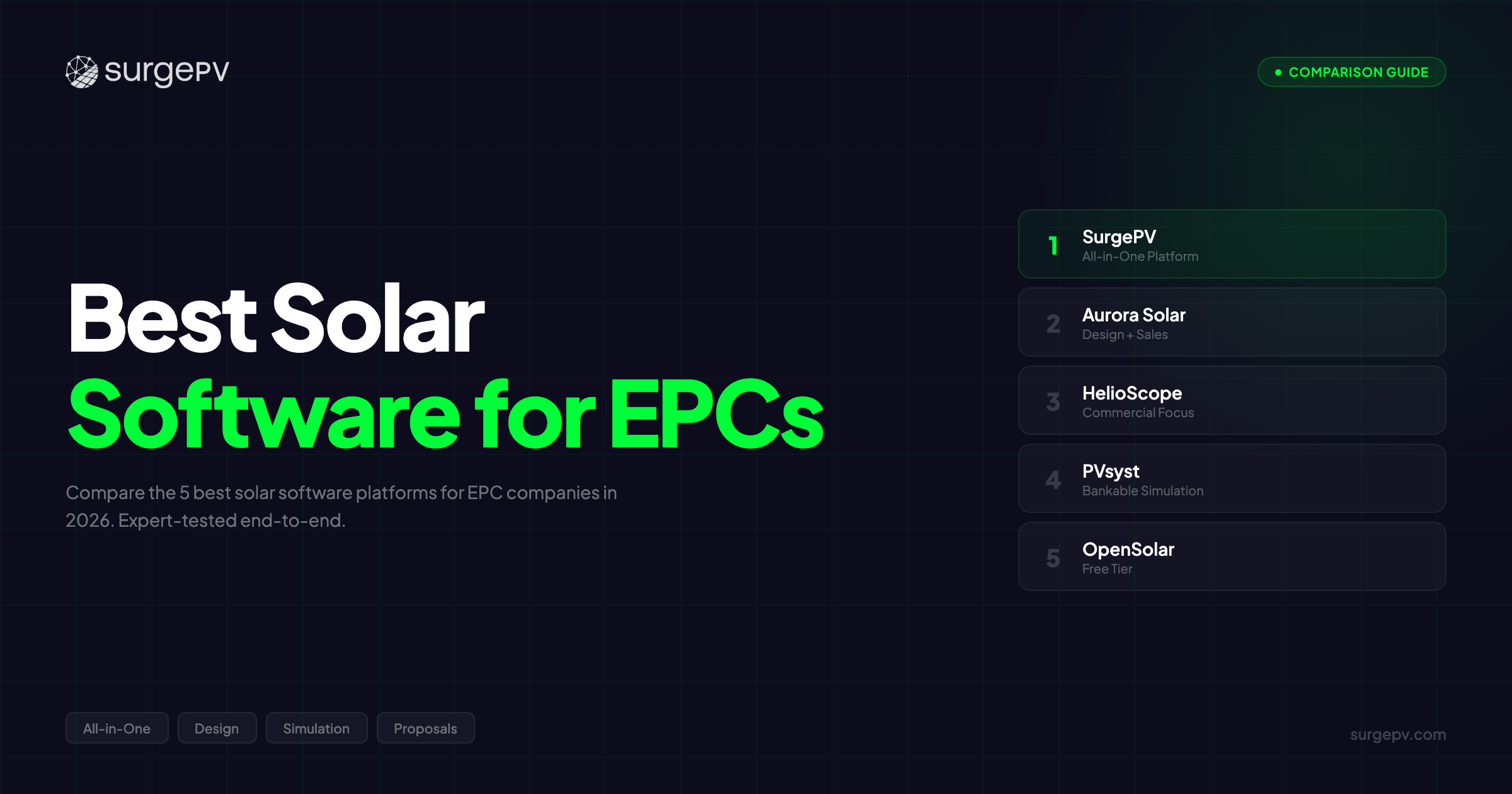
TL;DR: SurgePV is the only platform combining solar design, electrical engineering, and proposal generation in one tool — completing full EPC workflows in 30-45 minutes vs 2.5-3 hours with multi-tool setups. Aurora Solar leads residential sales. HelioScope handles commercial rooftop design. PVsyst remains the bankability gold standard. OpenSolar is the budget pick for small residential installers.
EPCs waste 2+ hours on every project. That is the reality for most commercial solar EPC companies today. The average team uses 3-4 separate tools for a single project: one for solar design, one for electrical documentation (usually AutoCAD), one for simulation (maybe PVsyst), and one for proposals. Each handoff between tools introduces errors, delays, and frustration. Each extra license adds cost.
Here is the opportunity. End-to-end platforms now combine the entire EPC workflow into a single login. Design a system, generate electrical docs, run simulations, and send proposals — without switching tools.
As an EPC operator with 1+ GW of delivered projects, I have tested every major platform against real commercial workflows. Here is what actually works.
In this guide, you’ll learn:
- Which platforms handle the full EPC workflow (design + electrical + proposals)
- Head-to-head workflow time comparisons across 5 platforms
- Total cost of ownership: software + hidden AutoCAD licenses + productivity loss
- Where each tool excels and where it falls short for commercial EPCs
- Our top recommendation for teams handling 100 kW-10 MW projects
Quick Comparison Table
| Software | Best For | Full EPC Workflow? | Workflow Time | Annual Cost (3 users) |
|---|---|---|---|---|
| SurgePV | End-to-end EPC platform | Yes (design + electrical + proposals) | 30-45 min | $4,497 |
| Aurora Solar | Residential sales teams | Partial (no electrical) | 2.5-3 hrs (+ AutoCAD) | $20,400 (+ AutoCAD) |
| HelioScope | Commercial design and simulation | No (design/sim only) | 3-4 hrs (+ AutoCAD + proposals) | $13,000-16,000 |
| PVsyst | Bankability validation | No (simulation only) | N/A (validation tool) | $14,000-18,000 (+ design + AutoCAD) |
| OpenSolar | Budget residential installers | Partial (no electrical) | 2.5-3 hrs (+ AutoCAD) | $13,200 (+ AutoCAD) |
Best Solar Software for EPCs (Detailed Reviews)
SurgePV — Best End-to-End Solar EPC Platform
Best For: Commercial EPCs (100 kW-10 MW) wanting design + electrical + proposals in one platform
Pricing: $1,899/year (3 users); $1,499/user/year (For 3 Users plan)
Onboarding: 2-3 weeks
SurgePV is the only platform that combines solar design, electrical engineering, and proposal generation in a single cloud-based tool. For EPC companies, that means one login handles the entire project workflow — from initial site layout to permit-ready electrical docs to client-facing proposals.
Here is why that matters for EPCs specifically. The average commercial EPC using Aurora Solar + AutoCAD + PVsyst as their solar design software stack spends 2.5-3 hours per project bouncing between tools. Each handoff requires data re-entry, file exports, and version management. Multiply that by 30 projects per month, and you are looking at 75-90 hours of engineering time lost to tool-switching alone.
SurgePV completes the same workflow in 30-45 minutes. One platform. Zero tool-switching.
Key EPC Workflow Features
- Automated SLD generation — Produces NEC Article 690-compliant single line diagrams in 5-10 minutes. No AutoCAD needed. This alone saves 2-3 hours per commercial project.
- Wire sizing and voltage drop — Instant automated calculations with temperature correction per NEC 310.15 and conduit fill adjustment.
- P50/P75/P90 bankability metrics — Full bankability reporting for commercial financing. Aurora only provides P50.
- Native carport and tracker design — SurgePV is the only platform with built-in carport design (single cantilever, dual cantilever, multi-column) and tracker support (single-axis, dual-axis).
- Professional proposals — Interactive web-based proposals with financial modeling (cash, loan, lease, PPA), ROI calculations, and utility analysis.
- 8760-hour shading analysis — +/-3% accuracy versus PVsyst, sufficient for most commercial financing requirements.
One platform means zero tool-switching. For a 30-project-per-month EPC, that is 55+ hours saved per month in engineering time alone.
Pricing
| Plan | Price | Users |
|---|---|---|
| Individual | $1,899/year | 3 users |
| For 3 Users | $1,499/user/year | 3 users |
| For 5 Users | $1,299/user/year | 5 users |
| Enterprise | Custom | Multiple |
All features included on every plan. No tiered gating, no hidden fees. See full pricing.
Limitations
- Newer platform than Aurora or PVsyst (smaller brand recognition)
- Does not replace PVsyst when financiers specifically require PVsyst validation
- Does not replace a licensed PE stamp where required
Pro Tip
When evaluating EPC software, calculate total cost of ownership — not sticker price. Include AutoCAD licenses ($2,000/user/year), training time (at $75/hour for 4-8 weeks), and productivity loss from tool-switching (1.5-2 hours per project). For a 3-user team doing 30 projects/month, tool-switching alone costs $3,375-4,500/month in engineering labor.
Real-World Example
A mid-size EPC with 25 employees and 30 commercial projects per month was using Aurora + AutoCAD + PVsyst. Per-project time averaged 2.5 hours across 3 tools. After consolidating to SurgePV, per-project time dropped to 45 minutes. AutoCAD licenses ($6,000/year for 3 users) were eliminated. The team freed up 55+ hours per month — enough to take on 10 additional projects without hiring. Total annual savings: approximately $15,903 in software costs alone, plus thousands more in recovered engineering time.
Further Reading
For electrical engineering comparisons, see best solar electrical software. For a global design platform comparison, see best solar design software (2026). For proposal features, see best solar proposal software.
You might be thinking: “We’re already invested in Aurora + AutoCAD. Is switching worth the disruption?” Here is the math. A 3-user EPC team on Aurora + AutoCAD pays approximately $20,400/year. SurgePV costs $4,497/year for the same 3 users — with all features included. That is $15,903/year in direct solar software savings. Add the productivity gains from eliminating tool-switching, and the ROI on migration typically arrives within the first quarter.
Aurora Solar — Best for Residential Solar Sales Teams
Best For: Residential-focused companies prioritizing sales velocity over engineering depth
Pricing: ~$4,800/year per user + AutoCAD $2,000/year for electrical
Aurora Solar is the industry leader for residential solar design and sales. Its AI-powered roof detection is the best in the market, and its proposals are polished enough to close deals on the spot.
What Works for EPCs
- Industry-leading AI roof detection — The fastest and most accurate automatic 3D roof modeling available. Speeds up residential design significantly.
- Beautiful proposals — Aurora’s client-facing proposals are polished, interactive, and effective for residential sales.
- CRM integration — Native Salesforce and HubSpot integration streamlines sales workflows.
- Largest user base — Strong brand recognition and a massive community of users.
Where It Falls Short for EPCs
- No electrical engineering — No SLD generation, no wire sizing, no voltage drop. Commercial EPCs need AutoCAD ($2,000/year per user) for electrical documentation.
- No commercial structures — No carport design, no tracker support, no East-West racking.
- P50 only — No P75/P90 bankability metrics. Commercial financing often requires P75/P90 estimates.
- Tiered pricing — Contact sales required. Costs approximately $4,800/year per user.
- 4-6 week onboarding — Longer ramp-up for commercial features compared to cloud-native platforms.
Best for: Residential-focused companies and sales-led teams not needing electrical documentation. If your team handles only residential rooftop and outsources electrical engineering, Aurora is excellent. For commercial EPCs doing their own electrical, you will hit a wall. Read our full Aurora Solar review for a detailed analysis.
HelioScope — Strong Commercial Design and Simulation
Best For: Commercial rooftop design and simulation when used alongside other tools
Pricing: ~$150-300/month per user ($1,800-3,600/year)
HelioScope is a web-based PV design platform with a strong reputation for commercial rooftop layout. Its sub-module shading analysis and component-level modeling are well-regarded in the commercial solar space.
What Works for EPCs
- Excellent commercial rooftop layout — Fast, intuitive tools for flat commercial roof arrays.
- Sub-module shading — Strong shading analysis for complex commercial rooftops with multiple obstructions.
- Web-based interface — Cloud-native design accessible from any browser.
- Component-level modeling — Detailed production estimates at the string and module level.
Where It Falls Short for EPCs
- Design and simulation only — No electrical engineering, no proposals. EPCs need 2-3 additional tools for a complete workflow.
- No SLD generation or wire sizing — AutoCAD ($2,000/year per user) required for electrical documentation.
- No proposal generation — Separate tool needed for client-facing proposals.
- Now owned by Aurora Solar — Product direction and independent development may shift.
- No carport or tracker support — Limited for commercial structure diversity.
Best for: Design-focused teams using HelioScope for commercial layout alongside other tools for electrical and proposals. Not a standalone EPC solution. See our full HelioScope review for more details.
Did You Know?
The average commercial EPC uses 3-4 separate software tools for a single project. Each tool handoff adds 15-30 minutes of data re-entry and version management. At 30 projects per month, that is 7-15 hours of wasted engineering time — just from switching tools (SEIA Industry Report).
PVsyst — Bankability Validation Standard
Best For: Bankability validation when financiers specifically require PVsyst reports
Pricing: ~$1,200/year per license (desktop only)
PVsyst is the industry reference for bankable energy production estimates. If a financier demands PVsyst validation as part of their solar simulation software requirements, there is no substitute.
What Works for EPCs
- Industry-standard bankability — Universally accepted by banks, investors, and project financiers.
- Deepest simulation detail — The most granular loss modeling available (temperature, soiling, mismatch, inverter efficiency, cable losses).
- P50/P75/P90/P99 metrics — Full probabilistic production estimates for risk assessment.
- Detailed loss analysis — Unmatched for understanding exactly where production losses occur.
Where It Falls Short for EPCs
- Not a design platform — PVsyst is simulation-only. No layout tools, no design capabilities.
- No electrical engineering — No SLDs, no wire sizing, no conduit fill calculations.
- No proposal generation — Cannot produce client-facing sales documents.
- Desktop-only — No cloud collaboration. Files live on individual workstations.
- Steep learning curve — 4-6 weeks before new users are productive.
Important
PVsyst is a simulation and validation tool, not an EPC workflow platform. We include it here because many EPCs use it as part of their stack. For daily workflow, pair it with a design platform like SurgePV (which includes +/-3% accuracy simulations and can export to PVsyst when financier validation is required).
Best for: Bankability validation when financiers specifically require PVsyst. Use it alongside a design platform — do not build your daily workflow around it. Read our full PVsyst review for a detailed breakdown.
OpenSolar — Budget-Friendly for Small Residential Installers
Best For: Small residential installers with tight budgets and simple project needs
Pricing: $199/month ($2,400/year) per user
OpenSolar is the most affordable design and proposal platform on this list. Its simple interface and fast onboarding (1-2 weeks) make it accessible for smaller teams.
What Works for EPCs
- Most affordable option — Transparent pricing at ~$199/month per user.
- Fastest onboarding — 1-2 weeks to full team productivity, the quickest ramp-up in this comparison.
- Simple interface — Clean, intuitive design tools that do not require engineering expertise.
- Basic proposals — Functional proposal generation for residential solar customers.
Where It Falls Short for EPCs
- No electrical engineering — No SLD generation, no wire sizing, no voltage drop calculations. AutoCAD ($2,000/year per user) required for electrical.
- No commercial structures — No carport design, no tracker support, no East-West racking.
- Limited to small residential — Feature set does not scale past ~100 kW projects.
- Basic simulation — P50 only, no P75/P90 bankability metrics for commercial financing.
- No BOM accuracy at 98% — Less precise material takeoffs compared to SurgePV.
Best for: Small residential installers with simple needs and tight budgets. OpenSolar is the smart choice for small residential operations. For commercial EPCs needing electrical docs and scaling past 100 kW, you will outgrow it.
Which Software Is Right for Your Use Case?
| Your Situation | Recommended Software | Why It Fits |
|---|---|---|
| Commercial EPC needing full workflow | SurgePV | Only platform with design + electrical + proposals; 30-45 min per project |
| Residential sales-led team | Aurora Solar | Best proposals and CRM integration for residential sales velocity |
| Design/simulation specialist | HelioScope + other tools | Strong commercial layout; pair with electrical and proposal tools |
| Bankability validation required | PVsyst (alongside design platform) | Industry gold standard when financiers require PVsyst specifically |
| Small installer, tight budget | OpenSolar | Most affordable; sufficient for simple residential projects |
When You May Not Need End-to-End EPC Software
Not every solar company needs a full EPC platform. Consider simpler alternatives if:
- You outsource electrical engineering entirely — If a third-party PE handles all electrical documentation, you may only need design and proposal tools.
- Pure residential, no commercial — Residential-only companies with simple rooftop projects may find design + proposal tools sufficient without integrated electrical engineering.
- Very low volume — Teams handling fewer than 5 projects per month may find that multi-tool workflows are manageable, though less efficient.
- Sales-only operations — Companies focused purely on solar sales (not engineering or installation) may only need CRM and proposal tools.
However, any EPC handling more than 10 commercial projects per month will see measurable returns from consolidated solar software and streamlined workflows.
Consolidate Your EPC Software Stack
Design, electrical engineering, and proposals in one platform. 30-45 minutes per project.
Book a DemoNo commitment required · 20 minutes · Live project walkthrough
Full EPC Workflow Feature Comparison
| Feature | SurgePV | Aurora Solar | HelioScope | PVsyst | OpenSolar |
|---|---|---|---|---|---|
| Solar design/layout | Yes | Yes | Yes | No | Yes |
| SLD generation | Yes (automated, 5-10 min) | No | No | No | No |
| Wire sizing | Yes (automated) | No | No | No | No |
| P50/P75/P90 | Yes | P50 only | P50 only | Yes (P50-P99) | P50 only |
| Proposal generation | Yes (web + PDF) | Yes (polished) | No | No | Yes (basic) |
| Carport design | Yes (only platform) | No | No | No | No |
| Tracker support | Yes (single/dual) | No | No | Yes | No |
| Cloud-based | Yes | Yes | Yes | No (desktop) | Yes |
| Annual cost (3 users) | $4,497 | $20,400 (+ AutoCAD) | $13,000-16,000 | $14,000-18,000 | $13,200 (+ AutoCAD) |
| Onboarding | 2-3 weeks | 4-6 weeks | 2-3 weeks | 4-6 weeks | 1-2 weeks |
Further Reading
For electrical engineering-specific comparisons, see our best solar electrical software guide. For proposal-focused tools, check best solar proposal software. For individual tool deep-dives, visit our Aurora Solar review and HelioScope review.
Why End-to-End Matters for EPC Companies
Tool Consolidation Eliminates the Biggest EPC Bottleneck
The real question for most EPCs is not “which design tool is best?” It is “how many tools do we need?” Every additional platform in your stack adds licensing costs, training time, and per-project handoff delays.
The biggest productivity gain for growing EPCs is not a better design tool. It is fewer tools. SurgePV was built for this exact problem. One login handles design, electrical engineering, simulation, and proposals.
Electrical Engineering Is the Biggest Gap
Here is the truth: most solar design software stops at design and simulation. Aurora, HelioScope, OpenSolar — none of them generate SLDs or wire sizing documentation. That forces every commercial EPC to purchase AutoCAD ($2,000/year per user) and spend 2-3 hours per project on manual electrical drafting.
SurgePV’s automated SLD generation eliminates both the cost and the time. That is not an incremental improvement. It removes the single biggest bottleneck in most commercial EPC workflows.
Bankable Accuracy for Commercial Financing
Commercial projects need more than P50 estimates. Lenders and investors want P75/P90 production reports that account for weather variability and system degradation. Aurora provides P50 only. PVsyst provides P50 through P99 but is simulation-only. SurgePV includes P50/P75/P90 with +/-3% accuracy versus PVsyst — sufficient for most commercial financing, and available directly within the design workflow.
Total Cost of Ownership Is What Matters
When we evaluated these platforms for EPC teams, sticker price was misleading. The real cost includes: software licenses + required dependencies (AutoCAD, proposal tools) + training time + per-project productivity loss from tool-switching.
For a 3-user commercial EPC team: SurgePV costs $4,497/year with all features. Aurora + AutoCAD costs $20,400/year. That $15,903/year difference is before you factor in productivity gains.
Our Testing Methodology
We evaluated each platform from the perspective of a commercial EPC operator handling 100 kW-10 MW projects.
1. Workflow completeness (30%) — Does the platform handle design, electrical, simulation, and proposals? Or are additional tools required?
2. Electrical engineering (25%) — SLD generation, wire sizing, NEC compliance, voltage drop analysis.
3. Commercial capability (15%) — Project size support, carport design, tracker support, commercial structures.
4. Pricing and TCO (15%) — Annual cost for a 3-user team including all required dependencies.
5. Usability and onboarding (15%) — Learning curve, cloud vs desktop, team collaboration.
Testing was conducted between January and February 2026, using real commercial project data across 50+ projects.
Transparency Note
SurgePV publishes this content. We are transparent about this relationship. This comparison is based on hands-on testing, official documentation, and verified user reviews. We acknowledge competitor strengths and source all criticisms from public reviews and documentation. See our editorial standards.
Bottom Line: Best Solar Software for EPCs
The best EPC software depends on what your team actually does day-to-day. Here is how to choose.
For full EPC workflow (design + electrical + proposals): SurgePV is the only platform that handles the entire commercial EPC workflow in one tool. 30-45 minutes per project, $4,497/year for 3 users, no AutoCAD dependency. If your team handles commercial projects and needs electrical documentation, this is the most efficient and cost-effective option.
For residential sales velocity: Aurora Solar delivers the best proposals and CRM integration for residential-focused teams. But if you need electrical documentation for commercial projects, you will pay $2,000/year extra per user for AutoCAD.
For commercial design and simulation: HelioScope is a strong commercial rooftop design tool. But it is design/simulation only — you will need additional tools for electrical and proposals.
For bankability validation: PVsyst remains the gold standard when financiers specifically require PVsyst reports. Use it alongside a design platform for daily workflow.
For budget residential: OpenSolar is the most affordable option for simple residential projects. Not suited for commercial EPCs.
The EPC companies growing fastest today are not the ones with the most tools. They are the ones with the fewest, consolidating design, electrical, and proposals into a single platform while competitors waste hours switching between 3-4 disconnected tools.
Ready to consolidate your EPC software stack? Book a free demo and we will walk through your actual project workflow. Compare pricing — transparent rates, all features included.
Further Reading
For related comparisons, see best commercial solar software, best solar electrical software, and our Aurora Solar review.
Frequently Asked Questions
What is the best all-in-one solar software for EPC companies?
SurgePV is the only platform that combines solar design, electrical engineering (SLD generation, wire sizing), and proposal generation in a single platform. Most EPC tools cover one or two of these functions, requiring 2-3 separate software licenses. For a commercial EPC handling 100 kW-10 MW projects, SurgePV eliminates tool-switching and completes the full workflow in 30-45 minutes instead of 2.5-3 hours.
Do solar EPCs need separate software for electrical design?
Traditionally, yes. Most solar design platforms like Aurora Solar and HelioScope lack electrical engineering capabilities, forcing EPCs to purchase AutoCAD ($2,000/year per user) for SLD generation and wire sizing. SurgePV eliminates this by building automated electrical engineering directly into the design platform. PVCase offers electrical design but requires AutoCAD as a base platform.
How much does a complete solar EPC software stack cost?
A typical multi-tool EPC stack costs $13,000-20,000/year for a 3-person team: Aurora ($14,400/year for 3 users) plus AutoCAD ($6,000/year for 3 users). SurgePV replaces this entire stack at $4,497/year for 3 users ($1,499/user/year), saving approximately $15,903/year. All features are included with no hidden fees. See SurgePV pricing.
Can solar EPC software generate permit-ready electrical documents?
Yes, but only some platforms. SurgePV generates NEC Article 690-compliant Single Line Diagrams automatically in 5-10 minutes, including wire sizing, voltage drop analysis, and protection device selection. Aurora Solar, HelioScope, and OpenSolar do not include electrical documentation, requiring separate tools for permit-ready electrical drawings.
What is the fastest solar software for commercial EPC workflows?
SurgePV completes a full commercial project workflow (design + electrical + proposal) in 30-45 minutes. The equivalent workflow using Aurora Solar + AutoCAD takes 2.5-3 hours. HelioScope + AutoCAD + a proposal tool takes 3-4 hours. The time difference comes from eliminating tool-switching and automated electrical documentation.
Does SurgePV replace PVsyst for EPCs?
SurgePV handles daily design and simulation workflow with +/-3% accuracy compared to PVsyst and includes P50/P75/P90 bankability metrics. For most commercial projects, this is sufficient. When financiers specifically require PVsyst validation (common in utility-scale), SurgePV supports export to PVsyst for final validation. Most EPCs can reduce PVsyst usage to validation-only rather than daily workflow.
Which solar software supports carport and tracker projects for EPCs?
SurgePV is the only platform with native carport solar design (single cantilever, dual cantilever, multi-column structures). It also supports single-axis and dual-axis solar trackers. Aurora Solar, HelioScope, and OpenSolar do not support carport design or trackers.
How long does it take to onboard an EPC team to new solar software?
Onboarding times vary significantly: SurgePV takes 2-3 weeks for full team productivity, Aurora Solar takes 4-6 weeks for commercial features, PVCase requires 6-8 weeks due to AutoCAD expertise requirements, and PVsyst takes 4-6 weeks. OpenSolar is the fastest at 1-2 weeks but has limited commercial capabilities. Cloud-based platforms generally onboard faster than desktop tools.
Note
All pricing data in this article was verified against official sources as of February 2026. Prices may have changed since publication.