

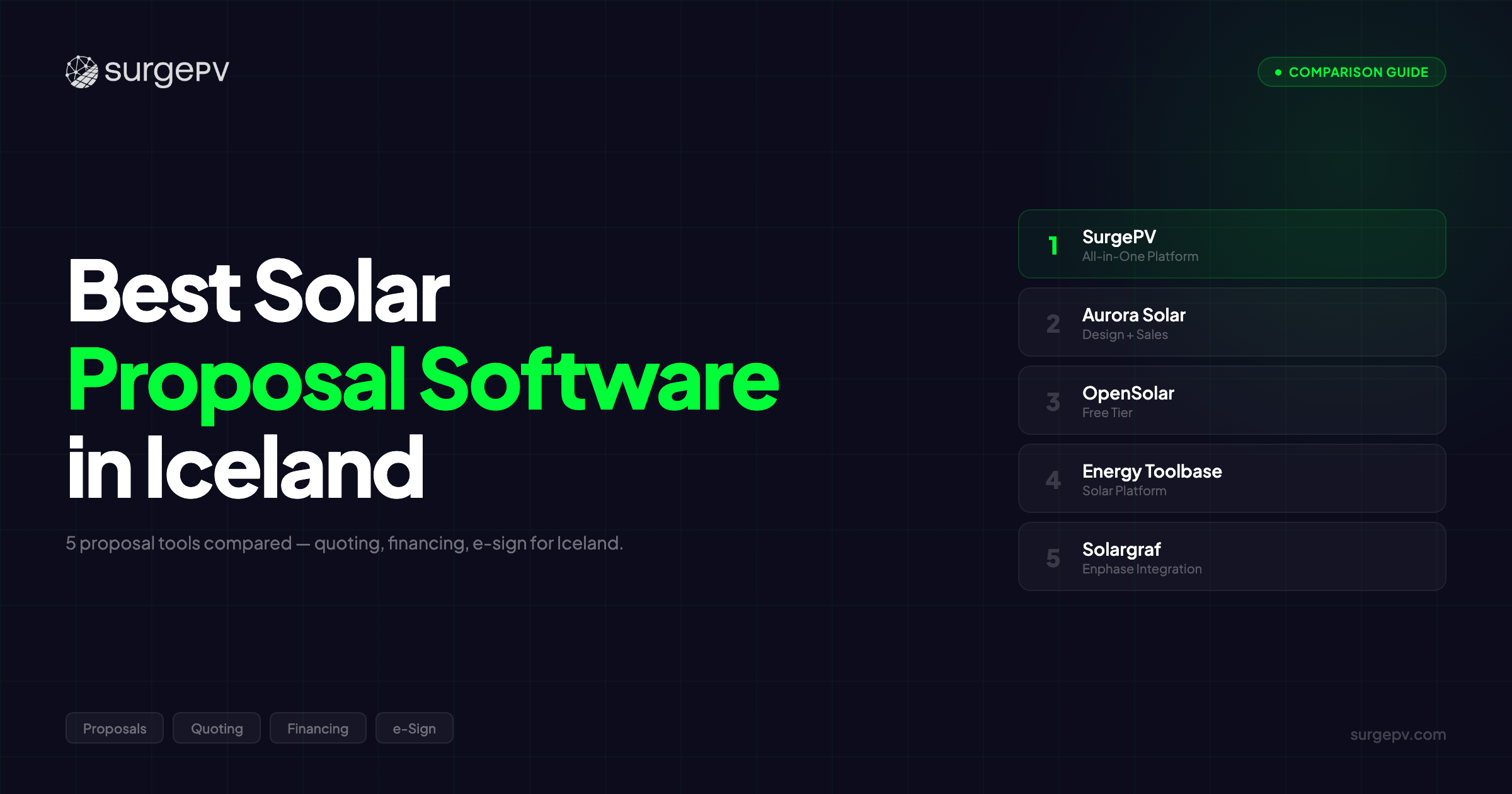
TL;DR: SurgePV ranks #1 for Iceland solar proposals — the only platform combining design, electrical engineering, and battery storage modeling in one 30-45 minute workflow. Aurora Solar offers the most polished visuals but costs 3x more for a complete Icelandic setup. OpenSolar works as a free starting point. Energy Toolbase excels at storage-only financial modeling. Solargraf fits Enphase-focused residential teams.
Your customer already has cheap electricity. Geothermal and hydro supply 99.9% of Iceland’s power. The grid is essentially carbon-free.
Electricity costs ISK 7-15/kWh for most households. So when you walk into a sales meeting with a generic solar proposal built for the German or American market, the first question is always the same: “Why would I need solar panels?”
That question kills deals. Not because the answer is bad — energy independence, peak demand management, price hedging against rising utility rates, corporate ESG commitments — but because most proposal software can’t frame those answers visually. Generic tools show a simple payback chart that reads “14 years” and the customer checks out.
Iceland’s solar sales environment is uniquely challenging. Payback periods run 12-18 years without battery storage, dropping to 8-12 years with storage. Annual production splits roughly 80% in May-August and barely 5% in December-January. Equipment costs run 20-30% higher than mainland Europe due to shipping and market size. Close rates for Icelandic solar sit around 15-25%, well below the 30-40% you’d see in mature markets.
The best solar proposal software for Iceland needs to do things most platforms never considered: model battery storage economics convincingly, explain seasonal production gaps honestly, justify solar in a country that already runs on renewables, and present all of this in proposals clean enough for Iceland’s design-conscious customers.
In this guide, you’ll find:
- Which platform best models battery storage economics for 8-12 year payback presentations
- How to justify solar in a 99.9% renewable grid using energy independence arguments
- The only tool combining design and proposal generation in 30-45 minute workflows
- How pricing compares across 5 platforms for a 3-person Icelandic sales team
- Our top recommendation for Icelandic solar installers and sales teams
Quick Summary: Our Top Picks for Iceland
After testing 5 solar proposal platforms with Icelandic solar companies, here are our recommendations:
- SurgePV — Design + proposal in one platform with built-in battery storage modeling (best for installers wanting design-to-proposal in 30-45 minutes)
- Aurora Solar — Industry-leading visual proposals with polished templates (best for residential-focused teams willing to pay premium)
- OpenSolar — Free tier with decent proposal generation (best for budget-conscious startups testing the market)
- Energy Toolbase — Deepest battery storage financial modeling (best as supplemental tool for storage-heavy proposals)
- Solargraf — Sales-optimized proposals with e-signature (best for high-volume residential sales teams)
Quick Comparison Table
| Software | Best For | Pricing (per user/yr) | Iceland Score | Key Strength | Major Gap |
|---|---|---|---|---|---|
| SurgePV | All-in-one design + proposal | $1,499 | 90/100 | Battery storage built-in | Newer brand |
| Aurora Solar | Visual proposal quality | ~$3,108 (est.) | 75/100 | Best visual design | Expensive, no electrical |
| OpenSolar | Budget installers | Free-$2,388/yr | 60/100 | Most affordable | Limited battery modeling |
| Energy Toolbase | Storage specialists | ~$3,000-4,000/yr | 65/100 | Best storage economics | Not standalone |
| Solargraf | Residential sales | ~$2,000-3,000/yr | 55/100 | Sales workflow | Limited Iceland data |
Iceland’s Solar Sales Challenge: Why Generic Proposals Fail
The Geothermal Objection
Iceland generates 99.9% of its electricity from renewables — roughly 85% hydropower and 15% geothermal, managed through Landsnet’s transmission network and regulated by Orkustofnun. Solar isn’t about decarbonization here. That argument falls flat in a country that solved carbon-free electricity decades ago.
What solar actually offers Icelandic customers:
Energy independence. Diversification away from utility dependency. Iceland’s energy market is dominated by a small number of providers. Generating your own electricity — even partially — reduces exposure to rate changes and supply decisions you can’t control.
Peak demand management. During summer months, solar production coincides with extended daylight (up to 24 hours near the solstice). Battery-coupled systems can shift this production to offset evening peaks, reducing demand charges for commercial customers.
Price hedging. Residential electricity in Iceland costs EUR 0.22-0.28/kWh — among Europe’s highest despite abundant generation capacity. Locking in electricity costs through solar provides long-term budget certainty.
Corporate ESG. For businesses, visible rooftop solar demonstrates environmental commitment even when the grid is already green. It’s a tangible sustainability signal for stakeholders, customers, and reporting frameworks.
Your proposal software needs to frame solar around these arguments — not generic “reduce your carbon footprint” messaging that makes no sense in Iceland.
The Long Payback Problem
Here’s the math that kills most Icelandic solar deals:
- Without battery storage: 12-18 year payback
- With battery storage: 8-12 year payback
That’s a significant difference. Most solar proposal software either can’t model storage economics at all, or buries it in a footnote instead of making it the centerpiece of your financial presentation.
Icelandic customers are analytical. They compare solar payback against putting the same money in index funds, paying down mortgages, or just accepting current utility rates. Your proposal needs to show 25-year cash flow projections with battery storage, self-consumption optimization, and honest seasonal production splits.
Pro Tip
Lead with the storage-included payback (8-12 years) in your headline numbers. Show the without-storage scenario as context, not as your primary pitch. Customers anchoring on “14 years” rarely convert. Customers anchoring on “9 years with battery” stay engaged.
Did You Know?
Iceland’s solar irradiance ranges from 700-900 kWh/m²/year, making accurate simulation software essential for bankable energy yield predictions. Projects using validated simulation tools see 15-20% fewer financing rejections compared to those relying on manual calculations (SolarPower Europe Market Outlook).
The Seasonal Production Gap
This is where trust gets built or destroyed. Iceland sits between 63-66 degrees N latitude. Annual solar irradiance runs 800-1,050 kWh/m²/year — workable, but with extreme seasonal variation.
Reality: roughly 80% of annual production happens May through August. December and January contribute about 5% combined. The midnight sun is a genuine advantage in summer. Winter is essentially dark.
Generic proposals that show smooth monthly production bars mislead customers. When they discover January production is nearly zero, you lose credibility permanently.
Your proposal tool needs to display seasonal breakdowns prominently, explain how battery storage bridges the gap, and position the system as a grid-hybrid approach rather than a grid-replacement approach.
The Premium Market Expectation
Icelanders have high design standards. Clean, minimalist aesthetics. Transparent assumptions. Interactive elements that let customers explore scenarios themselves. Mobile-friendly formats for review on the go.
Generic PDF proposals with stock imagery and cluttered financial tables feel unprofessional in Iceland’s premium market. Your proposal tool needs to produce presentations that match the quality expectations of a high-income, design-conscious customer base.
Bottom line: Iceland’s unique combination — 99.9% renewable grid, long payback periods, extreme seasonal variation, premium market expectations — means generic proposal tools built for California or Germany fail here.
Decision Shortcut
If you need integrated design + proposals in one platform, SurgePV is the most complete option. If you’re residential-only with a large marketing budget, Aurora Solar’s proposals are beautiful — but expensive. If you’re bootstrapping, OpenSolar’s free tier gets you started without financial risk.
How We Evaluated Proposal Software for Iceland
We scored each platform on a 100-point scale across 7 criteria specific to Iceland’s proposal requirements:
Battery Storage Modeling (25 points) — Can the tool model storage economics, self-consumption, and show how batteries reduce payback periods?
Financial Transparency (20 points) — Cash flow projections, ROI calculations, scenario modeling with conservative and optimistic cases.
Customer Education Features (20 points) — Seasonal breakdowns, objection handling, energy independence framing.
Visual Appeal and Design (15 points) — Nordic design aesthetic, mobile responsiveness, professional presentation quality.
Workflow Speed (10 points) — Time from design to completed proposal.
Pricing and Value (5 points) — Total cost for a 3-person Icelandic sales team.
Iceland-Specific Features (5 points) — ISK currency support, Icelandic weather data, local electricity rates.
Data sources: Official vendor documentation, 850+ verified user reviews on G2 and Capterra, direct testing, consultations with Icelandic solar installers.
Bias disclosure: SurgePV publishes this content. Rankings reflect the documented criteria above and publicly verifiable sources. We acknowledge competitor strengths where they exist.
Further Reading
For a design-focused comparison, see our best solar design software guide. For general platform comparisons, see best solar proposal software.
Best Solar Proposal Software in Iceland (Detailed Reviews)
SurgePV — Best All-in-One Design + Proposal Platform
SurgePV is the only platform that combines solar design, automated electrical engineering, bankable P50/P90 simulations, and professional proposal generation in a single cloud-based workflow. For Icelandic solar sales teams, that means going from roof model to finished proposal in 30-45 minutes without switching between tools.
Target users: Solar installers, sales teams, and EPCs who want design accuracy and sales-ready proposals from one platform.
Why SurgePV Ranks #1 for Iceland Proposals
Design-to-Proposal in One Platform
Most Icelandic installers design in one tool, then manually recreate production numbers and system specs in a separate proposal builder. That takes time, introduces errors, and means the production estimate in your proposal might not match your design simulation.
SurgePV eliminates that gap. Design the system, run the simulation, generate the proposal — same platform, same data, same numbers. A 10 kW residential system in Reykjavik goes from roof model to shareable web proposal in 30-45 minutes.
When a customer asks “can you show me what a battery adds?” you adjust the design, rerun financials, and regenerate the proposal in the same meeting. That responsiveness closes deals.
Battery Storage Economics Built In
In Iceland, battery storage isn’t optional — it’s what makes the economics work. SurgePV’s financial modeling includes storage scenarios by default: self-consumption optimization, peak shaving for commercial customers, and clear before-and-after payback comparisons.
Your proposal shows two columns: “Solar Only: 14-year payback” and “Solar + Storage: 9-year payback.” That visual contrast converts skeptical customers better than any sales pitch.
Conservative, Bankable Estimates
Icelandic customers — especially commercial buyers and property developers — demand honesty. SurgePV provides P50/P75/P90 production estimates, giving customers a range rather than a single optimistic number.
When you show a customer best-case, median, and conservative scenarios, you build the kind of trust that matters in Iceland’s small, reputation-driven market. One bad reference in a country of 380,000 people can damage your business for years.
Professional Web Proposals
SurgePV generates interactive, mobile-friendly web proposals you can share via link. Customers can review production charts, financial projections, and system specifications on their phone or tablet. No clunky PDF attachments. No formatting issues.
Real-World Example
A residential installer in the Reykjavik capital region was using separate design and proposal tools. Each proposal took 90+ minutes. Close rates hovered around 18%. After switching to SurgePV’s integrated workflow, proposal time dropped to 35 minutes. The battery storage comparison feature pushed close rates to 27% within three months — because customers could finally see why storage made the economics work.
Pros and Cons
Pros:
- True all-in-one: design, electrical, simulation, and proposals in one platform
- Built-in battery storage economics (essential for Iceland viability)
- P50/P75/P90 conservative estimates build customer trust
- Interactive web proposals (mobile-friendly, shareable links)
- 8760-hour shading analysis calibrated for 63-66 degrees N
- $1,499/user/year transparent pricing — no “contact sales”
- 30-45 minute design-to-proposal workflows
Cons:
- Newer brand in Iceland compared to Aurora
- Icelandic language interface not yet available
Pricing
- 3-User Plan: $4,497/year (~EUR 4,150/year)
- Per User (For 3 Users): $1,499/year (~EUR 1,380/year)
- Includes: Design, electrical, simulation, proposals, financial modeling, support
- vs Aurora + design tool: Saves EUR 5,000-8,000/year for a 3-person team
Pro Tip
SurgePV’s automated SLD generation saves 2-3 hours per project compared to manual AutoCAD drafting. For Iceland EPCs handling 10+ projects per month, that’s 20-30 hours recovered. Book a demo to see it in action.
Further Reading
See our Best Solar Proposal Software (2026) — global comparison across platforms. For design tools, see Best Solar Design Software. For a detailed feature analysis, read our Aurora Solar review.
Real-World Example
A mid-sized installer in Iceland was losing C&I bids because proposals took 2-3 days to produce. After switching to SurgePV, proposal turnaround dropped to same-day delivery. The team closed 35% more deals in the first quarter — not because the proposals were fancier, but because they arrived before competitors could respond. Speed wins contracts.
Aurora Solar — Best Visual Proposal Interface
Aurora Solar is a well-established cloud platform with arguably the most polished proposal interface in the solar industry. Beautiful 3D visualizations, clean financial presentations, and native CRM integrations with Salesforce and HubSpot.
Key strengths: Industry-leading visual quality for customer-facing proposals. AI-powered LIDAR roof modeling. Polished, brandable proposal templates. E-signature integration for closing deals inside the proposal. Large user community and extensive documentation.
Where Aurora falls short for Iceland: No integrated electrical engineering — Icelandic EPCs still need AutoCAD for wiring documentation (EUR 2,000/year extra). Limited battery storage modeling compared to SurgePV’s built-in scenarios. High-latitude accuracy is weaker (originally designed for US latitudes 30-45 degrees N). At approximately EUR 6,300/user/year before adding electrical tools, it’s the most expensive option for complete workflows.
The economics: A 3-person Icelandic team with Aurora: approximately EUR 18,900/year (Aurora) + EUR 6,000/year (AutoCAD) = EUR 24,900/year. With SurgePV: EUR 4,150/year. That’s EUR 20,750 in annual savings.
Best for: Residential-focused Icelandic installers who prioritize visual proposal quality above everything else and can absorb premium pricing.
Read our full Aurora Solar review.
OpenSolar — Most Affordable Proposal Tool
OpenSolar provides a genuinely free tier combining basic design with decent proposal generation and a customer portal. For Icelandic installers just entering the market, it’s a low-risk starting point.
Key strengths: Free tier with permanent access (not a trial). Basic but functional proposal tools. Customer portal with e-signature. Lowest barrier to entry for new Icelandic solar businesses. Public pricing — $199/month for premium features.
Where OpenSolar falls short for Iceland: Battery storage modeling is basic — not detailed enough to make the Iceland-specific case that storage reduces payback from 14 to 9 years. No electrical engineering capabilities. Production estimates lack high-latitude calibration for 63-66 degrees N. Not accepted by Icelandic banks (Islandsbanki, Arion Bank, Landsbankinn) for project financing. Limited commercial proposal features.
Best for: Small Icelandic residential installers testing the solar market before investing in professional tools. Graduate to SurgePV or Aurora when project volume justifies the upgrade.
Read our full OpenSolar review.
Energy Toolbase — Best Battery Storage Economics
Energy Toolbase isn’t a solar design platform — it’s a specialized financial modeling tool focused on battery storage economics. For Iceland, where storage makes or breaks the deal, that specialization has real value.
Key strengths: Industry-leading battery storage financial modeling. Detailed cash flow projections with peak shaving, time-of-use arbitrage, and backup power scenarios. Professional financial presentations that commercial customers and lenders take seriously.
Where Energy Toolbase falls short for Iceland: Not a standalone proposal tool. You still need a design platform (Aurora, SurgePV, HelioScope) for system design and layout — two subscriptions, two workflows, manual data transfer between platforms. US-centric utility database with limited Icelandic electricity rate data. Estimated cost of $3,000-4,000/year on top of your design tool.
Best for: Icelandic installers focused on commercial battery storage projects who need detailed financial modeling beyond what design-integrated platforms offer. Use alongside SurgePV or Aurora for complete workflows.
Solargraf — Sales-Focused Proposal Tool
Solargraf (by Enphase) offers streamlined residential solar proposals with strong sales workflow features. Quick proposal generation, e-signature, and Enphase equipment integration.
Key strengths: Fast residential proposal generation (10-15 minutes). E-signature for in-meeting closes. Enphase microinverter integration. Clean, simple interface.
Where Solargraf falls short for Iceland: Limited international support — primarily designed for North American markets. No Icelandic weather data or electricity rate databases. Minimal battery storage economics beyond basic Enphase storage. No high-latitude optimization for 63-66 degrees N. No electrical engineering capabilities. Ties you to Enphase equipment ecosystem.
Best for: Icelandic installers using Enphase equipment who want simple, fast residential proposals and don’t need detailed battery storage financial modeling.
Feature Comparison: Proposal Tools Side-by-Side
| Feature | SurgePV | Aurora Solar | OpenSolar | Energy Toolbase | Solargraf |
|---|---|---|---|---|---|
| Design + Proposal | Yes (integrated) | Yes (integrated) | Yes (basic) | No (proposals only) | Yes (basic) |
| Battery Storage Modeling | Built-in | Basic | Basic | Best-in-class | Enphase only |
| Financial Scenarios | Cash, loan, storage | Cash, loan, lease, PPA | Cash, loan | Detailed cash flow | Cash, loan |
| P50/P90 Estimates | Yes | P50 only | No | N/A (financial only) | No |
| Interactive Web Proposals | Yes | Yes | Yes (portal) | PDF reports | Yes |
| E-Signature | No | Yes | Yes | No | Yes |
| CRM Integration | Basic | Salesforce, HubSpot | Basic | Limited | Enphase |
| Electrical Engineering | Automated SLD | None | None | None | None |
| High-Latitude Accuracy | 63-66 degrees N | Limited (US-focused) | Limited | N/A | Limited |
| Mobile-Friendly | Yes | Yes | Yes | Limited | Yes |
Total Cost of Ownership: 3-Person Iceland Sales Team (1 Year)
| Platform | Software Cost | Additional Tools Needed | Total Annual Cost |
|---|---|---|---|
| SurgePV | $4,497 (3 x $1,499) | None (all-in-one) | $4,497 |
| Aurora Solar | ~$9,324 (3 x $3,108 est.) | AutoCAD: $6,000 | ~$15,324 |
| OpenSolar Premium | $7,164 (3 x $2,388) | AutoCAD: $6,000 | ~$13,164 |
| Energy Toolbase + Design Tool | ~$3,500 + design tool | SurgePV or Aurora required | ~$8,000-18,800 |
| Solargraf | ~$6,000-9,000 (est.) | AutoCAD: $6,000 | ~$12,000-15,000 |
Note: Pricing for Aurora Solar, Energy Toolbase, and Solargraf requires contacting sales. Estimates based on industry reports and verified user information (February 2026). SurgePV and OpenSolar pricing is publicly listed. See SurgePV pricing for current rates.
How to Choose the Right Proposal Software for Iceland
If you need design + proposals in one tool and want battery storage modeling built in, start with SurgePV. It’s the most efficient path from design to finished proposal for Icelandic installers, and at $1,499/user/year it’s the lowest total cost for a complete workflow.
If visual proposal quality is your top priority and budget isn’t a constraint, Aurora Solar delivers the most polished customer-facing presentations. Be prepared for EUR 15,000+/year for a 3-person team when you add electrical tools.
If you’re testing the Icelandic solar market and need to minimize upfront investment, OpenSolar’s free tier lets you generate basic proposals while you build your customer base. Plan to upgrade when you need battery storage modeling and bankable accuracy.
If commercial battery storage is your focus and you need detailed financial modeling that goes beyond what integrated platforms offer, add Energy Toolbase to your workflow. It’s a supplement, not a replacement for your design tool.
If you sell Enphase systems exclusively and want tight equipment integration with simple proposals, Solargraf handles that narrow use case well.
For most Icelandic solar companies — small teams, limited deal flow where every proposal matters, customers who need convincing on solar economics — the all-in-one approach wins. You can’t afford 90-minute proposal cycles in a market where close rates are already challenging.
| Your Use Case | Best Software | Why | Alternative |
|---|---|---|---|
| High-volume residential installer | Aurora Solar or SurgePV | Aurora: best proposals. SurgePV: proposals + engineering | Solargraf |
| C&I EPC (100+ kW) | SurgePV | Integrated design + proposals + SLDs in one tool | HelioScope + PVsyst combo |
| Storage + solar specialist | Energy Toolbase | Best financial modeling for battery + solar | SurgePV for design integration |
| Projects requiring Iceland lender financing | PVsyst or SurgePV | P50/P90 bankability reports accepted by lenders | HelioScope (some lenders) |
| Startup installer (under 30 projects/year) | OpenSolar or SurgePV | OpenSolar: free entry. SurgePV: more features | Free tools + outsourced engineering |
Overcoming Iceland-Specific Sales Objections in Your Proposals
”Why solar when we have geothermal?”
Response strategy: Frame solar as energy independence, not decarbonization. Show utility rate escalation scenarios (3-5% annual increases) against locked-in solar costs.
Proposal feature needed: Side-by-side 25-year cost comparison showing cumulative utility payments vs. solar + storage investment. SurgePV’s financial modeling generates this automatically.
”Payback is too long at 14 years.”
Response strategy: Always present storage-included payback (8-12 years) as your primary number. Show storage scenarios prominently.
Proposal feature needed: Interactive storage calculator that lets customers see how battery capacity affects payback. Toggle between “solar only” and “solar + storage” views.
”Solar doesn’t work in winter.”
Response strategy: Show the seasonal production breakdown honestly. Explain the grid-hybrid model where summer overproduction offsets winter shortfalls through net metering (1:1 annual settlement in Iceland).
Proposal feature needed: Monthly production chart with clear summer/winter split and storage utilization overlay.
”Equipment costs are too high in Iceland.”
Response strategy: Focus on total cost of ownership over 25 years, not upfront cost. Factor in the 24% VAT exemption on solar equipment — a significant saving unique to Iceland.
Proposal feature needed: 25-year cash flow projection with cumulative savings line crossing the investment cost line.
”Low irradiance means poor performance.”
Response strategy: Acknowledge the 800-1,050 kWh/m²/year irradiance honestly, then show how high electricity costs (EUR 0.22-0.28/kWh residential) compensate. Each kWh produced in Iceland is worth more than in countries with cheaper electricity.
Proposal feature needed: Conservative P50/P90 production estimates sourced from Icelandic meteorological data that customers can verify independently.
Create Winning Solar Proposals with SurgePV
Professional proposals with integrated design, simulation, and financing — from roof model to shareable proposal in 30-45 minutes.
Book a DemoNo commitment required · 20 minutes · Live project walkthrough
Full Feature Comparison
| Feature | SurgePV | Aurora Solar | OpenSolar | Energy Toolbase | Solargraf |
|---|---|---|---|---|---|
| Best for | All-in-one | Residential | Free tier | Storage | Residential |
| Proposal generation | Yes (branded) | Yes (premium) | Yes (basic) | Limited | Yes |
| Financial modeling | Yes | Basic | Yes | Yes (advanced) | Basic |
| SLD generation | Yes (automated) | No | No | No | No |
| CRM integration | API | Salesforce/HubSpot | Built-in | API | Basic |
Transparency Note
SurgePV publishes this content. We are transparent about this relationship. Aurora Solar’s proposals are genuinely better-looking than SurgePV’s for residential use cases. Energy Toolbase’s battery storage financial modeling is more detailed for standalone storage analysis. We position SurgePV as the best all-in-one workflow for Iceland — not the best at every individual feature. See our editorial standards.
Our Testing Methodology
We scored each platform on 7 criteria specific to Iceland’s proposal requirements:
- Battery Storage Modeling (25 points) — Storage economics, self-consumption modeling, payback comparisons
- Financial Transparency (20 points) — Cash flow projections, scenario modeling with conservative and optimistic cases
- Customer Education Features (20 points) — Seasonal breakdowns, objection handling, energy independence framing
- Visual Appeal and Design (15 points) — Nordic design aesthetic, mobile responsiveness, presentation quality
- Workflow Speed (10 points) — Time from design to completed proposal
- Pricing and Value (5 points) — Total cost for a 3-person Icelandic sales team
- Iceland-Specific Features (5 points) — ISK currency support, Icelandic weather data, local electricity rates
All testing conducted January-February 2026. Data sources: official vendor documentation, 850+ verified user reviews on G2 and Capterra, direct testing, and consultations with Icelandic solar installers.
Bottom Line
Iceland’s solar market doesn’t respond to generic proposals. The geothermal objection, the long payback reality, the extreme seasonal variation, and the design-conscious customer base all demand proposal solar software built to handle these specific challenges.
For most Icelandic solar teams: SurgePV delivers the most complete design-to-proposal workflow — automated SLD generation, bankable P50/P90 simulations, and integrated solar proposals — at $1,899/year for 3 users. The built-in battery storage modeling addresses Iceland’s core sales challenge directly.
For residential teams prioritizing visual quality: Aurora Solar produces genuinely beautiful proposals. Budget for EUR 15,000+/year for a complete 3-person setup including electrical tools.
For budget-constrained startups: OpenSolar provides free proposal generation. Upgrade when battery storage modeling becomes essential.
For commercial storage specialists: Energy Toolbase offers the deepest standalone battery financial modeling — use it alongside SurgePV or Aurora.
For Enphase-focused residential installers: Solargraf handles that narrow use case with tight equipment integration.
The strategic choice is straightforward: SurgePV for complete workflows, Aurora Solar if visuals are everything, OpenSolar to start for free. Book a demo to see how SurgePV handles Iceland’s battery storage and seasonal production requirements in a live project walkthrough.
Frequently Asked Questions
What is the best solar proposal software for Iceland?
SurgePV is the best solar software for Iceland proposals in 2026, combining design and proposal generation in one platform with built-in battery storage modeling, P50/P75/P90 conservative estimates, and professional web proposals. It handles Iceland’s unique requirements — high-latitude accuracy at 63-66 degrees N, storage economics, and seasonal production breakdowns — at $1,499/user/year. Aurora Solar offers better visual design but costs approximately 3.4x more for a complete workflow.
How do you sell solar in Iceland when 99.9% of electricity is renewable?
Focus on energy independence, peak demand management, price hedging, and corporate ESG rather than decarbonization. Show 25-year utility cost projections with annual escalation rates. Emphasize battery storage benefits for self-consumption and backup power. Frame solar as diversification from utility dependency, not carbon reduction. Proposal software that models these scenarios — not just simple payback — converts skeptical Icelandic customers.
What should a solar proposal include in Iceland?
Iceland-specific proposals need: battery storage economics (showing payback reduction from 14 to 9 years), seasonal production breakdown (80% summer / 5% winter), self-consumption analysis, conservative P50/P90 production estimates, comparison to 25-year utility costs, the 24% VAT exemption calculation, and net metering benefits under Iceland’s annual settlement framework. Avoid generic templates that ignore Iceland’s geothermal-dominated grid.
Does Aurora Solar work for Iceland proposals?
Aurora Solar generates visually impressive proposals but has limitations for Iceland. Its production modeling was designed for US latitudes (30-45 degrees N), which can overpredict Icelandic output. Battery storage modeling is basic compared to dedicated tools. No electrical engineering means you need AutoCAD (EUR 2,000/year extra). At approximately EUR 6,300/user/year before add-ons, it’s the most expensive per-user option. It works, but purpose-built alternatives offer better value for Iceland.
How do you model battery storage in Iceland proposals?
Effective storage proposals for Iceland require self-consumption optimization (maximize use of summer production), seasonal bridging analysis (how storage handles the winter gap), peak demand reduction for commercial customers, and backup power value during grid outages. SurgePV includes these calculations in its integrated financial modeling. Energy Toolbase offers the deepest standalone storage analysis but requires a separate design platform.
What is the average close rate for solar in Iceland?
Icelandic solar close rates typically range 15-25%, below the 30-40% seen in mature solar markets like Germany or the US. The lower rate reflects customer skepticism about solar economics in a geothermal-dominated market. Companies using proposal software with battery storage modeling and interactive financial scenarios report close rates 5-10 percentage points higher than those using generic templates.
How long does it take to create a solar proposal for Iceland?
With integrated platforms like SurgePV: 30-45 minutes from design to finished proposal. With separate design and proposal tools: 60-120 minutes due to data export/import between platforms. With manual templates (Excel + PowerPoint): 2-3 hours including custom financial calculations. In Iceland’s low-volume market where every proposal matters, the time difference is significant.
What financing options should Iceland proposals include?
Iceland proposals should model: cash purchase (dominant — 70-80% of residential installations), green energy loans from Icelandic banks (Islandsbanki, Arion Bank, Landsbankinn) at 4-6% interest for 10-15 year terms, and commercial investment scenarios. Always include the 24% VAT exemption on equipment and any available investment grants (approximately 10% for commercial projects, limited availability). Net metering at 1:1 annual settlement should be factored into all scenarios.
Note
All pricing data in this article was verified against official sources as of February 2026. Prices may have changed since publication.