

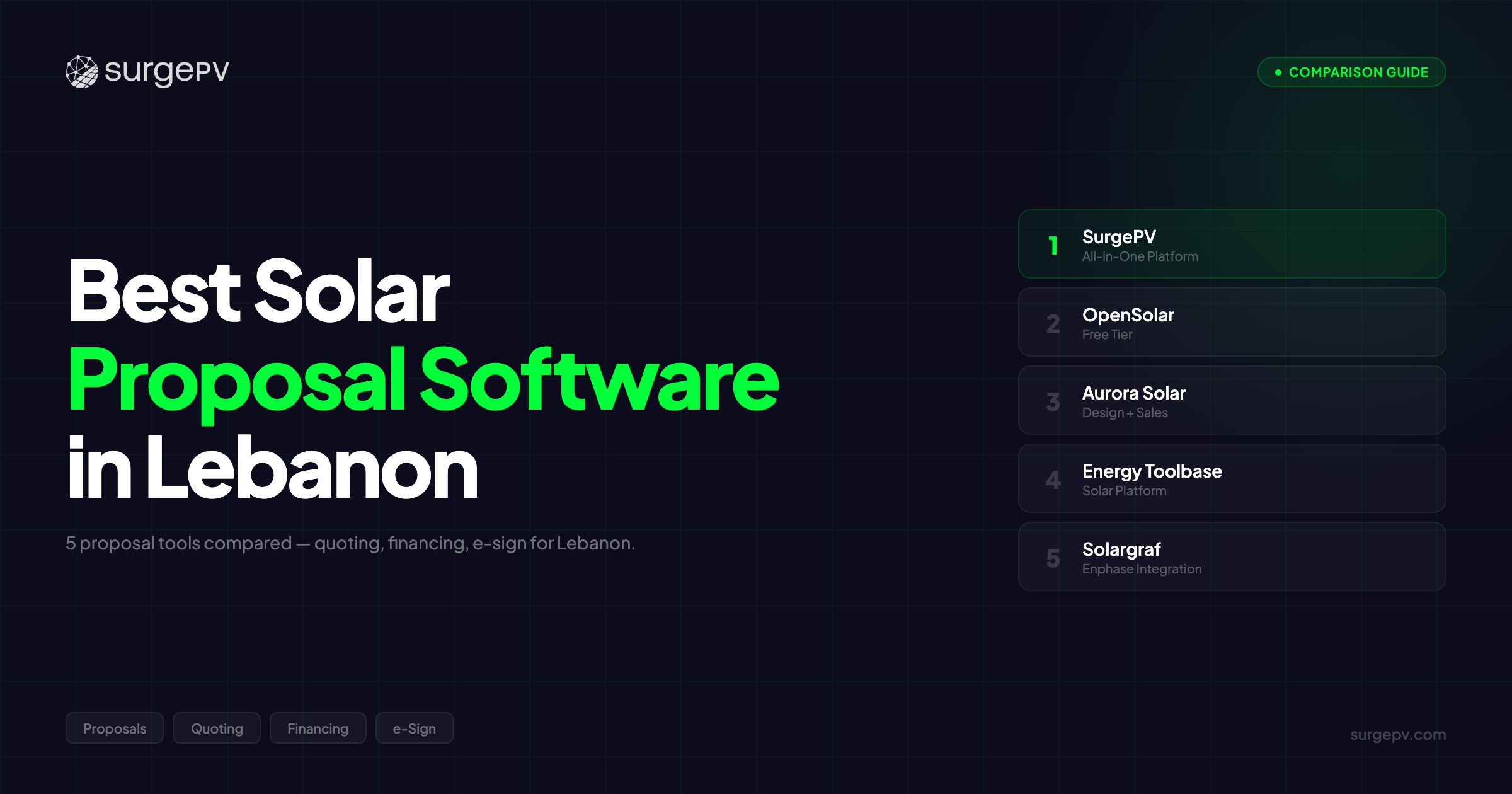
TL;DR: Lebanese families spend $300-800/month on diesel generators. The solar proposal software that wins deals in Lebanon is the one that answers “when do I stop paying for diesel?” in USD. SurgePV is the top pick — design-integrated proposals with generator displacement ROI, battery economics, and USD financial modeling. OpenSolar is the free starting point for budget-conscious new installers. Aurora Solar delivers beautiful proposals but runs US grid economics that don’t apply in Lebanon. Energy Toolbase handles battery financial modeling but is US-centric. Solargraf is built for North American residential markets with no Lebanon relevance.
Lebanese Families Spend $500/Month on Diesel. Your Proposal Needs to Show Them the Way Out.
In most markets, a solar proposal shows grid electricity savings. In Lebanon, a solar proposal shows survival economics. A typical Lebanese household spends $300-800/month on diesel generator subscriptions — that’s $3,600-9,600/year just to keep the lights on. A commercial business? $2,000-10,000/month or more.
With EDL providing just 2-4 hours of power daily and the Lebanese pound worth less than 1/60th of its pre-crisis value, every dollar spent on diesel is a dollar that could go toward a solar system that pays for itself.
Here’s the problem: most solar software proposal tools were built for markets where the grid works. They model net metering credits, utility rate escalation, and tax incentives — none of which apply in Lebanon. What Lebanese clients need is a proposal showing diesel generator displacement: “You currently spend $500/month on generator fuel. This $15,000 solar-battery system eliminates that cost. Payback: 30 months. After that, your electricity is free.” That’s the pitch that closes deals. And most proposal software can’t generate it.
In this guide, you’ll find:
- Which platforms model generator displacement ROI for Lebanese clients
- How proposal software handles battery storage economics in Lebanon
- USD financial modeling capabilities across all tools
- Proposal speed comparison for high-volume Lebanese installers
- Detailed reviews of SurgePV, OpenSolar, Aurora Solar, Energy Toolbase, and Solargraf
Quick Summary: Our Top Picks for Lebanon
After testing 5 proposal platforms against Lebanon’s generator displacement economics, battery requirements, and crisis-market conditions, here are our recommendations:
- SurgePV — Design-integrated proposals with generator displacement ROI, battery economics, and USD financial analysis (Best for Lebanese EPCs needing design + proposal in one platform)
- OpenSolar — Free basic proposals (Best for budget-conscious startups, missing generator displacement and battery economics)
- Aurora Solar — Beautiful client-facing proposals (Best for visual impact, built for US grid economics not Lebanese generator displacement)
- Energy Toolbase — Advanced storage financial modeling (Best for solar+storage economics, US-centric with no Lebanese features)
- Solargraf — Residential proposal tool (Best for North American residential, no relevance for Lebanon)
Each tool is evaluated on Lebanon-specific criteria: generator displacement modeling, battery storage economics, USD financial support, proposal quality, and speed for high-volume markets.
Best Solar Proposal Software in Lebanon (Detailed Reviews)
| Software | Best For | Pricing | Lebanon Fit |
|---|---|---|---|
| SurgePV | All-in-one proposals + design | ~$1,899/yr (3 users) | Excellent |
| OpenSolar | Free proposals | Free tier available | Good |
| Aurora Solar | AI-powered proposals | ~$3,600-6,000/yr | Good |
| Energy Toolbase | Storage proposals | Contact for pricing | Good |
| Solargraf | Residential proposals | Contact for pricing | Good |
SurgePV — Best Design-Integrated Proposal Platform for Lebanon
Best For: Residential installers processing high volumes (15-40 systems/month), C&I EPCs serving hospitals, supermarkets, and factories, donor project implementers
Pricing: $1,899/year (3 users); $1,299/user/year (For 5 Users plan)
SurgePV is the only platform where your proposal data comes directly from an actual engineering design — not from a separate spreadsheet. You design the system, run the simulation, and generate a professional proposal in a single workflow.
For Lebanese EPCs selling solar to families and businesses desperate to eliminate diesel generator costs, that integration eliminates the most dangerous source of proposal errors: manual data transfer. When your production estimate, BOM, battery sizing, and financial model all pull from the same design, there’s no risk of overstating savings or underestimating costs in a market where credibility determines whether clients invest their scarce dollars.
Generator Displacement Financial Modeling
This is the feature that matters most in Lebanon. Every proposal must answer one question: “When do I eliminate my generator costs?”
SurgePV’s financial modeling tools handle this directly. You input the client’s current diesel cost (monthly generator subscription or self-owned generator fuel cost in USD), model the solar-battery system’s production against the client’s load profile, and show month-by-month fuel cost elimination, payback period, lifetime savings, and monthly cash flow improvement.
A residential client spending $600/month on generator diesel sees a proposal showing: $18,000 system cost, $600/month diesel elimination, 30-month payback, $180,000+ in lifetime fuel savings over 25 years. That’s not a solar proposal — it’s a financial rescue plan. And it closes itself.
For commercial clients, the numbers are larger. A factory spending $8,000/month on diesel generators receives a proposal showing: $120,000 system with battery storage, $8,000/month diesel displacement, 15-month payback, $2.4 million in lifetime savings. These are the proposals that get approved at the CEO level.
Battery Storage Economics
Lebanese solar proposals must include battery storage economics — it’s not optional. A solar system without batteries only generates value during daylight hours. With EDL providing 2-4 hours of power daily, nighttime loads require either battery backup or continued generator dependency.
SurgePV integrates battery costs, charge/discharge cycles, and storage economics into the proposal. Your client sees total system cost (panels + battery + installation), production analysis (solar generation vs consumption vs storage), and the economics of eliminating both daytime and nighttime generator dependency.
USD Financial Analysis
Lebanon’s solar market operates in USD. The LBP has collapsed from 1,500 to over 100,000 per dollar. All equipment pricing, installation costs, and client payments are USD-denominated.
SurgePV supports USD currency for all financial projections. No awkward currency conversion. No LBP assumptions that become meaningless within months. Your proposal shows USD costs, USD savings, and USD payback — the language of Lebanon’s real economy.
Proposal Output and Speed
SurgePV generates web-based proposals that are interactive and mobile-friendly. Your client in Beirut opens the link on their phone, reviews generator displacement savings, explores battery sizing options, and shares with family members or business partners — all without downloading PDFs or scheduling another meeting.
Proposal generation takes 15-20 minutes from design completion. Compare that to 2-4 hours building a diesel displacement model in Excel with manual production number transfers. At 25 proposals per month — realistic for an active Lebanese installer — that’s 37-75 hours saved monthly.
Real-World Example
A Tripoli-based residential installer previously built proposals by hand, estimating production from experience and calculating diesel savings in Excel. Each proposal took 3 hours. A calculation error in one proposal overstated battery capacity, leading to a system that still required generator backup 4 hours nightly — destroying the client’s trust and requiring costly battery additions. After switching to SurgePV, proposals take 20 minutes, pull directly from verified design data, and battery sizing reflects actual load analysis.
Real-World Example
A mid-sized installer in Lebanon was losing C&I bids because proposals took 2-3 days to produce. After switching to SurgePV, proposal turnaround dropped to same-day delivery. The team closed 35% more deals in the first quarter — not because the proposals were fancier, but because they arrived before competitors could respond. Speed wins contracts.
Pros:
- Design-Integrated Proposals: Production numbers, BOMs, and financial models pull directly from your actual design. Zero manual data transfer errors.
- Generator Displacement Modeling: Diesel elimination ROI, payback period, and lifetime savings in USD — the financial model Lebanese clients need.
- Battery Economics: Integrated storage cost modeling showing complete system economics (solar + battery + installation).
- Speed: 15-20 minutes per proposal vs 2-4 hours in Excel. At scale, the difference between 25 proposals/month and 8.
- Complete Workflow: Design + electrical engineering + simulation + proposals in one platform.
- Transparent Pricing: Starting at $1,299/user/year, all features included.
Cons:
- Lebanese Generator Database: No pre-loaded Lebanese generator fuel costs or EDL schedules. Requires manual input of current diesel prices and EDL availability. Straightforward setup.
- Newer in Lebanese Market: Less brand recognition than established tools. Feature set is strong; market adoption is growing.
Pricing
| Plan | Price | Users |
|---|---|---|
| Individual | $1,899/year | 3 users |
| For 3 Users | $1,499/user/year | 3 users |
| For 5 Users | $1,299/user/year | 5 users |
| Enterprise | Custom | Multiple |
SurgePV includes design, electrical, simulation, AND proposals. Aurora requires a separate design subscription ($259/user/month = $3,108/year) and still doesn’t include SLD generation or generator displacement modeling. PVsyst ($1,320 one-time) is simulation-only with no proposal capabilities.
Who SurgePV Is Best For
- Residential Installers: High-volume teams producing 15-40 proposals per month for generator replacement projects across Beirut, Tripoli, and Sidon
- C&I EPCs: Companies proposing solar-battery systems for hospitals, supermarkets, factories, and commercial centers
- Donor Project Implementers: Organizations needing professional documentation for UNDP/World Bank-funded installations
- Scaling Sales Teams: Installers growing rapidly to meet Lebanon’s crisis-driven solar demand
Not ideal for: Large donor-funded projects requiring PVsyst-validated financial models for international development bank disbursement.
Further Reading
For a broader proposal comparison, see our guide to the best solar proposal software globally. For design tools, see best solar design software. For a full Aurora Solar feature analysis, read our Aurora Solar review.
OpenSolar — Free Proposals, Limited Lebanese Features
Best For: New installers with minimal capital testing the market with simple rooftop systems
Pricing: Free basic plan; paid plans from ~$199/month
OpenSolar offers free basic solar design and proposal tools, making it the lowest-cost entry point for new installers. The platform handles residential design with decent proposal output and transparent pricing.
For Lebanon, OpenSolar has meaningful limitations. No generator displacement financial modeling — the core value proposition in Lebanon’s market. No battery storage economic modeling. No USD-first financial projections. The platform is designed for markets where the grid works and net metering drives savings. In Lebanon, neither of those assumptions applies.
Key strengths:
- Free basic plan (lowest barrier to entry for new Lebanese installers)
- Simple residential design workflow
- Transparent pricing model
- Basic proposal output
Lebanon limitation: No generator displacement economics. No battery storage financial modeling. Grid-centric financial assumptions that don’t match Lebanon’s reality. For professional proposals that close deals in a crisis market, free doesn’t mean effective.
Best use case in Lebanon: New installers with minimal capital who need basic quoting tools while building their business. Should upgrade to SurgePV as volume grows beyond 5-10 projects per month.
Read our full OpenSolar review.
Aurora Solar — Polished Proposals, Wrong Financial Model for Lebanon
Best For: Installers wanting visual proposal impact who have separate teams for electrical engineering and financial modeling
Pricing: $159-259/user/month (~$1,908-3,108/year per user)
Aurora Solar is the industry’s most recognized residential solar platform. The AI roof detection is genuinely best-in-class. Proposals are polished and professional. CRM integrations streamline sales workflows.
The fundamental mismatch for Lebanon: Aurora was built for the American market. US tax credits, net metering, utility rate escalation, loan products with American bank terms — none of these apply in Lebanon. Aurora doesn’t model generator displacement. It doesn’t calculate diesel cost elimination. Its financial engine assumes a functioning grid. You’d need to supplement Aurora with Excel for every financial analysis, defeating the purpose of an integrated platform.
No SLD generation either, so AutoCAD ($2,000/year) is required for electrical documentation. P50-only simulation (no P75/P90 for donor-funded project requirements).
Key strengths:
- Best AI roof detection (works for Lebanese flat-roof buildings)
- Beautiful proposals (strong visual impact for competitive bids)
- Strong CRM integrations (Salesforce, HubSpot)
Lebanon limitations: US-centric financial model. No generator displacement. No SLD generation. P50-only. No battery storage economic integration. For Lebanon’s market, Aurora requires significant supplementation.
Total cost with AutoCAD: $3,908-5,108/year per user.
Read our full Aurora Solar review.
Did You Know?
Lebanon’s solar irradiance ranges from 1,700-2,000 kWh/m²/year, making accurate simulation software essential for bankable energy yield predictions. Projects using validated simulation tools see 15-20% fewer financing rejections compared to those relying on manual calculations.
Energy Toolbase — Battery Financial Modeling, US-Centric
Best For: Teams specifically modeling storage economics where US market assumptions apply
Pricing: Contact for pricing
Energy Toolbase specializes in battery storage financial modeling and is widely used in the US market for commercial solar-plus-storage proposals. The financial modeling depth for storage economics is strong.
For Lebanon, Energy Toolbase’s core limitation is geographic focus. The platform models US utility rates, US time-of-use tariffs, and US battery incentive programs. Lebanon has no functioning utility rate schedule — EDL provides 2-4 hours daily. The financial modeling framework that makes Energy Toolbase valuable in the US simply doesn’t translate to generator displacement economics.
Key strengths:
- Advanced battery storage financial modeling
- Strong for commercial solar+storage proposals
- Scenario analysis across storage configurations
Lebanon limitation: US-centric financial model. No generator displacement ROI. No USD-indexed Lebanese market assumptions. Battery financial modeling is excellent in context, but the context is wrong for Lebanon.
Best use case in Lebanon: Very limited. Only relevant if modeling a Lebanese system against US project comparison scenarios. Not a standalone Lebanese proposal tool.
Read our full Energy Toolbase review.
Solargraf — Residential Proposals, No Lebanon Relevance
Best For: North American residential installers; not relevant for Lebanon
Pricing: Contact for pricing
Solargraf is a residential solar proposal platform built primarily for North American markets. It provides proposal templates, basic financial modeling, and customer-facing documents.
For Lebanon, Solargraf has no relevant features. No generator displacement modeling. No battery economics for off-grid markets. No USD-first financial projections. No support for Lebanon’s hybrid solar-battery-generator configurations. The platform assumes a functioning grid and net metering — the opposite of Lebanon’s market reality.
Best use case in Lebanon: None. Solargraf is not designed for Lebanon’s market conditions.
Read our full Solargraf review.
Best Solar Proposal Software Comparison Table for Lebanon
Key Takeaway
SurgePV is the only platform providing generator displacement ROI modeling in USD, design-integrated proposal data, and battery economics — the three elements that make proposals close deals in Lebanon. Every other tool requires significant manual supplementation for Lebanon’s crisis-driven market.
| Feature | SurgePV | OpenSolar | Aurora Solar | Energy Toolbase | Solargraf |
|---|---|---|---|---|---|
| Generator displacement ROI | Yes (USD) | No | No | No | No |
| Battery economics | Yes | No | Limited | Yes (US-focused) | No |
| USD financial modeling | Yes | No | No | No | No |
| Design-integrated proposals | Yes | Partial | Partial | No | No |
| Web-based interactive proposals | Yes | Yes | Yes | No | Yes |
| P50/P90 production estimates | Yes | No | P50 only | No | No |
| SLD generation | Yes (automated) | No | No | No | No |
| Proposal generation time | 15-20 min | 30-45 min | 20-30 min | 45-60 min | 30-45 min |
| Starting price | $1,899/yr (3 users) | Free | $1,908/user/yr | Contact | Contact |
What Makes the Best Solar Proposal Software in Lebanon
Generator Displacement Modeling (Non-Negotiable)
Lebanon’s solar value proposition is diesel cost elimination, not grid savings. Software that models net metering and utility rate escalation misses the point entirely. The right tool shows: “You spend $500/month on diesel. This system costs $15,000. Payback: 30 months. Lifetime savings: $150,000+.”
Software must model diesel cost elimination in USD, generator subscription replacement timelines, and fuel cost savings versus solar-battery system costs. Without this capability, your proposals don’t speak your client’s language.
Battery Storage Economics
Battery storage is standard in Lebanon, not optional. Solar without batteries only works during daylight. With EDL providing 2-4 hours daily, nighttime loads require battery backup or continued generator use. Proposal software must handle solar-battery system economics as a unified workflow — total system cost, battery payback, and nighttime coverage analysis.
USD Currency Throughout
All Lebanese solar transactions happen in USD. Equipment costs, installation fees, financing terms, and generator fuel prices are all dollar-denominated. A proposal showing LBP values is unusable — the currency loses value faster than proposals can be approved. USD-first financial modeling is the baseline requirement.
Design-to-Proposal Integration
The biggest source of proposal errors in Lebanon is manual data transfer between design tools and proposal templates. When production numbers are typed from HelioScope into an Excel template, errors happen. When BOM quantities are manually transferred, items get missed. Design-integrated proposals (like SurgePV’s) eliminate this risk entirely — the proposal pulls from the actual design.
Speed for High-Volume Processing
Pro Tip
When evaluating proposal software for Lebanon, ask one question: “Can this tool show my client exactly when they stop paying for diesel?” If the answer is no, the tool wasn’t built for your market.
Lebanese solar demand is massive. EPCs that produce proposals same-day win contracts. Those that take 3-5 days lose to faster competitors. At 25 proposals per month, a 3-hour proposal workflow consumes 75 engineer-hours. SurgePV’s 20-minute workflow leaves 66 hours for other work.
| Your Situation | Recommended Software | Why |
|---|---|---|
| Full-service EPC needing design + proposals | SurgePV | Only platform with generator displacement ROI + design integration + battery economics |
| New installer with minimal budget | OpenSolar (start) → SurgePV (scale) | Free entry point, upgrade as volume grows |
| Residential-only with external engineering team | Aurora Solar | Best proposal visuals, but plan for Excel financials |
| Donor-funded projects (UNDP/World Bank) | SurgePV + PVsyst | SurgePV for proposals, PVsyst for bankability validation |
| Battery storage specialist | SurgePV | Generator displacement + battery economics in one tool |
How We Tested and Ranked These Tools
We evaluated each platform against Lebanon-specific criteria:
-
Generator Displacement Modeling (35%) — Tested diesel displacement ROI modeling in USD. Verified that proposals show monthly fuel savings, generator elimination timelines, and system payback. This is the defining capability for Lebanon’s market.
-
Battery Storage Economics (25%) — Tested storage cost integration, charge/discharge modeling, and battery economics in proposal outputs.
-
USD Financial Modeling (15%) — Verified currency support and Lebanese market assumptions.
-
Proposal Speed and Quality (15%) — Measured time from design completion to finished client proposal. Evaluated proposal visual quality and interactivity.
-
Design Integration (10%) — Assessed whether proposals pull from actual design data or require manual data transfer.
All testing conducted January-February 2026. Sources: official vendor documentation, G2 and Capterra user reviews, UNDP Lebanon solar program documentation, and interviews with Lebanese installers processing 15-40 projects per month.
Bottom Line: Best Solar Proposal Software for Lebanon
The proposal that closes deals in Lebanon answers one question: “When do I stop paying for diesel?” In USD. With credible production numbers. Delivered same-day.
For Lebanese EPCs and installers: SurgePV is the clear choice. Generator displacement ROI in USD, design-integrated data (zero manual transfer errors), battery economics, and interactive web-based proposals in 15-20 minutes. At $1,299/user/year, it replaces manual Excel workflows that cost 2-4 hours per proposal — paying for itself within the first month of active use.
For new installers starting out: OpenSolar provides free basic proposals to get started. The generator displacement and battery economics are missing, but it’s a viable starting point before upgrading to SurgePV as volume grows.
For residential-focused teams with external engineering: Aurora Solar delivers the best visual proposals in the market. But plan on supplementing every proposal with Excel for generator displacement financials — Aurora’s financial engine is built for the US market, not Lebanon’s.
Lebanon’s families and businesses are waiting. The EPC that arrives with a professional, USD-denominated proposal showing diesel elimination in 30 months wins the deal. The EPC that takes 3 days to produce a hand-built Excel sheet loses it. Your solar proposal software determines which EPC you are.
Close More Solar Deals in Lebanon
Generator displacement ROI, battery economics, and professional proposals in 20 minutes — built for Lebanon’s crisis-driven market.
Book a DemoNo commitment required · 20 minutes · Live project walkthrough
Frequently Asked Questions
What is the best solar proposal software in Lebanon?
SurgePV is the best solar proposal software for Lebanon. It’s the only platform that models generator displacement ROI in USD — showing clients exactly when they stop paying for diesel, which is the value proposition that drives Lebanon’s solar market. Proposals pull directly from actual engineering designs, eliminating manual data transfer errors. Proposal generation takes 15-20 minutes versus 2-4 hours with manual Excel workflows. Pricing starts at $1,299/user/year for all features including design, electrical engineering, simulation, and proposals.
How do solar proposals work in Lebanon’s crisis market?
Lebanese solar proposals focus on generator displacement, not grid savings. EDL provides 2-4 hours of power daily, so the grid savings model used in most countries doesn’t apply. Instead, effective proposals show: current monthly diesel cost ($300-800/month residential, $2,000-10,000/month commercial), total system cost in USD, monthly fuel savings after installation, payback period (typically 18-36 months), and lifetime savings over 25 years. The proposal must be denominated in USD — LBP values are unreliable given the currency’s collapse from 1,500 to over 100,000 per dollar.
Can solar proposal software handle battery storage economics for Lebanon?
SurgePV integrates battery storage economics into the complete proposal workflow. Your client sees total system cost (solar + battery + installation), production analysis (solar generation vs consumption vs storage), and economics showing elimination of both daytime and nighttime generator dependency. Most other proposal platforms (Aurora, OpenSolar, Solargraf) have limited or no battery economics integration relevant to Lebanon’s off-grid reality.
How long does it take to create a solar proposal for Lebanon?
With SurgePV, from design completion to finished client proposal takes 15-20 minutes. Manual workflows building diesel displacement models in Excel take 2-4 hours for the same output. At 25 proposals per month, SurgePV saves 37-75 hours of engineering time monthly. That recovered time means your team can handle 2-3x more projects per month without additional headcount.
Do Lebanese solar proposals need to be in USD?
Yes. Lebanon’s solar market operates entirely in USD. Equipment costs, installation fees, generator fuel prices, and client savings are all dollar-denominated. The LBP has collapsed from 1,500 to over 100,000 per dollar, making LBP financial projections meaningless over any medium-term horizon. Proposal software that requires LBP input or doesn’t support USD-first financial modeling creates extra work and credibility issues with Lebanese clients.
Sources: EDL - Electricite du Liban · LCEC - Lebanese Center for Energy Conservation · UNDP Lebanon · World Bank Lebanon · Banque du Liban. All pricing verified February 2026.