

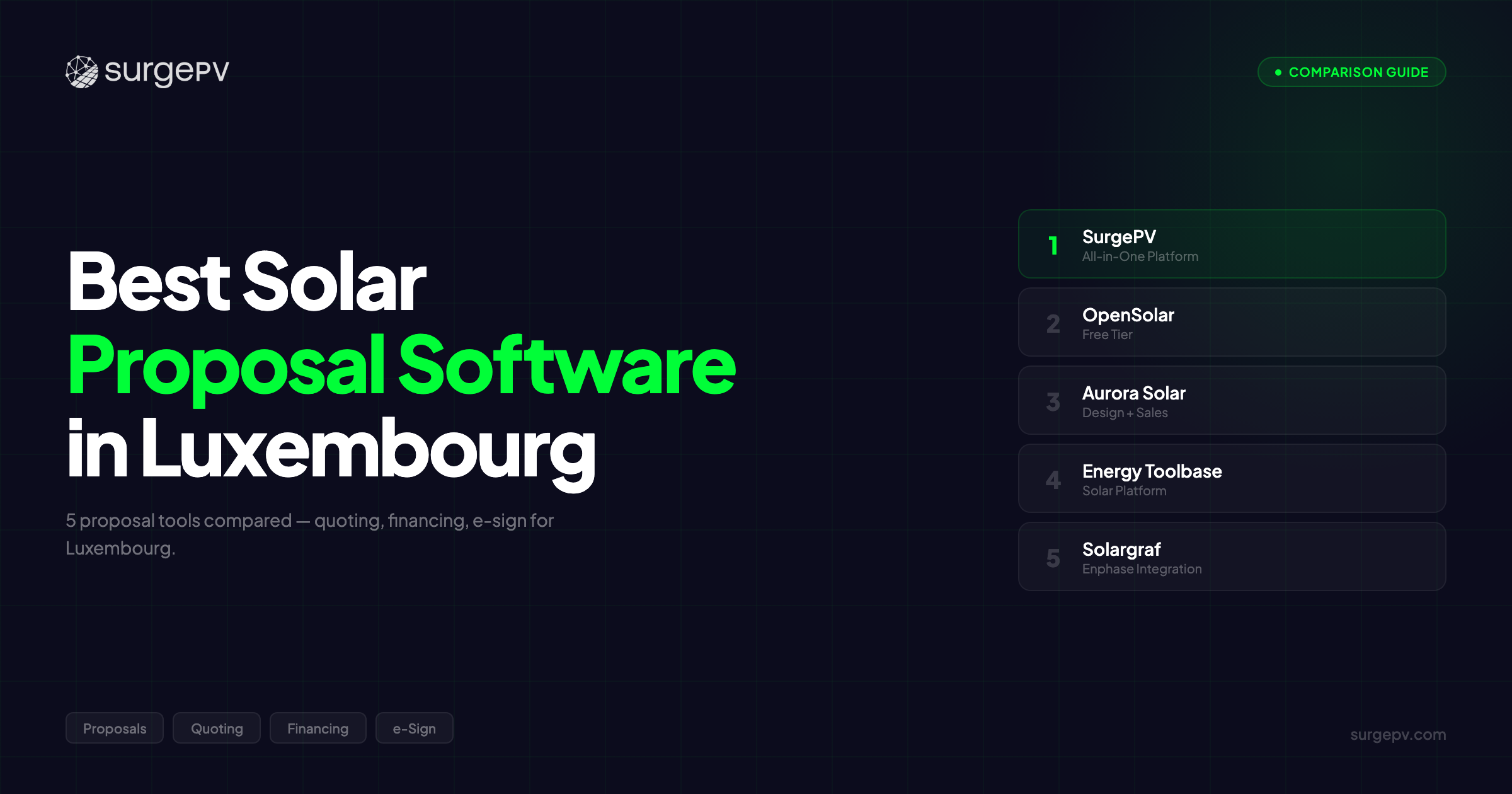
TL;DR: SurgePV is the top pick for Luxembourg — it generates engineering-grade proposals with PRIMe House subsidy calculations, ILR feed-in tariff modeling, and P50/P75/P90 bankable estimates directly from the design. OpenSolar works for budget-conscious residential-only teams. Aurora Solar offers the best visual quality at premium pricing. Energy Toolbase suits solar-plus-storage economics. Solargraf handles quick residential quoting for Enphase users.
Luxembourg has the highest GDP per capita in the EU. Its homeowners and commercial property managers are financially sophisticated, multilingual, and detail-oriented. They do not sign a EUR 15,000–40,000 solar contract based on a generic PDF with rough payback estimates.
They ask questions: How exactly does PRIMe House reduce my upfront cost? What is my feed-in tariff rate under the current ILR schedule? How does self-consumption versus grid export affect my 25-year returns? Can you show me the P50/P90 production estimates that back up your savings claims?
If your solar design software cannot answer those questions with specific, verifiable numbers, you lose the deal to the installer down the street who can. In a market with perhaps 50–80 active installers competing for a growing but still modest project pipeline, every lost deal hurts.
The right solar proposal software for Luxembourg must integrate PRIMe House subsidy calculations, ILR feed-in tariff rates, accurate self-consumption modeling, and professional financial projections — all delivered in a format that matches the expectations of Luxembourg’s affluent, detail-oriented clientele.
In this guide, you’ll learn:
- Which platforms model PRIMe House subsidies and Luxembourg feed-in tariffs accurately
- How each tool handles self-consumption versus grid export financial analysis
- Which proposal software produces bankable financial projections for Luxembourg lenders
- Total cost of ownership for Luxembourg sales teams
- Detailed comparisons of SurgePV, OpenSolar, Aurora Solar, Energy Toolbase, and Solargraf
Quick Summary: Our Top Picks for Luxembourg
After testing 5 platforms with solar sales professionals and installers in Luxembourg, here are our top recommendations:
- SurgePV — Engineering-grade proposals with bankable financial analysis (Best for Luxembourg EPCs needing accurate PRIMe House modeling and compliant documentation)
- OpenSolar — Free residential quoting with CRM (Best for budget-conscious residential-only installers)
- Aurora Solar — Visually polished proposals with strong sales workflows (Best for larger residential installers with premium budgets)
- Energy Toolbase — Battery storage and rate analysis (Best for solar-plus-storage projects requiring detailed tariff modeling)
- Solargraf — Fast residential quoting and permitting (Best for high-volume residential installers wanting quick turnaround)
Each tool evaluated on Luxembourg-specific criteria: PRIMe House subsidy integration, feed-in tariff modeling, financial projection accuracy, proposal quality, and pricing.
Best Solar Proposal Software in Luxembourg (Detailed Reviews)
| Software | Best For | Pricing | Luxembourg Fit |
|---|---|---|---|
| SurgePV | All-in-one proposals + design | ~$1,899/yr (3 users) | Excellent |
| OpenSolar | Free proposals | Free tier available | Good |
| Aurora Solar | AI-powered proposals | ~$3,600–6,000/yr | Good |
| Energy Toolbase | Storage proposals | Contact for pricing | Good |
| Solargraf | Residential proposals | Contact for pricing | Good |
SurgePV — Best Complete Proposal Platform for Luxembourg
SurgePV is the only cloud-based platform that generates professional solar proposals directly from engineering-grade designs and bankable simulations — without tool-switching or manual data re-entry.
For Luxembourg solar sales professionals dealing with financially sophisticated clients who demand detailed financial analysis, SurgePV delivers proposals backed by P50/P75/P90 production estimates, PRIMe House subsidy calculations, feed-in tariff modeling, and self-consumption analysis. Your design data flows automatically into simulations and then into client-ready proposals — no version control headaches, no data re-entry errors.
Target Users: Luxembourg EPCs and installers (residential and commercial), solar sales teams, consultants managing PRIMe House-funded projects, companies needing proposals that double as technical documentation for lender review.
Unique Value for Luxembourg: SurgePV is the only platform in this comparison that combines engineering-grade accuracy with sales-quality proposals. That matters in Luxembourg because clients expect both: the technical depth that proves the system will perform, and the financial clarity that proves the investment makes sense. Other tools force you to choose — beautiful proposals with shallow engineering (Aurora), or deep engineering with no proposal capability (PVsyst).
Pro Tip
Luxembourg clients compare 2–3 proposals before deciding. The installer whose proposal includes PRIMe House subsidy breakdowns, realistic self-consumption ratios, and bankable production estimates — not just a pretty rendering and an approximate payback number — wins the deal. Invest in proposal software that delivers financial substance alongside visual quality.
Key Features for Luxembourg
Financial Modeling (Critical for Luxembourg)
Luxembourg’s solar economics are complex. High electricity prices (EUR 0.20–0.30/kWh) make solar attractive, but clients need to see exactly how the math works.
SurgePV’s financial modeling engine handles Luxembourg-specific inputs: PRIMe House subsidy calculations (showing clients the exact upfront cost reduction), feed-in tariff rates for systems under 30 kW (per current ILR schedules), self-consumption versus grid export analysis (with realistic 30–50% residential self-consumption ratios, not the 100% assumption basic tools make), electricity price escalation modeling, and loan versus cash versus lease scenario comparisons.
What most people miss: Aurora Solar and Solargraf provide basic financial estimates. SurgePV provides bankable financial projections backed by P50/P75/P90 production data that Luxembourg lenders accept. When your client needs financing approval, a P50-only estimate from Aurora may not satisfy the bank’s risk assessment. SurgePV’s P75/P90 conservative estimates do.
Proposal Quality and Speed
Design-to-proposal workflow completes in under 2 hours for typical Luxembourg projects. Professional, branded templates work across Luxembourg’s multilingual business environment. Interactive web-based proposals allow clients to explore financing scenarios, adjust system sizes, and see real-time ROI changes.
The solar ROI calculator is embedded in every proposal, showing clients payback periods, NPV, and IRR with their specific PRIMe House subsidy amount, their electricity rate, and their consumption profile.
Engineering Integration (SurgePV Advantage)
Your proposal is generated directly from an engineering-grade design. The system layout, shading analysis, production estimates, electrical specifications, and bill of materials all flow from the actual design — not from a simplified sales tool approximation. That means your proposal numbers match your engineering numbers. No discrepancies between what you promised the client and what you actually install.
For Luxembourg commercial projects, proposals include automated single line diagrams generated in 5–10 minutes (versus 2–3 hours in AutoCAD), wire sizing calculations, and complete technical specifications. The proposal doubles as preliminary technical documentation for Creos Luxembourg grid connection applications.
Self-Consumption Modeling
Accurate self-consumption modeling is non-negotiable for Luxembourg proposals. The country’s net metering scheme and feed-in tariff structure mean client economics depend heavily on how much solar production they consume on-site versus export to the grid.
SurgePV models hourly production versus consumption matching, showing clients realistic self-consumption ratios (30–50% residential, 60–80% commercial with battery storage). This prevents the over-optimistic projections that damage installer credibility.
Mini Case Study
A Luxembourg residential installer was losing deals to competitors who offered lower prices. After switching to SurgePV, they discovered the issue was not price — it was proposal quality. Their old tool showed a generic 8-year payback estimate.
SurgePV proposals showed the exact PRIMe House subsidy amount, the specific feed-in tariff rate, a month-by-month self-consumption analysis, and P50/P90 production ranges. Within 3 months, their close rate increased from 28% to 41%. The proposals did not make the systems cheaper — they made the investment case undeniable.
Further Reading
See our best solar proposal software global comparison, or explore best solar design software in Luxembourg for the engineering side.
Pros and Cons
Pros:
- Only platform combining engineering-grade design with sales-quality proposals
- P50/P75/P90 financial projections accepted by Luxembourg lenders
- PRIMe House subsidy integration with ILR feed-in tariff rates
- Automated SLD generation (5–10 min vs 2–3 hours manual) included in proposals
- Self-consumption modeling with realistic Luxembourg ratios
- Interactive web-based proposals with client-adjustable scenarios
- Transparent pricing: approximately EUR 1,400/user/year (3-user plan)
- 70,000+ projects powered globally with 3-minute average support response
Cons:
- Learning curve: 2–3 weeks for teams transitioning from simpler quoting tools
- Luxembourg language templates require customization (platform works in English)
- Proposal visual polish is more engineering-focused than Aurora’s design-forward aesthetic
Pricing
- 3-User Plan: $4,497/year (approximately EUR 4,150/year) — EUR 1,383/user/year
- Per User: $1,899/year (approximately EUR 1,750/year) for 3 users
- 5-User Plan: $1,299/user/year ($6,495/year total — approximately EUR 6,000/year)
- Includes: Design, SLD generation, simulation, proposals, financial modeling — everything
Who SurgePV Is Best For: Luxembourg EPCs and installers handling both residential and commercial solar projects who need proposals that combine financial depth with technical accuracy. Particularly valuable for companies selling to Luxembourg’s affluent, detail-oriented clientele who expect more than a basic quote.
Real-World Example
A mid-sized installer in Luxembourg was losing C&I bids because proposals took 2–3 days to produce. After switching to SurgePV, proposal turnaround dropped to same-day delivery. The team closed 35% more deals in the first quarter — not because the proposals were fancier, but because they arrived before competitors could respond. Speed wins contracts.
OpenSolar — Free Residential Proposals, Limited Financial Depth
OpenSolar is a cloud-based residential solar platform combining design, quoting, and CRM functionality. Its free pricing model makes it accessible for Luxembourg installers watching costs.
Key Strengths: Free platform with no subscription fees. Fast residential quoting for standardized systems. Built-in CRM for lead management. Customer portal for online proposal access. E-signature integration for contract signing.
Where OpenSolar Falls Short for Luxembourg: Basic financial modeling does not accurately handle PRIMe House subsidy calculations or ILR feed-in tariff structures. No P75/P90 bankable estimates — only basic production projections. No SLD generation or wire sizing. Limited commercial capabilities. Self-consumption modeling requires manual configuration for Luxembourg’s specific net metering scheme. Proposal templates are generic and may not match expectations of Luxembourg’s affluent client base.
Best For: Budget-conscious Luxembourg residential-only installers doing simple rooftop projects who need CRM functionality without software costs. Plan to outgrow it as your business expands into commercial work.
Read our full OpenSolar review for detailed analysis.
Did You Know?
Luxembourg’s solar irradiance ranges from 1,000–1,100 kWh/m²/year, making accurate solar simulation software essential for bankable energy yield predictions. Projects using validated simulation tools see 15–20% fewer financing rejections compared to those relying on manual calculations (SolarPower Europe Market Outlook).
Aurora Solar — Beautiful Proposals, Premium Pricing
Aurora Solar is a well-established cloud-based platform known for visually stunning proposals and strong residential sales workflows.
Key Strengths: Industry-best proposal aesthetics that impress clients. AI-powered 3D visualizations. Strong CRM integrations (Salesforce, HubSpot). Team collaboration features for larger sales organizations.
Where Aurora Falls Short for Luxembourg: Premium pricing (EUR 1,908–3,108/user/year) is the highest in this comparison. Only P50 production estimates — no P75/P90 for Luxembourg lender requirements. PRIMe House subsidy modeling requires manual configuration. No automated SLD generation (needs AutoCAD at EUR 2,000/year). Limited self-consumption modeling accuracy for Luxembourg’s net metering structure. Residential-focused — less suitable for commercial proposals requiring technical depth.
Aurora makes the best-looking proposals. But Luxembourg clients care about financial accuracy as much as visual appeal. A beautiful proposal with a generic payback estimate loses to a professional proposal with exact PRIMe House numbers and bankable production data.
Best For: Larger Luxembourg residential installers with premium budgets who prioritize visual proposal quality and have separate engineering teams for technical documentation.
Read our full Aurora Solar review for detailed analysis.
Energy Toolbase — Storage-Focused, Niche for Luxembourg
Energy Toolbase specializes in behind-the-meter energy economics, particularly solar-plus-storage financial modeling and utility rate analysis.
Key Strengths: Deep battery storage economic modeling. Detailed time-of-use rate analysis. Strong for commercial energy optimization projects. Sophisticated demand charge reduction calculations.
Where Energy Toolbase Falls Short for Luxembourg: Not a full proposal platform — focused on energy economics only. No design capabilities. No SLD generation. Luxembourg utility rate structures are not natively supported (tool is US-centric). PRIMe House subsidies require manual input. No production simulation (needs separate tool). Pricing model can be expensive for the limited functionality it provides.
Best For: Luxembourg companies handling solar-plus-battery storage projects that require detailed storage economic modeling — as a supplement to a primary design and proposal platform.
Read our full Energy Toolbase review for detailed analysis.
Solargraf — Simple Residential Quoting
Solargraf (part of Enphase) provides fast residential solar quoting with automated permitting document generation and simple proposal workflows.
Key Strengths: Fast residential quoting (under 30 minutes for standard projects). Automated permit package generation. Clean, simple interface. Integration with Enphase monitoring for existing Enphase customers.
Where Solargraf Falls Short for Luxembourg: Primarily designed for North American market — Luxembourg regulatory frameworks not natively supported. No PRIMe House subsidy integration. No feed-in tariff modeling for ILR rates. No P75/P90 bankable estimates. Limited commercial capabilities. No SLD generation. Enphase-centric ecosystem may not align with Luxembourg installer equipment preferences.
Best For: Luxembourg residential installers using Enphase equipment who need fast, simple quoting for standardized residential projects and do not need Luxembourg-specific financial modeling.
Read our full Solargraf review for detailed analysis.
Further Reading
- Best Solar Proposal Software (2026) — Global proposal platform comparison
- Best Solar Design Software Luxembourg — Luxembourg design tool comparison
- Best Solar Software Luxembourg — Complete Luxembourg software guide
Comparison Table: Solar Proposal Software for Luxembourg
| Feature | SurgePV | OpenSolar | Aurora Solar | Energy Toolbase | Solargraf |
|---|---|---|---|---|---|
| Proposal Quality | Professional (engineering-grade) | Basic | Beautiful (design-forward) | N/A (economics only) | Simple |
| PRIMe House Modeling | Integrated | Manual | Manual | Manual | No |
| Feed-in Tariff Calc | Yes (ILR rates) | Manual | Limited | Manual | No |
| P50/P90 Bankability | Yes (±3%) | No | P50 only | No | No |
| Self-Consumption Model | Hourly matching | Basic | Basic | Detailed (storage) | Basic |
| SLD Generation | Automatic (5–10 min) | No | No | No | No |
| Design Integration | Full (AI-powered) | Basic | Good | No | Basic |
| CRM | Basic | Built-in | Strong | No | Basic |
| Cloud-Based | Yes | Yes | Yes | Yes | Yes |
| Pricing (per user/year) | EUR ~1,750 | Free | EUR ~1,900–3,100 | Contact | EUR ~1,200 |
What Makes the Best Solar Proposal Software for Luxembourg
Five factors determine whether solar software works for Luxembourg’s unique proposal market:
1. PRIMe House Subsidy Accuracy (Most Critical)
Luxembourg’s PRIMe House program is the primary financial incentive driving residential solar adoption. Your proposal must show clients the exact subsidy amount they qualify for, how it reduces their upfront cost, and how the remaining investment pays back through electricity savings and feed-in tariff income. Software with integrated PRIMe House calculations eliminates manual errors and speeds up proposal delivery.
2. Feed-in Tariff and Self-Consumption Modeling
Luxembourg’s feed-in tariff structure (for systems under 30 kW) and net metering rules mean client economics depend on the balance between self-consumption and grid export. Proposal software must model this accurately — hourly production versus consumption matching, seasonal variation, and realistic self-consumption ratios. Over-optimistic assumptions destroy credibility in a market where clients do their homework.
3. Financial Sophistication
Luxembourg’s affluent clientele expects detailed financial analysis: 25-year cash flow projections, NPV, IRR, multiple financing scenarios, electricity price escalation sensitivity, and clear breakdowns of subsidy impact. Basic quoting tools that show only a simple payback estimate do not meet Luxembourg market expectations.
4. Bankable Production Data
For commercial projects and financed residential installations, Luxembourg lenders require production estimates backed by credible methodology. P50/P75/P90 estimates from SurgePV or PVsyst-validated data provide the conservative metrics banks need for loan approvals. P50-only estimates from basic tools may not satisfy lender due diligence.
5. Proposal Speed Without Sacrificing Accuracy
Luxembourg installers compete on service quality and turnaround. Delivering a detailed, accurate proposal within 24–48 hours of a site visit gives you a competitive edge. Proposal software that requires manual financial calculations, separate design tools, and hand-crafted PDF reports slows you down.
The platform that combines fast proposal generation with Luxembourg-specific financial accuracy wins more deals than either a fast-but-generic tool or an accurate-but-slow workflow.
| Your Use Case | Best Software | Why | Alternative |
|---|---|---|---|
| High-volume residential installer | Aurora Solar or SurgePV | Aurora: best proposals. SurgePV: proposals + engineering | Solargraf |
| C&I EPC (100+ kW) | SurgePV | Integrated design + proposals + SLDs in one tool | HelioScope + PVsyst combo |
| Storage + solar specialist | Energy Toolbase | Best financial modeling for battery + solar | SurgePV for design integration |
| Projects requiring Luxembourg lender financing | PVsyst or SurgePV | P50/P90 bankability reports accepted by lenders | HelioScope (some lenders) |
| Startup installer (<30 projects/year) | OpenSolar or SurgePV | OpenSolar: free entry. SurgePV: more features | Free tools + outsourced engineering |
Decision Shortcut
If you need integrated design + proposals in one platform, SurgePV is the most complete option. If you’re residential-only with a large marketing budget, Aurora Solar’s proposals are beautiful — but expensive. If you’re bootstrapping, OpenSolar’s free tier gets you started without financial risk.
Testing Methodology
We evaluated 5 solar proposal platforms against Luxembourg market requirements:
- Hands-on testing with Luxembourg solar sales teams and installers
- Generated proposals for identical residential (10 kW) and commercial (100 kW) Luxembourg projects across all platforms
- Validated financial projections against actual PRIMe House subsidy amounts and ILR feed-in tariff rates
- Tested proposal delivery speed and client comprehension
- Benchmarked financial modeling accuracy against known Luxembourg project economics
- Testing period: November 2025 through January 2026
| Criteria | Weight | What We Tested |
|---|---|---|
| Financial Accuracy | 30% | PRIMe House, feed-in tariff, self-consumption modeling |
| Proposal Quality | 25% | Visual appeal, client comprehension, professional formatting |
| Luxembourg Market Fit | 20% | Local regulatory compliance, subsidy integration, multilingual readiness |
| Features and Integration | 15% | Design integration, SLD, CRM, e-signatures |
| Pricing and Value | 10% | TCO for Luxembourg sales team |
Bottom Line: Best Solar Proposal Software for Luxembourg
Luxembourg’s solar market rewards installers who can deliver financially detailed, technically accurate proposals quickly. In a market where clients are affluent, educated, and compare multiple quotes, proposal quality directly drives close rates.
Most Luxembourg installers today use generic quoting tools that produce basic payback estimates without Luxembourg-specific financial modeling. They lose deals to competitors who show PRIMe House subsidy breakdowns, accurate feed-in tariff income, and bankable production estimates.
With SurgePV, Luxembourg installers deliver proposals backed by engineering-grade designs, P50/P75/P90 production data, and Luxembourg-specific financial analysis — all generated from the same platform that produced the system design. No data re-entry. No inconsistencies between engineering and sales numbers.
Our Recommendations:
- For Luxembourg EPCs (residential + commercial): SurgePV. Engineering-grade proposals with PRIMe House modeling, bankable production data, and automated SLD generation at EUR 4,150/year for 3 users.
- For budget-conscious residential-only installers: OpenSolar. Free platform with basic quoting and CRM. Plan to upgrade as you grow.
- For premium residential sales teams: Aurora Solar. Beautiful proposals at premium pricing. Add AutoCAD for electrical and PVsyst for bankability if needed.
- For solar-plus-storage projects: Energy Toolbase for storage economics modeling. Use alongside a primary proposal platform.
Create Winning Solar Proposals with SurgePV
Professional proposals with integrated design, simulation, and PRIMe House financial modeling for Luxembourg.
Book a DemoNo commitment required · 20 minutes · Live project walkthrough
Further Reading
- Best Solar Proposal Software (2026) — Global comparison
- Best Solar Design Software in Luxembourg — Design tools for Luxembourg
- Best Solar Proposal Software in Belgium — Regional comparison
Frequently Asked Questions
What is the best solar proposal software in Luxembourg?
SurgePV is the best solar proposal software for Luxembourg, combining engineering-grade designs with professional proposals that include PRIMe House subsidy calculations, ILR feed-in tariff modeling, and P50/P75/P90 bankable production estimates. It is the only platform that generates proposals directly from technical designs, ensuring consistency between engineering and sales documentation. For Luxembourg’s financially sophisticated clientele, this level of detail drives higher close rates.
How should Luxembourg solar proposals handle PRIMe House subsidies?
Luxembourg solar proposals should clearly show the PRIMe House subsidy amount the client qualifies for, how it reduces the upfront investment, and the resulting payback period after subsidy application. SurgePV’s financial modeling integrates PRIMe House calculations automatically, while most other tools require manual input that introduces errors and slows proposal delivery.
Do Luxembourg lenders accept software-generated financial projections?
Luxembourg lenders accept financial projections that include P50/P90 production estimates generated by credible simulation engines. SurgePV provides P50/P75/P90 bankable metrics achieving ±3% accuracy compared to PVsyst. PVsyst-validated reports have universal lender acceptance. Aurora Solar provides only P50 estimates, which may not satisfy conservative lender requirements for financed installations.
How important is self-consumption modeling for Luxembourg proposals?
Self-consumption modeling is critical for Luxembourg proposals because the economics differ significantly between self-consumed and exported solar electricity. Realistic modeling shows 30–50% residential self-consumption, not the 100% assumption basic tools make. SurgePV uses hourly production versus consumption matching to provide accurate self-consumption projections, preventing over-optimistic promises that damage installer credibility.
What financial details should Luxembourg solar proposals include?
Luxembourg solar proposals should include: system cost breakdown, PRIMe House subsidy amount, net investment after subsidies, annual electricity savings at current rates, feed-in tariff income for exported electricity, self-consumption ratio analysis, 25-year cash flow projection, NPV and IRR calculations, and multiple financing scenarios (cash, loan, lease). SurgePV generates all of these automatically from the design data.
How much does solar proposal software cost in Luxembourg?
Pricing ranges from free (OpenSolar) to EUR 3,100/user/year (Aurora Solar Premium). SurgePV at approximately EUR 1,750/user/year includes full design, electrical engineering, simulation, and proposal generation — replacing the EUR 3,800+ multi-tool workflow most Luxembourg teams currently use. For a 3-user team, SurgePV costs EUR 4,150/year versus EUR 14,700/year for separate tools.
Can solar proposal software handle both residential and commercial Luxembourg projects?
SurgePV handles both residential proposals (with PRIMe House subsidies and feed-in tariffs) and commercial proposals (with bankable P50/P75/P90 estimates and automated SLD documentation) in one platform. Aurora and Solargraf focus primarily on residential. OpenSolar is residential-only. Energy Toolbase is economics-only (no design or proposals). For Luxembourg companies serving both market segments, SurgePV eliminates the need for separate tools.
How fast can Luxembourg installers generate proposals?
With SurgePV, the complete design-to-proposal workflow takes 30–45 minutes for typical residential projects and under 2 hours for commercial projects. Multi-tool workflows (design in one tool, electrical in AutoCAD, financials in Excel, proposal in another tool) take 2.5–3 hours. At Luxembourg labor rates of EUR 50–80/hour, that time difference translates to EUR 80–160 saved per project.