

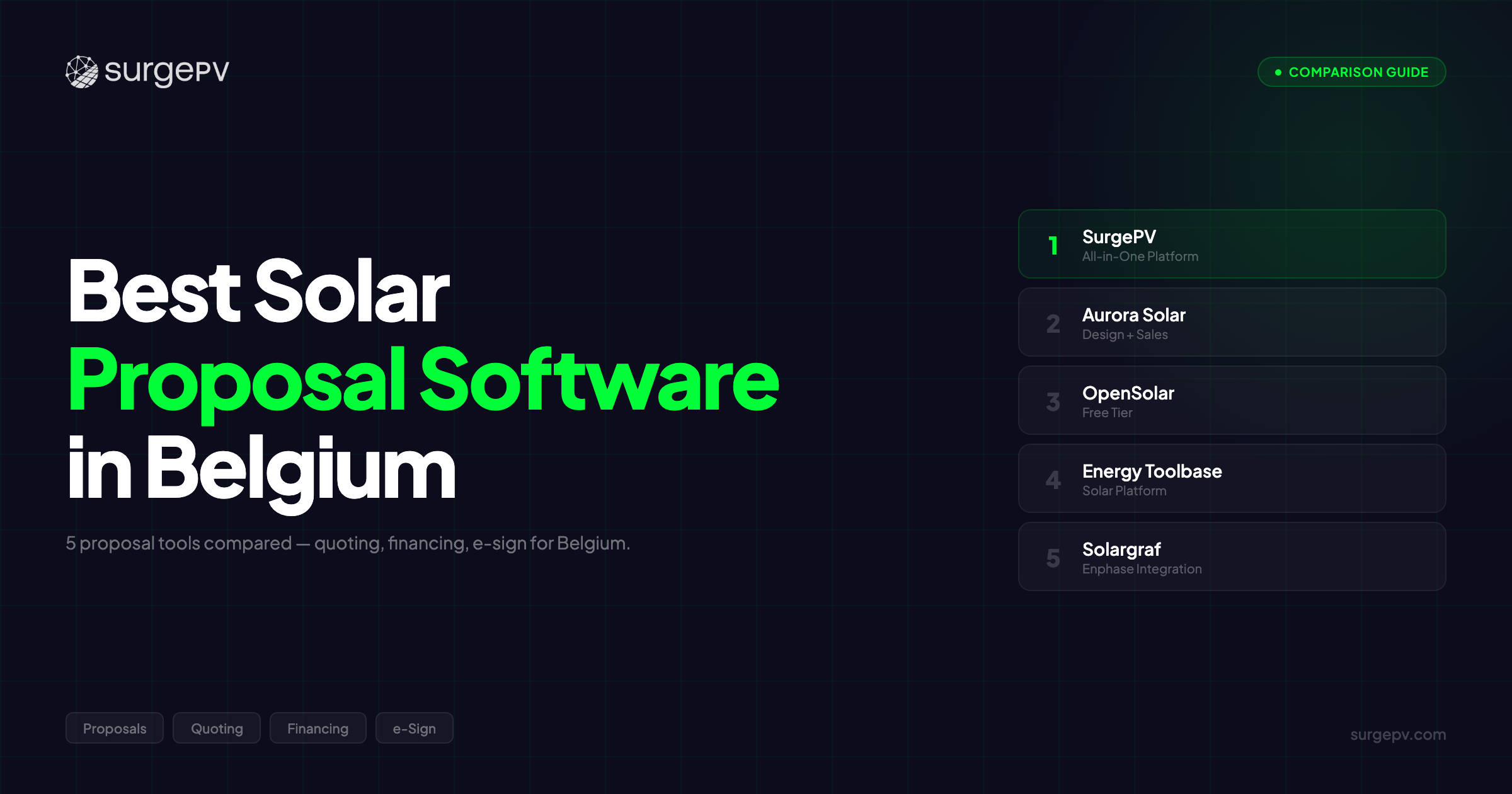
TL;DR: Belgium’s three regions each have different solar incentive structures: Flanders’ prosumer tariff, Wallonia’s green certificates, and Brussels’ net metering. SurgePV is the best integrated design-to-proposal platform for Belgian EPCs. Aurora Solar has the best-looking proposals for Flemish residential installers. OpenSolar is the most affordable option for small teams starting under EUR 900/year.
Belgian solar installers face a challenge that installers in most other countries do not.
Belgium operates as three distinct regions — Flanders, Wallonia, and Brussels — each with its own government, energy regulator, incentive structures, and official languages. A solar proposal that works perfectly for a customer in Antwerp may be completely wrong for a customer in Namur or Brussels.
This means your solar proposal software needs to adapt financial modeling, language, and incentive calculations to three separate regulatory frameworks within a single small country. Most global proposal tools were not built for this.
The Belgian solar market installed approximately 1.2 GW of new capacity in 2025, with Flanders accounting for roughly 60% of residential installations. Homeowners in Belgium are highly educated about solar economics and typically compare 3-5 quotes before making a decision. This makes the quality and accuracy of your proposal a direct competitive advantage.
For our global solar proposal software comparison, we evaluated 12 solar proposal platforms and narrowed the list to the 5 tools most relevant for Belgian installers. Each tool was tested with real Belgian project data across all three regions.
In this guide, you will learn:
- Which 5 proposal platforms handle Belgian regional incentives best
- How to model Flanders’ prosumer tariff, Wallonia’s green certificates, and Brussels’ net metering
- Which tools support Dutch and French language proposals
- How to generate region-specific proposals in under 30 minutes
- Our recommendation by company type: residential installer, commercial EPC, or budget-conscious small team
Why Belgian Proposals Are Different
Before comparing specific platforms, here is why Belgium demands specialized proposal software capabilities that generic tools miss.
| Factor | Flanders | Wallonia | Brussels |
|---|---|---|---|
| Key Incentive | Prosumer tariff (capacity-based) | Green certificates (production-based) | Net metering + Prime Energie |
| Primary Language | Dutch | French | French / Dutch |
| Proposal Focus | Self-consumption optimization | Certificate revenue projection | Net metering savings + grant amount |
Regional Financial Incentives
Understanding each region’s incentive structure is essential for creating accurate proposals. Here is what your proposal software needs to model for each Belgian region.
Flanders (Vlaanderen)
Since the end of the Flemish net metering scheme in 2021, Flanders operates under a prosumer tariff model. Solar system owners pay a capacity-based grid fee of approximately EUR 57.91 per kW of inverter capacity per year. This means a typical 5 kW residential system incurs roughly EUR 290/year in prosumer tariff charges.
The key to a winning Flemish proposal is demonstrating how self-consumption offsets the prosumer tariff cost. Systems paired with home batteries or heat pumps that maximize self-consumption ratios above 50-60% show the strongest financial returns. Proposals should also highlight the reduced 6% VAT rate on residential solar installations (for homes older than 10 years), which significantly lowers the upfront investment.
Wallonia (Wallonie)
Wallonia offers green certificates (certificats verts) worth approximately EUR 200-240 per MWh over a 10-year qualification period. For a typical 6 kWp residential system producing around 5,400 kWh/year, this translates to roughly EUR 1,080-1,296 in annual green certificate revenue.
Walloon proposals must clearly project 10-year green certificate income as a separate line item. This is a major selling point — the certificate revenue alone can cover 30-40% of the system cost over the qualification period. Your proposal software needs to calculate certificate quantities based on actual production estimates, not just nameplate capacity.
Brussels (Bruxelles / Brussel)
Brussels currently operates a 1:1 net metering scheme alongside the Prime Energie grant of approximately EUR 2,500-3,500 depending on system size. The net metering arrangement means every kWh exported to the grid offsets one kWh of imported electricity at full retail rate.
Important: Brussels Net Metering Ending
Brussels has announced plans to phase out the 1:1 net metering scheme by 2027-2028, transitioning to a prosumer tariff model similar to Flanders. Proposals for Brussels customers should include scenario analysis showing returns under both the current net metering scheme and the projected post-transition model. This creates urgency for customers to install sooner and lock in the current favorable terms.
Best Solar Proposal Software for Belgium: 2026 Comparison
| Feature | SurgePV | Aurora Solar | OpenSolar | Energy Toolbase | Solargraf |
|---|---|---|---|---|---|
| Best For | Integrated design-to-proposal | Visual proposal quality | Affordable residential | Commercial solar+storage | Fast residential quotes |
| Prosumer tariff modeling | Custom | Manual | No | Manual | No |
| Green certificate revenue | Custom | Manual | No | Manual | No |
| Net metering scenarios | Yes | Yes | Yes | Yes | No |
| Commercial proposals | Yes | Yes | No | Yes | No |
| Design integration | Native | Native | Basic | No | Basic |
| Interactive web proposals | Yes | Yes | Yes | No | No |
| P50/P75/P90 | Yes | No | No | Yes | No |
| Dutch/French proposals | Custom templates | No | No | No | No |
| eSignature | Yes | Yes | Yes | No | Yes |
| Pricing (EUR/user/yr) | 1,200-1,760 | 1,765-2,875 | 900-1,685 | 5,500-9,000 | 1,125-2,250 |
| Our Rating | 9.0/10 | 8.2/10 | 7.8/10 | 7.5/10 | 7.2/10 |
Quick verdict: For Belgian EPCs handling residential and commercial projects across all three regions, SurgePV offers the most complete integrated workflow. For visual proposal quality in Flemish residential markets, Aurora Solar stands out. For budget-conscious small teams, OpenSolar delivers adequate functionality at the lowest price.
See how SurgePV handles Belgian regional incentive modeling and multilingual proposals. Book a free demo
The 5 Best Solar Proposal Tools for Belgium (2026)
SurgePV — Best Integrated Design-to-Proposal Platform
Rating: 9.0/10 | Price: EUR 1,200-1,760/user/year | Book a demo | See SurgePV pricing
SurgePV is the top pick for Belgian EPCs and installers who want a single platform that handles everything from solar design through to customer-ready proposals. Unlike tools that handle only the proposal stage, SurgePV integrates 3D design, shading simulation, financial analysis, and proposal generation into one seamless workflow — eliminating the data re-entry and errors that come with using separate tools.
Why SurgePV works for Belgian proposals:
For the Belgian market specifically, SurgePV supports custom financial incentive modeling that can accommodate Flanders’ prosumer tariff calculations, Wallonia’s green certificate projections, and Brussels’ net metering scenarios. The platform generates both interactive web proposals and downloadable PDF documents.
SurgePV’s design-to-proposal integration means your proposals pull directly from 3D models and simulation data. There is no re-entering system capacity, production estimates, or equipment specifications into a separate proposal tool. For Belgian installers quoting across multiple regions, this saves 20-30 minutes per proposal compared to using separate design and proposal tools.
Key features:
- Native design integration — proposals pull directly from 3D models and simulation data
- Multiple financing options — cash, loan, lease, and PPA scenarios in one proposal
- P50/P75/P90 production estimates for bankable energy yield projections
- 8760-hour shading simulation for accurate annual production modeling
- Automated single-line diagrams (SLDs) included with every project
- Interactive web proposals with e-signature plus downloadable PDF format
Pros:
- Single platform for design, simulation, SLDs, and proposals — no data re-entry
- Custom financial modeling supports Belgian regional incentive structures
- P50/P75/P90 estimates add bankability and credibility to proposals
- Competitive pricing at EUR 1,200-1,760/user/year for a full-stack platform
Cons:
- Belgian regional incentives require initial configuration in financial settings
- Proposal templates use English as the default language
Best for: Belgian EPCs and mid-to-large installers who want to eliminate separate design and proposal tools. Ideal for teams doing both residential and commercial projects across multiple Belgian regions.
Pro Tip
SurgePV’s generation and financial modeling tool supports custom incentive inputs for each Belgian region. Configure Flanders’ prosumer tariff, Wallonia’s green certificate rates, and Brussels’ net metering parameters once, then reuse them across all projects in that region.
Aurora Solar — Best Visual Proposal Quality
Rating: 8.2/10 | Price: EUR 1,765-2,875/year (+ EUR 1,800 AutoCAD) | Aurora Solar | Aurora Solar review
Aurora Solar produces some of the best-looking solar proposals on the market. The platform’s strength lies in its polished visual presentation — high-quality 3D renderings, clean financial charts, and professional PDF output that makes a strong first impression with Belgian homeowners who are comparing multiple quotes.
Why Aurora has a role in Belgian residential markets:
Aurora’s CRM integration and e-signature capabilities streamline the sales workflow, and the platform handles residential solar design competently. The AI-powered design automation generates panel layouts in minutes using satellite imagery. For a Belgian residential installer quoting 20-30 projects per month, that speed translates to faster sales cycles.
Here is where Aurora struggles in the Belgian market.
Aurora lacks native financial modeling for regional incentives — you cannot automatically calculate Flanders’ prosumer tariff or Wallonia’s green certificates within the platform. Belgian installers must add regional incentive values manually, which takes extra time and introduces errors. The interface is primarily English, with no Dutch or French language proposal generation.
Pros:
- Best-looking proposals with high-quality 3D renderings and clean charts
- Strong CRM integration for managing the sales pipeline
- Built-in e-signature for faster deal closing
Cons:
- No native Belgian financial modeling — prosumer tariff and green certificates require manual input
- AutoCAD integration adds EUR 1,800/year to total cost for advanced design features
- Higher cost than alternatives without delivering Belgian-specific value
Best for: Flemish residential installers who prioritize visual proposal quality and already have a separate spreadsheet workflow for Belgian incentive calculations.
OpenSolar — Most Affordable Residential Option
Rating: 7.8/10 | Price: EUR 900-1,685/year | OpenSolar | OpenSolar review
OpenSolar offers the lowest entry price for Belgian installers who need basic solar proposal capabilities. The platform covers residential solar design, simple financial projections, and clean proposal output at a fraction of the cost of premium tools. For small teams or solo installers just getting started with digital proposals, OpenSolar provides genuine value.
The trade-off is feature depth. OpenSolar does not model Belgian regional incentives, operates primarily in English, and lacks the commercial project capabilities that growing Belgian EPCs need. It is a solid starting point, but teams will likely outgrow it as their business scales.
Pros:
- Most affordable option starting at EUR 900/year
- Simple, intuitive interface with minimal learning curve
- Built-in CRM for basic lead and project management
Cons:
- No Belgian regional incentive modeling — all incentives must be calculated externally
- English-only interface — no Dutch or French language support
- No commercial project support — residential only
Best for: Small residential-only installers or solo operators in Belgium who need affordable digital proposals and are comfortable handling incentive calculations separately.
Design and Propose in One Platform
SurgePV combines solar design, simulation, SLDs, and proposals — built for European installers.
Start Free TrialNo credit card required
Energy Toolbase — Advanced Commercial Solar+Storage
Rating: 7.5/10 | Price: EUR 5,500-9,000/year | Energy Toolbase
Energy Toolbase is the most technically sophisticated tool on this list, offering deep financial modeling for commercial solar and battery storage projects. The platform excels at complex tariff analysis, demand charge reduction modeling, and storage dispatch optimization — capabilities that no other tool on this list matches.
However, Energy Toolbase was built primarily for the US market. Its tariff databases, incentive libraries, and default financial models are US-centric. Belgian commercial installers can use the platform, but they will need to manually configure Belgian electricity tariffs, incentive structures, and tax treatment. The high price point also limits its appeal to larger EPCs with significant commercial project volume.
Pros:
- Deepest financial analysis capabilities — demand charges, TOU modeling, complex tariffs
- Best-in-class battery storage dispatch modeling and optimization
- Detailed 8760-hour interval analysis for commercial projects
Cons:
- US-centric design — Belgian tariffs and incentives require full manual configuration
- Most expensive option at EUR 5,500-9,000/year
- Steep learning curve — requires significant configuration time before productive use
Best for: Large Belgian EPCs focused on commercial solar+storage projects who need advanced financial modeling and can justify the premium price with high-value project volume.
Solargraf — Fast Budget-Friendly Residential
Rating: 7.2/10 | Price: EUR 1,125-2,250/year | Solargraf | Solargraf review
Solargraf (by Enphase) is the fastest proposal tool on this list. It prioritizes speed over depth — you can generate a basic residential solar proposal in as little as 10 minutes. The platform includes satellite-based roof measurement, simple financial projections, and clean proposal templates that get the job done for straightforward residential projects.
For Belgian installers, Solargraf’s limitations become apparent quickly. The platform has no regional incentive modeling capabilities, uses basic proposal templates without extensive customization options, and is designed primarily for the North American market. It works as a rapid quoting tool but falls short for the detailed, incentive-rich proposals that Belgian homeowners expect.
Pros:
- Fastest proposal generation — 10 minutes from start to customer-ready output
- Budget-friendly pricing accessible for small teams
- Enphase ecosystem integration for Enphase-focused installers
Cons:
- No Belgian regional incentive capability — entirely North American focused
- Basic proposal templates with limited customization
- Tied to Enphase hardware ecosystem — less flexible for multi-vendor installers
Best for: Enphase-focused Belgian residential installers who need fast initial quotes and are willing to supplement proposals with manual incentive calculations.
How to Choose the Right Tool
The best solar proposal software for your Belgian company depends on your team size, project types, and regional focus. Use this selection guide to find the right match.
| Your Situation | Recommended | Why |
|---|---|---|
| EPC doing residential + commercial across all 3 regions | SurgePV | Only platform combining design and proposals with customizable regional financial modeling |
| Residential installer in Flanders prioritizing visual quality | Aurora Solar | Best-looking proposals that stand out when homeowners compare 3-5 quotes |
| Small team or solo installer on a tight budget | OpenSolar | Lowest cost entry point at EUR 900/year with adequate basic features |
| Large EPC focused on commercial solar+storage | Energy Toolbase | Deepest financial modeling for complex commercial tariff structures and battery optimization |
| Enphase-focused installer needing fast residential quotes | Solargraf | Fastest proposal generation with native Enphase ecosystem integration |
Regional Best Practices
Creating winning solar proposals in Belgium requires adapting your approach to each region’s expectations. Here are the best practices for each.
Flanders Best Practices
- Lead with self-consumption ratio. Flemish homeowners understand the prosumer tariff and want to know how much solar energy they will consume directly. Show the self-consumption percentage prominently on page one.
- Model battery storage scenarios. Include a side-by-side comparison showing ROI with and without a home battery. Battery attachment rates in Flanders exceed 40% for new installations.
- Highlight the 6% VAT advantage. For homes older than 10 years, the reduced 6% VAT rate (vs. 21%) saves EUR 800-1,500 on a typical residential system. Make this savings visible.
- Show the prosumer tariff as a line item. Do not hide the prosumer tariff cost. Present it transparently alongside the savings to build trust. Homeowners who discover hidden costs lose confidence in the installer.
- Write proposals in Dutch. Flemish homeowners expect professional documentation in Dutch. English-only proposals signal that your company is not locally established.
- Include a 25-year projection. Flemish homeowners are analytical buyers. Show year-by-year savings, cumulative returns, and system degradation over the full panel warranty period.
Wallonia Best Practices
- Lead with green certificate revenue. For Walloon homeowners, the green certificate income is the headline financial benefit. Present the 10-year certificate projection as a prominent table showing annual income.
- Separate certificate income from electricity savings. Show green certificate revenue and self-consumption savings as distinct line items. This makes the total value proposition clearer and more credible.
- Calculate certificates based on actual production estimates. Do not use generic calculator outputs. Use your simulation data to project realistic annual kWh production, then calculate the corresponding certificate quantities.
- Explain what happens after year 10. Green certificates expire after the 10-year qualification period. Your proposal should clearly show the financial profile before and after this transition point.
- Write proposals in French. Walloon homeowners expect documentation in French. This is non-negotiable for professional credibility in the region.
- Address the electricity price outlook. Walloon homeowners are sensitive to energy price forecasts. Include a brief note on rising Belgian electricity prices to strengthen the investment case.
Brussels Best Practices
- Lead with net metering simplicity. The 1:1 net metering scheme in Brussels makes the value proposition simple: every kWh produced is a kWh you do not pay for. Keep the financial summary clean and straightforward.
- Include the Prime Energie grant. Show the EUR 2,500-3,500 grant as a reduction to the net investment on the first page. This immediately makes the payback period more attractive.
- Add a net metering phase-out scenario. Include a secondary financial analysis showing projected returns under the post-2027/2028 prosumer tariff model. This creates urgency and demonstrates your expertise.
- Offer proposals in both French and Dutch. Brussels is officially bilingual. Ask the customer’s language preference or provide both versions.
- Highlight limited roof space solutions. Brussels properties often have smaller, more complex rooftops. Show how your design maximizes production on constrained roof areas.
Generate Region-Specific Belgian Proposals in Minutes
Design, simulate, and create client-ready proposals with custom financial modeling for Flanders, Wallonia, and Brussels incentive structures.
Book a DemoNo commitment required · 20 minutes · Live project walkthrough
Testing Methodology
We evaluated each tool by creating identical proposals for a 6.5 kWp residential system and a 50 kWp commercial system, using real Belgian addresses in each region. Every platform was tested with its default settings and then with optimized Belgian configurations where available. Proposals were assessed by a panel of three Belgian solar professionals.
Our evaluation used the following weighted criteria:
- Regional financial modeling (30%) — Ability to accurately model Flanders prosumer tariff, Wallonia green certificates, and Brussels net metering scenarios
- Proposal quality (25%) — Visual design, clarity of financial information, professional presentation, and customization options
- Workflow efficiency (20%) — Time from project start to customer-ready proposal, including design integration and data flow
- Multilingual support (15%) — Ability to generate proposals in Dutch, French, and English for the respective Belgian regions
- Pricing (10%) — Annual cost per user relative to the features and value delivered for Belgian market requirements
Bottom Line: Best Solar Proposal Software for Belgium
Belgium’s three-region structure makes proposal software selection more complex than in most European markets. The tool that handles Flanders’ prosumer tariff accurately may not model Wallonia’s green certificates at all. And the tool with the best visual proposals may not support Dutch or French language output.
For Belgian EPCs handling residential and commercial projects across all three regions, SurgePV offers the most complete integrated workflow. Design, simulation, SLDs, and proposals in one platform with custom financial modeling for each region’s incentive structure. At EUR 1,200-1,760/user/year, it replaces the need for separate design, simulation, and proposal tools.
For Flemish residential installers who prioritize visual quality and already manage incentive calculations externally, Aurora Solar delivers the best-looking proposals on the market. For budget-conscious small teams, OpenSolar starts at EUR 900/year with adequate basic features.
Belgian homeowners compare 3-5 quotes before deciding. The installer who delivers the most accurate, professionally presented, region-specific proposal wins. Pick the tool that fits your workflow. Test it on 3-5 real Belgian projects across different regions. Then commit.
Ready to see SurgePV handle Belgian regional incentives and multilingual proposals? Book a 15-minute demo and bring a real Belgian project (we will walk through prosumer tariff modeling, green certificate projections, and proposal generation live).
Solar Proposal Software in Other European Markets
Looking for proposal software comparison guides for other European countries? We have tested the top platforms for region-specific requirements:
- Solar Proposal Software for Germany — German EEG tariff and KfW compliance
- Solar Proposal Software for Italy — Italian regulatory compliance and language support
- Solar Proposal Software for the Netherlands — Dutch market requirements
- Solar Proposal Software for Poland — Polish market analysis
- Solar Proposal Software for Spain — Spanish autoconsumo and OMIE pricing
For our global comparison covering all markets, see Best Solar Proposal Software 2026.
Frequently Asked Questions
What is the best solar proposal software in Belgium?
SurgePV is the best overall solar proposal software for Belgian installers in 2026. It offers native design-to-proposal integration, supports regional financial modeling for Flanders, Wallonia, and Brussels incentive structures, and generates both interactive web proposals and PDF documents. Aurora Solar is a strong alternative for teams prioritizing visual proposal quality for residential projects.
How do I present the Flanders prosumer tariff in proposals?
The Flanders prosumer tariff (EUR 57.91/kW as of 2026) should be presented transparently in your proposals as an annual grid cost, alongside the savings from self-consumption. Show a clear comparison of electricity costs with and without solar, factoring in the prosumer tariff. SurgePV can model this automatically, while most other tools require manual calculations or spreadsheet workarounds.
Can solar proposal software calculate Wallonia green certificates?
Most international solar proposal tools cannot natively calculate Wallonia green certificate revenue (EUR 200-240/MWh over 10 years). SurgePV supports custom financial incentive modeling that can incorporate green certificate income into ROI projections. For other tools like Aurora Solar or OpenSolar, you will need to calculate green certificate values separately and add them manually to your proposals.
What language should Belgian solar proposals be in?
Belgian solar proposals should match the primary language of the region where your customer is located. In Flanders, proposals should be in Dutch. In Wallonia, proposals should be in French. In Brussels, provide proposals in both French and Dutch, or ask the customer’s preference. Multilingual proposal capability is important for installers operating across multiple Belgian regions.
How long should a Belgian solar proposal be?
Belgian solar proposals should typically be 8-12 pages for residential projects and 15-25 pages for commercial installations. Belgian homeowners expect detailed financial projections including regional incentives, self-consumption analysis, and 25-year savings forecasts. Include technical specifications, but keep the executive summary on the first page concise and focused on ROI and payback period.
Do Belgian homeowners prefer interactive or PDF proposals?
Research indicates that 60-70% of Belgian homeowners prefer PDF proposals they can review offline, share with family members, and compare side-by-side with competing quotes. However, interactive web proposals are growing in popularity, especially among younger homeowners. The best approach is to offer both formats — send an interactive web proposal for the initial presentation and follow up with a detailed PDF for their records.
How much does solar proposal software cost in Belgium?
Solar proposal software for Belgian installers ranges from EUR 900 to EUR 9,000 per year depending on the platform and features. OpenSolar starts at EUR 900/year for basic residential proposals. SurgePV costs EUR 1,200-1,760/user/year with full design-to-proposal integration. Aurora Solar ranges from EUR 1,765-2,875/year. Energy Toolbase, focused on commercial solar+storage, costs EUR 5,500-9,000/year.
Should Belgian installers use separate design and proposal software?
No. Using separate design and proposal tools creates inefficiencies, data re-entry errors, and longer turnaround times. Belgian installers benefit most from integrated platforms like SurgePV that combine solar design , simulation, and proposal generation in one workflow. This is especially important in Belgium where proposals need to reflect region-specific incentives that are tied to system design parameters like capacity and orientation.
Transparency Note
SurgePV publishes this content. We are transparent about this relationship. This comparison is based on hands-on testing, official documentation, and verified user reviews from Belgian solar installers. See our editorial standards.
Note
All pricing data in this article was verified against official sources as of March 2026. Prices may have changed since publication.