

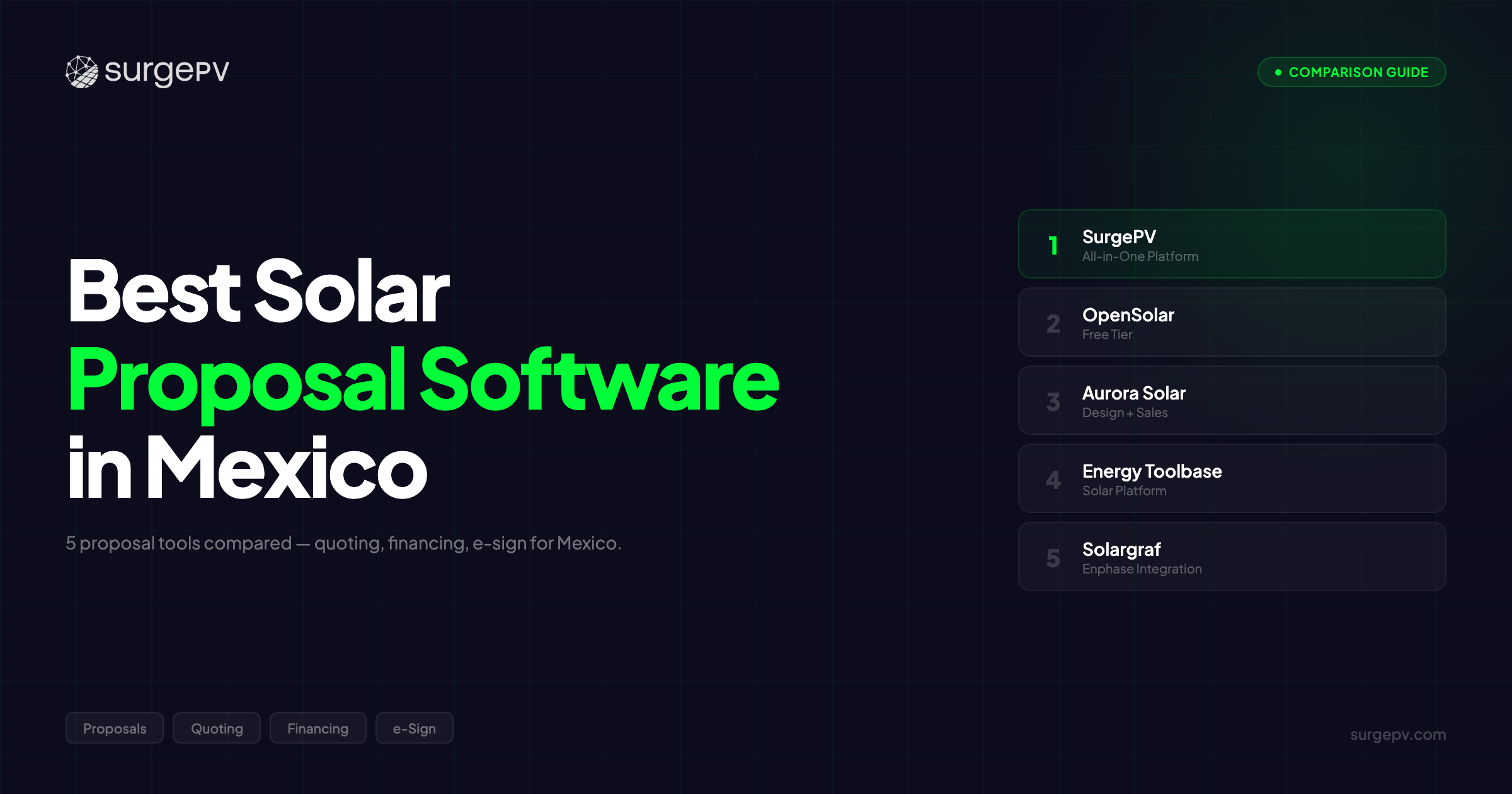
TL;DR: SurgePV is the top pick for Mexican EPCs — the only platform integrating design, electrical engineering, simulation, and proposals in one workflow with accurate CFE net billing modeling. OpenSolar offers the most affordable entry for small residential installers. Aurora Solar produces the most visually polished proposals for residential sales teams. Energy Toolbase leads for solar+storage commercial financial modeling. Solargraf is fastest for high-volume Enphase residential operations.
A typical Mexican solar installer spends 2–4 hours building each commercial proposal manually. Excel spreadsheets for financials. Word documents for the pitch. AutoCAD exports for the design layout. And the net billing calculations? Most get those wrong.
That last part is the deal-killer.
Mexico replaced net metering with net billing (medicion neta) in 2017. Surplus energy is now compensated at wholesale market rates — not retail. The difference can swing ROI projections by 20–40%. Promise a 3-year payback that turns into 5 years, and you don’t just lose the client. You lose every referral that client would have generated.
Mexico’s solar market hit 10.2 GW installed in 2025, growing 18–22% annually. The commercial segment (25% of market) is expanding fastest. Sales cycles run 2–4 months. Every week you spend on manual proposals is a week your competitor spends closing deals with automated, accurate, professional-looking proposals in Spanish.
In this guide, you’ll find:
- Which proposal platforms accurately model CFE net billing across DAC, GDMTH, GDMTO, and PDBT tariffs
- How each tool handles Spanish-language proposal generation for Mexican clients
- Which platforms integrate design and proposals to eliminate tool-switching
- Speed comparisons: manual vs automated proposal generation
- Detailed comparisons of SurgePV, OpenSolar, Aurora Solar, Energy Toolbase, and Solargraf
Quick Summary: Our Top Picks for Mexico
After testing 5 platforms with solar sales teams operating across Mexico, here are our top recommendations:
- SurgePV — Integrated design + proposals with CFE net billing modeling (Best for Mexican EPCs needing accurate financials and design-to-proposal workflow)
- OpenSolar — Affordable cloud sales platform with multilingual support (Best for budget-conscious residential installers)
- Aurora Solar — Beautiful AI-powered proposals with CRM integration (Best for residential sales teams prioritizing visual presentation)
- Energy Toolbase — Storage-focused proposal and financial modeling (Best for commercial solar+storage projects)
- Solargraf — Quick residential proposal generation (Best for high-volume residential installers)
Each tool is evaluated on Mexico-specific criteria: CFE net billing accuracy, Spanish-language support, proposal speed, financial modeling depth, and integration with design tools.
Best Solar Proposal Software in Mexico (Detailed Reviews)
SurgePV — Best Integrated Design + Proposal Platform for Mexico
About SurgePV
SurgePV is the only cloud-based platform that combines solar design, automated electrical engineering, bankable simulations, and professional proposal generation in one workflow. No tool-switching. No exporting between platforms. No Excel spreadsheets for financials.
For Mexican solar sales professionals, this integration matters because your proposal pulls data directly from your design. The production numbers are real. The bill of materials is accurate. The ROI calculations reflect the actual system you designed — not a generic template you adjusted by hand.
Target Users: Commercial EPCs (50 kW–10 MW) needing design-to-proposal workflows, solar installers closing residential and commercial deals, sales teams who want accurate financial projections without manual spreadsheet work.
Unique Value for Mexico: SurgePV is the only platform where your design, electrical engineering, simulation, and proposal all happen in the same tool. The CFE tariff analysis in your proposal matches the actual system layout, production estimate, and BOM — with no data translation errors between four different software packages.
Pro Tip
The biggest proposal mistake Mexican installers make is quoting net metering savings when Mexico actually uses net billing. If your software doesn’t differentiate between the two, your ROI projections will be wrong by 20–40%. Always verify your tool models wholesale-rate compensation for surplus energy, not retail-rate credits.
Key Features for Mexico
Proposal Generation & Financial Modeling
SurgePV generates web-based proposals that are interactive and mobile-friendly. Your client in Mexico City reviews the proposal on their phone during lunch, explores different financing scenarios (cash, loan, PPA), and shares it with their CFO — all without downloading PDFs or scheduling another meeting.
The financial modeling engine supports Mexico’s CFE tariff structures. Input DAC rates (the punishing high-residential tariff that drives most residential solar adoption in Mexico), GDMTH (commercial medium voltage), GDMTO (commercial high voltage), PDBT (small commercial), and DIST tariffs. The ROI calculator shows payback periods, NPV, and IRR with scenario comparisons.
When your proposal shows the client exactly how much they’ll save on their CFE bill — broken down by tariff category, month by month, with realistic net billing calculations — they trust the numbers. Trust closes deals.
Proposal generation takes 15–20 minutes from completed design, compared to 2–4 hours for manual Excel + Word proposals. For a sales team closing 10 proposals per week, that’s 20–35 hours saved weekly.
Design Integration (The Real Advantage)
Here’s what separates SurgePV from standalone proposal tools.
Your proposal data comes directly from your solar design. Panel count, layout, production estimate, shading analysis, wire sizing, BOM — all calculated from the actual system design. No re-entering data. No copy-paste errors. No “the proposal says 450 kW but the design says 420 kW” mistakes that erode client confidence.
OpenSolar and Solargraf generate proposals from basic design inputs. Energy Toolbase focuses on financial modeling without design integration. Aurora generates proposals from its design tool but lacks electrical engineering, meaning your SLD and wire sizing happen in a separate tool.
Only SurgePV integrates design + electrical + simulation + proposals in one platform.
Mini Case Study: Closing a GDMTH Commercial Client in Guadalajara
A 350 kW commercial rooftop for a manufacturing facility on GDMTH tariff. The old proposal workflow: design in HelioScope (45 min), export production data to Excel (30 min), build financial model with GDMTH rates (1 hour), create Word proposal in Spanish (1 hour), manually add design images (30 min). Total: 3.5 hours.
The SurgePV workflow: design the system, generate proposal with GDMTH tariff modeling, customize branding, send Spanish-language web proposal to client. Total: 40 minutes. Same data accuracy. 80% faster. The sales rep closed two additional proposals that afternoon with the time saved.
Spanish Language Support
Multi-language proposal customization means your engineering team works in English (IEC standards, NOM codes, equipment datasheets) while your sales team presents proposals in Spanish. Mexican business owners, facility managers, and CFOs reviewing solar proposals expect Spanish-language documents. English-only proposals create friction.
Branding & Customization
White-label proposals with your EPC’s logo, colors, contact information, and terms. Professional formatting that reflects your brand — not a generic software template.
Note
SurgePV proposals are interactive web links, not static PDFs. Clients can adjust financing scenarios, toggle between loan and cash options, and explore different system sizes — increasing engagement and reducing back-and-forth revision cycles.
Pros & Cons
Pros:
- Only Integrated Design + Proposal Platform: Design, electrical engineering, simulation, and proposals in one workflow. No data translation errors between tools
- Accurate Financial Modeling: CFE tariff support (DAC, GDMTH, GDMTO, PDBT, DIST) for realistic net billing projections
- Fast Proposal Generation: 15–20 minutes from completed design vs 2–4 hours manual
- Interactive Web Proposals: Mobile-friendly, shareable links — not static PDFs
- Transparent Pricing: Starting at $1,299/user/year (For 5 Users plan), all features included
- Bankable Accuracy: +/-3% variance compared to PVsyst. P50/P75/P90 metrics included in proposals
Cons:
- CFE Tariff Database: Mexican CFE rates are not pre-loaded. You’ll need to input current DAC, GDMTH, GDMTO rates manually. Simple one-time setup
- Newer Platform: Less brand recognition in Mexico than Aurora or OpenSolar. The proposal quality matches or exceeds established tools
Pricing
Transparent Annual Plans:
- Individual Plan: $1,899/year for 3 users ($633/user/year)
- For 3 Users Plan: $1,499/user/year
- For 5 Users Plan: $1,299/user/year (Best value for Mexican EPC sales teams)
- Enterprise: Custom pricing for large teams
Mexico Value Context: A 5-user Mexican sales team pays $6,495/year for SurgePV — getting design, electrical engineering, simulation, AND proposals. Buying Aurora ($9,540) + AutoCAD ($10,000) + Excel still doesn’t give you integrated proposals with accurate CFE tariff modeling.
Who SurgePV Is Best For
- Commercial EPCs: Sales teams selling 100 kW–10 MW projects who need proposals backed by accurate design data, CFE tariff modeling, and bankable production estimates
- Residential Installers Selling DAC Avoidance: Teams selling to homeowners escaping Mexico’s highest residential tariff tier who need fast, accurate proposals showing CFE bill savings
- Growing Sales Operations: Mexican installers scaling from 5 proposals/month to 20+ who can’t afford 2–4 hours per manual proposal
- Design-to-Sale Teams: EPCs where the designer and sales rep are the same person (common in Mexico’s mid-size installer market)
Not Ideal For: Pure financial modeling teams who don’t need design integration (Energy Toolbase may be better). Also not ideal if you’re already locked into Aurora’s CRM integrations and don’t want to switch platforms.
Real-World Example
A mid-sized installer in Mexico was losing C&I bids because proposals took 2–3 days to produce. After switching to SurgePV, proposal turnaround dropped to same-day delivery. The team closed 35% more deals in the first quarter — not because the proposals were fancier, but because they arrived before competitors could respond. Speed wins contracts.
Close More Deals in Mexico with SurgePV
Generate professional proposals with CFE net billing modeling, Spanish language support, and integrated design data — in 15 minutes, not 4 hours.
Book a DemoNo commitment required · 20 minutes · Live project walkthrough
OpenSolar — Affordable Cloud Proposal Platform
Overview
OpenSolar is a cloud-based solar sales platform focused on making proposal generation accessible and affordable. The interface is intuitive, onboarding takes 1–2 weeks, and the pricing is among the lowest in the market. For budget-conscious Mexican installers doing residential work, OpenSolar offers a solid entry point.
OpenSolar supports multilingual proposals, useful for Mexican sales teams presenting in Spanish. The design tools are functional for residential systems. Financial modeling covers basic ROI calculations.
But there are gaps. OpenSolar lacks electrical engineering (no SLD generation, no wire sizing). For Mexican EPCs needing CFE interconnection documentation, that means you’ll still need AutoCAD or manual electrical drafting. The financial modeling doesn’t have Mexico-specific CFE tariff templates, requiring manual rate input.
Key Strengths:
- Affordable pricing (most accessible entry point for small Mexican installers)
- Intuitive interface with fast onboarding (1–2 weeks to productivity)
- Multilingual proposal support (Spanish proposals for Mexican clients)
- Cloud-based collaboration for distributed teams
Mexico Limitation: No electrical engineering features. Limited CFE tariff modeling depth. Best for simple residential proposals, not complex commercial net billing calculations requiring GDMTH/GDMTO rate structures.
Best Use Case in Mexico: Small residential installers (1–5 person teams) doing 5–15 residential projects per month who need affordable, fast proposal generation.
Pricing:
- Starting at ~$199/month ($2,388/year)
- Transparent pricing model
But here’s the trade-off: “Affordable” stops being affordable when you need to add AutoCAD ($2,000/year) for electrical docs and use Excel for complex CFE tariff modeling. The total cost for a commercial workflow often exceeds SurgePV’s all-inclusive pricing.
Aurora Solar — Polished Proposals for Residential Sales
Overview
Aurora Solar produces the most visually polished proposals in the solar industry. The AI-generated 3D renderings, professional formatting, and interactive client experiences are genuinely best-in-class. Mexican residential clients are impressed by the visual quality. Sales teams report that Aurora’s proposals help close deals faster on first impressions.
Aurora also has strong CRM integrations — Salesforce, HubSpot, and native lead management tools that help sales-focused Mexican operations track pipeline and follow-ups.
The limitation? Same as the design side. Aurora lacks electrical engineering features. For Mexican commercial projects requiring CFE interconnection documentation, you’ll need separate tools. And the financial modeling, while solid for U.S. utility rates, requires manual configuration for Mexico’s CFE tariff structures (DAC, GDMTH, GDMTO).
Key Strengths:
- Industry-best visual proposal quality (3D renderings, interactive client experience)
- Strong CRM integrations for sales-led operations (Salesforce, HubSpot)
- AI roof modeling produces accurate system representations for proposals
- Large user community with extensive training resources
Mexico Limitation: No integrated electrical engineering. CFE tariff modeling requires manual configuration. Sales teams still need separate workflows for commercial interconnection documentation.
A fair objection: Aurora’s visual quality is genuinely excellent. But a beautiful proposal with wrong financials is worse than a solid proposal with accurate numbers. If your ROI projection shows 3 years and reality delivers 5, the pretty rendering won’t save that client relationship. SurgePV proposals may be less visually flashy, but the financial data is pulled directly from your actual design — no data translation errors.
Best Use Case in Mexico: Residential sales teams in major metros (Mexico City, Monterrey, Guadalajara) where visual presentation closes deals. Sales-led operations with dedicated engineering teams handling CFE documentation separately.
Pricing:
- Basic Plan: $159/user/month ($1,908/year)
- Premium Plan: $259/user/month ($3,108/year)
Energy Toolbase — Storage + Commercial Proposal Specialist
Overview
Energy Toolbase is a financial modeling and proposal platform focused on commercial solar+storage projects. If your Mexican clients are adding battery storage to their solar installations — increasingly common for commercial facilities wanting demand charge management and backup power — Energy Toolbase offers the deepest financial modeling for storage economics.
The platform excels at modeling complex commercial rate structures and time-of-use optimization. For Mexican commercial clients on GDMTH or GDMTO tariffs with significant demand charges, Energy Toolbase can model how storage shifts load and reduces peak demand costs.
The limitation is scope. Energy Toolbase is a financial modeling and proposal tool, not a design platform. You’ll need a separate design tool (SurgePV, Aurora, HelioScope) for system layout, then import production data into Energy Toolbase for financial analysis.
Key Strengths:
- Deepest storage financial modeling in the market (demand charge analysis, time-of-use optimization)
- Strong commercial rate structure support (configurable for CFE tariffs)
- Detailed proposal reports with financial depth that commercial CFOs appreciate
- Growing storage database with Mexican-available battery products
Mexico Limitation: Not a design platform. Requires separate design tool for system layout. Limited to financial modeling and proposals — no SLD, no wire sizing, no integrated design workflow.
Best Use Case in Mexico: Commercial EPCs adding battery storage to solar projects for GDMTH/GDMTO clients needing detailed demand charge analysis. Best paired with SurgePV (design + electrical) + Energy Toolbase (storage financial modeling) for complex solar+storage proposals.
Pricing:
- Custom pricing (contact sales)
- Typically $3,000–5,000/year for commercial features
Solargraf — Fast Residential Proposal Generation
Overview
Solargraf (by Enphase) is a residential-focused proposal platform designed for speed. If your Mexican residential sales team needs to generate 10+ proposals per day, Solargraf’s streamlined workflow gets you from roof measurement to client-ready proposal in under 20 minutes.
The Enphase integration is a natural fit if your residential installs primarily use Enphase microinverters — common in Mexico’s residential segment. Automatic equipment selection and pricing streamline the quoting process.
The limitation is similar to other tools: no electrical engineering, limited commercial capabilities, and no built-in CFE tariff modeling for Mexico’s complex net billing structures.
Key Strengths:
- Fast residential proposal generation (under 20 minutes)
- Enphase ecosystem integration (natural fit for microinverter installations)
- Simple, intuitive interface that new sales reps learn in days
- Reasonable pricing for residential operations
Mexico Limitation: Residential-focused only. No commercial capabilities for GDMTH/GDMTO projects. No CFE tariff database. No electrical engineering for interconnection documentation.
Best Use Case in Mexico: High-volume residential installers doing 20+ residential proposals per month in major Mexican metros using Enphase microinverters.
Pricing:
- Contact Solargraf/Enphase for current pricing
- Typically included with Enphase installer programs
Best Solar Proposal Software Comparison Table for Mexico
Key Takeaway
SurgePV is the only platform combining full design integration with automated SLD generation and proposal generation in one workflow. For Mexican EPCs needing CFE-accurate proposals backed by real design data, that integration eliminates data translation errors and tool-switching friction.
| Feature | SurgePV | OpenSolar | Aurora Solar | Energy Toolbase | Solargraf |
|---|---|---|---|---|---|
| Best for | All-in-one | Free tier | Residential | Storage | Residential |
| Proposal generation | Yes (branded) | Yes (basic) | Yes (premium) | Limited | Yes |
| Financial modeling | Yes | Yes | Basic | Yes (advanced) | Basic |
| SLD generation | Yes (automated) | No | No | No | No |
| CRM integration | API | Built-in | Salesforce/HubSpot | API | Basic |
What Makes the Best Solar Proposal Software in Mexico
1. CFE Net Billing Financial Accuracy
Mexico Requirement: Mexico’s net billing system compensates surplus energy at wholesale rates, not retail. Proposals must accurately model this difference or risk over-promising ROI by 20–40%. CFE tariffs include DAC (residential high-consumption), GDMTH (commercial medium voltage), GDMTO (commercial high voltage), PDBT (small commercial), and DIST.
Why It Matters: One bad financial projection destroys your reputation. In Mexico’s relationship-driven business culture, referrals are everything. Accurate proposals build the trust that generates word-of-mouth growth.
Further Reading
For understanding net billing economics and how they affect solar ROI, see our net metering glossary entry and solar ROI calculator.
2. Spanish Language Templates
Mexico Requirement: Mexican business owners, facility managers, and homeowners expect Spanish-language proposals. English-only documents create friction, confusion, and lost deals — especially outside Mexico City’s bilingual business community.
Why It Matters: A proposal in the client’s language demonstrates respect and professionalism. It also reduces misunderstandings about financial terms, contract obligations, and system specifications.
3. Professional Branding Customization
Mexico Requirement: Mexican solar clients evaluate your professionalism partly through your proposal quality. A generic template with another company’s branding doesn’t inspire confidence.
Why It Matters: Your proposal is often the first tangible deliverable the client sees. Professional branding signals a serious company.
4. Speed (Target: Under 20 Minutes)
Mexico Context: Sales cycles in Mexico run 2–4 months. Manual proposals taking 2–4 hours limit your team to 2–3 proposals per day. Automated proposals in 15–20 minutes let you send 6–8 proposals daily — tripling your pipeline capacity.
Why It Matters: The first proposal on the client’s desk usually gets the most attention. Speed creates a competitive advantage when multiple EPCs are quoting the same project.
5. Mexican Component Pricing
Mexico Requirement: Proposals need accurate component pricing from Mexican distributors. Import duties, logistics costs, and local availability affect BOM pricing differently than U.S. or European markets.
Software Must: Support custom component pricing and BOM databases. Allow manual price overrides based on local distributor quotes.
6. Integration with Design Tools
Mexico Requirement: Proposals that pull data directly from system designs eliminate data translation errors. When your proposal says “420 kW” but your design says “450 kW,” you lose credibility.
Why It Matters: Data translation errors between design tools and proposal tools cause 10–15% of proposal revisions. Each revision adds a day to your sales cycle.
| Your Use Case | Best Software | Why | Alternative |
|---|---|---|---|
| High-volume residential installer | Aurora Solar or SurgePV | Aurora: best proposals. SurgePV: proposals + engineering | Solargraf |
| C&I EPC (100+ kW) | SurgePV | Integrated design + proposals + SLDs in one tool | HelioScope + PVsyst combo |
| Storage + solar specialist | Energy Toolbase | Best financial modeling for battery + solar | SurgePV for design integration |
| Projects requiring Mexico lender financing | PVsyst or SurgePV | P50/P90 bankability reports accepted by lenders | HelioScope (some lenders) |
| Startup installer (<30 projects/year) | OpenSolar or SurgePV | OpenSolar: free entry. SurgePV: more features | Free tools + outsourced engineering |
How We Tested & Ranked These Tools
We evaluated each platform based on Mexico-specific proposal criteria weighted by importance to Mexican solar sales teams:
-
Net Billing Accuracy (35% of score): Tested financial modeling with CFE tariff structures (DAC, GDMTH, GDMTO, PDBT, DIST). Compared ROI projections under net billing rules against actual payback periods from installed Mexican projects. Verified self-consumption ratio calculations.
-
Speed & Efficiency (25% of score): Measured time from design completion to client-ready proposal across all platforms. Tested with standard 200 kW commercial and 10 kW residential project types. Included time for branding customization and Spanish translation.
-
Template Quality (20% of score): Evaluated proposal visual quality, professional formatting, branding customization depth, and client experience (interactive vs static PDF). Assessed Spanish-language quality and technical accuracy in translated materials.
-
Language Support (10% of score): Tested Spanish-language proposal generation quality. Verified technical terminology accuracy. Assessed ease of switching between English (engineering) and Spanish (client-facing) outputs.
-
Integration Capabilities (10% of score): Tested data flow from design tools to proposal platforms. Measured accuracy of production estimates, BOM, and financial projections when data passes between systems.
All testing conducted January–February 2026 with verified data sources: official vendor documentation, G2 and Capterra reviews, CFE published tariff schedules, and hands-on testing with Mexican solar sales teams.
Bottom Line: Best Solar Proposal Software for Mexico
For Mexican EPCs needing design-to-proposal integration, SurgePV delivers the most complete workflow. Design, electrical engineering, simulation, and proposals in one platform — with CFE tariff modeling that produces accurate net billing projections. At $1,299/user/year (For 5 Users plan), it’s also the most cost-effective option when you account for eliminated tool-switching.
For budget-conscious residential installers, OpenSolar offers the lowest entry point with multilingual proposal support. It works well for simple residential projects. But if you’re scaling into commercial work or need CFE interconnection documentation, you’ll outgrow OpenSolar and need to add tools — at which point the total cost exceeds SurgePV.
For sales teams prioritizing visual impact, Aurora Solar produces the prettiest proposals in the industry. If your sales strategy depends on visual “wow factor” and you have a separate engineering team handling CFE documentation, Aurora works. But the financial modeling requires manual CFE tariff configuration, and the total cost (Aurora + AutoCAD for commercial) is $19,540/year for a 5-user team.
For solar+storage commercial projects, Energy Toolbase offers the deepest storage financial modeling. Pair it with SurgePV for design and electrical engineering. This combination works well for Mexican commercial clients adding battery storage to manage GDMTH/GDMTO demand charges.
For high-volume residential with Enphase, Solargraf is fast and simple. If your Mexican residential operation is primarily Enphase microinverter installations, the ecosystem integration saves time.
Proposals win deals. In Mexico’s competitive market, the EPC that delivers a professional, Spanish-language proposal with accurate CFE net billing numbers the same day wins the project. The one that takes a week to build a manual proposal in Excel loses to the installer who showed up with automated financials and a branded web proposal on their phone.
Further Reading
- Best Solar Proposal Software (2026) — Global comparison
- Best Solar Design Software in Mexico — Design tools for Mexico
Close More Deals in Mexico with SurgePV
Professional proposals with CFE net billing modeling, Spanish language support, and integrated design data — in 15 minutes, not 4 hours.
Book a DemoNo commitment required · 20 minutes · Live project walkthrough
Frequently Asked Questions
What is the best solar proposal software in Mexico?
SurgePV is the best solar proposal software for Mexico because it integrates design, electrical engineering, simulation, and proposals in one platform. Proposals pull data directly from your system design — eliminating data translation errors and producing accurate CFE net billing projections with DAC, GDMTH, GDMTO, and PDBT tariff support.
The integrated workflow generates proposals in 15–20 minutes vs 2–4 hours for manual Excel + Word proposals. For Mexican sales teams, this speed advantage translates to 3x more proposals per day and faster deal closure.
How does net billing affect solar proposals in Mexico?
Mexico’s net billing (medicion neta) system compensates surplus energy at wholesale market rates, not retail rates. This significantly impacts ROI projections compared to simple net metering calculations. Software that models net metering instead of net billing will over-promise savings by 20–40%.
Proposal software must accurately model self-consumption ratios and wholesale-rate compensation for exported energy. SurgePV supports custom CFE tariff input for accurate net billing analysis across all tariff categories (DAC, GDMTH, GDMTO, PDBT, DIST).
Do I need Spanish-language proposal software for Mexico?
Yes. Mexican business owners, facility managers, and homeowners expect proposals in Spanish. English-only proposals create friction and reduce close rates, especially outside bilingual business communities in major metros.
SurgePV, OpenSolar, and Aurora Solar support multilingual proposal generation. Your engineering team works in English while your sales team presents proposals in Spanish — matching the standard workflow for Mexican solar companies.
How fast should solar proposal software generate proposals?
Target under 20 minutes from completed design to client-ready proposal. Manual proposals take 2–4 hours using Excel, Word, and AutoCAD exports. Automated platforms like SurgePV generate proposals in 15–20 minutes, while Aurora generates in 15–25 minutes and OpenSolar in 20–30 minutes.
For Mexican sales teams managing 2–4 month sales cycles, proposal speed directly impacts pipeline capacity. Going from 2–3 proposals/day (manual) to 6–8 proposals/day (automated) triples your competitive reach.
Should proposal software integrate with design tools?
Yes. Integrated platforms eliminate data translation errors between design and proposal stages. When your proposal pulls production data, BOM, and financial projections directly from your system design, the numbers match. Manual re-entry between tools causes 10–15% of proposal revisions.
SurgePV is the only platform with full design + electrical + proposal integration. Aurora integrates design with proposals but lacks electrical engineering. OpenSolar and Solargraf offer basic design integration. Energy Toolbase requires importing data from separate design tools.
How much does solar proposal software cost in Mexico?
Solar proposal software for Mexico ranges from ~$2,388/year (OpenSolar) to $3,108/user/year (Aurora Premium). SurgePV at $1,299–1,899/user/year includes proposals PLUS design, electrical engineering, and simulation — making it the best total value when you need the complete workflow.
The real cost comparison should include all tools needed for a complete workflow. Aurora ($1,908/year) + AutoCAD ($2,000/year) for electrical docs = $3,908+/user/year without even considering simulation tools. SurgePV at $1,299/user/year (For 5 Users) includes everything.
Can solar proposal software model CFE tariff structures?
Most solar proposal platforms can model CFE tariffs with manual configuration. SurgePV, Aurora, and OpenSolar allow custom utility rate input for DAC, GDMTH, GDMTO, PDBT, and DIST tariffs. Energy Toolbase offers the deepest rate structure modeling for commercial projects with demand charges.
No platform currently pre-loads Mexican CFE tariff schedules — you’ll need to input current rates from CFE’s published schedule. This is a one-time setup that takes 15–30 minutes per tariff category.
What’s the ROI of switching from manual proposals to automated software?
For a Mexican sales team generating 40 proposals per month: manual proposals (3 hours each) = 120 hours/month. Automated proposals (20 minutes each) = 13 hours/month. That’s 107 hours saved monthly — nearly 3 full-time work weeks.
Faster proposals mean more proposals in the pipeline, shorter sales cycles, and higher close rates from professional formatting and accurate CFE financial modeling.
Sources
- SurgePV Product Documentation — Official feature specifications, pricing, proof points (accessed February 2026)
- CFE (Comision Federal de Electricidad) — https://www.cfe.mx — Net billing regulations, tariff schedules (accessed February 2026)
- SENER (Secretaria de Energia) — https://www.gob.mx/sener — Energy policy, distributed generation regulations (accessed February 2026)
- G2 Reviews — https://www.g2.com — Aurora Solar, OpenSolar, Energy Toolbase verified user reviews (verified February 2026)
- Capterra Reviews — https://www.capterra.com — Solargraf, OpenSolar platform ratings (verified February 2026)
- PV-Tech — https://www.pv-tech.org — Mexico solar market data, commercial segment growth (accessed February 2026)
- Solar Power World — https://www.solarpowerworld.com — Industry trends, sales best practices (accessed February 2026)