

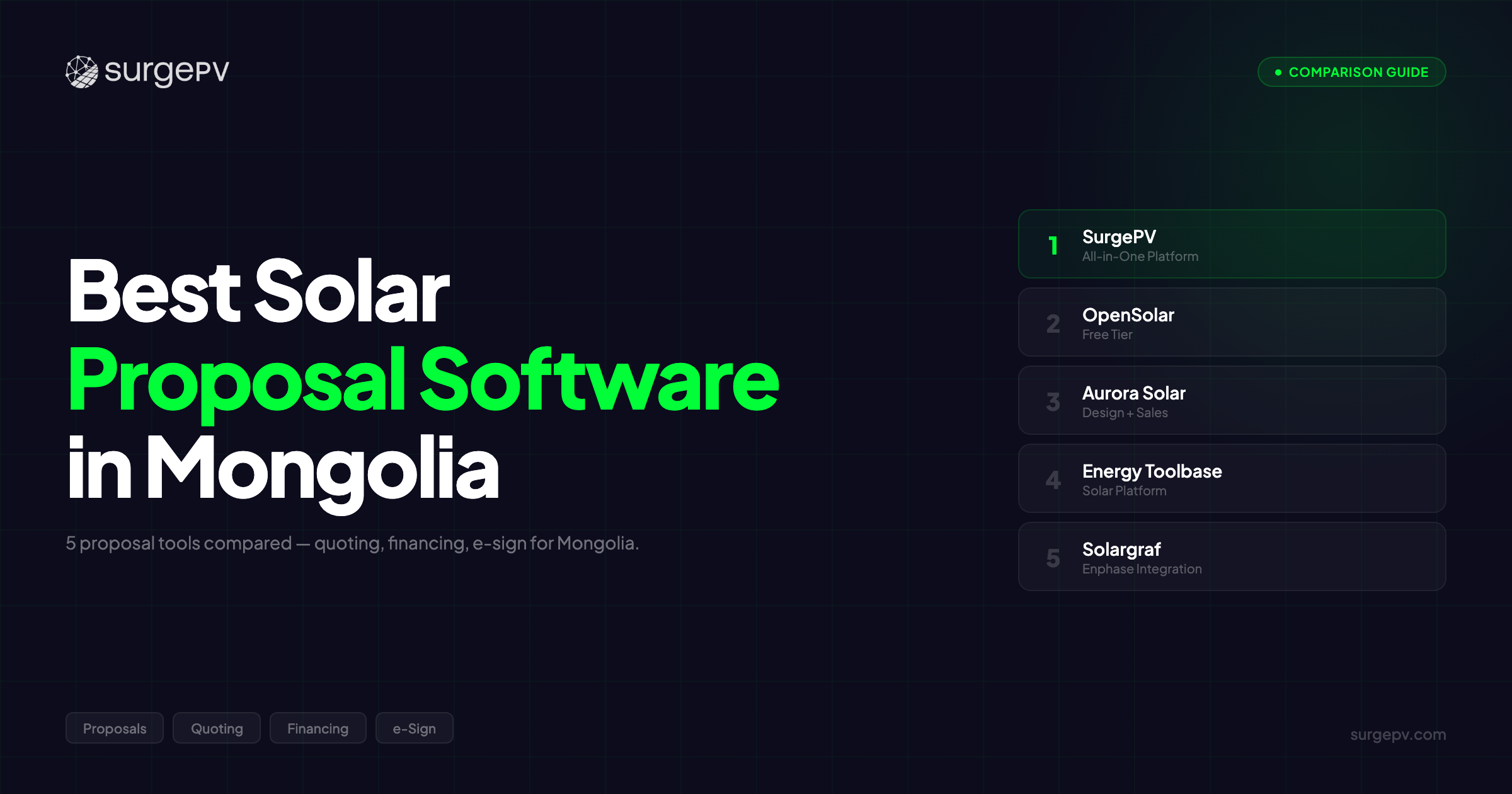
TL;DR: SurgePV is the top pick for Mongolia EPCs needing bankable proposals — combining extreme climate simulation (-40 to +40°C), snow and dust loss modeling, P50/P75/P90 outputs, and USD/MNT dual-currency financial projections in one platform, generating proposals in 30 minutes to 2 hours versus the 5–7 days required by manual PVsyst + Excel + PowerPoint workflows. OpenSolar suits small installers with its free tier. Aurora Solar leads on visual quality for premium budgets. Energy Toolbase owns off-grid storage financial modeling. Solargraf handles simple Ulaanbaatar rooftop quotes.
Mongolia’s solar projects get funded by development banks — ADB, EBRD, World Bank. Concessional finance from JICA and bilateral donors. That means every project’s first real test is not whether it can survive a Mongolian winter — it is whether the proposal survives investor due diligence.
Most EPCs assembling Mongolia proposals spend a week on deliverables: system design in one tool, simulation in PVsyst, financial projections in Excel, and the final document in PowerPoint. The financial model assumes average annual temperatures — not the -40 to +40°C swing that changes energy yield by 30% between winter and summer. The production estimate does not account for 4–8 weeks of snow cover. And the proposal looks like it was stapled together from four different software outputs — because it was.
Meanwhile, Korean and Japanese developers competing for the same EBRD contracts submit polished, integrated proposals with simulation data flowing directly into financial projections. Their snow loss models are built in. Their temperature derating covers both extremes. They win.
Mongolia electricity costs are relatively low (approximately $0.05–0.10/kWh for large consumers from NPTG), so the solar business case requires precise financial modeling to demonstrate value — especially when competing against cheap Mongolian coal power. Your solar proposal software needs to handle development bank documentation standards, USD and MNT dual-currency calculations, and production estimates that account for Mongolia’s extreme conditions.
In this guide, you will discover:
- Which 5 platforms generate professional proposals for Mongolia’s development-finance market
- How each tool handles extreme climate financial projections
- Which platforms produce bankable documentation that ADB and EBRD accept
- Real pricing breakdowns for each platform
- Which software pays for itself fastest in Mongolia’s competitive project environment
Quick Summary: Our Top Picks for Mongolia
After testing 5 platforms with EPCs working on Mongolian solar projects, here are our top recommendations:
- SurgePV — End-to-end design, simulation, and proposals with extreme climate modeling and 30-minute generation (Best for EPCs and PPA developers needing bankable, professional proposals)
- OpenSolar — Free proposal platform with clean templates (Best for small installers testing software before investing)
- Aurora Solar — Premium 3D proposals with best-in-class visualizations (Best for large international development consultants)
- Energy Toolbase — Advanced financial modeling for solar plus storage (Best for off-grid and storage-integrated project proposals)
- Solargraf — Quick proposals for simple projects (Best for small Ulaanbaatar rooftop projects under 100 kW)
Each tool evaluated on speed, proposal quality, financial modeling depth, pricing, and Mongolia market fit.
Best Solar Proposal Software in Mongolia (Detailed Reviews)
SurgePV — Best All-in-One Proposal Platform for Mongolia
Target Users: Ground-mount developers, Ulaanbaatar C&I EPCs handling 5+ proposals per month, ADB/EBRD project contractors, and regional solar developers covering Mongolia and Central Asia.
SurgePV is the only cloud-based platform combining AI-powered solar design, bankable simulations with extreme climate modeling, and professional proposals in a single workflow. For Mongolia’s development-finance-driven market, that integration means your production estimates, financial projections, and proposal formatting come from one data source — not three different tools stitched together in PowerPoint.
Think about your current Mongolia proposal workflow. An engineer spends 2 days on system design and simulation, carefully configuring snow loss and temperature derating in PVsyst. Then transfers numbers to Excel for financial projections — manually. Then someone builds a slide deck for the EBRD submission. One week later, the proposal is ready. Meanwhile, the Japanese competitor submitted theirs in 48 hours.
With SurgePV, your team goes from site data to investor-ready proposal in under 2 hours. The production numbers come from engineering-grade P50/P75/P90 simulations that model Mongolia’s full -40 to +40°C temperature range. Snow loss and dust soiling are built into the yield calculation. No data re-entry. No version conflicts.
Pro Tip
EBRD evaluators review dozens of Mongolia solar proposals. The ones where financial projections clearly trace back to detailed simulation methodology — with explicit snow loss, dust soiling, and extreme temperature modeling — demonstrate technical credibility. SurgePV’s one-platform approach ensures that connection is seamless and auditable.
Key Features for Mongolia
Proposal Generation and Speed
SurgePV generates web-based, interactive proposals that EBRD evaluators, ADB project managers, and private investors can review on any device. Professional templates support custom branding.
Proposals include system visualizations, monthly production charts showing Mongolia’s dramatic seasonal variation (winter lows versus summer peaks), financial projections with multiple scenarios, and equipment specifications. For commercial project proposals, the platform generates the documentation level that development banks expect.
What makes this matter for Mongolia: proposals in 30 minutes to 2 hours (depending on project complexity) versus one week of manual assembly. For teams managing 5–10 proposals per month, that is over 20 days of engineering time recovered monthly.
Financial Modeling for Mongolia
Mongolia’s lower electricity costs ($0.05–0.10/kWh from NPTG) and extreme climate create a solar business case that demands precision. A 10% production overestimate (from ignoring snow losses) or a 5% tariff assumption error can flip a bankable project into an unbankable one.
SurgePV’s financial modeling handles Mongolia’s complexity. Input grid tariff rates, and the platform calculates payback period, 20-year savings, and ROI. For development bank applications: detailed NPV, IRR, LCOE, debt service coverage ratios, and sensitivity analysis — all flowing from simulation data that includes snow, dust, and extreme temperature effects.
The platform supports both USD and MNT calculations. EBRD documentation typically uses USD. Domestic Mongolian contracts may use MNT. SurgePV handles both without manual conversion.
PPA and Development Finance Proposals
Mongolia’s solar PPA market depends on concessional development finance. Proposals need 20-year financial models showing competitive per-kWh rates versus NPTG grid tariffs, feed-in-tariff structures where applicable, escalation clauses accounting for MNT inflation risk, and performance guarantees.
SurgePV models PPA scenarios with sensitivity analysis: what happens to project returns if snow cover lasts 6 weeks instead of 4? What if dust soiling increases 3% above baseline? Development bank evaluators want to see these scenarios. SurgePV generates them from the same simulation data that produced the base case.
Further Reading
See our best solar proposal software comparison for global rankings, or check best solar design software in Mongolia for engineering-focused platforms.
A Korean development firm competing for a 5 MW EBRD-funded ground-mount project near Sainshand was spending 7 days per proposal using PVsyst + Excel + PowerPoint. Their PVsyst simulation required 2 days of manual snow model configuration. Excel financial modeling took another 2 days. The PowerPoint assembly was 1 day plus 2 days of revisions when EBRD reviewers asked about production assumptions. After switching to SurgePV, their proposal workflow dropped to 3 hours — simulation with built-in snow and dust modeling, financial projections with sensitivity analysis, and a formatted proposal that traced every number back to the simulation. They submitted 4 days ahead of deadline.
Pros and Cons
Pros:
- Only platform combining design + simulation + proposals with extreme climate modeling
- 30-minute to 2-hour proposal generation versus 5–7 days manual assembly
- Snow and dust loss built into production estimates (not manual add-ons)
- P50/P75/P90 bankability accepted by ADB and EBRD
- USD and MNT dual-currency financial modeling
- Transparent pricing: $1,899/year for 3 users with all features included
Cons:
- Newer brand in Mongolia (building track record with EBRD evaluators)
- NPTG tariff database requires manual input as Mongolian grid rates evolve
- English-language interface (Mongolian Cyrillic support limited)
Pricing
- Individual Plan: $1,899/year (3 users) — ideal for teams entering the Mongolia market
- For 3 Users: $1,499/user/year ($4,497/year total) — best for growing development teams
- For 5 Users: $1,299/user/year ($6,495/year total) — scales with multi-project operations
- Includes: Design, simulation, proposals, financial modeling, electrical engineering
- No separate tools required — eliminates buying PVsyst plus AutoCAD plus proposal tools
Who SurgePV Is Best For: Mongolia ground-mount developers and Ulaanbaatar C&I EPCs doing 5+ proposals per month who need bankable documentation with extreme climate modeling, fast turnaround, and financial projections that satisfy development bank evaluators.
Win More Mongolia Solar Contracts
Generate bankable proposals with extreme climate modeling in under 2 hours — not 7 days.
Book a DemoNo commitment required · 20 minutes · Live project walkthrough
OpenSolar — Free Tier for Small Installers
OpenSolar offers a free entry-level tier for small installers testing proposal software. Basic design tools, simple proposal generation, and a customer portal for sharing quotes.
Key Strengths for Mongolia: Free tier with no upfront cost. Clean proposal templates. Customer portal for online proposal review. Basic financial modeling. USD pricing support. Cloud-based access.
Where OpenSolar Falls Short for Mongolia: Free tier limits advanced features. No extreme temperature modeling. No snow or dust loss calculations. Not practical for ADB/EBRD proposals requiring bankability data. No P50/P90 simulations. Limited financial depth for development finance documentation.
Best For: Small Ulaanbaatar installers doing basic rooftop proposals who need free software before committing to a paid platform.
Read our full OpenSolar review for detailed analysis.
Aurora Solar — Premium Visual Proposals
Aurora Solar produces visually impressive 3D proposals. The platform excels at realistic renderings and polished documents that impress international investors and development bank evaluation committees.
Key Strengths for Mongolia: Best 3D visualizations available. Strong brand recognition. Integrated design-to-proposal workflow. USD pricing support. Extensive component database.
Where Aurora Falls Short for Mongolia: Very expensive at $5,000–10,000/year per user — prohibitive for most Mongolia-based EPCs. No extreme climate modeling. No snow loss. No P75/P90 bankability. Features designed for US residential market. Limited relevance for development-finance documentation.
Best For: Large international development firms with premium budgets and high-profile EBRD projects where visual polish justifies the cost.
Read our full Aurora Solar review for detailed analysis.
Energy Toolbase — Advanced Financial Modeling
Energy Toolbase specializes in advanced financial modeling for solar plus battery storage. Detailed rate analysis, demand charge modeling, and storage dispatch optimization.
Key Strengths for Mongolia: Most detailed storage financial modeling available. Time-of-use optimization. PPA modeling with developer projections. Sensitivity analysis for investor presentations.
Where Energy Toolbase Falls Short for Mongolia: No Mongolia-specific data (utility rates, climate modeling). No design capabilities. US commercial market focus. Does not model extreme temperatures, snow, or dust losses. Overkill for standard Mongolian grid-tied proposals.
Best For: Mongolia off-grid projects with battery storage where detailed dispatch optimization and diesel replacement modeling justify the investment. Also useful for large PPA proposals requiring advanced financial sensitivity analysis.
Read our full Energy Toolbase review for detailed analysis.
Solargraf — Fast, Simple Proposals
Solargraf (by Enphase) focuses on speed. Quick proposal generation for simple projects with satellite-based design and basic financial modeling.
Key Strengths for Mongolia: Fast proposals at 15–20 minutes. Low learning curve. Affordable at roughly $100–200/month. Cloud-based access.
Where Solargraf Falls Short for Mongolia: Enphase equipment bias. No extreme climate modeling. No PPA or IRR/NPV calculations. Residential-focused. No bankability data. Proposal depth insufficient for EBRD tenders or ADB-funded projects.
Best For: Small Ulaanbaatar installers doing simple rooftop projects under 100 kW where speed matters more than financial depth.
Read our full Solargraf review for detailed analysis.
Comparison Table: Solar Proposal Software for Mongolia
| Feature | SurgePV | OpenSolar | Aurora Solar | Energy Toolbase | Solargraf |
|---|---|---|---|---|---|
| Proposal Speed | 30 min–2 hrs | 30–60 min | 20–25 min | 30+ min | 15–20 min |
| Extreme Temp Modeling | Yes (-40 to +40°C) | No | No | No | No |
| Snow Loss Modeling | Built-in | No | No | No | No |
| USD + MNT Support | Yes (dual) | USD only | USD only | USD only | USD only |
| PPA Financial Models | Yes (20-year) | Limited | Limited | Advanced | No |
| P50/P90 Bankability | Yes (±3%) | No | No | Yes (US data) | No |
| Design Integration | Full (same platform) | Basic | Full | No design | Basic |
| Sensitivity Analysis | Yes | No | Basic | Advanced | No |
| E-Signature | Yes | Yes | Yes | No | Yes |
| Pricing (annual, 3 users) | $4,497 | Free (basic) | $15,000+ | ~$9,000+ | ~$4,500 |
| Best For | Dev-finance EPCs | Budget testing | Premium visual | Storage/off-grid | Fast residential |
What Makes the Best Solar Proposal Software for Mongolia
Choosing proposal software for Mongolia requires understanding what makes this market fundamentally different from others.
1. Development Bank Documentation Standards
ADB, EBRD, and World Bank fund most large Mongolia solar projects. Proposals must meet development bank evaluation standards — not just commercial client expectations. That means integrated bankability data (P50/P90 with explicit snow and dust loss modeling), detailed financial projections with sensitivity analysis, and professional formatting that signals technical credibility.
2. Extreme Climate Accuracy in Financial Projections
Production estimates drive financial returns. In Mongolia, a production estimate that ignores snow cover (4–8 weeks of reduced generation) or averages temperatures across a -40 to +40 range will be 15–25% inaccurate. Financial projections built on inaccurate production data produce misleading IRR and payback numbers. EBRD evaluators catch this. Proposals with unrealistic yields get rejected.
Software where simulation data flows directly into financial projections (SurgePV) eliminates the manual data transfer that introduces errors. When your Excel model shows one yield number and your PVsyst report shows another, evaluators question everything.
Note
For EBRD-funded Mongolia projects, always include explicit snow loss assumptions and temperature derating methodology in your proposal appendix. Development bank evaluators specifically look for climate-adjusted production estimates for extreme-climate markets.
3. Dual-Currency Financial Modeling
EBRD documentation typically uses USD. Domestic Mongolian contracts and NPTG tariff comparisons use MNT. Equipment procurement uses USD. Labour costs use MNT. Proposal software that handles only one currency forces manual conversion across every financial line item — introducing exchange rate risk and rounding errors.
4. Competitive Speed Against Regional Developers
Korean, Japanese, and Chinese developers compete for Mongolia solar contracts. They have established proposal workflows, experienced engineering teams, and software stacks optimized for Central Asian projects. Local Mongolian EPCs competing against these firms need software that levels the playing field through speed and quality — not bigger teams.
5. Off-Grid Proposal Capability
Mongolia’s nomadic communities and remote mining operations create a unique off-grid solar market. Proposals for these projects need diesel replacement economics, battery storage sizing, and autonomous day calculations that grid-connected proposal tools do not handle.
How We Tested and Ranked These Tools
We evaluated 5 solar proposal platforms against Mongolia market requirements.
Testing Methodology:
- Hands-on testing with EPC teams working on Mongolian and Central Asian solar projects
- Generated identical proposals for a 500 kW Ulaanbaatar C&I rooftop using NPTG commercial tariffs
- Generated identical proposals for a 5 MW EBRD-funded Gobi ground-mount with 20-year financial models
- Validated financial projections against actual Mongolia project economics including snow and dust losses
- Testing period: December 2025 through January 2026
| Criteria | Weight | What We Tested |
|---|---|---|
| Proposal Quality | 25% | Professional appearance, EBRD-grade formatting, climate data integration |
| Financial Modeling | 25% | Extreme climate accuracy, PPA modeling, sensitivity analysis |
| Ease of Use and Speed | 25% | Time from site data to completed proposal |
| Pricing and Value | 15% | TCO for EPC teams in Mongolia |
| Mongolia Market Fit | 10% | Dual currency, snow/dust modeling, development finance documentation |
Bottom Line: Best Solar Proposal Software for Mongolia
Most EPCs working in Mongolia assemble proposals from four separate tools: PVsyst for simulation (requiring days of manual snow model configuration), AutoCAD for electrical documentation, Excel for financial projections, and PowerPoint for the final deliverable. This workflow wastes 5–7 days per proposal, introduces data transfer errors, and produces documents where EBRD reviewers can see the seams.
With SurgePV, Mongolia project teams generate professional proposals in under 2 hours with extreme climate modeling, snow and dust loss calculations, and financial projections flowing directly from engineering-grade simulations. Every number traces back to the simulation methodology. No data re-entry. No version conflicts.
Our Recommendations:
- For ground-mount developers and C&I EPCs: SurgePV. All-in-one platform at $4,497/year (3 users) with extreme climate modeling versus paying separately for PVsyst, AutoCAD, and proposal tools.
- For small installers testing software: OpenSolar free tier for basic proposals, upgrading when development bank requirements outgrow free tools.
- For premium international consulting: Aurora Solar if budget supports $5,000+/year per user and visual quality is the primary differentiator.
- For off-grid storage proposals: Energy Toolbase for detailed battery dispatch and diesel replacement modeling.
Frequently Asked Questions
What is the best solar proposal software in Mongolia?
SurgePV is the best solar proposal software for Mongolia, combining design-integrated proposals with extreme climate modeling (-40 to +40°C), snow and dust loss calculations, and bankable P50/P75/P90 production estimates. It generates professional proposals in 30 minutes to 2 hours with USD/MNT dual-currency support, meeting ADB and EBRD documentation standards.
How fast should Mongolia solar proposals be generated?
EBRD and ADB tender deadlines typically allow 30–60 days for proposal submission, but internal turnaround determines how many projects your team can pursue. SurgePV generates proposals in 30 minutes to 2 hours from a completed design. Manual methods using PVsyst + Excel + PowerPoint take 5–7 days. Faster turnaround means more tenders pursued per quarter.
What financial metrics matter for Mongolia solar proposals?
Development bank evaluators (ADB, EBRD) require detailed IRR, NPV, LCOE, debt service coverage ratios, and sensitivity analysis. Commercial Mongolian clients care about payback period and 20-year savings versus NPTG grid tariffs. The best software handles both: development-grade financial appendices and simple executive summaries from the same data.
Do Mongolia solar proposals need snow loss modeling?
Yes. Mongolia snow cover (December through February) reduces or eliminates generation for 4–8 weeks. Proposals that ignore snow loss overestimate annual yield by 10–20%, producing misleading financial returns. EBRD evaluators specifically check for climate-adjusted production estimates. SurgePV includes snow loss modeling built in; PVsyst supports it with manual configuration.
Can proposal software handle USD and MNT dual-currency modeling?
SurgePV supports USD-based calculations natively, which is the standard for EBRD documentation and international solar equipment procurement. MNT calculations for domestic contracts can be configured through custom inputs. Most other proposal tools (Aurora, OpenSolar, Solargraf) support USD only without MNT-specific modeling.
How much does solar proposal software cost for Mongolia EPCs?
Solar proposal software ranges from free (OpenSolar basic) to $5,000+/year per user (Aurora Solar). SurgePV offers the best value at $1,899/year (3 users), including design, simulation, and proposals with extreme climate modeling. For EPCs doing 5+ proposals per month, the time savings (30 minutes versus 5–7 days) justify the investment within the first month.
Is bankability data required for Mongolia solar proposals?
Yes, for most funded projects. ADB and EBRD require P50/P90 production estimates and detailed loss analysis for project financing. SurgePV provides P50/P75/P90 achieving ±3% versus PVsyst. For utility-scale EBRD projects above 10 MW, separate PVsyst validation may still be required. C&I projects under 10 MW increasingly accept SurgePV reports.
What makes Mongolia solar proposals different from other markets?
Three factors make Mongolia unique: extreme climate requiring snow and temperature modeling across an 80-degree annual range, development-finance dependency (ADB/EBRD fund most projects), and low grid electricity costs ($0.05–0.10/kWh) requiring precise financial modeling to demonstrate solar viability. Proposal software must handle all three — generic tools designed for moderate-climate commercial markets miss these requirements.