

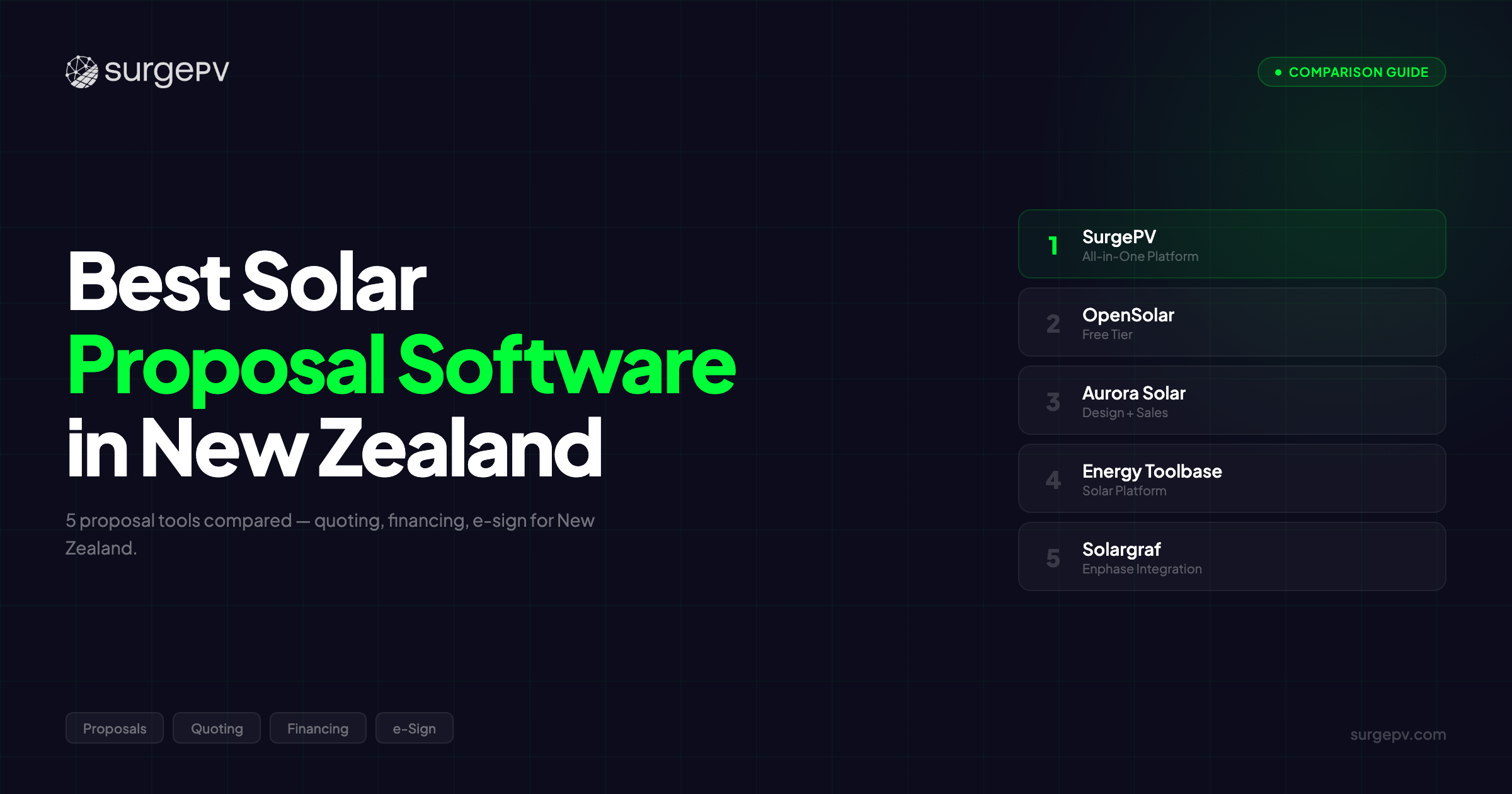
TL;DR: SurgePV is the best solar proposal software for New Zealand, with native NZD pricing, automatic 15% GST, 40+ retailer tariff plans, lines company charge integration for Vector and Orion, and built-in ANZ/ASB/Harmoney financing calculators. OpenSolar works for small residential installers on tight budgets. Aurora Solar suits established residential teams that prioritize proposal polish. Energy Toolbase is the specialist choice for commercial battery + solar projects. Solargraf fits high-volume residential teams that need speed above all else.
NZ solar installers are leaving money on the table.
New Zealand’s solar market is growing 35%+ annually. Residential systems sell for NZD $12,000-18,000. Commercial projects range from NZD $80,000-350,000. Good margins — if you can close.
The problem is closing rate. The industry average sits at 20-30% proposal-to-install. That means 7 out of 10 proposals go nowhere.
And when you look at why customers say no, it often comes down to the proposal itself. Generic templates. Savings projections that don’t account for their Genesis or Contact Energy plan. Monthly payments calculated wrong because someone forgot the 15% GST. No mention of the ANZ GreenLoan option that would have made the project cash-flow positive from month one.
New Zealand’s electricity market is uniquely complex for proposals. You have 20+ retailers, each with multiple plans. Time-of-use rates. Lines company charges from Vector, Orion, or Powerco that vary by network area. Export rates ranging from NZD $0.07-0.17/kWh depending on the retailer and plan. Getting any one of these wrong in a proposal undermines your credibility.
The best solar proposal software for New Zealand must handle NZD pricing with 15% GST, model specific retailer tariffs and lines company charges, integrate with NZ financing options, and produce professional presentations that Kiwi customers trust.
In this guide, you’ll discover:
- Which 5 platforms work best for NZ solar sales teams
- How each tool handles NZ retailer tariffs and lines company charges
- Which platforms integrate ANZ, ASB, and Harmoney financing
- Real pricing comparisons in NZD
- Where most platforms fall short for New Zealand market specifics
Quick Summary: Our Top Picks for New Zealand
After testing 5 platforms with solar installers across New Zealand, here are our top recommendations:
| Software | Best For | NZD Pricing/mo | NZ Fit |
|---|---|---|---|
| SurgePV | All NZ installers | ~$250-350 | Excellent |
| OpenSolar | Budget/Small | $100-200 | Good |
| Aurora Solar | Residential teams | $400-800 | Good |
| Energy Toolbase | Commercial + battery | $500-1,000 | Good |
| Solargraf | High-volume resi | $150-250 | Good |
- SurgePV — End-to-end design, simulation, and proposals with NZ tariff library and financing integration (Best for NZ installers and EPCs across residential and commercial)
- OpenSolar — Free tier with decent proposal templates (Best for small residential installers under 100 systems/year)
- Aurora Solar — Premium proposals with CRM integration (Best for established residential teams with premium pricing)
- Energy Toolbase — Advanced financial modeling for storage + solar (Best for commercial battery projects in Auckland and Wellington)
- Solargraf — Fast proposal generation for high-volume residential (Best for installers doing 300+ systems/year)
Each tool evaluated on NZ pricing accuracy, proposal quality, speed, financing integration, and value.
Best Solar Proposal Software in New Zealand (Detailed Reviews)
SurgePV — Best All-in-One Proposal Platform for New Zealand
Target Users: Residential installers scaling to commercial work, commercial solar EPCs, multi-office companies (Auckland + Wellington + Christchurch), and sales teams needing standardized NZ-ready proposals.
SurgePV combines AI-powered solar design, bankable simulations, and professional proposals in a single platform. For New Zealand, that means your design engineer and sales team work in the same tool — the production numbers in the proposal match what the engineer calculated, and the financial projections use the customer’s actual retailer tariff.
That matters more in New Zealand than in most markets. When your proposal shows savings based on a Genesis time-of-use plan but the customer is on a Contact Energy flat rate, you lose credibility instantly. When your GST calculation is wrong by even a few dollars, the customer notices. New Zealand buyers are detail-oriented. They compare.
Pro Tip
NZ customers typically get 2-3 quotes. The installer who sends a complete, accurate proposal within 24 hours sets the pricing anchor. SurgePV generates proposals in 15-20 minutes from completed designs. If your competitor takes a week, you have already shaped the customer’s expectations.
Key Features for New Zealand
NZ Pricing and Financial Accuracy
SurgePV supports native NZD calculations with automatic 15% GST. The platform includes NZ tariff data for major retailers — Genesis, Contact, Meridian, Mercury, Powershop — and models lines company network charges for Vector (Auckland), Orion (Christchurch), Powerco, and Wellington Electricity. Export tariff modeling accounts for buy-back rates that vary by retailer (NZD $0.07-0.17/kWh).
What most people miss: lines company charges significantly impact savings calculations. A solar proposal that ignores Vector’s network fees in Auckland or Orion’s charges in Christchurch overstates savings by 10-20%. SurgePV factors these in.
The financial modeling tool generates 25-year projections including NPV, IRR, payback period, and LCOE. It models electricity price escalation at historical NZ rates (2.5-3.5% annual increase) and includes degradation assumptions.
Financing Integration
Over 60% of NZ residential solar customers need financing rather than cash purchase. SurgePV integrates calculators for ANZ GreenLoans, ASB Energy Loans, and Harmoney personal loans with accurate NZ interest rates (6-12% typical). Payment plan options show monthly costs across 12-month to 60-month terms, with deposit and down payment scenarios.
Proposals show a critical comparison: monthly loan payment versus monthly electricity savings. When the savings exceed the payment from day one, close rates jump. Software that does this calculation automatically and presents it clearly makes a measurable difference.
Proposal Quality and Professionalism
Professional PDF proposals with customizable NZ-branded templates. Cover page with your company identity, 3D roof visualization from the shading analysis tool, financial charts showing savings timeline and payback, equipment specifications, and legal disclaimers compliant with NZ Consumer Guarantees Act requirements.
Digital signature capability compliant with NZ e-signature laws allows customers to accept proposals online. Proposal tracking shows when the customer opens and views the document.
Design Integration
Proposals pull system data directly from the design module. No manual data transfer. The bill of materials, production estimates, and financial projections all reference the same underlying design. Change the panel count in design, and the proposal updates automatically.
Further Reading
See our best solar proposal software comparison for global rankings, or check best solar design software in New Zealand for engineering-focused platforms.
Pros and Cons
Pros:
- All-in-one platform (design + simulation + proposals) eliminates tool switching
- NZ-specific: NZD pricing, 15% GST, retailer tariff library, lines company charges
- Financing integration with ANZ, ASB, and Harmoney calculators
- 15-20 minute proposal generation from completed designs
- Commercial multi-site proposals for retail chains and portfolio projects
- Cloud-based access from Auckland to Invercargill
Cons:
- More capability than needed for installers doing fewer than 50 systems/year
- Learning curve for advanced commercial and multi-site features
- NZ tariff library requires periodic updates as retailers change plans
Pricing
- Individual Plan: $1,899/year (3 users) — approximately NZD $3,100/year
- For 3 Users: $1,499/user/year ($4,497/year total) — approximately NZD $7,400/year
- For 5 Users: $1,299/user/year ($6,495/year total) — approximately NZD $10,700/year
- Includes: Design, simulation, proposals, financial modeling, electrical engineering
Who SurgePV Is Best For: NZ installers doing 50+ systems per year who need accurate NZ financial modeling, professional proposals, and the ability to handle both residential and commercial projects from one platform.
OpenSolar — Best Budget Option for Small Installers
OpenSolar offers affordable cloud-based proposal software with AU/NZ market awareness. Its free tier and low-cost paid plans make it the entry point for small NZ residential installers.
Key Strengths for NZ: Low cost starting free with paid plans at NZD $100-200/month. Good proposal templates. NZD currency support with GST calculation. Basic NZ tariff library covering Genesis, Contact, and Meridian major plans. Cloud-based. Digital signatures.
Where OpenSolar Falls Short for NZ: Limited tariff depth (only major retailer plans, not all 40+ NZ plans). No lines company network charge automation — Vector and Orion fees require manual entry. Basic financial modeling without 25-year NPV/IRR projections. No ANZ/ASB/Harmoney financing integration. No commercial multi-site proposals.
Best For: Small NZ residential installers (under 100 systems/year) in Auckland or Christchurch on tight budgets who need a starting point.
Read our full OpenSolar review for detailed analysis.
Aurora Solar — Best for Residential Sales Teams
Aurora Solar delivers premium proposal quality with strong CRM integration for managing sales pipelines. Its polished outputs and brand recognition support high-close-rate sales processes.
Key Strengths for NZ: Professional proposal quality with high visual polish. Good sales CRM integration for lead management and follow-ups. Mobile app for site visits. Digital financing options. Strong brand recognition.
Where Aurora Falls Short for NZ: Expensive at USD $250-500/month (NZD $400-800+). Limited NZ tariff library requiring manual entry for many retailers. No lines company network charge automation. US-centric platform needing NZ customization. No native NZD support (manual currency handling). Residential focus makes it less suitable for commercial EPCs.
Best For: Established NZ residential installers (200+ systems/year) with budget for premium tools where proposal quality drives measurably higher close rates.
Read our full Aurora Solar review for detailed analysis.
Energy Toolbase — Best for Commercial Battery Storage Proposals
Energy Toolbase specializes in advanced financial modeling for solar + battery storage projects. For NZ’s growing commercial storage market, it offers the most detailed dispatch modeling and demand charge analysis available.
Key Strengths for NZ: Advanced battery + solar financial modeling. Detailed demand charge analysis for commercial clients. NPV, IRR, and LCOE over 25 years. Integration with battery manufacturers (Tesla, Enphase). Suitable for C&I multi-site projects.
Where Energy Toolbase Falls Short for NZ: Expensive at USD $300-600/month (NZD $500-1,000+). Limited NZ tariff library requiring manual configuration. Steep learning curve, overkill for simple residential proposals. No NZ financing integration. Desktop-focused with limited mobile capability.
Best For: Commercial solar EPCs in Auckland and Wellington doing battery + solar projects (50 kW+) where detailed storage financial modeling justifies the cost.
Read our full Energy Toolbase review for detailed analysis.
Solargraf — Best for Quick Residential Proposals
Solargraf focuses on speed — generating residential proposals faster than any competitor. For high-volume NZ residential installers who need standardized output, the 5-10 minute turnaround is hard to beat.
Key Strengths for NZ: Fastest proposal generation at 5-10 minutes. Simple interface with low learning curve. AU/NZ market awareness. Affordable at NZD $150-250/month. Good for standardized high-volume residential.
Where Solargraf Falls Short for NZ: Basic financial modeling without 25-year NPV/IRR. Limited customization with template-driven approach. No design integration (requires separate tools). No CRM features. No commercial multi-site support. Limited NZ tariff depth.
Best For: High-volume NZ residential installers (300+ systems/year) who prioritize proposal speed and standardization over financial depth.
Read our full Solargraf review for detailed analysis.
Comparison Table: Solar Proposal Software for New Zealand
| Feature | SurgePV | OpenSolar | Aurora Solar | Energy Toolbase | Solargraf |
|---|---|---|---|---|---|
| NZD Currency | Native | Yes | Manual | Manual | Yes |
| 15% GST Calculation | Automatic | Automatic | Manual | Manual | Automatic |
| NZ Tariff Library | 40+ plans | 10+ plans | Limited | Manual | 10+ plans |
| Lines Company Charges | Auto (Vector, Orion) | Manual | None | Manual | Manual |
| 25-Year Financial Model | NPV/IRR/LCOE | Basic | Yes | Advanced | Basic |
| ANZ/ASB/Harmoney | Integrated | None | Generic | None | None |
| Design Integration | Full (same platform) | Own tool | Own tool | None | None |
| Digital Signatures | Yes | Yes | Yes | Limited | Yes |
| Mobile-Friendly | Yes | Yes | Yes | Limited | Yes |
| Proposal Speed | 15 min | 20 min | 25 min | 30 min | 10 min |
| Pricing (NZD/month) | ~$250-350 | $100-200 | $400-800 | $500-1,000 | $150-250 |
| Best For | All NZ installers | Budget/Small | Residential teams | Commercial + battery | High-volume resi |
What Makes the Best Solar Proposal Software in New Zealand
NZ solar proposals have requirements that software designed for the US or Australian markets often misses:
1. NZ Pricing and Financial Accuracy
NZD currency support, 15% GST clearly displayed, and 25-year financial projections using NZ-specific inflation assumptions (RBNZ 1-3% CPI target). Electricity price escalation at historical 2.5-3.5% annual increases. Getting these numbers wrong by even small margins erodes customer trust.
2. Retailer Tariff Complexity
New Zealand has 20+ electricity retailers, each with multiple plans (time-of-use, fixed, demand). Software must model the customer’s specific retailer plan — not a national average. A customer on Contact Energy’s time-of-use plan saves differently than one on Genesis’s flat rate. Feed-in tariff buy-back rates range from NZD $0.07-0.17/kWh depending on the retailer.
3. Lines Company Network Charges
Vector (Auckland), Orion (Christchurch), Powerco, and Wellington Electricity charge different network fees that affect savings calculations. Proposals ignoring these charges overstate savings. Software with automatic lines company charge inclusion produces accurate projections that survive customer scrutiny.
4. Financing Options
Over 60% of NZ residential customers finance rather than pay cash. Proposals must show financing scenarios with accurate NZ interest rates. Integration with ANZ GreenLoans, ASB Energy Loans, and Harmoney personal loans lets customers see monthly payment versus monthly savings — the comparison that closes deals.
5. Professional NZ Presentation
NZ customers expect polished, branded proposals. Clean design. Clear financial charts. Warranty details compliant with the NZ Consumer Guarantees Act. Equipment certified to AS/NZS 4777.2. Legal disclaimers that reflect NZ requirements. The standard of professionalism drives trust.
NZ Use Case Scenarios
Auckland Residential (8 kW, Genesis Energy): Customer on Genesis time-of-use plan with Vector lines company charges. Needs ANZ GreenLoan financing over 5 years. Best Software: SurgePV (auto-detects Genesis tariff plus Vector charges, ANZ loan calculator, 15-minute proposal) or OpenSolar (budget option, but manual loan calculations).
Christchurch Commercial (200 kW, Contact Energy): Warehouse flat roof with Orion network charges. Requires 25-year NPV/IRR for ASB Bank commercial loan. Best Software: SurgePV (all-in-one with Orion charges and ASB calculator) or Energy Toolbase (advanced financial modeling, but needs separate design tool).
Wellington Multi-Site Portfolio (15 locations, Meridian Energy): Retail chain needing portfolio-level analysis and standardized proposals. Best Software: SurgePV (multi-site portfolios, standardized templates, Meridian tariff library).
How We Tested and Ranked These Tools
We evaluated 5 platforms against NZ-specific requirements:
- Hands-on testing with installers in Auckland, Wellington, and Christchurch
- Generated identical proposals for an 8 kW residential system (Genesis Energy, Vector network)
- Generated identical proposals for a 200 kW commercial system (Contact Energy, Orion network)
- Validated financial accuracy against actual NZ electricity bills
- Tested financing calculator accuracy against ANZ, ASB, and Harmoney published rates
- Testing period: November 2025 through January 2026
| Criteria | Weight | What We Tested |
|---|---|---|
| NZ Pricing Accuracy | 25% | NZD, GST, tariff library, lines company, export rates |
| Proposal Quality | 20% | Templates, branding, professionalism, legal compliance |
| Speed and Efficiency | 20% | Proposal generation time, workflow integration |
| Financing Integration | 15% | ANZ/ASB/Harmoney, payment plans, credit disclosure |
| Design Integration | 10% | Seamless design-to-proposal workflow |
| CRM and Sales Pipeline | 10% | Lead management, tracking, follow-up automation |
Bottom Line: Best Solar Proposal Software for New Zealand
Most NZ solar installers waste 2-3 hours per proposal on manual data entry, tariff lookups, GST calculations, and formatting. That is time not spent selling.
With SurgePV, NZ installers generate proposals in 15-20 minutes with accurate retailer tariffs, lines company charges, GST, and financing options — all flowing from the same design data. No re-entry. No spreadsheet errors.
Our Recommendations:
- For most NZ installers: SurgePV. NZ-specific financial modeling, all-in-one platform, professional proposals at NZD $250-350/month.
- For budget-conscious small installers: OpenSolar. Adequate features at NZD $100-200/month, upgradeable as the business grows.
- For residential sales teams with premium budgets: Aurora Solar. Highest proposal quality if NZD $400-800/month is justified by close rates.
- For commercial battery + solar projects: Energy Toolbase. Advanced storage financial modeling for Auckland/Wellington commercial market.
- For high-volume residential (300+ systems/year): Solargraf. Fastest proposals for standardized residential operations.
Win More NZ Solar Deals with SurgePV
Generate NZ-ready proposals with retailer tariffs, lines company charges, GST, and ANZ/ASB financing — in 15-20 minutes.
Book a DemoNo commitment required · 20 minutes · Live project walkthrough
Frequently Asked Questions
What is the best solar proposal software in New Zealand?
SurgePV is the best solar proposal software for New Zealand, offering NZD pricing with automatic 15% GST, NZ retailer tariff library (Genesis, Contact, Meridian, Mercury), lines company charge integration (Vector, Orion, Powerco), and ANZ/ASB/Harmoney financing calculators. It generates professional proposals in 15-20 minutes with design integration.
How much does solar proposal software cost in New Zealand?
NZ pricing ranges from free (OpenSolar basic) to NZD $1,000+/month (Energy Toolbase). SurgePV costs approximately NZD $250-350/month (all-in-one), OpenSolar $100-200/month, Aurora Solar $400-800+/month, and Solargraf $150-250/month. For most NZ installers, SurgePV offers the best value with NZ-specific features.
Do I need proposal software for residential solar in NZ?
Professional proposals are not legally required, but they increase close rates by 30-50% compared to basic email quotes. NZ customers expect polished PDFs with NZD pricing, GST breakdown, financing options, and retailer-specific savings projections. Manual proposals take 2-3 hours. Software reduces this to 15-20 minutes.
What NZ tariffs should proposal software support?
At minimum: Genesis, Contact, Meridian, Mercury, and Powershop. SurgePV supports 40+ NZ retailer plans plus lines company charges. Your proposal must model the customer’s specific plan — a customer on Contact Energy’s time-of-use rate saves differently than one on Genesis’s flat rate.
Can proposal software integrate with ANZ or ASB solar loans?
SurgePV integrates with ANZ GreenLoans, ASB Energy Loans, and Harmoney personal loans with accurate NZ interest rates (6-12%). Most other platforms require manual loan calculations, which slow down proposal generation and introduce errors in monthly payment comparisons.
How fast can I generate a solar proposal in NZ?
With software: 10-30 minutes (Solargraf fastest at 5-10 minutes, SurgePV at 15 minutes with full financial modeling). Manual proposals using spreadsheets and presentation tools take 2-3 hours. For a team doing 200+ proposals per year, software saves 400-600 hours annually.
Is OpenSolar good for NZ solar installers?
OpenSolar works well for small NZ residential installers doing under 100 systems per year. It offers NZD support, GST calculation, and basic proposal templates at low cost. It falls short on NZ tariff depth (only major plans), has no lines company automation, no NZ financing integration, and no commercial multi-site capability. Growing businesses typically upgrade within 6-12 months.
Do I need separate design software or all-in-one?
All-in-one platforms like SurgePV are more efficient for most NZ installers. Separate tools (design + simulation + proposals) cost more, require data re-entry between platforms, and introduce errors. All-in-one eliminates tool switching and ensures the proposal matches the engineering design exactly.