

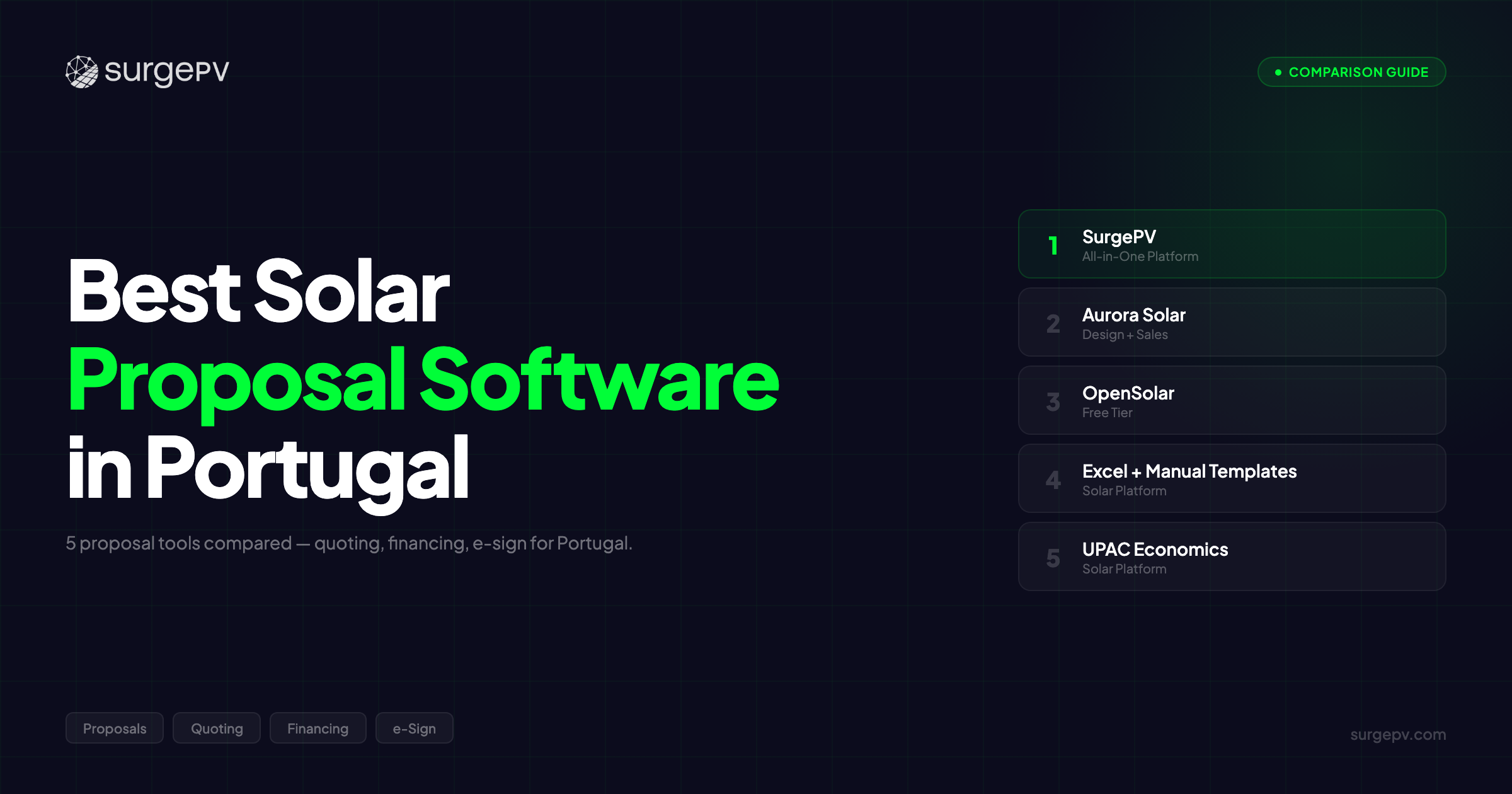
TL;DR: SurgePV is the best solar proposal software for Portugal in 2026 — integrating design, bankable simulations, and professional proposal generation with UPAC self-consumption economics and Portuguese tariff modeling in one platform at $1,499/user/year. OpenSolar is the best free alternative for small residential teams.
Speed wins solar deals. That’s not speculation.
In Portugal, residential customers request 3–8 quotes before signing. The installer who delivers a professional, accurate proposal within 24–48 hours wins. Everyone else is chasing.
Most Portuguese installers still build proposals manually. Design in one tool. Simulate in another. Export to Excel. Model UPAC self-consumption by hand. Calculate Fundo Ambiental subsidies separately. Paste everything into PowerPoint.
The result? One to two hours per proposal. Error-prone financial calculations. Generic-looking output that doesn’t build customer trust.
Meanwhile, Portugal’s solar market is accelerating. Over 4.5 GW installed capacity. Annual additions of 1.2–1.5 GW. Residential installations growing 30–40% year-over-year (SolarPower Europe). The UPAC self-consumption regime (DL 162/2019) and rising electricity prices (0.18–0.25 EUR/kWh residential, per ERSE) are driving demand that manual workflows can’t sustain.
The right solar proposal software in Portugal automates UPAC economics, generates professional EUR-denominated proposals, and cuts turnaround from hours to minutes.
We tested the top 5 proposal platforms specifically for the Portuguese market — referencing regulatory data from DGEG, industry standards from APESF, and grid requirements from REN — evaluating UPAC financial modeling, proposal quality, design integration, speed, and cost.
In this guide, you’ll learn:
- Which platforms model UPAC self-consumption and Portuguese tariffs accurately
- How proposal quality and speed compare across tools
- What a professional Portuguese solar proposal must include
- Our recommendation based on hands-on testing and 500+ commercial projects
Our Top Solar Proposal Software Picks for Portugal (2026)
- SurgePV — Best integrated design-to-proposal platform with Portuguese financial modeling
- Aurora Solar — Best visual proposals for enterprise teams
- OpenSolar — Best free proposal tool for small installers
- PVsyst + Manual Templates — Best for bankable reports requiring manual proposal assembly
- Excel + Templates — Baseline manual approach still used widely
Solar Proposal Software Comparison Table for Portugal
| Feature | SurgePV | Aurora Solar | OpenSolar | PVsyst + Manual | Excel Templates |
|---|---|---|---|---|---|
| UPAC Economics | Yes (automated) | Basic | Basic | Manual export | Manual calculation |
| Multi-Tariff Modeling | bi/tri-horario | Limited | Limited | Manual | Manual |
| Design Integration | Full (same platform) | Full | Full | No (simulation only) | None |
| Proposal Speed | 15–20 min | 20–30 min | 15–25 min | 1–3 hours | 1–2 hours |
| Output Format | Web + PDF | Web + PDF | Web + PDF | PDF (simulation) | PDF/PPT |
| Battery Storage ROI | Yes | Basic | Basic | Yes (manual) | Manual |
| Subsidy Calculator | Yes | No | No | No | Manual |
| EUR Pricing | Yes | AUD/USD | Yes | CHF | Yes |
| Annual Cost | $1,499/user/yr | $3,108+/yr | Free | ~EUR 1,500/yr + labor | Free–EUR 500 |
Pro Tip
In Portugal’s competitive residential market, the first installer to deliver a professional, accurate proposal often wins the contract. SurgePV’s integrated design-to-proposal workflow cuts delivery time to 15–20 minutes — compared to 1–2 hours for manual approaches.
Best Solar Proposal Software in Portugal: Detailed Reviews
SurgePV — Best Integrated Design-to-Proposal Platform
Best For: Portuguese EPCs and installers needing end-to-end design + proposal workflows with UPAC economics built in
Pricing: $1,499/user/year (approximately EUR 1,399). All features included — design, simulation, SLD generation, proposals, financial modeling.
Onboarding: 2–3 weeks
SurgePV is the only platform where Portuguese installers can design a system, run bankable simulations, and generate a professional customer proposal without leaving the application.
UPAC financial modeling runs automatically. When you finish designing a system in SurgePV’s design tools, the platform already knows the array size, energy production, and shading losses. It feeds those numbers directly into the proposal — modeling self-consumption versus wholesale market injection at current rates (50–80 EUR/MWh per ERSE), calculating savings across simples, bi-horario, and tri-horario tariff structures, and projecting payback periods. No data re-entry. No spreadsheet errors. No wasted time.
Portuguese tariff modeling covers all three ERSE-regulated rate structures. For residential customers on bi-horario (two-period) tariffs, the platform models peak and off-peak self-consumption separately — critical because the difference between consuming your own solar energy during peak hours versus off-peak hours can shift ROI calculations by 15–25%.
Subsidy integration includes Fundo Ambiental calculations (Fundo Ambiental). Proposals automatically show pre-subsidy and post-subsidy payback periods, helping residential customers see the true cost of their solar investment after government incentives.
Proposal output is professional. Interactive web-based proposals (shareable link, mobile-friendly) or PDF export. EUR-denominated pricing with detailed line items, reduced VAT (6% IVA) for residential, and BOM generated from the actual design geometry — not estimates.
Speed: 15–20 minutes from completed design to finished proposal. One click. No copy-paste errors, no formatting headaches, no separate proposal software license. For teams handling 20+ proposals per week, this is the difference between winning and losing in a market where customers collect 3–8 competitive quotes.
Simulation accuracy: Bankable P50/P90 metrics within +/-3% of PVsyst, backed by 70,000+ projects globally. Portuguese banks are increasingly accepting SurgePV reports for commercial financing. Your proposals include the bankability data lenders actually require — not just optimistic P50 estimates that get questioned during due diligence.
Pros:
- Integrated design-to-proposal (no tool switching)
- UPAC self-consumption and Portuguese tariff modeling
- Fundo Ambiental subsidy calculations in proposals
- Professional web + PDF output, EUR-denominated
- 15–20 minute turnaround from design to proposal
- 3-minute average support response, 2–3 week onboarding
Cons:
- Newer brand in Portugal vs established tools
- Subscription model (no perpetual license)
- Portuguese language templates still evolving
Real-World Example
A residential installer in the Lisbon metropolitan area generating 80+ proposals per month was juggling three tools — design software, simulation software, and spreadsheets for financials. Each proposal took 3–4 hours. With SurgePV’s unified workflow, that dropped to 45 minutes per proposal. Same-day proposals instead of next-week follow-ups. Their close rate improved because in solar sales, speed wins deals.
Further Reading
See our best solar proposal software globally, Aurora Solar review, and best solar simulation software for broader comparisons.
Book a demo — we’ll generate a sample proposal using your actual Portuguese project data.
Aurora Solar — Best Visual Proposals for Enterprise Teams
Best For: Large residential installation companies with enterprise budgets prioritizing visual proposal quality
Pricing: $259/user/month (monthly) or approximately $220/user/month (annual)
Aurora Solar produces some of the most visually polished solar proposals in the industry. The 3D visualization capabilities are strong, and the customer-facing experience is designed to close residential deals.
Strengths: Beautiful, interactive proposals with 3D roof renderings. Native Salesforce and HubSpot CRM integration for sales pipeline management. Fast design workflows for residential rooftops.
Where Portuguese teams hit friction: UPAC economics modeling is basic. Aurora doesn’t include Portuguese-specific wholesale market injection pricing or multi-tariff period analysis. Installers must calculate UPAC self-consumption savings separately in Excel and add them manually to proposals. No SLD generation — commercial EPCs need AutoCAD ($2,000/year per user) alongside Aurora. No Fundo Ambiental subsidy calculator.
Best for: Large Portuguese residential installation companies with enterprise budgets that prioritize visual proposal quality and CRM integration over Portuguese-specific financial modeling. See our detailed Aurora Solar review.
OpenSolar — Best Free Proposal Tool
Best For: Small residential installers on tight budgets doing fewer than 15–20 proposals per month
Pricing: Free for installers
OpenSolar gives small Portuguese residential installers a way to generate basic proposals without licensing fees. For teams doing fewer than 15–20 proposals per month with simple residential projects, it’s hard to argue against free.
Strengths: Free for installers (partnership model). Easy to learn — most teams are productive within 1–2 weeks. Cloud-based with basic design and proposal generation. Fast for simple residential projects.
Limitations: Basic financial modeling — no UPAC-specific self-consumption optimization, no multi-tariff analysis, no subsidy calculators. Basic simulation quality (not accepted by Portuguese banks for financing). No SLD generation.
You’ll outgrow OpenSolar the moment you need bankable simulation reports, UPAC economics modeling, or electrical documentation for commercial projects. But as a starting point, it’s solid. Read our full OpenSolar review.
PVsyst + Manual Proposal Workflow
Best For: Portuguese EPCs that already own PVsyst and build proposals for utility-scale projects
Pricing: CHF 1,100 (~EUR 1,150) perpetual license + CHF 350/year for updates. Plus labor cost for manual proposal creation.
PVsyst produces the gold-standard simulation reports that every Portuguese lender accepts. But PVsyst does not generate customer proposals.
The workflow: simulate in PVsyst (desktop only). Export the data. Open Excel. Build your financial model. Calculate UPAC self-consumption manually. Add Fundo Ambiental subsidies. Format everything in Word or PowerPoint. Total time: 1–3 hours per proposal for an experienced team.
Simulation quality: Unmatched. P50/P75/P90/P99 probability distributions. Granular loss analysis. 30+ years of industry validation. Every Portuguese bank accepts PVsyst reports (PVsyst official).
Proposal quality: Depends entirely on your Excel and PowerPoint skills. No standardized, professional output.
Best for: Portuguese EPCs that already own PVsyst and build proposals manually — primarily for utility-scale projects where proposal speed matters less than simulation depth.
Excel + Manual Templates — The Baseline
Best For: Very small installers handling fewer than 5 proposals per month
Pricing: Free (Microsoft Office) to EUR 100–500 for purchased templates
Many small Portuguese installers still build proposals from scratch using Excel spreadsheets and Word/PowerPoint templates. It’s free. It’s flexible. And it’s remarkably slow.
Strengths: No software cost. Full customization. Familiar tools.
Limitations: 1–2 hours per proposal. Error-prone (formula mistakes, outdated tariff data). Unprofessional appearance. Not scalable beyond 5–10 proposals per month. No integration with design tools (manual data entry from scratch).
In a market where customers compare 3–8 quotes, a generic Excel proposal loses to a professional, interactive SurgePV or Aurora Solar proposal almost every time. The investment in proper proposal software pays for itself within the first month for most teams.
Close More Portuguese Solar Deals with Faster Proposals
UPAC economics, Fundo Ambiental subsidies, and professional EUR-denominated proposals — all from one integrated platform.
Book a DemoNo commitment required · 20 minutes · Live project walkthrough
Why Most Portuguese Installers Lose Deals on Proposal Speed
Portugal is not the US. Or Germany. Or Australia. The proposal requirements here are specific, and generic international platforms miss critical details.
UPAC Economics — The Non-Negotiable
Every Portuguese solar proposal must accurately model self-consumption versus grid injection under the UPAC regime (DL 162/2019, DGEG).
Self-consumed energy saves the customer 0.18–0.25 EUR/kWh (retail rate). Excess injected energy earns only 0.05–0.08 EUR/kWh (wholesale rate). That 3–5x difference means proposal accuracy depends entirely on how well the software predicts the self-consumption ratio.
SurgePV automates this calculation based on actual load profiles and system design. Aurora Solar and OpenSolar offer only rough estimates.
Multi-Tariff Period Analysis
Portuguese consumers choose between three ERSE-regulated tariff structures:
- Simples: Flat rate (one price, all hours)
- Bi-horario: Two periods (peak and off-peak)
- Tri-horario: Three periods (peak, intermediate, off-peak)
A proposal showing savings on a simples tariff when the customer is on tri-horario will be inaccurate by 10–20%. SurgePV models all three structures. Most competitors require manual calculation.
Subsidy and Incentive Integration
The Fundo Ambiental (Fundo Ambiental) provides subsidies for residential solar + storage installations. Reduced VAT (6% IVA vs 23% standard) applies to residential solar.
Proposals that show pre-subsidy and post-subsidy payback periods convert better because customers see the true out-of-pocket cost. SurgePV includes this. Aurora Solar and OpenSolar do not.
Battery Storage ROI
An estimated 40–50% of new Portuguese residential systems include battery storage. Proposal software must model how batteries increase self-consumption ratios (from 30–40% to 60–80%), shifting more energy consumption to solar and reducing grid injection at lower wholesale rates.
SurgePV models battery storage ROI directly in proposals. PVsyst can simulate battery impact but requires manual proposal assembly.
Design Integration — The Speed Multiplier
When proposal software is separate from design software, every proposal requires manual data transfer. System size, energy production, shading losses, BOM quantities — all re-entered by hand. Every re-entry is a chance for error and wasted time.
SurgePV’s design tools pull all design data directly into proposals. No re-entry. No errors. The bill of materials comes from actual design geometry — not estimates. For Portuguese teams handling 20+ proposals per week, this single feature saves 5–10 hours weekly.
Use Case Comparison
| Your Use Case | Best Software | Why | Alternative |
|---|---|---|---|
| High-volume residential installer | Aurora Solar or SurgePV | Aurora: best proposals. SurgePV: proposals + engineering | Solargraf |
| C&I EPC (100+ kW) | SurgePV | Integrated design + proposals + SLDs in one tool | HelioScope + PVsyst combo |
| Storage + solar specialist | Energy Toolbase | Best financial modeling for battery + solar | SurgePV for design integration |
| Projects requiring Portugal lender financing | PVsyst or SurgePV | P50/P90 bankability reports accepted by lenders | HelioScope (some lenders) |
| Startup installer (<30 projects/year) | OpenSolar or SurgePV | OpenSolar: free entry. SurgePV: more features | Free tools + outsourced engineering |
Our Testing Methodology
We evaluated each platform on five Portugal-specific criteria:
- UPAC economics modeling (30% weight): Self-consumption vs injection accuracy, multi-tariff support, battery storage ROI
- Proposal quality and professionalism (25%): Visual design, mobile-friendly output, Portuguese language support, subsidy visualization
- Design integration (20%): Single-platform workflow, BOM accuracy from design, no manual data entry
- Financial completeness (15%): Fundo Ambiental subsidies, reduced VAT, payback/IRR/NPV calculations, cash vs loan comparison
- Speed and automation (10%): Time to generate proposal, template reuse, email delivery
Testing included sample proposals for residential projects in Lisbon (3–6 kW), commercial projects in Porto (100–500 kW), and utility-scale projects in the Alentejo region.
Use our solar ROI calculator to estimate your specific savings from switching to integrated proposal software.
All pricing verified against official sources as of February 2026. Prices may have changed since publication.
Bottom Line: Best Solar Proposal Software for Portugal
If you need integrated design + proposals with Portuguese financial modeling: SurgePV is the clear choice. UPAC economics, multi-tariff analysis, Fundo Ambiental subsidies, and professional proposals — all from one platform at $1,499/user/year. Proposals go from 1–2 hours to 15–20 minutes, and accuracy improves because data flows from design to proposal automatically.
If you’re a large enterprise team prioritizing visual polish: Aurora Solar delivers beautiful proposals with strong CRM integration. Budget for the premium pricing ($3,108+/year) and manual UPAC calculations.
If you’re a small residential installer just starting out: OpenSolar is free and functional. You won’t get UPAC-specific modeling or bankable reports, but you’ll have a professional step up from Excel.
If you need bankable reports above all else: Use PVsyst for simulation, but invest in SurgePV for the proposal workflow. The combination gives you gold-standard bankable reports and professional customer-facing proposals without the 1–3 hour manual assembly.
Portugal’s solar market isn’t slowing down. The installers winning deals today are the ones with professional proposals and accurate financials on the customer’s table same-day. Manual proposal workflows don’t scale. The teams investing in proposal automation now will capture disproportionate market share over the next 2–3 years.
Book a free demo — see how SurgePV handles UPAC economics and Portuguese tariff modeling with your actual project data. See transparent pricing — all features included, no hidden tiers.
Further Reading
See best solar design software in Portugal, best solar proposal software globally, and OpenSolar review for broader comparisons.
Frequently Asked Questions
What is the best solar proposal software in Portugal?
SurgePV is the best solar proposal software for Portugal in 2026. It combines design, simulation, and proposal generation with UPAC self-consumption modeling, Portuguese financial calculations, and professional EUR-denominated proposals in one platform at $1,499/user/year. The integrated workflow means proposals pull data directly from your design — eliminating manual data entry, reducing errors, and cutting proposal time to 15–20 minutes.
Can proposal software model UPAC self-consumption economics?
Yes. SurgePV models UPAC self-consumption economics including wholesale market injection pricing (50–80 EUR/MWh), multi-tariff period analysis (bi-horario, tri-horario), and battery storage ROI per DL 162/2019 requirements (DGEG). Accurate UPAC modeling is critical because the difference between self-consumed energy (0.18–0.25 EUR/kWh) and grid-injected energy (0.05–0.08 EUR/kWh) directly affects customer payback calculations.
How fast can you generate a solar proposal in Portugal?
With SurgePV, proposals take 15–20 minutes from design completion. OpenSolar delivers basic proposals in 15–25 minutes. Manual Excel workflows take 1–2 hours. In Portugal’s competitive market where installers submit 3–8 quotes per project, speed matters. The first professional proposal often wins the deal.
How much does solar proposal software cost in Portugal?
Solar proposal software in Portugal ranges from free (OpenSolar) to EUR 6,000+/year (Aurora with enterprise features). SurgePV costs $1,499/user/year for integrated design plus proposals. PVsyst costs approximately EUR 1,500/year but requires manual proposal assembly.
Can proposal software calculate Fundo Ambiental subsidies?
SurgePV includes government incentive calculators that factor Portuguese Fundo Ambiental subsidies (Fundo Ambiental) into customer proposals. Proposals automatically show pre-subsidy versus post-subsidy payback periods and ROI, helping customers understand true investment costs.
What should a solar proposal include in Portugal?
A professional solar proposal in Portugal must include: system design specifications with 3D visualization, UPAC self-consumption analysis, electricity savings by tariff period (simples, bi-horario, or tri-horario), payback period with subsidy calculations, detailed BOM with VAT breakdown (6% reduced rate for residential), equipment warranties, and E-REDES compliance documentation.
Which software supports Portuguese language proposals?
SurgePV and OpenSolar offer customizable proposal templates configurable for Portuguese language output. Aurora Solar is primarily English-focused with limited Portuguese support. For the Portuguese residential market, proposals in Portuguese are essential for customer trust and conversion rates.
Does proposal software support Portuguese electricity tariffs?
SurgePV includes Portuguese electricity tariff modeling with support for simples (flat rate), bi-horario (two-period), and tri-horario (three-period) tariff structures regulated by ERSE. This enables accurate savings calculations by time-of-use period — critical for customers on multi-tariff plans.
Sources
- DGEG (Direcao-Geral de Energia e Geologia) — UPAC/UPP regulations, SERUP registration portal: https://www.dgeg.gov.pt
- ERSE (Entidade Reguladora dos Servicos Energeticos) — Portuguese electricity tariffs: https://www.erse.pt
- E-REDES — Portuguese distribution system operator, grid connection standards: https://www.e-redes.pt
- Fundo Ambiental — Government subsidies for residential solar + storage: https://www.fundoambiental.pt
- SolarPower Europe — European solar market statistics: https://www.solarpowereurope.org
- PVGIS (EU Science Hub) — Solar irradiation data for Portugal: https://re.jrc.ec.europa.eu/pvg_tools/
- IEA PVPS — International Energy Agency Photovoltaic Power Systems: https://iea-pvps.org
- Aurora Solar — Competitor pricing page: https://aurorasolar.com/pricing/
- PVsyst Official — Competitor pricing and features: https://www.pvsyst.com