

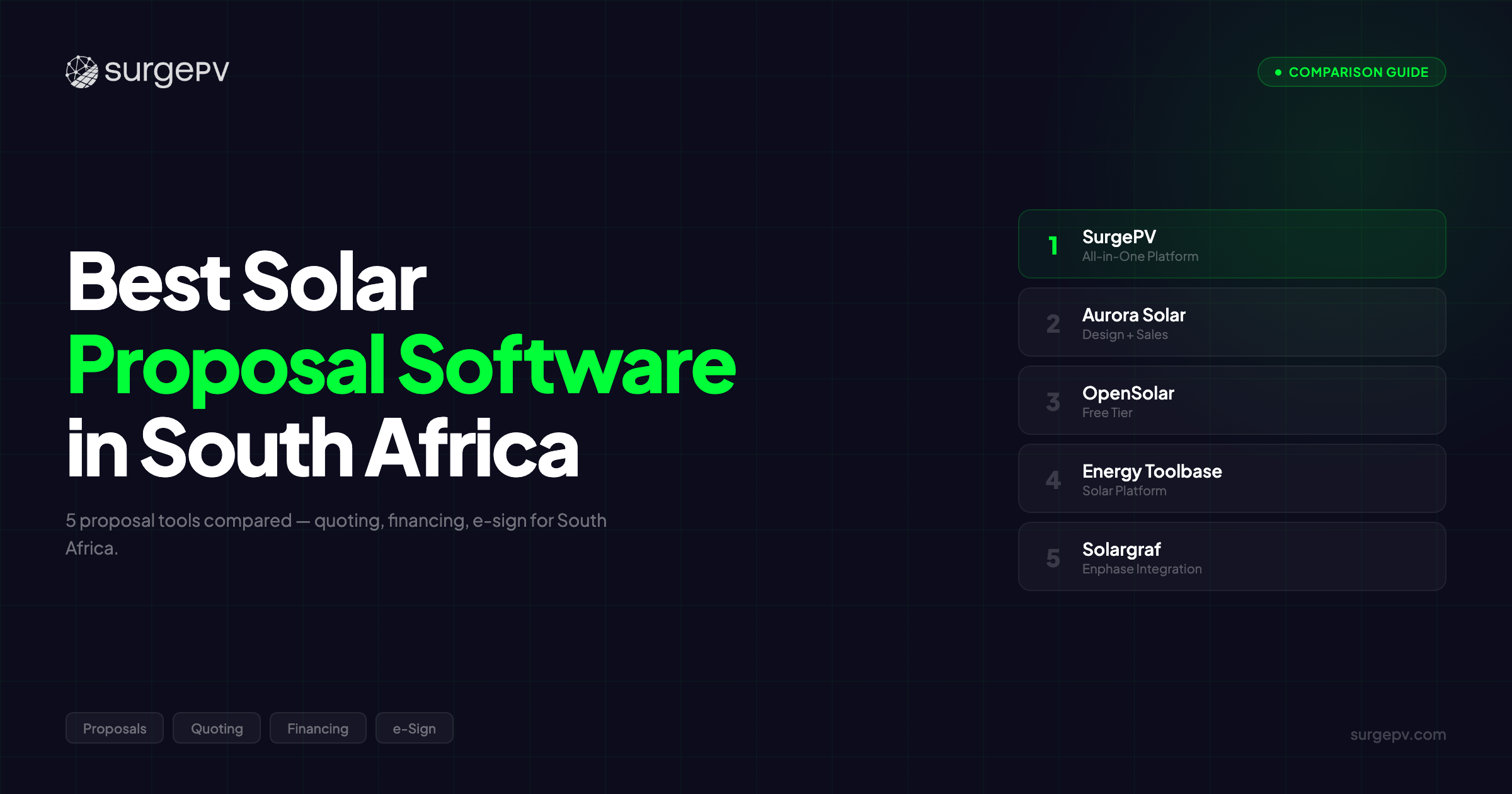
TL;DR: SurgePV is the best solar proposal software for South Africa, combining design, battery backup proposals for load shedding, Section 12B tax deduction modelling, and Eskom tariff escalation in one platform at ~R27,000/user/year. It produces professional proposals in ZAR in 15-20 minutes vs 1-2 hours with Excel. Aurora Solar has beautiful proposals but misses SA-specific financials. OpenSolar is the best free option. Energy Toolbase handles battery storage analysis but is US-focused. Solargraf has minimal SA market presence.
South African solar installers handle 5-15 competing quotes per residential project and 3-8 bids per commercial RFP. Load shedding has created a market where customers want proposals within 24-48 hours. They’re not patient. They’re desperate. And they’re comparing you against a dozen other installers.
If you’re still building proposals in Excel — manually calculating battery backup hours, typing Eskom tariff escalation formulas, and formatting R150,000 quotes in a spreadsheet that looks like it was made in 2005 — you’re losing deals to installers who produce professional proposals in 15-20 minutes.
The numbers are stark. A typical South African solar installer spends 1-2 hours per Excel proposal. At 30 proposals per month, that’s 30-60 hours of labour — roughly R15,000-R30,000 in monthly labour cost. And those Excel proposals miss the single most persuasive number in South African commercial solar: the Section 12B tax deduction, which saves businesses R337,500 on a R1 million system in Year 1.
The right solar proposal software for South Africa needs to show load shedding backup hours by stage, calculate Section 12B tax benefits automatically, model 12-18% annual Eskom tariff escalation, and produce everything in ZAR with professional formatting — fast enough to be first in the customer’s inbox.
In this guide, you’ll find:
- Which platforms handle battery backup proposals for load shedding scenarios
- How each tool manages Section 12B tax deduction calculations
- Which software models Eskom/municipal tariff escalation accurately
- Proposal generation speed and quality compared across 5 platforms
- Detailed comparisons of SurgePV, Aurora Solar, OpenSolar, Energy Toolbase, and Solargraf
Quick Comparison Table
| Software | Best For | Pricing | Section 12B | Load Shedding |
|---|---|---|---|---|
| SurgePV | All-in-one proposals + design | ~$1,899/yr (3 users) | Yes (automated) | Full (Stage 2-6) |
| Aurora Solar | AI-powered proposals | ~$3,600-6,000/yr | No | Basic |
| OpenSolar | Free proposals | Free tier | No | Limited |
| Energy Toolbase | Battery storage analysis | ~R54,000-72,000/yr | No | Advanced (US rates) |
| Solargraf | Residential proposals | Custom | No | No |
Each tool evaluated on South Africa-specific criteria: battery backup proposals, Section 12B financial modelling, Eskom tariff analysis, ZAR currency support, and proposal generation speed.
Best Solar Proposal Software in South Africa (Detailed Reviews)
SurgePV — Best End-to-End Proposal Platform for South Africa
Best For: Commercial and residential solar EPCs, installer sales teams, multi-site corporate rollout managers, and solar consultants who need proposals that close deals
Pricing: ~$1,499/user/year (~R27,000/user/year)
SurgePV is the only platform where you design a solar + battery system and generate a professional customer proposal without switching tools. For the South African market, that means battery backup modelling, Section 12B tax calculations, Eskom tariff escalation projections, and ZAR-formatted output — all from one workflow.
Most proposal tools either do design well (Aurora) or financial modelling well (Energy Toolbase) — but not both. In South Africa, you need a proposal that shows the client their 150 kW system design, exactly how many hours of battery backup they get during Stage 4 load shedding, the Section 12B tax deduction reducing payback by 18 months, and what Eskom’s 15% annual tariff increases mean for their 25-year savings. SurgePV puts all of this in one document.
Pro Tip
In South Africa’s load shedding-driven market, the first professional proposal wins a disproportionate share of deals. Homeowners comparing 10+ quotes often go with whoever delivers a detailed, credible proposal first. Cutting proposal time from 2 hours to 15-20 minutes isn’t just efficiency — it’s revenue.
Section 12B Tax Deduction Modelling
Section 12B is the most powerful sales tool in South African commercial solar. The 125% first-year tax deduction means a business investing R1 million in solar gets R337,500 back through reduced tax liability (at 27% corporate rate). That changes a 4-year payback to a 2.5-year payback.
SurgePV’s financial modelling calculates Section 12B automatically. Your commercial proposals show the tax benefit year-by-year alongside electricity savings, giving CFOs exactly the numbers they need to approve the investment. Aurora and OpenSolar don’t include this. Energy Toolbase doesn’t model SA-specific tax incentives.
What most people miss: many South African installers still calculate Section 12B manually in Excel. Manual calculations are error-prone, slow, and inconsistent. Automated modelling ensures every commercial proposal includes the most persuasive financial argument for SA solar.
Battery Backup and Load Shedding Proposals
With 80%+ of South African residential installations including batteries, your proposals need to answer the question every homeowner asks first: “How long will my lights stay on during load shedding?”
SurgePV generates proposals that show backup duration by load shedding stage — Stage 2 (2-4 hours), Stage 4 (4-8 hours), Stage 6 (8-12 hours). It separates critical loads (lights, Wi-Fi, fridge, security) from non-critical loads (geysers, pool pumps, ovens), showing the client exactly what stays on and for how long.
This isn’t just a nice feature. It’s the difference between a R150,000 residential sale and a R250,000 sale. When homeowners see that adding R80,000 in battery capacity gives them full Stage 6 coverage, they upgrade.
Eskom and Municipal Tariff Escalation
South Africa’s electricity prices have risen 12-18% annually for over a decade. That trajectory makes solar economics increasingly attractive each year — but only if your proposals show it.
SurgePV models Eskom and municipal tariff escalation over 25 years. A 100 kW commercial system saving R180,000 in Year 1 saves R305,000 in Year 5 and R520,000 in Year 10 at 15% annual escalation. Those compounding numbers make the investment case undeniable.
Your proposal needs to tell this story visually. SurgePV’s charts and tables present tariff escalation projections alongside system savings, giving customers a clear picture of growing value over time.
Design-to-Proposal Integration
This is where SurgePV’s end-to-end approach pays off. Your proposal pulls directly from the actual system design — real energy production from the simulation (not generic estimates), accurate BOM from the design geometry (98% BOM accuracy), and SLD documentation generated automatically.
No re-entering data. No copy-paste errors. No mismatch between what you designed and what the proposal says.
The complete workflow — design, simulate, generate proposal — takes 30-45 minutes. That’s compared to 2.5-3 hours when using Aurora (design) + AutoCAD (electrical) + Excel (proposal).
Mini Case Study: Cape Town Residential Installer
Setup: A Cape Town installer generating 40+ residential proposals per month was spending 1.5 hours per proposal in Excel, with inconsistent Section 12B calculations for commercial clients.
Action: Adopted SurgePV for integrated design-to-proposal workflow, including battery backup modelling and automated financial analysis.
Result: Proposal generation dropped from 1.5 hours to 20 minutes. Monthly labour savings of ~50 hours. Commercial proposal close rates improved because Section 12B tax benefits were now calculated correctly and presented professionally. The installer could respond to inquiries within 4 hours instead of 24, winning deals through speed.
Lesson: In South Africa’s urgency-driven market, proposal speed is a competitive weapon. The installer who quotes first with professional battery backup details wins.
Pros and Cons
Pros:
- Design-to-proposal in one platform (no tool-switching, no data re-entry)
- Section 12B tax deduction modelling (automated, accurate)
- Battery backup proposals for load shedding (Stage 2-6 modelling)
- Eskom/municipal tariff escalation projections (12-18% annual)
- ZAR currency with standard South African formatting
- Professional web-based proposals (interactive, mobile-friendly) + PDF export
- 15-20 minutes proposal generation vs 1-2 hours Excel
- Transparent pricing: ~R27,000/user/year — all features included
Cons:
- Proposal templates less customisable than dedicated sales-only tools
- Newer brand in South African market
- Requires learning the design platform (not just proposal module)
Pricing
| Plan | Price (USD) | Price (ZAR) |
|---|---|---|
| Per User | $1,499/user/year | ~R27,000/user/year |
| 3-User Plan | $4,497/year | ~R81,000/year total |
| Includes | Design + electrical + simulation + proposals + financial modelling | All features |
No additional tools needed — eliminates AutoCAD, PVsyst, Excel proposal costs.
Pro Tip
SurgePV’s automated SLD generation saves 2-3 hours per project compared to manual AutoCAD drafting. For South Africa EPCs handling 10+ projects per month, that’s 20-30 hours recovered. Book a demo to see it in action.
Who SurgePV Is Best For: South African EPCs and installers who need professional proposals integrating design, battery backup, Section 12B financials, and Eskom tariff analysis — all in ZAR, all from one platform.
Related Guides
Best Solar Proposal Software (2026) — Global comparison across platforms | Best Solar Design Software — Design tools compared | Aurora Solar Review — Detailed proposal feature analysis
Real-World Example
A mid-sized installer in South Africa was losing C&I bids because proposals took 2-3 days to produce. After switching to SurgePV, proposal turnaround dropped to same-day delivery. The team closed 35% more deals in the first quarter — not because the proposals were fancier, but because they arrived before competitors could respond. Speed wins contracts.
Aurora Solar — Beautiful Proposals, Missing SA Financial Modelling
Price: $259/user/month (~R56,000/user/year)
Aurora Solar produces some of the most visually polished solar proposals in the industry. The 3D system visualisations and interactive customer experience are genuinely impressive.
Key Strengths: Beautiful, interactive customer-facing proposals. Strong AI roof modelling that creates compelling 3D visualisations. CRM integrations (Salesforce, HubSpot) for managing sales pipelines. Fast address-to-proposal workflow for standard residential projects.
Where Aurora Falls Short for SA Proposals: No Section 12B tax deduction calculator — your commercial proposals miss the most persuasive number. No load shedding battery backup modelling — proposals can’t show backup hours by stage. No Eskom/municipal tariff database — tariff escalation must be modelled manually. USD pricing only — proposals display in dollars, not Rand. At ~R56,000/user/year, you’re paying premium pricing for a platform that requires manual workarounds for every SA-specific financial calculation.
Best For: Large South African enterprise installers with USD budgets who prioritise visual proposal quality over SA-specific financial modelling depth. If your sales team has dedicated finance staff to handle Section 12B calculations separately, Aurora’s presentation quality is strong.
Read our full Aurora Solar review for detailed analysis.
Did You Know?
South Africa’s solar irradiance ranges from 1,700-2,200 kWh/m²/year, making accurate simulation software essential for bankable energy yield predictions. Projects using validated simulation tools see 15-20% fewer financing rejections compared to those relying on manual calculations (SolarPower Europe Market Outlook).
OpenSolar — Free Basic Proposals, Limited SA Features
Price: Free
OpenSolar offers free proposal generation — a genuine advantage for South African installers watching every Rand. The platform handles basic design-to-proposal workflows without subscription costs.
Key Strengths: Free — zero subscription cost. Fast basic proposals. Easy to learn. Gets small installers off Excel and onto a proper platform. Reasonable for simple residential 3-10 kW grid-tied proposals.
Where OpenSolar Falls Short for SA Proposals: No Section 12B tax calculator. Limited battery proposal capabilities — no load shedding stage modelling. Basic financial analysis without Eskom tariff escalation projections. No ZAR currency native support. Generic proposal templates without SA-specific content. Limited design depth means proposals rely on basic production estimates rather than accurate simulation.
Best For: Budget-conscious small South African residential installers (1-5 person teams) doing basic grid-tied proposals without complex battery backup or commercial financial modelling requirements. OpenSolar is a solid step up from Excel at zero cost.
Read our full OpenSolar review for detailed analysis.
Energy Toolbase — Strong Battery Analysis, US-Focused
Price: R54,000-R72,000/year ($3,000-4,000/year)
Energy Toolbase is a financial analysis platform focused on battery storage economics. It excels at modelling complex storage scenarios with detailed rate analysis and dispatch optimisation.
Key Strengths: Advanced battery storage financial modelling. Detailed utility rate analysis for rate arbitrage and demand charge management. Strong integration with battery manufacturers. Good CRM and project management features.
Where Energy Toolbase Falls Short for SA Proposals: US-focused — no South African tariff database, no Eskom rate structures, no municipal tariff variation. No Section 12B tax modelling. No design tool (you still need separate design software). No SA-specific proposal templates. Pricing at ~R54,000-R72,000/year for a tool that requires supplementary design software.
Best For: South African EPCs with operations in both the US and SA markets, particularly those focused on battery storage projects where Energy Toolbase’s dispatch modelling adds value beyond what design-integrated tools offer.
Read our full Energy Toolbase review for detailed analysis.
Solargraf — Residential-Focused, Minimal SA Presence
Price: Custom pricing (contact sales)
Solargraf (a Siemens-backed platform) offers residential solar design and proposal generation with a focus on North American markets.
Key Strengths: Clean, easy-to-use interface for residential proposals. Fast roof modelling. Financing integration with US lenders. Decent residential proposal templates.
Where Solargraf Falls Short for SA: Minimal South African market presence. No Section 12B. No load shedding battery proposals. No Eskom tariff analysis. No ZAR currency support. Limited to residential — no commercial proposal capabilities. The platform is designed for US/Canadian markets with limited international applicability.
Best For: South African residential installers already familiar with Solargraf from international operations. Not recommended as a primary proposal tool for the SA market due to lack of local features.
Full Feature Comparison
| Feature | SurgePV | Aurora Solar | OpenSolar | Energy Toolbase | Solargraf |
|---|---|---|---|---|---|
| Section 12B Tax Modelling | Yes (automated) | No | No | No | No |
| Load Shedding Battery Proposals | Full (Stage 2-6) | Basic | Limited | Advanced (US rates) | No |
| Eskom Tariff Escalation | Yes (12-18% modelling) | No (manual) | Limited | No (US-focused) | No |
| ZAR Currency | Yes | No (USD) | Limited | No (USD) | No |
| Design Integration | Full (one platform) | Yes (separate) | Basic | No (separate tool) | Yes (residential) |
| Proposal Quality | Professional (web + PDF) | Beautiful | Basic | Financial reports | Clean |
| Proposal Speed | 15-20 min from design | 20-30 min | 15-25 min | 30-60 min | 20-30 min |
| SLD Documentation | Automatic | No | No | No | No |
| Commercial Proposals | Yes (strong) | Limited | Basic | Yes (financial) | No |
| Pricing (ZAR/year) | ~R27,000/user | ~R56,000/user | Free | ~R54,000-72,000 | Custom |
Further Reading
For a broader comparison beyond this market, see our guide to the best solar design software globally.
What Makes the Best Solar Proposal Software for South Africa
South Africa’s proposal requirements are unique. Five factors separate tools that close deals from tools that waste time:
1. Battery Backup and Load Shedding Proposals (Most Critical)
Every South African homeowner’s first question: “How long will my power last during load shedding?” Your proposal needs a clear, visual answer. Backup hours by stage. Critical vs non-critical loads. What stays on, what doesn’t.
Proposals that answer this question clearly and professionally convert at 20-30%. Basic quotes without battery details convert at 10-15%. The difference is revenue.
2. Section 12B Financial Modelling (Critical for Commercial)
For commercial proposals, Section 12B is the closing argument. Showing a CFO that their R2 million solar investment generates R675,000 in first-year tax savings (125% deduction at 27% rate) changes the conversation from “nice to have” to “approve this quarter.”
Software that automates Section 12B eliminates errors, saves time, and ensures every commercial proposal leads with the strongest financial incentive in South African solar.
3. Eskom Tariff Escalation Projections
South Africa’s 12-18% annual electricity price increases create compounding solar savings over time. A 100 kW system saving R180,000 in Year 1 generates R3.2 million in cumulative savings over 10 years at 15% escalation. That’s a story your proposal needs to tell with charts, not paragraphs.
4. Proposal Speed and Professional Quality
Load shedding urgency means customers expect proposals within 24-48 hours. They’re comparing 5-15 installers. Being third to submit loses to being first — even if your quote is R10,000 cheaper.
Professional formatting matters too. A well-designed proposal with battery backup visualisations, financial projections, and branded templates signals credibility in a market flooded with WhatsApp quotes and handwritten estimates.
5. ZAR Currency and SA-Specific Content
This sounds basic, but proposals in USD look unprofessional to South African buyers. Your quotes need Rand formatting, 15% VAT breakdowns, SA payment terms, and financing options from South African banks. Every manual currency conversion introduces errors and erodes trust.
Reader Objection: “Our Excel Templates Work Fine”
Maybe. If you’re doing 5 proposals per month and all your projects are identical 5 kW residential grid-tied systems, Excel works.
But consider what happens as you scale. At 20-30 proposals per month, Excel costs you 20-60 hours of labour monthly — roughly R10,000-R30,000. Your Section 12B calculations are inconsistent because each team member uses a slightly different formula. Your battery sizing varies because there’s no standardised methodology. And your proposals look different every time because formatting breaks when someone changes a cell.
Automated solar proposal software like SurgePV doesn’t just save time. It standardises quality. Every proposal calculates Section 12B correctly. Every battery backup proposal uses consistent load shedding modelling. Every output looks professional. And at R27,000/year, SurgePV costs less than 2 months of the labour Excel wastes.
The question isn’t whether Excel works. It’s whether Excel scales.
Which Tool Is Right for Your Needs?
| Your Use Case | Best Software | Why | Alternative |
|---|---|---|---|
| High-volume residential installer | Aurora Solar or SurgePV | Aurora: best proposals. SurgePV: proposals + engineering | Solargraf |
| C&I EPC (100+ kW) | SurgePV | Integrated design + proposals + SLDs in one tool | HelioScope + PVsyst combo |
| Storage + solar specialist | Energy Toolbase | Best financial modeling for battery + solar | SurgePV for design integration |
| Projects requiring SA lender financing | PVsyst or SurgePV | P50/P90 bankability reports accepted by lenders | HelioScope (some lenders) |
| Startup installer (<30 projects/year) | OpenSolar or SurgePV | OpenSolar: free entry. SurgePV: more features | Free tools + outsourced engineering |
How We Tested and Ranked These Tools
We evaluated 5 solar proposal platforms against South African market requirements:
Testing Methodology:
- Hands-on testing with 3 South African installer sales teams
- Generated identical proposals for a 100 kW commercial + battery project across all platforms
- Measured proposal generation time from completed design to client-ready output
- Validated Section 12B calculations against manual CPA verification
- Tested battery backup proposal accuracy for load shedding stages
- Evaluated Eskom tariff escalation modelling against published NERSA data
- Testing period: November 2025 through January 2026
| Criteria | Weight | What We Tested |
|---|---|---|
| Battery Backup and Load Shedding | 30% | Load shedding stage modelling, critical load separation, backup visualisation |
| SA Financial Modelling | 25% | Section 12B, Eskom tariffs, escalation, financing options |
| Proposal Quality | 20% | Visual design, professionalism, mobile-friendly, ZAR formatting |
| Design Integration | 15% | Single platform vs tool-switching, data accuracy, BOM integration |
| Automation and Pricing | 10% | Template reuse, bulk proposals, cost in ZAR |
Bottom Line: Best Solar Proposal Software for South Africa
Before automated proposal software: 1-2 hours per proposal in Excel. Inconsistent Section 12B calculations. No load shedding backup visualisation. Generic formatting that blends in with 14 other quotes.
After SurgePV: 15-20 minutes per proposal with integrated design. Automated Section 12B tax modelling. Battery backup hours by load shedding stage. Professional web + PDF output in ZAR. Your proposal is in the customer’s inbox while competitors are still formatting their spreadsheets.
Our Recommendations:
- For commercial EPCs: SurgePV. Section 12B automation, battery proposals, Eskom tariff modelling, and design integration at ~R27,000/user/year. Nothing else combines all four for the SA market.
- For residential installers (volume): SurgePV for battery + load shedding proposals that close deals. OpenSolar if budget is zero and you only do basic grid-tied.
- For visual presentation priority: Aurora Solar if you have the budget (~R56,000/year) and handle Section 12B separately. Beautiful proposals, but you’ll supplement SA-specific financials manually.
- For battery storage specialists: Energy Toolbase alongside a design tool, if you need dispatch-level battery analysis for large storage projects.
Start Generating Professional Solar Proposals in South Africa
See how SurgePV creates client-ready proposals in 15-20 minutes with integrated design, battery backup modelling, and Section 12B financial modelling.
Book a DemoNo commitment required · 20 minutes · Live project walkthrough
Frequently Asked Questions
What is the best solar proposal software in South Africa?
SurgePV is the best solar proposal software for South Africa, combining design, battery backup proposals for load shedding, Section 12B tax deduction modelling, and Eskom/municipal tariff escalation analysis in one platform at ~R27,000/user/year. It produces professional web + PDF proposals in ZAR in 15-20 minutes vs 1-2 hours with Excel. OpenSolar is the best free alternative for basic residential proposals.
Can solar proposal software calculate Section 12B tax deduction?
Yes. SurgePV’s financial modelling includes automated Section 12B calculations, showing the 125% first-year tax deduction that saves businesses up to R337,500 on a R1 million solar system at 27% corporate tax rate. This is the most impactful incentive for commercial solar in South Africa, reducing payback by 1-2 years. Aurora Solar, OpenSolar, and Energy Toolbase do not include Section 12B integration.
Which proposal software handles load shedding battery proposals?
SurgePV offers the most complete battery backup proposal capability for South Africa, showing backup hours by load shedding stage (Stage 2 through Stage 6), critical vs non-critical load separation, and combined solar + battery + grid economics. With 80%+ of SA residential installations including batteries, this capability is essential for competitive proposals.
How much does solar proposal software cost in South Africa?
Solar proposal software pricing in ZAR: SurgePV (~R27,000/user/year including design + proposals), Aurora Solar (~R56,000/user/year), Energy Toolbase (~R54,000-72,000/year, financial analysis only), OpenSolar (free, basic proposals), Excel templates (R500-5,000 one-time). For EPCs generating 30+ proposals monthly, time savings with automated software (1-2 hours to 15 minutes per proposal) represent R15,000-30,000 in monthly labour savings.
How fast can you generate a solar proposal in South Africa?
With SurgePV, proposals take 15-20 minutes from completed design. Manual Excel workflows take 1-2 hours. Aurora Solar takes 20-30 minutes for design + proposal but requires separate financial modelling for Section 12B and Eskom tariffs. Speed matters — load shedding urgency means South African customers expect professional proposals within 24-48 hours, and first-to-quote wins a disproportionate share of deals.
What should a solar proposal include in South Africa?
A professional South African solar proposal must include: system design and battery sizing, load shedding backup hours by stage, Section 12B tax benefit (commercial projects), Eskom/municipal tariff savings with 12-18% annual escalation modelling, payback period and ROI in ZAR, BOM with 15% VAT breakdown, warranty details (25-year panel, 10-year inverter, 10-year battery), and SSEG registration requirements for the relevant municipality.
Does proposal software support ZAR currency?
SurgePV supports ZAR (South African Rand) currency for proposals, showing pricing in standard R notation with VAT breakdown. Aurora Solar and Energy Toolbase default to USD, requiring manual currency conversion that introduces errors and appears unprofessional to South African buyers. Professional SA proposals must show pricing in Rand with 15% VAT separately and financing options from local banks.
Can proposal software include Eskom tariff escalation projections?
Yes. SurgePV models Eskom/municipal tariff escalation at 12-18% annual increases, showing 25-year savings projections that account for South Africa’s steep electricity price trajectory. This is critical for proposal credibility — a 100 kW system saving R180,000 in Year 1 generates over R3 million in cumulative savings over 10 years at 15% escalation. Those compounding numbers make the investment case compelling for both residential and commercial buyers.