
Spain is one of Europe’s most solar-favorable countries — and its residential solar market is finally delivering on that potential. With electricity tariffs at record highs, IDAE NextGenerationEU grants covering up to 40% of installation costs, and a net metering framework that has been in place since 2019, Spanish homeowners now have a compelling economic case for rooftop solar that did not exist five years ago.
The challenge is navigating the system: grants are distributed through autonomous communities, application windows vary by region, the net metering rules differ from Germany’s feed-in tariff model, and the emerging comunidades de vecinos (apartment building community solar) trend is reshaping how urban Spaniards access solar energy.
This guide covers every dimension of residential solar in Spain in 2026 — from installation costs per kWp and IDAE grant application steps to regional payback comparisons, tax deductions, and how apartment residents can now participate in community solar projects.
TL;DR — Spain Residential Solar 2026
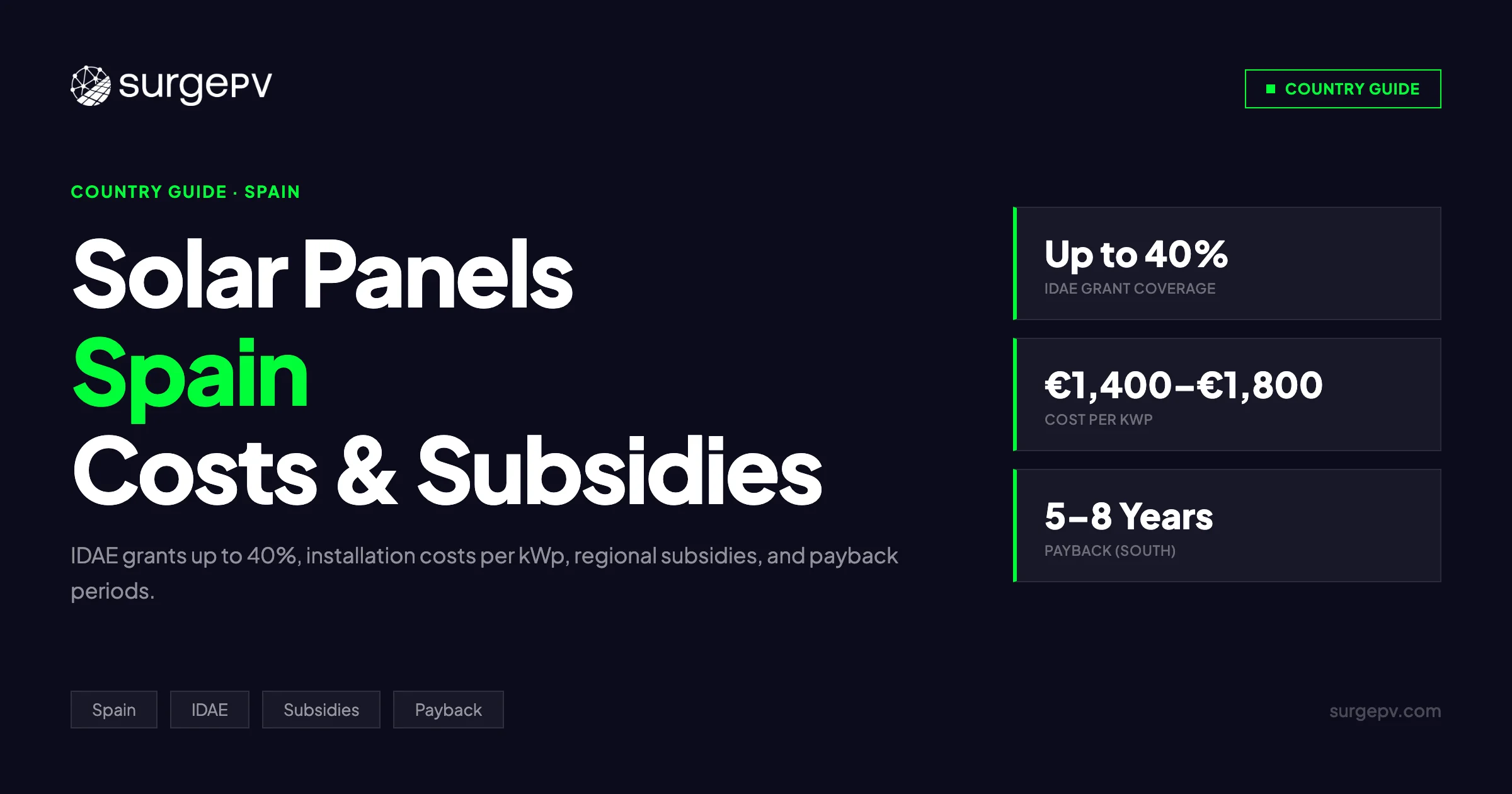
IDAE grants cover up to 40% of solar installation costs (up to 80% for vulnerable households). Solar panels cost €1,400–€1,800 per kWp installed. Payback runs 5–8 years in the south, 9–13 years in the north. Net metering via Royal Decree 244/2019 provides bill credits for surplus export. Comunidades de vecinos can now install shared rooftop solar with pooled grant applications. IBI property tax discounts of up to 50% are available in many municipalities. All major grants must be applied for before installation begins.
In this guide:
- Latest 2026 updates to Spain’s solar grant programs and electricity tariffs
- Solar panel installation costs per kWp — full breakdown by system size
- IDAE grants: what they cover, how to apply, and what documents you need
- Regional grants by autonomous community (Catalonia, Andalusia, Madrid, Valencia, Basque Country)
- How Royal Decree 244/2019 net metering works in practice
- Comunidades de vecinos community solar — Spain’s fastest-growing residential trend
- Payback period by region — north vs. south irradiance comparison
- IBI property tax discounts and municipal solar incentives
- Step-by-step guide to going solar as a Spanish homeowner
Latest Updates: Spain Solar Market 2026
For anyone tracking the spain solar energy 2025 and 2026 market, here is the current program status as of March 2026.
Spain Solar Grant & Policy Status — March 2026
| Program | Status | Key Change |
|---|---|---|
| IDAE NextGenerationEU Residential Grants | Active — rolling | Grant rates confirmed through 2026; some CCAAs still distributing 2025 allocations |
| Royal Decree 244/2019 (Net Metering) | Active | Compensation rates updating with quarterly electricity market |
| Comunidades de vecinos solar (RD 244/2019) | Active — expanded | Sharing coefficients reform under consultation (2026) |
| IBI municipal tax discount | Active (optional by municipality) | No change — ~40–50% of large municipalities participate |
| VAT (IVA) on solar installations | 10% reduced rate | Maintained at reduced 10% IVA for residential solar |
| PNIEC 2021–2030 solar target | On track (74 GW by 2030) | 30+ GW installed by end 2024; acceleration required 2026–2030 |
| Autonomous community programs | Variable by region | Catalonia, Andalusia, Valencia windows open Q1 2026 |
Key 2026 Developments
Electricity tariff context: Spain’s PVPC (Precio Voluntario para el Pequeño Consumidor) tariff averaged €0.17–€0.24/kWh across 2024–2025 with significant seasonal peaks. High tariffs directly improve solar self-consumption economics.
IDAE grant pipeline: Spain received one of Europe’s largest NextGenerationEU clean energy allocations. As of early 2026, regional distribution of residential solar grants is ongoing, with some autonomous communities (Catalonia, Murcia, Aragon) still processing applications from 2025 funds.
Community energy framework: Spain transposed the EU Renewable Energy Directive (RED II) community energy provisions into national law, providing the formal legal basis for Comunidades de Energía Renovable (CERs) — renewable energy communities — that go beyond the existing apartment building models.
Module price decline: Spanish module prices have declined 25–35% since 2022 due to global oversupply, though installation labor and permitting costs have remained stable, moderating total system cost reductions.
Key Takeaway — Apply Before Installing
All IDAE grants and autonomous community programs require application and approval before installation begins. Installing first and applying retroactively results in automatic disqualification — no exceptions. This is the single most common and costly mistake made by Spanish homeowners seeking solar subsidies.
Solar Panels Cost Spain: What You Will Pay in 2026
The spain photovoltaic market has seen significant hardware cost reductions, but total installed system costs have fallen more modestly — labor, permitting, inverter costs, and grid connection fees are increasingly the dominant cost components.
Residential Solar Panel Cost Per kWp — Spain 2026
| System Size | Total Installed Cost (Gross) | Cost Per kWp | After 40% IDAE Grant |
|---|---|---|---|
| 2 kWp | €3,200 – €4,400 | €1,600 – €2,200 | €1,920 – €2,640 |
| 3 kWp | €4,500 – €6,500 | €1,500 – €2,167 | €2,700 – €3,900 |
| 5 kWp | €7,500 – €10,500 | €1,500 – €2,100 | €4,500 – €6,300 |
| 8 kWp | €11,200 – €16,000 | €1,400 – €2,000 | €6,720 – €9,600 |
| 10 kWp | €13,000 – €18,500 | €1,300 – €1,850 | €7,800 – €11,100 |
All-in cost: panels, inverter (string or hybrid), mounting hardware, DC/AC cabling, electrical protection, grid connection application, administrative permits, and labor. Excludes battery storage. Source: UNEF (Unión Española Fotovoltaica) installer survey data, 2025.
System Cost Breakdown — 6 kWp Residential Spain
| Component | Share of Total | Typical Cost |
|---|---|---|
| Solar panels (monocrystalline PERC/TOPCon) | 25–35% | €2,200 – €3,800 |
| String or hybrid inverter | 15–20% | €1,300 – €2,200 |
| Mounting and racking | 10–15% | €870 – €1,650 |
| DC/AC cabling and protection | 10–15% | €870 – €1,650 |
| Labor (2–3 days, 2 electricians) | 18–25% | €1,570 – €2,750 |
| Grid connection, permits, legalization | 8–12% | €700 – €1,320 |
Battery storage add-on (LFP, 5–10 kWh): adds €3,000–€7,000 to gross system cost, or approximately €500–€800 per kWh of usable capacity. The IDAE grant eligible cost for battery storage has a separate CAPEX ceiling in most regional programs.
Why Prices Vary by Region
Labor costs in Spain vary significantly by region. A 6 kWp installation in the Basque Country or Catalonia may cost 10–20% more than the same system in Extremadura or Murcia — reflecting regional wage differences and installer density. Southern Spain has more competitive installer markets due to higher installation volumes. Using solar design software for accurate yield-adjusted system sizing avoids oversizing in lower-irradiance northern regions, where a smaller, correctly sized system delivers better ROI than a larger one.
Pro Tip — Get 3 Quotes
The Spanish solar market is fragmented — installer pricing for the same system can vary 25–40% between quotes in the same city. UNEF (Spain’s PV association) recommends obtaining at minimum 3 quotes from IDAE-certified installers before committing. Certification is mandatory for grant eligibility — always verify your installer is registered with the competent authority in your autonomous community.
IDAE Grants and Subsidies for Residential Solar in Spain
The IDAE (Instituto para la Diversificación y Ahorro de la Energía) is Spain’s national energy efficiency agency and the primary channel for NextGenerationEU solar funds at the residential level. Understanding how IDAE grants for solar panels in Spain actually work — and what the money covers — is essential before applying.
How IDAE Grant Funding Flows
IDAE does not pay homeowners directly. The funding flows as follows:
- European Commission releases NextGenerationEU funds to Spain under PRTR (Plan de Recuperación, Transformación y Resiliencia)
- IDAE receives the funds and sets national eligibility criteria and minimum grant rates
- Autonomous communities (CCAAs) receive their regional allocation and open application windows
- Homeowners apply through their autonomous community’s portal (not the IDAE national portal)
- Approved applicants proceed with installation and submit proof of completion for payment
This layered structure means that grant rates, application timelines, and required documentation vary by region — even though the underlying funding source is the same.
IDAE Residential Solar Grant Rates — 2026
| Applicant Category | Maximum Grant (% of eligible CAPEX) |
|---|---|
| Standard residential homeowner | Up to 40% |
| Installation with battery storage included | Up to 45% |
| Low-income / energy-vulnerable household | Up to 60% |
| Households in energy poverty | Up to 80% |
Eligible CAPEX: panels, inverter, structural mounting, and electrical protection equipment. Labor costs and administrative fees are eligible in most regional programs but at lower percentages. Battery storage is eligible in programs that specifically include storage (varies by region).
Grant Eligible Cost Ceilings Per kWp
Most autonomous community programs cap the eligible installation cost per kWp — meaning the grant percentage applies to a capped baseline, not the actual invoice. Typical ceilings are:
| System Size | Eligible Cost Ceiling Per kWp |
|---|---|
| 1–3 kWp | €1,800 – €2,100/kWp |
| 3–10 kWp | €1,500 – €1,800/kWp |
| 10–100 kWp (community solar) | €1,300 – €1,600/kWp |
If you pay €2,500/kWp installed and the eligible ceiling is €1,800/kWp, the 40% grant applies only to €1,800/kWp. The excess is not subsidized.
What the Grant Does NOT Cover
- Solar battery storage (in most programs — some CCAAs have separate battery grants)
- Administrative management fees charged by installers for subsidy paperwork
- Permit costs beyond the legal maximum in the eligible cost schedule
- System upgrades requested by the homeowner beyond minimum sizing
Key Takeaway — Apply Through Your CCAA, Not IDAE Directly
There is no national IDAE application portal for residential homeowners. All applications go through your autonomous community. Search your CCAA’s energy agency website — ICAEN (Catalonia), Agencia Andaluza de la Energía (Andalusia), AVEN (Valencia), EREN (Castile and León), EVE (Basque Country) — for the current application form and submission deadline.
IDAE Grant Application — Step by Step
Step 1 — Verify eligibility and current window in your CCAA Check your autonomous community’s energy agency portal to confirm the current grant program is open for residential applications. Windows typically open Q1–Q2 and close when the regional budget is exhausted — often within 4–8 weeks of opening.
Step 2 — Get quotes from certified installers You need a minimum of 2–3 formal quotes (presupuesto detallado) from installers registered with the competent authority in your region. The selected installer must be certified (empresa instaladora habilitada) for the grant to be eligible.
Step 3 — Submit the pre-authorization application Submit your application to the CCAA portal before installation. Required documents typically include: DNI or NIE, property title or rental authorization from owner, installer quote with technical specifications, site plan showing roof area and orientation, and self-certification of income bracket.
Step 4 — Receive pre-authorization (resolución provisional) Processing times vary from 4 weeks to 6 months depending on the CCAA and application volume. Some regions use a competitive scoring system; others operate first-come, first-served. Do NOT begin installation until pre-authorization is received.
Step 5 — Install with the certified installer Complete installation. The installer must provide a commissioning certificate (certificado de instalación), an electrical boletín, and register the system in your CCAA’s renewable energy registry.
Step 6 — Submit proof of completion and receive payment Upload the final invoice, commissioning certificate, registration confirmation, and any additional CCAA-specific documents. Payment is typically made within 30–90 days of approval. Some regions pay in a single disbursement; others in two tranches.
Regional Grants by Autonomous Community
Beyond the national IDAE grant pool, each of Spain’s 17 autonomous communities operates its own supplementary programs — or has specific terms for distributing the national IDAE allocation. Here is the status for Spain’s largest solar markets as of March 2026.
Catalonia — ICAEN Solar Programs
Catalonia’s Institut Català d’Energia (ICAEN) has historically been one of Spain’s most active regional solar subsidy administrators.
| Program | Amount | Notes |
|---|---|---|
| ICAEN residential solar (IDAE pass-through) | Up to 40% of eligible CAPEX | Applications via oficinavirtual.icaen.gencat.cat |
| Autonomous community supplement | Up to €3,000 additional per installation | For systems ≥3 kWp; income-tested |
| Battery storage bonus | Up to €1,500 | For storage ≥5 kWh, paired with solar |
| Comunitat de veïns installations | Same % grant per dwelling unit | Each participating unit submits separately or community applies collectively |
Catalonia has relatively high solar irradiance in its Terres de l’Ebre and Lleida inland areas (1,700–1,900 kWh/m²/year). Barcelona itself receives approximately 1,600 kWh/m²/year — enough for a 6–8 year payback after grants.
Andalusia — Agencia Andaluza de la Energía
Andalusia is Spain’s highest-irradiance region (2,000–2,400 kWh/m²/year in Almería, Sevilla, and Córdoba) and has Spain’s fastest payback periods.
| Program | Amount | Notes |
|---|---|---|
| Incentivos Energías Renovables Andalucía | 30–40% eligible CAPEX | Via ventanilla única electrónica |
| Vulnerable household supplement | Additional 20–40% | Income and energy poverty certification required |
| PYME solar grants | For self-employed / small business with home office | Check current eligibility with Agencia |
| Municipios con mayor potencial solar | Priority scoring in Almería, Huelva, Jaén | Irradiance bonus in competitive scoring |
Andalusia’s 5–8 year residential payback makes it Spain’s strongest solar investment case for homeowners operating without any grant support, let alone with 40% CAPEX coverage.
Madrid — Community of Madrid
Madrid receives approximately 1,700–1,800 kWh/m²/year — better than most northern European capitals and sufficient for strong solar economics.
| Program | Amount | Notes |
|---|---|---|
| IDAE grant (Madrid CCAA distribution) | Up to 40% eligible CAPEX | Via Comunidad de Madrid energy portal |
| IBI discount — municipal | 30–50% for 3 years | Available in majority of Madrid municipalities |
| Avalmadrid solar financing | Low-interest loans for net cost after grant | Complements, does not replace, IDAE grant |
| Madrid City Council supplement | €500–€1,000 for installations in urban areas | Check with Ayuntamiento de Madrid for current program |
Madrid’s urban density makes comunidades de vecinos solar particularly relevant — many Madrid apartment buildings have flat or south-facing rooftops suited to shared installations.
Valencia — AVEN Solar Programs
Valencia (Comunitat Valenciana) has one of the most organized regional solar grant delivery systems in Spain, with AVEN (Agencia Valenciana de l’Energia) operating dedicated residential windows.
| Program | Amount | Notes |
|---|---|---|
| AVEN Programa de Renovables Residencial | 30–40% eligible CAPEX | Annual window, typically Q1 |
| Storage supplement | Up to 45% for systems with battery | LFP batteries ≥5 kWh required |
| Vulnerable household tier | Up to 80% | Requires justification and income documentation |
| Consorci solar comunitats | Community solar pilot | For comunidades de vecinos; larger systems |
Valencia receives 1,750–1,900 kWh/m²/year (Alicante coast reaches 2,100 kWh/m²/year), giving southern Valencia payback periods comparable to Andalusia.
Basque Country — EVE (Ente Vasco de la Energía)
The Basque Country is Spain’s lowest-irradiance major region (1,050–1,250 kWh/m²/year), which extends payback periods significantly. However, EVE’s grant programs are among Spain’s most generous per-unit, partially compensating for lower solar yield.
| Program | Amount | Notes |
|---|---|---|
| EVE Energía Solar Residencial | 30–40% eligible CAPEX | Via www.eve.eus |
| Bonus for north-facing or low-irradiance retrofits | Additional 5–10% | Acknowledges local conditions |
| Storage integration grant | Up to 45% | Basque Country actively promotes storage given grid conditions |
| IBI discount | Varies by municipality — Bilbao, San Sebastián, Vitoria all participate | Confirm with local ayuntamiento |
Basque Country homeowners face 10–14 year payback periods even with full grant stacking — primarily due to irradiance, not cost. Accurate solar shadow analysis software is especially important here: optimizing panel orientation and avoiding shading losses is the most significant lever for improving system performance.
Net Metering in Spain: Royal Decree 244/2019 Explained
Spain’s approach to compensating residential solar generators differs from Germany’s feed-in tariff model. Understanding the actual mechanics of Royal Decree 244/2019 (compensación simplificada) is essential for correctly calculating payback periods.
How Compensación Simplificada Works
Under Royal Decree 244/2019, Spanish homeowners with solar installations up to 100 kWp can participate in the simplified compensation (net metering equivalent) scheme:
- Self-consume first — all solar generation consumed directly by the household avoids the full grid electricity purchase price
- Export surplus to the grid — excess generation flows to the grid and is metered by a bidirectional smart meter
- Receive a bill credit — the electricity supplier pays a compensation rate for exported kWh, applied as a deduction on the next electricity bill
- Net out monthly — the compensation credit reduces the bill; if credits exceed the bill amount in a given month, excess credits are NOT carried forward to future months
Compensación Rates in Practice
The compensation rate is agreed between the homeowner and their electricity supplier and is updated periodically. As of 2025–2026, typical rates are:
| Supplier Type | Typical Compensation Rate |
|---|---|
| Regulated tariff (PVPC) suppliers | €0.05 – €0.10/kWh (based on pool price) |
| Free market suppliers | €0.06 – €0.12/kWh (negotiated) |
| Energy community (CER) members | Higher rates possible within community |
Important: These rates are significantly below Spain’s retail electricity tariff of €0.17–€0.24/kWh. This makes self-consumption the priority — every kWh consumed directly from the solar system avoids buying grid electricity at full tariff, while exported kWh are compensated at only 25–50% of the retail rate.
The Self-Consumption Priority Principle
| Scenario | Economics |
|---|---|
| 1 kWh self-consumed | Saves €0.17–€0.24 (avoided purchase price) |
| 1 kWh exported | Earns €0.05–€0.12 (compensation rate) |
| Ratio | Self-consumption is 2–4x more valuable than export |
This ratio explains why battery storage improves ROI so significantly in Spain: storage shifts surplus daytime generation to evening/night consumption, converting low-value export into high-value self-consumption.
Pro Tip — Right-Size for Self-Consumption
In Spain, oversizing a solar system to maximize export is a poor strategy. A correctly sized system that covers 80–90% of household consumption with minimal export will outperform an oversized system with high export in nearly every Spanish residential scenario. Model consumption profiles and irradiance data carefully before finalizing system size. The SurgePV generation and financial tool can model Spanish household consumption curves and irradiance by municipality to find the optimal sizing point.
Who Qualifies for Compensación Simplificada
- Residential homeowners with systems up to 100 kWp
- Comunidades de vecinos with collective installations (shared compensation among units)
- Self-employed / autonomous workers with systems at their residence
- NOT eligible: commercial or industrial installations using energy as primary business input
- NOT eligible: installations over 100 kWp (must use a different comercializadora arrangement)
Comunidades de Vecinos Solar: Spain’s Community Solar Revolution
One of the most notable changes in the Spanish residential solar market over the past three years is the rapid growth of comunidades de vecinos solar installations — apartment building communities installing shared rooftop solar systems and distributing the generation to individual apartments.
This trend is uniquely important in Spain because approximately 65% of Spaniards live in apartments. Traditional individual rooftop solar was inaccessible to this majority. The Royal Decree 244/2019 framework changed that.
How Community Solar Works in a Spanish Apartment Building
Step 1 — Community vote The community of owners (junta de propietarios) votes to install a shared solar system. Under Spanish horizontal property law (Ley de Propiedad Horizontal), a simple majority is sufficient for sustainability-related improvements, rather than the unanimous consent historically required.
Step 2 — System design and IDAE grant application The community collectively applies for IDAE grants. Each participating apartment unit can qualify for its proportionate share of the grant. The system is typically sized based on the combined consumption of participating units.
Step 3 — Coefficient assignment A “sharing coefficient” (coeficiente de reparto) is assigned to each participating unit — typically proportional to the apartment’s participation in community expenses (cuota de comunidad). Each unit’s coefficient determines what proportion of the solar generation is attributed to it.
Step 4 — Billing and compensation The electricity supplier applies each unit’s attributed solar generation as a deduction on their individual bill. Each apartment’s bill shows: grid consumption minus attributed solar generation, with compensation for any net export.
Why Comunidades de Vecinos Solar Is Growing Rapidly
| Driver | Impact |
|---|---|
| 65% of Spaniards live in apartments — no individual roof access | Community solar makes solar accessible to this majority |
| IDAE grants apply per apartment unit — pooled grant capacity | A 20-unit building can pool grants for a much larger system |
| Simplified voting threshold (simple majority since 2021) | Removes the historical unanimous consent barrier |
| Growing energy bills — collective action appeal | Community-wide savings build neighbor consensus |
| Professional management companies facilitating installations | Reduction in complexity for individual communities |
Practical Example — 15-Apartment Building, Madrid
| Parameter | Value |
|---|---|
| Number of participating units | 12 of 15 |
| System size (rooftop, south-facing) | 20 kWp |
| Gross installation cost | €24,000 |
| IDAE grant (40% of eligible CAPEX) | −€9,600 |
| Net community cost | €14,400 |
| Net cost per participating apartment | €1,200 |
| Annual savings per apartment (avg.) | €320 – €480 |
| Estimated payback per apartment | 2.5 – 4 years |
At these economics, comunidades de vecinos solar offers one of the best payback profiles of any residential solar configuration in Spain — largely because the system cost is shared while each unit captures its full bill savings individually.
Further Reading
Community energy models are also growing rapidly across Europe. See our guide to community solar projects in Germany for a comparison of how Germany’s Mieterstrom (tenant electricity) model differs from Spain’s comunidades de vecinos framework.
Solar Panel Payback Period by Region — Spain 2026
Spain’s geographic diversity creates dramatic differences in solar economics. The country spans from the Galician coast (1,000–1,200 kWh/m²/year) to Almería in Andalusia (2,200–2,400 kWh/m²/year) — a difference that dominates payback calculations.
Payback Period By Region — 6 kWp Residential System
| Region | Annual Irradiance (kWh/m²) | Annual Generation (6 kWp) | Payback (No Grant) | Payback (40% IDAE Grant) |
|---|---|---|---|---|
| Almería (Andalusia) | 2,200 – 2,400 | 9,500 – 10,300 kWh | 5.5 – 7 yr | 3.5 – 4.5 yr |
| Sevilla / Córdoba | 1,950 – 2,200 | 8,400 – 9,500 kWh | 6 – 7.5 yr | 4 – 5 yr |
| Murcia | 1,900 – 2,100 | 8,200 – 9,000 kWh | 6.5 – 8 yr | 4 – 5 yr |
| Valencia / Alicante | 1,750 – 1,950 | 7,500 – 8,400 kWh | 7 – 9 yr | 4.5 – 5.5 yr |
| Madrid | 1,700 – 1,850 | 7,300 – 8,000 kWh | 7.5 – 9.5 yr | 5 – 6 yr |
| Catalonia (Lleida / Tarragona) | 1,700 – 1,900 | 7,300 – 8,200 kWh | 7.5 – 10 yr | 5 – 6.5 yr |
| Barcelona | 1,550 – 1,700 | 6,700 – 7,300 kWh | 8.5 – 11 yr | 5.5 – 7 yr |
| Zaragoza (Aragon) | 1,600 – 1,800 | 6,900 – 7,800 kWh | 8 – 10 yr | 5 – 6.5 yr |
| Galicia (Santiago) | 1,050 – 1,250 | 4,500 – 5,400 kWh | 12 – 16 yr | 8 – 11 yr |
| Asturias / Cantabria | 1,100 – 1,350 | 4,800 – 5,800 kWh | 11 – 15 yr | 7 – 10 yr |
| Basque Country | 1,050 – 1,250 | 4,500 – 5,400 kWh | 12 – 16 yr | 8 – 11 yr |
Assumptions: 6 kWp system, €10,000 gross cost. Electricity tariff €0.20/kWh average. Self-consumption rate 65%. Compensación simplificada rate €0.07/kWh for surplus export. No battery storage. 40% IDAE grant applied to eligible CAPEX.
North vs. South: The Irradiance Divide
The contrast between southern and northern Spain is the most important variable in any residential solar analysis:
Southern Spain (Andalusia, Murcia, Extremadura):
- Irradiance 1,900–2,400 kWh/m²/year — among Europe’s highest
- A 6 kWp system generates 8,000–10,000+ kWh annually
- Even without any grants, payback periods of 5–7 years are achievable
- With 40% IDAE grant: payback as short as 3.5–5 years — among the best in Europe
Northern Spain (Galicia, Asturias, Cantabria, Basque Country):
- Irradiance 1,050–1,350 kWh/m²/year — comparable to central Germany
- A 6 kWp system generates 4,500–5,800 kWh annually
- Without grants: payback periods of 11–16 years
- With 40% IDAE grant: 7–11 years — acceptable but requires careful system sizing
Pro Tip — Northern Spain System Sizing
In northern Spain, the temptation is to oversize to compensate for lower irradiance. This is counterproductive. A smaller, correctly-sized system with a high self-consumption ratio outperforms an oversized system with high export in northern Spain’s low-compensation rate environment. Use accurate irradiance data by municipality before sizing. The solar shadow analysis software at SurgePV generates site-specific yield estimates using PVGIS and local shading analysis — essential for northern Spanish rooftops where every percentage point of panel orientation matters.
Battery Storage Impact on Payback
In Spain, the ratio of retail electricity price (€0.20/kWh) to export compensation rate (€0.07/kWh) creates a strong economic case for storage:
| Configuration | Self-Consumption Rate | Payback — Andalusia | Payback — Catalonia |
|---|---|---|---|
| 6 kWp, no battery | 55–65% | 6 – 7.5 yr | 8.5 – 10 yr |
| 6 kWp + 5 kWh battery | 75–85% | 7 – 9 yr | 10 – 13 yr |
| 6 kWp + 10 kWh battery | 85–92% | 7.5 – 10 yr | 11 – 14 yr |
Note that battery storage initially lengthens payback in Andalusia (where high generation and already-favorable self-consumption rates mean battery impact is marginal at the margins), but shortens total lifetime energy cost. In northern Spain, storage shifts generation to high-consumption evening hours more substantially, which changes the economics more meaningfully.
Model Spain Solar ROI for Your Clients in Minutes
SurgePV’s generation and financial tool models IDAE grant scenarios, regional irradiance, compensación simplificada export rates, and household consumption profiles — so Spanish solar installers can produce accurate ROI proposals without manual calculations.
Book a DemoNo commitment required · 20 minutes · Live project walkthrough
Tax Deductions for Solar Panels in Spain
Beyond IDAE grants, Spanish homeowners can access three layers of tax incentives: municipal IBI property tax discounts, autonomous community income tax deductions, and (in certain years) state-level Impuesto sobre la Renta de las Personas Físicas (IRPF) deductions.
IBI Municipal Property Tax Discount
The IBI (Impuesto sobre Bienes Inmuebles) is Spain’s annual property tax, paid to the local municipality. Spanish law permits municipalities to offer a discount of up to 50% on IBI for properties with solar installations — but it is entirely optional, and each municipality sets its own rules.
| Typical IBI Discount Structure | Range |
|---|---|
| Discount percentage | 10% – 50% |
| Duration | 3 – 10 years |
| System size eligibility | Usually no minimum (all solar installations qualify) |
| Application | Declare to ayuntamiento after commissioning; include commissioning certificate |
Municipalities known to offer IBI solar discounts (2025): Madrid (30% for 3 years), Barcelona (50% for 5 years in certain districts), Sevilla, Málaga, Zaragoza, Bilbao, Valencia, and most municipalities with over 20,000 inhabitants. Confirm with your local ayuntamiento — the program may require annual renewal or a one-time declaration.
Annual IBI savings example: A property with €900/year IBI tax receiving a 30% discount for 5 years saves €1,350 over the discount period. While not transformative, it is available with a simple declaration form.
Autonomous Community IRPF Deductions
Several autonomous communities offer personal income tax (IRPF) deductions for solar installations:
| Region | IRPF Deduction | Maximum Deduction | Notes |
|---|---|---|---|
| Catalonia | 15% of installation cost | €750 per year | Applied in regional IRPF declaration |
| Andalusia | Up to 20% | €1,000 | Income-tested; check current year program |
| Valencia | 20% of net investment | €800 | After IDAE grant deducted from base |
| Madrid | 15% | €1,000 | For primary residence |
| Castile-La Mancha | 15% | €500 | Smaller amounts; check current status |
IRPF deductions are applied to the net investment (after grants), so they compound the benefit of IDAE grants — the grant reduces the amount you pay, and the IRPF deduction gives you back 15–20% of that reduced amount.
State-Level IRPF Deductions (National)
At the national level, Spain periodically introduces temporary IRPF deductions for energy efficiency improvements. In 2022–2024, the Real Decreto-ley 14/2022 introduced deductions for:
- 15% deduction for energy efficiency works including solar (Modalidad A)
- 40% deduction for works achieving a 30%+ reduction in non-renewable primary energy demand (Modalidad B)
- 60% deduction for works on entire buildings (Modalidad C)
These deductions were time-limited to 2022–2024. Check with a gestor or tax advisor whether any current national IRPF solar deduction is active in 2026 — the Spanish government has historically renewed these programs, but confirmation of the current year’s rules is essential.
Key Takeaway — Stack Every Layer
A Spanish homeowner in Catalonia with a 6 kWp system can potentially access: IDAE grant (40% CAPEX) + ICAEN supplement (up to €3,000) + Catalonia IRPF deduction (15%) + IBI municipal discount (varies). Stacking all four layers can reduce effective net cost by 55–65% compared to paying without any support.
Finding Solar Installers in Spain
The quality of your solar installer has a larger impact on long-term system performance than brand of panel or inverter. In Spain’s growing but sometimes fragmented installer market, due diligence matters.
What to Look for in a Spanish Solar Installer
IDAE certification (mandatory for grant eligibility): Your installer must be registered as a empresa instaladora de energía solar fotovoltaica with the competent authority in your autonomous community. Without this certification, your installation will not qualify for IDAE grants or autonomous community programs.
Electrical license (BT): All solar installers must hold a valid baja tensión (BT) electrical installation license. Ask to see the empresa instaladora number and verify it with your CCAA’s energy registry.
Track record in your region: An installer experienced with your specific CCAA’s grant application process is worth seeking out. Grant application errors — wrong documentation, missed deadlines, incorrect system categorization — are common with installers who primarily work in other regions.
Post-installation support: Solar systems require monitoring, potential inverter firmware updates, and eventual cleaning and maintenance. Confirm the installer offers a post-installation support contract or at minimum guarantees a call-out response time for the first 5 years.
What to ask for in quotes:
- Itemized cost breakdown (panels, inverter, labor, permits separately)
- Panel and inverter brand and model (research manufacturer warranties)
- Expected annual generation estimate with irradiance data source cited
- Confirmation they will handle IDAE/CCAA grant paperwork
- Timeline from contract signing to grid connection
For solar companies and EPCs working with multiple clients across Spanish regions, using solar software that generates accurate yield models and automated proposals by location reduces the manual work of adapting quotes to each region’s irradiance and grant conditions. The solar proposal software at SurgePV includes ROI modeling calibrated for Spain’s compensación simplificada framework.
Pro Tip — Verify the Grid Connection Application
One often-overlooked complexity in Spain is the grid connection application (solicitud de acceso a la red). This must be submitted to the local electricity distribution company (Iberdrola, Endesa, UFD Distribución, etc.) and can take 4–8 weeks for residential systems. A good installer handles this in parallel with the grant application process. Confirm your installer explicitly includes grid connection management in their service scope before signing.
Spain’s Photovoltaic Market Overview
Understanding the Spain photovoltaic market context helps homeowners and installers make better decisions about when and how to install.
Market Size and Growth Trajectory
Spain’s cumulative solar PV capacity has grown from approximately 8 GW in 2019 to over 30 GW by end of 2024 — a near-quadrupling in five years driven primarily by large utility-scale projects. Residential solar has grown from a negligible base to approximately 2–2.5 GW of cumulative installed capacity by 2025.
The residential segment is now accelerating faster than the utility segment in percentage terms, driven by:
- IDAE NextGenerationEU grants making residential installations economically compelling
- Rising electricity tariffs (PVPC spikes) creating urgent consumer interest
- Falling module prices reducing the gross cost before grants
- Growing awareness and improving installer quality and density
PNIEC 2021–2030 Solar Target
Spain’s government has committed to 74 GW of total solar PV capacity by 2030 under the Plan Nacional Integrado de Energía y Clima (PNIEC). With 30+ GW installed by end 2024, Spain needs roughly 44 GW more in six years — requiring 6–8 GW of new annual installation.
Residential and commercial rooftop solar is expected to contribute 8–12 GW of the remaining capacity, which means the grant programs and policy framework must sustain growth well beyond 2026.
Spain in European Context
| Country | Cumulative Solar PV (2024) | Residential Share | Primary Subsidy Mechanism |
|---|---|---|---|
| Germany | ~90 GW | ~22 GW | EEG feed-in tariff + KfW grants |
| Spain | ~30 GW | ~2.5 GW | IDAE grants + compensación simplificada |
| Italy | ~28 GW | ~6 GW | Superbonus / Conto Energia history |
| Netherlands | ~24 GW | ~11 GW | Net metering (SDE++) |
| France | ~21 GW | ~2 GW | Self-consumption premium |
Spain’s residential solar penetration relative to total installed capacity is lower than Germany or the Netherlands, which shows how much room for growth remains — particularly given Spain’s superior irradiance resources.
For a broader view of how Spain’s solar incentives compare to other European markets, see our guide to European solar incentives and EU solar energy policies.
ROI Examples: Spain Solar With and Without Grants
Example 1 — 6 kWp Residential, Sevilla (Andalusia)
| Without Grants | With 40% IDAE Grant | With Grant + IBI Discount | |
|---|---|---|---|
| Gross installation cost | €9,000 | €9,000 | €9,000 |
| IDAE grant (40%) | — | −€3,600 | −€3,600 |
| Net investment | €9,000 | €5,400 | €5,400 |
| IBI discount (30%, 5yr, €800/yr IBI) | — | — | −€1,200 |
| Effective net investment | €9,000 | €5,400 | €4,200 |
| Annual savings (self-consumption €0.20/kWh) | €1,140 | €1,140 | €1,140 |
| Annual export compensation | €180 | €180 | €180 |
| Total annual benefit | €1,320 | €1,320 | €1,320 |
| Payback period | 6.8 years | 4.1 years | 3.2 years |
At 3.2 years payback with full grant and IBI stacking, a Sevilla homeowner with a correctly sized 6 kWp system is looking at one of the best residential solar investments in Europe.
Example 2 — 4 kWp Residential, Barcelona (Catalonia)
| Without Grants | With 40% IDAE + ICAEN Supplement | |
|---|---|---|
| Gross installation cost | €6,400 | €6,400 |
| IDAE grant (40% of €5,600 eligible CAPEX) | — | −€2,240 |
| ICAEN supplement | — | −€1,500 |
| Net investment | €6,400 | €2,660 |
| Annual savings + compensation | €880 | €880 |
| Payback period | 7.3 years | 3.0 years |
The ICAEN supplement (where available) dramatically changes the economics for Catalonia — a 3-year payback in Barcelona is achievable when both IDAE and ICAEN grants are successfully captured.
Example 3 — Comunidad de Vecinos, 18-Unit Building, Madrid
| Parameter | Value |
|---|---|
| Participating units | 14 of 18 |
| System size | 22 kWp |
| Gross cost | €29,000 |
| IDAE grant (40%) | −€11,600 |
| Net community cost | €17,400 |
| Cost per participating unit | €1,243 |
| Annual savings per unit (average) | €380 |
| Payback per unit | 3.3 years |
Community solar delivers exceptional per-unit economics because the grant scales with system size while the per-unit cost is shared.
Step-by-Step Guide: Going Solar as a Spanish Homeowner in 2026
Step 1 — Check your roof’s solar potential
Use PVGIS (the European Commission’s free tool) or ask an installer for a site assessment. Key inputs: GPS coordinates, roof angle (inclinación), roof azimuth (orientación — south is 180°), and any shading sources (nearby buildings, chimneys, trees). The solar shadow analysis software at SurgePV provides more granular 3D shading analysis than PVGIS alone for complex rooftops.
Step 2 — Determine your current electricity consumption
Pull 12 months of electricity bills and calculate your average monthly and annual kWh consumption. This is the primary input for system sizing. A 6 kWp system in Madrid generates approximately 7,300–8,000 kWh/year — close to the Spanish household average of ~3,500–4,500 kWh/year, meaning a 4–5 kWp system may be better sized for a typical single-family home.
Step 3 — Check your autonomous community’s current grant window
Visit your CCAA’s energy agency portal (ICAEN, Agencia Andaluza de la Energía, AVEN, EVE, etc.) and confirm the residential grant window is open and what documents are required. Note the application deadline — windows typically close quickly.
Step 4 — Get 3 quotes from certified installers
Request detailed quotes (presupuesto detallado) from at minimum 3 installers registered in your CCAA. Each quote should include: system size, panel and inverter specifications, expected annual generation, permit handling, and confirmation they will process the grant application.
Step 5 — Submit your grant application before installation
With your chosen installer’s quote and the required documentation, submit your application to the CCAA portal. Do NOT sign the installation contract until you have at minimum received confirmation of application submission — and ideally until pre-authorization is received.
Step 6 — Receive pre-authorization and schedule installation
Wait for resolución provisional from your CCAA. Processing times range from 4 weeks (Andalusia, some municipalities) to 6 months (some oversubscribed regions). Once received, proceed with the installation.
Step 7 — Install, register, and notify your supplier
After installation: (a) obtain the boletín eléctrico and commissioning certificate from the installer; (b) register the installation in your CCAA’s renewable energy registry; (c) notify your electricity supplier of the new installation and request activation of the compensación simplificada billing mode; (d) confirm the bidirectional smart meter is installed and reading correctly.
Step 8 — Submit proof of completion and receive grant payment
Upload all required documents to the CCAA portal: final invoice, commissioning certificate, registry confirmation, and any other region-specific documentation. Payment is typically made within 30–90 days of approval.
Step 9 — Declare for IBI discount and IRPF deductions
After commissioning, visit your ayuntamiento (local town hall) and declare the solar installation to request the IBI discount (if your municipality offers one). At tax time, check with your gestor whether any CCAA IRPF or national IRPF solar deductions apply for the tax year in which you installed.
Conclusion
Spain’s residential solar market in 2026 has solid economics — particularly in the south and for apartment building communities. IDAE NextGenerationEU grants cover up to 40% of costs, the compensación simplificada framework has been stable since 2019, and installer quality and density have improved across most regions. The conditions that once made Spanish residential solar marginal no longer apply.
For solar companies and installers working in Spain: the competitive edge now lies in grant expertise and proposal accuracy. Homeowners who understand exactly which grants they qualify for, from which CCAA portal, and how to avoid the pre-installation application requirement are the ones converting. Using solar design software that integrates Spanish regional irradiance and IDAE grant scenarios into proposals puts accurate numbers in front of prospects faster than manual calculations allow.
The three most important actions for 2026:
- Apply before you install — IDAE and CCAA grants are void if the installation begins before pre-authorization. This rule has no exceptions and no appeal.
- Stack every available layer — IDAE grant + CCAA supplement + IBI discount + IRPF deduction can reduce net cost by 55–65% in high-grant regions. Each layer requires a separate declaration or application.
- Size for self-consumption, not for maximum generation — Spain’s compensación simplificada rates are too low relative to retail electricity prices to justify oversizing. A correctly sized system with 80%+ self-consumption ratio always outperforms an oversized one with high export.
For the broader European context, see our guides to European solar incentives and EU solar energy policies.
Frequently Asked Questions
How much do solar panels cost in Spain in 2026?
Solar panel installation costs in Spain range from €4,500–€6,500 for a 3 kWp system to €13,000–€18,500 for a 10 kWp system (all-in). The average cost per kWp is €1,400–€1,800 for residential systems. After IDAE grants (up to 40% of eligible CAPEX), net costs fall significantly — a 6 kWp system in Andalusia can be installed for a net cost under €6,000 with full grant capture.
What IDAE grants are available for solar panels in Spain?
IDAE NextGenerationEU residential solar grants cover up to 40% of eligible CAPEX for standard households, up to 45% with battery storage, up to 60% for low-income households, and up to 80% for energy-poverty households. Grants are distributed through autonomous communities — apply through your CCAA’s energy agency portal (ICAEN, AVEN, EVE, etc.), not directly through IDAE nationally. All applications must be submitted before installation begins.
How does net metering work in Spain?
Spain’s net metering equivalent is “compensación simplificada” under Royal Decree 244/2019. Surplus solar generation is exported to the grid; the electricity supplier applies a credit at a negotiated rate (typically €0.05–€0.12/kWh) against your monthly bill. Self-consumption is always more valuable than export — grid electricity costs €0.17–€0.24/kWh while export compensation rates are 25–50% of that. Unused credits do not roll forward month to month.
What is the payback period for solar panels in Spain?
Payback varies dramatically by region: 3.5–5 years in Andalusia (with 40% IDAE grant), 5–7 years in Valencia and Madrid (with grants), 7–11 years in northern Spain (Galicia, Basque Country). The national average without any grants is approximately 7–9 years; with full grant capture, 4.5–7 years across most of Spain’s higher-irradiance zones.
Can a comunidad de vecinos install shared solar panels in Spain?
Yes. Under Royal Decree 244/2019 and horizontal property law reforms, apartment building communities can install shared rooftop solar with a simple majority vote. Each participating unit receives a share of generation as a bill credit. Community installations qualify for IDAE grants (pooled across participating units), making the per-unit net cost dramatically lower than individual rooftop installations. Payback per apartment unit in community installations typically runs 2.5–4 years in high-irradiance locations.
Which autonomous communities have the best solar grants in Spain?
Catalonia (ICAEN up to €3,000 supplement + IRPF deduction + IDAE), Andalusia (strong base grants + fastest payback due to irradiance), and Valencia (AVEN program with storage supplement) have the most complete stacked incentive packages. Basque Country and Navarre compensate for lower irradiance with more generous per-unit grants through EVE. Always combine national IDAE and regional CCAA grants — they are designed to be stacked.
Do solar panels qualify for IBI tax discounts in Spain?
Yes. Spanish municipalities can offer IBI property tax discounts of up to 50% for homes with solar installations. The discount is optional — each municipality decides the rate (typically 10–50%) and duration (typically 3–10 years). Approximately 40–50% of Spanish municipalities with over 50,000 inhabitants offer some form of IBI solar bonus. Declare the installation to your ayuntamiento after commissioning and request the discount formally.
What is the Spain photovoltaic market outlook for 2026?
Spain’s total installed PV capacity exceeded 30 GW by end 2024, with residential growing to approximately 2.5 GW. The government PNIEC target is 74 GW by 2030 — requiring 6–8 GW of new annual installations. Residential solar is growing as a share of new capacity. IDAE NextGenerationEU funding remains active through 2026. The biggest growth driver is rising electricity tariffs combined with falling installation costs — a dynamic that continues to improve solar ROI even before any grants are applied.