
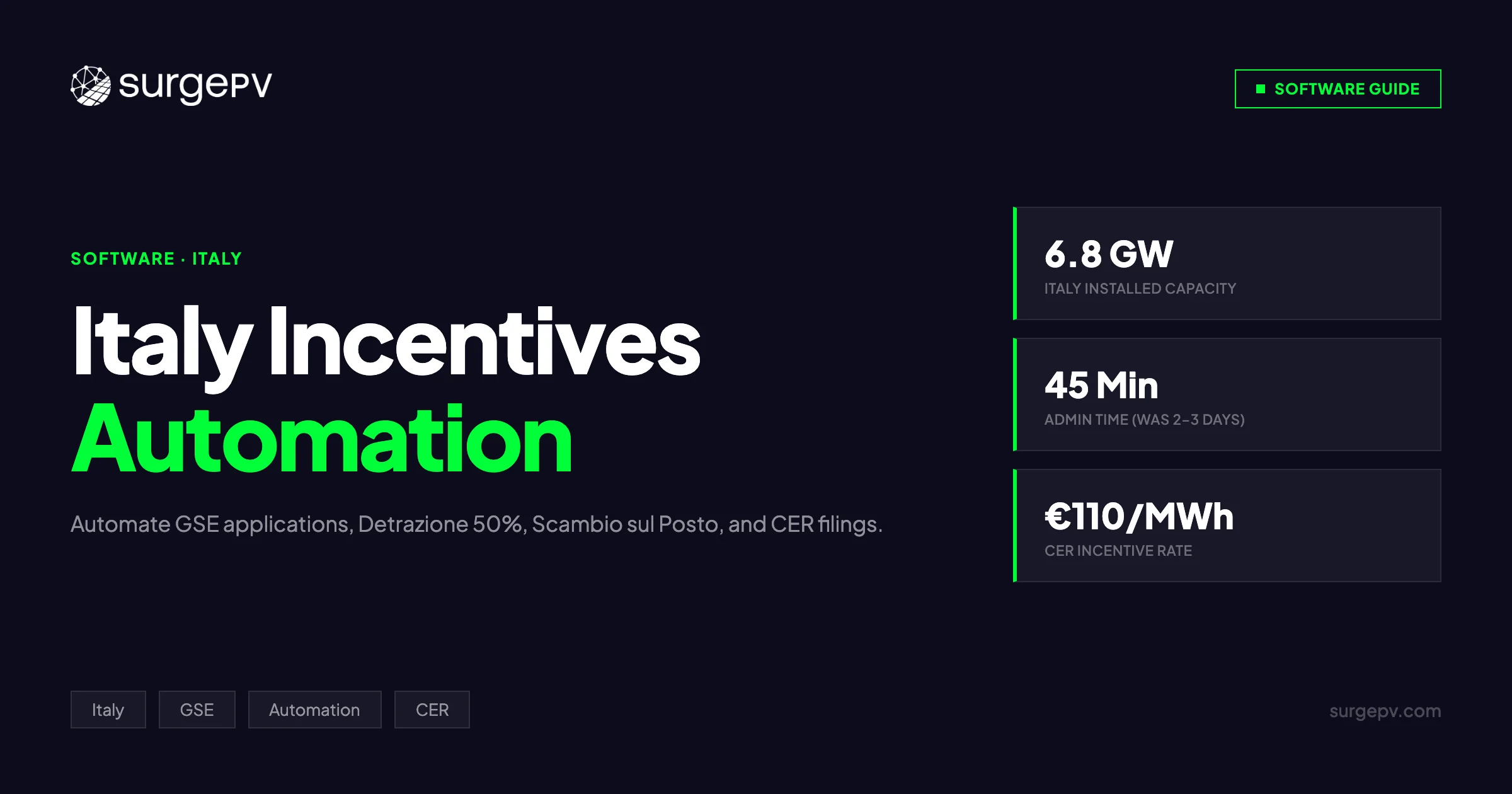
Italy’s solar market is growing faster than most installers can process paperwork. The country added 6.8 GW of new photovoltaic capacity in 2024 — a record — and the 2026 pipeline is larger still. But behind every installation sits a stack of incentive applications, compliance filings, and tax documentation that can take weeks to assemble manually. For small-to-medium installation companies, incentive administration has become the hidden cost that erodes margin and delays cash flow.
The good news is that nearly every document GSE requires can be generated automatically from data that already lives inside your design software. Panel count, inverter model, total kWp, irradiance values, annual yield estimates — all of it feeds directly into the forms that Scambio sul Posto, Ritiro Dedicato, and CER enrollment demand. What used to require a dedicated back-office coordinator copying numbers between a CAD file and a PDF form can now happen in the same session where you finalize the system design.
This guide covers the full Italy incentive stack as of 2026, maps every manual step in the application process to an automation opportunity, and shows how solar design software reduces incentive admin from days to under an hour per project.
TL;DR — Solar Incentives Italy Automation 2026
Italy’s incentive stack includes Detrazione Fiscale 50%, Scambio sul Posto net metering, Ritiro Dedicato, CER energy community incentives, and PNRR Agri-PV grants. Each requires GSE registration with technical documentation drawn from your system design. Software automation pre-fills GSE forms, generates Detrazione documentation packages, calculates CER incentive entitlements, and embeds incentive-adjusted ROI into customer proposals — turning a 2–3 day admin task into a 45-minute workflow per project.
In this guide:
- The complete Italy solar incentive stack — every active program in 2026 and eligibility rules
- The manual incentive application process — time per application, common errors, rejection rates
- What can be automated — GSE registration forms, compliance documents, incentive calculations, Detrazione packages
- How design software pre-fills GSE documentation from your system model
- CER incentive calculation automation — shared self-consumption entitlements
- ROI impact of faster applications — the real cost of delayed incentive payments
- Integrating incentive data into customer proposals — closing faster with accurate numbers
- SurgePV’s Italy-specific automation features
Latest Updates: Italy Solar Incentive Automation 2026
Italian solar incentive rules changed significantly between 2023 and 2026. The administrative machinery changed too — GSE launched a new version of its portal in late 2024, the CER decree introduced a new class of incentive calculations, and regional programs across Puglia, Lombardy, and Sicilia now require digital submissions that match GSE’s technical schema. Here is the current status of every program that matters for automation planning.
Italy Solar Incentive Status — March 2026
| Program | Status | Automation Priority | Key Documents |
|---|---|---|---|
| Detrazione Fiscale 50% (Ecobonus) | Active | High | Invoice package, technical spec, IRPEF declaration |
| Scambio sul Posto | Active | High | GSE portal form, technical annex, DSO connection letter |
| Ritiro Dedicato | Active | Medium | GSE contract, production meter data, IBAN |
| CER — Comunità Energetiche Rinnovabili | Active | High | Membership deed, virtual self-consumption calculation, GSE enrollment |
| PNRR Agri-PV Grants | Active | Medium | Agricultural land certification, system design file, yield projection |
| Superbonus (legacy claims) | Closing | Low | SAL certifications; no new applications |
| Regional grants (Puglia, Lombardy, Sicilia) | Active (budget-limited) | High | DSO approval, regional portal form, site photos |
Key Administrative Changes Since 2024
GSE portal v2 launched (Q4 2024). The new portal requires structured XML uploads for Scambio sul Posto applications rather than PDF attachments. Software that can export technical annexes in GSE’s schema format eliminates the most error-prone manual step — transcribing inverter model codes and kWp values from design files into XML fields by hand.
CER decree operationalized. Italy’s January 2024 CER decree came into full effect mid-2024. Energy communities now receive up to €110/MWh on shared virtual self-consumption for 20 years — but calculating the incentive entitlement requires simulating hourly production and consumption profiles across all member prosumers. This is not a calculation that can be done in a spreadsheet at scale.
Detrazione documentation requirements tightened. The Agenzia delle Entrate clarified in circular 17/2025 that Detrazione Fiscale claims must include a technical annex showing panel-level specifications and a signed dichiarazione di conformità. Claims submitted without the full package are being returned rather than processed — adding 60–90 days to the deduction cycle.
Regional program digitization. Puglia’s POR solar grant and Lombardy’s AxEL battery grant now require applications submitted through regional portals that validate against GSE’s national system registry. If your GSE registration data does not match what you submit regionally, both portals reject the application.
Key Takeaway — 2026 Documentation Standards
Every Italian solar incentive program now expects technical documentation that is traceable to a specific system design file. The shift from PDF attachments to structured data submissions means that software generating documentation directly from the design model is no longer just convenient — it is the only reliable way to avoid mismatches that trigger automatic rejections.
The Complete Italy Solar Incentive Stack
Understanding what each program requires administratively is the prerequisite for knowing what to automate. Here is the full 2026 incentive stack with the documentation burden for each.
Detrazione Fiscale 50% (Ecobonus)
The Detrazione Fiscale 50% is Italy’s primary residential solar incentive. It allows homeowners to deduct 50% of the total installation cost from their IRPEF income tax liability, spread over 10 annual installments. For a €9,000 residential system, this means €4,500 recovered over a decade — approximately €450 per year in tax savings.
Eligibility: Residential PV systems on principal or secondary residences. No capacity cap for the 50% rate (was previously capped, cap removed for 2024+). System must be installed by a registered electrical contractor and comply with CEI 0-21.
Documentation required:
- Contractor invoice showing itemized costs (panels, inverter, mounting, labor, permits, GSE fees)
- Technical datasheet with panel model, kWp total, inverter specifications
- Dichiarazione di conformità (CEI 0-21 compliance declaration)
- Bonifico bancario or postal payment receipt (payment must be made via traceable bank transfer — cash payments void the claim)
- IRPEF tax return with the deduction scheduled across 10 years
Administrative timeline (manual process): Collecting and formatting this documentation package typically takes 4–6 hours per project across the installer’s admin team and the customer’s accountant. Errors in the invoice format or missing inverter specification codes are the leading cause of claim returns.
What can be automated: The technical datasheet compiles directly from the design model. The invoice package format can be templated once and populated from project data. The 10-year deduction schedule calculates automatically from the invoice total.
Scambio sul Posto (Net Metering)
Scambio sul Posto is Italy’s net metering mechanism, administered by GSE. Under SSP, exported energy earns a compensation credit applied against the customer’s electricity bill — currently approximately €0.08–€0.13/kWh depending on grid tariff zone. Registration must be completed before the system is commissioned; retroactive applications are accepted but delay the compensation start date.
Eligibility: Systems up to 500 kWp. One SSP contract per POD (point of delivery). Incompatible with Ritiro Dedicato on the same meter. Storage systems are permitted.
Documentation required:
- GSE online portal application with structured technical annex
- System technical sheet: panel count, module model and Wp rating, inverter model and rated AC output, total kWp DC and kWp AC, POD code
- Grid connection authorization from DSO (Enel Distribuzione, A2A, or local operator)
- Commissioning certificate (dichiarazione di messa in servizio)
- Property or building authorization documents
- IBAN for compensation payment transfers
Administrative timeline (manual process): A complete SSP application with no errors takes 2.5–4 hours to prepare. The most common errors are: kWp totals that don’t match DSO records (because the design was modified after the permit was issued), inverter model codes entered incorrectly, and missing CEI 0-21 references. GSE’s rejection rate for first submissions runs approximately 18–22% across Italian EPCs — each rejection adds 3–6 weeks to the compensation start date.
What can be automated: The technical annex populates directly from the design model — panel count, module Wp, inverter model code, total kWp DC and AC. The POD code and DSO authorization import from the permit file. The commissioning date triggers automatic form generation.
Ritiro Dedicato
Ritiro Dedicato is GSE’s dedicated purchase program for surplus production above the Scambio sul Posto threshold, or for systems that prefer direct market sale over net billing. GSE purchases the surplus at the Ritiro Dedicato reference price — a monthly market-indexed rate published by ARERA.
Eligibility: Systems above 20 kWp are typically directed to Ritiro Dedicato for their surplus. Systems below 20 kWp may choose SSP or RD; combining them on the same POD is not permitted. Commercial and industrial systems over 200 kWp generally default to RD.
Documentation required:
- GSE RD contract application
- Production meter data (fiscal-grade meter required for systems above 20 kWp)
- System commissioning certificate
- IBAN for monthly settlement payments
What can be automated: Eligibility determination — software flags RD vs. SSP routing automatically based on system capacity and customer type. The contract application pre-fills from the design model.
CER — Comunità Energetiche Rinnovabili
CER energy communities are Italy’s fastest-growing incentive category for 2025–2026. Under the 2024 CER Decree, groups of prosumers sharing a distribution substation can form an energy community and receive up to €110/MWh on their hourly virtual self-consumption — the overlap between collective production and collective consumption in any given hour.
Eligibility: All members must connect through the same medium-voltage/low-voltage transformer (cabina di trasformazione secondaria). Communities can include residential, commercial, and municipal members. Minimum two members; no maximum. Systems must be registered with GSE separately before CER enrollment.
Documentation required:
- CER membership deed (statuto della comunità energetica)
- Individual GSE registrations for all prosumer systems
- Hourly energy production and consumption simulation for each member
- Aggregated virtual self-consumption calculation demonstrating incentive entitlement
- GSE CER enrollment application
Administrative timeline (manual process): For a 10-member CER, assembling the documentation package manually takes 3–5 days across the legal, technical, and administrative teams. The hourly simulation requirement is particularly burdensome — it requires 8,760 hourly data points per member, typically generated from meteorological data and consumption profiles.
What can be automated: Design software that includes hourly simulation generates the production profile automatically. Consumption profiles can be imported from smart meter data or estimated from building type. The virtual self-consumption overlap calculation — the core of the CER incentive entitlement — can be computed and documented in seconds.
PNRR Agri-PV Grants
Italy committed €1.5 billion in PNRR (Piano Nazionale di Ripresa e Resilienza) funds to agri-photovoltaic projects — solar installations co-located with active agricultural land, using elevated or bifacial panel configurations that preserve ground-level farming. Applications are managed through GSE with support from MASE (Ministero dell’Ambiente e della Sicurezza Energetica).
Eligibility: Land must be registered as agricultural in the catasto (land registry). Panels must be elevated or configured to maintain at least 70% of normal crop productivity (verified by an agronomist). Minimum system size: 200 kWp. Priority given to southern regions.
Documentation required:
- Agricultural land certification from catasto
- Agri-PV system design with panel elevation specifications and shading analysis
- Agronomist certification of crop compatibility
- Financial viability study
- GSE technical annex matching the design file
What can be automated: The system design file feeds directly into the GSE technical annex. Shading analysis outputs from the design tool satisfy the crop-compatibility documentation requirement. Financial viability calculations auto-populate from design data.
The Manual Incentive Application Process: Time, Errors, and Rejection Rates
Before mapping automation opportunities, it is worth understanding exactly where the time goes in a manual Italian solar incentive application workflow. Based on industry benchmarks from Italian EPC operators and the GSE’s own published statistics, here is what a fully manual process looks like.
Time Per Application (Manual Baseline)
| Application Type | Time Per Project (Admin Hours) | Leading Error Source | First-Submission Rejection Rate |
|---|---|---|---|
| Detrazione Fiscale package | 4–6 hours | Invoice format, missing annexes | ~12% |
| Scambio sul Posto registration | 2.5–4 hours | kWp mismatch, inverter codes | ~18–22% |
| Ritiro Dedicato contract | 1.5–2.5 hours | Meter class documentation | ~8% |
| CER enrollment (10 members) | 3–5 days | Hourly simulation, member docs | ~30% |
| PNRR Agri-PV application | 2–4 days | Agronomist cert, catasto match | ~25% |
| Regional grant (Puglia/Lombardy) | 4–8 hours | Portal schema mismatch | ~20–35% |
For a company installing 100 projects per year with an average two incentive applications per project, the manual administration burden runs 1,200–2,000 admin hours annually — roughly the equivalent of one full-time coordinator. At Italian administrative staff costs of €30,000–€45,000 per year, that is €30,000–€45,000 in overhead that automation can eliminate.
The Compounding Cost of Rejection
The more damaging cost is not the initial filing time — it is the rejection cycle. When GSE rejects an application, the 3–6 week delay before the compensation period begins represents real lost revenue. For a 6 kWp residential system exporting 2,000 kWh annually at €0.10/kWh, a 6-week delay costs the customer approximately €23 in lost compensation. Across 100 rejected applications per year, that is €2,300 in customer-facing losses — enough to trigger complaints and reputation damage that affects future sales.
For commercial systems, the stakes are higher. A 100 kWp commercial rooftop exporting 30,000 kWh annually at €0.10/kWh loses approximately €346 for every 6-week rejection delay. Installers who consistently deliver clean first-time submissions protect customer relationships and differentiate their service offering.
Pro Tip
Track your first-submission acceptance rate with GSE as a business KPI. Italian EPCs in the top quartile achieve 92–96% first-submission acceptance. The gap between top and bottom quartile performance is almost entirely explained by whether the company uses automated documentation generation or manual data entry — not by the quality of their technical work.
Common Errors That Trigger Rejection
kWp mismatch between design and application. The most common rejection cause. If the system design was modified after the permit was issued — even by one panel — and the application still reflects the original design, GSE flags the discrepancy. Software that generates the application directly from the current design file eliminates this error entirely.
Incorrect inverter model codes. GSE’s portal validates inverter model codes against a certified product registry. Manual transcription from a datasheet to a portal form introduces typos that trigger automatic rejection. Software with an inverter product database pre-populates the validated code.
Missing or incorrectly dated commissioning certificates. The commissioning date must match what the DSO has registered. If the installer submits the application before the DSO has updated its registry, the dates conflict. Software that pulls DSO confirmation data before generating the application prevents this.
Detrazione invoice format errors. The Agenzia delle Entrate requires invoices to separately itemize panels, inverter, mounting hardware, labor, and permit costs. A single-line “solar system installation” invoice is typically returned. Software with a pre-defined invoice template for Italian fiscal compliance generates the correct format automatically.
CER hourly simulation format errors. GSE’s CER portal requires hourly simulation data in a specific CSV format. Submissions in the wrong format are rejected regardless of whether the underlying numbers are correct.
What Can Be Automated: The Full Map
The following sections map every major documentation requirement to the design software feature that eliminates it.
GSE Registration Forms
Scambio sul Posto technical annex. Every field in the SSP technical annex corresponds to data that exists in your design model: panel count, module model, Wp per panel, total kWp DC, inverter model, rated AC output, total kWp AC, expected annual yield (kWh/year), POD code, installation address. Solar design software that exports directly to GSE’s technical annex format — including the XML schema required for the new portal — eliminates the transcription step entirely.
Ritiro Dedicato contract pre-fill. The RD contract requires system capacity, commissioning date, POD code, and IBAN. Three of these four fields are in the design model; the IBAN is entered once per customer. Full automation is achievable.
CER enrollment application. The CER application requires individual system registrations for all member prosumers plus the aggregated virtual self-consumption calculation. Software with multi-site design capability can generate all member technical annexes in one session and compute the VCS entitlement automatically.
Compliance Documentation
Dichiarazione di conformità (CEI 0-21). The compliance declaration requires inverter model, panel model, total kWp, and installer certification details. It follows a standardized format. Software pre-fills everything except the installer’s signature date.
Technical datasheets for Detrazione packages. The Agenzia delle Entrate’s Detrazione documentation requirement is essentially a well-formatted technical annex. The same data that feeds the GSE application feeds the Detrazione package — panel manufacturer and model, Wp rating, total kWp, inverter manufacturer and model, rated AC output, installation address, commissioning date.
Shading analysis for PNRR Agri-PV. The agronomist certification for agri-PV requires a shading analysis demonstrating that panel placement does not reduce crop productivity below 70%. Design software with 3D shading simulation generates this analysis automatically as part of the standard design workflow.
Incentive Calculations
Scambio sul Posto compensation estimate. The SSP compensation amount depends on the export/consumption overlap, the local grid tariff zone, and the ARERA-set compensation rate. Software that models the hourly consumption and production profile calculates the annual SSP compensation accurately — giving customers a reliable figure for their proposal rather than a range.
Detrazione 10-year deduction schedule. The deduction schedule is mechanical: (total_invoice_cost × 50%) ÷ 10 per year. Software generates it automatically and can format it for the accountant’s use.
CER virtual self-consumption entitlement. This is the most technically demanding calculation in the Italian incentive stack. VCS is calculated hourly: VCS(h) = min(total_production(h), total_consumption(h)). Over 8,760 hours per year, this requires a simulation engine. Design software with hourly yield modeling can compute VCS and the resulting annual incentive entitlement (VCS × €110/MWh) automatically.
Regional grant eligibility and amount. Regional programs have eligibility rules (system size, municipality population, building type) and grant amounts (€/kW or flat amounts). Software with a regional grant database checks eligibility automatically and includes the grant amount in the ROI calculation.
How Design Software Pre-Fills GSE Documentation
The technical data GSE requires for every application is a subset of what you generate during system design. The issue has always been the transfer — taking data from the design environment and entering it into government portals manually. Here is how that transfer works when it is automated.
The Design-to-Application Data Flow
When you finalize a system design in solar design software, you have already specified:
- Physical layout — panel count, orientation, tilt, row spacing, shading obstructions
- Equipment — panel manufacturer, model, Wp rating; inverter manufacturer, model, rated AC output; string configuration
- Performance — annual yield (kWh/year), monthly production profile, performance ratio, specific yield (kWh/kWp)
- Site — GPS coordinates, installation address, POD code (if linked), municipality and region
- Financial — system cost, component costs, labor
The GSE technical annex for Scambio sul Posto requires: panel count, module model, Wp rating, total kWp DC, inverter model, rated AC output, total kWp AC, annual yield estimate, and installation address. Every one of these fields is a direct export from items 1–4 above. The software does not need to calculate anything new — it formats and transmits data that already exists.
Inverter Code Validation
The most technically sensitive field in the GSE application is the inverter model code. GSE validates submissions against the Registro Nazionale degli Impianti — a national registry of certified equipment. If the model code entered does not match the registry exactly (including version suffixes like “-IT” or “-EU”), the application is rejected.
Solar software maintains a validated inverter database cross-referenced against GSE’s registry. When you select an inverter during system design, the software stores the GSE-validated code, not just the commercial model name. When the application generates, the validated code populates automatically — eliminating the most common single cause of SSP rejections.
DSO Coordination
The grid connection authorization from the DSO (Enel Distribuzione or local operator) is the one document that requires external coordination and cannot be auto-generated from design data. However, software can manage the status of DSO requests as part of the project workflow — tracking the request submission date, the expected response date, and flagging when the authorization arrives. When the authorization is received and uploaded to the project, it triggers automatic population of the GSE application fields that depend on DSO data (POD code, connection point voltage, meter identification).
Document Package Generation
Once the design is finalized and DSO authorization is on file, the complete GSE application package — technical annex, supporting documents, compliance declaration — generates in a single export. The package includes:
- Pre-filled GSE portal data export (XML format for the new portal)
- Technical annex PDF for the application file
- Equipment datasheets (pulled from the built-in product library)
- Dichiarazione di conformità template (pre-filled, requires installer signature)
- Checklist of items requiring customer action (payment via bonifico, IBAN for compensation)
Pro Tip
Generate the GSE documentation package at the same time as the customer proposal — not after commissioning. Having the application ready before installation removes the lag between commissioning and registration, ensuring the compensation period starts from day one. Customers who receive their SSP payment in the first billing cycle after installation report significantly higher satisfaction scores than those who wait 60+ days for a delayed registration.
CER Incentive Calculation Automation
Energy community (CER) incentive calculations are the most computationally intensive task in Italian solar finance. They require hourly simulation, member-level production and consumption profiles, and aggregated virtual self-consumption calculations across potentially dozens of prosumers sharing a distribution substation. Manual approaches — spreadsheet models built per community — are error-prone, slow to update, and nearly impossible to audit.
The Virtual Self-Consumption Calculation
Italy’s CER incentive is paid on virtual self-consumption (autoconsumo virtuale condiviso) — the hourly overlap between aggregate production and aggregate consumption within the community. The formula is simple; the data requirement is demanding.
For each hour h:
- Aggregate production P(h) = sum of all member production in hour h
- Aggregate consumption C(h) = sum of all member consumption in hour h
- Virtual self-consumption VCS(h) = min(P(h), C(h))
Annual incentive = sum of VCS(h) × €110/MWh for all 8,760 hours
For a 10-member CER with five prosumers (households with solar) and five consumers (households without solar), calculating this requires:
- 10 × 8,760 = 87,600 hourly data points for one year
- Production profiles derived from irradiance data for each system’s specific location, tilt, and azimuth
- Consumption profiles from smart meter data or statistical models by building type
- Aggregation and overlap calculation across all members
- Sensitivity analysis for different self-consumption scenarios (more consumers, seasonal variation, storage)
This is tractable for a software tool with an integrated hourly simulation engine. For a spreadsheet model built per project, it is a 2–3 day exercise that has to be repeated for every community — and repeated again whenever a member is added or removed.
CER Sizing Optimization
Beyond calculating the incentive for a proposed community configuration, software can optimize the configuration itself — identifying the mix of prosumers and consumers, the optimal panel orientation and capacity for each prosumer, and the total community size that maximizes VCS and therefore incentive revenue.
A community with 10 kWp of solar and 10 members consuming 50 kWh/day collectively may achieve 70–80% VCS in summer but drop to 20–30% in winter as production falls and heating consumption rises. Software that models this seasonality and suggests adding battery storage or additional prosumers to improve winter VCS provides a genuine design advisory service — not just a calculation.
CER Documentation Output
After the VCS calculation, software generates the documentation GSE requires for CER enrollment:
- Member-by-member production and consumption simulation (8,760-hour tables)
- Aggregated VCS calculation with hourly breakdown
- Annual incentive entitlement summary (€/year)
- Sensitivity table showing incentive range under low/mid/high production scenarios
- GSE CER enrollment data export in the required format
This documentation package, generated automatically from the design model and consumption inputs, satisfies the GSE CER enrollment requirement without manual calculation.
ROI Impact of Faster Incentive Applications
The financial argument for automation is not just about labor savings — it is about the time value of incentive payments. Italian solar projects are underwritten partly on the basis of incentive cash flows that start from commissioning. Every week of delay in GSE registration is a week of cash flow that does not materialize. This matters for project ROI, for customer satisfaction, and for installer cash flow where installation payments are partially tied to incentive enrollment confirmation.
The Cost of Delayed Scambio sul Posto Registration
Consider a 6 kWp residential system in Bari:
- Annual production: approximately 9,000 kWh (southern Italy irradiance)
- Self-consumption rate: 40% (3,600 kWh consumed, 5,400 kWh exported)
- SSP compensation rate: €0.11/kWh on exported energy
- Annual SSP compensation: 5,400 × €0.11 = €594/year
- Monthly SSP compensation: €49.50/month
A 6-week delay in SSP registration — a realistic outcome of a first-time rejection — costs the customer approximately €74 in lost compensation (1.5 months × €49.50). For the installer, a rejection means a follow-up call, a corrected submission, and customer friction. Across 100 projects per year with a 20% rejection rate, that is 20 rejections — each one costing the installer 2–3 hours of re-work and jeopardizing referrals.
The Cost of Delayed Detrazione Fiscale Claims
The Detrazione Fiscale 50% does not pay out as a cash refund — it reduces annual income tax liability over 10 years. A delay in filing the deduction does not directly cost the customer cash in the short term, but it does mean the first-year deduction (typically €450–€900 for residential systems) is not available in the tax year of installation.
For customers who are sold on the tax benefit as part of the ROI narrative, discovering that the Detrazione documentation was incomplete and the first-year deduction is deferred by one year creates a trust problem that affects referrals. Getting the documentation right — and providing customers with a complete package to hand to their accountant — is a service differentiator that high-performing Italian installers use explicitly in their sales process.
The Compounding ROI of Faster CER Enrollment
CER incentives are structurally different from SSP compensation — they are paid on shared self-consumption at €110/MWh, compared to SSP’s grid tariff-based rate. For a well-sized energy community with 60% VCS:
- 10 prosumers, 50 kWp total production
- Annual production: 62,500 kWh
- VCS at 60%: 37,500 kWh
- Annual CER incentive: 37,500 × €0.110 = €4,125/year shared across members
A 3-month delay in CER enrollment — realistic if documentation is assembled manually and returned once for errors — costs the community €1,031 in incentives that are not recoverable. Across a community that shares these benefits proportionally, each member loses approximately €103.
For installers who develop CER projects as a service line, the ability to enroll communities quickly and reliably is a direct competitive advantage. Communities that are enrolled within 30 days of commissioning generate better testimonials, faster referrals to neighboring buildings, and stickier ongoing relationships than those that take 3–6 months to activate.
Key Takeaway — The Time Value of Incentive Applications
Delayed incentive applications are not just an administrative inconvenience — they are a quantifiable financial loss for customers and a service quality problem for installers. For a portfolio of 100 projects per year, eliminating the 20–30% rejection rate through automated documentation generation recovers approximately €5,000–€15,000 in aggregate customer incentive value and 300–600 hours of installer admin time annually.
Integrating Incentive Data into Customer Proposals
The financial case for Italian solar is built on the combination of electricity savings, net metering compensation, tax deductions, and (where applicable) CER incentives and regional grants. A proposal that captures all of these elements accurately — with figures grounded in the actual system design rather than generic estimates — closes at a meaningfully higher rate than one that presents ranges or leaves incentive amounts vague.
This is where solar proposal software delivers the most visible impact. The design-to-proposal pipeline means that the SSP compensation figure, the Detrazione deduction schedule, and the CER incentive entitlement in the customer proposal are not estimates — they are calculated from the specific system designed for that customer’s roof.
What a Complete Italian Solar Proposal Includes
System design summary. Panel count, total kWp, inverter model, expected annual yield (kWh/year), and a satellite or 3D roof view showing panel placement. This is not just persuasive — it is what customers use to verify that the installer understood their site.
Annual production and self-consumption model. Monthly production breakdown, self-consumption estimate by month, estimated export by month. This feeds directly into the SSP and Ritiro Dedicato calculations.
Incentive stack summary. Itemized table showing:
- Detrazione Fiscale 50%: annual deduction amount × 10 years = total benefit
- Scambio sul Posto: estimated annual compensation (€/year)
- CER incentive (if applicable): estimated annual entitlement (€/year)
- Regional grant (if eligible): grant amount (€)
Electricity bill savings. Monthly savings from self-consumption at current tariff rates. Sensitivity analysis showing savings at +10%, +20% tariff scenarios (relevant given Italy’s volatile energy market).
ROI summary. Payback period, 10-year and 25-year cash flow, net present value using a 3% discount rate (conservative Italian benchmark). The payback calculation links directly to the generation financial tool framework — showing customers how production translates to financial return.
GSE registration timeline. A simple Gantt chart showing when the SSP application will be submitted, when approval is expected, and when the first compensation payment will arrive. Customers who see this timeline close faster because the abstract benefit becomes a concrete schedule.
Incentive-Adjusted Payback Periods for Italian Proposals
| System Size | Region | Base Payback (Savings Only) | With Detrazione 50% | With SSP | With SSP + Detrazione | With SSP + Detrazione + CER |
|---|---|---|---|---|---|---|
| 6 kWp residential | Bari (South) | 8.2 years | 5.8 years | 7.1 years | 5.1 years | 4.4 years |
| 6 kWp residential | Rome (Centre) | 9.1 years | 6.4 years | 7.9 years | 5.6 years | 4.9 years |
| 6 kWp residential | Milan (North) | 10.8 years | 7.6 years | 9.3 years | 6.6 years | 5.8 years |
| 20 kWp commercial | Bari (South) | 6.5 years | N/A (commercial) | 5.8 years | 5.8 years | 4.9 years |
| 50 kWp commercial | Rome (Centre) | 7.2 years | N/A | 6.3 years | 6.3 years | 5.2 years |
These figures are illustrative benchmarks. The actual payback period for any specific project depends on the site’s irradiance, the customer’s self-consumption profile, the system cost, and the applicable incentive rates at the time of application. Software calculates these figures project-by-project from real design data — not from lookup tables.
Proposal Credibility as a Sales Tool
Italian customers are more financially literate about solar than the European average. Italy’s long experience with Conto Energia, Superbonus, and now CER means that many homeowners and business owners have encountered solar installers before — and have learned to ask about the specifics of incentive claims. A proposal that says “you may be eligible for a 50% tax deduction” loses to one that says “your Detrazione Fiscale deduction is €4,275, payable as €427.50 per year against your IRPEF from 2026 through 2035.”
The specificity that proposal software enables — figures drawn from a real design, not a generic estimate — is the most powerful trust signal available in Italian solar sales. Customers who receive a proposal with accurate, itemized incentive calculations are less likely to ask for competitive quotes and more likely to sign within the same week.
For further context on Italian solar economics, see our detailed analysis of solar panel ROI in Italy and the Italy Superbonus solar guide.
See Italy Incentive Automation in Action
Book a live walkthrough of how SurgePV generates GSE documentation packages, calculates CER entitlements, and builds incentive-adjusted proposals for Italian solar projects.
Book a DemoNo commitment required · 20 minutes · Live project walkthrough
SurgePV’s Italy-Specific Features
SurgePV was designed for the specifics of European solar markets, with Italy’s incentive complexity as a primary design constraint. The following features address the documentation burden described throughout this guide.
GSE Documentation Package Generator
After finalizing a system design, SurgePV generates the complete GSE application package with a single export action. The package includes:
- Scambio sul Posto technical annex — pre-filled from design data, exported in GSE’s XML schema format for the v2 portal
- Equipment datasheets — pulled from SurgePV’s built-in product library, which includes GSE registry validation codes for all listed inverters
- Dichiarazione di conformità template — pre-filled with system and installer details, requiring only a signature
- Application checklist — items requiring customer action (bonifico payment, IBAN provision, DSO coordination status)
The package generates in under 2 minutes from a completed design. The same design data feeds the Detrazione Fiscale documentation package simultaneously.
Detrazione Fiscale Documentation Builder
SurgePV’s Detrazione builder generates the complete documentation set for Italian income tax deduction claims:
- Itemized invoice template — separating panels, inverter, mounting hardware, labor, permits, and GSE fees in the format required by Agenzia delle Entrate
- Technical annex — panel and inverter specifications, total kWp, commissioning date
- 10-year deduction schedule — showing annual IRPEF deduction amount for each year 2026–2035 (or the relevant 10-year window)
- Customer summary — a one-page summary formatted for the customer’s accountant
CER Simulation and Incentive Calculator
SurgePV’s CER module handles energy community design from site selection through incentive calculation:
- Multi-site design — design individual systems for each prosumer member in a shared workspace
- Hourly production simulation — generates 8,760-hour production profiles for each member system using TMY (typical meteorological year) irradiance data
- Consumption profile import — import smart meter data or use built-in statistical profiles by building type (residential, commercial, institutional)
- Virtual self-consumption calculation — computes hourly VCS across all members, aggregates annual entitlement
- Incentive sensitivity analysis — shows how incentive changes if storage is added, if new members join, or if consumption patterns shift seasonally
- GSE CER enrollment export — generates the documentation package for GSE CER enrollment application
Regional Grant Eligibility Engine
SurgePV maintains an updated database of active regional grant programs across Italy, including Puglia POR Solar, Lombardy AxEL, Sicilia FESR, and others. When a project address is entered, the eligibility engine automatically checks:
- Municipality population (relevant for Puglia POR threshold)
- Region-specific program availability and current allocation status
- Grant amount based on system size
- Application portal link and deadline (where published)
Eligible grants are automatically included in the project’s ROI calculation and flagged in the customer proposal.
Italy-Specific Proposal Templates
SurgePV’s Italian proposal templates include:
- Incentive stack table with all applicable programs itemized
- Payback period chart showing cumulative cash flow with and without each incentive
- GSE registration timeline (commissioning → application → approval → first payment)
- Detrazione deduction calendar showing annual tax savings through the 10-year window
- CER incentive projection (for community projects)
- Regulatory footnotes referencing the relevant Italian law for each incentive claim
These templates use real figures from the system design — not placeholder ranges — because the design data is already present in the software when the proposal is generated.
Bill of Materials for Italian Compliance
Italian solar projects require a bill of materials that satisfies both GSE registration and Detrazione documentation requirements. SurgePV generates a BOM that includes GSE registry-validated equipment codes alongside commercial specifications. For more detail on Italian BOM requirements, see our guide to solar bill of materials software in Italy.
Building an Efficient Italy Incentive Workflow
The technology is only as effective as the workflow it supports. Here is a recommended process sequence for Italian solar companies using automation tools to manage their incentive pipeline.
Phase 1: Pre-Sale (Before Proposal)
- Design the system in your solar design software — full panel layout, equipment selection, shading analysis
- Run the regional grant eligibility check — confirm which programs the project qualifies for
- Generate the incentive stack summary — SSP estimate, Detrazione schedule, CER entitlement if applicable
- Build the customer proposal with live figures from the design — not generic estimates
At this stage, the GSE documentation is already 80% complete in the background. The proposal closes on real numbers.
Phase 2: Post-Sale (Before Installation)
- Initiate DSO connection request — the one external coordination step that requires lead time
- Confirm customer’s IBAN for compensation payments
- Verify that panel and inverter model codes in the design match products actually being ordered — if there is a substitution, update the design before generating application documents
- Pre-generate the SSP technical annex — review for any fields requiring external data (POD code from DSO)
Phase 3: Post-Commissioning (Within 5 Business Days)
- Upload DSO authorization and commissioning certificate to the project file
- Trigger final document package generation
- Submit SSP application to GSE portal (upload XML export directly)
- Send Detrazione package to customer for accountant delivery
- If CER project: submit CER enrollment application with VCS documentation
- Log submission date and track GSE response timeline in project management system
Phase 4: Incentive Tracking
- Monitor GSE portal for application status
- Verify first SSP compensation appears in customer’s electricity bill (typically within 60 days of approval)
- Confirm CER incentive first payment (quarterly payment cycle from GSE)
- Archive completed incentive documentation in project file for 10-year Detrazione audit period
This four-phase workflow, supported by automation at every documentation-generation step, reduces total incentive administration per project from 8–12 hours to under 2 hours — including the steps that still require human judgment.
Frequently Asked Questions
How can software automate Italian solar incentive applications?
Solar design software automates Italian incentive applications by pulling system specifications — panel count, inverter size, AC/DC capacity, commissioning date — directly from the design model and pre-filling GSE registration forms for Scambio sul Posto and Ritiro Dedicato. It auto-generates the technical annexes, compliance declarations, and Detrazione Fiscale documentation packages that used to require manual data entry across multiple portals. The result is a process that takes 45 minutes instead of 2–3 days.
What documents does GSE require for Scambio sul Posto registration?
GSE’s Scambio sul Posto registration requires: the system technical datasheet (panel specs, inverter model, total kWp), a site plan showing panel placement, the grid connection approval letter from your DSO (Enel Distribuzione or local operator), the commissioning certificate (dichiarazione di conformità CEI 0-21), property documentation, and the completed GSE portal application with IBAN for compensation payments. Software that auto-populates these fields from the design file eliminates the most common rejection triggers — mismatched kWp figures and missing inverter certification codes.
What is the GSE portal v2 and how does it change the application process?
GSE launched an updated portal in Q4 2024 that requires structured XML uploads for Scambio sul Posto technical annexes rather than PDF attachments. This means manual transcription from a PDF into the portal no longer works — the submission must conform to GSE’s XML schema. Solar design software that exports directly to this schema format is now essentially required for efficient SSP registration; manual workarounds add 4–6 hours per application to reformat data.
How is the CER virtual self-consumption incentive calculated?
Italy’s CER incentive (up to €110/MWh) is calculated on virtual self-consumption — the hourly overlap between total community production and total community consumption. For each of the 8,760 hours in a year, the VCS equals the lesser of aggregate production and aggregate consumption. The annual incentive is the sum of VCS(h) × €110/MWh across all hours. This requires hourly simulation of production (from irradiance data and system specs) and consumption (from meter data or statistical profiles) for every community member — a calculation that is impractical to perform manually at scale.
What is the first-submission rejection rate for GSE applications and how can automation reduce it?
Italian EPCs report first-submission rejection rates of 18–22% for Scambio sul Posto applications and up to 30–35% for CER enrollments when assembled manually. The leading causes are kWp mismatches between design files and application forms, incorrect inverter model codes, and format errors in technical annexes. Automation reduces rejections by generating application data directly from the validated design model — eliminating transcription errors — and by using GSE registry-validated inverter codes rather than commercial model names. High-performing Italian EPCs using automated documentation tools achieve 92–96% first-submission acceptance.
Can Italian regional grants be claimed alongside national incentives?
Most Italian regional grants can be stacked with national incentives, but there are program-specific rules. Puglia’s POR Solar grant is compatible with Detrazione Fiscale 50% and Scambio sul Posto. However, some regional grants specifically exclude Superbonus-eligible projects, and certain PNRR-funded programs restrict stacking with other public grants. Software with a regional grant eligibility engine checks compatibility rules automatically and flags conflicts before documentation is generated — preventing applications that would be rejected for incompatibility at the regional portal.
How long does GSE take to approve Scambio sul Posto applications?
GSE’s stated processing time for SSP applications is 30 business days (approximately 6 weeks) from the date of a complete submission. In practice, applications with no errors are often processed in 20–25 business days. Rejected applications restart the clock — adding another 30-business-day window after resubmission. This means the gap between commissioning and first compensation payment ranges from approximately 5 weeks (clean submission, fast processing) to 14+ weeks (one rejection and resubmission). Automation that achieves high first-submission acceptance keeps the average at the short end of this range.
How does incentive automation affect customer proposal close rates?
Proposals that include specific, design-derived incentive figures — the actual annual SSP compensation amount for this roof and this system, the actual Detrazione deduction per year for this invoice total — consistently outperform proposals with generic ranges. Italian customers who have researched solar independently recognize the difference between a calculated figure and a placeholder estimate. Installers who use solar proposal software with live incentive calculations report 15–25% higher close rates on qualified leads, and significantly shorter time-to-signature — typically 3–7 days versus 14–21 days for proposals with generic incentive estimates.