
Italy has spent over €120 billion on building energy incentives since 2020 — the most aggressive residential retrofit program in European history. At the center of that effort was the Superbonus 110%, a scheme that let homeowners recover more than their entire solar installation cost through tax credits. That program is now largely closed. But Italy’s solar incentive market did not disappear — it restructured.
In 2025 and 2026, the Ecobonus (50% deduction), Conto Termico 2.0, and regional EU-funded programs across Sicily, Sardinia, and Calabria remain active. For homeowners and solar installers operating in Italy, knowing which programs are live, which are expired, and how to maximize what remains is what separates a well-structured project from a missed opportunity.
This guide covers the full arc: what the Superbonus 110% was, what replaced it, how Sicily’s regional programs work, the step-by-step application process for current deductions, and real ROI calculations with and without incentives.
TL;DR — Italy Superbonus & Solar Incentives 2026
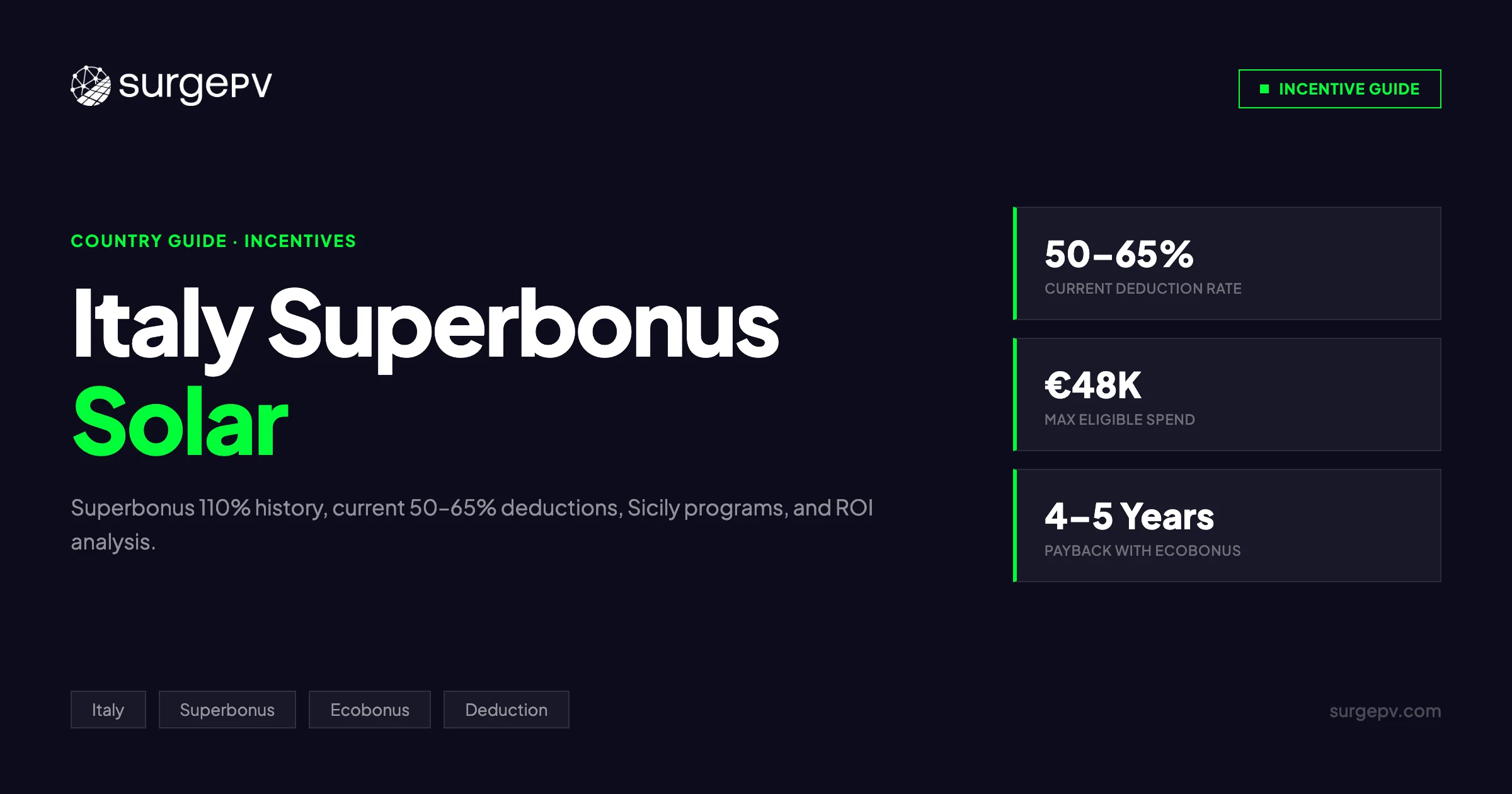
Superbonus 110% is effectively closed for new applicants. Active solar incentives: Ecobonus 50% (max €48,000 eligible expense, 10-year deduction), Conto Termico 2.0 (up to 65% for solar thermal), and regional EU grants in Sicily, Sardinia, and Calabria. Pay via bonifico parlante, submit ENEA form within 90 days, claim on annual tax return. Sicily has additional FESR Sicilia grants. ROI with Ecobonus: 4–5 years on a standard 6 kWp system.
In this guide:
- Current status of every Italian solar incentive program (updated March 2026)
- The full history of Superbonus 110% — how it worked, why it ended
- Current deductions: Ecobonus 50%, Ecobonus 65%, Conto Termico 2.0
- Superbonus Sicily — regional programs and how to access them
- Step-by-step application process for the Ecobonus in 2025–2026
- ROI examples with and without deductions for a 6 kWp system in Rome and Palermo
- The most common mistakes that void eligibility
- FAQ: every key question answered
Latest Updates: Italy Superbonus News 2025–2026
For anyone searching for italy superbonus news today 2025, here is the current status of every relevant program as of March 2026.
Italy Solar Incentive Status — March 2026
| Program | Rate | Status | Notes |
|---|---|---|---|
| Superbonus 110% | 110% | Closed (new applications) | Still paying out for pre-2023 approved projects |
| Superbonus 70% | 70% | Very limited | Low-income / IACP social housing only |
| Ecobonus — Solar PV | 50% | Active | Standard residential, 10-year deduction |
| Ecobonus — High-Performance | 65% | Active | With qualifying energy class improvement |
| Conto Termico 2.0 | Up to 65% | Active | Solar thermal + renewable heating |
| Bonus Facciate | 90% | Expired (Dec 2023) | No longer claimable for new work |
| Sicily FESR Sicilia 2021–2027 | Variable | Active | Check current open windows at regione.sicilia.it |
| GSE Scambio sul Posto (Net Metering) | Per-kWh | Active | Applies regardless of other bonuses |
Key Changes Since 2024
January 2024 — Superbonus rate cut from 90% to 70% for most households. The 110% rate ceased entirely for new applications from most property categories.
June 2024 — Invoice discounting (sconto in fattura) and credit transfer (cessione del credito) were banned for new Superbonus projects under Law 11/2023 and subsequent amendments, effectively eliminating zero-cost installation for new applicants. Only direct tax deduction remains.
January 2025 — Superbonus 65% introduced briefly for first-home owners in earthquake zones, then extended narrowly. Most homeowners now fall under the standard Ecobonus framework.
2026 Outlook — No reinstatement of 110% is expected. EU-funded regional programs (Sicily, Sardinia, Calabria, Campania) are the primary source of supplemental grants for Southern Italy. Italy’s PNRR commitments maintain the Ecobonus framework through at least 2026.
Key Takeaway — The Transition Is Complete
Superbonus 110% as a mass-market program is over. The Ecobonus at 50–65% is now Italy’s primary solar deduction mechanism. The financial logic changes: instead of recovering more than you spend, you recover half your costs over 10 years — which still delivers a 4–5 year effective payback on well-designed Italian solar systems.
What Was the Superbonus 110%?
Origin: Decree-Law 34/2020 and Italy’s Green Recovery
The Superbonus 110% was launched under Decree-Law 34/2020, known as the “Decreto Rilancio,” in May 2020. It emerged during Italy’s COVID-19 economic recovery period as a dual-purpose instrument: stimulate construction employment and accelerate building decarbonization.
Italy’s building sector accounts for roughly 40% of national energy consumption — the highest share in Europe. Policymakers saw deep renovation as the fastest route to both economic stimulus and emissions reduction.
The scheme’s core promise: spend money on qualifying energy upgrades, and the government returns 110% of that spend through tax credits. No net cost, in theory. In many cases, a net gain.
The results were transformative — and expensive. Between 2020 and 2023, Italy disbursed over €120 billion in Superbonus-related claims. Residential solar installations tripled over the same period, reaching nearly 5 GW of newly installed capacity. The scheme generated genuine energy transition progress, but also massive fiscal strain that ultimately led to its curtailment.
How the 110% Deduction Worked
The Superbonus operated through a 110% tax credit on qualifying renovation costs, recovered via one of three routes:
Route 1 — Direct tax deduction: Credit spread over 4 years (condominiums) or 5 years (individuals) and applied against income tax (IRPEF). Required sufficient tax liability to absorb the credit.
Route 2 — Invoice discount (sconto in fattura): The installer reduced the invoice by the full 110% credit value and then sought reimbursement from the state. This created zero-upfront-cost installations for the homeowner. Now banned for new projects.
Route 3 — Credit transfer (cessione del credito): The homeowner sold the tax credit to a bank or financial institution at approximately 95–100% face value, receiving cash. The bank then claimed the deduction against its own tax position. Also now banned for new projects.
The intervention hierarchy used two categories:
- Trainante (leading) interventions — thermal insulation of the building envelope, replacement of heating/cooling systems, seismic reinforcement. These unlocked Superbonus eligibility.
- Trainato (linked) interventions — solar PV, battery storage, EV chargers, window replacement. These could only qualify when installed alongside a trainante intervention.
Solar panels alone did not qualify. Solar plus insulation, or solar plus heat pump — these combinations qualified fully.
Spending Caps Under Superbonus 110%
| Intervention Type | Maximum Eligible Expense |
|---|---|
| Thermal insulation (single-family) | €50,000 |
| Heating system replacement (single-family) | €30,000 |
| Solar PV (trainato, single-family) | €48,000 |
| Battery storage (trainato) | €48,000 combined with PV |
| EV charging station (trainato) | €2,000 per unit |
A homeowner who installed insulation + solar + battery could theoretically claim €128,000 at 110%, recovering €140,800 in tax credits on €128,000 in spend — a net gain of €12,800 before any energy savings.
Why the Superbonus Ended
Three factors drove the curtailment:
1. Fiscal cost overrun. Initial projections estimated the scheme at €30 billion over its lifetime. Actual disbursements exceeded €120 billion by 2023. The structural deficit impact forced government intervention.
2. Fraud. The credit transfer mechanism created opportunities for fraudulent credit generation — phantom renovations producing sellable tax credits. The Italian Revenue Agency (Agenzia delle Entrate) estimated over €9 billion in fraudulent claims before controls were tightened.
3. EU fiscal rules. Italy’s return to EU deficit-reduction frameworks under the Stability and Growth Pact made open-ended incentive commitments fiscally incompatible with its PNRR commitments.
The program leaves a genuine legacy: millions of Italian homes are better insulated, more energy-efficient, and increasingly solar-powered. But new applicants must work with the successor framework.
Current Solar Bonuses in Italy (2025–2026)
What replaced the Superbonus? Italy did not abandon solar incentives — it reverted to the Ecobonus framework that predated the Superbonus and updated Conto Termico 2.0, while preserving GSE net metering for all solar generators.
Ecobonus — 50% Solar PV Deduction
The Ecobonus is Italy’s foundational energy efficiency tax deduction, continuously active since 2013. For solar PV installations in 2025–2026:
| Parameter | Detail |
|---|---|
| Deduction rate | 50% of eligible costs |
| Maximum eligible expense | €48,000 |
| Maximum total deduction | €24,000 |
| Repayment structure | 10 equal annual installments |
| Annual deduction per year | Up to €2,400 |
| Required payment method | Bonifico parlante (tax-tracked bank transfer) |
| ENEA submission deadline | Within 90 days of work completion |
| Eligible works | PV system + inverter + mounting + electrical connection |
| Ineligible costs | Scaffolding, VAT for non-residential, permit fees |
The Ecobonus applies to the first-home (abitazione principale) and other residential properties. Rental properties qualify under certain conditions, though the deduction goes to the property owner, not the tenant.
Ecobonus — 65% for Qualifying Energy Upgrades
A higher 65% deduction applies when solar installation is combined with a qualifying energy efficiency upgrade that achieves a measurable improvement in the building’s energy performance class (APE certificate). Common combinations that unlock the 65% rate:
- Solar PV + heat pump replacement
- Solar PV + thermal insulation improving the building by at least one energy class
- Solar PV + solar thermal system for water heating
The 65% rate uses the same €48,000 spending cap, delivering a maximum deduction of €31,200 over 10 years.
Pro Tip — Pair Solar with a Heat Pump to Unlock 65%
If you are replacing an aging gas boiler with a heat pump, adding solar PV to the same project triggers the 65% Ecobonus rate instead of 50%. On a €20,000 combined project, that means €13,000 in deductions versus €10,000. The heat pump also benefits from its own separate Ecobonus eligibility.
Conto Termico 2.0 — Solar Thermal Incentive
Conto Termico 2.0 is a direct incentive managed by GSE (Gestore dei Servizi Energetici) for thermal energy from renewable sources. It covers solar thermal collectors (not photovoltaic electricity), heat pumps, and biomass systems.
| Parameter | Detail |
|---|---|
| Managing body | GSE (Gestore dei Servizi Energetici) |
| Incentive rate | Up to 65% of eligible costs |
| Maximum incentive | Varies by system size and type |
| Payment structure | Annual installments over 2–5 years |
| Eligible systems | Solar thermal collectors, heat pumps, biomass |
| Application portal | gse.it/servizi-per-te/efficienza-energetica/conto-termico |
Conto Termico is distinct from the Ecobonus — you cannot claim both for the same equipment. For solar thermal, Conto Termico typically offers better economics than the Ecobonus.
GSE Scambio sul Posto — Net Metering
All solar PV systems in Italy can register with GSE for the Scambio sul Posto (net metering) program, regardless of which deduction they use. This program compensates solar owners for surplus energy exported to the grid.
Current key parameters (2026):
- Virtual net metering — compensation calculated annually by GSE
- Compensation rate varies based on GSE’s annual energy price determination
- Applicable to systems up to 500 kW
- Registration via GSE’s online portal within 60 days of commissioning
Net metering income is separate from tax deductions and compounds the financial case for solar across all incentive regimes.
Bonus Solare Italia — What the Keyword Covers
Searches for “bonus solare italia” typically refer to the combination of Ecobonus + net metering that makes up Italy’s current solar incentive package. There is no single program called “Bonus Solare” — the term is colloquial shorthand for the overall incentive stack available to Italian solar homeowners.
For Italian installers preparing proposals, solar proposal software that accurately models the 10-year Ecobonus deduction schedule alongside net metering income and electricity bill savings produces the most compelling client-facing financial case.
Superbonus Sicily
The North-South Access Gap
Sicily is a useful case study in how a national incentive program can be structurally undermined by regional capacity constraints. Despite having among the best solar irradiance in Europe — averaging 1,700–1,900 kWh/m²/year compared to 1,100–1,400 in Northern Italy — Sicily consistently underperformed national Superbonus uptake rates.
By the end of 2023, Lombardy had captured over 15% of national Superbonus disbursements. Sicily, with comparable population-adjusted eligibility, captured approximately 6%. The reasons:
- Installer density. Sicily had fewer SOA-certified installers and fewer ENEA-experienced engineers per eligible household.
- Municipal processing delays. CILA permits (Comunicazione Inizio Lavori Asseverata) took 3–6 months in some Sicilian municipalities versus weeks in Northern Italy.
- Credit market access. Southern Italian homeowners had less access to the bank credit transfer market, making invoice discounting harder to execute.
- Income constraints. The Superbonus was more valuable to higher-income households with larger tax liabilities to absorb credits. Income levels in Sicily are lower than the national average.
Sicily FESR Sicilia 2021–2027
The most important current regional program for Sicilian solar is FESR Sicilia (Fondo Europeo di Sviluppo Regionale) 2021–2027, funded through EU Structural Funds. Unlike the national Ecobonus, FESR programs provide direct grants — cash payments, not tax deductions — making them more accessible to lower-income households.
Current FESR Sicilia energy-related programs include:
- Azione 3.1 — Efficienza Energetica Abitativa: Grants for residential energy efficiency upgrades including solar PV, available to homeowners and condominium associations
- Azione 4.1 — Rinnovabili e Autoproduzione: Support for renewable energy self-production at household and community level
Grant amounts vary by project size and applicant income. Application windows open periodically — check the official Sicilian region portal at regione.sicilia.it or the dedicated FESR portal for current open calls.
Key Takeaway — Sicily Solar in 2026
Sicilian homeowners have access to two overlapping incentive layers: the national Ecobonus (50–65%) and regional FESR Sicilia grants. The combination can reduce net solar installation cost by 60–70% in qualifying scenarios. Grant windows open and close — check regione.sicilia.it before starting a project to align timing with open calls.
Stacking National and Regional Programs in Sicily
A Sicilian homeowner installing a 6 kWp solar system in 2026 could access:
| Incentive Layer | Type | Value (6 kWp, €9,000 system) |
|---|---|---|
| Ecobonus 50% | Tax deduction over 10 years | €4,500 |
| FESR Sicilia grant (example) | Direct cash grant | €1,500–€3,000 |
| GSE Scambio sul Posto | Annual income from net metering | €150–€250/year |
| Total non-energy benefit | €6,000–€7,500 |
The combination produces an effective net system cost of €1,500–€3,000 on a €9,000 installation — making Sicily potentially one of the most financially attractive solar markets in Europe when regional programs are active.
Regional Solar Situation: Beyond Sicily
Other Southern Italian regions with active EU-funded solar programs in 2025–2026:
| Region | Program | Status |
|---|---|---|
| Sardinia | POR FESR Sardegna 2021–2027 | Active — check open calls |
| Calabria | POR FESR Calabria | Active — periodic windows |
| Campania | Campania FESR | Active |
| Puglia | FESR Puglia | Active — strong solar history |
Northern Italy relies more heavily on the national Ecobonus framework, with fewer regional supplement programs. The EU-funded regional programs disproportionately benefit Southern Italy — a deliberate structural choice to address energy poverty and infrastructure gaps.
How to Claim Solar Tax Deductions in Italy
The Correct Application Sequence
The most important rule in Italian solar deductions: payment method controls everything. If you do not pay via bonifico parlante (a specific bank transfer type that records tax-deduction intent), the deduction is void. No exceptions.
Step 1 — Select a certified installer
Your installer must hold the appropriate professional certification (SOA OS30 for energy systems, or equivalent). Not every solar company qualifies. Ask for their certification number before signing a contract. The Ecobonus specifically requires that the installer issue invoices with all legally required details.
Step 2 — Obtain an energy performance certificate (APE)
If you are claiming the 65% Ecobonus (energy class improvement required), you need an APE (Attestato di Prestazione Energetica) both before and after the installation. The pre-installation APE establishes the baseline. The post-installation APE must show an improvement of at least one energy class.
For the standard 50% Ecobonus for solar PV alone, a pre-installation APE is not mandatory, but is recommended for documentation completeness.
Step 3 — Pay via bonifico parlante
All payments must be made via this specific bank transfer that includes:
- The tax code (codice fiscale) of the property owner
- The VAT number of the installer
- The specific ENEA/tax deduction purpose statement (causale)
Most Italian banks have a dedicated “bonifico per ristrutturazioni/risparmio energetico” option in online banking. Use it — a standard bank transfer does not qualify.
Step 4 — Collect all documentation
Required documents before ENEA submission:
- Invoices from the installer (including detailed cost breakdown)
- Proof of payment via bonifico parlante (bank statement)
- Technical datasheet of installed panels and inverter
- Installation certificate from the installer
- Post-installation APE (if claiming 65% rate)
- Photos of the installation (recommended)
Step 5 — Submit the ENEA form within 90 days of completion
Visit detrazionifiscali.enea.it to submit the required technical information within 90 days of the installation completion date. Late submission voids the deduction.
The ENEA form requires:
- Property address and cadastral data
- Type of intervention performed
- Total cost of works
- Energy data of installed equipment
- Installer’s details
ENEA assigns a protocol number upon successful submission — save this. It is your proof of compliance.
Step 6 — Claim on your annual tax return
The deduction is claimed in 10 equal annual installments on your income tax return (Modello 730 for employees, Modello Redditi for self-employed/businesses). The deduction code for solar PV Ecobonus is E8 (50%) or E6 (65% with energy class improvement).
If your annual tax liability is lower than your annual deduction installment, the unused portion is lost — it cannot be carried forward. Taxpayers with low income should model their deduction absorption capacity before proceeding.
Pro Tip — Use a CAF or Commercialista
Italian tax returns for energy deductions involve multiple supporting forms (Quadro E). If you are not familiar with Italian tax filings, engaging a CAF (Centro di Assistenza Fiscale) or commercialista (tax advisor) for the deduction claim is worth the cost. Errors in the tax return can trigger recovery demands from Agenzia delle Entrate years later.
Tracking Your ENEA Status
After submission, you can track the status of your ENEA registration at detrazionifiscali.enea.it using your protocol number and fiscal code. Check within 30 days of submission:
- “In lavorazione” — processing
- “Approvata” — approved, deduction is validated
- “Integrazione richiesta” — additional documents required — respond promptly
Superbonus + Solar ROI Examples
Example 1: 6 kWp System in Rome (Lazio) — Ecobonus 50%
| Parameter | Value |
|---|---|
| System size | 6 kWp |
| Gross installed cost | €9,000 |
| Ecobonus 50% deduction | €4,500 (spread over 10 years) |
| Annual deduction value | €450/year |
| Annual electricity production | ~8,100 kWh |
| Self-consumption (65%) | ~5,265 kWh |
| Grid export (35%) | ~2,835 kWh |
| Electricity rate (avoided) | €0.28/kWh |
| Annual electricity bill saving | €1,474 |
| Annual net metering income | €200 |
| Total annual financial benefit | €1,674 |
| Effective net investment (post-deduction PV) | €4,500 |
| Payback period (with deductions) | ~2.7 years |
| Payback period (without deductions) | ~5.4 years |
Note: Deductions reduce effective investment but are received over 10 years, not upfront. True cash payback accounting for the deduction schedule is approximately 4–5 years on a net-present-value basis.
Example 2: 6 kWp + 5 kWh Battery in Rome — Ecobonus 50%
| Parameter | Value |
|---|---|
| System size | 6 kWp + 5 kWh battery |
| Gross installed cost | €14,000 |
| Ecobonus 50% deduction | €7,000 (€700/year over 10 years) |
| Annual electricity production | ~8,100 kWh |
| Self-consumption with battery (80%) | ~6,480 kWh |
| Annual electricity bill saving | €1,814 |
| Annual net metering income | €110 |
| Total annual financial benefit | €1,924 |
| Effective net investment (post-deduction PV) | €7,000 |
| Payback (with deductions, NPV basis) | ~5–6 years |
| Payback (without deductions) | ~7–8 years |
Example 3: 6 kWp System in Palermo (Sicily) — Ecobonus + FESR Grant
| Parameter | Value |
|---|---|
| System size | 6 kWp |
| Gross installed cost | €9,000 |
| Ecobonus 50% deduction | €4,500 |
| FESR Sicilia grant (assumed open call) | €2,500 |
| Total non-energy financial benefit | €7,000 |
| Annual electricity production | ~9,500 kWh (higher irradiance in Sicily) |
| Annual electricity bill saving | €1,680 |
| Annual net metering income | €220 |
| Total annual financial benefit | €1,900 |
| Effective net investment | €2,000 |
| Payback (with both incentive layers) | ~1.1 years |
Sicily’s higher irradiance (1,800+ kWh/m²/year vs ~1,350 in Rome) combined with the regional grant layer produces dramatically compressed payback periods when FESR windows are open.
The Former Superbonus 110% vs. Current Ecobonus 50% — Comparison
| Parameter | Superbonus 110% (2020–2022) | Ecobonus 50% (2025–2026) |
|---|---|---|
| Deduction rate | 110% | 50% |
| Homeowner net cost | Zero or negative | ~50% of install cost |
| Deduction term | 4–5 years | 10 years |
| Solar alone eligible? | No (trainato only) | Yes |
| Invoice discount option | Yes (banned 2023) | No |
| Credit transfer option | Yes (banned 2023) | No |
| ENEA submission required | Yes | Yes |
| Maximum solar expense | €48,000 | €48,000 |
The Ecobonus is less generous but simpler, has no fraud risk for homeowners, and solar PV is now eligible on a standalone basis without requiring a paired thermal intervention.
Using solar design software to accurately model production in Italian irradiance zones ensures that the financial projections underpinning these deduction claims are grounded in real yield data, not estimates. The generation and financial tool calculates 10-year Ecobonus deduction schedules alongside energy savings, giving clients a complete picture of their investment recovery timeline.
Model Italian Solar ROI for Your Clients
SurgePV’s generation and financial tool models 10-year Ecobonus deduction schedules, net metering income, and irradiance by Italian commune — so your proposals show clients exactly what they recover and when.
Book a DemoNo commitment required · 20 minutes · Live project walkthrough
Common Mistakes and Expired Programs
Programs That Are Closed — Do Not Confuse With Active Ones
| Program | Status | Last Eligible Date |
|---|---|---|
| Superbonus 110% (general) | Closed | Dec 31, 2023 (most categories) |
| Superbonus 90% (general) | Closed | Replaced by 70% then wound down |
| Bonus Facciate 90% | Expired | Dec 31, 2023 |
| Invoice discounting (sconto in fattura) | Banned for new projects | Banned from Feb 17, 2023 |
| Credit transfer (cessione del credito) | Banned for new projects | Banned from Feb 17, 2023 |
| Sismabonus at 110% (most categories) | Closed for new applications | Dec 31, 2023 |
Warning — Fraudulent “Superbonus 110%” Offers in 2025–2026
Some installers and intermediaries are still marketing “Superbonus 110% compliant” installations in 2025–2026. These offers cannot be legitimate for new projects. Any installer claiming you can receive 110% reimbursement via invoice discount on a new installation started in 2025 is either misinformed or operating a fraudulent scheme. Verify all incentive claims with Agenzia delle Entrate or a qualified commercialista before signing contracts.
The 10 Most Common Errors That Void Ecobonus Eligibility
| Error | Consequence | Prevention |
|---|---|---|
| Payment via cash or standard bank transfer | Deduction voided, no appeal | Always use bonifico parlante with correct causale |
| ENEA submission after 90-day deadline | Deduction voided | Submit as soon as installation is complete |
| Uncertified installer | Deduction rejected at audit | Verify installer certification before contracting |
| Missing technical datasheet for panels | ENEA rejection | Obtain CE-marked equipment with Italian conformity docs |
| Incorrect ENEA form version | Submission rejected | Download fresh form from ENEA portal on submission day |
| Insufficient tax liability to absorb deduction | Lost deduction installments | Model annual deduction absorption against income tax capacity |
| Missing post-installation APE when claiming 65% | Rate reduced to 50% | Arrange APE before and after with qualified certifier |
| Paying for non-eligible costs (permits, scaffolding) | Excess deduction claimed — recovery demand | Ensure invoice separates eligible from ineligible costs |
| Mixing Ecobonus and Conto Termico for same equipment | Double-dipping violation | Choose one incentive per piece of equipment |
| Subcontracting without notifying GSE | GSE registration voided | Ensure GSE registration reflects actual installer |
Superbonus-Specific Errors for Pre-2024 Projects Still in Payment
Some homeowners with active Superbonus 110% projects approved before 2024 are still receiving deductions across their 4–5 year schedules. Common errors that can interrupt these payments:
- Selling the property before deduction period ends — deductions can typically be transferred to the buyer, but must be declared in the deed (rogito)
- Missing ENEA annual confirmation — some multi-year projects require annual ENEA status confirmation
- Changed fiscal code due to marriage/divorce — notify Agenzia delle Entrate promptly
Italy’s Long-Term Solar Policy Outlook
PNRR and EU Alignment
Italy’s National Recovery and Resilience Plan (PNRR), funded through the EU’s NextGenerationEU program, commits €6.3 billion to energy efficiency and renewable energy through 2026. The Ecobonus is structurally embedded in Italy’s PNRR commitments, providing policy continuity through at least 2026.
Italy’s NECP (National Energy and Climate Plan) targets:
- 52 GW of installed solar PV by 2030 (from approximately 28 GW in 2024)
- 65% renewable electricity share by 2030
- 55% reduction in building-sector emissions
Reaching 52 GW from 28 GW requires installing roughly 4–5 GW per year through 2030 — a rate that requires sustained incentive infrastructure. The Ecobonus framework, combined with regional programs, is the primary residential driver.
Comunità Energetiche Rinnovabili (CER) — Energy Communities
Italy is building regulatory framework for Renewable Energy Communities (CERs) under Legislative Decree 199/2021, which transposes the EU’s Clean Energy Package. CERs allow groups of consumers — neighborhoods, condominiums, small businesses — to collectively self-produce, share, and consume renewable energy.
The GSE incentive for CERs:
- Incentive tariff on shared energy: up to 9.5 ct/kWh
- Access to Ecobonus for qualifying investment components
- Compatible with Scambio sul Posto for individually metered participants
For solar installers, CERs represent a significant emerging segment. A condominium with 20 units that collectively installs a shared rooftop PV system qualifies for both the Ecobonus and the CER incentive tariff — a more favorable combined position than individual installations.
Solar software that can model multi-unit and shared-generation scenarios is increasingly important as the CER market develops in Italy.
Commercial and Industrial Solar in Italy
The Italy 110 deduction solar discussion predominantly covers residential applications. Commercial and industrial solar in Italy uses a different framework:
- Sconto fiscale (Tax credit): Accelerated depreciation on capital investment in renewables
- Conto Energia legacy contracts: Systems installed before 2013 may still be in active Conto Energia feed-in contracts (20-year guaranteed periods)
- GSE Ritiro Dedicato: Grid price purchase for commercial PV above net metering thresholds
- Marktprämie equivalent: Italy does not operate the German auction system at the same scale, but larger utility projects (>1 MW) enter GSE tender programs
For commercial projects, accurate system design is directly linked to bankable yield projections. Solar shadow analysis software that produces irradiance modeling at the site level is standard for Italian commercial PV proposals.
The Role of Solar Design Software in Italy’s Incentive Environment
Italy’s solar incentive framework — particularly the Ecobonus — requires that proposals and deduction claims be grounded in precise system specification. ENEA submissions require equipment datasheets, installation details, and energy production estimates. Errors in these documents can void deductions or trigger Agenzia delle Entrate audits.
For Italian solar installers and EPCs, the proposal-to-installation workflow benefits from tools that:
- Generate irradiance and yield models by Italian commune (PVGIS data integration)
- Produce equipment-level bills of materials for ENEA submission support
- Calculate 10-year Ecobonus deduction schedules in client-facing proposals
- Model net metering income under GSE Scambio sul Posto parameters
Solar design software that integrates these outputs into a single workflow reduces the documentation burden and improves proposal accuracy — both of which matter in Italy’s incentive-claim environment.
For detailed shading analysis on complex Italian roofscapes — particularly the dense urban configurations common in Rome, Milan, Naples, and Palermo — solar shadow analysis software is essential for yield modeling accuracy that holds up under ENEA scrutiny.
Conclusion
Italy’s Superbonus 110% era transformed the country’s solar market. Between 2020 and 2023, it tripled residential solar installations, created a new generation of certified installers, and established ENEA as a genuine national registry for energy upgrades. That phase is over.
What remains is a mature, if less dramatic, incentive framework. The Ecobonus at 50–65% still delivers real financial value — particularly when combined with Sicily’s FESR regional grants, GSE net metering income, and Italy’s strong solar irradiance in the South. A well-structured project in Sicily or Puglia can still achieve a sub-3-year effective payback even without the 110% regime.
For homeowners deciding in 2026: act on what exists now. The Ecobonus is confirmed through the current PNRR cycle. Regional FESR windows open and close — align your project timeline with active windows. Pay via bonifico parlante, submit your ENEA form within 90 days, and claim via your annual tax return.
For installers and EPCs: the competitive advantage in Italy’s post-Superbonus market is accuracy. Clients are more skeptical, documentation requirements are real, and proposals that correctly model the 10-year Ecobonus schedule alongside net metering income will close faster than those that don’t.
Three actions for 2026:
- Check the current FESR Sicilia / regional program window before starting any Southern Italian project — timing a project to coincide with an open call can add €2,000–€3,000 in direct grants.
- Verify your installer’s SOA certification before signing any contract — uncertified installers void Ecobonus eligibility automatically.
- Submit your ENEA form the week installation completes — do not wait for the 90-day window to approach.
For the broader European incentive picture, see our guides to European solar incentives and EU solar energy policies. For Italian solar ROI modeling, see solar panel ROI Italy.
Frequently Asked Questions
Is the Superbonus 110% still available in Italy in 2025?
The Superbonus 110% is no longer available for new applicants in most categories. The rate dropped to 70% in 2024 and has been further restricted to low-income households and social housing (IACP) projects. Most homeowners now access the standard Ecobonus at 50–65%. Projects approved under Superbonus 110% before the cutoff are still paying out deductions across their 4–5 year schedules.
What is the Superbonus 110% Italy and how did it work?
Introduced under Decree-Law 34/2020, Superbonus 110% offered a 110% tax credit on qualifying renovation costs — covering solar PV when paired with a “leading” intervention like thermal insulation or heat pump installation. Homeowners could take the deduction over 4–5 years, transfer the credit to a bank for immediate cash, or receive a direct invoice discount from the installer. Those last two options are now banned for new projects.
What solar bonuses are available in Italy now in 2025–2026?
Active programs: Ecobonus 50% (standard solar PV deduction, max €48,000 eligible expense, 10-year schedule), Ecobonus 65% (when combined with qualifying energy class improvement), Conto Termico 2.0 (solar thermal, up to 65%), FESR regional grants in Sicily, Sardinia, Calabria, and Puglia, and GSE Scambio sul Posto net metering for all installations.
What is Superbonus Sicily? Are there regional solar programs in Sicily?
Superbonus Sicily refers to both the application of national Italian solar incentives in Sicily and the supplemental FESR Sicilia 2021–2027 regional grant program. Sicily combines the national Ecobonus with EU Structural Fund grants, which are particularly valuable as direct cash payments rather than tax deductions. Grant windows are periodic — check regione.sicilia.it for current open calls.
What is the maximum eligible solar expense under current Italian incentives?
Under the standard Ecobonus, the maximum eligible solar PV expense is €48,000, delivering a maximum deduction of €24,000 (50%) or €31,200 (65%) spread over 10 years. When solar is bundled with thermal insulation under the residual Superbonus provisions, combined caps can be higher. Regional FESR grants are separate and additive within EU state aid limits.
How do I apply for the Italian solar tax deduction in 2025?
Key steps: hire a certified installer, pay via bonifico parlante (not cash or standard transfer), submit the ENEA form at detrazionifiscali.enea.it within 90 days of completion, retain all invoices and payment proofs, and claim the deduction on your annual Modello 730 or Modello Redditi tax return in 10 equal installments.
What is the ROI for solar panels in Italy with and without the Superbonus?
With Ecobonus 50%: effective net payback of 4–5 years on a standard 6 kWp system in Central Italy. In Sicily with FESR regional grants: potentially under 2 years. Without any incentive: 8–10 years. The Superbonus 110% era produced zero-cost or negative-cost installations — that regime is closed, but the current framework still delivers strong financial returns, especially in Southern Italy.
Can solar deductions be combined with other Italian bonuses?
Yes, within limits. Ecobonus can be combined with GSE Scambio sul Posto net metering and compatible regional grants. It cannot be combined with Conto Termico for the same equipment. Regional FESR grants can stack on the national Ecobonus provided total subsidy does not exceed the eligible investment cost (EU de minimis rules apply).