
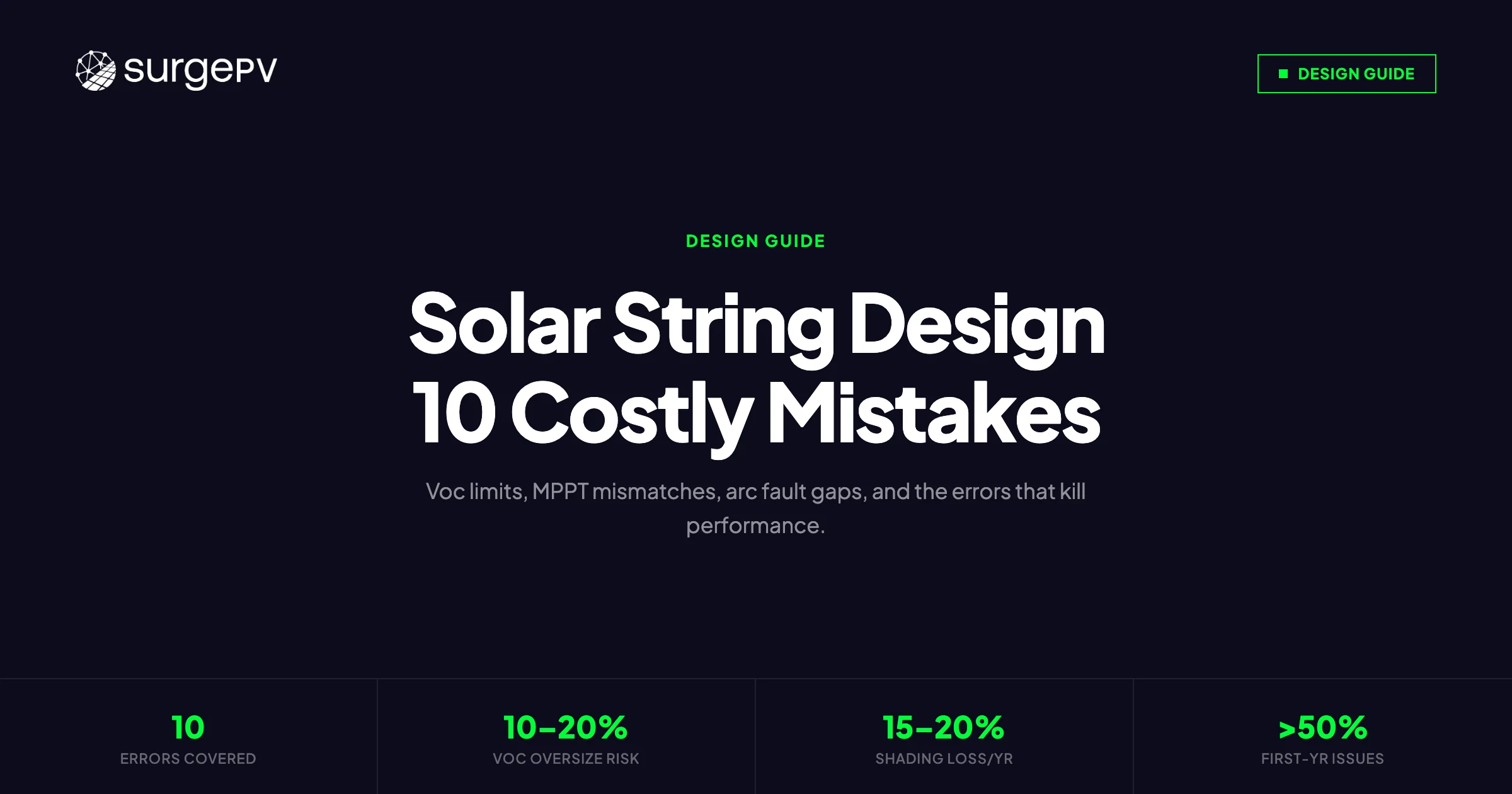
String design errors are responsible for a disproportionate share of underperforming solar systems. A study of service calls at commercial PV sites consistently shows that voltage compliance failures, MPPT mismatches, and shading configuration mistakes account for more than half of all first-year performance shortfalls — problems that could have been eliminated at the design desk.
This guide covers every major string design mistake in technical detail. Each section includes the exact calculation or check you need to avoid the error, real worked examples, and guidance on where automated solar design software catches mistakes that manual spreadsheets miss.
TL;DR
The 10 mistakes below — starting with wrong Voc limits and ending with NEC 2023 arc fault gaps — are the most common causes of inverter damage, energy loss, and failed inspections in string-configured PV systems. Each has a specific, calculable fix.
What you will learn in this guide:
- How to apply temperature-corrected Voc calculations using module datasheets
- Why the MPPT voltage range matters more than the inverter’s absolute maximum DC voltage
- The NEC 690.9 overcurrent protection formula every DC combiner design must satisfy
- How bifacial modules change string configuration requirements
- What NEC 2023 adds to arc fault and rapid shutdown compliance
- How automated string sizing engines eliminate these errors before a permit set is submitted
The 10 Most Common Solar String Design Mistakes
Before diving into each mistake in detail, here is a quick-reference table of all ten errors and their primary consequence:
| # | Mistake | Primary Consequence |
|---|---|---|
| 1 | Voc exceeds inverter maximum (no temperature correction) | Inverter shutdown or permanent damage |
| 2 | Mixing modules with different electrical characteristics | Current mismatch, chronic underperformance |
| 3 | Paralleling strings with different shading profiles | Backfeed losses, bypass diode stress |
| 4 | Ignoring temperature coefficients (STC vs operating Vmp) | MPPT dropout at high temperatures |
| 5 | Undersizing DC combiners and overcurrent protection | NEC 690.9 violation, fire risk |
| 6 | Wrong MPPT voltage range (operating vs rated) | Power derating, clipping losses |
| 7 | Incorrect string configuration for bifacial modules | Rear-gain losses, GCR errors |
| 8 | Not accounting for module degradation in multi-year systems | Voltage dropout below MPPT minimum |
| 9 | Ground mount shading losses from incorrect row spacing | 5–20% annual yield loss |
| 10 | Missing DC arc fault and rapid shutdown (NEC 2023) | Failed inspection, AHJ rejection |
Mistake #1: Wrong String Length — Voc Exceeds Inverter Maximum
This is the single most dangerous string design error and the most common. Designers look up module Voc at STC (Standard Test Conditions: 25°C cell temperature, 1,000 W/m² irradiance) and divide the inverter’s maximum DC input voltage by that number to get string length. This method ignores the fundamental physics of silicon photovoltaics: Voc rises as temperature falls.
Why Cold Temperatures Drive Voc Up
The open-circuit voltage of a silicon PV module increases when ambient temperatures drop below 25°C. Every module datasheet specifies a temperature coefficient of Voc — typically written as α_Voc or β_Voc — expressed in %/°C or mV/°C. Standard monocrystalline silicon panels have coefficients between −0.27%/°C and −0.40%/°C. The negative sign means Voc increases as temperature decreases.
NEC 690.7(A) — the temperature coefficient method:
Per NEC 690.7(A), when a module’s temperature coefficient of Voc is known (which it always is from the datasheet), the designer must use it to calculate the maximum PV system voltage. The formula:
Voc_corrected = Voc_STC × [1 + (α_Voc × (T_min − 25))]Where T_min is the lowest expected ambient temperature at the site in °C.
Worked Example: 20-Module String in Minnesota
Module: 400 W monocrystalline, Voc = 41.2 V, α_Voc = −0.29%/°C Inverter: Maximum DC input voltage = 1,000 V Site: Minneapolis, MN — minimum design temperature = −28°C (per ASHRAE 99.6% heating design temperature)
Step 1 — Naive string length (STC only, wrong method):
Max modules = 1,000 V ÷ 41.2 V = 24.3 → 24 modules
String Voc at STC = 24 × 41.2 = 988.8 V  ← appears safe
Step 2 — Temperature-corrected Voc (correct method):
α_Voc per °C = −0.29% ÷ 100 = −0.0029 /°C
ΔT = T_min − 25 = −28 − 25 = −53°C
Correction factor = 1 + (−0.0029 × −53) = 1 + 0.1537 = 1.1537

Voc_corrected per module = 41.2 × 1.1537 = 47.53 V
String Voc (24 modules) = 24 × 47.53 = 1,140.7 V
A 24-module string at −28°C will see 1,140 V — 14% above the inverter’s 1,000 V maximum. The inverter shuts down to protect itself, and repeated over-voltage events will degrade or destroy the input stage.
Correct string length:
Max modules = 1,000 V ÷ 47.53 V = 21.04 → 21 modulesThe string must be reduced to 21 modules, not 24. This is the string length that appears in your permit set and single-line diagram.
Pro Tip
Always use the ASHRAE 99.6% heating design temperature (not the historical record low) for your minimum design temperature. It is more statistically reliable and is the value referenced in most AHJ interpretations of NEC 690.7. The Lawrence Berkeley National Laboratory PVTOOLS string length calculator uses this database automatically.
Mistake #2: Mixing Modules with Different Electrical Characteristics
Series strings are current-limited by the weakest module in the chain. When you mix modules with different Imp (current at maximum power) values — whether from different manufacturers, different wattages, or even different production lots of the same model — every module in the string is forced to operate at the lowest Imp.
The Current Mismatch Penalty
Consider a 20-module string with 19 modules at Imp = 10.2 A and one legacy module at Imp = 9.4 A:
String current = 9.4 A (limited by the weakest module)
Power lost per module = (10.2 − 9.4) × Vmp = 0.8 × 38.5 = 30.8 W
Total loss from 19 higher-rated modules = 19 × 30.8 = 585 W

As a fraction of rated string output:
Rated string output = 20 × 400 W = 8,000 W
Loss = 585 W ÷ 8,000 W = 7.3% chronic power loss
A 7.3% permanent performance shortfall is the result of a single mismatched module — and this loss occurs every hour the system operates.
Mismatched Temperature Coefficients Compound the Problem
When modules from different manufacturers are strung together, their Voc temperature coefficients differ. In cold weather, one module’s Voc rises faster than the other’s. This creates internal voltage stress within the string and makes accurate Voc limit calculations impossible — you cannot simply apply one correction factor to a mixed string.
Rule: Every module in a string must be from the same manufacturer, same model, same wattage bin, and ideally the same production batch. If replacement modules are needed for an existing system, match the Voc, Vmp, Isc, and Imp within 2% and use the same temperature coefficient.
Mistake #3: Paralleling Strings with Different Shading Profiles
Bypass diodes protect individual modules from hot spots, but they do not protect against the system-level losses that occur when shaded and unshaded strings are paralleled at the same MPPT input.
How Shading Mismatches Cause Backfeed Losses
When two strings are paralleled, their voltages equalize. If String A is fully unshaded (Vmp = 780 V) and String B has two modules bypassed by shading (Vmp = 780 − 2 × 38.5 = 703 V), the parallel combination will operate at a voltage somewhere between the two. The unshaded string’s MPPT is dragged away from its true maximum power point, cutting its output. String B’s remaining active modules are also operating off their optimum point.
Research by Greenlancer quantifies the compound effect: with two strings having asymmetric shading profiles, losses from the unshaded string’s MPPT offset can equal or exceed the direct power loss from the shaded modules themselves.
The Correct Rule for Parallel Strings
Never parallel strings that have different:
- Roof facets (different azimuth or tilt angles)
- Shading sources (trees, chimneys, HVAC equipment, neighboring structures)
- String lengths (different number of modules)
Strings with different orientations must be assigned to separate MPPT inputs, even on the same inverter. If your inverter has two MPPT channels, use one for south-facing strings and the other for east- or west-facing strings.
Pro Tip
The solar shadow analysis software in SurgePV generates per-string shading profiles for every hour of the year. Use it to verify that strings assigned to the same MPPT input have matching annual shading curves before finalizing your layout.
Mistake #4: Ignoring Temperature Coefficients (STC vs Operating Temperature Voc Correction)
Mistake #1 covered the cold-side Voc problem. Mistake #4 covers the hot-side Vmp problem — equally important, but for a different reason.
Why Hot-Weather Vmp Drops Out of the MPPT Range
At high cell temperatures, Vmp (voltage at maximum power) drops significantly below its STC value. The relevant parameter is the temperature coefficient of Vmp, typically between −0.38%/°C and −0.50%/°C. If Vmp falls below the inverter’s MPPT minimum voltage at peak summer temperatures, the inverter cannot track maximum power — or, in extreme cases, drops out entirely.
Worked Example: Low-Voltage MPPT Dropout in Arizona
Module: 405 W monocrystalline, Vmp_STC = 34.2 V, α_Vmp = −0.40%/°C Inverter: MPPT voltage range = 200–800 V String: 7 modules Site: Phoenix, AZ — NOCT = 45°C, maximum ambient = 46°C
Cell temperature at peak summer:
T_cell = T_ambient + [(NOCT − 20) × (G / 800)]
T_cell = 46 + [(45 − 20) × (1000 / 800)]
T_cell = 46 + [25 × 1.25]
T_cell = 46 + 31.25 = 77.25°C
Hot-side Vmp per module:
ΔT = 77.25 − 25 = 52.25°C
Correction = 1 + (−0.0040 × 52.25) = 1 − 0.209 = 0.791
Vmp_hot = 34.2 × 0.791 = 27.05 V
String Vmp at peak summer:
String Vmp_hot = 7 × 27.05 = 189.4 VThe 7-module string produces only 189 V at peak summer conditions — below the inverter’s 200 V MPPT minimum. The inverter drops out completely during the hottest hours of the day, when generation is most valuable.
Fix: Increase to 8 modules minimum.
String Vmp_hot = 8 × 27.05 = 216.4 V  ← within MPPT range
String Voc_cold = 8 × Voc_corrected  ← verify against inverter max DC
Always solve both constraints simultaneously: Voc_corrected < inverter max DC voltage AND string Vmp_hot > MPPT minimum voltage.
Mistake #5: Undersizing DC Combiners and Overcurrent Protection
NEC 690.9(A) is the governing code section for PV source circuit overcurrent protection. Many designers misread it or apply simplified rules of thumb, creating code violations and fire hazards.
The NEC 690.9 Two-Factor Formula
NEC 690.9(A) requires overcurrent protection when a PV source circuit can receive fault current from more than one source. In a multi-string array, every string can backfeed current into a faulted string through the combiner bus. Therefore, each string needs its own overcurrent protection device (OCPD).
The minimum fuse or breaker rating is:
Step 1: String rated current = Isc × 1.25 (NEC 690.8(A) — continuous current factor)
Step 2: Minimum OCPD rating = String rated current × 1.25 (NEC 690.8(B) — OCPD continuous loading factor)

Combined: OCPD minimum = Isc × 1.25 × 1.25 = Isc × 1.5625
Worked Example: DC Combiner for 4-String Array
Module: Isc = 10.85 A Array: 4 strings paralleled at combiner
Step 1: Rated current = 10.85 × 1.25 = 13.56 A
Step 2: Minimum OCPD = 13.56 × 1.25 = 16.95 A → round up to 20 A fuse (standard size)
Each string gets a 20 A fuse at the DC combiner. The combiner’s main breaker or disconnect must be rated for the total parallel current:
Total array Isc = 4 × 10.85 = 43.4 A
Main OCPD = 43.4 × 1.5625 = 67.8 A → 70 A breaker (nearest standard size)
Common Undersizing Errors
- Using Isc × 1.25 only (omitting the second 1.25) — results in an OCPD sized for continuous operation but not for the full NEC safety margin
- Using Imp instead of Isc — Imp is lower; using it produces an even more undersized OCPD
- Skipping per-string protection when strings are combined at the inverter — some string inverters have internal string fusing; confirm this is listed and rated per NEC 690.9 before omitting external fuses
Code Reference
NEC 690.9(C) requires that the OCPD be rated for the DC voltage of the circuit. Standard AC breakers are not rated for DC use. Use fuses or breakers specifically listed for DC PV service, rated at the string’s maximum system voltage — typically 600 VDC, 1,000 VDC, or 1,500 VDC as appropriate.
Mistake #6: Wrong MPPT Voltage Range (Operating vs Rated Maximum)
Designers frequently confuse two inverter voltage specifications that appear on the same datasheet:
- Maximum DC input voltage — the absolute ceiling; exceeding it risks equipment damage
- MPPT voltage range — the operating window where the inverter actually tracks maximum power
The MPPT range is always narrower than the maximum DC input voltage. An inverter with a 1,000 V maximum DC input might have an MPPT range of only 200–800 V. Designing a string to operate at 950 V (safely below 1,000 V) means the string spends most of the day above the MPPT upper limit, where the inverter clips or derates its output.
The Three Voltage Constraints for Correct String Sizing
For any string, all three of the following must be simultaneously true:
| Constraint | Formula | Purpose |
|---|---|---|
| Cold Voc limit | Voc_cold < V_max_DC | Prevent inverter damage |
| Hot Vmp lower limit | Vmp_hot > MPPT_min | Prevent MPPT dropout |
| STC Vmp upper limit | Vmp_STC < MPPT_max | Prevent clipping at rated conditions |
Most single-inverter string designs target Vmp_STC at 70–85% of the MPPT maximum, leaving headroom for cold-day voltage rise while staying well within the tracking range.
DC/AC Ratio and Clipping
A related concept is the DC/AC ratio: total STC DC array power divided by inverter AC output rating. Standard residential and commercial designs target 1.1–1.3. Above 1.35, clipping losses become significant — the inverter limits AC output, and excess DC power is wasted. This is intentional when electricity pricing peaks at midday and morning/evening shoulder generation matters more than noon peaks, but must be calculated explicitly, not discovered after commissioning.
Pro Tip
The automated string sizing engine in SurgePV evaluates all three voltage constraints simultaneously for every string in the array. It highlights strings where Vmp_hot approaches the MPPT minimum or where the DC/AC ratio exceeds 1.3, before the design is submitted for permitting.
Stop Catching String Errors on the Roof
SurgePV’s automated string sizing engine checks Voc limits, MPPT range, and NEC 690 compliance for every string — before you submit a permit set.
Book a DemoNo commitment required · 20 minutes · Live project walkthrough
Mistake #7: Incorrect String Configuration for Bifacial Modules
Bifacial modules capture sunlight from both the front and rear surfaces, adding 5–25% additional energy from reflected irradiance (albedo) at the rear. This rear-side gain fundamentally changes how strings should be configured — and how performance should be modeled.
Why Standard String Sizing Underestimates Bifacial Performance
Most string sizing calculations use front-side STC parameters from the module datasheet. For bifacial modules, this ignores rear-side current contribution. A bifacial module with a 10% bifaciality factor and 15% rear irradiance boost will produce approximately 1.5% more current at the string level than its front-side Isc suggests.
This matters for two reasons:
- Overcurrent protection sizing — if rear-side gain drives Isc above your fuse rating under high-albedo conditions (snow, white roofing membrane, light-colored ground cover), the fuse may blow on a clear winter day
- Combiner box ampacity — conductors sized for front-side Isc only may be undersized when rear gain is factored in
Ground Clearance and Row Spacing for Bifacial Ground Mounts
Bifacial modules need adequate rear-surface exposure to ambient irradiance. The design parameters:
Mounting height: Industry best practice is 0.5–1.5 m clearance from the ground surface to the bottom of the module. At less than 0.3 m, the central modules in a row see heavily reduced rear irradiance because the ground directly below is shaded by the module itself.
Ground Coverage Ratio (GCR): For bifacial ground mounts, GCR (the ratio of module area to total ground area) should target 0.25–0.40 for optimal rear-side gain. At GCR above 0.50, row-to-row inter-row shading begins to suppress rear irradiance significantly.
Albedo surface: Light-colored gravel (albedo 0.20–0.25), white membrane roofing (0.65–0.75), or fresh snow (0.80+) dramatically increases bifacial yield compared to dark soil (0.05–0.10).
Row-to-Row Shading and String Assignment
In a bifacial ground mount, the rear surface of Row 2 is partially shaded by the shadow of Row 1 during morning and evening hours. This means front-row strings and middle-row strings have different shading profiles — and must be assigned to separate MPPT inputs, exactly as you would handle differently tilted roof faces.
Key Takeaway
For bifacial ground-mount arrays, size overcurrent protection using bifacial Isc (front Isc × bifaciality factor correction for expected rear irradiance), assign edge rows and interior rows to separate MPPT inputs, and verify GCR is below 0.45 before finalizing row spacing.
Mistake #8: Not Accounting for Module Degradation in Multi-Year Systems
PV modules degrade over time. Standard monocrystalline panels degrade at approximately 0.5%/year after the first-year light-induced degradation (LID) of about 1–2%. Over a 25-year system life, this means a panel rated at 400 W at commissioning may produce only 312 W in year 25.
Degradation affects voltage — specifically, both Voc and Vmp decrease gradually as the module’s electrical characteristics change. This matters for string sizing because a system that starts within the MPPT voltage range may drift below the MPPT minimum voltage in later years.
Worked Example: 15-Module String After 20 Years
Module: 400 W, Vmp_STC = 34.5 V, degradation = 0.5%/year String: 15 modules Inverter MPPT minimum: 200 V
Year 1 string Vmp at STC:
String Vmp = 15 × 34.5 = 517.5 V ← comfortably above 200 VYear 20 string Vmp at STC (after 0.5%/year degradation for 19 years + 2% LID):
Total degradation ≈ 2% + (19 × 0.5%) = 2% + 9.5% = 11.5%
Year 20 Vmp per module = 34.5 × (1 − 0.115) = 30.53 V
String Vmp (STC) = 15 × 30.53 = 457.9 V  ← still well above 200 V
For a 15-module string, degradation does not push Vmp below the MPPT minimum. But for short strings designed to sit near the MPPT minimum in Year 1:
Short string failure scenario:
Minimum 5-module string: Year 1 Vmp = 5 × 34.5 = 172.5 V (already below 200 V minimum!)This demonstrates why string length must be verified not just at STC but with the hot-side Vmp calculation — and why very short strings in hot climates may violate MPPT minimums even at commissioning.
For long-duration systems (20+ years), add one module per string when the calculated hot-side Vmp sits within 10% of the MPPT minimum. The additional module provides insurance against degradation-driven dropout.
Mistake #9: Ground Mount Shading Losses from Row-to-Row (Tilt Angle Errors)
Row-to-row shading in ground-mount arrays is one of the most calculable yet frequently miscalculated sources of yield loss. The geometry is straightforward, but designers routinely underestimate the shadow angle by using noon sun angles instead of the low-angle winter sun that creates the longest shadows.
The Row Spacing Formula
The minimum row spacing to avoid inter-row shading at a specified sun elevation angle:
D = L × cos(θ) + L × sin(θ) ÷ tan(α)Where:
- D = row-to-row spacing (center to center) in meters
- L = module length (along the tilt direction) in meters
- θ = module tilt angle from horizontal in degrees
- α = minimum sun elevation angle to target (typically the winter solstice at 9:00 AM solar time)
Worked Example: 25° Tilt Array at 35° Latitude
Module: 2.1 m length, tilt = 25° Site: 35°N latitude Minimum sun elevation at 9:00 AM on winter solstice: approximately 14° (calculated from declination −23.45° and hour angle for 9:00 AM)
D = 2.1 × cos(25°) + 2.1 × sin(25°) ÷ tan(14°)
D = 2.1 × 0.906 + 2.1 × 0.423 ÷ 0.249
D = 1.903 + 0.888 ÷ 0.249
D = 1.903 + 3.566
D = 5.47 m
A center-to-center row spacing of 5.47 m is needed to avoid shading before 9:00 AM on the winter solstice. Many ground-mount designs at this latitude use 4.0–4.5 m spacing to maximize GCR, accepting morning and evening shading losses.
The cost of that shortcut:
At 4.5 m spacing, the array begins shading adjacent rows when the sun elevation drops below approximately 18°. During winter months (November through January) at 35°N, that represents the first and last 90 minutes of each generation day. Greentech Renewables puts annual shading losses for this configuration at 5–12%, depending on latitude.
String Assignment for Multi-Row Arrays
In a multi-row ground mount, front row modules are unshaded during morning and evening when rear rows are shaded. This means front-row strings and rear-row strings have opposite shading profiles at low sun angles. They must never be paralleled at the same MPPT input.
Correct MPPT assignment for a 4-row array:
- MPPT Input 1: Rows 1 and 2 (south-most, least affected by inter-row shading)
- MPPT Input 2: Rows 3 and 4 (greater morning/evening shading from Rows 1 and 2)
Use the solar shadow analysis software to generate per-row shading curves and verify MPPT assignments before finalizing the SLD.
Mistake #10: Missing DC Arc Fault and Rapid Shutdown Requirements (NEC 2023)
NEC 2023 (Article 690) tightened requirements for both arc fault protection and rapid shutdown. These changes affect systems designed under previous code editions and all new systems submitted for permit under jurisdictions that have adopted NEC 2023.
NEC 690.11 — DC Arc Fault Circuit Interrupter (AFCI) Requirements
NEC 690.11 (2023) requires listed DC AFCI protection for PV systems where any conductor operates at 80 V DC or greater between any two conductors. This covers virtually every grid-tied string system.
The AFCI device must:
- Be listed to UL 1699B (the DC AFCI standard for PV systems)
- Detect series arcing faults in DC source circuits, output circuits, and associated conductors
- Interrupt the arc within the time limits specified in the listing standard
Where AFCI is integrated vs external:
Most current-generation string inverters (SMA, Fronius, SolarEdge, Enphase IQ series) include integrated DC AFCI listed under NEC 690.11. Verify the inverter’s listing documentation explicitly states “NEC 690.11 compliant” — not just “arc fault detection.” For legacy inverters or combiners without integrated AFCI, a standalone listed DC AFCI breaker must be added at the combiner box.
NEC 690.12 — Rapid Shutdown Updates
Rapid shutdown (RSD) requires that DC conductors within a building structure be de-energized to safe voltage levels within 30 seconds of initiating shutdown. NEC 2023 introduced several key changes:
New exception for non-enclosed detached structures: PV systems on carports, trellises, and similar open structures no longer require rapid shutdown under NEC 690.12. This applies only to structures that are not enclosed and where firefighters are unlikely to perform rooftop operations.
Retained requirements for building-integrated systems:
| Location | Voltage limit after 30 seconds |
|---|---|
| Outside the array boundary (>1 ft from modules) | ≤ 30 V DC |
| Within the array boundary | ≤ 80 V DC |
Compliant RSD approaches:
- Module-level power electronics (MLPE) — microinverters or DC optimizers with built-in RSD functionality
- Listed rapid shutdown systems (PVHCS — PV Hazard Control Systems) per UL 3741
- String inverters with listed rapid shutdown transmitters and module-mounted receivers
AHJ Adoption Note
Not all jurisdictions have adopted NEC 2023. Check your local AHJ’s adopted code edition before specifying AFCI and RSD equipment. Many jurisdictions are still under NEC 2020 or NEC 2017. However, designing to NEC 2023 standards is recommended for any system expected to operate for 25+ years, as code adoption typically catches up within 3–5 years of publication.
How Software Eliminates String Design Errors
Manual string sizing using spreadsheets introduces errors at every step: wrong temperature lookup, incorrect coefficient sign, overlooked MPPT minimum, missed NEC formula. Every one of the 10 mistakes above is a calculable, preventable error — and every one is the kind of systematic calculation that software performs instantly and without arithmetic errors.
What SurgePV’s Automated String Sizing Engine Does
SurgePV’s solar design software includes a dedicated string sizing and compliance engine that:
1. Pulls live module and inverter data from curated databases Rather than requiring the designer to transcribe Voc, α_Voc, MPPT range, and max DC voltage from PDFs, SurgePV’s component library stores verified electrical parameters for thousands of modules and inverters. This eliminates transcription errors — one of the most common sources of string calculation mistakes.
2. Applies temperature-corrected Voc automatically After the designer inputs the site location, SurgePV retrieves the ASHRAE 99.6% heating design temperature and the summer peak ambient temperature. It applies both the cold-side Voc correction (NEC 690.7(A)) and the hot-side Vmp correction, then displays the maximum and minimum allowable string lengths.
3. Validates all three voltage constraints simultaneously The engine checks:
- Voc_cold < inverter max DC voltage
- Vmp_hot > MPPT minimum voltage
- Vmp_STC within the MPPT tracking range
It flags any string where any constraint is violated, with the exact voltage margin displayed.
4. Generates NEC 690.9-compliant overcurrent protection sizing For each string and each combiner, SurgePV calculates the minimum fuse rating using the Isc × 1.25 × 1.25 formula and recommends the nearest standard fuse size.
5. Checks shading-based MPPT assignment When integrated with the solar shadow analysis software, the string engine identifies strings with mismatched annual shading profiles and flags them for separate MPPT assignment.
6. Produces permit-ready single-line diagrams (SLD) After string sizing is validated, SurgePV generates a complete SLD showing string configurations, fuse ratings, conductor sizes, and equipment labels — ready for AHJ submission without additional drafting work.
Time Savings vs. Manual Methods
| Task | Manual (Spreadsheet) | SurgePV |
|---|---|---|
| Temperature-corrected Voc for all strings | 15–30 min | Automatic |
| MPPT range validation | 10–20 min | Automatic |
| NEC 690.9 overcurrent sizing | 20–40 min | Automatic |
| SLD generation | 60–120 min | 2–5 min |
| Permit package compilation | 30–60 min | 5–10 min |
| Total | 2–4+ hours | ~15 min |
For a company doing 20–50 residential designs per month, this time difference compounds into dozens of engineering hours saved — and eliminates the liability exposure from calculation errors.
Further Reading
Solar string design intersects closely with shading simulation. See our guide on solar shadow analysis software for a detailed walkthrough of how shading curves affect MPPT assignment decisions and annual yield calculations.
Conclusion
Solar string design looks deceptively simple — divide the inverter’s maximum voltage by module Voc, pick a string length, and move on. In practice, every one of the 10 mistakes covered in this guide represents a real failure mode that causes inverter damage, chronic underperformance, code violations, or failed inspections.
Three actions to take before your next string design:
-
Run the temperature-corrected Voc calculation for every string. Use the module’s published α_Voc coefficient and the site’s ASHRAE 99.6% heating design temperature. If you are not doing this calculation today, you are relying on luck in cold climates.
-
Verify all three voltage constraints: Voc_cold, Vmp_hot, and Vmp_STC. The MPPT range is as important as the absolute maximum DC voltage. A string that is safe from inverter damage but operates below the MPPT minimum for three months a year is still a design failure.
-
Assign strings with different shading profiles to separate MPPT inputs. This applies to mixed-orientation roof arrays, multi-row ground mounts, bifacial arrays with edge-row effects, and any array where obstructions create uneven shading. The solar software you use for your designs should make this check automatic.
The 10 mistakes in this guide are not edge cases. They appear in real permit sets submitted every day. A disciplined string sizing workflow — or better, an automated one — is the difference between a system that performs as modeled and one that generates service calls.
Frequently Asked Questions
What is the most common solar string design mistake?
The most common error is failing to apply temperature-corrected Voc calculations. Designers use the nameplate Voc at STC (25°C cell temperature, 1,000 W/m² irradiance) without adjusting for minimum site temperatures. In cold climates, this can push string voltage 10–20% above the inverter’s maximum DC input rating, causing shutdowns or equipment damage. The NEC 690.7(A) temperature coefficient method is mandatory when the module’s α_Voc is known — which it always is from the datasheet.
How do I calculate the maximum string length for a solar inverter?
Divide the inverter’s maximum DC input voltage by the temperature-corrected Voc of one module. Corrected Voc = Voc_STC × [1 + (α_Voc × (T_min − 25))], where α_Voc is the voltage temperature coefficient (typically −0.27% to −0.40%/°C) and T_min is the lowest expected ambient temperature in °C. For a module with Voc = 41.2 V, α_Voc = −0.29%/°C, T_min = −28°C, corrected Voc = 41.2 × 1.154 = 47.5 V. For a 1,000 V inverter: 1,000 ÷ 47.5 = 21 modules maximum.
What happens if a solar string voltage exceeds the inverter maximum?
Exceeding the inverter’s maximum DC input voltage can permanently damage the inverter’s input stage, void the manufacturer warranty, and create an electrical safety hazard. At a minimum, the inverter will shut down via its over-voltage protection circuit. In severe cases, the input filter capacitors or switching transistors fail catastrophically. Replacement costs for a string inverter input stage typically exceed $1,000 and require a service call — all preventable with a correctly sized string.
Can you mix solar panels with different wattages in the same string?
Technically yes, but it almost always reduces performance. The string current is limited by the lowest-Imp module in the string. If you mix a 400 W module (Imp = 10.2 A) and a 380 W module (Imp = 9.4 A), the entire string operates at 9.4 A. The power loss per high-rated module is (10.2 − 9.4) × Vmp = approximately 31 W. Over 19 such modules, that is nearly 590 W of chronic loss — 7.3% of a nominally rated 8 kW string.
What is the MPPT voltage range and why does it matter for string sizing?
The MPPT (Maximum Power Point Tracking) voltage range is the operating window within which the inverter actively tracks and extracts maximum power. If string Vmp falls below the MPPT minimum at peak summer temperatures, or rises above the MPPT maximum on cold days, the inverter either derates its output or fails to produce power entirely. This range is always narrower than the inverter’s absolute maximum DC input voltage and must be checked separately. For example, an inverter with a 1,000 V maximum DC input might only have an MPPT range of 200–800 V.
What does NEC 2023 require for DC arc fault protection in solar systems?
NEC 690.11 (2023) requires listed DC arc-fault circuit interrupter (AFCI) protection for PV systems operating at 80 V DC or greater between any two conductors. The device must be listed to UL 1699B, detect series arcing faults in DC source circuits and associated conductors, and interrupt the arc within the standard’s time limits. Most current-generation string inverters include integrated DC AFCI listed under NEC 690.11; verify the listing documentation explicitly states compliance. For systems using older equipment, a standalone listed DC AFCI breaker must be added at the DC combiner.
How does shading affect solar string performance?
When a module in a series string is shaded, its current output drops, limiting current for the entire string. Bypass diodes activate to route current around the shaded module, but the shaded module’s full voltage contribution is lost. At the system level, paralleling strings with different shading profiles causes the higher-voltage string’s MPPT to be dragged off its optimum point, adding losses beyond the directly shaded modules. Even 10% daily shading exposure can reduce annual string yield by 15–20%.