
The U.S. solar industry added more than 250,000 jobs in 2023 alone — and the Bureau of Labor Statistics projects solar installer roles will grow 22% through 2032, nearly six times the average for all occupations. But raw installer numbers only tell part of the story. The biggest talent gap is in solar design: EPCs, project developers, and residential installers are all competing for people who can open a project file, configure stringing, run a simulation, and deliver a compliant proposal. That gap is where solar design courses matter most.
The course you choose will determine whether you graduate knowing theory or knowing tools. This guide covers the full market: the best solar PV design courses by level and outcome, the top-rated PVsyst instructors by name, exactly how NABCEP certification works, where university programs fit in, free resources that are genuinely worth your time, and how solar design software like SurgePV fits into practical training for real EPC workflows.
TL;DR — Key Findings
The best career-track solar design course is HeatSpring’s NABCEP PV Associate Boot Camp ($300–$600). The most popular PVsyst Udemy instructor is Noor Aldeen Najdeah (4.6 stars, 16,000+ students). PVsyst has no Coursera course — best alternatives are Udemy, SEI, and Reo.online. NABCEP PV Associate requires a 70-question exam after a registered training course or 6 months of relevant work experience. The fastest free start: Coursera Solar Energy Basics (Delft) + Najdeah’s free PVsyst tutorial on Udemy.
In this guide you will learn:
- The full solar design course market in 2026 — online, university, and certification paths
- NABCEP certification tiers, exam structure, fees, and the most efficient study timeline
- The best online solar design courses ranked by learning outcome and EPC relevance
- Which PVsyst Udemy instructors have the most students and highest ratings — by name
- Why PVsyst has no Coursera course and what the best alternatives are
- How SurgePV built-in training and its demo library accelerate real-world skill building
- University and community college solar programs in the US and Europe
- A course selection decision framework matched to your career target
- Salary data and job title progression after solar design certification
Solar Design Course Market 2026
The solar design education market has matured significantly in the last three years. What was once a fragmented collection of hobbyist YouTube videos and expensive in-person workshops has become a layered set of options at every price point and skill level.
In 2026, there are four broad categories of solar design education:
1. Professional certification programs — NABCEP-registered training through providers like HeatSpring, Solar Energy International (SEI), Ecotech Training, and ImagineSolar. These are the highest-value paths for anyone targeting EPC employment or client-facing solar sales roles. They are more expensive than self-paced platforms ($200–$600 per course) but produce the credentials employers recognize.
2. Software-specific training — PVsyst courses on Udemy and through SEI, Aurora Solar’s online training center, and platform-specific onboarding libraries like SurgePV’s built-in tutorial system. These teach tool fluency directly and are the fastest path to employable skills.
3. Academic programs — University extension courses, community college vocational programs, and formal engineering degrees with renewable energy concentrations. These carry institutional credibility but are slower and more expensive than professional certification paths.
4. Free and self-directed resources — Coursera, YouTube, OpenSolar’s free tier, and manufacturer knowledge bases. These are most useful for foundational learning, tool sampling, and filling specific knowledge gaps.
The right path depends on where you are starting, where you want to go, and how quickly you need to get there. The decision framework in the “How to Choose” section later in this guide maps out each scenario. But first: the credentials that matter most.
NABCEP Certification: The Gold Standard
The North American Board of Certified Energy Practitioners (NABCEP) issues the most widely respected solar credentials in the United States and Canada. For anyone targeting a solar design or installation role in North America, NABCEP certification is the clearest signal of competency you can give an employer. NABCEP credentials are also increasingly recognized by European EPCs that work on international or US-funded projects.
There are three NABCEP credentials directly relevant to solar designers:
NABCEP PV Associate (PVA) — Entry-Level Credential
The PV Associate is the starting credential for most solar career beginners. It demonstrates fundamental competency in PV system design, installation concepts, and safety.
Exam structure:
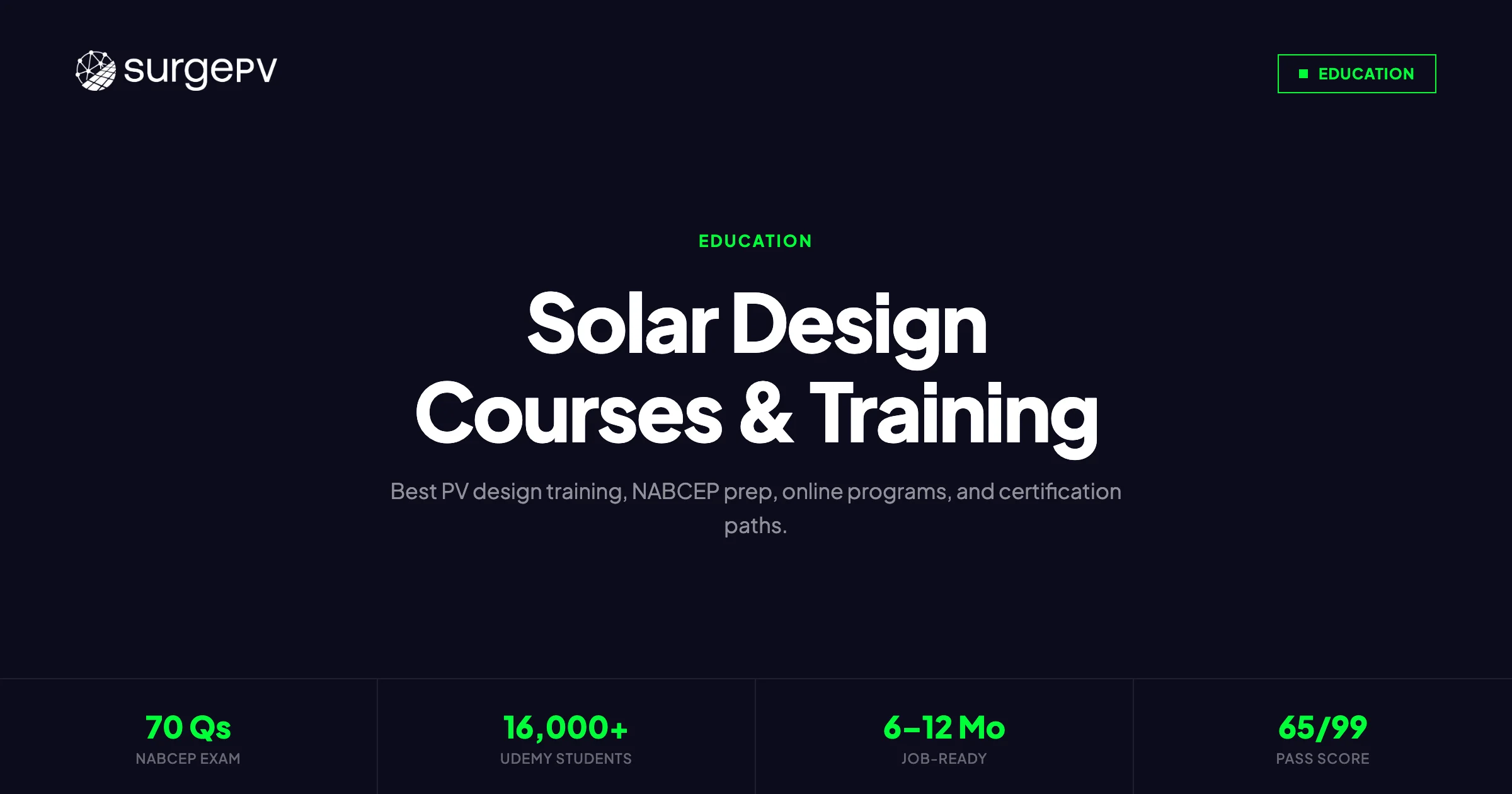
- 70 multiple-choice questions (60 scored, 10 unscored pilot questions)
- 4 answer choices per question
- 2-hour time limit
- Passing score: 65 on a 0–99 scaled score
- Available via live online proctoring (at home) or at 1,350+ Meazure Learning testing centers worldwide
Exam fee: $225 USD (2026 pricing)
How to qualify — three pathways:
-
Education pathway — Complete a training course from a NABCEP-registered training provider. HeatSpring, SEI, Ecotech Training, and ImagineSolar all qualify. This is the fastest path for beginners with no field experience.
-
Experience pathway — Document at least 6 months of full-time equivalent work experience directly involving PV or solar heating technologies. No course required.
-
Entry level conversion — Convert an existing NABCEP Entry Level Achievement Award. If the award was earned more than 3 years ago, 12 hours of continuing education within the last 3 years is also required.
Maintenance: Renewal every 3 years requires 12 hours of advanced PV training and documentation submission to NABCEP.
Study timeline: Most candidates with zero background need 60–90 days of structured study alongside a registered course. Candidates with electrical or construction backgrounds typically compress this to 30–45 days. The NABCEP PV Associate Content Outline (available free on nabcep.org) maps every exam domain and should be your primary study guide framework.
NABCEP Registered Course Catalog
NABCEP maintains a publicly searchable course catalog at coursecatalog.nabcep.org listing all registered accredited and non-accredited training providers. Confirm a course qualifies before enrolling — not every solar course that uses “NABCEP” in its title is actually registered.
NABCEP PV Installation Professional (PVIP) — Advanced Credential
The PVIP is the senior NABCEP credential, targeting experienced solar professionals who design and oversee PV system installation. Requirements are substantially more demanding than the PVA:
- 58 hours of advanced PV training from NABCEP-registered providers
- Demonstrated work experience (specific hour requirements vary by role — installation, design, project management)
- Passing a technical exam covering the full PVIP Content Outline
- Renewal every 3 years with 30 hours of continuing education
- Exam fee: $599 USD
The PVIP exam covers advanced topics including NEC Article 690, system commissioning, troubleshooting, advanced shading analysis, and project management principles. Most designers pursue the PVA first, gain 1–2 years of field or design experience, then pursue PVIP as a career advancement credential that opens project management and senior design engineer roles.
NABCEP PV Design Specialist (PVDS) — Office Designer Credential
The PVDS is the most relevant NABCEP credential for office-based solar designers who are not doing physical installation work. It focuses specifically on the design side of the profession: load analysis, site assessment, system sizing, string configuration, simulation, code compliance, and documentation.
Requirements:
- 40 hours of advanced PV design training from NABCEP-registered providers
- Passing a design-focused technical exam
- Exam fee: $299 USD
- Renewal every 3 years with 20 hours of continuing education
HeatSpring offers a dedicated PVDS prep course with 40 hours of structured content and practice exams. The PVDS is increasingly valued by EPCs that distinguish between field installation staff and office design engineers — and it is the most direct credential for someone targeting a design-only role.
| Credential | Target Role | Exam Questions | Exam Fee | Study Time |
|---|---|---|---|---|
| PV Associate (PVA) | Entry-level solar | 70 | $225 | 60–90 days |
| PV Design Specialist (PVDS) | Office designer | 100 | $299 | 90–120 days |
| PV Installation Professional (PVIP) | Senior installer/PM | 150 | $599 | 6–12 months prep |
Best Online Solar Design Courses 2026
Below is a ranked assessment of the best solar PV design courses available online in 2026. Evaluated on: content depth, tool coverage, industry relevance, certification value, and value for money.
Tier 1 — Professional / Career-Accelerating
| Course | Provider | Duration | Cost | NABCEP Credit | Best For |
|---|---|---|---|---|---|
| NABCEP PV Associate Boot Camp | HeatSpring | ~40 hours | $300–$600 | Yes | Career changers, graduates |
| PV System Design & PVsyst | Solar Energy International (SEI) | 2–6 weeks | $200–$600 | Yes | Engineers, analysts |
| NABCEP Certification Prep | Ecotech Training | Variable | $200–$400 | Yes | Working professionals |
| NABCEP Exam Prep | ImagineSolar | ~20 hours | $250–$400 | Yes | Field workers seeking credential |
| Advanced Solar PV Installer | OSSIA | 30 hours | Varies | Yes (renewal) | Recertification |
HeatSpring Solar PV Boot Camp + NABCEP PV Associate Exam Prep
HeatSpring’s NABCEP PV Associate Boot Camp is the strongest single-course investment for a serious solar design candidate. HeatSpring is the exclusive provider of PV Associate Training at the 2026 NABCEP Conference in Milwaukee, WI. The course covers system types, NEC code, shading, stringing, financial analysis, and the full PVA exam content outline — with structured modules and practice exams.
Solar Energy International (SEI)
SEI’s training catalog has the broadest range of NABCEP-registered courses and is recognized globally. Their courses count toward NABCEP certification requirements. The “PVsyst for PV System Production Modeling” short course is worth adding for anyone targeting simulation or energy analyst roles.
Ecotech Training
Ecotech Training offers both online and live classroom NABCEP prep courses with flexibility for working professionals. Their courses are recognized by NABCEP and cover the full PV Associate exam content outline.
ImagineSolar
ImagineSolar’s NABCEP prep course is exam-focused: structured modules covering every domain of the PVA content outline with practice questions and timed mock exams. Best for learners who already have field experience and need structured exam prep rather than conceptual teaching.
Tier 2 — Skill-Building / Tool-Specific
| Course | Platform | Duration | Cost | Software Taught |
|---|---|---|---|---|
| Solar Energy Design with SketchUp & PVsyst | Udemy (Najdeah) | ~15 hours | $15–$50 | SketchUp, PVsyst |
| PVsyst Photovoltaic Software Training | Udemy (Nitish Singh) | ~8 hours | $15–$30 | PVsyst |
| PVsyst Training with Instructor Feedback | Reo.online | ~10 hours | ~$200 | PVsyst |
| Advanced PVsyst for Energy Simulation | Outright Solar Training | ~8 hours | ~$250 | PVsyst (advanced) |
| Complete PV Solar Energy (PVsyst, Excel & AutoCAD) | Udemy | 12–15 hours | $15–$40 | PVsyst, Excel, AutoCAD |
Udemy — Solar Energy Design Course with SketchUp & PVsyst (Noor Aldeen Najdeah)
The most enrolled PVsyst + solar design course on Udemy. Covers the full design workflow from site survey through PVsyst simulation and financial report generation. Excellent community support and regularly updated. A 4.3/5 rating with 11,000+ students makes it the most validated self-paced PVsyst course available.
Udemy — PVsyst Photovoltaic Software Training (Nitish Singh)
A focused PVsyst course from an instructor with SCGJ government certification and 10+ years in the solar sector. Strong for learners who specifically need PVsyst simulation depth without the SketchUp design workflow.
Reo.online — PVsyst Training with Instructor Feedback
Reo.online offers hands-on PVsyst courses with personal instructor feedback on submitted simulation work. This is the closest to mentored training outside of formal SEI or bootcamp programs, and the main reason to choose it over a cheaper self-paced alternative if you need accountability to progress.
Tier 3 — Supplementary / Specialist
Outright Solar Training — Advanced PVsyst for Energy Simulation & Optimization
A specialist course for learners who already know PVsyst basics and want to advance to complex scenario modeling, tracker simulations, bifacial modules, and Monte Carlo uncertainty analysis. Not a starting point — a depth-builder.
Indepth Research Institute (IRES) — Mastering PVsyst
Instructor-led, cohort-based training covering PVsyst across a structured curriculum with live sessions. Suitable for learners who prefer cohort learning over self-paced platforms.
Pro Tip: Stack Courses by Purpose
Do not try to find one course that does everything. The most effective stack is: one conceptual foundation course (Coursera or SEI free modules) + one tool-specific course (Udemy PVsyst) + one NABCEP-registered course (HeatSpring or SEI) for the credential. Total investment under $700 — a fraction of a semester of university tuition.
PVsyst Training & Certification
PVsyst is the industry-standard energy simulation platform used globally by project developers, independent engineers, and large-scale EPC contractors. Nearly every solar project financing package requires a PVsyst report, which makes PVsyst proficiency non-negotiable for any role that involves energy yield analysis or investor-grade simulation.
Official PVsyst Resources
PVsyst SA (the developer, based in Switzerland) does not offer a formal certification program. However, they maintain free official resources that every learner should use:
- PVsyst documentation — technical reference available at pvsyst.com, covering every software module and methodology in detail
- PVsyst forum — an active community forum where the PVsyst development team answers technical questions alongside experienced users
- PVsyst YouTube channel — official tutorial videos covering software updates, specific modeling scenarios, and new features
- Free 30-day trial — PVsyst offers a full-featured 30-day free trial. Download it the same week you start any PVsyst course.
Top PVsyst Udemy Instructors (Named)
Multiple instructors teach PVsyst on Udemy, and quality varies significantly. Here are the most-enrolled and highest-rated, by name:
1. Noor Aldeen Najdeah — Most Students, Highest Rating
Noor Aldeen Najdeah is the most popular PVsyst instructor on Udemy by student count and instructor rating. He holds Certified Energy Manager (CEM®) and Certified Energy Auditor (CEA™) certifications from the Association of Energy Engineers (AEE) and works as a Regional Manager at Best Energy, with design experience covering over 15 MW of projects across Yemen, Saudi Arabia, Egypt, and the broader Arab region.
His flagship course — “SOLAR ENERGY Design Course (With SketchUp & PVsyst)” — has attracted over 16,000 students with a 4.6 instructor rating. The course covers site survey, system components, SketchUp 3D modeling, PVsyst simulation, pricing logic, and technical/financial report generation. He also offers a free PVsyst tutorial (1 hour 25 minutes, 4.5 stars, 3,500+ students) — the most accessible free PVsyst introduction available online.
Najdeah also founded the Acadeemi Training platform, publishing Arabic-language solar energy content for MENA-region learners.
2. Nitish Singh — SCGJ Government of India Certified
Nitish Singh has over 10 years of experience in the solar sector and carries SCGJ (Govt. of India) certification. His Udemy course “PVsyst Photovoltaic Software Training” covers residential and commercial utility-scale applications and is among the most searched PVsyst courses on the platform. Strong for learners in the Indian solar market or those targeting Indian project workflows.
3. Mohamed Lamaachi — Engineer and Entrepreneur
Mohamed Lamaachi is an engineer with a 4.2 Udemy instructor rating and over 8,000 students enrolled across his PVsyst and solar design courses. He focuses on practical simulation with PVsyst for both commercial and residential project types.
4. Kiran Ramkrishna Beldar — Mumbai University Professor
Kiran Ramkrishna Beldar is a professor at Mumbai University. His courses blend engineering theory with PVsyst application and have accumulated over 1,480 student reviews at a 4.1 rating — a strong option for learners who want theory alongside tool training.
5. Ahmed Attia — Electrical Engineer
Ahmed Attia teaches PVsyst on Udemy with a 4.3 instructor rating and 334+ reviews. His courses focus on the electrical engineering side of PV design, making them a strong option for learners from an EE background.
Which PVsyst Instructor to Choose?
For maximum community support and highest student volume: Noor Aldeen Najdeah. For academic theory depth: Kiran Ramkrishna Beldar. For India-specific workflows and government certification context: Nitish Singh. For engineer-to-engineer instruction: Ahmed Attia. All courses regularly discount to under $20 USD on Udemy — check on any Tuesday for the best prices.
Is PVsyst on Coursera?
No — there is no dedicated PVsyst course on Coursera as of March 2026.
The closest available option is the “Solar Power Generation” course by L&T EduTech on Coursera, which includes PVsyst demonstrations as part of a broader curriculum — but it is not a hands-on PVsyst training course.
For dedicated PVsyst training, the best alternatives to Coursera:
| Platform | Course | PVsyst Depth | Price |
|---|---|---|---|
| Udemy | Solar Energy Design with SketchUp & PVsyst (Najdeah) | Deep — full workflow | ~$15–$20 |
| Solar Energy International (SEI) | PVsyst for PV System Production Modeling | Professional-grade | ~$300 |
| Reo.online | PVsyst Training — Practical Solar Design | Instructor-led, feedback | ~$200 |
| Udemy | PVsyst Photovoltaic Software Training (Nitish Singh) | Focused simulation | ~$15 |
| Outright Solar Training | Advanced PVsyst for Energy Simulation & Optimization | Advanced / C&I focus | ~$250 |
What a Quality PVsyst Course Covers
Whether you take a course on Udemy, through SEI, or another platform, quality PVsyst training follows a consistent progression:
- Software navigation — project types, database structure, import/export
- Meteorological data — inputting location, using Meteonorm or NASA databases
- System definition — PV module and inverter selection, string configuration
- Near shading — creating 3D shading scenes, horizon profiles, mutual shading losses
- Far shading — horizon input for mountain or obstruction environments
- Loss analysis — defining soiling, wiring, mismatch, and transformer losses
- Simulation run — interpreting the report, PR (Performance Ratio), specific energy yield
- Validation — cross-checking results against PVWatts or Helioscope
Advanced courses also cover grid-tied battery storage, bifacial module modeling, tracker configuration, and Monte Carlo uncertainty analysis. A quality 8–12 hour Udemy course covers items 1–7. Professional SEI and Outright Solar Training courses cover the full list including advanced modeling.
SurgePV Software Training — Built-In Tutorials and Demo Library
Solar design software like SurgePV is increasingly embedded in EPC workflows — particularly in European and US commercial rooftop markets — because it handles the complete design pipeline in a single environment. Learning SurgePV builds skills that translate directly to real EPC design roles.
What SurgePV Teaches (That Generic Courses Do Not)
Most solar design courses teach tools in isolation — PVsyst in one course, layout in another, proposals in a spreadsheet. SurgePV connects all of these in a single workflow that matches how professional EPCs actually operate:
Layout and Roof Design SurgePV uses aerial imagery with real roof geometry detection. You place panels on real rooftops — not theoretical diagrams — with fire setback rules enforced automatically based on regional codes. That is what an EPC designer does on day one of any residential or commercial project.
Shading Analysis SurgePV’s built-in shadow analysis software runs 3D shading simulations without exporting to a separate platform. Interpreting shading loss outputs and adjusting layouts accordingly directly reinforces what you learn in PVsyst training — both tools model shade from the same physical principles.
Auto-Stringing with Inverter Validation SurgePV’s auto-stringing engine respects inverter MPPT window constraints and Voc limits automatically, producing compliant string configurations in one step. Working through why the engine makes the string decisions it does is one of the most effective ways to internalize string sizing concepts from a course. For a detailed look at what happens when stringing goes wrong, see our guide to solar string design mistakes.
Clara AI Design Assistant Clara AI — SurgePV’s built-in AI design assistant — generates initial panel layouts from site images and suggests stringing configurations. Learners can iterate across multiple designs quickly and see directly how each design decision affects system output.
BOM Generation and Proposals After finalizing a design, SurgePV generates a bill of materials and customer-ready proposal — the documentation EPCs deliver to clients and submit for permitting. Producing these outputs is what separates a hirable designer from a theory student. For a full look at how proposal generation fits in, see how solar proposal software integrates into the design-to-close workflow.
Getting Started with SurgePV Training
SurgePV is available with a free trial. New users can start designing real projects immediately using the platform’s guided workflow. The built-in tutorial library walks through each major feature in sequence — layout, stringing, shading, BOM, and proposal — with real project examples.
The SurgePV demo library includes walkthroughs of common project types: residential rooftop, commercial flat roof, and small ground mount. These are useful for portfolio-building: following along produces a documented project output that matches what an EPC designer would actually deliver.
See SurgePV’s Design Workflow in Action
Watch how professional EPCs design, string, analyze shading, and generate proposals — all in a single workflow built for speed and compliance.
Book a DemoNo commitment required · 20 minutes · Live project walkthrough
University & Community College Programs
For learners who want institutional credentials alongside practical skills, several universities and community colleges offer recognized solar design programs.
United States University Programs
Arizona State University (ASU) — Solar Energy Engineering ASU’s Ira A. Fulton Schools of Engineering cover solar energy within their electrical engineering and sustainability engineering programs. ASU also offers online professional development modules through Coursera on energy systems and solar technology, accessible without full degree enrollment.
University of California Extension Programs UC Berkeley and UCLA Extension both offer renewable energy certificates that include solar PV design modules. These programs run 6–12 months, are accessible online, and carry university name recognition on a resume. Costs range from $3,000–$8,000 for the full certificate.
Community Colleges — Fastest and Most Affordable Community colleges with solar vocational programs often represent the best value for practical solar design training in the US:
- Santa Barbara City College (CA) — Sustainable Energy Technology certificate, NEC-aligned, industry advisory board
- Lane Community College (OR) — Renewable Energy Technology certificate with hands-on lab component
- Waukesha County Technical College (WI) — Electrical and solar technician programs aligned with Wisconsin EPC industry needs
Costs typically range from $2,000–$5,000 for a full certificate and 1–2 semesters to complete. NABCEP-registered elective hours are often available within these programs.
Solar PV Training (solarpvtraining.com) A fully updated residential installation/design course released in December 2025, covering 46+ hours of instruction aligned with the 2023 National Electric Code. Designed for professionals who need current code literacy and a structured, self-paced learning environment.
OSSIA — Online Solar Specialists Industry Alliance The Online Solar Specialists Industry Alliance (OSSIA) offers a 30-hour Advanced Solar PV Installer Training that qualifies for the 30 hours of advanced training required every 3 years for NABCEP recertification. Good for existing certified professionals who need renewal hours.
Midwest Renewable Energy Association Offers NABCEP PV Associate packages including course, exam prep, and vouchers for the PVA exam. Particularly accessible for Midwest-based learners with regional industry connections.
European University Programs
Fraunhofer ISE (Germany) Fraunhofer ISE runs research-driven solar training programs with a strong emphasis on simulation and performance modeling. Programs require a STEM bachelor’s degree and are closely connected to German EPC and research networks. It is the most rigorous academic solar training available in Europe.
UNED (Spain) UNED offers a hybrid solar program combining online theory with regional bootcamp sessions. Accessible with a high school diploma and linked to national Spanish EPC bodies — a practical option for learners targeting the Spanish solar market.
ENEA (Italy) Italy’s National Agency for New Technologies, Energy and Sustainable Economic Development (ENEA) offers part-time in-person solar diplomas integrated with policy and regulatory frameworks. Government-backed and connected to Italian EPCs.
Solar Academy — PVsyst Mastery Solar Academy’s approximately €150 PVsyst Mastery course targets utility-scale and commercial/industrial designers in European markets. It combines live sessions with on-demand video and includes European regulatory context alongside simulation methodology.
University vs. Professional Certification: Which Is Worth It?
For most solar design career paths, professional certification (NABCEP) delivers better ROI than a university certificate in terms of employer recognition, time invested, and cost. University programs are worth it if you are targeting project development, energy consulting, or finance roles where institutional credibility and analytical depth matter more than production-line design speed.
Solar Design Courses for Beginners vs. Advanced Learners
The right entry point depends on where you are starting. Here is how to map your background to the right course level.
Beginner: No Solar Background
If you are coming from outside the energy industry, start with conceptual foundations before touching software. The most common beginner mistake is jumping into PVsyst or Aurora Solar before understanding the underlying physics — you end up producing results you cannot interpret or troubleshoot.
Recommended beginner path:
- Coursera — Solar Energy Basics by Delft University (free, 4 weeks)
- Noor Aldeen Najdeah’s free PVsyst tutorial on Udemy (1.5 hours, free)
- HeatSpring NABCEP PV Associate Boot Camp or SEI PV System Basics
- PVsyst 30-day free trial — run your first simulation in parallel with step 3
Total cost: $0–$20 to start; $300–$600 for the credential course
Intermediate: Electrical or Construction Background
Learners from electrical, mechanical, or construction backgrounds can compress the foundation stage significantly. You already understand circuits, voltage, current, and safety concepts. The gap is solar-specific knowledge.
Recommended path for electricians and EEs:
- Skip Coursera basics — start with SEI’s PV System Design Fundamentals or HeatSpring Boot Camp directly
- Add a focused PVsyst course (Nitish Singh or SEI’s PVsyst module) for simulation depth
- Sit the NABCEP PVA exam within 45–60 days
- Trial solar software like SurgePV and Aurora to build tool fluency for your target market
Total cost: $400–$800; credential achievable in 45–90 days
Advanced: Working Solar Professionals
For designers already producing layouts and proposals who want to advance their credentials or deepen simulation capabilities:
- NABCEP PVDS — if you are office-based and want the design-specific credential
- NABCEP PVIP — if you are targeting senior installer, project manager, or technical lead roles
- SEI PVsyst Production Modeling or Outright Solar Training Advanced PVsyst — for simulation depth
- Helioscope training — for commercial/utility-scale US market workflows
- Advanced courses on bifacial modeling, tracker configuration, and storage integration
For working professionals, the most valuable investment is usually the next NABCEP credential tier combined with a specialist simulation course that addresses specific knowledge gaps in current project work.
Free Solar Design Resources
If you are starting with zero budget or zero background, these resources are worth your time.
1. Coursera — Solar Energy Basics by Delft University of Technology
The best free foundation course in solar energy available online. Delft University’s course covers:
- The photovoltaic effect and how solar cells convert light to electricity
- System types: grid-tied, off-grid, hybrid
- PV performance concepts: specific energy yield, performance ratio
- Shading effects and irradiance measurement
- Financial and environmental assessments
Audit for free at Coursera.org. A completion certificate is available with paid enrollment.
2. SEI Free PV Fundamentals
Solar Energy International’s free PV fundamentals modules cover electrical theory, system components, and basic sizing logic. Completing these gives partial credit toward NABCEP Associate training requirements — the only free resource that counts toward your certification pathway.
3. Noor Aldeen Najdeah — Free PVsyst Tutorial (Udemy)
The free version of Najdeah’s PVsyst course (1 hour 25 minutes, 4.5 stars, 3,500+ students) introduces the software interface, project setup, and a basic simulation run. It is the fastest free way to see what PVsyst does before committing to deeper training.
4. PVsyst Official YouTube Channel
PVsyst publishes official tutorial videos covering software updates, specific modeling scenarios, and new features. Searching “PVsyst site:youtube.com” or visiting the PVsyst channel directly gives manufacturer-accurate guidance on specific questions — useful for filling gaps after a structured course.
5. YouTube — Curated Learning Path
A DIY YouTube learning path can get surprisingly far:
- Search “PVsyst tutorial beginner 2025” — filter by recent uploads
- Search “Aurora Solar walkthrough residential” for US design workflows
- Search “SurgePV tutorial” for European EPC design workflow
- Search “NABCEP PV Associate study guide” for certification content
YouTube works best for answering specific questions (“how do I model a tracker in PVsyst”) rather than structured learning from scratch. Combine it with one paid course.
6. OpenSolar — Free Freemium Platform Practice
OpenSolar’s free tier lets you design real solar systems, generate proposals, and learn design logic without a subscription. It does not give PVsyst-level simulation depth, but it is a no-cost environment to practice layouts and produce first portfolio samples.
7. PVWatts — NREL’s Free Estimation Tool
NREL’s PVWatts is the industry standard for quick energy yield estimates and a useful cross-check against PVsyst results. Free, browser-based, and maintained by the National Renewable Energy Laboratory — knowing how to run it and read its outputs is a foundational skill for any solar designer.
| Free Resource | Platform | Time | What You Get |
|---|---|---|---|
| Solar Energy Basics (Delft) | Coursera | 4 weeks | Solar fundamentals, no tools |
| PV System Basics | SEI | 2–3 weeks | Partial NABCEP credit |
| Free PVsyst Tutorial | Udemy (Najdeah) | 1.5 hours | PVsyst interface intro |
| PVsyst Official Videos | YouTube | Variable | Specific modeling answers |
| PVWatts | NREL (web) | Hours | Quick yield estimates |
| OpenSolar Free Tier | OpenSolar | Ongoing | Layout + proposal practice |
How to Choose the Right Solar Design Course — Decision Framework
With dozens of options across multiple platforms, the choice can feel like a lot. Use this framework to match your situation to the right course.
Step 1: Define Your Career Target
Your target role should drive your course selection above everything else.
| Target Role | Priority Courses | Priority Software |
|---|---|---|
| Solar Design Engineer (EPC) | HeatSpring Boot Camp + SEI PVsyst | PVsyst, SurgePV or Aurora |
| Energy Yield Analyst | SEI PVsyst + Outright Advanced PVsyst | PVsyst (advanced), Helioscope |
| Residential Designer (US) | HeatSpring PVA + Aurora training | Aurora Solar, PVsyst basics |
| Residential Designer (Europe) | SEI basics + PVsyst course | SurgePV, PVsyst |
| Solar Sales Support | HeatSpring PVA or OpenSolar | Aurora or OpenSolar |
| Technical Drafter | NEC-focused course + AutoCAD | AutoCAD, SketchUp |
| Freelance Solar Designer | PVsyst + market-specific tool | PVsyst + Aurora or SurgePV |
Step 2: Assess Your Starting Point
- No background → Start with Coursera Solar Energy Basics (free) before any paid course
- Electrical/construction background → Skip fundamentals, go direct to NABCEP prep
- Engineering degree → Focus on PVsyst depth and advanced simulation; NABCEP PVDS is the credential target
- Already designing, need credential → NABCEP PVA exam prep is the only thing missing
Step 3: Set a Budget and Timeline
| Budget | Best Path |
|---|---|
| $0 | Coursera + SEI free + Udemy free tutorial + PVsyst trial |
| $20–$50 | Above + Najdeah’s full Udemy course |
| $200–$300 | Above + Reo.online or SEI PVsyst module |
| $400–$600 | HeatSpring NABCEP Boot Camp (includes certification prep) |
| $800–$1,200 | HeatSpring + SEI PVsyst + NABCEP PVA exam fee |
Step 4: Confirm NABCEP Eligibility
If certification is part of your goal, confirm your chosen course appears in the NABCEP registered course catalog before enrolling. Not every solar course that uses NABCEP language in its marketing is actually registered.
Pro Tip: Use Free Trials in Parallel
PVsyst offers a 30-day free trial. SurgePV offers a free trial for new users. Aurora Solar has a student access pathway. Do not wait for a course to give you access — download and explore each platform the week you start any solar design course. Tool familiarity compounds rapidly with even 30 minutes of daily hands-on practice.
For a full comparison of solar design software platforms relevant to US installers — including AI-powered tools, NEC compliance features, and proposal integration — see our software comparison guide.
Career Outcomes After Solar Design Certification
Training is an investment. Here is what solar design credentials actually deliver.
Salary Benchmarks for Solar Design Roles
From the U.S. Bureau of Labor Statistics Occupational Employment and Wage Statistics program and industry salary surveys from 2024–2025:
| Job Title | Entry Level | Mid Level (3–5 yrs) | Senior (8+ yrs) |
|---|---|---|---|
| Solar Design Technician | $45,000–$60,000 | $60,000–$75,000 | $75,000–$90,000 |
| Solar Design Engineer | $55,000–$70,000 | $70,000–$90,000 | $90,000–$115,000 |
| Energy Yield Analyst | $60,000–$75,000 | $75,000–$95,000 | $95,000–$130,000 |
| Solar Project Manager (design-side) | $65,000–$80,000 | $80,000–$105,000 | $105,000–$135,000 |
| Freelance Solar Designer | $40–$75/hour | $60–$100/hour | $80–$150/hour |
NABCEP certification adds a real salary premium at the entry and mid levels: a 2024 IREC survey found NABCEP-certified professionals earn on average 14% more than non-certified peers in equivalent roles.
Job Titles Along the Solar Design Career Path
A typical progression from first course to senior designer looks like this:
-
Solar Design Drafter / Junior Designer — Produces layouts, permits, and basic BOM under supervision. Requires: tool proficiency, basic NEC knowledge, NABCEP PVA helpful.
-
Solar Designer / PV System Designer — Works independently on residential and light commercial projects. Requires: NABCEP PVA or equivalent experience, PVsyst basics, layout tool proficiency.
-
Senior Solar Design Engineer — Handles complex commercial and utility-scale projects, mentors juniors, reviews designs for code compliance. Requires: NABCEP PVIP or PVDS, advanced PVsyst, AutoCAD proficiency.
-
Energy Yield Analyst — Produces investor-grade PVsyst reports, uncertainty analyses, and P50/P90 generation estimates. Requires: advanced PVsyst, statistical modeling knowledge, engineering background.
-
Solar Design Manager / Technical Lead — Manages design team, sets workflows, owns quality control and code compliance across the department. Requires: deep technical knowledge, NABCEP PVIP, project management skills.
Job Market Outlook
The Bureau of Labor Statistics projects solar photovoltaic installer employment will grow 22% from 2022 to 2032, compared to 3% for all occupations. The design side is growing faster than installation: automated installation techniques are reducing physical labor needs while each project becomes more design-complex, which increases demand for skilled designers.
The strongest geographic markets for solar design roles in the US are California, Texas, Florida, Arizona, and Massachusetts — states with high installation volumes and active EPC workforces. Remote design roles are increasingly common, since design work is location-independent once you have tool access.
What EPCs Look for in New Design Hires
The most consistent feedback from EPC hiring leads: tool fluency comes before certificates, and portfolio proof comes before either. “Can you produce a compliant layout with correct stringing in under 30 minutes?” is the first question. NABCEP PVA answers the knowledge credential question. Your portfolio of documented projects answers the practical competency question. You need both.
Conclusion
The path to becoming a solar designer in 2026 is better resourced than ever — and more competitive. The market is not hiring people who understand solar theory. It is hiring people who can open a project file, configure stringing correctly, run a compliant simulation, interpret the results, and generate a professional proposal. The right combination of structured courses, tool practice, and a documented portfolio is what closes that gap.
Three actions to take this week:
- Enroll in Coursera’s Solar Energy Basics (free, 4 weeks) if you are starting from zero — it eliminates the conceptual confusion that causes beginners to produce simulation results they cannot explain
- Download and trial PVsyst (30 days free) the same week you start any course — tool familiarity built in parallel to structured learning compounds dramatically faster than sequential learning
- Choose a NABCEP-registered course from HeatSpring, SEI, or Ecotech and book your PV Associate exam date 60–90 days out before you start — the fixed deadline creates the productive urgency that self-paced learning alone rarely generates
If you are ready to practice real design work, solar design software like SurgePV connects layout, shading analysis, stringing, and proposal generation in a single environment — which is what top-performing EPCs use to scale design output, as shown in our best solar design software guide.
Frequently Asked Questions
What is the best solar PV design course for beginners?
For complete beginners, start with Coursera’s “Solar Energy Basics” by Delft University of Technology (free, 4 weeks) for conceptual grounding. Then try Noor Aldeen Najdeah’s free PVsyst tutorial on Udemy (1 hour 25 minutes, free) to see the software before committing to paid training. For a structured paid path, HeatSpring’s NABCEP PV Associate Boot Camp is the most career-relevant single investment — it combines solar design education with exam eligibility for the industry’s standard entry-level credential.
What is the NABCEP PV Associate certification and how do I get it?
The NABCEP PV Associate (PVA) is the entry-level solar credential recognized by employers across North America. The exam has 70 multiple-choice questions (60 scored, 10 unscored) with a 2-hour time limit. A scaled score of 65 on a 0–99 scale is required to pass. You can qualify through an education pathway (completing a NABCEP-registered training course from HeatSpring, SEI, Ecotech, or ImagineSolar), an experience pathway (6 months of full-time solar-related work), or by converting a prior NABCEP Entry Level Award. The exam fee is $225 USD and renewal requires 12 hours of advanced training every 3 years.
Who is the most popular PVsyst instructor on Udemy?
The most popular PVsyst instructor on Udemy by student count and rating is Noor Aldeen Najdeah — a Certified Energy Manager (CEM®) and Certified Energy Auditor (CEA™) with over 16,000 students enrolled across his courses and a 4.6 instructor rating. Other well-known Udemy PVsyst instructors include Nitish Singh (SCGJ Govt. of India certified, 10+ years solar sector experience), Mohamed Lamaachi (engineer, 4.2 rating, 8,000+ students), Kiran Ramkrishna Beldar (Mumbai University professor, 1,480+ reviews), and Ahmed Attia (electrical engineer, 4.3 rating, 334+ reviews).
Is PVsyst available on Coursera?
No — there is no dedicated PVsyst course on Coursera as of March 2026. The closest option is “Solar Power Generation” by L&T EduTech on Coursera, which includes PVsyst demonstrations as part of a broader curriculum but is not a hands-on PVsyst course. For dedicated PVsyst training, the best platforms are Udemy (Najdeah, Nitish Singh), Solar Energy International (SEI) at solarenergy.org, and Reo.online, which offers instructor-led PVsyst training with personal feedback on your simulation work.
What solar design software should I learn first?
Start with PVsyst for simulation modeling — it is the global standard for energy yield analysis and required for most engineering and project development roles. For the design workflow (layout, stringing, proposals), learn the tool your target employers use: Aurora Solar for US residential, solar software like SurgePV for European EPC workflows and end-to-end design-to-proposal pipelines. AutoCAD and SketchUp are useful secondary tools for technical drafting and 3D visualization. For a full platform comparison, see our guide to solar design software.
Can I get a solar design job without a degree?
Yes. Many working solar designers do not hold engineering degrees. Employers consistently prioritize tool proficiency, demonstrated ability to produce compliant layouts and BOMs, and basic electrical knowledge over formal academic credentials. NABCEP PV Associate certification satisfies employers who prefer credentialed candidates. A portfolio of 3–5 documented projects — showing real layouts, shading analysis, stringing configurations, and client proposals — is often more persuasive than a degree at the entry level.
How long does it take to become a certified solar designer?
With a focused learning path, most dedicated learners reach NABCEP PVA certification within 4–6 months: 1–3 months for conceptual foundations (Coursera + free resources) and 3–6 months for the NABCEP-registered course plus exam prep. Learners from related backgrounds (electrical engineering, construction) typically compress this to 45–90 days from enrolled course to passed exam. Job-readiness — meaning a portfolio plus the credential — typically takes 6–12 months total from a zero-background start.
What are the salary expectations for a certified solar designer?
Entry-level solar design technicians earn $45,000–$60,000 annually in the US. Mid-level solar design engineers with 3–5 years of experience and NABCEP certification earn $65,000–$90,000. Senior designers and simulation analysts at EPCs or project developers earn $90,000–$120,000+. A 2024 IREC survey found NABCEP-certified professionals earn on average 14% more than non-certified peers in equivalent roles. European compensation varies significantly by country — Germany and the Netherlands show the strongest pay for certified designers in the EU market.